OGAWALivre Rare Book
829 résultats
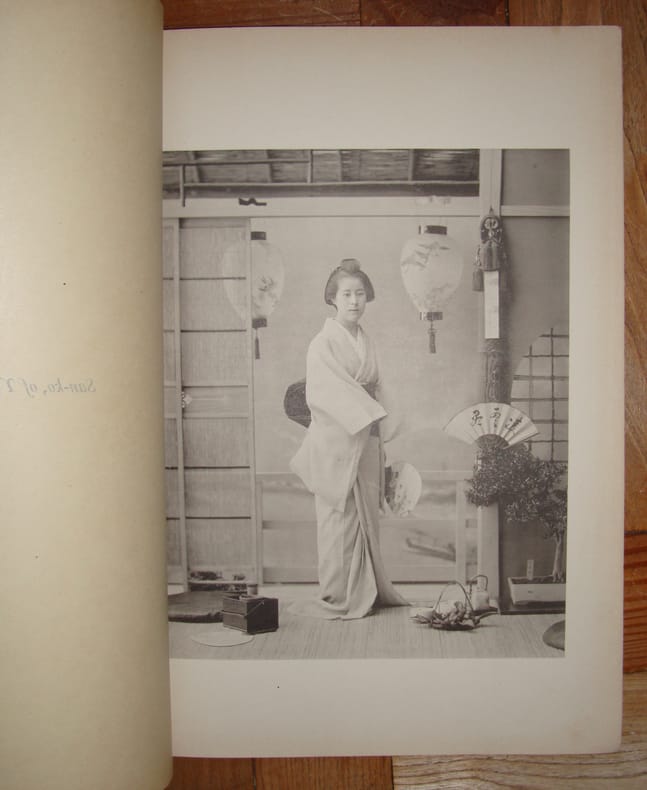
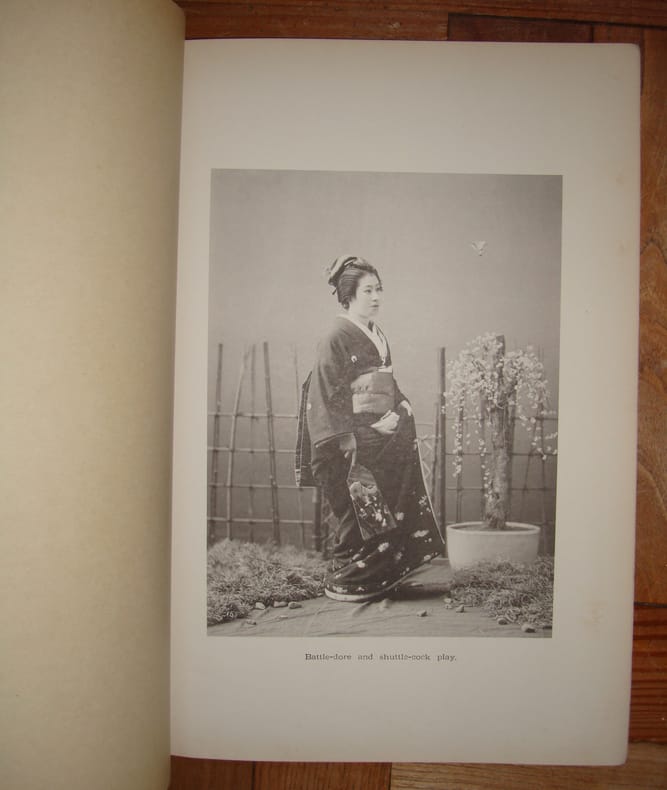
189313328Rare publication du photographe japonais Ogawa Kazumasa. L'album contient 12 collotypes d'après ses photographies. Chaque collotype est protégé par une serpente et est titré en anglais. L'album (40,5 x 30 cm) est en excellent état . On trouve parfois 2 volumes pour ce titre, mais notre volume ne porte aucune mention de tomaison. Il se lit à l'européenne et son étiquette de titre sur la couverture ne mentionne pas l'adresse du photographe. (Type I, Kelly & Walsh Imprint - Cover Title - "In Collotype"). Broché Très bon Tokyo 1893 1 plaquette in-4°
189213327Rare publication du photographe japonais Ogawa Kazumasa. L'album contient 12 collotypes d'après ses photographies. Chaque collotype est protégé par une serpente sur laquelle est imprimé le nom de la geysha et le quartier de Tokyo où elle se trouvait. L'album (40,5 x 30 cm) est en excellent état si ce n'est un minuscule manque de papier aux angles du plat supérieur. Il semble s'agir du tout premier tirage ne comportant pas l'adresse précise du photographe, et la mention Collotype au lieu de Phototype. Broché Très bon Tokyo 1892
188129348Paris, Librairie L. Conquet, 1881 et 1883. 2 vol. au format in-4 (354 x 254 mm) non paginés, en feuilles, sous chemises de plein papier titrée réunies dans une chemise à larges rabats de pleine percaline satinée crème, dos lisse et muet, titre frappé en rouge et noir au premier plat.
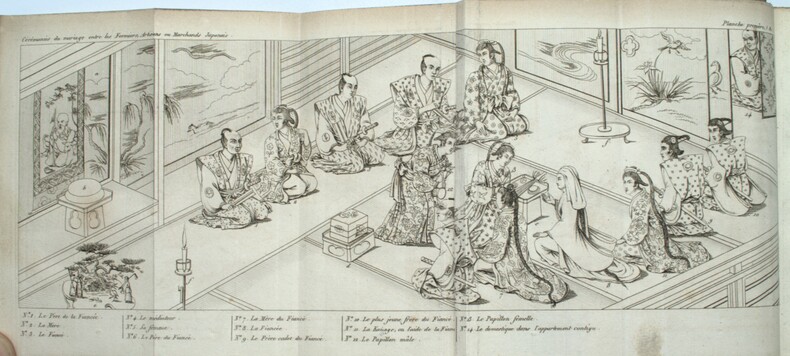
18202231PARIS. A. NEPVEU. 1820. IN-8 BROCHE (14 X 21CENTIMETRES ENVIRON) DE XXVIII + 302 PAGES, COUVERTURE D'ORIGINE MUETTE. ILLUSTRE DE 5 GRANDES PLANCHES DEPLIANTES EN COULEURS, TEL QUE DECRIT PAR CHADENAT, TOME 1, LOT 993. "ON TROUVERA DANS CE VOLUME LE PLAN DE LA FACTORERIE HOLLANDAISE ET LE PLAN DE LA FACTORERIE CHINOISE A NAGASAKI. A LA SUITE DES MEMOIRES DES DJOGOUNS, ON TROUVERA : REMARQUES SUR LES POIDS ET MESURES DU JAPON, P. 269. - FRAGMENS DES POESIES JAPONAISES, P. 271. - DIVISION DE L'ANNEE CHEZ LES JAPONAIS, P. 285. - SUR LE SUICIDE LEGAL DES JAPONAIS, P. 298. " (CORDIER. BIBLIOTHECA JAPONICA. 449-450). IL MANQUE LE PLAT INFERIEUR DE LA COUVERTURE, PREMIERS FEUILLETS EN PARTIE DETACHES, SINON BEL ETAT, INTERIEUR TRES FRAIS.
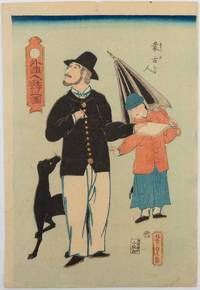
1862220053Japan.: 山田屋庄次郎. Yamada Shōjirō. Bunkyu 1 1862. Colour woodblock print 37.2 x 25.3 cms the sheet a little age-toned a spot of browning at the foot and a pinhole in the upper margin but the image unaffected very good condition. This colour woodblock print by Utagawa Yoshitora is an excellent example of Yokohama-e Yokohama Prints which were very popular in Japan after the country was opened in the mid-19th century. Yokohama was one of the trading ports with the outside world and many foreigners were residing in the area. The Yokohama-e was very similar to the Nagasaki-e Nagasaki Prints and depicted people and cultures which were foreign to the Japanese. Utagawa Yoshitora was active between the end of Edo Period to the mid-Meiji Period and produced numerous Nishiki-e prints including Yokohama-e in his career. He was regarded as one of the top Nishiki-e artists around that time. <br> <br>In this print a Western man is strolling outside with his dog and a Mongolian boy who carries an umbrella for him. The man is observing something in the distance and about to jot down something in his notebook with a pen which he holds in his right hand. Behind him his young attendant plays with the dog unobserved by his pre-occupied master. . 山田屋庄次郎. [Yamada Shōjirō]. unknown
1870811701870. BASEBALL - JAPAN Shihon Gakkou-hen. SHÔGAKU TOKUHON Maki no Ichi. Aichi-ken Nagoya Shihongakkô Teacher's College n.d. 1870's An interesting little elementary school reader from the first series of textbooks designed and created by the Teachers College Normal School system in Japan after the Meiji restoration to introduce "Western Learning" to the country. What follows is a series of excerpts from an informative article found online at http://wwwwp.mext.go.jp/hakusyo/book/hpbz198103/hpbz198103_2 _035.html "The Normal School which was under the direct jurisdiction of the Department of Education was also requested to compile elementary school textbooks on the basis of its practical experience. Also an office for editing elementary school textbooks was set up in the Normal School in December 1872. The Department of Education encouraged independent prefectures to reprint the textbooks and other educational material which it and the Normal School had compiled and it was not long before most of the prefectures adopted this practice and the reprinted textbooks were in nationwide use. Especially following the establishment of regulations for the course of study for elementary schools by the Normal School the textbooks prepared by this institute gained wide acceptance. These textbooks included elementary school readers introductory geography outlines of Japanese topography outlines of world topography outlines of Japanese history outlines of world history elementary school arithmetic etc. .The elementary school textbooks proved to be an interesting introduction of the new knowledge based on the Civilization and Enlightenment Bunmeikaika thought and they were accepted not only as textbooks but also as popular reading material for the public at large. Thus their influence was of considerable importance in the dissemination of the new culture." It is pretty clear that the introduction of Western culture also entailed the introduction of a least a variety of baseball in the 1870's as well a fact confirmed by other sources on the origins of baseball in Japan. The American educational consultants and their Japanese colleagues in Aichi saw fit to include a cut and a story with a group of boys playing with bats and balls pitching and hitting - interesting proof that baseball is nearly as old in Japan as it is in the States. The text of the story crude. unknown books
18812091202133201037Shinshichi Okajima and others 1881. Soft Cover. Fine. Number of books: 50 books in total Shinshichi Okajima and others paperback
1822PHO-1568Paris, Nepveu, 1822. 3 volumes in-16 (14.5x90mm), reliés demi-basane époque, XXX-127pp.-139pp-206pp. Illustré de 23 gravures dont 17 dépliantes, accroc au dos tome 3, légers frottements aux plats, 2 planches volantes.
19009033029Paris: Maurice De Brunoff 1900. 1st. Hardcover. Fine. Bound in quarter vellum with tan cloth boards spine and cover stamped in illustrated gilt. Top edge gilt textured cloth endpapers. A dazzling massive and stately book. Full of illustrations. Sixty-eight beautiful full-page photogravures in black and white and color with printed-text tissue guards. Ninety-nine additional illustrations drawings engravings and photos in black and white interspersed with the text. In French. 12 x 15 1/2 inches. 277 pages plus preface. <br/><br/> Maurice De Brunoff hardcover
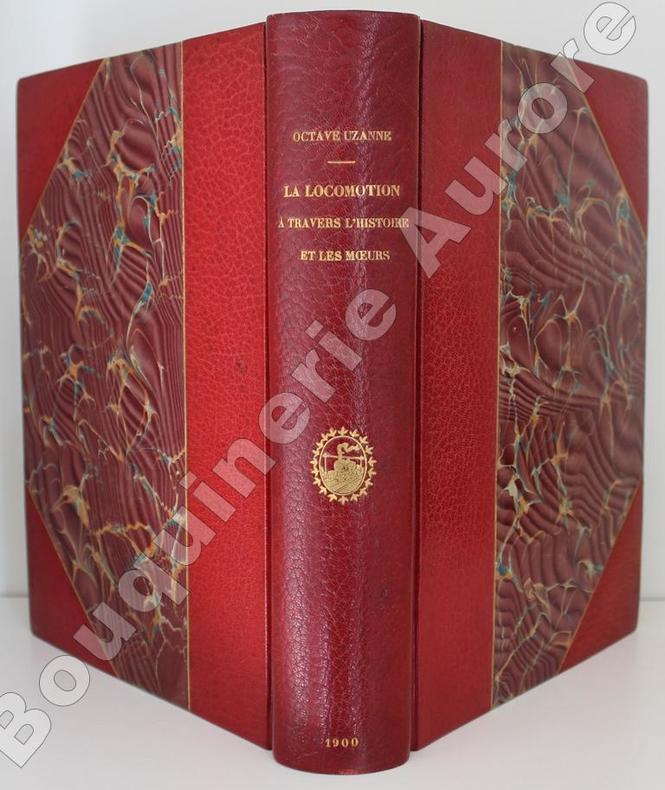
1900116431900 P., Librairie Paul Ollendorff, 1900, 1 vol. in-4° (290 x 197) relié à la Bradel œ maroquin cerise à coins, auteur, titre, fleuron ferroviaire et date en queue dorés sur le dos, filet doré bordant les plats, couvertures et dos conservés (V. CHAMPS), de (2) ff. (faux-titre et titre) - XX (Propos avant-coureurs) - 281 pp. - (1) f. (achevé dimprimer). Dos légèrement assombri, discrètes rousseurs en tête du tirage en noir de certains triptyques, très bel exemplaire par ailleurs.
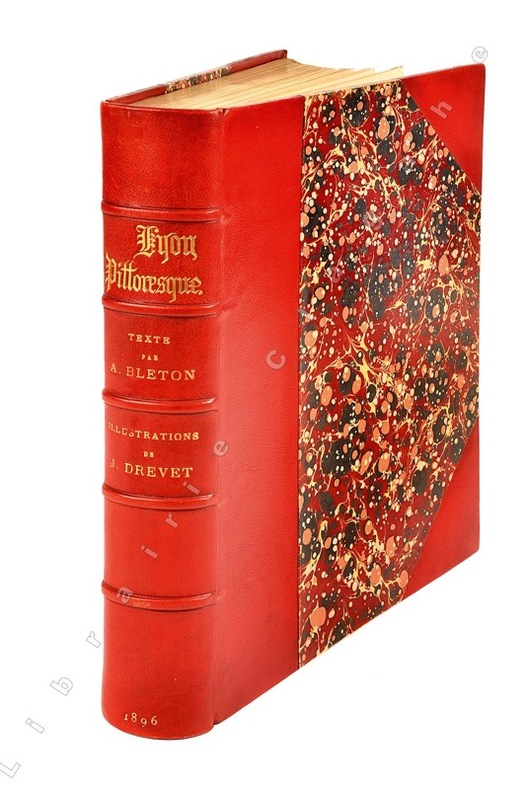
189615772Lyon, Bernoux et Cumin, 1896 ; in-4 ; demi-maroquin à coins rouge vif, dos à nerfs, titre, auteur et illustrateur dorés, tête dorée, couverture et dos conservés, non rogné (reliure de l’époque) ; 320, [4] pp., Bulletin de souscription de [4] ff. relié à la suite.
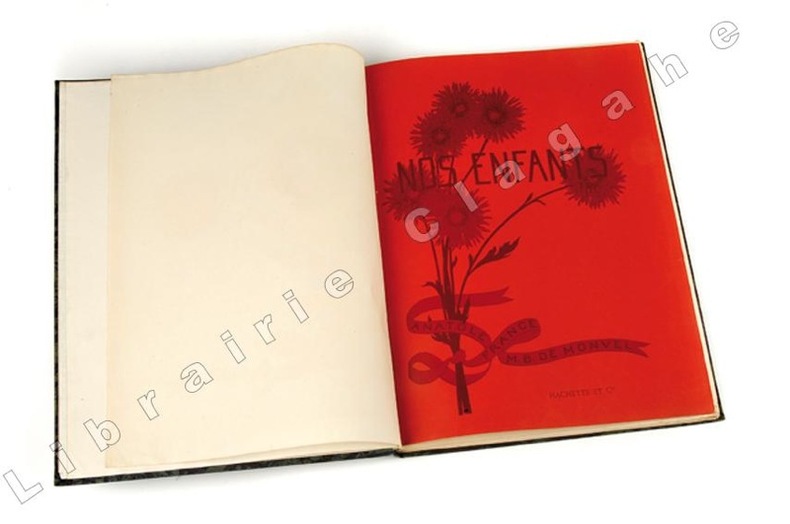
188718214Paris, Hachette (Gravure de Guillaume frères, imprimé par A. Lahure), 1887 ; grand in-4, reliure rigide bradel de papier plissé décoré de grandes fleurs bleu foncé sur fond vert kaki, titres dorés au dos, couverture rouge décoré d’un bouquet (reliure de l’époque) ; 56 pp. non chiffrées et 24 illustrations hors-texte légendées et lithographiées en couleurs, recto seul, intercalées et 48 dessins en noir et blanc.
182314852AB1823. London Ackermann 1823. 14 : 9 cm. XIII 286 pages 20 hand-coloured engravings. Full calf in contemporary style richly blind-tooled with the name Japan on booth boards spine with title and date gilt in marbled paper slip-case. First and only edition. A very early resource on all aspects of Japan and the Japanese. Here in an wonderful copy complete very clean and in an outstinding binding. The beautiful hand-colopured engravings show all different aspects of Japan. A comprehensive early guide to the Japanese Islands Buddhism missionaries architecture language woman festivals Yezo Hokkaido Ainu arts science suicide infanticide earthquakes moral character cleanliness fondness of strong liquuors from of goverment etc. etc. hardcover
185629005Paris Mallet-Bachelier 1856 in-8 demi-veau blond, dos lisse orné à l'imitation de filets dorés et de fleurons à froid, pièces de titre noire et cerise, tranches dorées [Rel. moderne]
186532680Paris Maisonneuve 1865 in-4 carré demi-chagrin noir, dos à nerfs orné de filets à froid [Rel. de l'époque]
182314852ABLondon, Ackermann, 1823. 14 : 9 cm. XIII, 286 pages, 20 hand-coloured engravings. Full calf in contemporary style, richly blind-tooled with the name Japan on booth boards, spine with title and date gilt, in marbled paper slip-case.
188721822Paris Magnier & Cie 1887 -in-folio cartonné illustré un volume, reliure pleine percaline bleu-foncé cartonnage éditeur à plaques spéciales monochromes pour le permier plat grand in-folio (35,1 x 27,1 cm) (editor hard-back percale with specials covers editor for the front cover in-quarto), dos long muet (spine without raised bands and title), premier plat illustré couleur "ARGENT" d'un pierrot pendu (la corde au cou sur fond de lune, Etiquette blanche Ex-Libris gravée en noir : Georges PROVOST (écrivain Nantais), receuil tiré sur japon avec un dessin original signé d'A. WILLETTE joint, receuil de 40 planches gravées par A. Willette en feuilles libres non-paginées, signature manuscrite de l'Auteur à l'encre noire en bas à gauche de la page de titre, planche de titre roussie, sinon agréable exemplaire, sans date [1887] PARIS M. Magnier & Cie Editeur,
1900129659Kazusaya Chûsuke [ca 1900] 1900 2 volumes, 22.3 x 16 cm Reliure en sachet fukurotoji . Couvertures bleues, gaufrées, à motifs de losanges, avac étiquette de titre, 27 & 22 ff. 10 & 9 estampes en clours à double page signées Kitagawa-sha Murasaki-ya Utamaro, sur un texte de Jippensha Ikku. Le dernier livre qu'illustra Utamaro, qui devait mourir deux années plus tard, l'ouvrage est particulièrement connu en France au travers du livre d'Edmond de Goncourt, Outamaro, le peintre des maisons vertes. Selon une pratique courante dans la gravure japonaise, Utamaro délégua une partie des dessins à 3 de ses disciples : Kikumaro, Hidemaro et Takemaro. Scènes de la vie des quartiers de courtisanes, leurs rituels et cérémonies au fil de l'année ; Le texte de Jippensha Ikku, décrit de façon vivante les grands moments qui scandent la vie des courtisanes comme celle de leurs clients.
1861173654London.: Richard Bentley. 1861. First edition hand-coloured lithographed frontispiece and black and white text illustrations i-xxxii 350pp with a final advertisment leaf of Bentley's Standard Novels 19.4 x 13cm original blind-stamped blue cloth boards gilt-lettered spine dulled and gilt vignette of a ship with pennants a flutter to the top board slight spotting mainly limited to the endpapers and age toning to the edges of the text old varnish to the boards obscuring gilt lettering to spine and dulling the gilt to the ship vignette corners tender but a good clean example of a title scarce on the market. Written in the year Japan opened its doors to foreign trade but published three years later by the first British Consul to Nagasaki Christopher Pemberton Hodgson he also served as French Consul. As well as giving a key survey of a landmark period including the structure of society religion and Japanese attitudes to the West Hodgson importantly includes a catalogue of Japanese plants with an index prepared by the eminent botanist Sir William Hooker the work's dedicatee and his own on natural history. Pemberton noted his keen interest in botany and geology in an earlier work written after a turbulent five years on the Darling Downs in Australia. The present work also includes a lengthy chapter by Pemberton's wife taken from letters to her mother noting her experiences and impressions. . Richard Bentley. hardcover
185639285Paris Mallet-Bachelier 1856 in-8 maroquin rouge, dos à nerfs orné de filets et caissons dorés, plats ornés d'arabesques et d'encadrements dorés, filet doré sur les coupes, tranches dorées [Rel. de l'époque], charnières et coins frottés
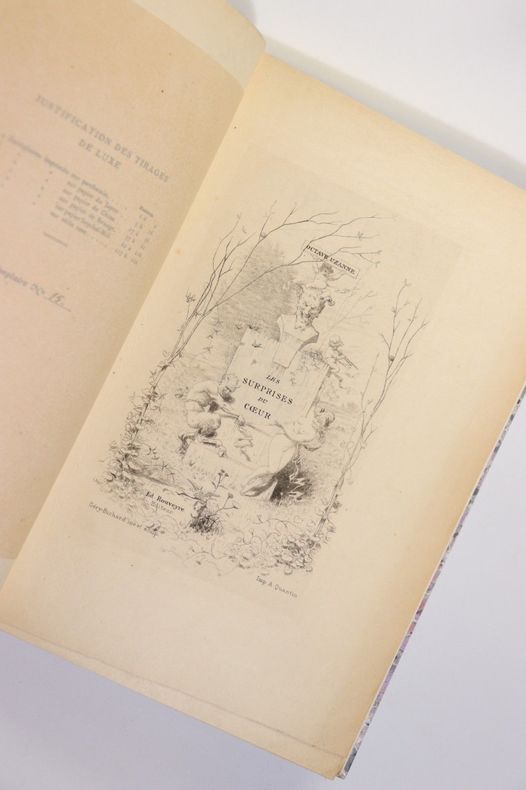
1881AMO-2704aris, Ed. Rouveyre, 1881 1 volume in-8 (22,8 x 15 cm), 187-(2)-(2) pages. Frontispice gravé à l'eau-forte par Géry-Bichard. Reliure moderne bradel demi-maroquin lie de vin, couverture illustrée par Paul Avril conservée (reliure signée honegger), tête dorée, relié sur brochure (non rogné). Exemplaire à l'état proche du neuf. Intérieur parfait. Quelques marques/taches sombres au dos du volume (voir photos). ÉDITION ORIGINALE. TIRAGE PROBABLE A 1.000 EXEMPLAIRES. CELUI-CI, 1 DES 12 EXEMPLAIRES SUR PAPIER DU JAPON. Le tirage de luxe est établi comme suit : 4 ex. sur parchemin, 12 ex. sur Japon (notre ex.), 20 ex. sur Chine, 25 ex. sur Renage, 55 ex. sur Seychall-Mill et 6 ex. sur papier rose, soit un total de 122 exemplaires de luxe. Les exemplaires du tirage ordinaire sont tirés sur papier vergé de type Hollande Van Gelder. Voici comment Octave Uzanne commente lui-même cet ouvrage lors de la vente d'une partie de sa bibliothèque en mars 1894 : "Quatrième et dernier volume de la série Rouveyre (avec Le Bric-à-Brac de l'Amour, le Calendrier de Vénus et Les Caprices d'un Bibliophile) ; quelques bons chapitres, mais deux ou trois vraiment faiblots. La couverture, composée par Paul Avril "est venue" imparfaitement au tirage, mais le frontispice, gravé par Géry-Bichard, d'après sa composition, est d'une grâce, d'une légèreté, d'un charme et d'une fraîcheur de pointe qui rachètent bien les imperfections décoratives des autres parties du volumes." Ce volume contient quelques chapitres sur l'amour et les femmes : A ma maîtresse inconnue (épître), Les Surprises du Coeur, L'Organe du Diable, Les Hasards des petits papiers, Piments. « Me reprocherait-on en outre de spécialiser mes sujets et de reprendre souvent mes mêmes théories sur les femmes et l'amour ? - Aimables lectrices ! vous ne sauriez m'en tenir rigueur, car, mieux que quiconque, vous savez qu'on aime à quitter fort tard ce que la passion nous a fait épouser de bonne heure, et qu'il est toujours temps de regretter ses vices, quand les vices nous abandonnent » Post-face aux Surprises du Cœur (20 juin 1881). Provenance : collection Bertrand Hugonnard-Roche avec son monogramme à l'encre au verso du premier plat (BHR 2018). BEL EXEMPLAIRE FINEMENT RELIÉ PAR HONEGGER DU RARE TRÈS TIRAGE SUR JAPON.
1894129426Tokio, Tsoukidji [Flammarion] 1894 2 volumes in-8, broché à la chinoise yamato-toji, 54 - 54 pp., ff. imprimés au recto et repliés, cordons de soie deux en haut et deux en bas, à la fois croisés et liés à l'avant. 29 compositions en couleurs, dont une répétée en couverture et 28 à double page hors-texte, gravées sur bois et portant toutes le sceau de l'artiste, nombreuses vignettes in t. tirées en noir. Pages de titre en noir et bistre. Édition originale, second tirage non justifié, paru la même année que le tirage de luxe de ce célèbre ouvrage illustré de 28 estampes hors-texte en couleurs en double-page par Kajita Hanko, Kano Tomonobu, Okakura Shusui, Kawanabe Kyosui et Eda Mahiko, et de nombreuses vignettes en noir dans le texte. Curieuse édition des fables de La Fontaine appartenant au genre des livres sur papier crépon publiée à Tokyo entre 1885 et le début du XXe siècle à l'intention d'une clientèle occidentale surplace, mais aussi et surtout pour l'exportation. Bon exemplaire.
188317192Paris, Quantin, 1883. 2 Bände. Mit sehr zahlreichen Textabbildungen, 13 Radierungen, 21 Heliogravuren, 2 Gravuren und 28 Chromolithographien. 35,4/28 cm. 2 Bl., IV,208 S., 2 Bl./ 2Bl., 369,3 S. Wohl etwas spätere Halbleinenbände mit goldener Rückentitel-Prägung. Deckel mit Buntpapierbezug. Leinen gering fleckig, Kanten berieben und an den unteren Ecken mit leichten Knickspuren. Papier minimal vergilbt. Eine Tafel mit kleinem Einriss im Rand, 1 Tafel und die gegenüberliegende S. etwas gebräunt. Vor 2 Tafeln fehlt das Seidenhemdchen. Vordere Innendeckel mit Exlibris.
188033455Japan: No publisher ca. 1880. An Album of copies of Literati Paintings. Illustrated with 56 Literati Paintings mounted on 25 double-sided accordion-fold boards some with woodblock colour some finished in colour by hand the illustrations mounted with gilt-speckled borders. Oblong folio the album 28 3/4 x 17 1/2 cm. the paintings 22 x 13 1/2 cm. the upper cover of the album with original padded silk brocade and paper label. The album includes 7 'Poetry Competition paintings and poems from the '100 Famous Poems' an 8th century Heian period compilation. A very pleasing example well preserved with minor rubbing to the extremities the mountings and illustrations all in fine condition. A FINE EXAMPLE. THE JAPANESE ART OF BUNJIN-GA WAS INTRODUCED IN THE 17TH CENTURY FROM CHINA'S SOUTHERN SCHOOL OF PAINTING. This occurred during the Ming dynasty through the 'Painting Manual of the Mustard Seed Garden' although that in itself was based on Song and Yuan dynasty landscape painting; and the poetry of the Japanese literati painting was in the style of Classical Chinese poetry termed Kanbun in Japan.<br> Literati painting in Japan is generally referred to as Bunjinga literati painting; Ch. Wen ren hua or Nanga Southern School painting; Ch. nan zong hua both terms borrowed from China. Wen ren hua refers to the status of artists who belonged to the scholar-gentleman class. Nan zong hua was coined by the Chinese painter and theorist Dong Qichang b. 1555–d. 1636 who used it to describe art by literati ostensibly amateurs whose paintings were indebted to their mastery of calligraphy expressed their inner feelings and sought to capture the spiritual essence of their subjects. Japanese Literati Painting and Calligraphy<br>P. J. Graham F. L. Chance.<br> No publisher hardcover
189025344AJapan, ca. 1890. 9 Fotografien im Format ca. 20,5 x 27 cm (Fotopapier), ca. 31 x 40 cm (Karton); 37 Fotografien im Format ca. 19 x 25 cm (Fotopapier), ca. 23,5 x 32 cm (Karton).