(JAPAN). MORTON-CAMERON, W H :Biblio.com
11 476 résultats
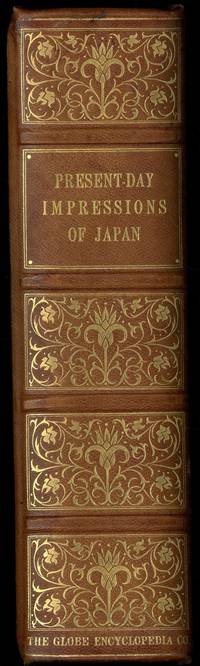
191972087London 1919. Stor 4to. Originalt helskinnbind med rik ryggforgylling svakt opphøyde ryggbånd gulldekor på fordekkelen helt gullsnitt. 931 s. Gjennomillustrert. Med noen farveillustrasjoner. Med et farvetrykt foldekart. The Globe Encyclopedia Company Engelsk. <br/><br/><em>Med noen små skriblerier på forsatsene. Fremre snitt en tanke misfarvet. En side med lang rift. Et praktverk om Japan. </em> unknown
196074819Tokyo: Kokusai Bunka Shinkokai Society for International Cultural Relations 1960. First edition. Octavo. 20 page introductory booklet by Garfias bound at front hinge 6 fanfold cardstock pages housing 36 color slides of dancers costumes masks musical instruments stage etc. bound at rear hinge. Publisher's Japon vellum red lettering to spine and front mulberry endpapers. Old stain to lower front corner about a quarter of an inch and general rubbing but still a very handsome copy with all the slides still present. Only one copy located by OCLC.Gagaku is a type of Japanese classical music that was created by the fusion of music brought to Japan from continental Asia and Japanese original music and dance. It was developed as court music of the Kyoto Imperial Palace and was established in the Heian period around the 10th century. It remains much like its 10th century iteration. In many ways it is simply the music of the Imperial Court. The popularity of gagaku reached its peak in the 9th century to the 10th century when court aristocracy began to hold private concerts but declined in the Kamakura period 1185-1333 when the power of the court aristocracy became diminished while that of the samurai rose. Gagaku was played by musicians who belonged to hereditary guilds. During the Kamakura period military rule was imposed and gagaku was performed rarely at court. At this time there were three guilds based in Osaka Nara and Kyoto.Because of the Onin War a civil war from 1467 to 1477 during the Muromachi period gagaku ensembles ceased to perform in Kyoto for about 100 years. In the Edo period the Tokugawa Shogunate revived and reorganized the court-style ensembles the direct ancestors of the present gagaku ensembles. After the Meiji Restoration of 1868 musicians from all three guilds came to the capital and their descendants make up most of the current Tokyo Imperial Palace Music Department. Ethnomusicologist Robert Garfias worked in Japan Korea The Philippines Mexico Burma Romania Portugal Puerto Rico and Turkey. He was a past President of the Society for Ethnomusicology and was appointed by the White House to the Council of the National Endowment for the Arts. Kokusai Bunka Shinkokai (Society for International Cultural Relations) hardcover
192475093Tokyo: N.p. 1924. A charming and chatty letter from Miss Takeuchi of Tokyo to Miss Clapman of Arlington MA. The sheets are of onion-skin paper and tinted blue. Each sheet measures 11 x 7 inches and each sheet has a finely executed gouache of a Japanese woman in traditional garb on the right margin. Original canceled envelope still present. The expected fold-lines else a wonderful survivor.The letter was penned in late June of 1924. We know Berith Clapman was born in in 1904 and thus she was twenty when she received this letter. Hana Takeuchi writes of how much she enjoyed her stay in Boston so that is likely where the two met and thus became pen pals The letter is full of the trivial things new pen pals write to each other but the real highlight of this item are the gouaches painted by Hana Takeuchi on the left margin of every sheet. All four of the paintings are of high society Japanese women in kimonos. A sentence from Hana's letter lays out the obvious - "I am studying a little of Japanese painting and should I become more of an artist some day I will send you one of my works." N.p. unknown
190273783Tokyo: Post Office 1902. First and only edition. Octavo. Accordion-fold book containing 8 panels. On four of them are to be found original Japanese postage stamps. Publisher's green brocade silk with printed paper cover label. An excellent copyOnly one copy located by OCLC British Museum. This little book was issued by the postal authorities to celebrated the 25th anniversary of Japan's entry into the Universal Postal Union. It was issued in conjunction with the opening of the Postal Museum Yuubin Hakubutsukan on the grounds of the Ministry of Communications and Transportation at what was then Kobikicho Kyobashi-ku Tokyo current site of the Ginza Branch of Japan Post Inc. 8-chome Ginza Chuo-ku Tokyo. Post Office unknown
194275667Toyohasi and others: V.p. 1942. A fine album photographically recording the life of a Japanese soldier during the Second World War. Soldiers albums abound and are usually crammed with pictures of family members loved places in Japan battle scenes fellow soldiers etc. They are not uncommon. This album is quite different and we believe it is something of an official album. It is a professionally bound quarto album 10 x 12 inches string tied and with printing on the cover that reads "Toyohashi Rikugun Kyodo Gakko 1942"’ Imperial Japanese Army Academy. Toyohashi being a city in Aichi prefecture near Nagoya. The album contains 52 original silver gelatin photographs with all but three nicely mounted in the album almost always just one to a page making it more of an aesthetic album more like a tribute. The majority of the photographs are 6 x 4 1/2 inches and are nicely composed. It feels that these particular photos were well chosen as opposed to most albums that have a confusion of photographs. The first five leaves are almost assuredly the same in every album. The first leaf bears the lyrics of the school song; the photo of text on the following leaf are the “Five Teachings†of Heihachiro Togo 1838-1934 who was the highest-ranking officer in the Japanese Imperial Navy. On the following page is a photographic portrait of Hideki Tojo 1884-1948 General of the Japanese Imperial Army during World War II. Beneath this portrait is the text of an address written and signed by officials of the Ministry of the Army which is dated December 8 1941 - just one day after the Japanese attack n Pearl Harbor. Nest comes a photograph of Isoruku Yamamoto Marshal Admiral of the Imperial Japanese Navy IJN and the commander-in-chief of the Combined Fleet. Two further portraits of Japanese leading military figures follow. At the end of the album is a list of all the men who graduated from that training camp and one of names is checked off; a man named Yamanaka. We may deduce from this that this album is devoted to his activities in the war. There are a few photographs of the school in Toyohashi e.g. an officer addressing the entire platoon. Yamanaka seems to have been assigned to a tank brigade and there are a number of pictures of tanks in action the men crossing small rivers camping in the open etc. Quite a few seem like actual battle scenes although we can never see the opposing army. It is impossible to tell the location but from the flora it seems to be one of the many islands in the South Pacific. There are a few photographs of aircraft one of the controversial Yasukuni Temple and a few artistic commercial photos of battle paintings. The very last photograph is smaller than any other in the album 2 x 3 inches and just shows one soldier kneeling in the grass helmet on and rifle in hand. One gets the very strong impression that this is Soldier Yamanaka as his parents wanted to remember him. On a purely conjectural basis we think that early in the war these albums were given to the families of enlisted men and all of the albums came with the same first 6 photographs. Presumably the intention was for their sons to mail back pictures of their activities overseas and Soldier Yamanaka apparently did so as would any dutiful Japanese son giri or duty is a powerful idea in Japan. That there are no pictures of him reunited with his parents or even back in Japan leads to the inevitable conclusion that he died overseas. A rather sad album that just seems to echo loss. V.p. unknown
191073978Meadville: Keystone ca. 1910. Ten Keystone Magic Lantern Slides concerning silk farming in Japan. Reputedly by photographer William Rau. All are numbered and with printed captions. Many have longer descriptions issued by Keystone excised from the booklet that accompanied the entire set. Slides offered here are; 525-Fujiyama; 527-Girls Putting the Finishing Touches on Bamboo Baskets; 534-A Charming Outlook Over Fertile Fields and Cozt Homes at Kiriu Japan; 535-A Japanese Garden; 536-Silkworm Incubator; 537-Gathering Mulberry Leaves for Silkworms; 538-Feeding Mulberry Leaves to Silkworms; 539-Cocoons of Silkworms; 540-Reeling Silk from Cocoons; 541-One of Japan's Largest Silk Weaving Plants kiriu. All are sleeved and in excellent condition. Keystone unknown
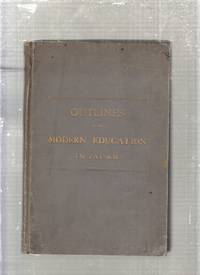
1893GE15319Tokyo Japan: Department of Education 1893. First edition. Hardcover. Good. First edition. Hardcover in grey cloth lettered in gilt. Translated into English and published by the Tokto Department of Education. 217 pp. plus final leaf in printed in Japanese. Extremely scarce in this original ediiton. Covers quite soiled but gilt title lettering still very clear. Overview of the modern era education system in Japan as it was at the end of the 19th century. Includes sections on elementary schools norman schools middle schools university special schools female schoolsschools for the blind and "dumb" kindergartens libraries and educational museums teachers degrees textbooks Japanese students in foreign countries etc. With charts and statistical information as well. Tight in its binding but with cloth soiled and with rubbing to the extremities. Presentation isncription on front free endpaper "Presented to Miss Marguerite ___/ Y. Yambi" and with additional inscription in Japanese. Department of Education hardcover
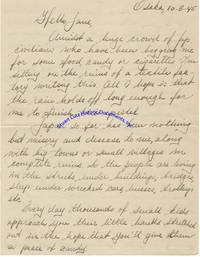
5824OCCUPIED JAPAN. ALS. 4 pages. 8 x 10 . Osaka Japan October 8 1945. An autograph letter signed Van to Jane describing the misery on the ground in Japan right after the end of the Second World War. Van is writing Amidst a large crowd of Jap. civilians who have been begging me for some food candy or cigarettes. He later writes that Japan so far has been nothing but misery and disease to me along with big towns or small villages in complete ruins. So the people are living in the streets under buildings bridges sleep under wrecked cars busses trolleys etc. Every day thousands of small kids approach you their little hands stretched out in the hope that youll give them a piece of candy. Women unable to feed their babies come up to you with the little child sucking away on their breast but not getting any milk at all. They beg for milk on their knees. Other women offer their gold wedding rings for a couple of C ration crackers. Disease is all over. Children with sores as big as a silver dollar all over their skinny bodies by the dozens. How the heck can you possibly refuse to give them a negative answer. This afternoon I actually couldnt walk because I was surrounded by women who kneeled down in front of me begging for food. I finally had to show them that they had no reason to be afraid of me so I bent over and put my hand underneath the chin of a young women who was quite pretty. I lifted up her head and lookedThe people here have no food at all except for a few potatoes that they manage to grow in the streets or among the ruined buildings. They all carry huge sums of money in the hope that some G.I. will sell them a can of C-rations or a K-ration which they will pay for with as much as 500 yen $30.00 of course it is strictly sic forbidden. But some guys get away with it and are making a fortune at the present. After a few concluding thoughts and sending Loads of Love Van writes a postscript saying he expects to be home by Easter. Pages are numbered at the top. The collection is missing the third and fourth pages and contains a noticeable horizontal crease across the middle of the pages but is in otherwise very good condition. unknown
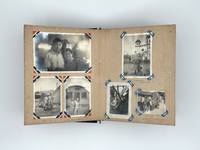
1949370387Kobe or Fukuoka Japan 1949. Approx. 145 photographs mostly 3x2 inches some 1-1/2x1 and a few 4-1/2x3 inches or larger. Inserted on photo corners or with small strips of cellotape at the corners. Many captioned in English or Japanese. Some images missing a few loose photographs inserted. Signed by Tadao Maeda on the rear endpaper. Approx. 7x6 inches. Contemporary dark green cloth minor wear. Approx. 145 photographs mostly 3x2 inches some 1-1/2x1 and a few 4-1/2x3 inches or larger. Inserted on photo corners or with small strips of cellotape at the corners. Many captioned in English or Japanese. Some images missing a few loose photographs inserted. Signed by Tadao Maeda on the rear endpaper. Approx. 7x6 inches. The snapshots comprise mostly images of Japanese soldiers attached to the U.S. regiment outside of barracks or on bases but also street scenes family members unknown
47445Osaka Japan: Yuki Museum of Art n.y. Small 4to 5" X 9¼" opens to 39½" X 9¼" housed in open-topped presentation box. Fine/fine. Pristine tabletop color reproduction of an eight-panel depiction created during the Genroku Era 1688-1704 printed on eight thin gilt-edged hinged boards. Verso bears glossy silk-like decorative paper. Recto has ½" decorative cloth border and superb facsimile of this detailed cityscape of Osaka a southern coastal town that today is Japan's third-largest city. Depicted is a vast panorama of the city and its citizens and while undated is probably of 1970s-90s vintage. Laid-in leaflet one side in English the other in Japanese titled "Naniwa at Work and Play" features associate curator Sachiyo Suehiro's description and history of "The Naniwa Panel Screens" reading in part: "Numerous persons from all walks of life: samurai merchants oarsmen stonemasons together with palanquin bearers street vendors priests soliciting contributions plus a Feudal Lord procession a festival pilgrims and passers-by are all captured on this canvas for posterity." This lovely presentation comes from the personal collection of Adlai E. Stevenson III 1930-2021 U.S. Senator from Illinois 1969-81 son of governor and twice presidential candidate Adlai II 1900-65 and great-grandson of congressman/postmaster general/vice president Adlai I 1935-1914. Senator Stevenson was likely presented it as a visiting dignitary by a government representative or perhaps in later years in his capacity as chairman of the first Sino-U.S. intermediary company. A lovely display piece with interesting provenance. Yuki Museum of Art unknown
1989267375Tokyo: Toppan 1989. hardcover. fine/very good. Text in English and Japanese. 561 pages thick square 4to grey cloth black glossy French fold dust wrapper. Tokyo: Toppan 1989. A fine copy in a very good dust wrapper just some light surface rubbing to wrapper.<br/> <br/> In protective cardboard sleeve<br/> <br/> Toppan unknown
190072742Boston: Knight & Miller ca. 1900. First edition. Oblong octavo in landscape format. 10 stiff leaves bearing 10 original hand-colored albumen photographs tipped-in and all with printed captions. Photographs measure 5 1/2 x 3 1/2 inches. Leaves bound to stubs. Japanese-style except it opens in the Western manner gilt rose and beige brocade cloth with red string tie printed paper cover label. House in the original box with a printed label on one of the sides. Box top with split side joints. Inside front cover with charming Arts & Crafts bookplate of Alice Rosamond Kendall and a pencil presentation to her dated 1902. Book and albumens in beautiful condition. This remarkably scarce little album is almost entirely devoted to rice farming and silk cultivation in Japan. The photographer was likely Tamamura Kozacuro. "Regarded as an originator of "Yokohama shashin" for tourists Tamamura Kozaburo opened his first studio in Tokyo in 1874 and then moved to Yokohama in 1883. For the next 30 years he became one of the most successful and popular commercial photographers in Japan by selling souvenir photograph albums to foreigners and taking profitable commissions from various organizations. He received many awards for his photography before his son Tamamura Kihei took over the business in 1916" Widener Library. The captions are as follows: Ploughing a rice field; Planting rice before Osan Temple Yokohama; Cultivating rice field; Harvesting the rice crop; Farmers threshing rice; Farmer pounding rice; Sorting silkworms; Weighing kuwa leaves for feeding silkworms; Cultivating silkworms; Farmers wearing rain-coats. These coats are made of straw. Knight & Miller hardcover
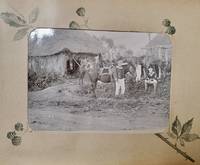
191075221Japan: N.p. ca. 1910. Oblong octavo 8 1/2 x 6 1/4 inches with a total of 25 stiff leaves mounted to stubs. Each leaf has a window on each side all bearing original photographs or early postcards. All windows have printed floral borders. There is total of 23 original albumen and silver gelatin photographs many hand-colored and 27 very early Japanese postcards again some with hand coloring. Contemporary padded burgundy morocco with gilt cover lettering floral endpapers. A few of the window frames with a tear rear joint of album starting but still strong. An unusual gathering of material.The majority of the photographs are of women and most of them are hand colored. The two most interesting postcards of battle scenes from the Russo-Japan war with captions in English and Japanese. There is also a rather rare photograph of Yoshiwara the famous prostitute section of Tokyo. The women in Yoshiwara are all behind bars as usual. There are a couple of books about Yoshiwara but precious few postcards. The seeming obsession with Japanese women is likely explained by the fact that this album was almost surely assembled by a sailor in the German Navy.The two most interesting photographs in the album are of German naval personnel riding horses in the countryside of Japan. These are rather confusing as Japan is justifiably famous for it's unwelcoming posture toward foreigners especially mere naval soldiers of no great distinction. But all becomes clear when we read the name of their ship on their cap: SMS Hansa. The Hansa served in the East Asia Squadron during the Boxer Rebellion of 1900 along with SMS Hertha SMS Iltis and SMS Gefion bombarded the Taku Forts. Her sailors then took part in the successful storming of the forts. During the Russo-Japanese War SMS Hansa along with the protected cruiser SMS Furst Bismarck the gun boats SMS Tiger and SMS Luchs and the cruisers Hertha and Geier took part in the forcible internment of the Russian battleship Tsesarevich and three destroyers at Tsingtao in 1904. SMS Hansa was a protected cruiser of the Victoria Louise class launched in 1898. As a gesture of appreciation the Japanese government probably allowed a number of the sailors to travel the country. abaa-ny-2022 N.p. unknown
19822092902137403253Kodansha 1982. Soft Cover. Fine. Volume: 1 Kodansha paperback
19392083002115804119Kenkosha Archives Reprint 1939. Soft Cover. Fine. The book is in fine condition. Kenkosha Archives Reprint paperback
2081002108300241Shirobei Kitamura Sosuke Kitamura N.A. Soft Cover. Fine. Number of pages: 26 Size: 17cm Shirobei Kitamura Sosuke Kitamura paperback
20022080502106915981International Tourist Service Center 2002. Soft Cover. Fine. The book is in fine condition. International Tourist Service Center paperback
17952110502151105306Azusa Nagata 1795. Soft Cover. Fine. Number of books: 1 Azusa Nagata paperback
20072090502113709034Not Available 2007. Soft Cover. Fine. The book is in fine condition. Not Available paperback
193561713E-105: Japan Times and Mail. Very Good in Good dust jacket. 1935. First Edition; First Printing. Hardcover. Hardcover. 4to. Published by The Japan Times & Mail Tokyo Japan. 1936. 294 pgs. Illustrated with Black and White Plates. First Edition/First Printing. DJ has chipping shelf-wear and rubbing present to the DJ especially around the extremities. Bound in cloth boards with gilt titles present. Boards have shelf-wear present to the extremities edges of the boards faded and discolored. No ownership marks present. Previous owner's name present to the FFEP. Foxing Present. Text has marks and notes present in the text. Text is clean and free of marks. Binding tight and solid. A look at Pre-War Japanese Modern as well as classical Architecture. In some cases these are the only records of buildings destroyed during WWII. ; 4to 11" - 13" tall; 294 pages . Japan Times and Mail hardcover
5101WORLD WAR II IN JAPAN. ALS. 2pgs. October 1 1945. Hirosaki Japan. An autograph letter signed Dale Christensen written home by an Allied serviceman stationed in Japan shortly after the official end of World War II. Well I havent had a chance to write for some time. We made it up here O.K. but the ship sure was loaded. We landed at Aomori and this place is inland about 30 miles. We have had no trouble at all. We spent the first night at an airport and then moved to another Army camp the next day then the third bn came up and took over here. I was in on the big thing at this camp I came up with the first gen jeeps and saw the Jap General sign the camp over to us then to top it all off I was picked to take the Jap General to his home. He talked to me all the way but I didnt know a thing he said. When he got out he saluted me. He seemed happy about the whole thing. The climate here is good and cool. We have a big mt right afore us and it looks just like Mt Fugiama sic. They say it sure gets cold here in the winter. The rice is just headed out and it is very pretty here but I hope I can soon come homeWe are cleaning this camp up now it sure needed it. I dont see how the Japs lived in it. Bugs and dirt all over. We sure are making a change in the looks of it. They say they might give each one of us a Jap Rifle and bayonet to take home I dont think there is any thing to it. I sure would like to have one. They sure can grow the fruit and garden stuff here but they sure are way behind in the way to live. I think even behind the PhilippinesThe papulation sic of this place in 97000 and Aomori 57000. Aomori was bombed and it sure was smashed and burned. Well we have a few Japs working in this camp and I think as a whole they will like better from now on that ever before. There clothes are all patches but they look healthy and happy. Well I will write more later. I hope we soon get a mail call. Tell Ann and the rest Hello. Everything is fine here. Write soon. Dale. The letter is in fine condition. hardcover
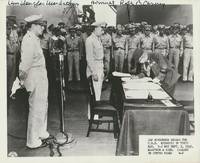
50969Carney was a U.S. Navy admiral and had a distinguished career through World War Two; he helped to arrange and was present at the Japanese surrender ceremony aboard the U.S.S. Missouri; he served as commander-in-chief of NATO forces in Southern Europe 1951-53 and Chief of Naval Operations 1953-54. MacArthur was a famed New York socialite and philanthropist and devoted wife of controversial general Douglas MacArthur; she was at his side aboard a PT boat when he left the Philippines ahead of a Japanese siege; she often represented him at official functions. PS glossy black-and-white 10" X 8" n.p. n.y. Near fine. Circa 1945-issued news agency photograph taken aboard the U.S.S. Missouri on V-J Day -- September 2 1945 -- showing Douglas MacArthur standing at left in foreground in front of a microphone watching Japanese general Yoshijiro Umezu at right signing the surrender document on behalf of the armed forces as their senior officer. Rows of the highest-ranking American officers -- Nimitz Halsey etc. -- fill the background. Along the narrow blank upper margin Robert B. Carney signs boldly in black fineline and actually draws an arrow about one inch down to himself standing alongside Admiral William F. "Bull" Halsey. On the same margin at left directly above General Douglas MacArthur his wife signs "Mrs Douglas MacArthur" also in black fineline. She was not aboard the ship in Tokyo Bay during the signing but waited in the closest nearby port of Yokohama. Printed text in lower right corners reads "Jap Surrender Aboard the U.S.S. Missouri in Tokyo Bay. V-J Day Sept. 2 1945. McArthur & Aide. Halsey in Center Rear N-2." An evocative iconic image signed later in life by the last surviving U.S. admiral present and the wife of the noted general at front. unknown
3655a TLS. 2pg. 8 x 10. July 15 1920. Yokohama Japan. A typed letter signed Neil laced with anti-Semitic sentiment. In part: Went out calling last night with the bunch of fellows across the street. The host and his side partner are N.Y. Jews but sort of decent people. The wife is very nice but the husband is a regular East Sider. He is always talking about not that I mind the expense of the house here but the servant is always telling about the money she needs for this and that and I cant see where it goes to. You know just about what kind of a guy he is better than I do no doubt and you havent seen him. Anyway it was sort of a pleasant evening as he left the States in March and brought a lot of the new songs with him. He is a very good piano player and I had a fine time listening to him. One of the songs he played and tried to sing just like John was Pal of Mine you know how nice it was in comparison to the real singer and this Jew did the same stunt of turning to his wife too as John does to his wife when she sits up in the box. The husband was just a regular N.Y. smart alex Jew. Typed on letterhead from Yokohamas Grand Hotel which famously burned down as a result of the devastating 1923 Great Kanto earthquake the letter is in very fine condition with light toning throughout and a few handwritten corrections not affecting legibility.b TLS. 3pg. 8 x 10. July 19 1920. Yokohama Japan. A typed letter signed Neil regarding work and life as an American abroad in early 20th century Japan. In part: There isnt much doing as for excitement but just hang around and do nothing. I really think I am gaining weight on the job. I met a fellow here who deals in all sorts of dress goods from Boston and I am getting on the right side of him as he gets all his stuff from here and I may be able to get some things for you people wholesale when you need them. He is one of us you get me being from Boston and a very fine chap. Eleanor will have nothing on me then getting things wholesale. About the only thing we need now wholesale is to get a bank to give us more money on our checks when we cash in. I am thinking of buying a kimono for Connors in the office for his wife as they are married in the Fall. He is a nice fellow and I thought for his trouble in calling up and the like I would bring him back one. I am not sure about it as yet but I think I will. Typed on letterhead from Yokohamas Grand Hotel which famously burned down as a result of the devastating 1923 Great Kanto earthquake the letter is in very fine condition with light toning throughout and a few handwritten corrections not affecting legibility. unknown
19552110502150414186Asahishinbunsha 1955. Soft Cover. Fine. Volume: 1 Asahishinbunsha paperback
19592110502150415054Housewife and Seikatsusha 1959. Soft Cover. Fine. Volume: 1 Housewife and Seikatsusha paperback