11 476 résultats
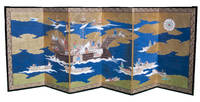
1700ABC_49540Japan 1700. 104 x 272 cm each illustrated panel: ca. 90.5 x 44.5 cm. Ink watercolours gold paint and gold leaf on paper. The image is surrounded by a frame of silk brocade a narrow frame in burgundy and gold and a wider frame in yellow gold and black with a clear floral pattern; together the frame is 5 cm wide the whole is mounted on six roiro black lacquered wood panels with gilt metal fittings on the outer corners of the outer panels. The panels are backed with decorative paper. A remarkable example of a Nanban byobu literal translation: Southern Barbarian screen a type of Japanese folding screen byobu depicting the arrival of Europeans especially the Portuguese in Japan during the late 16th- and early 17th centuries. It shows the vast expanse of the Portuguese seaborne empire. From their possessions along the coast of the Indian subcontinent and their lease of Macau individual Portuguese reached Japan in 1542 and were followed by traders and missionaries the most famous being Francis Xavier. Nanban art provides a unique glimpse into a period of significant cultural exchange and the Japanese perspective on the arrival of the Portuguese in their islands. While inspired by the arrival of and trade with the Portuguese in Japan before the enforcement of the isolationist foreign policy commonly known as Sakoku by the Japanese Tokugawa shogunate from 1633/1639 onwards it remained a popular subject to depict on these folding screens and in other artworks during the Edo period and beyond. The image on the present folding screen shows a large four-masted ship probably approaching the port of Nagasaki. Crew members both Portuguese and people from Portuguese possessions in the Indian subcontinent are seen furling the sails and performing remarkable acrobatic feats in the ship's rigging. The artist emphasises the balloon-like bagginess of their bombacha trousers typically associated with the Portuguese and other Europeans but focuses also on distinctive details such as heavy gold necklaces facial hair hats capes frilly white handkerchiefs and ruffled collars. The foreigners are depicted as being exotic but not scary or very "other" they are depicted as being different while still simply being human. The decoration and colours of the flags flown at the top of each mast are reminiscent of Christian symbols the Cross of Christ and Portugal's colours green and red. Cargo and passengers are offloaded into small boats that pull alongside the ship the top right corner shows a 12-point wind rose including a depiction of the globe. The whole scene is enschrouded in gold clouds.After the Sengoku period a period of practically consecutive and almost continuous civil wars and social upheavals in the 15th- and 16th centuries Japan entered a more peaceful and prosperous period. Folding screens such as the present example were used to divide larger homes and generally show of the growing wealth and prosperity of the warrior and merchant classes. The screens are finely executed in detail and using vibrant colours and copious amounts of gold paint and/or gold leaf. Thematically the painting here continues a tradition of now-lost screens of Chinese trade ships that were in vogue during the 15th- and 16th centuries at the peak of the Sino-Japanese tribute missions that brought entourages numbering in the thousands from the Ming court. The precise subject of these paintings had since shifted from Chinese trade ships to Chinese- or more general Southeast Asian-style ships carrying European including men from the European possessions in Africa and Asia crews. The scene illustrates the dynamic convergence of Eastern and Western cultures through trade around 1600. Portuguese traders first arrived in Japan in 1543 and by 1570 they had established the Bay of Nagasaki as a strategic hub for their commercial operations which were largely unregulated. They generated significant profits by exchanging Chinese silk for Japanese silver although some European goods were also part of the trade. The Portuguese carracks massive three-decked vessels weighing up to 1600 tons captivated local observers with their impressive scale unfamiliar crews and exotic cargo.Alongside these traders Jesuit missionaries sought to spread Christianity finding particular success in Kyushu where many local daimyo converted. However a Christian-led rebellion in 1638 alarmed the Tokugawa authorities raising fears of European colonial interference. As a result the Portuguese were expelled in 1639. When a Portuguese delegation attempted to restore diplomatic relations the following year all sixty members were executed. In 1640 the shogunate instituted a policy of national seclusion restricting foreign contact to limited trade with Chinese merchants a small number of Dutch traders and occasional Korean envoys. By 1650 Christianity was outlawed and any missionary work was punishable by death. The present screen is a slightly later example and the focus of the scene lies mostly on trade and the ship's crew itself and not directly on any Christian identity of the foreigners arriving on Japanese shores.This screen belongs to approximately ninety surviving Nanban screens ranking second only to capital city scenes in popularity among Japanese patrons. The earliest examples date to the 1590s and their continued production throughout the Edo period demonstrates the lasting impact of the Portuguese encounter on Japanese culture.Some minor flaking of the gold paint/gold leaf barely any soiling the decorative paper back of the work shows some traces of wear and use. The image remains clear and the colours vibrant. Overall in very good condition. This exceptional screen offers collectors an important historical document that captures both Portuguese maritime exploration and the Jesuit mission to Japan-a unique period of cultural exchange between East and West. unknown
19902110502150901946Japan Map Center 1990. Soft Cover. Fine. Number of books: 55 Japan Map Center paperback
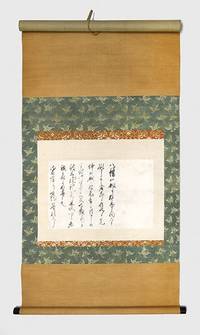
159734Japan: c.1300. A brush with power A well-preserved and boldly brushed work of Japanese imperial calligraphy attributed to Emperor Go-Fukakusa 1243-1304 r. 1246-1259 and authenticated with a June 1977 box inscription by the Japanese calligraphy scholar Koresawa Kyozo 1894-1991. Go-Fukakusa's calligraphy was highly regarded in his lifetime and examples held in the Kyoto National Museum are classed as "national treasures". Provenance: Shidoritei Library Kyoto with its ownership labels affixed to the end of the box. Exhibited at the Chado Research Center Galleries Kyoto "Shidoritei bunko korekushon: koshoga tono deai" Shidoritei Library collection: Encountering Classical Calligraphy and Paintings 7 January - 20 March 1997 and published in the exhibition catalogue of the same title; Christie's New York Japanese and Korean Art 18 September 2013 lot 525; private collection UK. Koresawa Kyozo served as calligraphy expert for the Japanese government's Agency of Cultural Affairs and authenticated a number of works attributed to royal personages including a letter from the Empress Meisho 1624-1696 now found in the archives of the Imperial Household Agency as well as examples later sold at Christie's New York in 2007 and 2013. He also wrote several scholarly studies addressing topics such as the calligraphy of the Momoyama and Edo periods. The present example is presented according to Japanese styles of connoisseurship in a traditional three-colour hanging scroll format often employed for adorning literary and tea studios with antiquities. Original calligraphy on paper 280 x 442 mm recently mounted on scroll in the three-colour style 1330 x 670 mm unrolled with decorative silk brocade and two 420 mm silk brocade strips. Housed in custom 294 x 78 x 75 mm wooden box with removable decorative card covering. A fine example with just a little surface soiling. unknown
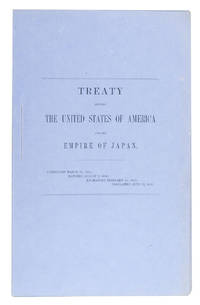
1855876DLLAMJKGSWashington D.C. 1855. Folio. Original printed self-wrappers stitched. Signed in type by Franklin Pierce as President and by W. L. Marcy as Secretary of State. 5 1 blank pp. Second recorded copy of the Kanagawa Treaty of Friendship resulting in the opening of Japan to trade with the West. The American expection to open Japan was undertaken at the suggestion of its leader Commodore Matthew Calbraith Perry 1794-1858. ''The key document caried by Perry to Japan was a letter to the Emperor from President Fillmore in which the President requested Japan to open relations cooperate in the development of trade assist distressed whalers and provide bunkering and supplies for ships on the California to China run. The Treaty of Friendship 1854 negotiated by Perry provided for 'perfect permanent and universal piece' and it contained assurances that the Japanese would meet the demands of the United States for safe haven and acces to naval supplies. Two ports Shimoda and Hakodate were to be openened for this purpose and Americans using them were to be allowed to exhange gold and silver for goods 'under regulations for this purpose' and were not to be subject to restrictions on movement as stringent as those applied to the Dutch and Chinese. The treaty does not include provisions for the development of normal foreign trade'' Howe but it did provide for the stationing of American consuls in Japan of which the first was Townshend Harris 1804-1878 an avid student of Engelbert Kaempfer who played an important part in the early economic education of Japanese leadership and among others was the negotiator of the Treaty of Shimoda in 1857 which granted the Americans extraterritorial rights. Fine copy. Extremely rare document concerning the opening of Japan to trade with the West and an important Americanum as well.l Howe The origins of Japanese trade supremacy London 1999 pp. 73-74; WorldCat and RLIN 1 copy in Harvard; not in Cordier Japonica; the Library of Congress; Nipponalia; NUC; Sabin. unknown
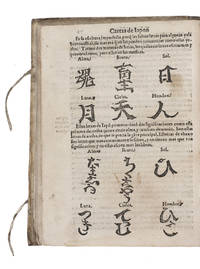
15755741Alcalá der Henares Spain: Juan Iniguez de Lequerica 1575. Contemporary limp vellum with ties. 4to in 8s. With woodcut of the Crucifixion on verso of the colophon 2R4v woodcut Japanese characters in the text I8v and woodcut decorated initials throughout. First Spanish edition of 87 Portuguese letters by Jesuit missionaries in Japan very valuable for the history of the Jesuits in Japan India and other parts of Southeast Asia. The work was first published in Portuguese in Coimbra in 1570 and contains 10 additional important Jesuit letters which had never published before. Noteworthy are the woodcut Chinese and Japanese characters included in the text on leaf I8v. Cordier gives a list of these additional letters dating from 1567 to 1571. Other newly added were: the life of Francis Xavier Relacion de las cosas de la India by Manuel Acosta with remarks on in order of appearance Goa Cochin Daman Ceylon Comorin Bassein Ormuz Ethiopia Inambay and Manomotapa Malaca the Moluccas Ambonia Solor Macassar etc. and Breve relacion de la Isla y Reynos del Iapon.Lacking 2 leaves ¶7 and ¶8 from the preliminaries containing the "Indulgencias que nuestro Sancto Padre el Papa Pio. 4 ". With 18th-century manuscript annotations in brown ink on the recto of the first free flyleaf the title-page at the start of the text on fol. 1r the recto of the final leaf and in the margins throughout; the margins show only marks to highlight certain passages the other annotations are variations of the same owner's inscription most elaborate on the front flyleaf: "Ex icDn. Francesco et Paula Caveda Costo 15 . Mad. a 4 . Octobre 1786". The vellum of the binding is somewhat creased and stained water stained throughout the first and last few leaves are frayed and slightly damaged in the margins without affecting the text somewhat browned throughout. Otherwise in good condition.l Alt-Japan-Katalog 298; Cordier Japonica cols. 67-68; Iberian Books 54608; Laures 140; Palau 46311; Porbase 363133 1 copy; Salva 3282; Streit IV 1519 with a full list of all letters; USTC 337147. Juan Iniguez de Lequerica, hardcover
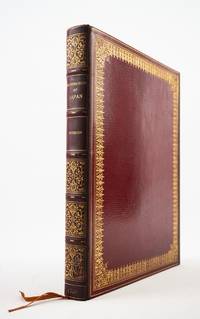
1822ST20877London: Printed for R. Ackermann 1822. First English Edition. 300 x 235 mm. 11 3/4 x 9 1/2". xvi 325 1 pp.Translated by Frederic Shoberl. <br/> Imposing contemporary crimson straight-grain morocco gilt covers with filigree frame with densely massed scrolling fleurons raised bands spine gilt in compartments with radiating viny scrolls surrounded by leaves and annular dots marbled endleaves all edges gilt. WITH 13 HAND-COLORED PLATES in etching and aquatint many after Japanese artworks one folding. Bookplate removed from front flyleaf. Bookseller's ticket of J. L. Thompson & Co Kobe Japan on front pastedown. Abbey Travel 557; Tooley 489; Martin Hardie "English Coloured Books" pp. 113-14. See also E. F. Strange "Japanese Illustration" pp. xxiii-xxiv. Spine and fore-edge of upper board slightly darkened a few minute flakes to lowest spine compartment but the binding extremely well preserved with very lustrous boards. Final 10 leaves slightly creased one repaired marginal tear but still A FINE COPY INTERNALLY exceptionally bright smooth and entirely fresh and clean.<br/> <br/> This generously proportioned production illustrated with 13 vibrant colored plates is a rare European account of Japan during the period in which the country was "closed" to the west offered here in its first English edition. Originally published in French in 1820 "Illustrations of Japan" is comprised of a history and description of the Tokugawa shogunate which Titsingh had translated from the Japanese plus Titsingh's own observations on the language customs and ceremonies of the Japanese people. The present English edition is accompanied by plates in etching and aquatint enhanced with hand coloring. Our author Dutch diplomat Isaac Titsingh 1745-1812 spent 14 years in Nagasaki for the Dutch East India company and between 1779-84 he served as trade director-cum-ambassador travelling to Edo now Tokyo for audiences with the shogun and other high officials in the shogunate. Unlike most of his Western contemporaries Titsingh was open-minded and curious about the people he encountered engaging with their art and culture; in fact art historian and Victoria & Albert Museum keeper Edward F. Strange tells us that Titsingh is the earliest known European collector of Japanese prints of which a number appear in the present volume. Our publisher Rudolph Ackermann 1764-1834 made his living issuing sumptuously illustrated books such as the present volume and was an early adopter of color aquatint and lithography technologies; Hardie writes that he was "the great presiding genius before whose magic wand so many pictorial books sprang into existence." In very attractive period morocco this is a particularly appealing copy of the work free of the foxing and offsetting that often plague copies of this and other large-format color illustrated books. Printed for R. Ackermann unknown
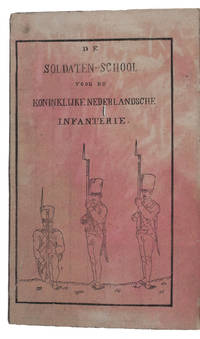
18568CFB37BBNOWBcopy imprint: The Hague & Amsterdam 1856. 8vo. Gebroeders van Cleef Contemporary Japanese brown paper covers side stitched and oversewn through 4 holes near the head and near the foot and 2 holes between them. In a modern Japanese gold brocade cloth chitsu folding case with 2 bone fastenings and a brown paper label. Printed from woodblocks on Japanese paper in the traditional Japanese manner on the outside of double leaves with the fold at the fore-edge. With woodcut Japanese text on the half title and last leaf. With an illustrated title-page printed on paper which has been dyed red facing the half-title showing three soldiers. 15 179 6 pp. Very rare first and only Japanese edition of a Dutch military manual being a concise guidebook for the military school originally intended for the Royal Dutch Infantry. It discusses various topics for the beginning foot soldier for example the order of rank within the army the education of soldiers and higher ranks such as officers how a soldier should stand and march and of course how to carry load and fire a rifle and the many different ways to do so. It therefore presents the basics for a trainee soldier and was commonly used at the Dutch military schools.The present manual is a beautiful example of the many Dutch military science books that were imported to and distributed throughout Japan during the Bakumatsu 1853-1867 the final years of the Edo period when the Tokogawa shogunata ended and the Meiji government was restored. Earlier Dutch editions were printed in 1826 1831 and 1833 by the brothers Van Cleef in The Hague and Amsterdam. The present edition is of great importance to illustrate the Dutch-Japanese exchange of military science but also of the utmost rarity. WorldCat records only 1 copy of the present edition in the library of Leiden University.Binding only very slightly worn a few wormholes without loss of text the last leaf with Japanese text slightly stained red colour of the illustrated title-page a little faded but overall still in good condition. Rare Japanese edition in the original Dutch language of a military manual preserved in a Japanese gold brocade folding case.l WorldCat 1 copy; not in Alt Japan Kat.; Cordier Nipponalia. hardcover
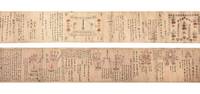
9137Numerous fine paintings & diagrams throughout using blue green red gray yellow much gold silver & flesh-colored pigments. Siddham script in several places. Two scrolls 185 x 17660 mm.; 175 x 9210 mm. each with gold-speckled inner endpapers at front dark blue paper on outsides. At the end of the first scroll a note states these texts were first written in 1192 KenkyÅ« 建久 3 & copied on an auspicious day in the 12th month of Genna 元和 5 this part of Genna 5 corresponds to 1620; the second scroll is also dated at end “the 12th month of Genna 5.â€<br /> <BR> <BR> These two scrolls are related to a kind of Daoist-influenced star worship that was associated with esoteric Buddhism. This practice became popular within the Japanese aristocracy in the medieval period. It drew on several strands of thought imported from China that were synthesized in Japanese religious practice. Buddhism as it appeared when imported to China from India and Central Asia in the first millennium CE carried with it astronomical and astrological knowledge including an identification of the planets and their association with the calendar e.g. the association between the planets and the days of the week still apparent in the modern Japanese names for them. In China this knowledge became influenced by Daoism exemplified for example by the worship of the stars of the Big Dipper Ch.: beidou J.: hokuto 北斗. In medieval Japan star worship under the auspices of esoteric Shingon and Tendai Buddhism became popular and highly ritualized. One star-related ritual expressed the worship of an individual’s birth and year stars. During these rituals offerings were made to a star or a constellation to obtain fortune or longevity. Such rituals are described in these two scrolls.<br /> <BR> <BR> Mandala dhÄraṇī and mudrÄ were important features of ritualized star worship and the three of them are present in the first scroll. There is a fine series of 158 flesh-toned paintings of mudrÄ gestures of the hand depicted and labeled. MudrÄ were hand and arm gestures made during the course of ritual practice or depicted in images of buddhas bodhisttvas tantric deities and other Buddhist images. With the development of Mahayana and Vajrayana iconography the number of mudrÄ proliferated and reaching the hundreds. DhÄraṇī were incantations and are presented as lists of syllables written in the Indic Siddham script. There is also a diagram a mandala depicting the Big Dipper the legends reference the earthly branches each listed as either yin or yang.<br /> <BR> <BR> The second scroll includes among other things a list of the Seven Planets sun moon and the planets of the solar system minus Neptune and Pluto and associated Buddhist deities stars in the constellation of the Big Dipper and years in the sexagenary calendrical cycle. Through this list an individual’s personal star can be determined. Further into the scroll the layout of the altar featuring e.g. silver coins food offerings and candles and the conduct of the rituals for various kinds of worship are described and illustrated in a series of scenes. Ritual objects like mandalas with Siddham characters are depicted as well. The instructions for the conduct of these rituals include the performance of combinations of mudrÄ and dhÄraṇī associated with the mystery of the body and the mystery of speech respectively.<br /> <BR> <BR> In addition to the importance of the Big Dipper the Daoist influence on these scrolls is evident in its mention of deities such as the Dongyue emperor and Huang Shigong.<br /> <BR> <BR> Very good preserved in a modern box. Some worming carefully repaired. unknown
19252111902160308032Japan Federation of Boy Scouts Ministry of Education 1925. Soft Cover. Fine. Number of books: 181 Japan Federation of Boy Scouts Ministry of Education paperback
2081502111901000Culture publishing company N.A. Soft Cover. Fine. The book is in fine condition. Culture publishing company paperback
19682110502151001436Senmon-do shoten 1968. Soft Cover. Fine. Number of books: 29 combined books Senmon-do shoten paperback
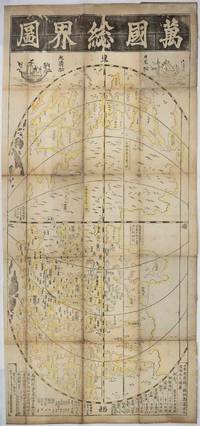
1708219243東京. Tokyo.: 須原屋茂兵衛. Suwaraya Mohei. Hoei 5 1708. Black and white woodblock map with yellow outlining in original hand colour 55.8 x 127cm map; 59.5 x 131cm sheet folding into the original Japanese wrappers chipped and rather worn 26.4 x 17.4cm the map with old repairs laid down on washi rather browned and wormed at the folds but with no serious loss the sheet age-toned and a little dusty but overall in remarkably good condition. Preserved in a modern blue linen Japanese case with toggle-closures. A famous woodblock-printed Japanese map of the world by renowned Edo Period map-maker Ishikawa Tomonobu who is also known as Ishikawa Ryūsen. This is a revised version of an earlier map produced by Ishikawa in 1688. <br> <br>The map appears to draw on Chinese and Portuguese geographical knowledge. The Chinese production of world maps had been transformed by the influence of the Italian Jesuit Matteo Ricci who collaborated with Chinese cartographers to produce a 1584 map of the world. In Japan the production of maps of "the myriad countries" or "the international countries" bankoku had been inspired by contact with Portuguese missionaries and with the Dutch in the 16th century. <br> <br>Ishikawa's map broadly resembles the Ricci map in being placed in an oval frame with the Pacific and thus also China and Japan at the centre. The content though is different. While Ricci's map is oriented to the north Ishikawa's is oriented to the east with America at the top of the page and the sketchy outlines of Europe including 'Ikiresu' England and a large and clearly marked Holland and Africa 'Kafuri' at the bottom. This orientation apparently influenced by the first world map in Japan "Bankoku Sōzu" 万国総図 which was published in 1645. Interestingly although Ishikawa had earlier produced a quite detailed and fairly accurate map of Japan the Japan shown on this world map is a rather loosely outlined collection of islands in which for example Ryūkyū the Ryukyu Kingdom now Okinawa and Hachijōjima appear much larger than they are in reality. Japan is also unusually oriented making it appear as though Ezo now Hokkaido is in the middle of the Pacific. It seems that the cartographer's interest here was less in outlining Japan in detail than in broadly setting out the country's place in relation to the land masses to the east and west. <br> <br>Like other Japanese world maps of the Edo period and like Ricci's map Ishikawa's image of the world includes imagined countries such as 'The Land of Giants". The continuing centrality of China in Japanese thought is indicated by the fact that Ishikawa's map contains a very clearly marked depiction of the Great Wall and that the map is decorated at the top with depictions of a Japanese and a Chinese sailing ship. The text at the bottom gives estimated distances between Hizen Province where the port of Nagasaki provided Japan's main official outlet to the world in this age of seclusion and various places in China and between Hizen and the Ryūkyū Kingdom. It also gives the estimated distance from Korea to Tsushima Island which served as Japan's gateway for diplomatic and trade relations with Korea. <br> <br>Engelbert Kaempfer a German physician and explorer brought back the 1688 edition of this map printing to Europe after his stay in Japan between 1690 and 1692. The map was introduced to European audiences in the 17th century and impacted on later European cartographic endeavours. <br> <br>Copies of this rare and historically significant map are held only in a handful of major collections: the British Library National Diet Library NDL of Japan the Staatsbibliothek of Berlin University of California Berkeley's Japanese Historic Maps Collection and the University of British Columbia. . 須原屋茂兵衛. [Suwaraya Mohei]. unknown
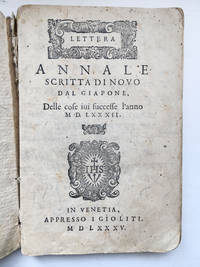
15854676<p>ENTRY NO. 1 IN BOSCARO<br />THE FIRST REFERENCE TO THE JAPANESE EMBASSY OF 1585 PRINTED ON THE TITLE-PAGE</p><p>Venice I Gioliti 1585.</p><p>Small 8vo 15.3 x 10 cm 103 pp. Bound in old vellum. Discrete former ownership stamp on title. Gutter margin of title reinforced; inconsequential toning otherwise excellent.</p><p>Rare early edition of this Jesuit letter containing news of missions and activity in Japan from the year 1582 the only edition of 5 printed that year to contain a title-page advertising the famous Japanese embassy of 1584-86. Significantly the work also discusses the embassy the participants and their noble lineage and expresses the hope that the embassy will prove a convincing sign of the Jesuit's spectacular success in Japan p. 7. The present imprint of this edition comprises the first entry in Boscaro's bibliography of printed works related to the embassy. It thus stands at the head of nearly 50 works printed in 1585 alone to record and commemmorate an event that-in addition to providing a public relations coup for the Jesuits-became a watershed moment in cross-cultural exchange between the Orient and the West: "no Japanese emissaries to Europe either before or since aroused comparable interest or enthusiasm" Lach.</p><p>In the annals of international relations between Europe and Japan in the 16th C it is particularly noteworthy "how the physical presence of the Japanese in Europe stimulated an unexpected number of typographical presentations" Boscaro of which this particular Gioliti edition with the titlepage advertising the embassy-Portata de Novo Dal Giapone Dai Signori Ambasciatori-is the very first. Boscaro notes that there were four other editions of Coehho's letter published in Italy in 1585 around the time the embassy arrived in Venice on June 25 including another by Gioliti but none of these uses the embassy as a way to market itself.</p><p>The report itself is also a significant document of the embassy's genesis: Coelho composed it in February 1582 the month that the embassy of four Japanese Christian converts departed from Nagasaki. In it he describes the ongoing missionary activity across the country: e.g. in Hirado Amasuka Bungo and especially Funai Oita City the home of a thriving Jesuit college. Presumably the contents of this letter as the title suggests were "brought from Japan by the eminent ambassadors" as the latest news on the Jesuits current success in that faraway land.</p><p>Though the embassy did not reach Lisbon until August 1584 it eventually was as Coelho had hoped a resounding success: from 1584-86 the four young Japanese nobles were the object of intense curiosity wherever they traveled and they were treated to lavish receptions in Lisbon Madrid Florence Rome Venice and other cities throughout Catholic Europe.</p><p>Provenance: Alfred Hamy 1838-1904 French Jesuit historian and prolific author of books relating to the history of the members of the Company of Jesus.</p><p>OCLC: Cornell NYPL HU and Newberry. Boscaro 1; Alt-Japan 812; Sommervogel II.1267; Cordier 78; Laures 169; Pagès 22; Lach I.2.690.</p><p> Boscaro 1; Alt-Japan 812; Sommervogel II.1267; Cordier 78; Laures 169; Pagès 22; Lach I.2.690.</p> I Gioliti
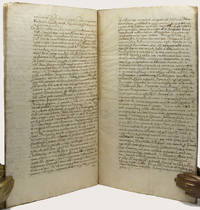
162134518Lisbon and Hangzhou China: Manuscripts ca.1623 and 1621. Very Rare A Similar Manuscript Exists in Brussels. We know of no others. The Latin text of both letters is written in a neat uniform cursive hand in brown. Folio leaves 33 x 20.5 cm The transcripts bound in 18th Century stiff blue wrappers the blank paste-downs and endpapers are late 18th century most likely the third quarter between 1745/1753 and 1776 since they contain a clear "lion/vryheit/pro patria" watermark with a crowned GR countermark which resembles Heawood 3148 3149 and 3154. The paper used for the manuscript contains a faint double-headed eagle watermark and it has been reinforced in the gutters. A very pleasing survival very well preserved edges slightly mellowed the wrappers show some signs of wear. VERY RARE MANUSCRIPT TRANSCRIPTS. Chrysostomus Johann Gall 1586-1643 was a German Jesuit and scholar. He left Ingolstadt Germany to teach astronomy mathematics and navigation in Lisbon fro 1620to 1627 before leaving to work in the Jesuit missions in India. The Colégio de Santo Antŕo benefitted from the arrival of many foreign mathematicians and other scholars as Lisbon serves as a gateway for all missionaries departing for Asia. The original letter by Gall was written in Lisbon September 1623 and concerns a newspaper style description of various events including details of the perseution of Christians in Japan particularly the execution of large numbers of the Christian community in Nagasaki in 1622.<br> The second letter in the present work is especially interesting as the original was written by Johannes Terentius also known as Johannes Schreck an Deng Yuhan Hanpo 1576-1630. Terentius was a prominent Jesuit scholar specialized in natural science and mathematics. Before joining the Jesuits as a novice1611 he already enjoyed a grea reputation in Germany as a scholar. In 1621 Terentius left for China to join the Jesuit mission. The original letter by Terentius was written in Hangzhou China on 30 August 1621 to the rector of teh Jesuit College in Munich Jakob Keller 1568-1631. He discusses his journey to China which he started in 1618 his intentions to participate in the planned calendar reform in China and his impressions of the city of Hangzhou which he reached in 1621 Terentius wrote several works on european medicine mathematics and technology in Chinese and together with Johann Adam Schall von Bell and G. Roho introduced European tigonometry and European astronomical instruments to China. In 1629 he began to reform the calendar which J.A. Schall von Bell ocmpleted after Terentius' early death a year later.<br><br>Backer & Sommervogel VII col. 1929-F<br> Manuscripts unknown
1585125<p>Coelho Gaspar. <em>Lettera annale scritta di novo dal Giapone delle cose ivi successe l'anno MDLXXXII. </em>Venice: Gioliti 1585<em>.</em></p><p>8vo 154x99 mm contemporary <em>cartonato alla rustica</em> original sewing to spine preserved pp. 103. Woodcut printer's device woodcut initials.</p><p>The scarcest issue of Jesuits' report of their missions and activity for the year 1582: one of the earliest printed Western testimony of the ancient Japan.</p><p>Gaspar Coelho composed this report in February 1582 describing the ongoing missionary activity across the country: in Hirado Amasuka Bungo and especially Funai Oita City the home of a thriving Jesuit college.</p><p>Streit describes another edition printed by the same publisher in the same year and according to Boscaro there were four editions of Coehho's letter published in Italy in 1585 around the time the embassy arrived in Venice on June 25: two issue printed in Venice by Gioliti one printed in Rome by Zanetti and one printed in Milano by Pontio. A French edition translated by Michel Coyssard was published in Paris in 1586 and one German translation in Dilingen in 1586.</p><p>According to Edit 16 our variant issue is the scarcest one located only in 2 Italian institutional library Biblioteca Universitaria of Bologna and Biblioteca nazionale Marciana of Venice:</p><p>CNCE 14783: <em>Lettera annale scritta di novo dal Giapone delle cose ivi successe l'anno MDLXXXII. </em>Venice: Gioliti 1585<em>. </em><u>Our variant</u> 2 copies.</p><p>CNCE 12736: <em>Lettera annale portata di nuouo dal Giapone da i signori ambasciatori delle cose iui successe l'anno MDLXXXII</em>. Venice: Gioliti 1585 12 copies.</p> Gioliti
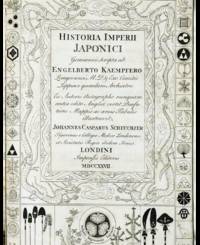
1728019215London: for the Publisher and Thomas Woodward and Charles Davis 1728. First Edition. Hardcover. Light dampstaining in second volume. Generally clean and bright Near Fine. Two folio 8-1/2" x 13-3/4 volumes in contemporary calf leather neatly rebacked preserving the original gilt spine labels. First edition in English second issue with the additional appendix in volume 2 translated from the German by J. G. Scheuchzer. Titles printed in red and black with additional engraved titles and 45 mostly double-page or folding plates and maps. Kaempfer's HISTORY OF JAPAN "was for more than a century the chief source of Western knowledge of the country. It contains the first biography of Kaempfer; an account of his journey; a history and description of Japan and its fauna; a description of Nagasaki and Deshima; a report on two embassies to Edo with a description of the cities which were visited on the way; and six appendices on tea Japanese paper acupuncture moxa ambergris and Japan's seclusion policy" DICTIONARY OF SCIENTIFIC BIOGRAPHY. Kaempfer was a physician for the Dutch East India Company's trading settlement at Nagasaki in the late 17th century. Sir Hans Sloane acquired the manuscript after Kaempfer's death and arranged for it to be translated into English for this edition. Of significance is the fine folding map of Japan "Imperium Japonicum in Sexaginta et Octo Provincias Divisum." <br/><br/>Cordier JAPONICA pages 414-15; Cox I: 332; Garrison-Morton 6374.11; See Nissen BBI 1019 note; Wellcome III: 376. for the Publisher, and Thomas Woodward and Charles Davis hardcover
19682110502151002316Senmon-do shoten 1968. Soft Cover. Fine. Number of books: 29 combined books Senmon-do shoten paperback
19622092902137704351Keiso Shobo Gyosei 1962. Soft Cover. Fine. The book is in fine condition. Keiso Shobo Gyosei paperback
172816JAPAN. Higashi Nihon Kaigan shosaizu. Coloured manscript map in the form of a scroll. ca. 29.5 x 488 cm with two foldouts extending ca. 17.5 x 29.5 cm housed in a wooden box. N.p.: n.d. A detailed map of the east coast of Japan depicting the coastline from the Mura Peninsula to the Boso Peninsula and from the Sanriku Coast to Hachinohe in Aomori. unknown
20022080202104501889Hon'notomosha 2002. Soft Cover. Fine. Number of pages: 11 books Number of books: 11 books Hon'notomosha paperback
20022080402107100080Hon'notomosha 2002. Soft Cover. Fine. Size: 22cm Number of books: 9 books in total Hon'notomosha paperback
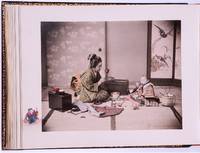
1892019217@1892. Hardcover. Photographs are Fine and bright with tissue guards. Both boxes in nice shape. The front cover of the album with a horizontal crack about 3 inches from the bottom and extending across most of the cover doing little to detract from the lovely decorative scene. Overall a beautiful example uncommon in such nice condition. Oblong Folio 14" x 10-1/2" with a black morocco leather spine with gilt designs and exquisite black enamel painted and onlaid covers. Containing 50 hand-colored 10-1/4" x 7-3/4" albumen photographs laid down onto heavy cardboard pages titled in the negative in English and with small color drawings of figures in the margins of each page. Images include cityscapes landmarks and scenes of daily life and rituals in mid-to-late Meiji period Japan. Places shown include Tokyo Kyoto Yokohama Nagoya Enoshima the shrines of Nikko and two views of Mt. Fuji. Occupational scenes include women spinning cotton men striking wheat a rice plantation men transporting rice bales on horseback a samurai a Shinto priest Shinto pilgrims a "blind shampooer" a pottery shop a shoe shop a grocery a cloth store "reading at home" "gathering the cocoons" "playing at ball" and more. Albums such as this were sold to overseas visitors to Japan ca 1880s- early 1900s who would choose their favorite scenes from the photography studio's stock and whether to pay extra for hand-coloring fine binding and artistic covers. We have offered a handful of examples over the years and this is easily the finest in content with more occupational and daily life scenes as opposed to the standard landmarks as well as special touches such as the small hand-painted characters in the margins of each page and also in the finest condition. Housed in a clamshell box with decorative cloth covers and likely the original tin container used for shipment to America. <br/><br/> hardcover
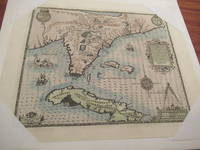
1592026339Frankfurt am Main 1591 1592. Original Antique Map . Single Sheet. Near Fine. Laid Paper. Size: Image And Border Approximately 17 7/8 Inches X 1M.5 Inches 45.2 Cm X 36.75 Cm. Debry Printed His Voyage To Virginia In 1590 As Part I Of His Works But Burden Mapping Of North America Provides No Record That A 1592 Printing Exists. This Map Has No Center Fold But Contemporary Engravings Exist Of The Offices Of The Great 17Th Century Cartographic Publishers With Row Upon Row Of Flat Drawers For Storage Of Single Maps; It Would Be Unreasonable To Believe That None Of These Unbound Maps Survived. This Appears To Be One Of Them Although The Consensus Of Modern Dealers Is That No Unfolded Large Map First Published In A Book Can Exist. Although We Have Been Unable To Locate A 1592 German Edition Of Debry We Believe This Is A Map As Issued In The 1592 German Edition Of De Bry Which Was First Published In 1591 And Subsequently Reprinted In 1592 And 1594 And In The Seventeenth Century. Small Cartouche At Lower Left Monogram With Text "Caesavece Matis. Privilegio Mdxcii" In The Plate Added After Original 1591 Printing. This Is An Unfolded Sheet Which Was Never Bound In A Book; A Strong Impression Without Damage And With Old Light Partial Coloring. Once Quite Aged Then Professionally Cleaned De-Acidified And Mounted Loosely With Archival Materials By A Museum-Experienced Conservator In About 2000. Scarce. And Now 430 Years Later It's Depicting A Hangout For Orangutans. <br/> <br/> unknown
186034745Edo 1860. Two woodblock-printed Kawaraban broadsides on Japanese paper each 9 x 11 5/8 inches. Two late Edo Kawaraban broadsides recording foreign people objects coinage dress and material culture at the moment of Japan's accelerated contact with Europe and America.<br/> <br/> These two Kawaraban belong to the popular printed culture that developed around Japan's encounter with foreign powers in the 1850s and early 1860s. Produced for circulation beyond official channels such broadsides translated diplomatic and commercial contact into a form legible to a broad Japanese readership combining image caption anecdote and report. Their interest lies in the way they classify the foreign world through visible particulars: clothing physiognomy tools coins flags animals weapons and curiosities. The first broadside is arranged in four compartments under a title describing Western products and curiosities. It includes figures identified as foreign visitors or crewmen among them an English captain and a Black sailor together with a Dutch-style optical instrument and a draped clay or stone figure possibly a classical statue. The second broadside combines a portrait of a captain's wife with her dog a depiction of a foreign flag and examples of foreign coins shown obverse and reverse including Russian coinage and coins dated 1843 and 1854. Here the focus is less on a single event than on the material signs by which foreign nations could be distinguished. The woman's dress the dog the flag and the coins are presented as objects of information and curiosity evidence of a public appetite for visual knowledge about the peoples then appearing in Japanese ports. Together the broadsides show how Kawaraban helped mediate the experience of opening Japan to foreign trade and diplomacy. Their compact format and direct visual language made them effective vehicles for reporting and interpreting the unfamiliar preserving a popular Japanese response to the presence of Westerners at a moment of rapid political and cultural change. unknown
20062092902141504930Kawade Shobo Shinsha All 3 2006. Soft Cover. Fine. Size: Large Number of books: 3 books in total Kawade Shobo Shinsha All 3 paperback