235 résultats
1939866071939. ADVERTISING ART - JAPAN. KÔKOKKAI. ADVERTISING AND COMMERCIAL ART. Volume 16 number 1. Tokyo Seibundo Showa 14 1939. Decorated wrappers. 26.3 x 19 cm. 96 pp. Kôkokkai was the premier professional journal on the art and science of advertising in Japan at the time of its publication. Ken Dômon was in charge of photography. The issues were full of scientific and perceptive articles and illustrated with color and bw plates and reproductions of posters ads signboards etc. etc. Despite a bi-lingual title on the title page inside the text is entirely in Japanese. Ephemeral issues from early Shôwa have largely disappeared. The fragile paper is in nice condition overall. unknown books
1996326011996. Softcover. VG light bumping to rear corner. Pictorial wraps. 322 pp. 181 color plates. Text in Japanese. paperback books
192044621Yokohama: Japan Cotton Trading Co n.d. ca. 1920. Original illustrated inspection label 15.5x11cm. printed in four colors. Light soil contemporary ink notes to verso blank else Very Good and unused. Label to be affixed to Company-inspected export shipments depicting a gilt raptor flying over several continents and a small village. The Company was founded in 1892 by a conglomeration of twenty-five Osaka spinners and by 1912 cotton spinning would make up half of Japan's industrial output https://www.sojitz.com/history/en/company/nihon-menka/. Japan Cotton Trading Co unknown books
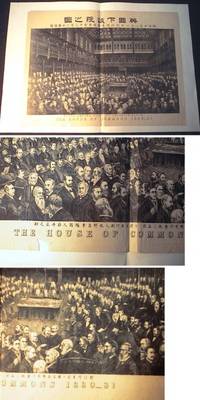
188117327Japan 1881. A newsheet insert or separate broadside publication printed one side only; approx.16 1/2" h. x 23" w. about a 1" margin surround; portraits of the British political worthies of the time; Japanese characters at top and bottom margins with title in English as well; appears to be a lithographic process; corners mounted to a larger paper sheet; edges with some wear and tear a few old reinforcements at edges; a little darkened one 1/2" chip at bottom edge; overall good condition and an interesting piece of British political ephemera from Asia. Good. unknown books
91322n.p. n.d. WWII. Very Good. Small WWII Japanese propaganda broadside. 13 x 10 cm. Chip and tear in bottom margin. Depict two Allied soldiers looking toward the "Philippine Deep' and seeing numerous presumably Allied. ships and planes under attack and sinking. <br/><br/> unknown books
15854676Venice: I Gioliti 1585. Hardcover. Very Good. 8vo - over 7¾ - 9¾" tall. 8vo. 103 pp. Bound in old vellum. Discrete former ownership stamp on title. Gutter margin of title reinforced; inconsequential toning otherwise excellent. Rare early edition of this Jesuit letter containing news of missions and activity in Japan from the year 1582 the only edition of 5 printed that year to contain a title-page advertising the famous Japanese embassy of 1584-86. Significantly the work also discusses the embassy the participants and their noble lineage and expresses the hope that the embassy will prove a convincing sign of the Jesuit's spectacular success in Japan p. 7. The present imprint of this edition comprises the first entry in Boscaro's bibliography of printed works related to the embassy. It thus stands at the head of nearly 50 works printed in 1585 alone to record and commemmorate an event that-in addition to providing a public relations coup for the Jesuits-became a watershed moment in cross-cultural exchange between the Orient and the West: "no Japanese emissaries to Europe either before or since aroused comparable interest or enthusiasm" Lach. In the annals of international relations between Europe and Japan in the 16th C it is particularly noteworthy "how the physical presence of the Japanese in Europe stimulated an unexpected number of typographical presentations" Boscaro of which this particular Gioliti edition with the titlepage advertising the embassy-Portata de Novo Dal Giapone Dai Signori Ambasciatori-is the very first. Boscaro notes that there were four other editions of Coehho's letter published in Italy in 1585 around the time the embassy arrived in Venice on June 25 including another by Gioliti but none of these uses the embassy as a way to market itself.The report itself is also a significant document of the embassy's genesis: Coelho composed it in February 1582 the month that the embassy of four Japanese Christian converts departed from Nagasaki. In it he describes the ongoing missionary activity across the country: e.g. in Hirado Amasuka Bungo and especially Funai Oita City the home of a thriving Jesuit college. Presumably the contents of this letter as the title suggests were "brought from Japan by the eminent ambassadors" as the latest news on the Jesuits current success in that faraway land.Though the embassy did not reach Lisbon until August 1584 it eventually was as Coelho had hoped a resounding success: from 1584-86 the four young Japanese nobles were the object of intense curiosity wherever they traveled and they were treated to lavish receptions in Lisbon Madrid Florence Rome Venice and other cities throughout Catholic Europe.OCLC: Cornell NYPL HU and Newberry. Boscaro 1; Alt-Japan 812; Sommervogel II.1267; Cordier 78; Laures 169; Pagès 22; Lach I.2.690. I Gioliti hardcover books
2060a TLS. 2pg. 8 ¼†x 10â€. July 15 1920. Yokohama Japan. A typed letter signed “Neil†laced with anti-Semitic sentiment. In part: “Went out calling last night with the bunch of fellows across the street. The host and his side partner are N.Y. Jews but sort of decent people. The wife is very nice but the husband is a regular East Sider. He is always talking about ‘not that I mind the expense of the house here but the servant is always telling about the money she needs for this and that and I can’t see where it goes to.’ You know just about what kind of a guy he is better than I do no doubt and you haven’t seen him. Anyway it was sort of a pleasant evening as he left the States in March and brought a lot of the new songs with him. He is a very good piano player and I had a fine time listening to him. One of the songs he played and ‘tried to sing’ just like John was ‘Pal of Mine’ you know how nice it was in comparison to the real singer and this Jew did the same stunt of turning to his wife too as John does to his wife when she sits up in the box. The husband was just a regular N.Y. smart alex Jew.†Typed on letterhead from Yokohama’s Grand Hotel which famously burned down as a result of the devastating 1923 Great KantÅ earthquake the letter is in very fine condition with light toning throughout and a few handwritten corrections not affecting legibility. b TLS. 3pg. 8 ¼†x 10â€. July 19 1920. Yokohama Japan. A typed letter signed “Neil†regarding work and life as an American abroad in early 20th century Japan. In part: “There isn’t much doing as for excitement but just hang around and do nothing. I really think I am gaining weight on the job. I met a fellow here who deals in all sorts of dress goods from Boston and I am getting on the right side of him as he gets all his stuff from here and I may be able to get some things for you people wholesale when you need them. He is one of us you get me being from Boston and a very fine chap. Eleanor will have nothing on me then getting things wholesale. About the only thing we need now wholesale is to get a bank to give us more money on our checks when we cash in. I am thinking of buying a kimono for Connors in the office for his wife as they are married in the Fall. He is a nice fellow and I thought for his trouble in calling up and the like I would bring him back one. I am not sure about it as yet but I think I will.†Typed on letterhead from Yokohama’s Grand Hotel which famously burned down as a result of the devastating 1923 Great KantÅ earthquake the letter is in very fine condition with light toning throughout and a few handwritten corrections not affecting legibility. unknown books
3655a TLS. 2pg. 8 ¼†x 10â€. July 15 1920. Yokohama Japan. A typed letter signed “Neil†laced with anti-Semitic sentiment. In part: “Went out calling last night with the bunch of fellows across the street. The host and his side partner are N.Y. Jews but sort of decent people. The wife is very nice but the husband is a regular East Sider. He is always talking about ‘not that I mind the expense of the house here but the servant is always telling about the money she needs for this and that and I can’t see where it goes to.’ You know just about what kind of a guy he is better than I do no doubt and you haven’t seen him. Anyway it was sort of a pleasant evening as he left the States in March and brought a lot of the new songs with him. He is a very good piano player and I had a fine time listening to him. One of the songs he played and ‘tried to sing’ just like John was ‘Pal of Mine’ you know how nice it was in comparison to the real singer and this Jew did the same stunt of turning to his wife too as John does to his wife when she sits up in the box. The husband was just a regular N.Y. smart alex Jew.†Typed on letterhead from Yokohama’s Grand Hotel which famously burned down as a result of the devastating 1923 Great Kanto earthquake the letter is in very fine condition with light toning throughout and a few handwritten corrections not affecting legibility. b TLS. 3pg. 8 ¼†x 10â€. July 19 1920. Yokohama Japan. A typed letter signed “Neil†regarding work and life as an American abroad in early 20th century Japan. In part: “There isn’t much doing as for excitement but just hang around and do nothing. I really think I am gaining weight on the job. I met a fellow here who deals in all sorts of dress goods from Boston and I am getting on the right side of him as he gets all his stuff from here and I may be able to get some things for you people wholesale when you need them. He is one of us you get me being from Boston and a very fine chap. Eleanor will have nothing on me then getting things wholesale. About the only thing we need now wholesale is to get a bank to give us more money on our checks when we cash in. I am thinking of buying a kimono for Connors in the office for his wife as they are married in the Fall. He is a nice fellow and I thought for his trouble in calling up and the like I would bring him back one. I am not sure about it as yet but I think I will.†Typed on letterhead from Yokohama’s Grand Hotel which famously burned down as a result of the devastating 1923 Great Kanto earthquake the letter is in very fine condition with light toning throughout and a few handwritten corrections not affecting legibility. unknown books
19072222218<p>First edition. Octavo. Illustrated by S. Morita and R. S. Hayata.Frontispiece portrait. Original green pictorial cloth with design in red white pink and gilt of rising sun flag Mt. Fuji and cherry blossom t.e.g. No dust jacket. Very good. 301 pages; 22 pages of reviews and ads. No signatures or bookplates.</p><p>Printed by The Wilkens-Sheiry Press Washington D.C.</p><p>Front pastedown with text in Japanese.</p> The Baker & Taylor Company hardcover books
195232518n.p.: n.p. 1952. First edition. Stapled paper wrappers. Annotations on rear wrapper else very good. 8 pp. 8vo. n.p. unknown books
199528668Honolulu: University of Hawaii Press. Near Fine in Fine dust jacket. 1995. Hardcover. 082481665X . First printing. Remainder dot on spine else fine in a fine dust jacket. . University of Hawaii Press hardcover books
200327263NY: Gotham Books 2003. 1st edition. Hardback. Dust jacket. F/F. xi 3 321 pp. 8vo. <br/><br/> Gotham Books hardcover books
1854WRCAM52135Yokohama 1854. 1p. Oblong folio sheet previously folded. A couple minor creases with very light dampstaining at foot of sheet. Very good. An impressive survival from Commodore Perry's expedition a decorative manuscript menu from the banquet that celebrated the agreement of the Treaty of Kanagawa between the United States and Japan in 1854. Although an official and extensive trade agreement between the two countries was not reached until 1858 the Treaty of Kanagawa achieved Perry and the United States government's primary goal of opening Japan to U.S. trade by allowing the use of two ports at Shimoda and Hakodate by American ships granting a degree of freedom of movement to American sailors while in port and establishing diplomatic relations via the appointment of an American consul. <br> <br> The banquet was held in the Treaty House at Yokohama which had been purpose-built for negotiating the agreement between the two countries. It was a return engagement following a first event hosted by the Americans on board Perry's flagship the U.S.S. Powhatan at which copious amounts of lamb beef and whiskey were reportedly served. The menu for the Japanese meal reflected the country's altogether different culinary tastes offering a long series of soup and seafood courses including sea bream and a number of other fish. It is unclear which side found the other's food more distasteful but Perry remarked that the Japanese offerings "Seemed particularly meager in comparison with American fare and soup however desirable in its proper place was found to be but a poor substitute for a round of beef or a haunch of mutton." For their part the Japanese were unimpressed by the Americans' loud and uncouth behavior at the event and were amused by their inability to use chopsticks. <br> <br> Despite the reservations of each side the banquet served as a capstone to one of the most critical moments in the development of Japanese-American relations. This possibly unique piece of ephemera is a wonderful document of that entertaining cross-cultural episode and the culmination of the Perry expedition. unknown books
738736 folding leaves of which four are blank. 8vo 240 x 170 mm. orig. blue semi-stiff wrappers wrappers somewhat worn orig. label heightened in gold with manuscript title new stitching. Japan: n.d.<br /> During the Edo period there were 12 Korean delegations to Japan whose purposes were mostly to congratulate a new Tokugawa shogun. The missions which normally included 300-500 Koreans accompanied by roughly 1500 Japanese escorts symbolized the amicable relationship between the two nations and in the early years served to legitimize the Tokugawa shogunate.<br /> These delegations which usually took nine or ten months round-trip were enormously expensive undertakings for both countries. The Koreans brought many luxurious presents both public and private gifts and the Japanese in turn furnished equally lavish gifts including large quantities of silver. Also the receiving Japanese were obligated to fund a number of elaborate and costly banquets during the delegation's travels on the mainland and in the capital city as well as provide accommodations throughout.<br /> Our manuscript is concerned with one of the three final missions which took place in 1748 1764 and 1811 this last mission was held on the island of Tsushima located roughly halfway between Kyushu and the Korean mainland. All three of these missions experienced considerable cost-cutting. We suspect our manuscript is a record of the banquets for the final 1811 mission as there is a reference to a Russian translator at this time there was considerable tension between Japan and Russia because of the Russian desire to open trade with the island nation.<br /> Our manuscript describes a series of banquets served during one of these three final missions. In spite of the newly instituted austerity it is clear that the participants ate very well. For each of the 13 banquets we are given the number of guests and their official positions the number of dishes per tray what foods were served etc. Some of the banquets were limited to just a dozen or so guests and others included more than 300 people. <br /> The cuisine is very much in the tradition of the ritualistic preparation and serving of the food on a series of trays known as honzen ryori "main tray cuisine" which was the dominant banqueting style for the elite from the Muromachi period through the Edo period. Various seafoods including luxury items like lobster smoked fish roe octopus and preserved fish are listed along with preparations of chickens eggs many kinds of vegetables burdock daikon radish ginger eggplant wild wasabi and many vegetables that are today quite obscure cooked in various ways pickles mushrooms fruits persimmons pears yuzu nuts rice and other grains and elaborate confections including sweets of Portuguese origin like pound cake or kasutera.<br /> Fine copy preserved in a chitsu. unknown books
189827983London: Edward Stanford 1898. Colored map. 1 vols. 22 x 26 1/2 inches. Bound in green cloth paper label folding paper over linen backing. Fine. Colored map. 1 vols. 22 x 26 1/2 inches. Edward Stanford unknown books
195332361Tokyo: Nihon Kotsu Kosha 1953. Cloth. A good copy discoloration to spine and front board a bit shaken. Unpaged. Illus. with approximately 400 b/w photos and 50 small maps. "Pictures of Japanese Hot Spring Spas." Covers approximately 70 spas most in two page spreads. Four pages of text eight pages of lists and twenty pages of advertisements. Nihon Kotsu Kosha hardcover books
196040126Tokyo: Meiji jing shamusho 1960. Linen with gilt titles. Light foxing along fore edge and blank else a very good bright copy in a very good cardboard slipcase torn along the fold. Unpaged. 170 pp. Illus. with 80 color plates and 4 b/w photos. Folio. Osanaga Kanroji preface. Captions and text in English and Japanese. Reproduces the pictures that are painted by famous artists which depict the lives of the Emperor and Empress Meiji.The gallery is located in the center of Meiji Park in Tokyo. [Meiji jing shamusho] unknown books
1985128261985. Softcover. VG- exlib small stamp. Color wraps. 147 pp. 29 color numerous bw plates. Six-page introduction by Gabriel P. Weisberg biographical passages on Millet Courbet and Corot many rich plates. paperback books
195034251Kohata Japan: Hanano - Shiro - Sha 1950. Oblong folio. 10 1/8 x 14 1/4 inches. Printed tissue covers over vivid paintings. Foreword 12 pages of text and 24 full page plates each with discussion and instruction on the arrangements. Publisher's silk paper label on upper cover.<br/> <br/>The illustrations are after paintings by Etsujin Kawahara; text by Seika Nishizaka; printed by Seizaburo Nishikawa. Hanano - Shiro - Sha unknown books
197940698NY & San Francisco: Kodansha International 1979. First US edition. 311 pp w/index. Fine in fine dust jacket. NY & San Francisco: Kodansha International unknown books
1979043396Tokyo Etc.: Kodansha International 1979. 1st Edition. 311p. dj. Kodansha International unknown books
18802560561880. Albumen print mounted and captioned beneath image "Fusiyama highest mt. in Japan 14500 feet high-90 miles from Yokohama.". 1 vols. 8-3/4 x 11-3/4 inches Image. Foxing waterstain on mount extending into top of image. Albumen print mounted and captioned beneath image "Fusiyama highest mt. in Japan 14500 feet high-90 miles from Yokohama.". 1 vols. 8-3/4 x 11-3/4 inches Image. WH/9/Box D unknown books
1856826971856. MAP - JAPAN Gyokuransai SADAHIDE & Kikuchi Shûzo. MUSASHI NO KUNI ZENZU. Edo Kikuya Kosaburo & 12 others. Ansei 3 1856 112 X 127 cm. An interesting colored woodcut map of the Musashi plain. Folds into its original titled covers 28 x 18.6 cm. Nice colors impression and colors. Sadahide was not only a talented printmaker but was also responsible for several important maps of the time. Beans 1856.13 in Supplement B page 41. See the UBC website at http://angel.library.ubc.ca/cdm4/item_viewer.phpCISOROOT=/t okugawa&CISOPTR=312&REC=3 for more info on this map. From The Keyes collection. unknown books
29359Softcover. VG minor wear to cover edges. Pictorial wraps. 237 pp. 365 bw and color plates. Text in Japanese. paperback books
1856WRCAM55468N.p. but probably Tokyo 1856. Ink and watercolor on twenty-five linen- mounted rice paper panels joined into a scroll measuring approximately 10 1/2 inches x 29 1/2 feet. Mounted on a wooden roller with silk tie housed in a custom balsa wood box. Intermittent creasing fairly regular small chips to bottom edge sometimes costing a bit of the image area. Very good. An incredible informative and beautifully rendered "Black Ship Scroll" giving a thirty- foot long visual account of the visit of Commodore Perry's U.S. naval squadron to Shimoda in the wake of the signing of the Treaty of Kanagawa. It is an awe-inspiring artifact of a momentous event in American and Japanese history and a brilliant work of art. <br> <br> Perry's 1854 arrival in the remote port of Shimoda aroused great curiosity and was recorded both by anonymous artisans as well as real artists the latter being the case for the present scroll. One of Perry's interpreters S. Wells Williams reported seeing similar scrolls depicting the naval visit just a few weeks after they anchored. He wrote in his account of the visit: "A pictorial representation of our squadron and description annexed and an account of the war between England and China were seen today by officers." Williams goes on the remark that it was forbidden to sell these scrolls to Americans and in fact being a non- trading closed society Japanese officials discouraged personal purchases of any kind by U.S. personnel. <br> <br> Evident in the present scroll is the Japanese fascination with American military technology. Perry's official account made note of the Japanese being insatiably inquisitive when invited on board: "When visiting the ship the mandarins and their attendants were never at rest: but went about peering into every nook and corner peeping into the muzzles of the guns.They were not contented to merely observing with their eyes but were constantly taking out their writing materials their mulberry bark paper." <br> <br> The present scroll depicts the deck and equipment details of one of Perry's frigate steamers as well as handsome harbor scenes of the numerous ships at anchor including a moonlight view brilliantly-colored American flags flying from the masts of the ships undulating coastlines maps of the locations of Perry's ships the narrative of their travel from Edo Bay a portrait of Commodore Perry and two of his interpreters and an account of naval gun salutes and the burial of a sailor with a rendering of his tombstone. Also shown is a small American military band large portraits of several of Perry's ships a detail of an American landing party departing one of the imposing Black Ships and much more. On the whole the expert illustrations give not only the details of Perry his men ships and their armaments but a sense of the level to which the American squadron impressed the Japanese. Accomplished by an artist that would almost certainly have had firsthand knowledge of the visit of the American squadron it is a far more artistically-polished memorial of Perry's extraordinary visit than many of the more folk-art type scrolls that make up the majority of surviving examples. <br> <br> Perry's sudden arrival near the entrance to Tokyo Bay at Uraga on July 8 1853 with two sloops and two paddle-steamer battleships carrying letters and gifts to deliver to the Emperor threw the Japanese authorities into a tailspin. The reports went back to the Emperor who immediately took ill presumably fearing an invasion. For several days there was a stand-off the smaller Japanese vessels amassing around the American vessels one of which had ninety-two cannons. Local warlord families took up arms all around the Bay and made promises of men for the defense of Edo. For five days the stand-off continued and Perry stayed in his cabin and let it be known he had a letter from President Fillmore to deliver to the Emperor and only the Emperor or his emissary could receive it. The Japanese first threatened him then tried to bribe him to leave and go to Nagasaki to complete his mission. Perry stood firm and ignored the Japanese demands. <br> <br> Perry sent out smaller boats to start surveying the area and the Japanese stood aside wondering if the cannon would strike them. On July 14 a hastily erected tent was put up on the shore of the bay and two sons of the Emperor Princes Ido and Toda came down by Imperial barge from Edo and sat in the tent to receive the letters. Perry arrived with his troops his marching band playing flags flying. He formally delivered the letters and said he would be back in a year for an answer to the President's call for a trade treaty with Japan protection for shipwrecked sailors and the establishment of refueling stations for American ships in the Western Pacific. The Japanese asked Perry to leave quickly but he stayed anchored for a further three days then spent some time doing surveys of other parts of Edo Bay returning via Okinawa to winter at the American station in Hong Kong. <br> <br> Perry returned the following February with a larger flotilla strengthened by newly- completed battleship steamers sent out from the United States. The second meeting took place at Yokohama from February to June 1854 where Perry insisted that negotiations begin and at that time there was an exchange of diplomatic gifts. A provisional treaty was signed in 1854 but the full trading treaty was not completed until 1858 after Townsend Harris came to Japan as U.S. Consul and set about finalizing the negotiations. <br> <br> Perry's return in 1854 with a much more substantial force provoked the same curiosity and trepidation among the Japanese populace as his first visit if not more so and it is this second visit that is captured in the present scroll. The Americans arrived by steam frigates the "black ships of evil men" as well as under sail with their canons and howitzers conspicuous. This second visit to Edo Bay was a purposeful display of the United States' superior military force to impress an essentially feudal society - all the better for Perry to encourage the signing of a treaty allowing American whalers to use the islands as a resupply outpost of America's burgeoning economic empire and Pacific expansion. <br> <br> Following the signing of the Treaty of Kanagawa on March 31 1854 Perry visited the two ports named as open to American ships Shimoda and Hakodate. Americans were also allowed to travel inland from these ports to a proscribed distance of seven ri approximately seventeen miles. Officers were allowed onshore and the manners appearance and customs of the Americans were of nearly insatiable interest to the inhabitants of these remote fishing villages. This was the first interaction common Japanese citizens had with Westerners. <br> <br> The present scroll descends from the Perry family specifically Calbraith Perry Rodgers famed aviator and Commodore Matthew Calbraith Perry's great-grandnephew. The scroll is accompanied by a later typed transcription of an 1858 account of Commodore Perry's life by R.S. Rodgers. <br> <br> One of the more impressive examples of a Black Ship Scroll documenting Perry's second interaction with the Japanese rulers and people executed by an accomplished Japanese artist and descended through the Perry family. unknown books