JapanABAA

235 résultats
1950016276Japan: Japan 1950. Book. Very good condition. Hardcover. First Edition. 12mo - over 6¾" - 7¾" tall. 484 pages of text. Flexible hardcover binding with minor creasing and shelfwear. Protected in the original printed cardboard slipcase which is heavily worn and splitting at two seams. The text is clean and unmarked. All publishing details including the edition are in Japanese; date assumed to be circa 1950. Japan Hardcover books
1858WRCAM52130AJapan 1858. Five volumes. 58; 58; 54; 58; 58pp. Original stiff textured tan wrappers stitched as issued each with printed paper title label. Some minor shelf wear and dust soiling. Very good. An attractive set of the "Ansei Five-Power Treaties" the formal diplomatic engagements between Japan and the United States United Kingdom France Russia and the Netherlands ending Japan's 250 years of seclusion and opening its ports to worldwide commercial trade so named for their signing in the fifth year of the Ansei era. The first treaty also known as the Harris Treaty was signed by the U.S. on the deck of the USS "Powhatan" in Edo now Tokyo Bay on July 29 1858. It opened the ports of of Shimoda Hakodate Kanagawa and Nagasaki to foreign trade effective July 4 1859 and then Niigata and Hyogo on January 1 1860 and January 1 1863 respectively. In addition to extensive trade and consular provisions the treaty also established the rights of U.S. citizens to reside permanently lease property purchase real estate and construct residences and warehouses; established a system of extraterritoriality whereby U.S. residents were subject only to the laws of their own consular courts and not the Japanese legal system; and established freedom of religious expression and the right to construct churches to serve the needs of U.S. residents within the confines of designated foreign settlements. The treaty followed the Convention of Kanagawa signed under threat of force in 1854 after Commodore Matthew Perry's aggressive visits to the Shogunate in 1853 and 1854. The Convention had granted coaling rights for U.S. ships and allowed for an American consul in Shimoda but Perry left the more important trading negotiations to Townsend Harris New York businessman and eventually the first U.S. Consul General to Japan. <br> <br> Each of the five volumes details the negotiations between Japan and a specific foreign power. These other accords are similar and duly inspired by the U.S. treaty; each nation forced Japan to grant the same "favored nation" provisions they had granted to the U.S. The Dutch already had several treaties with Japan; they were the only Western power to retain trade relations with Japan after the final expulsion of Europeans in 1638 and had been advising and supplying the Japanese navy since 1853. However once the U.S. had sealed its "Treaty of Amity" the Dutch quickly revised theirs to match on August 18 1858; Russia followed on August 19; Lord Elgin signed for Britain on August 26; and Jean-Baptiste Louis Gros commander of the French expedition in China signed for France on October 9 1858. Subsequent Japanese and Chinese scholars refer to these treaties and subsequent agreements as the "unequal treaties" as none of the provisions were ever reciprocated. <br> <br> This set is uncommon. We found only one record for another incomplete set at auction. This is the first time we have handled this title. unknown books
197034021Tokyo: The Japan Times. Fine in Fine dust jacket. 1970. Hardcover. Color and black and white photographs throughout. First edition. Fine in a fine dust jacket. . The Japan Times hardcover books
2014215377San Francisco: Japanese Cultural and Community Center of Northern California 2014. 127p. very good softcover 8.5x11 inches. Color photographs. Report on aid by the San Francisco-based organization with help from community groups and institutions such as the Giants baseball team. Japanese Cultural and Community Center of Northern California unknown books
1978109351978. Softcover. VG- some mild wear along spine. White wraps. 31 pp. 26 bw plates. Written dually in Japanese and English this volume contains an introduction by Kakuzo Tatehata a listing of 12 works a personal history/exhibition listing and an original poster promoting advertising the exhibition. unknown books
15852438<p>Venice: Appreso I Gioliti 1585. </p><p>Price: $8500.00 </p><p>Octavo: 16 x 10.5 cm. 188 11 pp. Collation: A-M8 N4</p><p>One of several 1585 editions first ed. 1584</p><p>Bound in modern cartoncino. A very good copy with some minor repairs lightly washed. With a fine woodcut headpiece and Jesuit emblem on the title page and numerous decorative head- and tailpieces and initials including one of a dragon throughout.</p><p>This collection contains the following letters from the Jesuit missions in Japan and Goa: Francesco Carreón writing from Kuchinotsu 1 Dec. 1579; Gregorio de Céspedes 1579; Lorenço Mexia at Bungo 20 Oct. 1580; three letters by LuÃs Fróis Miyako 14 April 1581; 19 May 1581; and 29 May 1581; Francesco Cabral 15 Sept. 1581; and Alessandro Valignano Goa 28 Dec. 1583.<br /><br />The Salsette Martyrs:<br /><br />This collection concludes with Valignano's important letter from Goa –one of only five Jesuit letters from India published between 1570 and 1585- detailing the deaths of the Jesuit Martyrs of Cuncolim who were killed on Monday 25 July 1583 in the village of Cuncolim in the district of Salsette territory of Goa India. The "martyrs" were the Italian Rudolph Acquaviva the Spaniard Alphonso Pacheco the Swiss Peter Berno the Portuguese Anthony Francis and Brother Francis Aranha also a Portuguese. In addition the Portuguese layman Gonçalo Rodrigues and some Indian youths Dominic Alphonso Francis Rodrigues Paul da Costa and ten others were also killed.<br /><br />While prosecuting their mission of Conversion in Cuncolim the Jesuits and their companions desecrated a Hindu temple by urinating in it a relatively mild if repugnant form of desecration; on an earlier excursion Father Berno had set fire to another temple and destroyed a sacred anthill. In addition they killed a cow that was also an object of worship and hurled its entrails into a sacred well thereby defiling it. The understandably outraged citizenry set upon the Jesuits and their companions killing them with scimitars lances and arrows. They then threw their bodies into a well. The five Jesuits quickly achieved great fame as martyrs and at last in the 19th century were elevated to sainthood while the lay Indians who were slaughtered with them were ignored. <br /><br />It should be remembered that three of the five Jesuit martyrs were in Cuncolim as chaplains to a force of Portuguese soldiers sent to exact harsh reprisals for indigenous resistance to Portuguese rule and the Jesuit campaign of forced conversion. In this context the killing of the Jesuits is remembered by the people of modern day Cuncolim as one of the first acts of revolutionary resistance to European rule in India.<br /><br />Of course the letter written in December of 1583 by the Jesuit Provincial of India Alessandro Valignano glorifies the "martyrs" and in true martyrological style vividly describes the deaths of Acquaviva and his companions.<br /><br />"The Pagans then fell upon them; Father Rudolph received five cuts from a scimitar and a spear and died praying God to forgive them and pronouncing the Holy Name. Father Berno was next horribly mutilated and Father Pacheco wounded with a spear fell on his knees extending his<br />arms in the form of a cross and praying God to forgive his murderers and send other missionaries to them.</p><p>Streit Bibliotheca Missionum IV. 1639; Sommervogel II col 492; Cordier Sinica 75; Laures 170</p> Appreso I Gioliti, books
44211<p>Japan and Western Medicine. Oranda jin Geka ryoji no zu Dutch Surgery in Nagasaki. Original pen ink and watercolor drawing on light brown-toned silk with 4 vertical lines of Japanese characters in the upper left corner. Japan: late 18th or early 19th century. 483 x 363 mm. mounted as a scroll at a modern date on light grey silk backed with paper with a half-round hanging rail with braided ribbon attached at the top and a suspension bar at the foot measuring 914 x 443 mm. overall; preserved in a custom-made wooden box. A few tiny pinholes in upper corners of image but fine with the coloring fresh and bright.</p> <p> This striking image showing an amputation carried out by a Dutch surgeon in Japan was most likely painted in the late eighteenth or early nineteenth century during Japan's self-imposed period of national isolation. The hand-painted image is related but by no means identical to a Nagasaki woodblock print titled "Surgery by a Dutch Physician" one of many popular souvenir prints depicting scenes unique to Nagasaki which at the time was the sole point of contact between Japan and the outside world. See our reproduction of the print. It may be that our scroll is the original of the image; however it is also possible that both hand-painted and woodcut versions of the image were produced simultaneously.</p> <p> Western surgery came to Japan in the sixteenth and seventeenth centuries via the Portuguese who in 1543 became the first Europeans to make direct contact with Japan and the Dutch who became the only European nation allowed to trade with Japan after Japan's expulsion of the Portuguese in 1639. Surgeons attached to the Dutch East India Company established practices at the island of Dejima in Nagasaki Bay which led to the formation of several Japanese schools of surgery based on European methods. "This aspect of Western medicine known as K m -ry geka or ‘Surgery of the Red-Haired' has had a profound effect on the development of surgical practice in Japan" Van Gulik p. 37. Van Gulik "Dutch surgery in Japan" in Red-Hair Medicine: Dutch-Japanese Medical Relations ed. Beukers et al. pp. 37-50. </p> <p>. unknown books
13932Original 19th Century Hand colored photograph of the Festival of Lanterns at Yokohama Japan. The photograph measures 8"x10" and is matted to 10-1/2"x13". Lower right hand corner label reads "A 264 Festival Lanterns at Bentendori Yokohama." Festival lanterns cheer up the business district of Bentendori 2-chome and 3-chome in Yokohama. During the Meiji Period this was Yokohama's premier shopping street. Foreign visitors came here to buy porcelain curios ivory silk and photographs. The photographer of this very image Kimbei Kusakabe actually had a studio on this street between 1881 and 1889. Unfortunately the exotic amalgamation of Japan and the Western world that existed on Bentendori was forever destroyed by the Great Kanto Earthquake of 1923. Photographs such as this are all that is left of a bygone era. In very good condition. unknown books
1985M12135Tokyo:: Journal of the Japan-Netherlands Institute 1985. 1985. 8vo. 161 pp. 4 figs. bibliog. Printed wrappers. Fine. Includes: W. J. Mulder Surgical and Obstetrical Instruments in the Netherlands 1750-1870. Journal of the Japan-Netherlands Institute, 1985. unknown books
19695ca. 1920-1931 Kyushu Japan. Very good . Oblong 4to. String-tied commecial album; black boards. Contains 57 gelatin-silver prints of various sizes including 8" by 10" 7.5" by 5" and smaller most of which are adhesive-mounted with several loose plus 11 postcards depicting Kyushu Lutheran churches and one bookmark. One photograph apparently perished; several others loosening from pages. Else apparently complete.Album edges moderately worn; one photo missing a chunk at edge. Most are lightly toned but overall clean. Very good or better. <br/><br/>Well-assembled photo album compiled by an American Lutheran missionary to Japan whose face appears consistently in the majority of the photographs. The island of Kyushu is home to several Lutheran schools and churches including the Kyushu Gakuin Kyushu Lutheran College and the Janice James School both of which are pictured here having recently been built in the early 1900's. The Kyushu Lutheran mission was founded in 1893 by American missionaries; within several years they began building churches under the supervision of one Charles Lafayette Brown 1874-1921 and presumably the subjects pictured here with members of that particualr mission. The album features posed group photographs of large congregations — as large as roughly 150 — captioned with date and location in cities including Kurume Kamamoto and Saga; additionally included are many images of church services in progress plus several family portraits of church members. While Christianity began to spread when Japan phased out its isolationist policies in the 1850s Protestant evangilization in particular slowed under the military government of the Showa period the early years of which are covered by this album.These anti-Western trends were closely tied to the patriotic fervor that culminated in WWII. An absorbing visual archive of a prospering Protestant community and of American missionary activity in Imperial Japan. hardcover books
17162Girls Education Japan Photograph album from a girl student in Japan c. 1926. Filled with 78 original silver gelatin print photographs of classmates school activities and social outings. Original cloth and red boards. 10 x 7.5 in. "Photo Album" printed on front cover. Pasted label on the final page with some information on the original owner dated 1926. Photographs of various small sizes from 1.75 x 2.5 inches to 3 x 5". Many images are school portraits of teenage girls in their matching uniforms posing either individually in pairs or small groups. Occasional photographs of teenage boys as well including one with the sitter dressed in a samurai outfit. Photos of a field day with outdoor footraces marches and performances. A few later photographs of older young women in civilian clothes posing by a river and strolling in a park together. These may be images of some of the younger students years later as adults. Most of the images show figures in Western styles clothes although 2 photographs show women dressed up in kimonos. Images lack captions but there is an autograph on one photograph. Some soiling to cover and 8 sheets of album are detached from spine. Unique images are in very good condition. unknown books
19250379901925. Original photograph album. Very Good. Oblong string-tied album of black cardstock leaves 11" x 13" photographs mounted on 35pp blanks at the rear. Bound in black flexible boards with an embossed sailing ship and gilt lettering Photo-Album on the cover. Pasted in are 116 albumen and silver gelatin prints ranging from small candids to 8 ½" x 10 ½" group portraits a few fading overall sharp and clean. Laid into the album are a Japanese news article a small head-shot of an older gentleman and a watercolor portrait 10" x 8 ¼" of a man's face. Most of the photographs in this album. circa 1895-1925 were taken in Mie-Ken or "Mie prefecture" part of the Kansai region on the main island of Honshu. The group and individual portraits reflect new social and economic developments and cultural norms that emerged during this period. Subjects are shown in either traditional Japanese garments or in Western dress. Group shots often depict people wearing both styles within the same picture. There are many group shots of schoolchildren of both sexes young people in uniforms posed before buildings with Japanese signs on them as well as many formal group shots of families some "nuclear"-husband wife children- others extended by relatives. Individual shots of young children show them almost invariably in western dress one posed with his tricycle young boys in uniform a young girl in kimono showing a dance move while holding a fan infants in traditional robes and young men in business suits. Several birdseye views feature very large groups of rural people in traditional dress posed outdoors. Among the most striking photographs are: one 8 ½" x 10 ½" showing 11 doctors/ medical students posed around two corpses one smiling happily being dissected on two tables; four women and one man posed around a table doing handwork weaving tatting; men in western dress "strap-holding" inside a streetcar; and 5 actors 2 male 3 female on stage in costume. ~~ The Meiji period 1868-1912 saw the restoration of the Emperor this time with a centralized bureaucracy behind him after years of shogun rule. Japan was under heavy influence from Western political economic and educational models and the country became more capitalist industrial and progressively democratic offering free education to youngsters of both genders. Transportation and communications systems were modernized the feudal lords and samurai lost their power and a powerful national army and navy were created. By the early 1870s the government declared all classes of people to be equal. The Taishu period 1912-26 saw the continued influence of Western culture and values such as efficiency and individualism continued to replace more traditional ones. Japanese participation on the world stage continued to grow as the nation co-founded the League of Nations and emerged on the winning side in WWI. By 1925 there was universal male suffrage in Japan. Corruption in government increased however and the West began to form negative views of this newly-powerful non-white nation exacerbated by Japan's poor treatment of China. <br/><br/> hardcover books
193513899np Japan nd ca. 1935. Hardcover. Near fine. Oblong 4to. double string-tied commercial album silk brocade bound 9" x 12". Containing 60 4.5" x 6" silver gelatin prints mounted to heavy gilt-edges card-stock one to a page both recto and verso. Printed captions in English additionally mounted below each photo. Near fine or better with only touches of wear to extremities. Quite well-preserved. <br/><br/>A handsome and rather lavish production by an unknown but likely professional photographer possibly as presentation for special occasion or visit from foreign dignitary/delegation. Undated but clearly pre-war and based on internal evidence ca. 1935-1940. A broad range of scenes from Japanese domestic and cultural life are included: cormorant fishing the tea ceremony flower arrangement Kabuki and Noh theater Sumo and other sports kendo archery battledore shuttlecock festivals musicians rice and tea harvesting as well as scenes of shrines temples cherry blossoms and gardens. More modern scenes include Tokyo street scenes a Nikko cable car and silk mill workers. An attractive and informative look at Japan in the years immediately preceding WWII. hardcover books
193951359Tokyo: Board of Tourist Industry Japanese Government Railways 1939. Paperback. Very Good. photos folding map vii 138p. Original wrapper. 19cm. Backstrip chipped at top. <br/><br/> Board of Tourist Industry, Japanese Government Railways paperback books
2002014057Japan: Institute of Developing Economies Japan External Trade Organization 2002. Cloth. Fine/Fine. 8vo - over 7¾" - 9¾" tall. ix 118p. maps Bibliography index. Naga City case study as a clue to Philippine politics with many insights found nowhere else. Already a scarce item most copies are found in university libraries. Institute of Developing Economies, Japan External Trade Organization unknown books
1904316723London: Anthony Treherne & Co. Ltd 1904. Second Impression. Color frontispiece 6 color plates and 30 iillustrations after Hokusai. 443pp. 1 vols. 8vo. Bound in three quarters modern mottled brown calf and marble boards red title label. Fine. Second Impression. Color frontispiece 6 color plates and 30 iillustrations after Hokusai. 443pp. 1 vols. 8vo. Anthony Treherne & Co., Ltd unknown books
188726924Chicago Illinois: Rand McNally & Co. 1887. Pocket map of Japan printed in colors detailing the Japanese island system in two separate maps: Northern Japan with an inset at top of Chishima; with the previous owner noting the location of the volcano Bandai-San. Approx. 13 3/4" x 21" overall size; and Southern Japan with inset of Yayeyama and Riukiu Island chain approx. 14" x 20 3/4". With a folding Index and Population of Towns in Japan having a pronunciation list and giving the districts islands lakes mountains provinces rivers and towns; this is printed two sides approx. 13 3/4" x 19 3/4" size. Bookseller's ticket on front inner panel of the cover of Kelly & Walsh Ltd. Printers Publishers Booksellers Stationers &c. &c. &c. No. 28. Yokohama. Small faint previous ownership stamps on the blank panels on the back of the maps as well as on the front endpaper of the cover of collector Dr. George R. Brush U.S. Navy; served as a surgeon and medical inspector from 1861-1894 & often on-station in various locales in Japan. Maps & index contained in the publisher's dark brown cloth binding approx. 3 1/2" x 6 1/4" size gilt titled. Some color mottling to the case light wear; map papers darkened a little; Northern Japan & the Index loose; Southern Japan still attached to the inner cover; in very good condition. Pocket Map. Hard Cover. Very Good. Rand, McNally & Co. hardcover books
1900WRCAM45650Various locations in Japan 1900. Ten leaves containing eighty photographs each 2 1/4 x 3 1/4 inches. Oblong octavo. Contemporary black three- quarter morocco and cloth. Hinges and corners lightly worn. Bookplate on front pastedown. Light foxing primarily to mounts and not images. Prints sharp and clear. Very good. Eighty attractive images of turn-of-the- century Japan as seen through a Western lens. Evidently narrating a trip in Japan each photograph is captioned in English usually stating location which include Kagoshima the Kuma River Kumamoto Nakatshu Fukuoka Nagasaki and Isahaya. While most of the images show landscapes and the scenery of the area many of them include local people - at temple and shrines in city streets going about every day life. Of particular interest are a photograph of a woodcutter's hut with the family in the foreground a fortuneteller plying his trade a group of young men washing vegetables a view of Suizenji Park a Buddhist Temple threshing rice the sulphur springs at Nagasaki and various scenes in native villages. A nice collection of images with the bookplate of New Zealand photo-historian Frederic Hardwicke Knight. hardcover books
193832594Tokyo: Asiatic Society of Japan 1938. First edition. Self wrappers. A very good clean copy with edgewear. 4 pp. 8vo. [Asiatic Society of Japan] unknown books
1998179421998. Hardcover. VG. Color boards. 180 pp. Numerous bw and color plates. Text in Japanese and French. hardcover books
19450088251945. Very good. Envelope only no letter. <br /><br />The envelope was addressed to Private First Class Walter Mikucki at the Osaka Yodogawa Bunsho POW Camp in Japan. It has a typed "Prisoner of War Postage Free" free frank in the upper right corner and has received a Chicago "War Savings machine postmark dated Jan 13 1944. The envelope was opened by a U.S. censor and resealed using censor tape annotated "Examined by 6587." The address was subsequently obliterated with a red cross and black bands using grease pencil or crayon. It has a circular handstamp in the lower right corner dated Nov 20 1945 with text that appears to read "LIBERATED HQ. USMC. WASH. D.C." There is a USMC "pointing finger" return-to-sender hand stamp that point to the return address. <br /><br />Pfc. Mikucki was a member of the 4th Marine Regiment when as war clouds rumbled in the Pacific it was sent from China to Corregidor to defend Manila Bay in the Philippines. Shortly after its arrival Japan launched its infamous sneak attack on Pearl Harbor and allied bases throughout the Pacific. Corregidor was bombed continuously from late December 1941 until May 5 1942 when an overwhelming force of Japanese soldiers landed on the island. After tanks were brought ashore the following day Lt. Gen. Jonathan Wainwright realized defeat was imminent and surrendered fearing the thousand or so wounded men and bedraggled defenders would be annihilated. <br /><br />Although most of the 4th Marine Regiment had been killed the remaining men were transported to prison camps in Japan. The Yodogawa Bunsho Camp near Osaka was one of the smallest Japanese prisoner of war camps and records in the National Archives identify only 12 prisoners that were known to have been held there. Pfc. Mikucki's name is not on that list. <br /><br />Other records show that Mikucki may also have been imprisoned at various times at the Itchioke Chikko and Umeda Bunsho camps. He died from unknown causes on March 11 1943. <br /><br />Clearly this information was not provided by the Japanese to the Red Cross as Mikucki's parents sent this letter ten months later. <br /><br />Examples of mail sent to American prisoners held in Japan are very scarce and this example may be unique for at the time of this listing I find no mention in philatelic or ephemera auction records in sale listings or institutional holdings of other returned mail for Corregidor Marines who died in Japanese prisoner of war camps . Also there is no mention of anything similar in Gruenzner's <i>Postal History of pf American POWs</i>. <br /><br /> books
197288919NY: Japan Society Inc 1972. Paperback. Very Good. Exhibition catalog Illustrated. 98p. Softcover in original wrapper. Slightly oblong 21 cm. Uneven browning and some foxing and staining on cover. Contents sound and clean. Issued in connection with the exhibition held in the winter of 1972. Text by Sidney B. Cardozo. <br/><br/> Japan Society Inc paperback books
191020624Nakatsucho Japan 1910. 7.5 x 10.5 in. oblong in string-tied faux-leather boards. Some edgewear one tie replaced and one lacking. Very good. Souvenir view book with two pages of text in Japanese folding map and 34 half-tone photographic plates captioned in Japanese and English. Located in the upper and middle reaches of the Yamaguni River in Nakatsu City Oita Prefecture the Yabakei Valley is considered one of Japan's most beautiful scenic areas. Among the views included here are Sugi Village from Blue Grotto Peak of Kyoshu Hachioji Rock Rakanji Temple Goryu Falls Nembutsu Bridge and other bridges waterfalls and geologic formations. unknown books
1919875901919. PHOTOGRAPHY- JAPAN. HOSHITA Eishô photographer. SCENES ON THE TRANS-SIBERIAN RAILWAYS ZEN SHIBERI TESTUDÔ SHASHIN-CHÔ. Urajio Vladivostok Taishô 8 1919 Contemporary oblong folio rebacked. Album of 250 photo illustrations of the Japanese Imperial Army in the Allied Siberian Expedition 1918-1922 ranging in size from 3 5/8" x 5 1/8" to 8 3/4 x 11 1/2". Includes a panoramic bird's eye view of Vladovostok measuring 7 3/8' x 41 7/8/" and a fold out map of the route of the expedition measuring 14" x 29 3/4". Three-quarter leather stamped in gilt rebacked. The cloth and leather corner pieces are worn and rubbed. Captions in Japanese English and Russian with text in Japanese. title is taken from cover. Includes a number of pictures of partisan sabotage of railway between Chita and Krasnoyarsk. Hoshita Eishô produced at least two such albums of the warfare in the Russian Far East. Very unusual and important record of a "lost war unknown books
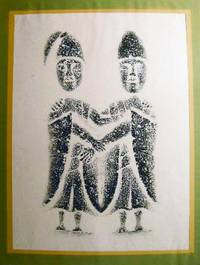
197223967Japan: Otosaburo Moriizumi 1972. 10 rubbings made by Otosaburo Moriizumi; these are printed in black and white on fine thin Japanese paper; each rubbing tipped-on by its corners to a thin cardstock backer and with a dark blue gray or green stiff paper "window" surround; with a 4-sided folding explanatory sheet text in Japanese & English including a brief introduction by Shoji Hamada; with an illustration of Mr. Moriizumi biographical details and information on the rubbings; the author-collector "chose ten lovely carvings found in the Matsumoto district" for this selection; images and titles in Japanese of the images with the dates of creation if known these from 1695 - 1870 - the undated images from earlier times; and with the sizes of the original carvings in cm.; from the author's text: ".We often find a group of three or four naive stone-carved images at the village borders and crossings when we travel along olden ways of Shinano Province. It became popular among farmers to make this sort of stone images from the middle Edo period based on their belief. They prayed for fertility and prosperity by erecting such images representing Buddhist Shinto and folkloric deities. Among them the most prevalent is Dosojin a pair of male and female folkloric gods. They were considered to be patron gods for children and young couples and gods who brought the peace of the village and abundance of crops.Besides these independent images there are stone carvings known as koshin tower. .the relief of Blue-headed Kongo a Buddhist deity as the main image and that of the sun and moon above."; all items loosely contained in a blue paper-covered hardcover folding portfolio with paper title label printed in two colors; the overall size is approx. 15" x 19 3/4"; the art of varying sizes some taking the entire sheet some smaller; the portfolio contained in the original protective cardboard slipcase also with paper title label; some edgewear age-darkening and closed tears to cardstock slipcase; blue portfolio with light wear a few cover scratches; text portion with a little edge-creasing; one of the rubbing plates with a ¾" paper flaw or rub in the background paper; two of the green paper surrounding 'window' mounts with sunning to gold on the inner ½" of the border; the artwork in very good condition; an interesting Japanese folk-art collection iconic imagery. First Edition. Portfolio. Very Good. Otosaburo Moriizumi Hardcover books