KOREA POSTCARD ALBUMBiblio.com

725 résultats
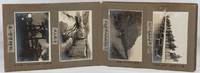
27011701Seoul n.d. ca 1900-1930's.Brown blind-stamp embossed album 34 x 26.5 cm. black pages most are collo-type photos some are hand-colored others are later glossy types all by and large clean all corner mounted in period album. RARE NICE! The album contains 23 pages in all each page with 3 or 4 average per page total postcard count is 76 in all. BEGINNING PAGE: The beginning page shows a "Korean District Governor at out" the a "Bird's-eye view of Seoul" which is a very RARE double photo postcard 2 attached. Then a "View of Seoul City." 1st. page: Begins with a picture of the King's ancient carriage Koka Gate of Shotoku Palace Throne Room and a Korean family of middle class. 2nd. page: Kokamon Seoul Nandimon 3 different photos two with an electric trolley. 3rd. page: The mourning dress man Full dresses two women: Keenan A student 4th. page: Choson Hotel Sin Song guide Game of checkers and three lower class women. 5th. page: The home dress of the Corean gentlemen another gentleman Keenan. 6th. 2 photos of Keenan girls. 7th. The lady going out on carriage. Buffalo vendor fishers house. 8th. The Pagoda Park Seoul 2 each Seoul Korea in Soul. The East Great Gate. 9th. Porters of water a Idol and a carrier Imperial musicians. 10th. Washing clothes in the river 2 each harvest of wheat Corean children collecting Hay. 11th. The front of Custom House Chemulpo Port of Chemulpo. 12th. Street in Seoul Nagate Dori Street of Fusan Corean cottages called Ondoru the middle below this house Chosan. 13th. Suckka Tower Grave of the Monmoo King Buddha statues. 14th. Bool Kuk Temple 2 each Grove of the domestic fowl stone pond. 15th. Chosen hotel Keijo Temple of Heaven in Choson hotel. Boy's school at Chinnampo Methodist Episcopal Mission The Old Korea news agency Korea Government building. The above are all old collotype photos probably from 1900-1915 period some hand-tinted. Next begins other photo postcards probably from the 1930's most are b.w. some color we state "color" in that case. . 16 th. Korean man smoking pipe women looking at a pond Keenan Upper class Korean gentleman. 17th. Royal Assembly Hall Ferry crossing the river Fusan Station color Capitol building. 18 th. White Buddha temple Royal Assembly Hall shows 2 girls. 19 th. City wall and gate Pyong Yang with long penned inscription Korean women weaving and spinning basket seller. 20 th. Water-wheel a firewood carrier carriers of timber. 21 st. Young porter beggar boy. Ferry below the Han River Labor of Corea. 22. nd. 4 color cards: Government of Korea two Keenan girls on the pond Sedan chair Main street Fusan a rendering not a photo card. The collection is superb with great examples of Korean-types people in native costume at daily chores and the sights of Korea its old buildings temples waterways and the like. A keen insight to the land people customs of old Korea and the Japanese administration period. CAPTIONS: Some captions are in English others in Japanese Hangul or Korean. . unknown
19832091502135413933Research Institute of Publishing 1983. Soft Cover. Fine. Volume: 11 Research Institute of Publishing paperback
1923220274Taisho 12 1923. Over fifty black and white photographs annotated laid down in concertina style cloth covered photograph album 18 x 26.5cm most photographs measure 9.3 x 13.5cm nine measure 10 x 7cm. Some silvering of photographs but most are in very good condition. A fascinating concertina-folded album of high-quality photos dating from 1923 and showing Japanese military training exercises in northeastern Korea as well as scenes of everyday life in the surrounding region including the Ranam Cheongjin Hoeryong and Gando areas. Many of the photos appear to have been produced by a professional photographer but acquired by the soldier who has created this album who has added his own annotations based on personal experience. <br> <br>The first photo shows an inset portrait of a soldier named Takuuchi next to the flag of the Japanese Imperial Army's 75th Infantry Division. This is followed by a series of photos of Japanese colonial buildings in Korea including the military base of the 75th Infantry Base an overview of the city of Hoeryong on which the owner has placed a cross in ink marking the location of the recently contructed Hoeryong Shinto Shrine Heoryong's hospital and railway station and a street in the city centre an overview of Cheongjin and a panoramic overview of Ranam City also with the Ranam Shinto Shrine marked with a cross. The attention paid to these shrines which were crucial symbols of Japanese colonial rule emphasises the album creator's nationalist sentiment. There are two images of the landscape of the Tuman River and a photo of sacks of soy beans being unloaded in Gando. Other photos show scenes of everyday life including women washing clothes and grinding grain and two photos of a Korean wedding ceremony. A few of these photos including one of a village of thatched-roofed houses are in a smaller format than the images in the rest of the album and may have been taken by the album's owner himself. Twenty of the photos show 1923 training exercises conducted by the 75th Infantry Division in the Ranam area. These have also been annotated with the album owner's comments providing extra information about the content of the photos. The album concludes with two striking images of thick ice on a river probably the Tuman and of the Hoeryong Shinto Shrine in late evening. . hardcover
19282091502133900057Not Available 1928. Soft Cover. Fine. Volume: 1 Not Available paperback
19382092902143902097Not Available 1938. Soft Cover. Fine. Volume: 1 Not Available paperback
19382092902143802133Not Available 1938. Soft Cover. Fine. Volume: 1 Not Available paperback
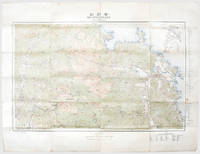
1917167697Tokyo: Rikuchi Sokuryobu 1917. First edition first printing of this bilingual tourist map of Mount Kumgang produced by the nascent Japanese colonial administration in Korea. In the 1910s politicized textbooks for Korean students singled out Fuji and Kumgang as the largest mountains in Japan and Korea while always stressing Fuji's status as the tallest. We have traced a single institutional copy at the National Diet Library. Kumgang was a popular destination for western travellers and naturalists. In 1917 the areas was visited by the legendary plant-hunter E. H. Wilson who discovered two species of maple as well as several new taxa on its slopes. In his notes he wrote how the mountain "drives a photographer to despair for no sooner has he taken one superb view than another seemingly more superb presents itself" quoted by Arnold Arboretum. Colour lithographed map 630 x 820 mm folding away to 209 x 110 mm as issued. Text in Japanese and English. Several contemporary ink circles and annotations. A few small splits along folds not affecting map area old brown paperclip mark a little creasing and soiling. A very good bright example. "1917-1919: Expedition to Eastern Asia" Arnold Arboretum available online. unknown
20062091502133905971Reprint Kress Publishing 2006. Soft Cover. Fine. Number of books: 5 (Reprint) Kress Publishing paperback
19342081002109002311Korea General-General Railway Bureau 1934. Soft Cover. Fine. Number of pages: 236 309p Size: 17cm Korea General-General Railway Bureau paperback
19302111902160200898Governor-General of Korea 1930. Soft Cover. Fine. Number of pages: 30 pages Size: 26.2cmx18.8cm 30p Number of books: 1 Governor-General of Korea paperback
19872091502135418900Not Available 1987. Soft Cover. Fine. Volume: 67 Not Available paperback
19292091502135403750Not Available 1929. Soft Cover. Fine. Number of books: 1 Not Available paperback
19912083002116300068Daigakudo Maruzen 1991. Soft Cover. Fine. The book is in fine condition. Daigakudo Maruzen paperback
19732091502135420913Hara shobo 1973. Soft Cover. Fine. Number of books: 2 Hara shobo paperback
1956215131956. African American Military History Korean War Unidentified photographer African American soldiers in South Korea 1956 documents Black military service within the early post armistice U.S. occupation of Korea and provides visual evidence of desegregation in practice following Executive Order 9981. Produced three years after the Korean Armistice Agreement the images situate African American enlisted men within the operational landscape of U.S. military engineering and logistical support during the Cold War consolidation of American presence on the Korean peninsula. The archive documents the role of Black soldiers in infrastructure maintenance transport and base security while also recording their proximity to Korean civilian life in a recovering war zone. The identification of the 376 Engineer Battalion places the material within the institutional framework of the U.S. Army Corps of Engineers whose work underpinned military mobility and reconstruction during this period.<br /> <br /> South Korea 1956. Archive of 22 black and white silver gelatin photographs most measuring approximately 5 x 4 inches depicting African American soldiers stationed near a U.S. military installation likely in the Uijeongbu or Dongducheon corridor north of Seoul where engineering and support units were concentrated. Multiple images include signage identifying the "376 Engineer Battalion" while others show mixed-race groups of soldiers gathered near convoys of M35 2½ ton cargo trucks and smaller support vehicles used for personnel and supply transport. One photograph includes a Fairchild C-119 Flying Boxcar aircraft in the background confirming the logistical environment of cargo movement and aerial supply. Soldiers appear in standard issue fatigues with visible non commissioned officer insignia engaged in routine duties such as transport checkpoint supervision and base operations. Several photographs depict Korean civilians moving through nearby marketplaces and village spaces including women wearing traditional hanbok passing through areas of visible economic strain characterized by unpaved roads and temporary structures. English and Hangul signage including a storefront labeled "Kind Shop" further situates the images within a localized commercial environment shaped by U.S. military presence.<br /> <br /> The archive documents a transitional period in both U.S. military policy and Korean society as the formal desegregation of the armed forces intersected with the realities of overseas deployment in a recently devastated region. While integrated units are visible the clustering of Black soldiers within shared duties and informal groupings indicates the persistence of racialized social structures within the ranks. At the same time the photographs establish the everyday presence of American troops within civilian Korean spaces during early Cold War reconstruction linking military labor to broader geopolitical objectives in East Asia. Light surface wear including minor creasing and scattered abrasions; images remain clear with strong contrast. Overall very good condition. A cohesive visual record of African American military labor postwar occupation and cross cultural contact in Korea during a formative phase of U.S. global military expansion. unknown
19232082702114905137Korean Police Association 1923. Soft Cover. Fine. Number of pages: 189 pages Size: B6 size Korean Police Association paperback
19102090202122900525Daiichiginko 1910. Soft Cover. Fine. Number of books: 1 Daiichiginko paperback
1997BN125803I.E.E.E.Press 1997. 1997. Hardcover. 1997 IEEE International Conference on Properties & Applications of Dielectric Materials Conference Record International Conference on Properties and Applications of Dielectrics Materials <br/><br/>1997 IEEE International Conference on Properties & Applications of Dielectric Materials Conference Record International Conference on Properties and Applications of Dielectrics Materials International Conference on Properties and Applications of Dielectric Materials 5th : 1997 : Seoul Korea I.E.E.E.Press hardcover
19372091502135416580Not Available 1937. Soft Cover. Fine. Number of books: 1 Not Available paperback
19082091502135406572Not Available 1908. Soft Cover. Fine. Number of books: 1 Not Available paperback
19372091502135501205Korea Sinuiju Chamber of Commerce 1937. Soft Cover. Fine. Number of pages: 107p151p Size: B5 size 19x26 cm Number of books: 2 Korea Sinuiju Chamber of Commerce paperback
19372091502133905820Not Available 1937. Soft Cover. Fine. Volume: 1 Not Available paperback
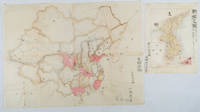
1902220266Japan. No date. Circa1902. Two very attractive colour folded manuscript maps one showing China and the other Korea. <br> <br>Map of China: Watercolour map 48 x 63.5cm. Closed tear now professionally repaired. <br> <br>Map of Korea: Finely detailed watercolour map a few tiny holes very neatly repaired on the verso with archival washi. 33 x 24.5cm Two delicate hand-painted maps one of China and one of Korea produced by a Japanese student cartographer named Koike Tokushige 小池徳重. <br> <br>The undated map of China appears to have been produced in the first five years of the twentieth century: a time when Japan had recently colonized Taiwan and when Japanese economic and political interest in the region was rapidly expanding. The inscription on the map suggests that it was a third year college project. But the high level of detail suggests that the artist had considerable experience of map making. The map of China shows the main provinces rivers major transport routes the Great Wall and the location of key cities although the names of the cities are not included. It also shows outlines of the Korean Peninsula Taiwan and the Japanese island of Kyushu but not the rest of Japan. <br> <br>The map of Korea is more detailed. It provides an accurate outline of the Korean Peninsula with careful hatching indicating changes in elevation. Rivers and major road routes are shown on the map and the locations of major towns are marked though only Busan and Incheon are named. Dotted lines show coastal sea routes and routes between Kyushu and Busan and between Incheon and China. The map shows the Gyeongin railway line between Seoul and Incheon which was completed in 1899 and route of the Gyeongbu railway line between Busan and Seoul whose construction started from both ends in 1901. But the map depicts only small sections of this line close to Seoul and Busan as being completed with the rest more lightly outlined to show the projected route implying that the map was drawn around 1901-1902 and certainly before the Gyongbu line was opened in 1904. <br> <br>Inserted text gives the land area and population of Korea. Rather strangely though the figure given for the Korean population is vastly underestimated. Ikeda gives this as 5.7 million when in fact at that time is was around 18 million. . unknown
19362083002115803779Fuchuu-won Governor-General of Korea 1936. Soft Cover. Fine. Volume: 1 Fuchuu-won, Governor-General of Korea paperback
19372091502135403775Not Available 1937. Soft Cover. Fine. Number of books: 1 Not Available paperback