2 084 résultats
38009901Korea late 18th-early 19th century 1780-1810. Eight color gouache pastel tinted maps ca. 57.5 x 90.1 cm.contemporary re-backing very solid clean examples complete set of all provinces hand-painted gouache manuscripts. RARE & OBSCURE . . . . A RARE & COMPLETE SET OF ANTIQUARIAN MANUSCRIPT KOREAN . . . YI PERIOD PROVINCIAL MAPS . . "P'ALTO CHIDO" OR "EIGHT PROVINCES MAPS" . . . DELUXE ELEPHANT FOLIO SIZE SHEETS . . . HAND-COLORED GOUACHE PASTELS . This is a very RARE & COMPLETE set of eight Korean provincial manuscript maps. Drawn circa 1780-1810 by an unsigned Korean cartographer. These maps are of historical importance giving place names isolating the time frame. . Painted on very thin finely hand-made mulberry-fiber tissue paper contemporary re-backed with a stiff hand-made paper. Beautifully hand-painted & colored in gouache pastels. . The record shows several reliable verities of manuscript maps showing the eight ancient Korean provinces. . Commonly these maps had no title cartographer's name date or other critical bibliographic colophon data. This is a common theme with Korean manuscript maps. . Political divisions of Korea are by and large mostly stable making name comparisons easier. . PROBABLE MAP TITLES INCLUDE: . a. The "SINJUNG-TONGGUK-YOJI-SUNGNAM:" "EIGHT SEPARATE MAPS EACH SHOWING ONE COMPLETE PROVINCE OF THE EIGHT KOREAN PROVINCES similar in intention to the "P'ALTO CHIDO." . The eight provinces were established during the Chosen dynasty 1392-1910 alternately and commonly called the Yi dynasty. . The eight provinces are from the north to south: . 1. Hamgyong 2. P'yong'an 3. P'yongyang 4. Kangwon 5. Hwanghae 6. Kanghwa 7. Kyongsang 8. Cholla'ungch'ong . During the Sejo reign 1455-68 Yang Songji made the first "P'Alt-do "P'ALTO CHIDO" type maps of the eight provinces this type and style became the "standard" for future examples. There after his style and format were copied by others for centuries. . b. A second version and style of the above eight provinces maps is called "TONGGUK CHIDO: MAP OF THE EASTERN COUNTRY i.e. KOREA" showing a compressed northern frontier along Manchuria the characteristic "CHONG CH'OK" style. . c. A third similar map: "P'ALDO-CHONGDO: A SINGLE MAP SHOWING THE EIGHT PROVINCES OF KOREA." . These maps are pictorially beautiful and artistically drawn in detail. Graphics expressing a primitive naive folk charm depicts prominent geological landscape features. Mountain ranges hills forests in green streams/rivers blues political district seats distinctively painted cartouches box-like in various differing colors for each province. Roads paddy coastal shore line & islands in blue tints with other features nicely colored. . There are a large number of name throughout each map all written in Hanzi traditional Chinese characters called "Hanja" in Korean as was the common practice at that time for Koreans. There are no Hangul characters at all. The Hanja identify navigational directions names of surrounding ocean harbors beaches geographical names city towns villages mountains rivers roads and the like. . Each of the eight maps illustrates a complete single province. Within each of the various political divisions and boundaries outlined and named. . RARITY OF KOREAN ANTIQUITIES: Antiquarian Korean examples are sparse when compared to items of the same period in China and Japan. Korean works are less than 10% of those created elsewhere. . Fewer Korean items were made survived and preserved. The attrition rate: bad weather unstable ancient mud building structures fires natural disasters earthquakes war and other factors diminished the remaining examples. . Those the numbers that come to marked are steadily reduced while the value continues to appreciate. Many never return to market when acquired by institutions or private collectors who eventually donate to museums. . DATING THESE MAPS: These were mostly undated. . There are three possible methods of dating. . a. BY PLACE NAME: there are details in the reference books about county seat names being colored or put in various kinds of 'boxes' on the map depending on that according to the resources approximate dates can be derived. . b. PAPER TECHNOLOGY & FIBERS: Koreans have been using hand-made mulberry bark and fiber paper from the Zhenguan period AD 627-649 printing Buddhist sutras by woodblocks on similar kinds of paper. . These two technologies papermaking and woodblock printing was transmitted to Japan around 700 AD. . Since that time both Koreans & Japanese have utilized mulberry paper Washi in Japanese to woodblock print and paint a large variety of items including maps books and single page works. . By comparing the paper of these maps with known dated printed Japanese books a very close approximate date can be derived. . These Korean map papers are nearly identical to dated woodblock-printed Japanese examples we have. It is therefore highly possible these maps were painted on hand-made mulberry paper from circa 1780-1810 period. . In ancient times sheet size was limited to a small size then joined to other sheets to create a large size single sheet. These maps are of that format. See McCune below where he states the kind of paper used which matches our examples. . CONDITION: Per McCune we summarize: as usual these maps were folded several times from their creation time so they could be safely stored and carried in small 'book' format in covers with a tied string. See McCune below. . Being painted on very fine & thin hand-made mulberry paper most all examples were eventually re-backed. Ours as typical have period re-backing using the same character hand-made mulberry fiber paper of a thicker quality. . They are well preserved however nevertheless as usual there remains some old original wear at the folds the expected light water stains dustiness with other typical very minor flaws for an item of this grand size being 200 years old. These do not detract from the overall excellent impression and stunning appeal. . RARITY: . The complete set is RARE! The work is nicely executed in a firm hand with artistic value illustrating artistically hills mountains and other features of the map pictorially. It is not only a map but a work of art. Tastefully colored in subtle pastels nice representation of water rives and sea. . Such early and beautifully artistic examples seldom come to market. . A RARE AND FRESH EXAMPLE NEVER BEEN ON THE MARKET IN THE LAST 120 YEARS ! . PROVENANCE: These items were acquired from a former missionary's estate who was stationed in Korea from circa 1900-1930's. They have been in this private collection since and have never been on the market. . Color scans are posted to our website. . REFERENCES: . TOOLEY Ronald V. et al.: Article: Shannon McCune: SOME KOREAN MAPS pp.70-102 with illustrations. McCUNE Shannon.: KOREAN MAPS OF THE YI DYNASTY KOREAN CULTURE Korean Consulate General L.A. Ca. Sept. 1983 pp.21-31 34 back cover color plate color & b.w. illustrated. . He discusses "P'ALTO CHIDO""EIGHT PROVINCES MAP" origins maps without scale and were copies of a Korean scholar named Won his title was: Haksaeng works based on Chong Ch'ok's 1390-1475 TONGGUK CHIDO MAP OF THE EASTERN COUNTRY then modified by Won to be the more typical "P'ALTO CHIDO" "EIGHT PROVINCES MAP" but in his new style. This new style clearly resembles our maps in layout format color of county seats and similar boxes around them and other critical details. KOREAN CONSUL GENERAL KOREAN CULTURE September 1983 pp.21-31 34 color map on back cover color and b.w. illustrated. . It was from these maps that the later versions similar to ours eventually emerged mostly by Imperial Order by the ".Yi Dynasty court specifically decreed that both magistrates and governors should prepare up-to-date maps of their territories udder their supervision." p.25. HARLEY J.B. ed. et al.: CARTOGRAPHY IN THE TRADITIONAL EAST AND SOUTHEAST ASIAN SOCIETIES. Ahead of Title: THE HISTORY OF CARTOGRAPHY Vol. 2 Book 2 an excellent article by Gari Ledyard: CARTOGRAPHY IN KOREA pp. 235-345239 figures 10.23 10.24 et al. NAKAMURA Hiroshi.: EAST ASIA IN OLD MAPS. . --. NIHON KO CHIZU TAISEI: GREAT COLLECTION OF OLD JAPANESE MAPS MONUMENTA CARTOGRAPHICA JAPONICA . --. OLD CHINESE WORLD MAPS PRESERVED BY THE KOREANS. Article in IMAGO MUNDI IV 1958. LEE Chan. CH'AN Yi.: OLD MAPS OF KOREA. Han'guk ko chido. By: Ch'an Yi Hong-gyu Che Han'guk Tosogwanhak Yon'guhoe. He discusses and illustrates a good number of similar examples. On pp.226-27 he outlines an early Yi Dynasty example of: THE MAP OF EIGHT provinces found in TONGGUK YOJI SUNGNAM Chong Sang-gi's Tongguk Chido. These manuscripts were on large paper one province per sheet. Many other fine related examples are illustrated & discussed. . --. OLD MAPS OF KOREA: HISTORICAL SKETCH. He traces the early origins of Early Yi dynasty1392-1910 Eight Provinces Map origins and progressions excellent lucid article with illustrations and references to Yi HOE's MAP OF EIGHT PROVINCES. Excellent essay on provincial maps. SHIN Michael D. ed.: KOREAN HISTORY IN MAPS: From Prehistory to the Twenty-First Century. British Museum similar examples cited: commons-wikimedia-org/wiki/Category:Room_67_British_Museum# /media/File:Map_of_the_Jeolla_Province_British_Library_c.27. f.14_fol.12_n02.jpg Library of Congress: Young Il Kim: dong-kookyu-do: A RECENTLY DISCOVERED MANUSCRIPT OF A MAP OF KOREA. Imago Mundi vol.21 1967 pp.31-49 illustrated. . . unknown
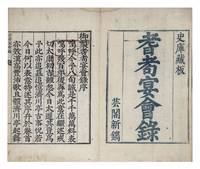
11384. 1 46 folding leaves. Small folio 346 x 227 mm. orig. yellow semi-stiff wrappers lightly rubbed title in manuscript on upper cover old stitching. HansÅng: Un'gak 1773.<br /> <BR> <BR> First and apparently only printing of the official record of "linked songs" composed at the royal banquet of elders on the occasion of King YÅngjo's r. 1724-76 80th birthday in 1773 printed the day after the banquet and presented to its guests. The title is not in WorldCat or KORCIS; we locate only two other copies both in Korea.<br /> <BR> <BR> In the intercalary third month of the 50th year of his reign King YÅngjo - the longest reigning monarch in ChosÅn history - held two birthday banquets within the KyÅnghÅigung 慶熙宮 palace complex. According to the colophon the first was a banquet of high-ranking officials held at the SungjÅng Hall 崇政殿 on the first day of the month. The second which took place a day later was a gathering of elders at the Kimsang Gate 金商門 "to reminisce about the events of the kingdom's past." The suggestion for these banquets came from the Grand Heir wangseson çŽ‹ä¸–å« enthroned as King ChÅngjo in 1776 and was accepted by King YÅngjo only reluctantly. The high-ranking official SÅ MyÅng-Ång å¾å‘½è†º 1716-87 who composed the colophon describes the festive banquet of elders as follows:<br /> <BR> <BR> "On this day the rain ceased and the sky cleared. A gentle breeze blew softly. Looking up at the throne one saw the King standing tall beneath the colorful canopies the table to his left and staff to his right. Looking down at the banquet hall one saw white-haired elders and toothless seniors their faces glowing amidst the delicacies. When the bells and drums were about to sound and the cups were not yet raised the elderly commoners delighting in this joyous gathering cast aside their staffs and rose to dance. Stooping and stumbling they advanced forward while shouting: 'May the King live a thousand years!'"<br /> <BR> <BR> King YÅngjo smiling at this sight composed a short verse that invoked the famous Song of Great Wind Ch. dafeng ge å¤§é¢¨æŒ of Liu Bang 劉邦 256-195 B.C.E. the first king of the Han dynasty likewise written during an auspicious gathering of elders. He then asked the Grand Heir and other officials at the banquet to each compose a song echoing his own in three enneasyllabic lines ending with the sinographs sul è¿° baek 百 and Åk å„„ respectively. The sequence of "linked songs" thus composed - together with the names and positions of their authors - were collected and printed to ensure the longevity of their transmission. The colophon continues<br /> <BR> <BR> "King Gao of the Han in the prime of his life happily celebrated with the elders of his village. This was of course a common occurrence. Yet he did not know that throughout the four quarters of the realm ritual and music take precedence; instead he was preoccupied with recruiting fierce warriors.Now our sovereign achieving the seniority of Yao and Shun observes the flourishing rites of Yu and Xia. The sagely ruler honors the longevity of his subjects and his subjects likewise revere the longevity of the sage ruler. This is truly something unheard of among the rulers of the Han and Tang dynasties."<br /> <BR> <BR> SÅ MyÅng-Ång believes that the format of linked songs which brought together King YÅngjo and his subjects through reciprocal "winds of transformation" K. p'unghwa 風化 elevated this Korean banquet above its various Chinese precedents and into closer proximity to the sagely rites of old. Writing on the transregional tradition of linked songs in East Asia Amy Y. Zhang observes the "ubiquitousness of linked verse as a potential means of constructing defining and negotiating community" and when adapted by the Korean monarchy it became "a way to cultivate harmonious relations with his subjects and to ensure continued prosperous rule"-Zhang "Writing Communities into Being: The Art of Linked Verse" PhD diss. Harvard 2025 pp. 243-44.<br /> <BR> <BR> Based on the presentation inscription on the front endpaper in our and another copy see below the woodblocks for the Record were likely carved overnight so that imprints could be distributed to guests of the banquet the next day "the third day of the intercalary third month of the 38th year of the Qianlong reign." The title-page states that the woodblocks were carved at Un'gak 芸閣 i.e. the kyosÅgwan æ ¡æ›¸é¤¨ the royal printing house and kept within the royal archives K. sago å²åº«. Our copy was presented to Sin U-sang 申禹相 1730-99 the Assistant Director of the Ministry of War K. pyÅngjo chwarang 兵曹ä½éƒŽ whose name together with the song he had composed at the banquet appears on f. 36r of the Record. Facing the title-page and on the first leaf of the royal Preface is the Seal of Presentation K. naesa'in å…§è³œå° which reads sÅnsajigi 宣賜之記. The oldest of five seals of presentation used throughout ChosÅn history the sÅnsajigi seal appears in royal presentation copies from 1534 to 1778 as Lee & Song demonstrate in "A Study on Naesabon Preserved in Kyujanggak" in Journal of Korean Library and Information Science Society 43 no. 2.<br /> <BR> <BR> The title though recorded in traditional Korean bibliography is not in WorldCat or KORCIS. We locate only two other copies one held at the Academy of Korean Studies in SÅngnam call no. MF35-2211 and the other at the Sudang kot'aek ä¿®å ‚å¤å®… residence of the Yi clan in Yesan. The front endpaper of the Academy of Korean Studies copy is not digitized while the Sudang kot'aek copy bears a similar royal presentation inscription dated to the same day as our copy. It was presented to Yi Su-il æŽç§€é€¸ 1705-79 whose composition is recorded on f. 30r-v.<br /> <BR> <BR> Excellent copy a few leaves lightly stained on upper corner. unknown
19292091502135421944Not Available 1929. Soft Cover. Fine. Volume: 56 Not Available paperback
17473878FBRostock, Verlag Christian Koppe, 1747-1749. 4°. 26,5 x 21,5 cm. [1] Blatt, 58, 472 Seiten; [1] Blatt, 56, 748; 28 Seiten, [2] Blatt, 548; 56, 264, 552 Seiten, [16] Blatt. Ganzlederbände der Zeit auf 4 Zierbünden mit Streicheisenlinien auf den Deckeln und rotem Sprengschnitt. [12 Warenabbildungen]
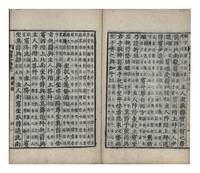
7461Two parts in one vol. Small folio orig. wrappers somewhat tired & a little soiled some light staining & soiling here & there manuscript title on upper cover later stitching. Hansong Seoul: Kyujanggak the Royal Library Preface dated 1793 & 1796.<br /> <P> First edition of this handsome and large-format 323 x 217 mm. royal publication. King Chongjo 1752-1800 was one of the most intellectual and enlightened of the Korean monarchs. Perhaps Korea's greatest bibliophile as royal patron he supported all aspects of the book: typographers printers authors librarians and lexicographers. A number of "royal" editions were published under his auspices. He founded the Kyujanggak Library in 1776 now part of the library of the Seoul National University.<br /> <P> "The official rhyming dictionary of Chinese characters compiled under the supervision of King Chongjo and engraved in 1796. The arrangement is different from the usual Korean system in that instead of three rows of characters in the same rhyme there are four rows with the ipsong characters distributed in the bottom row."-Fang The Asami Library. A Descriptive Catalogue 12.3.<br /> <P> The main compiler of this work was the reformer Tong-mu Yi 1741-93 who had travelled to China and was an important member of the Northern Learning School. This group of intellectuals recognized the practical benefits of commerce and technology and urged the modernization of Korean society. Yi was appointed by King Chongjo as one of the famed four editors of the Royal Library overseeing the publication of books.<br /> <P> A very nice copy. unknown books
7461Two parts in one vol. Small folio orig. wrappers somewhat tired & a little soiled some light staining & soiling here & there manuscript title on upper cover later stitching. Hansong Seoul: Kyujanggak the Royal Library Preface dated 1793 & 1796.<br/> <br/> First edition of this handsome and large-format 323 x 217 mm. royal publication. King Chongjo 1752-1800 was one of the most intellectual and enlightened of the Korean monarchs. Perhaps Korea’s greatest bibliophile as royal patron he supported all aspects of the book: typographers printers authors librarians and lexicographers. A number of “royal†editions were published under his auspices. He founded the Kyujanggak Library in 1776 now part of the library of the Seoul National University.<br/> <br/> “The official rhyming dictionary of Chinese characters compiled under the supervision of King Chongjo and engraved in 1796. The arrangement is different from the usual Korean system in that instead of three rows of characters in the same rhyme there are four rows with the ipsÅng characters distributed in the bottom row†Fang The Asami Library 12.3.<br/> <br/> The main compiler of this work was the reformer Tong-mu Yi 1741-93 who had travelled to China and was an important member of the Northern Learning School. This group of intellectuals recognized the practical benefits of commerce and technology and urged the modernization of Korean society. Yi was appointed by King ChÅngjo as one of the famed four editors of the Royal Library overseeing the publication of books.<br/> <br/> A very nice copy.<br /> <br> <br> References<br /> <br> <br> Fang Chaoying. The Asami Library: A Descriptive Catalog. Edited by Elizabeth Huff. Berkeley: University of California Press 1969. unknown
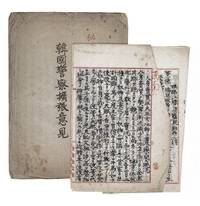
1116770 folding leaves all roughly 250 x 170 mm. Korea: mostly dated between 1910 and 1913.<br /> <BR> <BR> This fascinating collection comprises a series of handwritten administrative and case notes pertaining to police spying activities regulations and security planning in colonial Korea under Japanese rule. The documents were prepared by operatives in the Police Bureau of the Government-General of ChosÅn .<br /> Our documents are diverse in scope ranging from operational details such as surveillance and sentry procedures at the Amnok River Bridge 鴨緑江橋 the natural border between North Korea and China today accompanied by a folding colored map of the river oversight of local shrines and temples investigations into human trafficking and the abduction of women and civil police deployment plans covering major port cities. <br /> <BR> <BR> Certain entries are dated and bear the personal annotations of Akashi Motojiro who served as Chief of Police in the Government-General of ChosÅn and later became Governor-General of Taiwan. His contributions include a "Proposal to Expand the Ethnic Korean Police" marked "secret" and dated December 1911 as well as memoranda documenting statistics and tallies of Japanese and Korean police officers as of October 1912. Akashi's involvement underscores the significance of these notes for understanding the structure and priorities of the colonial police.<br /> <BR> <BR> Japan's formal annexation of Korea in 1910 inaugurated a colonial regime 1910-45 that employed its police force to maintain public order suppress dissent enforce new regulations and monitor civil society - overseeing everything from resident registration and religious activities to labor and public health. While the "military rule" of the 1910s gave way to a "cultural rule" with some reforms after 1919 police surveillance and public-security operations continued as fundamental mechanisms of control. This collection offers an extremely rare perspective on both the daily operations and the broader institutional planning of Japanese colonial policing.<br /> <BR> <BR> Fine condition. unknown
20212081502111906550Shanghai Dictionary Publishing House 2021. Soft Cover. Fine. The book is in fine condition. Shanghai Dictionary Publishing House paperback
20222081502111905065Shanghai science and technology literature 2022. Soft Cover. Fine. The book is in fine condition. Shanghai science and technology literature paperback
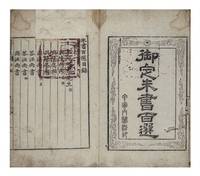
11191. 1 p.l. 4 25 34 29; 37 30 28 folding leaves. Six kwÅn in two volumes. Small folio 360 x 223 mm. orig. wrappers some wear & rubbing handwritten title on covers orig. stitching. HansÅng: Kyujanggak ca. 1799.<br /> <BR> <BR> A royal gift presented by the king of Korea. In 1794 King ChÅngjo 1752-1800 of the ChÅson dynasty compiled and had printed a collection of the letters of the great Neo-Confucian philosopher Zhu Xi 朱熹 1130-1200 to be disseminated throughout his kingdom. As King ChÅngjo wrote on this occasion “the learning of Master Zhu in its expansive and oceanic plentitude is best represented by his collected writings; the writings of Master Zhu in their utmost subtlety and precision are best represented by his personal correspondences†“ChusÅ paeksÅn yukkwÅn†朱書百é¸å…å· in Hongjae chÅnsŠ弘齋全書 Collected Writings of King ChÅngjo kwÅn 180. Drawing from a number of established collections he selected 100 letters and carefully arranged them “beginning with the letter to Yanping 延平 i.e. Li Tong æŽä¾— 1093-1163 Zhu Xi’s teacher to pronounce his lineage of instruction and ending with the letter to Zhiqing ç›´å¿ i.e. Huang Gan 黃干 1152-1221 Zhu Xi’s disciple to demonstrate the bestowment of teachings.â€<br /> <BR> <BR> That 1794 edition with moderate marginal annotations on “personal and place names as well as philological glosses and references†was sent to be printed with the chÅngyuja ä¸é…‰å— metal type cast in the year 1777. Printed copies were sent to various official printing houses throughout the kingdom and used as models to carve woodblocks for a xylographic edition ibid. Sometime around 1799 realizing that in the capital only metal type copies of the book remained the king ordered woodblocks to be made locally as well for the work so that more copies could be printed and distributed ChÅngjo “Sinin ogyÅng…†新å°äº”經… in Hongjae chÅnsÅ kwÅn 36.<br /> <BR> <BR> Most woodblock re-editions of this work retain the original title-page which contains not only the title Royal Edition of a Hundred Selected Letters of Zhu K. ÅŽjÅng chusÅ paeksÅn å¾¡å®šæœ±æ›¸ç™¾é¸ but also the inscription in seal script that reads ç”²å¯…å…§é–£æ´»å° â€” “palace edition printed with movable type in the kabin year 1794.†This title-page compounded with the absence of any additional paratextual information likely resulted in the description of these woodblock re-editions as the original metal type 1794 edition in spite of lacking the features of metal typography.<br /> <BR> <BR> We have carefully examined our copy and found that it was likely printed with the woodblocks carved around 1799 undoubtedly through the cannibalization of a typographic copy and kept within the royal library. Certain qualities of our copy make it distinctive: not only are the cursive characters rendered with impressive clarity the marginal annotations mentioned in King ChÅngjo’s edict are also preserved in faux-manuscript style — a feature absent in some other copies we have consulted erroneously described as the 1794 edition.<br /> <BR> <BR> The best evidence that our copy was printed by the royal library K. kyujanggak å¥Žç« é–£ of course is the fact that it was a royal gift K. naesabon 內賜本 presented by the king himself to notable officials or individuals in this case an examinee from SuwÅnbu 水原府. The “Record of Presentation†K. naesagi 內賜記 is handwritten on the front endpaper of the first volume as usual and is dated to the second month of Xianfeng 5 1855. However both the name of the recipient and the official responsible for the Record have been obscured. A name Im HÅi-ji 林熙之 is written next to the name of the recipient but in a clearly different hand and ink. Records of the Royal Secretariat K. SÅngjÅngwÅn ilgi 承政院日記 states that on the 29th day of this month copies of the Hundred Selected Letters were indeed bestowed to six examinees but all their names are not given.<br /> <BR> <BR> On the first leaf of the table of contents and facing the title-page is the Seal of Presentation K. naesa’in å…§è³œå° which reads å¥Žç« ä¹‹å® Treasure of the Kyujanggak. This seal was used for presentation copies roughly between 1782 and 1894 as shown by Lee & Song in “A Study on Naesabon Preserved in Kyujanggak†in Journal of Korean Library and Information Science Society 43 no. 2.<br /> <BR> <BR> This book is rare outside of East Asia. We find three copies under WorldCat 35891835 with a misspelled title and described as the 1794 edition on account of the aforementioned title-page which our copy also possesses. None of them is described as a presentation copy.<br /> <BR> <BR> Very good set. Some occasional soiling and dampstaining. Unimportant worming mostly marginal.<br /> <BR> <BR> ⧠King ChÅngjo Hongjae chÅnsŠ弘齋全書 in Han’guk munjip ch’onggan 韓國文集å¢åˆŠ digital access via krpia.co.kr. unknown
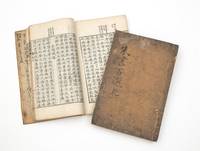
889392.5; 95 folding leaves. Two vols. Small folio orig. yellow-brown patterned wrappers some soiling to wrappers old stitching. ChÅnju today’s Jeonju: 1795 or possibly later.<br /> <BR> <BR> A selection of 100 letters written by Zhu Xi 1130-1200 the great synthesizer of the philosophical school known as Neo-Confucianism. Zhu Xi who lived in southeastern coastal China far from the center of power became extremely influential in East Asia for centuries following his death. His interpretation of Neo-Confucianism a metaphysically argued philosophy of the self the family and the state became official orthodoxy in late imperial China and ChosÅn Korea promulgated largely through the civil service examination system. However there were challenges to its primacy from intellectuals especially from the 18th century onward.<br /> <BR> <BR> “In the opinion of many historians the Song’s preeminent philosopher Zhu Xi outshined Confucius himself. He was the only person in Chinese history apart from Confucius and Mencius whom the official hagiography addressed as Master†Kuhn The Age of Confucian Rule 103.<br /> <BR> <BR> Given Zhu Xi’s standing in Korea several collections of excerpts from his works were published beginning in the 16th century. On account of its authorship Royally Authorized Selection of One Hundred Letters by Zhu Xi became one of the most widely circulated such collections for the last century of the ChosÅn period. According to the court chronicle the culturally ambitious King ChÅngjo 1752-1800 himself made the selection on the basis of Zhu Xi’s collected works a voluminous oeuvre that numbered 2354 pieces of writing in one scholar’s recent count. Text-critical notes e.g. on place names personal names official titles and expressions that might be unfamiliar to Korean readers were then added by four high civil officials which were printed in the upper margin of the text.<br /> <BR> <BR> The book was finished on the 25th day of the 12th month of the 18th year of ChÅngjo’s reign Qianlong 59 which corresponds to 15 January 1795. While most of the 18th year corresponds to 1794 it is incorrect to date the book to that year. The book was first printed in Seoul with metal movable type — the so-called chÅng’yu cha ä¸é…‰å— set of type cast in 1777 the chÅng’yu year when ChÅngjo ascended the throne. Further editions were subsequently published at several provincial offices using woodblocks intended for wide dissemination among the educated elite.<br /> <BR> <BR> Our copy belongs to one of these provincial woodblock editions. The title-page says Ålmyo wanyÅng kan’in ä¹™å¯å®Œç‡ŸåˆŠå° meaning that it was printed in 1795 the Ålmyo year in the provincial government offices at ChÅnju Jeonju in what is now southern South Korea. However it is possible that the actual copy was struck later than that date as the blocks remained on the site. They were moved to the local official Confucian school in 1899 where they remain today.<br /> <BR> <BR> Fine set of a very rare book. Minor staining and soiling at beginning and end of each volume.<br /> <BR> <BR> ⧠WorldCat accession number 874756267.<br /> <br> <br> <br /> References<br /> <br> <br> Kuhn Dieter. The Age of Confucian Rule: The Song Transformation of China. Cambridge: Mass.: Harvard University Press 2011. unknown
2091502135500199Not Available N.A. Soft Cover. Fine. Size: B5 size Not Available paperback
1797111991797. Woodblock-printed. 4 1 16 39; 40 33 2 folding leaves. Three kwÅn in two volumes. Small folio 341 x 216 mm. orig. semi-stiff patterned wrappers handwritten title on upper covers old stitching. HansÅng: Chujaso Preface dated 1797.<br /> <BR> <BR> Very rare Korean collection of community rituals K. hyangnye 鄉禮 compiled by and printed for the King of Korea. We find no copy in Korea and only three copies in WorldCat Berkeley Columbia and Harvard.<br /> <BR> <BR> The reign of King ChÅngjo of Korea r. 1776-1800 witnessed a shift in the sovereign’s role in relation to Confucian teachings. “ChÅngjo sought to formulate the sage-king as an active ruler who instructed his ministers rather than received instruction from them was directly involved in the administration of the state and exercised discretion when and how he in his sagely wisdom deemed fit.â€â€“Christopher Lovins King ChÅngjo SUNY: 2019 p. 29. As the guardian and propagator of Confucian learning he oversaw various editorial and printing projects carried out by the royal publishing house the Chujaso é‘„å—所.<br /> <BR> <BR> The compilation and publication of the Collected Community Rituals reflected King ChÅngjo’s belief that a king’s ritual transformation of his people must begin at the local level. The Collected Community Rituals opens with the royal edict dated 1797 followed by a list of community ritual records compiled throughout Chinese and Korean history. The bulk of the work is devoted to the rituals of the banquet and archery competitions followed by coming-of-age K. kwanrye å† ç¦® and marriage rituals. Detailed interlinear commentaries were compiled by scholars of the Kyujanggak å¥Žç« é–£ the Royal Library of the Korean court under the leadership of Yi PyÅng-mo 1742-1806. Their names are listed at the end of volume two.<br /> <BR> <BR> The original printing used the chÅngyuja ä¸é…‰å— kabinja style of movable metal type of 1777 and copies were distributed to localities throughout Korea. They were also sent to regional governmental printing houses where they were cannibalized to produce woodblocks for further printing. <br /> <BR> <BR> Nice set preserved in a jil. Our copy also has prayers for ancestral mountain and land deities as well as instructions for offering rites all handwritten in black ink on the endpapers. Red leaf-shaped seals on the first leaf of both volumes read 逸民山水 .<br /> <BR> <BR> ⧠Asami Library 4.14. King ChÅngjo Hongjae chÅnsŠ弘齋全書 in Han’guk munjip ch’onggan 韓國文集å¢åˆŠ digital access via krpia.co.kr. unknown
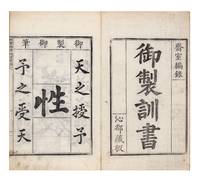
942941 folding leaves. Large 8vo 337 x 206 mm. orig. semi-stiff wrappers new stitching. Korea: Simdo æ²éƒ½ 1756.<br /> <br> <br> <br /> First edition and rare; WorldCat lists only one printed copy at Berkeley. This book of exhortations on good government with striking royal calligraphy was written by King YÅngjo or Yeongjo of ChosÅn 1694-1776 in 1756. At this time YÅngjo was commemorating the death of his father the previous king. According to Fang Chaoying 1908-85 YÅngjo then in his 65th year “could not foresee that he was to live twenty more years and so it appears that he was trying to justify himself in his own mind with regard to posterity as well as to the ancestors whom he expected to face any day†The Asami Library 115. YÅngjo offered three main principles for a king to follow: “to venerate Heaven to love the people and to treat the officials with respect†ibid.<br /> <br> <br> Large standard script characters written by the king himself are reproduced in the beginning of the book. The king’s brush records Confucian assertions such as “the following of human nature is called the Way / the cultivation of the Way is called instruction.†Accepting the Mencian dictum that human nature is inherently good the king continues: “I possess the good human nature / to realize the bright mandate of Heaven.â€<br /> <br> <br> The main text of the book is reproduced in the handwriting of the important scholar-official SÅ MyÅng-Ång or Seo Myeong-eung å¾å‘½è†º 1716-87. SÅ wrote in many genres and had a cosmopolitan outlook. For example he wrote a Preface to one of the major multilingual lexicographical works produced in ChosÅn in the 18th century see Söderblom Saarela “Mandarin over Manchu†379-80.<br /> <br> <br> Very fine and fresh copy beautifully printed.<br /> <br /> <br> <br> References<br /> <br> <br> Fang Chaoying. The Asami Library: A Descriptive Catalog. Edited by Elizabeth Huff. Berkeley: University of California Press 1969.<br /> <br> <br> Söderblom Saarela MÃ¥rten. “Mandarin over Manchu: Court-Sponsored Qing Lexicography and Its Subversion in Korea and Japan.†Harvard Journal of Asiatic Studies 77.2 2017. unknown
19682081402109800259Not Available 1968. Soft Cover. Fine. Volume: 13 Not Available paperback
19732092902141600506Masterpiece publication 1973. Soft Cover. Fine. Size: 42.3x30.8 cm Number of books: 15 Masterpiece publication paperback
9430Four leaves of illus. 30 folding leaves. Large 8vo 305 x 208 mm. orig. yellow semi-stiff wrappers upper wrappers somewhat soiled both wrappers with some worming new stitching. Korea: 1765.<br /> <br> <br> <br /> First edition of this book published on royal command by King YÅngjo of ChosÅn. The book was compiled by Kim Kwi-ju 金龜柱 1740-86 the older brother of Queen Consort ChÅngsun 1745-1805. The royal Preface is furthermore written in Kim’s standard script calligraphy. Years after the compilation of this book factional intrigue under YÅngjo’s successor ChÅngjo led to Kim being exiled after which he soon died.<br /> <br> <br> Our book outlines sacrifices at the Confucian temple in Seoul including the KyesÅng å•“è–ç¥ and SongjÅl å´‡ç¯€ç¥ shrines. The KyesÅng shrine built in 1669 was the site of sacrifices to the fathers of several Confucian sages including Confucius and Mencius. At the temple as a whole a number of Chinese and Korean Confucian sages and worthies were worshipped. The book contains illustrations outlining the layout of the shrines with the placement of the tablets for the various Confucian scholars marked with their names.<br /> <br> <br> The royal Preface is dated 1765. Ordering the compilation of a record of past exemplars apparently made the king reflect on his own character and actions. He wrote “when I with my shallow learning recite the writings of the sages and worthies but remain unable to learn the Way of the sages and worthies and when I admire the deeds of the sages and worthies but cannot act in their manner it is like knowing what something tastes like but not get to eat it or like knowing the road but being unable to follow it. Even though I might laugh at people of the past why would people of the future not laugh at me tooâ€<br /> <br> <br> Minor worming mostly marginal towards end. See WorldCat 855527023 for a digital copy. unknown
19392091502135500430Geumgangsan Electric Railway Co. Cheolwon-gun Gangwon-do Korea 1939. Soft Cover. Fine. Number of pages: Many photographs 181 text pages Size: 19 x 26 cm Geumgangsan Electric Railway Co., Cheolwon-gun, Gangwon-do, Korea paperback
19112092902138301906Not Available 1911. Soft Cover. Fine. Number of pages: 8242p Size: 23cm Not Available paperback
19182091502135420922Not Available 1918. Soft Cover. Fine. Number of books: 2 Not Available paperback
19372091502135421511Not Available 1937. Soft Cover. Fine. Volume: 11 Not Available paperback
A Paris, Chez Julien-Michel Gandouin, 1736, Quai de Conti, aux trois Vertus. Chez Jean-Baptiste Lamesle, rue vieille Bouclerie, à la Minerve. Chez Pierre-François Giffart, rue S.Jacques, à Sainte Thérese. Chez Rollin fils, Quai des Augustins près de la rue de Hurpois, à Saint Athanase. Chez Nyons fils, rue de Hurpois, à l’Occasion. Avec Approbation & Privilège du Roi. Ou l'on trouvera tout ce qu'on a pu apprendre de la nature & des Productions du Pays, du Gouvernement & du Commerce, de Révolutions arrivées dans l’Empire & dans la Religion; & l’examen de tous les Auteurs,qui ont écrit sur le même sujet. Avec les fastes chronologiques de la découverte du nouveau monde. Enrichie de Figures en taille-douce. 9 volumes in-12 reliés plein veau de l'époque. Dos ornés à 5 nerfs, pièce de titre et de tomaison maroquin rouge. Coiffes et queues faibles ou parfois manquantes, mors fendus, coins parfois émoussés, reliures frottées, rousseurs. Tome 1 : 1 ff. b, faux-titre, titre, XXXII + 418 pages, 2 ff (privilège), 1ff.blanc,. 1 carte dépliante (Empire du Japon, déchirure sans manque), 10 planches dépliantes. Petit manque au bas de la page 3 avec perte de texte partielle sur la dernière ligne. Tome 2 : 1 ff. b, faux-titre, titre, X (table), 1 ff. non chiffré d'errata, 586 pages, 1 ff.blanc. 1 planche dépliante (Plan de la ville de Meaco). Tome 3 : 1 ff. b, faux-titre, titre, XII (table), 590 pages, 1 ff. non chiffré d'errata, 1 ff. blanc. 2 planches dépliantes (Plan de la ville et chateau d'Anzuquiama, plan de la ville Dozaca et de son chateau). La page 215 est paginée 115 par erreur. Tome 4 : 1 ff. b, faux-titre, titre, XII (table et errata), 493 pages, 1 ff. blanc.1 carte dépliante (Corée), 1 planche dépliante. Tome 5 : 1 ff. b, faux-titre, titre, XVI (table et errata), 575 pages, 1 ff. blanc. 1 carte dépliante (Plan de Jédo). Tome 6 : 1 ff. b, faux-titre, titre, VIII (table), 432 pages, 1 ff. non chiffré d'errata, 1 ff. blanc. 1 carte dépliante (Isles du Japon). Tome 7 : 1 ff. b, faux-titre, titre, VIII (table et errata), 475 pages, 1 ff. blanc. Tome 8 : 1 ff. b, faux-titre, titre, II (table), 407 pages, 1 ff. blanc. 1 carte dépliante (Plan du port et de la ville de Nagansaki), 9 planches dépliantes, 28 planches hors-texte. Tome 9 : Faux-titre, titre, 442 pages, 1 ff. blanc (bibliographie et une liste alphabétique des "auteurs qui ont écrit du japon". Chronologie de la découverte du nouveau monde depuis 1363, table générale des matières). Exemplaire bien complet des 55 cartes, planches et plans. Malgré les défauts aux reliures mentionnés ci-dessus et dont notre prix tient compte, exemplaire très frais intérieurement. Très rare.
195516415ABJapan, The Zauho Press & The Kawada Shobo., 1955-1958. 31,5 : 22,5 cm. With many colour plates and b/w illustrations Original cloth in original board slipcase. 16 volumes (all).
Korea, Tonkin [Vietnam], circa 1866. Carte-de-visite albumen photographs of some of the earliest and most prominent Catholic priest martyrs who were tortured, maimed and killed in Korea and Tokin during persecution in the 1830s and 1860s. Thirteen (13) photographs, pasted onto a single nineteenth century framing matt, ensconced behind a window mount for an elegant presentation. Photographs vary slightly in size, the smallest measuring approximately 5,25 cm x 7,5 cm, and the largest 6 cm x 9,5 cm. Notable age-toning to some of the images, otherwise in very good condition, extraordinarily scare. The Kingdom of Korea, then an isolationist nation, was forbidden to foreigners and did not tolerate Christians. When a Chinese priest managed to secretly enter the country in the 1740s, he found 4,000 Catholics, none of whom had ever seen a priest. The dynamic Catholic communities were led almost entirely by educated laypeople from the aristocracy, as they were the only ones who could read the books that were written in Hanja. In 1801, during King Sunjo of Joseon's reign, Queen Jeongsun ordered a mass attack of Korean Catholics and suppressed Catholicism, in the belief that it conflicted with the tenets of Confucianism. Since the persecution of 1801, also known as the Sinyu Persecution, there had been no priest to care for the Christian community. Serious dangers awaited the missionaries who dared to enter Korea. The bishops and priests who confronted this danger, as well as the lay Christians who aided and sheltered them, were in constant threat of losing their lives. Eventually, two Chinese priests were sent from Beijing, but their ministry was short-lived, and another forty years passed before the Paris Foreign Mission Society began its work in Korea with the arrival of Father Maubant in 1836 who snuck in carefully guarding their purpose. Many arrived discreetly via China. All met and performed their missions in secrecy. Upon the authorities' learning of clandestine Christian activities, an edict was issued in April 1839 and followed by fierce persecution. It is estimated that 8,000 to 10,000 were killed for their faith in 19th-century Korea. Photo