DAUZAT L. deLivre Rare Book
2 592 résultats
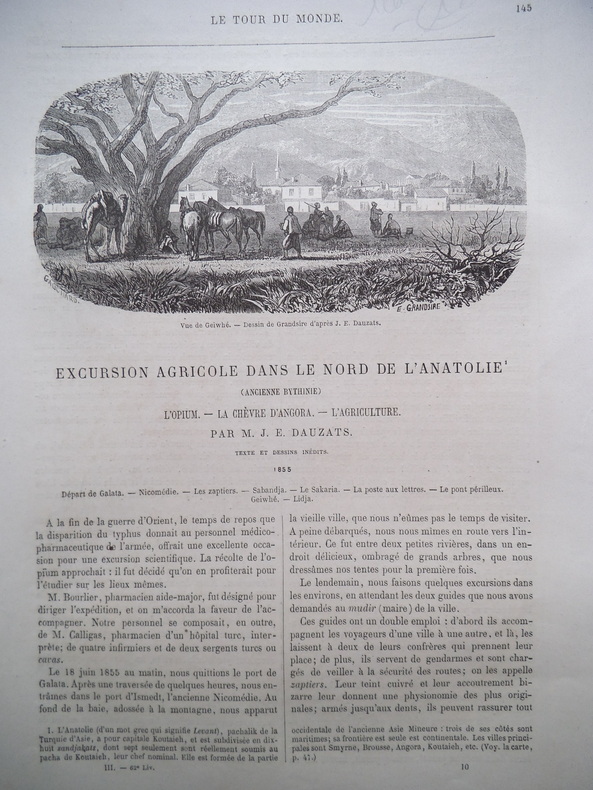
13914Excursion agricole dans le nord de l’Anatolie L’opium, la chèvre d’Angora , l’agriculture. LE TOUR DU MONDE volume III livraison 62. 12 illustrations dans le texte et à pleine page. 1 carte. Couverture bleue de livraison 62.
Stralcio in 4° dall'ebdomadario "Le Tour du Monde", 16 pp. (dalla pagina 145 alla pagina 160). Assolutamente inedito, ricchissimo iconograficamente di magnifiche silografie (13 illustrazioni di cui 4 a piena pagina, compreso la carta del territorio), Estratto dalla rivista settimanale "Le tour du monde" edita a Parigi negl'anni 1860 e seguenti illustra l'escursione di J. E. Dauzats nel nord dell'Anatolia. Di non facile reperibilità, senza legatura, sporadiche fioriture della carta, in più che buono stato.
New English Original bdg. HC. 4to. (29 x 22 cm). In English. 195 p., color and b/w plates. Roman archaeology in a South Anatolian landscape: The Via Sebaste, the Mansio in the Döseme Bogazi, and regional transhumance in Pamphylia and Pisidia. An investigation of a Roman road-station in its archaeological and geographical context that provides a new perspective on the historical landscape of southern Anatolia. This study is based on fieldwork carried out during the 1990s in southwest Turkey in the modern vilayets of Burdur and Antalya, and it focuses on the settlements associated with a Roman mansio located in the Döseme Bogazi, the pass that linked Pisidia with the coastal region of Pamphylia. The course of the road and the structures that emerged along it were defined not by the evolution of Pisidia's Hellenized indigenous culture but by the priorities of Roman rule, especially during late antiquity. Furthermore, the study of the road where the mansio was located raises fundamental questions about the role played by this mountain pass in the movement of people and animals between the lowlands and highlands of South-west Anatolia.
New English Paperback. 4to. (27 x 20 cm) In English. 223 p., numerous color and b/w plts. Roman, Late Roman and Byzantine inscriptions of Ankara. A selection. ARCHEOLOGY Anatolian civilizations The Roman Empire Byzantium Architecture Ankara - Ancyra - Angora Greek.
New English Original bdg. HC. 4to. (29 x 22 cm). In English. 113 p., b/w ills. Smintheion Studies I: The Roman baths and related structures. This project was carried out with permission from the Turkish Ministry of Culture under the auspices of the Department of Antiquities and Museums. Especially important was the support of Coskun Ozgunel, the director of excavations at Smintheion (Sanctuary of Apollo Smintheus) since 1980, who allowed me to excavate at the site. After I became a member of the archaeological team in 2003, I began to specialize on the Roman use of the sanctuary by placing special emphasis on the Roman Baths and other water-related buildings that were important for the operation of the sanctuary. My first work was to excavate the water distribution/storage/settling basins located to the west of the temple of Apollo Smintheus in the course of the 2006 and 2007 field seasons. Then, I excavated Large Baths between 2008 and 2013 and determined that ali the water distribution basins supplied Large Baths with water from the sacred spring next to the temple. My last work was to excavate Small Baths, located about 50 meter north of the temple between 2014 and 2017. This structure was partially dug in the l 970s as part of a rescue excavation by Çanakkale Archaeology Museum as it was a Roman villa. I re-excavated the structure and established that this was the second major Roman bath built in the sanctuary. With the excavations of these two Roman baths at Smintheion, I wanted to contribute to our general knowledge on the function of the 'sanctuary baths' and the monumentalization of the Greek sanctuaries during the Roman era. I am hoping that these works will shed new light on those studies dealing with the use of the Hellenic sanctuaries during the Roman era. Coskun Özgünel, my tutor and advisor throughout my Ph.D. course at Ankara University, also provided support during the years of excavation at the sanctuary. My experience working alongside him during excavations of a Roman bath at Salamis on Cyprus was an important reason for me to work on the Roman baths of Smintheion. His lovely wife Nese Ozgünel has become a mentor for me throughout my stay at Smintheion. Special thanks are due to my colleagues Turan Takaoglu, Erhan Oztepe, Tolga Ozhan, Tayyar Gürdal, and Oguz Koçyigit for sharing their thoughts on the finds recovered from the excavations of the Roman baths at the sanctuary. In addition, my warm thanks are due to Fikret K. Yegül who kindly shared his insights on the finds with me during his visit to the sanctuary in 2016. I am also deeply grateful to him for honoring me by contributing to this work with an introduction highlighting the importance of the Roman baths at the sanctuary of Apollo Smintheus. Davut Kaplan.
viii + 132pp., 24cm., brochure originale, peu de rousseurs, bon état, [Mémoire présenté au second congrès scientifique international des Catholiques tenu à Paris au mois d'avril 1891], X100898
1892X100898Bruxelles, Goemaere 1892 viii + 132pp., 24cm., brochure originale, peu de rousseurs, bon état, [Mémoire présenté au second congrès scientifique international des Catholiques tenu à Paris au mois d'avril 1891], X100898
Mm 145x225 Volume in copertina rigida con sovracoperta policroma, xiv-157 pagine, 42 incisioni, una cartina. Riproduzione dell'edizione pubblicata a Milano nel 1873 da Fratelli Treves Editori nella collana "Biblioteca di viaggi". Ottimo stato. Spedizione entro 24 ore dalla conferma dell'ordine.
br. Il volume conduce l'appassionato di archeologia, il viaggiatore curioso, ma anche lo studente universitario o l'archeologo professionista in un affascinante viaggio alla scoperta della più antica preistoria dell'odierna Turchia. Pur nella rigorosità dei dati scientifici il libro è infatti pensato come un racconto e una vera e propria guida. Il volume è suddiviso in tre parti: La prima parte fornisce un inquadramento geografico, climatico e paleoambientale dell'area, per poi ripercorrere in ordine cronologico lo stato delle conoscenze sulla preistoria anatolica. La ricca illustrazione affronta, per ciascuna fase cronologica, diversi temi che rendono più comprensibile e piacevole la narrazione, quali tecniche di sopravvivenza, strategie di caccia, approvvigionamento delle materie prime, riti e culti, forme d'arte, strategie di occupazione del territorio e di impiego/produzione delle risorse. La seconda parte raccoglie brevi descrizioni e informazioni utili, oltre a ubicazione e recapiti, sui siti archeologici, le aree e i musei dell'odierna Turchia dove sono conservati e visibili materiali e strutture della preistoria anatolica, illustrati nella prima parte del libro. La terza è un vero e proprio dizionario archeologico trilingue (italiano/turco/inglese).
1903X114407Paris, e.a., 1903-1950 8 ouvrages reliés en un volume physique, reliure demi-toile solide, plats marbrés, bon état, [Contenu: I: DELAPORTE Louis, Les hittites (Paris, La Renaissance du livre, 1936, 371pp. Avec ills. + 3 cartes et 4 planches hors-texte, peu de soulignements) // II: CAVAIGNAC E., Les hittites (Paris, Maisonneuve, 1950, 125pp., avec ills., qqs. Soulignements) // III: NAUMANN Rudolf, Die Hethiter (Berlin, Mann, 1948, 68pp. With ills.) // IV: GOTZE Albrecht, Das Hethiter-Reich, seine Stellung zwischen Ost und West (Leipzig, Hinrichs, 1929, 2nd edition, 46pp.) // V: MESSERSCHMIDT L., Die Hettiter (Leipzig, Hinrichs, 1903, 35pp.) // VI: GOTZE A., Kleinasien zur Hethiterzeit eine geographische Untersuchung (Heidelberg, Winter, 1924, 32pp.+ map) // VII: GOTZE A., Das Hethiter-Reich seine Stellung zwischen Ost und West (Leipzig, Hinrichs, 1928, 1st edition, 46pp.) // VIII: CUQ Edouard, Les lois hittites (Paris, Receuil Sirey, 1924, 67pp.)], X114407
1929X118519Paris, Adrien Maisonneuve 1929 iii + 188pp., 25cm., jolie reliure cart. solide en demi-toile rouge, plats décorés, exemplaire de la collection de B.L. Helmond (avec son ex-libris), bon état, poids: 1kg., X118519
New English Paperback. Pbo. 4to. (28 x 22,5 cm). Articles in English. 238 p. B/w ills. At the Crossroads of Empires: 14th - 15th Century Eastern Anatolia is a compilation of selected papers presented at a conference held in Istanbul in May 2007, treating history, coinage, architecture, and arts of the book. This publication gathers new scholarship about the remote, previously under-researched eastern parts of modern Turkey, from the final decades of Ilkhanid rule to the eve of the Ottoman empire. This is a very complex period and the lack of sources creates a serious handicap for its understanding. Much of the difficulty in dealing with the history of this region originates from its extreme political fragmentation and the rise of numerous local dynasties following the collapse of Mongol power in the mid-14th century. This book shows that cultural life flourished at various local centres despite long periods of political instability and discord in eastern Anatolia as it became embroiled in the ongoing conflicts between such states as the Mamluks and Ilkhanids, and later, the Timurids and Ottomans. This region, with its fertile lands and wealthy provincial centers, attracted the attention of the greater regional powers based in Egypt-Syria, Iran and western Anatolia. But the mountainous, somewhat harsh topography and considerable geographical distance from the centres of empires made it an area difficult to control from afar. Thus, local rulers and principalities, dependent, semi-dependent, and sometimes autonomous vassals thrived. Except where the Turkmen Aqquyunlu rulers managed to create their own empire, this area was never in the hands of a single dynasty. This picture of various factions is reflected in the artistic material which has no uniform and homogenous artistic style. Various traditions co-exist, so the area might best be defined as a cultural and artistic platform, where ideas circulated, emerged and interacted. ARCHEOLOGY Anatolian civilizations Anatolian Emirates Turkish and Islamic culture.
New English Paperback. Pbo. 4to. (28 x 20 cm). In Turkish. 118 p. Ills. Dogu Daglik Kilikia Bölgesi Roma Imparatorluk Dönemi detaylandirilmamis Korinth basliklari.
128pp., with colour illustrations, 28cm., illustrated softcover, exhibition catalogue (The Textile Museum, 13 September 2002 - 16 February 2003), good condition, ISBN 1-85759-283-2, S96966
2002S96966Washington D.C., The Textile Museum 2002 128pp., with colour illustrations, 28cm., illustrated softcover, exhibition catalogue (The Textile Museum, 13 September 2002 - 16 February 2003), good condition, ISBN 1-85759-283-2, S96966
Fine English Paperback., Very good., 20 x 14 cm, 168 p. "Toprak vatan kokuyordu. -Yasam ve anilar-, Derleyen: ALI YILMAZ, Aram Yayinlari, Istanbul, 1997"
New English Paperback. Pbo. Demy 8vo. (21 x 14 cm). In Turkish. 373 p., ills. 'Terra Sigililata' and 'Late Roman Ware' groups of ceramics. 'Terra Sigililata' ve 'Late Roman Ware' seramik gruplari.
New Turkish Paperback. Demy 8vo. (21 x 15 cm). In Turkish. 92 p., ills. Anadolu'da Neolitik Çag'da saman inanci. Shamanism in the Neolithic Anatolia.
New English Paperback. Pbo. Demy 8vo. (21 x 15 cm). 73 p. Color and b/w ills. In English and Turkish. Temple to Church: The transformation of religious sites from Paganism to Christianity in Cilicia.= Tapinaktan Kiliseye: Kilikya'da Putperestlikten Hiristiyanliga geçiste dini yerlesmelerin dönüsümü. Translator: Baris Taspinar.
New English Paperback. Pbo. Large 8vo. (21 x 21 cm). In English and Turkish. 48 p., b/w ills. From a dusty dig to the dusty shelves. The development of the archaeological literature in Turkey.= Hafriyattan hurufata. Türkiye'de arkeoloji literatürünün gelisimi.
128pp. + 1 tableau dépliant, 30cm., br.orig., qqs. cachets, texte frais et en bon état, R108323
1953R108323Oosterhout, Les éditions de Saint Michel 1953 128pp. + 1 tableau dépliant, 30cm., br.orig., qqs. cachets, texte frais et en bon état, R108323


