330 résultats
dola844Victoria BC: c1966. First Edition. 12mo. pp. 16. self-wrs. with illus. on upper cover partly spit along spine fold with slight loss to lower rear wr. rubberstamp & ownership entry on cover Victoria, BC: [c1966] unknown
1977044863NAM POWs. very nice copy; larger-format . Near Fine. Hardcover. 1st Edition. 1977. NAM POWs hardcover
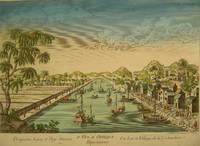
#[34149]Paris Daumont ca.1760. Contemporary handcoloured perspective view vue d'optique or Guckkastenbild depicting a view of the village of Yang-ka in Cochin with legend in Latin and French. Ca.285 x 39 cm. Handsome optical harbour view of a village with figures and canal with sailing-ships in Vietnam. unknown
197267771Saigon Republic of Viet-Nam: Ministry of Foreign Affairs 1972. Presumed first edition/first printing. Wraps. Good. Format is approximately 8.25 inches by 10.5 inches. Unpaginated by 32 pages plus covers. Decorative cover.with some color. Illustrations Maps color. This contemporary propaganda material is ephemeral and relatively few copies have survived in private hands in the more than four decades since it was published. From Wikipedia: "South Vietnam officially the Republic of Vietnam was a state which governed southern Vietnam until 1975. It received international recognition in 1949 as the "State of Vietnam" 1949-55 and later as the "Republic of Vietnam" 1955-75. The term "South Vietnam" became common usage in 1954. South Vietnam's origins can be traced to the French colony of Cochinchina a subdivision of French Indochina. After World War II the Vietminh led by Ho Chi Minh proclaimed the establishment of a Communist nation in Hanoi. In 1949 non-communist Vietnamese politicians formed a rival government in Saigon led by former emperor Bao Dai. Bao Dai was deposed by Prime Minister Ngo Dinh Diem in 1955 who proclaimed himself president after a referendum. After Diem was deposed in a military coup in 1963 there was a series of military governments. General Nguyen Van Thieu led the country from 1967 until 1975. The Vietnam War began in 1959 with an uprising by Viet Cong forces. Fighting climaxed during the Tet Offensive of 1968 when there were over 1.5 million South Vietnamese soldiers and 500000 U.S. soldiers in South Vietnam. Despite a peace treaty concluded in January 1973 fighting continued until the North Vietnamese army overran Saigon on 30 April 1975." This document from the Ministry of Foreign Affairs was aimed as the English-speaking audience was was aimed at rallying support against the North Vietnamese onslaught. Had it not been for the U.S. Air Force and Navy the Vietnam War might have ended in the spring of 1972 with North Vietnamese tanks in the streets of Saigon. On March 29 1972 fourteen North Vietnamese divisions backed by more than three hundred tanks crossed the Demilitarized Zone into South Vietnam. It was an assault every bit as ferocious as the Tet Offensive in 1969 and perhaps even more so: where Tet had been an uprising by Viet Cong guerrillas backed by regular North Vietnamese troops the Easter Offensive of 1972 was a blitzkrieg a conventional mechanized assault by troops well-equipped with armor artillery and antiaircraft weapons. Several North Vietnamese Army or NVA divisions crossed the DMZ into the northern tip of South Vietnam. Other forces struck from their bases in ostensibly neutral Cambodia into the southwest part of South Vietnam perilously close to Saigon. Unlike Tet the South Vietnamese army or ARVN would not have U.S. ground troops fighting beside them or instead of them. American advisers could assist the South Vietnamese but with America in the midst of withdrawing its ground troops and the American public tired of casualties ground combat units would not be committed to the battlefield. The ARVN would have to fight its own battle. The key northern border town of Quang Tri fell and the NVA advanced to the gates to the vital city of Hue. The ARVN and South Vietnam were in trouble. Then salvation came from the skies. Airpower had always been a key factor—actually the key factor—factor in America's favor during the war in Indochina. But this time it was the only politically feasible means by which the United States could aid South Vietnam in 1972. By that time the American air fleet in Southeast Asia had dwindled to about eight hundred combat aircraft in Vietnam and Thailand including two U.S. Navy carrier air wings. Illustrating the flexibility of airpower by the end of May an additional four hundred Air Force fighters had arrived plus four more carriers. Most significantly the aerial armada included more than two hundred B-52s. Ministry of Foreign Affairs paperback
1995BN151406München : Hirmer 1995. 1995. Hue : die Kaiserstadt von Vietnam. Ann Helen Unger ; Walter Unger <br/><br/>Hue : die Kaiserstadt von Vietnam. Ann Helen Unger ; Walter Unger Vietnam - Hue - Unger Ann Helen und Walter Unger München : Hirmer unknown
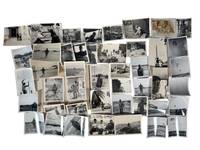
1965212871965. Archive of original photographs documenting African American soldiers serving in the Vietnam War during the early phase of large-scale United States military escalation in Southeast Asia. The material captures the daily experiences military operations and interpersonal relationships of Black servicemen stationed at Bien Hoa Air Base circa 1965 including members of the 173rd Airborne Brigade Combat Team. The photographs provide primary-source visual evidence of integrated military life during a period when African American troops served disproportionately in frontline combat roles while racial inequality and civil rights struggles intensified in the United States. Particularly significant is the candid nature of the images which were apparently taken by an African American serviceman identified by the surname Thomas offering an unusually personal perspective on Black military experience during the Vietnam conflict.<br /> Collection consists of 56 original black-and-white silver gelatin photographs measuring approximately 3.5 x 3.5 to 3.5 x 5.5 inches primarily loose with two mounted to an album page. The photographs depict African American soldiers at Bien Hoa Air Base near Saigon identifiable through a photographed base sign and visible 173rd Airborne Brigade insignia on soldiers' uniforms. Numerous images portray Black servicemen posing casually outside tents reading letters socializing in small groups smoking resting and interacting with fellow soldiers emphasizing camaraderie and the routines of military life between operations. Several photographs document airborne training exercises with parachutists descending beneath open canopies over the surrounding landscape. Other images depict military infrastructure and equipment including jeeps sandbag fortifications stacked munitions barracks areas and transport zones associated with the logistical operations of the base. The archive also includes photographs taken during off-duty excursions into Vietnamese civilian areas including a riverside marketplace crowded with vendors boats and local residents. Additional images show soldiers posed before local monuments and religious sites including one photograph of Thomas with a white serviceman in front of a Buddhist temple and another featuring a tall obelisk monument surrounded by military statuary.<br /> The archive documents the lived experience of African American servicemen within integrated combat units during one of the most consequential military conflicts of the twentieth century. Bien Hoa Air Base served as a major operational center for airborne and aerial missions during the early years of sustained U.S. intervention and the presence of Black paratroopers within these photographs provides important visual evidence of African American military participation during the Civil Rights era. Unlike official military photography the informal and personal nature of the images preserves moments of friendship boredom training and interaction with Vietnamese civilians that are often absent from institutional wartime records. Minor edge wear and light handling wear throughout; photographs remain sharp and well-preserved overall in very good condition. A substantial and historically valuable photographic record of African American military life in Vietnam during the mid-1960s. unknown
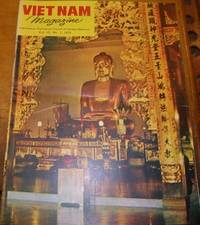
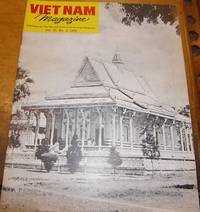
68-4973Saigon Vietnam: Vietnam Council On Foreign Relations 1973. 4to. Magazine. Stapled Wraps. 32 pp. Mostly B&W plates. Very Good. Vietnam Council On Foreign Relations paperwork and application loosely laid in. Saigon, Vietnam: Vietnam Council On Foreign Relations, 1973. paperback
68-4974Saigon Vietnam: Vietnam Council On Foreign Relations 1973. 4to. Magazine. Stapled Wraps. 28 pp. Mostly B&W plates. Very Good. Vietnam Council On Foreign Relations paperwork and application loosely laid in. Saigon, Vietnam: Vietnam Council On Foreign Relations, 1973. paperback
68-4971Saigon Vietnam: Vietnam Council On Foreign Relations 1973. 4to. Magazine. Stapled Wraps. B&W plates. Very Good. Vietnam Council On Foreign Relations paperwork and application loosely laid in. Saigon, Vietnam: Vietnam Council On Foreign Relations, 1973. paperback
1998I8015Hanoi: White Lotus Press 1998. Paperback. Good/no dj. 0.13. Endangered Animals: to Be or Not to Be White Lotus Press paperback
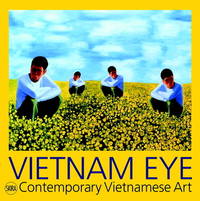
BIB-MM-9788857233604Vietnam Eye - Book - BRAND NEW & SEALED. Dispatched as soon as possible by Independent UK Seller thank you for your custom!. BRAND NEW. unknown
19662081002108500692Not Available 1966. Soft Cover. Fine. The book is in fine condition. Not Available paperback
19882092902141301297Rengoshuppan 1988. Soft Cover. Fine. Number of books: 1 Rengoshuppan paperback
19902091502135703525Rokkoshuppan 1990. Soft Cover. Fine. The book is in fine condition. Rokkoshuppan paperback
19902110502150308117Rokkoshuppan 1990. Soft Cover. Fine. Volume: 1 Rokkoshuppan paperback
19782090502113716868Not Available 1978. Soft Cover. Fine. The book is in fine condition. Not Available paperback
1970190661970. U.S. Army Engineer Company photo album early 1970s documents logistical operations base life and personnel composition at Oakland Army Base during the Vietnam War providing visual evidence of military transportation infrastructure and the integration of a diverse workforce within a key Pacific transit hub. The material records the functioning of an engineer unit responsible for vehicle maintenance cargo handling and operational readiness while also capturing the presence of African American servicemen and female personnel within the same working and ceremonial environments. It supports research into military logistics on the U.S. home front race and gender integration in the armed forces and the institutional processes that sustained overseas deployment during the Vietnam War.<br /> <br /> Album containing 369 photographs including 353 color and 16 black and white images most measuring approximately 5 x 3.5 inches compiled at Oakland Army Base and the adjacent Port of Oakland. The contents document heavy machinery and vehicle maintenance including bulldozers cranes transport trucks and military jeeps with numerous images showing mechanics engaged in repair work. Additional photographs depict combat training exercises including rifle instruction with M16 firearms alongside formal ceremonies in which soldiers of varied racial backgrounds and both genders receive promotions commendations and instruction from commanding officers. Several images show administrative office environments providing insight into the clerical and organizational functions supporting base operations. Group scenes include family-oriented gatherings and meals indicating the social dimension of service life within the base setting. Produced at a time when Oakland Army Base operated as a principal embarkation and return point for U.S. forces traveling to and from Vietnam and other locations in East Asia the album documents the domestic infrastructure underpinning overseas military engagement. The emphasis on machinery cargo movement and personnel readiness reflects the scale and complexity of logistical coordination required during the conflict. The visible diversity within the unit corresponds with broader transformations in the U.S. military following desegregation and evolving roles for women making the album relevant to studies of institutional change during the late stages of the Vietnam War. Light wear to album edges and corners photographs well-preserved with minor handling marks; overall very good. A substantial visual record of engineer operations and base life at a critical West Coast military installation during wartime. unknown
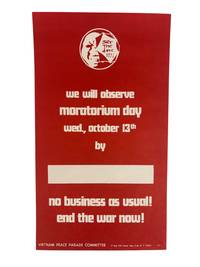
1971222041971. Counterculture Social Activism This striking 1971 protest poster was issued by the Vietnam Peace Parade Committee to promote national participation in Vietnam Moratorium Day observed on Wednesday October 13th 1971. Designed in bold agitprop style the poster combines militant typography with an urgent visual motif that reflects the escalating tone of the antiwar movement in the early 1970s. New York: Vietnam Peace Parade Committee 1971. Bold white typography with circular graphic emblem at top. <br /> <br /> Below the emblem centered white text declares: "we will observe / moratorium day / wed. october 13ᵗʰ / by" followed by a large white blank space left intentionally empty for local groups or individuals to fill in their planned action or statement of protest. The poster concludes with a defiant and unequivocal call: "no business as usual! / end the war now!" At the bottom the issuing organization is credited: Vietnam Peace Parade Committee 17 East 17th Street New York N.Y. 10003.<br /> <br /> The poster is a vivid artifact of the Vietnam Moratorium movement which began in October 1969 as a coordinated nationwide effort to halt everyday activities in protest of the war. Unlike previous marches and rallies Moratorium Day called for civic refusal and general strikes encouraging walkouts from schools workplaces and public institutions. By 1971 in the wake of the Cambodian incursion and the publication of the Pentagon Papers the antiwar movement had taken on a more urgent and radical tone. This poster's slogan-"no business as usual!"-reflects that shift asserting that complicity in everyday life was untenable while the U.S. continued to bomb and occupy Southeast Asia. As a piece of protest ephemera the poster is emblematic of the era's graphic culture of resistance: minimalist yet commanding visually direct yet ideologically expansive. Light handling wear otherwise very good. unknown
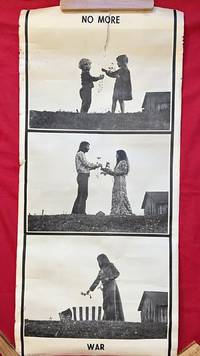
1970190631970. Anti-WarVietnam War "NO MORE WAR". Designed and photographed by Terry and Dennis Newell 1970. Measures 35" × 16" on offset tan lithographic paper. This monochromatic anti-war poster illustrates three scenes of a man and woman in three stages of their lives. In the first photo a young girl innocently gifts a young boy flowers on a grassy field. The following image conveys the young girl and boy in their adulthood---dressed in typical 1970's attire---as the woman hands flowers to the man in great despair. As her partner leaves to fight in the war she is left on the field longing for his return. Yet in the last image she is left lying flowers atop his coffin wrapped in the American flag. The Vietnam anti-war movement from 1960-1970 was one of the most pervasive displays of opposition to the government policy in modern times as protests raged all over the country. As a result posters like these were just one of the mediums used to highlight anti-war narratives. Five inch tear on the top margin minorly affecting the title text. Signs of foxing and discoloration to due to age otherwise in very good condition. unknown
1971VIETNAM012475Academy editions London. 1971. First edition. Royal octavo. Sewn card wrappers with dustwrapper. A verse sequence which was ''.the result of conversations with a recently returned marine.'' from the author's Note. Black and white frontispiece and cover drawings and two black and white illustrations in the text by Philip Hicks all taken from a sequence by him entitled ''Vietnam Requiem''. One of fifty numbered copies out of a total edition of 300 copies signed by the author and artist.Near fine. Academy editions, London. unknown
1968XA-2P8R-BCD61968. Hardcover. Good. First edition stated Cowles 1968. Good plus. Jacket has moderate wear nicks and fading. Book has moderate wear smudge to textblock edge; pages lightly yellowed with an occasional minor blemish; binding firm. hardcover
1972592342Boston: Beacon Press 1972. Hardcover. Fine/Fine. First edition. Fine in a fine dust jacket with the tiny price on the front flap inked over. The Winter Soldier Investigation was a controversial meeting of Vietnam veterans who met to testify about American war crimes in Vietnam. Former presidential candidate John Kerry is listed as a participant in the investigation but doesn't seem to be mentioned specifically in the text. Beacon Press hardcover
0807002518.Gpaperback. Good. Access codes and supplements are not guaranteed with used items. May be an ex-library book. paperback
1972507405beacon Press. Good/Good. 1972. Hardcover. Hard Cover. 080700250X RB-2 . beacon Press hardcover
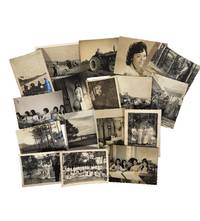
1960210781960. Vietnam War Photography Personal photograph album containing 17 silver gelatin photographs documenting civilian life education family and military service in South Vietnam during the 1960s. Original brown vinyl album measuring approximately 3.5" x 4.5"; photographs approximately 2.5" x 3.25".<br /> <br /> The album offers an intimate glimpse into the everyday experiences of South Vietnamese men and women during a period more often documented through the lens of war. Rather than combat scenes the photographs focus primarily on family friendship education courtship and community life creating a personal record of a society navigating rapid social change amid the conflict. Several photographs depict young Vietnamese women wearing traditional áo dài dresses both in formal portraits and informal outdoor settings. One particularly attractive image shows three smiling women walking along a path in patterned áo dài framed by a mixture of traditional and modern architecture. Another studio portrait captures a young woman posed alone and smiling toward the camera suggesting a family member friend or perhaps the album owner's sweetheart.<br /> <br /> Education and youth culture are prominently represented. Multiple photographs show school-aged girls gathered in classrooms and assembled outdoors in large group portraits. The students wear white áo dài and traditional conical hats illustrating the continued importance of educational institutions and cultural traditions during the war years. Several candid classroom scenes preserve moments of ordinary student life rarely encountered in wartime photographic archives. The album also documents changing fashions and modernization in South Vietnam. Young men and women appear in contemporary 1960s clothing posing in parks forests and rural landscapes. One photograph shows a young Vietnamese man seated proudly atop a large tractor reflecting the agricultural modernization efforts underway throughout much of South Vietnam during the period.<br /> <br /> Military service appears in several images. One photograph depicts a South Vietnamese serviceman standing beside an automobile with military vehicles visible in the background suggesting that the album may have belonged to a soldier or military family. Unlike official military photographs however the image emphasizes personal identity rather than military operations reinforcing the album's character as a private keepsake rather than a wartime record. Additional photographs show fishing boats riverside scenes rural landscapes and groups of family members and friends creating a portrait of everyday life that existed alongside the broader conflict. Together the photographs reveal the coexistence of tradition and modernity documenting a generation of South Vietnamese men and women whose lives were shaped by both enduring cultural customs and the upheavals of the Vietnam War era. Photographs appear to have been removed from a larger album at some point with remnants of mounting paper and adhesive visible on versos. Minor wear and handling marks; overall very good condition. A compelling personal archive documenting civilian life education culture and military service in South Vietnam during the 1960s. unknown