2 907 résultats
plaquette in-8°, 37 pages, agrafe, couverture Bel exemplaire [109B-16]
778Paris, Les Editeurs français réunis, 1969 ; in-12, broché. Quelques reproductions.
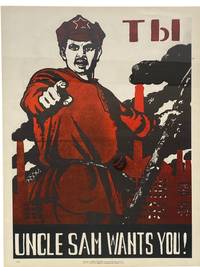
1968220901968. PropagandaCounterculture Ты / Uncle Sam Wants You! New York: International Poster Corp. 1968. Offset lithographic poster in red black and cream tones measuring 21 x 29 inches. A striking Cold War-era visual pastiche that fuses Soviet revolutionary imagery with American military propaganda this poster was issued during a peak moment of political unrest in the U.S. amid the Vietnam War and domestic resistance movements.<br /> <br /> This design is a bold recontextualization of the iconic 1920 Soviet recruitment poster "Ты запиÑалÑÑ Ð´Ð¾Ð±Ñ€Ð¾Ð²Ð¾Ð»ÑŒÑ†ÐµÐ¼" "Did you volunteer" by Dmitry Moor repurposed here with the English slogan "Uncle Sam Wants You!" emblazoned below in tall confrontational type. The juxtaposition of Soviet iconography-complete with red army uniform factory smokestacks and Cyrillic lettering-with a phrase universally associated with U.S. enlistment efforts delivers a searing critique of militarism nationalism and ideological doublespeak on both sides of the Cold War divide. Produced by the International Poster Corp. a commercial publisher in the late 1960s known for distributing countercultural and revolutionary imagery this poster was marketed to radical bookstores and student groups across North America. It exemplifies the era's politically charged appropriation of state propaganda styles as a vehicle for anti-war New Left and student movement critiques. The figure's accusatory point lifted directly from Moor's original underscores a shared visual vocabulary of coercion that transcended ideological boundaries. Very good condition with strong color retention and no visible tears small surface abrasion on recto not affecting images. Printed copyright and publishing line along bottom margin. An evocative artifact of 1960s countercultural print culture merging international iconographies of enlistment and resistance. unknown
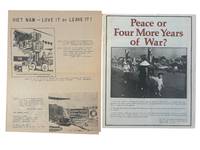
1969222221969. Archive of Two Anti-Vietnam War Pamphlets Critiquing Nixon-Era Policy 1969-1972. Birmingham AL and Cambridge MA / Los Angeles CA: Birmingham Moratorium Committee and Indochina Peace Campaign. Two pamphlets totaling 8 pages. A stark and emotionally charged pair of pamphlets confronting the human and economic cost of the Vietnam War particularly under the administration of Richard Nixon and his South Vietnamese ally Nguyễn Văn Thiệu. Both documents highlight the structural violence wrought by U.S. imperialism through quotes infographics and personal testimonies. One pamphlet issued by the Birmingham Moratorium Committee presents a Marxist-inflected indictment of American capitalism's complicity in the war; the other by the Indochina Peace Campaign anchors its critique in the grief of a widow counterposing Nixon's broken promises with devastating images of Vietnamese civilians and political prisoners.<br /> <br /> 1 Birmingham Moratorium Committee. "Viet Nam - LOVE IT or LEAVE IT!" Birmingham AL: 1969. A four-page pamphlet structured around working-class economic critique. On the front page black-and-white line art depicts a U.S. military cargo loader moving a casket-shaped crate labeled with stars beneath the caption "U.S. troops continue to be withdrawn from South Vietnam." It features a collage juxtaposing the Chase Manhattan logo with the silhouette of a prone soldier in Saigon. Alongside damning pull quotes from McNamara Gen. Harkins and Nixon ".this may have been one of America's finest hours." it lists the GI toll from 1961 to 1966: "killed: 38969; wounded & maimed: 254947." The interior spread lays out the economic beneficiaries of the war-"Who Profits"-stating "only big business. corporate profits after taxes rose 91%." One cartoon labeled "The Free Enterprise System" depicts a caricatured Nixon shaking down an American taxpayer for the wealth-hoarding "Corporations and Upper Income Earners". The final page calls for a debate and mass rally on November 13-14 involving Alabama's senators and representatives and denounces the war as a tool to "pay Vietnamese women 31¢ a day to make transistors as they do now in South Korea." The overall tone centers class exploitation with a particularly Southern regional organizing base.<br /> <br /> 2 Indochina Peace Campaign. "Peace or Four More Years of War" Cambridge MA / Los Angeles CA: 1972. Four-page pamphlet likely distributed in the lead-up to the 1972 election. The cover image-captioned "NBC-TV Dec. 12 1972"-depicts a Vietnamese woman and barefoot child walking past a bombed-out village. Beneath it is a widow's testimony: "If they had gone ahead and signed the treaty as promised my husband would be alive today with me and my children." The interior is a detailed exposé of the Nixon administration's duplicity in peace negotiations asserting that "After two years of negotiations all that remained was to settle one percent of a peace settlement." The Indochina Peace Campaign asserts that the U.S. deliberately sabotaged the Nine-Point Agreement by refusing to recognize the Provisional Revolutionary Government PRG despite "warnings by Congressmen and Senators" and international outrage over the Christmas bombings. The pamphlet cites major media: "The U.S. supported regime in Saigon have ruled by suppressing all their opposition" Pentagon Papers Gravel Edition Vol. 1 p. 256 and includes documentation of 40994 political assassinations under the Phoenix Program. A chilling image of children behind bars in Chanh Hung Prison accompanies these facts. The final call to action reads: "We have this choice: either we allow our government to prolong the rule of General Thieu or we pressure it to sign the Agreement."<br /> <br /> An ideologically diverse but thematically united pair of anti-war publications: one focused on working-class Southern economic outrage the other on moral urgency and state-sponsored atrocity. Together they demonstrate the breadth of opposition to the Vietnam War and the emotional political and class-based appeals that animated grassroots resistance across the U.S. Overall very good condition. unknown
1964222171964. Counterculture Vietnam War This pair of mimeographed documents issued in 1964 and 1969 respectively capture the shifting rhetorical and political frameworks of U.S. justification and policy aims in Vietnam offering rare comparative insight into both the Lyndon B. Johnson and Richard Nixon administrations' public positions. 1 Some Questions on Vietnam. Washington: Friends Committee on National Legislation June 3 1964. 2 Mr. Nixon's Points. N.p October 14 1969. Two double-sided mimeographed typescripts measuring 8.5" x 11" each. Together they trace the continuity and contradictions in American official thinking from the earliest stages of direct military intervention to the early attempts at managed withdrawal. The 1969 document is particularly notable for its side-by-side presentation of Nixon's proposed peace terms with those of the National Liberation Front NLF the political wing of the Viet Cong.<br /> 1 The first document dated June 3 1964 and issued by the Friends Committee on National Legislation in Washington D.C. is titled Some Questions on Vietnam. Framed as a briefing tool for concerned citizens it outlines the U.S. position in the early escalation phase of the war and provides extensive excerpts from contemporary sources including President Johnson's June 2 press conference and articles from The Washington Post and New York Times. Johnson is quoted stating that the U.S. is "bound by solemn commitments to help defend this area against Communist encroachment" reaffirming the domino theory logic underpinning American involvement. <br /> <br /> The handout catalogs U.S. military strategies then being deployed including the "Strategic Hamlet Program" in which "thousands of peasants were uprooted at gunpoint and moved into defensive village-clusters far removed from ancestral lands." Other methods included the use of lie detectors on suspected Viet Cong and defoliation tactics that the Washington Post acknowledged raised "questions of the wisdom of using such agents at all in this kind of war. where the consequences are visited upon a civilian population we are trying to defend." The leaflet also raises doubt about South Vietnamese support for the war: "the Saigon government has the allegiance of probably no more than 30 per cent of the people." Statistics from the Pentagon note that by May 25 1964 1130 American servicemen had been killed wounded or listed as missing since 1961. Senator Wayne Morse is quoted: "We have already poured into that sink-hole over $5½ billion." The final sections argue that economic aid cannot be separated from military goals and propose alternatives such as United Nations mediation. Notably the sheet warns that mail to the White House on Vietnam had been averaging fewer than 150 letters per week urging citizens to "make their views known to the President and your Congressmen."<br /> <br /> 2 The second document dated October 14 1969 presents President Nixon's public negotiating stance during the early phase of his "Vietnamization" strategy. Titled Mr. Nixon's 8 Points the yellow sheet begins with a justification of U.S. sacrifices: "The United States has suffered over a million casualties in four wars in this century. We are proud of this record and we bring the same attitude in our search for a settlement in Vietnam." Nixon outlines eight specific principles most notably: "We seek no bases in Vietnam. We insist on no military ties. We are willing to agree to neutrality for South Vietnam if that is what the South Vietnamese people freely choose." He continues "We have no intention of imposing any form of government upon the people of South Vietnam nor will we be a party to such coercion." The points include phased withdrawal over twelve months the establishment of an international supervisory body elections under international supervision release of prisoners of war and mutual agreement to observe the 1954 Geneva Accords. Nixon concludes with a reaffirmation that U.S. presence would end entirely once these measures were fulfilled.<br /> <br /> The reverse of the Nixon flyer contains The NLF's 10 Points the Viet Cong's counter-position which sharply contradicts Nixon's framing. Point 2 is categorical: "The U.S. Government must withdraw from South Vietnam all U.S. troops military personnel arms and war materiel. and liquidate all U.S. military bases in South Vietnam." Point 4 emphasizes sovereignty: "The people of South Vietnam shall settle themselves their own affairs without foreign interference." Throughout the NLF stresses full political participation neutral diplomatic relations and reunification of Vietnam as "a peaceful process. without foreign interference." Notably Point 9 demands that the U.S. government "must bear full responsibility for the losses and devastations it has caused to the Vietnamese people in both zones."<br /> <br /> Juxtaposing these two documents reveals a significant divergence between U.S. public rhetoric and Vietnamese revolutionary demands. While Nixon framed U.S. intentions as altruistic and limited the NLF viewed the war as colonial in nature and demanded unconditional withdrawal. This side-by-side format would have been a powerful tool for peace activists and educators in 1969 especially as public trust in government narratives about Vietnam eroded in the wake of the Tet Offensive and ongoing domestic protest. Very good condition overall. unknown
40031n. p. n. d. 1st printing presumed ca. 1973. Yellow printed paper. Modest wear faint horizontal crease rubbing. A VG example of Anti-War propaganda. Single sheet printed recto only. One printed illustration of a Vietnamese soldier gun raised. 14" x 8-1/2" <br/><br/>"Almost all these imperialist tactics are being used in Asia Africa Latin America and the Phillipines. The war was not a tragic mistake. It was a calculated attempt by the US imperialists to exploit the people resources and strategic position of Vietnam. These attempts are being made all over the world and like the Vietnamese the people of the world are FIGHTING BACK! Members of the anti-war movement should all feel proud at the small contribution we have been able to make to the recent victory but the war is not over." No holdings found on OCLC. Rare. unknown books
196940033Washington D.C.: Fifth Avenue Vietnam Peace Parade Committee 1969. 1st printing presumed. White printed paper. Modest wear age-toning to paper edges. A VG example. Single sheet folded once. Two b/w photographic images of a destroyed building and white graves printed to front. 8-1/2" x 5-1/2" <br/><br/>"The New Mobilization Committee to End the War in Vietnam is mounting a FALL OFFENSIVE TO STOP THE WAR STOP THE WAR MACHINE STOP THE DEATH MACHINE. It will culminate on November 15 in Washington and San Francisco in what we can make the most significant anti-war demonstrations in American history. Our efforts to end the war in Vietnam have reached a crossroads -- it must be ended or it will rise to new heights of horror and murder." OCLC only shows 1 institutional holding University of Kansas. Rare in the trade. Fifth Avenue Vietnam Peace Parade Committee unknown books
196940032Washington D.C.: Fifth Avenue Vietnam Peace Parade Committee 1969. 1st printing presumed. White printed paper. Light wear slight age-toning to back of paper. A VG example. Single sheet folded once. B/w photographic image of diapered Vietnamese children marching printed to front. 8-1/2" x 5-1/2" <br/><br/>"The New Mobilization Committee to End the War in Vietnam is mounting a FALL OFFENSIVE TO STOP THE WAR STOP THE WAR MACHINE STOP THE DEATH MACHINE. It will culminate on November 15 in Washington and San Francisco in what we can make the most significant anti-war demonstrations in American history. Our efforts to end the war in Vietnam have reached a crossroads -- it must be ended or it will rise to new heights of horror and murder." OCLC only shows 1 institutional holding University of Kansas. Rare in the trade. Fifth Avenue Vietnam Peace Parade Committee unknown books
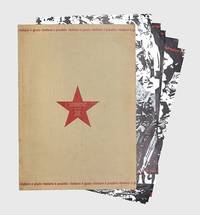
1969148329Milan: c.1969. Striking pop art-influenced suite of anti-imperialist propaganda posters published in Milan by the Comitato Vietnam - self-described in their literature as the "sezione italiana del tribunale Russell". The work of a collective comprised of six prominent Italian artists the images carry the theme 'Rebellion is right rebellion is possible' into various theatres of anti-imperialist struggle. Baratella b. 1935 Mariani b. 1936 and Spadari 1938-97 were long-term collaborators and members of the Nuova Figurazione art movement. Amadori 1945- 2015 won the Joan Miró prize in 1972. Spadari's contribution draws on the "solarised" image of Castro in the Cuban Revolution from his work "26 de julio" while in an anti-Vietnam War themed poster similarly treated repeated images of a Vietnamese women are overlain by a Lichtensteinian US fighter jet wheeling away from an explosion from which emerges a Coca-Cola bottle cap with the slogan 'Nixon boia' - Nixon executioner also the title of a song by popular singer-story teller Franco Trincale - and the partially obscured text 'Coca-Cola merda'. Nixon also features on a poster featuring his cartoonish portrait wearing a star-spangled neck-tie while being choked out by several nooses above him a ferociously snarling Black Panther head; while "Africa Rossa/Africa Nera" centres on a photographic image of the clenched first Black Power salute. Baratella based his poster around his painting "Benito Mussolini Storia del fascismo" where "Il Duce's" face morphs into a skull here with the lower part is superimposed with six small portraits of current political leaders including de Gaulle Pompidou Khrushchev and LBJ. The last in the group dramatises the Arab-Israeli conflict with a repeated image of a woman PFLP fighter - Leila Khaled - in keffiyeh and camo fatigues carrying a AK-47 above her a map of Jerusalem. No other set of these traced a couple of examples of individual posters noted institutionally; an excellent evocation of the artistic-political synergies of the period. Six large black and white photomontage posters 700 x 500 mm printed on coated paper each with the repeated slogan 'ribellarsi è giusto ribellarsi è possibile' in red; in the original tan slub-weave linen textured light card portfolio printed in red title to the front panel superimposed on a red five-pointed star. The portfolio a little rubbed and soiled pale damp spots at the spine-fold where there are a few short splits posters show light handling but overall very good. unknown
br. Da quando l'Oriente è diventato la discarica degli orrori dell'Occidente, il "viaggiatore incantato" può trovarsi a scoprire templi maestosi, divorati dalla vegetazione, all'interno di una corona protettiva di zone minate. Così accade ancor oggi, vent'anni dopo il conflitto in Vietnam, quindici dopo il genocidio in Cambogia, mentre l'Indocina si riapre agli stranieri e ai consumi e mostra le atroci rovine economiche e culturali delle guerre ideologiche più violente e più vane del nostro secolo. L'occhio e la penna di Arbasino ci trasmettono lo stupore provato di fronte al sorriso del Buddha affiorante da antiche pietre, come di fronte ai migliaia di teschi umani ordinati su scaffalature nel monumento-ossario dedicato alle vittime cambogiane del 1975-1979.
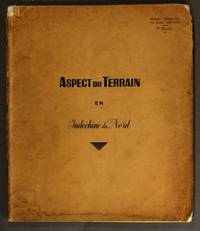
195435722Saigon: Édition du Service cartographique des F.T.E.O. 1954. First edition large square 4to pp. 117; photographic illustrations throughout; some wear a few short splits in the wrapper extremities else very good in original brown wrappers printed in black on the upper cover. At head of title: Forces terrestres du Nord Vietnam. 2. Bureau. Issued during the final battle for France in Vietnam at Dien Bien Phu. Cornell Arizona and Michigan only in OCLC. <br/><br/> Édition du Service cartographique des F.T.E.O. unknown books
195435722Saigon: Édition du Service cartographique des F.T.E.O. 1954. First edition large square 4to pp. 117; photographic illustrations throughout; some wear a few short splits in the wrapper extremities else very good in original brown wrappers printed in black on the upper cover. At head of title: Forces terrestres du Nord Vietnam. 2. Bureau. Issued during the final battle for France in Vietnam at Dien Bien Phu. Cornell and Arizona only in OCLC. Édition du Service cartographique des F.T.E.O. unknown
1968004062Washington, Library of Congress, 1968. -- Broschiert -- Lex. 8°
1966728908PN. New. 1966. Soft Cover. Date is original print. This is a reprint edition. . PN paperback
1964724846PN. New. 1964. Soft Cover. Date is original print. This is a reprint edition. . PN paperback
1963722937PN. New. 1963. Soft Cover. Date is original print. This is a reprint edition. . PN paperback
1963721952PN. New. 1963. Soft Cover. Date is original print. This is a reprint edition. . PN paperback
1965725912PN. New. 1965. Soft Cover. Date is original print. This is a reprint edition. . PN paperback
1963721265PN. New. 1963. Soft Cover. Date is original print. This is a reprint edition. . PN paperback
1966728497PN. New. 1966. Soft Cover. Date is original print. This is a reprint edition. . PN paperback
1963722935PN. New. 1963. Soft Cover. Date is original print. This is a reprint edition. . PN paperback
1966730951PN. New. 1966. Soft Cover. Date is original print. This is a reprint edition. . PN paperback
1965726082PN. New. 1965. Soft Cover. Date is original print. This is a reprint edition. . PN paperback
1963721264PN. New. 1963. Soft Cover. Date is original print. This is a reprint edition. . PN paperback
1963720442PN. New. 1963. Soft Cover. Date is original print. This is a reprint edition. . PN paperback