2 888 résultats
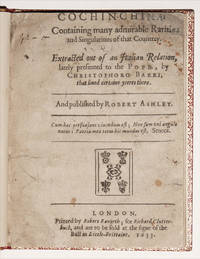
16334531London: Robert Raworth for Richard Clutterbuck 1633. Hardcover. Very Good. 4to - over 9¾ - 12" tall. Tastefully bound in ruled red morocco interior gilt dentelles; title-page dusty and trimmed at upper & outer margins; repaired corner of prelims. Otherwise very good. Rare first edition of the first book on Vietnam in English an eyewitness account of the commerce government and cultural life of Cochin-China central Vietnam written by the Jesuit missionary Cristoforo Borri and first published in Italian in 1631.Borri begins by marking the kingdom's boundaries identifying it as a narrow strip of land between Laos and the South China Sea bordered to the north by Tongking and to the south by Champa. A discussion of the kingdom's fertile land and rich natural resources follows emphasizing the abundance of fruits nuts rice fish textiles domestic stock and "all other things requisite for the entertainement of a man's life." Silk is produced in such quantities that "the baser sort of people wear it dayly." Gold and silver mines abound and "the Wood and Timber of this countrey is the best of all the world." Having piqued his readers' curiosity the author goes on to describe Cochin-China's vibrant commercial climate declaring it free of the red tape and bureaucratic hostility that so often greeted European traders in East Asia.Borri's 1631 Relazione a Jesuit missions letter directed at his Catholic superiors and lay readers was already unusual among works in its genre for devoting a substantial part exclusively to non-religious content. Ashley the translator executed further changes of his own in order to render the present work more attractive to Protestant business interests-most notably by omitting the part where Borri testified to the struggle and success of his Jesuit missions particularly the conversion of Pulucambi province. The translation also cheerfully elides two disastrous episodes in recent European trade with Cochin-China: the 1601 massacre of 23 members of an envoy from the VOC and a similar massacre in 1613 of the crew of an English trading vessel. This attempt to coax England's notoriously skittish merchants into commerce with Cochin-China is also borne out by Ashley's choice of dedicatee: Maurice Abbot the newly-elected governor of the British East India Company. According to Pollard and Redgrave the work's last signature is in 3 rather than 4 because the unsigned title-page was printed as the 4th and final leaf.Cristoforo Borri 1583-1632 a Milanese astronomer lived in Cochin-China from 1617-1622 where he learned enough of the language to hear confession. By 1633 two years after its first appearance his Relatione had been translated into French German Dutch and English. This is the first copy to appear on the market since 1988 Christie's sale of John Fleming 11.08.88.STC 1504; Lach.III v. 3 p. 1250-1266; Dror & Taylor Views of 17th C Vietnam pp. 66. Not in Löwendahl who nonetheless records translations in French German and Dutch. Robert Raworth for Richard Clutterbuck hardcover
16334531London: Robert Raworth for Richard Clutterbuck 1633. Hardcover. Very Good. 4to - over 9¾ - 12" tall. Tastefully bound in ruled red morocco interior gilt dentelles; title-page dusty and trimmed at upper & outer margins; repaired corner of prelims. Otherwise very good. Rare first edition of the first book on Vietnam in English an eyewitness account of the commerce government and cultural life of Cochin-China central Vietnam written by the Jesuit missionary Cristoforo Borri and first published in Italian in 1631.Borri begins by marking the kingdom's boundaries identifying it as a narrow strip of land between Laos and the South China Sea bordered to the north by Tongking and to the south by Champa. A discussion of the kingdom's fertile land and rich natural resources follows emphasizing the abundance of fruits nuts rice fish textiles domestic stock and "all other things requisite for the entertainement of a man's life." Silk is produced in such quantities that "the baser sort of people wear it dayly." Gold and silver mines abound and "the Wood and Timber of this countrey is the best of all the world." Having piqued his readers' curiosity the author goes on to describe Cochin-China's vibrant commercial climate declaring it free of the red tape and bureaucratic hostility that so often greeted European traders in East Asia.Borri's 1631 Relazione a Jesuit missions letter directed at his Catholic superiors and lay readers was already unusual among works in its genre for devoting a substantial part exclusively to non-religious content. Ashley the translator executed further changes of his own in order to render the present work more attractive to Protestant business interests-most notably by omitting the part where Borri testified to the struggle and success of his Jesuit missions particularly the conversion of Pulucambi province. The translation also cheerfully elides two disastrous episodes in recent European trade with Cochin-China: the 1601 massacre of 23 members of an envoy from the VOC and a similar massacre in 1613 of the crew of an English trading vessel. This attempt to coax England's notoriously skittish merchants into commerce with Cochin-China is also borne out by Ashley's choice of dedicatee: Maurice Abbot the newly-elected governor of the British East India Company. According to Pollard and Redgrave the work's last signature is in 3 rather than 4 because the unsigned title-page was printed as the 4th and final leaf.Cristoforo Borri 1583-1632 a Milanese astronomer lived in Cochin-China from 1617-1622 where he learned enough of the language to hear confession. By 1633 two years after its first appearance his Relatione had been translated into French German Dutch and English. This is the first copy to appear on the market since 1988 Christie's sale of John Fleming 11.08.88.STC 1504; Lach.III v. 3 p. 1250-1266; Dror & Taylor Views of 17th C Vietnam pp. 66. Not in Löwendahl who nonetheless records translations in French German and Dutch. Robert Raworth for Richard Clutterbuck hardcover books
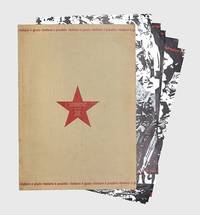
1969148329Milan: c.1969. Striking pop art-influenced suite of anti-imperialist propaganda posters published in Milan by the Comitato Vietnam - self-described in their literature as the "sezione italiana del tribunale Russell". The work of a collective comprised of six prominent Italian artists the images carry the theme 'Rebellion is right rebellion is possible' into various theatres of anti-imperialist struggle. Baratella b. 1935 Mariani b. 1936 and Spadari 1938-97 were long-term collaborators and members of the Nuova Figurazione art movement. Amadori 1945- 2015 won the Joan Miró prize in 1972. Spadari's contribution draws on the "solarised" image of Castro in the Cuban Revolution from his work "26 de julio" while in an anti-Vietnam War themed poster similarly treated repeated images of a Vietnamese women are overlain by a Lichtensteinian US fighter jet wheeling away from an explosion from which emerges a Coca-Cola bottle cap with the slogan 'Nixon boia' - Nixon executioner also the title of a song by popular singer-story teller Franco Trincale - and the partially obscured text 'Coca-Cola merda'. Nixon also features on a poster featuring his cartoonish portrait wearing a star-spangled neck-tie while being choked out by several nooses above him a ferociously snarling Black Panther head; while "Africa Rossa/Africa Nera" centres on a photographic image of the clenched first Black Power salute. Baratella based his poster around his painting "Benito Mussolini Storia del fascismo" where "Il Duce's" face morphs into a skull here with the lower part is superimposed with six small portraits of current political leaders including de Gaulle Pompidou Khrushchev and LBJ. The last in the group dramatises the Arab-Israeli conflict with a repeated image of a woman PFLP fighter - Leila Khaled - in keffiyeh and camo fatigues carrying a AK-47 above her a map of Jerusalem. No other set of these traced a couple of examples of individual posters noted institutionally; an excellent evocation of the artistic-political synergies of the period. Six large black and white photomontage posters 700 x 500 mm printed on coated paper each with the repeated slogan 'ribellarsi è giusto ribellarsi è possibile' in red; in the original tan slub-weave linen textured light card portfolio printed in red title to the front panel superimposed on a red five-pointed star. The portfolio a little rubbed and soiled pale damp spots at the spine-fold where there are a few short splits posters show light handling but overall very good. unknown
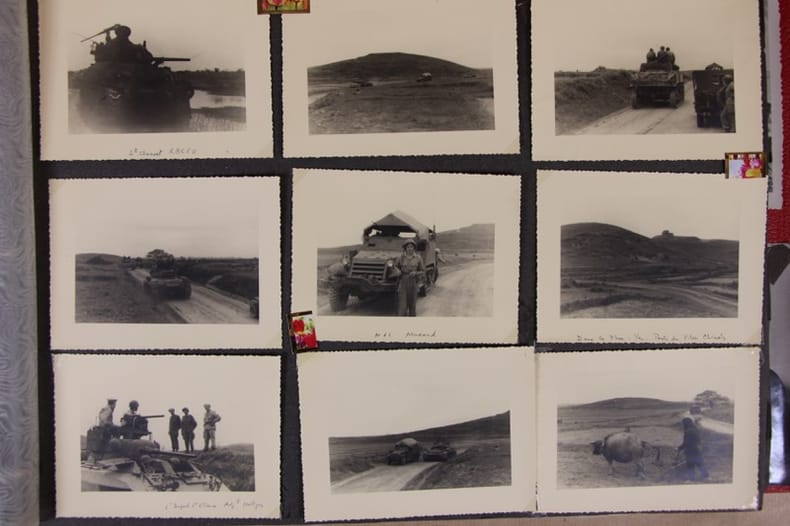
1954135183Sn 1954 Deux albums in-folio oblong, 411 & 607 photographies contrecollées en 40 & 50 planches, format divers : ca 6 x 6 à 17 x 24 cm., majorirtairement 8,5 x 11 cm., tirages argentique et mat, près d’une trentaine de retirages. Nombreuses légendes, en pastilles ou en marge de la photographie. Témoignage photographique d’un officier du 1er escadron du 8ème GSAP 8ème RSA en janvier 1953 au long de deux séjours 4 années et des multiples engagements de cette unité d’intervention : opérations Bissextile, Sablé, Porto, Lorraine, Artois-Bretagne, Corse, Mouette, etc. Le “récit” débute à Alger en 1942 sur quelques photographies familiales puis Saumur en 1949, les étapes du voyage : près de 145 vues prédédent son arrivée. Quelques portaits et scènes de groupe, prises d’arme, etc. précèdent le coeur du reportage : les engagements de son peloton sur half-tracks à l’appui de nombreuses vues de combat, ce qui est rare. Des coupures de presses enrichissent le récit, avec quelques correctifs manuscrits. En point d’orgue : l’opération Mouette. Le second album est agrémenté de près de 300 photographies de correspondants de guerre Camus, Corcuff, Ferrai, Varoqui, etc. de format divers et de très belle facture, débordant le cadre du 8ème spahis : opérations du 3ème BPVN, du 8ème BPC opérations Bambou et Hirondlelle, vue célèbre du 2ème classe Lardillier, le 2ème BEP au Laos, etc. Un document emblématique au coeur du conflit, de toute rareté.
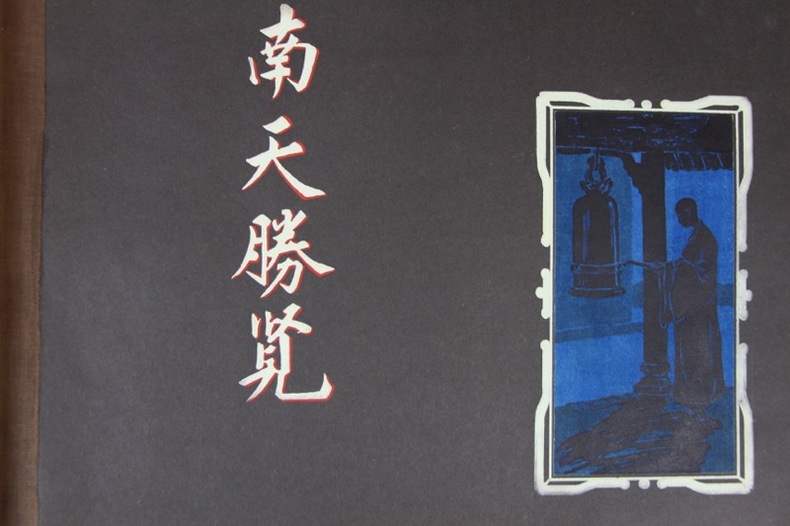
1933134089Sn. 1933 In-4 oblong 27 x 41,5, demi-basane verte à coins, 206 tirages argentiques de formats 23 x 17 cm 14 ; 16 x 11,5 cm 104 ; 11 x 7,5 cm 44 ; 8 x 6.5 cm 2. Superbe album réalisé par les services de communication du Gouvernement de l'Indochine et l'Aéronautique militaire d'Indochine à l'attention d'un haut-fonctionnaire. Les 104 pages grises intérieures sont toutes légendées à la gouache blanche par un calligraphe vietnamien. Majoritairement des vues d’Hanoï : les monuments, l’habitat, les rues, des portraits types et des scènes de la vie quotidienne, petits métiers, paysannerie... Une dizaine de vue aériennes 24 x 17 cm réalisées par des photographes embarqués à bord des biplans Potez de l'aéronautique militaire d'Indochine. Elles sont assez exceptionnelles par leur qualité. Vues d’Haïphong, de Moncay, Chapa, Vientiane, Hué, Dakto, Louang Praband, la baie d'Along, les femmes moïs, etc. Deux vues de têtes de pirates décapités.
1827127501Milan, Imprimerie de l'éditeur 1827 In-folio 35,5 x 25 cm. Brochés, couvertures d’attente, [51-67-36-54] pp., 9-4-5-6 planches sous serpentes. Exemplaires d’une très grande fraîcheur.
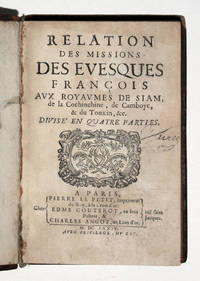
1674244<p>8 ff. 367 1 pp. Bound in contemporary calf gilt heraldic stamp on covers gilt spine with raised bands worn with joints cracked but sound head foot and corners bumped. Lacking endleaves; illegible ownership inscription on lightly soiled title; very good overall.</p><p>Rare first edition of this account of the state of Christianity in Thailand Cambodia Vietnam by rivals of the Jesuits. The Société des Missions Etrangères a new apostolic missionary group established in Paris in 1660 was as a society of secular priests who devoted their lives to foreign missions but refrained from taking vows. Under the aegis of the Propaganda Fide the Société des Missions soon became embroiled in conflicts over territory with the Jesuits. As a result of the patriotism of its priests the organization's impact extended beyond evangelicalism into the political realm: in addition to facilitating a series of embassies and treaties it also successfully established a more active trade between Indo-China the Indies and France. This Relation brought fresh information about the condition of the mission in different parts of southeastern Asia between 1666 and 1671.</p><p>It consists of four parts the first dealing with the mission in Siam and containing descriptions of amongst others Bourbon Island Madagascar and Mozambique the second treating the situation in Cochin-China the third the mission in Cambodia and the fourth being devoted to Tonkin including an account of the work of bishop Lambert de la Motte. Lambert was a member of the Society's first expedition to the Far East which had left Europe in 1660.</p><p>Fermanel de Favery c. 1632-88 superior and director of the "S'naire pour les Missions Etrangères" signs the dedicatory epistle to Cardinal de Bo' and consequently Streit Lach and Van der Kley ascribe authorship to him. The work was reprinted in 1680 and 1684 and an Italian translation <em>Relatione delle missioni de vescovi vicarii apostolici' alli regni di Siam Cocincina Camboia e Tunkino</em> was published in Rome in 1677 and 1697.</p><p> Cordier I.826 s.v. Evêques Français; Chadenat 1706 1684 ed.; Satow 46; Streit V.1797; Lach III.i.222ff.</p> Pierre Le Petit, Edme Couterot & Charles Angot hardcover
1950367089Paris: Édition de la Belle Page 1950. First editions from the limited issues each inscribed by the author. 4 vols. 8vo. Printed wrappers some light toning. First editions from the limited issues each inscribed by the author. 4 vols. 8vo. Collection of four works interpreting Vietnam for a contemporary French public written during the First Indochinese War by Tran Van Tùng 1915-post-1964 a France-based Vietnamese author and nationalist who became secretary general of the Democratic Party of Vietnam which presented itself as a political alternative to both the Diệm and communist governments. Each is inscribed by the author to Philip Dodson Sprouse then first secretary to the American ambassador to France in the early 1950s and later the U.S. ambassador to Cambodia from 1962-64.<br /> <br /> From the limited issues: Le Viet-Nam et sa civilisation is one of 500 hors commerce; Le Viet-Nam au combat is one of 200 on vélin blanc spécial Aussedat; Le Viet-Nam face a son destin one of 400 numbered copies on Marais Crèvecoeur. With Tran Van Tùng's card and associated ephemera. Édition de la Belle Page unknown
Ensemble de 100 volumes broch?s ou cartonn?s.
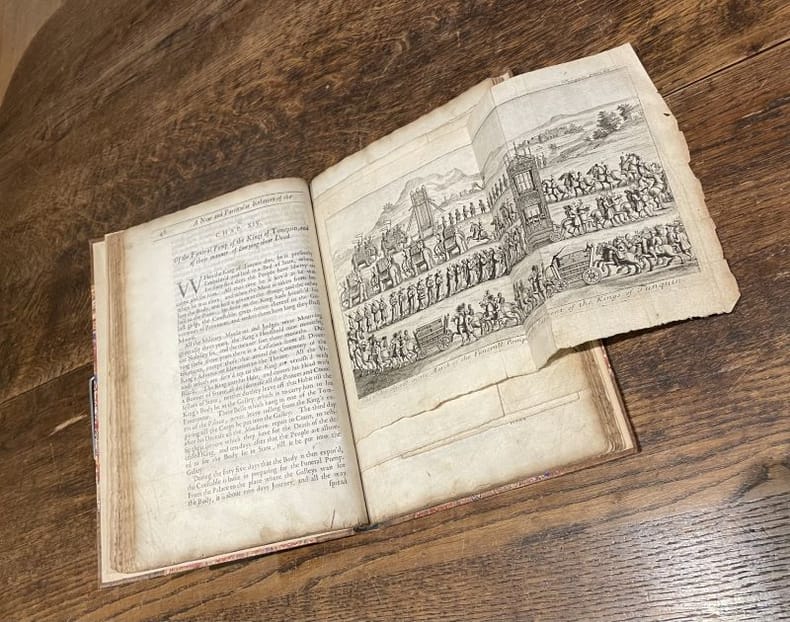
168082460Londres Printed by A. Godbid and J. Playford, for Moses Pitt at the Angel in S. Paul's Churchyard 1680 1 vol. relié in-4, demi-veau jaspé à coins, dos à nerfs encadrés de filets dorés, pièce de titre maroquin rouge, plats de papier peigné, non rogné, 1 f. + titre + 10 ff. (avertissement, dédicace, préface, table)+14-[4]-15-46-[4]-47-87+66 pp. Édition originale anglaise (l'originale française parut chez Clouzier l'année précédente) qui contient une description du Tonkin, dérivée des observations du frère de l'auteur, une description du Japon, recueillie auprès de négociants, et une violente attaque contre les agents de la Compagnie néerlandaise des Indes orientales. La première partie, consacrée au royaume du Tunquin (Tonkin), est illustrée de 8 planches gravées dépliantes oblongues. Mais il manque la planche réunissant les cartes du Japon et du Tonkin. Initiales gravées sur bois et ornements en tête de chapitres. Notes manuscrites sur la première page muette (deux citations poétiques en anglais dont une d'Alexander Pope : "If to her share some female errors fall, Look on her face and you'll forget them all") et ex-libris manuscrit au bas de la page d'avertissement "Franceis Stephens book 1721". Cet ouvrage très rare est conservé dans une bonne reliure du début du XXe siècle, mais présente deux restaurations grossières (au premier feuillet de la préface et à la dernière gravure collée qui ne se déplie plus), quelques déchirures sans manque (notamment sur trois des gravures), quelques rousseurs et tâches.
168082460Londres Printed by A. Godbid and J. Playford, for Moses Pitt at the Angel in S. Paul's Churchyard 1680 1 vol. relié in-4, demi-veau jaspé à coins, dos à nerfs encadrés de filets dorés, pièce de titre maroquin rouge, plats de papier peigné, non rogné, 1 f. + titre + 10 ff. (avertissement, dédicace, préface, table)+14-[4]-15-46-[4]-47-87+66 pp. Édition originale anglaise (l'originale française parut chez Clouzier l'année précédente) qui contient une description du Tonkin, dérivée des observations du frère de l'auteur, une description du Japon, recueillie auprès de négociants, et une violente attaque contre les agents de la Compagnie néerlandaise des Indes orientales. La première partie, consacrée au royaume du Tunquin (Tonkin), est illustrée de 8 planches gravées dépliantes oblongues. Mais il manque la planche réunissant les cartes du Japon et du Tonkin. Initiales gravées sur bois et ornements en tête de chapitres. Notes manuscrites sur la première page muette (deux citations poétiques en anglais dont une d'Alexander Pope : "If to her share some female errors fall, Look on her face and you'll forget them all") et ex-libris manuscrit au bas de la page d'avertissement "Franceis Stephens book 1721". Cet ouvrage très rare est conservé dans une bonne reliure du début du XXe siècle, mais présente deux restaurations grossières (au premier feuillet de la préface et à la dernière gravure collée qui ne se déplie plus), quelques déchirures sans manque (notamment sur trois des gravures), quelques rousseurs et tâches.
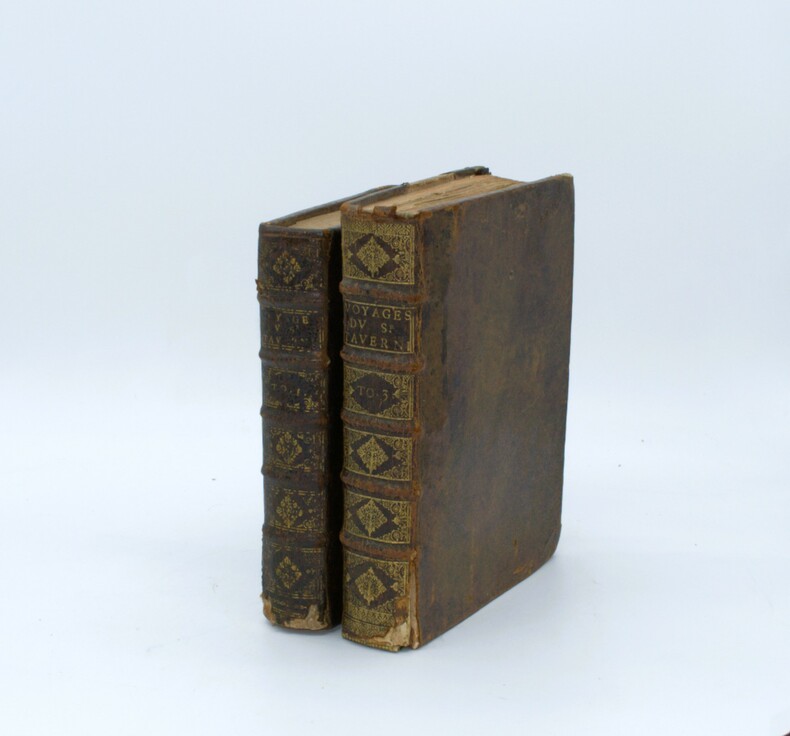
1676PHO-1352A Paris, Chez Gervais Clouzier, 1676-79, 2 volume in-4 (sur 3),30pp.- 698pp.-8pp.-2ff.,8 ff., 72 pp., 1 f., 156 pp.,2 ff., 96 pp. , 1 f., 178 pp., tome 1 ,illustré de 6 planches (7) et tome 3 ; 12 cartes et planches (complet), relié plein veau époque , dos à nerfs ornés avec titre et tomaison , tranches mouchetées , coins , coiffes et coupes usés , début de fente, manque de matière , tome 1 plus petit avec quelques rousseurs , plan d’Erevan coupé court , déchirures aux plis ,réparation carte du Tunquin , manque le tome 2.
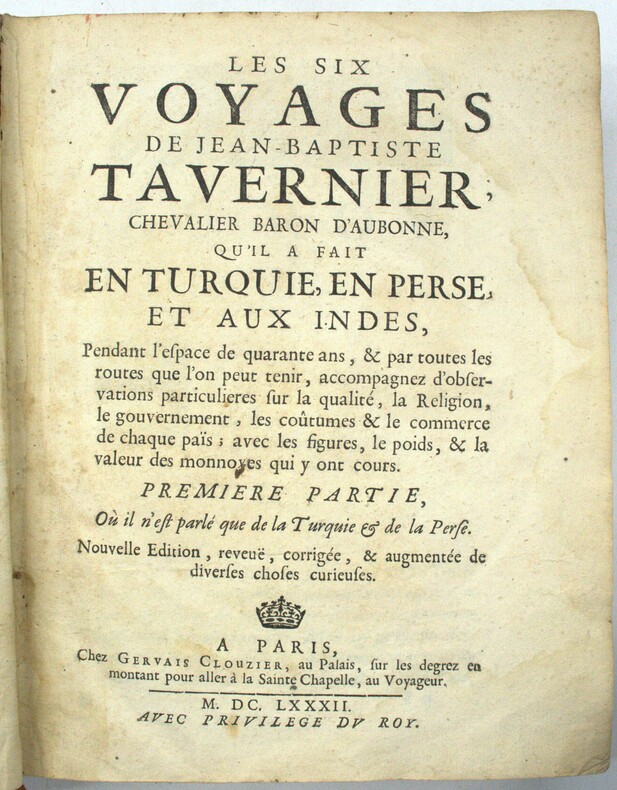
1680PHO-1964Paris, chez Gervais Clouzier, 1682-1680, 3 volumes in-4 (246x195mm), 14ff.-636pp., 4ff.-481pp., 8ff.-72pp.-1f.-156pp.-1f.-96pp.-4ff.-1f.-178pp., Illustration : Tome 1 ; 7 planches (6 dépliantes) sur 8, Tome 2 ; 26 planches dont 15 de monnaies, 5 de pierres et 4 gravures dans le texte, Tome 3 ; 2 grandes cartes (Japon, 79x56cm et Tunquin, 56x41cm) et 8 planches dépliantes. Basane époque, dos à nerfs avec titre et tomaison, frottements, griffures et épidermures, Tome 1 ; accroc au plat, coiffe sup. absente, 2 coins usés, rousseurs, mouillure en coin puis en marge, planches avec déchirures sans manque, page 431 déchirée avec manque. Tome 2 ; fente au dos et charnière, coins usés, rousseurs et brunissures, 1 planche déchirée sans manque. Tome 3 ; coins usés, coiffes arasées, carte du Japon volante, déchirure carte du Tunquin, carte du Japon légèrement oxydée, petites rousseurs.
1970WRCAM55101Biên Hòa Nha Trang Long Binh and other locations in Vietnam plus Luzon Philippines and Osan South Korea 1970. 469 black-and-white or color photographs measuring between 3 1/2 x 3 1/2 inches and 8 x 10 inches either mounted or laid-in to acetate sleeves almost all annotated in ink on the bottom margin or on the verso. Contemporary three-ring thick quarto-size binder black cloth over boards. Joints partially split some abrading and dust- soiling to covers. Slight fading to some of the color photos. Overall very good. An exceptional vernacular photograph album by a talented but unknown amateur photographer recording a wide variety of experiences on American Air Force bases in South Vietnam and Asia during peak years of the Vietnam War. <br> <br> The photographer was likely a member of the motor pool or a mechanic as the shots seem to center around truck airplane and helicopter maintenance. Most of the photographs capture scenes on or around the various bases with shots both inside and outside of barracks airplanes including several shots of a U2 spy plane bombed-out equipment and numerous photos of the people and structures in the "Vietnamese Area." A few images capture distant shots of the aftermath of a "rocket attack" on December 12 1969; shortly thereafter the photographer and his friends celebrate Christmas. Some of the more interesting photographs during the photographer's time in Vietnam include "VC Prisoners" "Group of Zips" "Papa-San Working His Rice Paddie" "Vietnamese Guard Tower" "Church on the West Side of Biên Hòa" "Refueling at Phan Rang Run" "Bring the Wounded Out" and several pictures labeled "Buddha Hill" likely the Long Son Pagoda in Nha Trang. Notably and for no obvious reason in two separate images the photographer snaps a picture in a magazine of the famous photograph of ThÃÂch Quang Duc the monk who burned himself alive at a busy intersection in Saigon in 1963. Several times the photographer takes a picture of another picture an interesting practice in the context of so many original photographs. <br> <br> A handful of images of the photographer himself can be seen in the album. In a couple of shots he is posed with his pet lizard. Later he and his fellow soldiers adopt a pet monkey who features in several photographs. There are also a healthy amount of aerial images featuring the South Vietnamese landscape notably rice fields villages rivers "bomb craters" and cities among other locations. Also the photographer identifies dozens of fellow soldiers by name throughout the album in both single portraits and in group photos. <br> <br> The album contains numerous shots both black-and-white and in color taken from the crowd and later on the runway during a December 28 1969 U.S.O. show at Long Binh with several images each of Bob Hope Neil Armstrong Connie Stevens Suzanne Charny Teresa Graves Les Brown the Golddiggers and others. One photograph of Neil Armstrong is captioned "Biggest Hit of the Show." This is understandable given the fact that Armstrong landed on the moon just five months before this U.S.O. show. There is also an 8 x 10 photograph of Connie Stevens inscribed to "Ron" either the photographer's first name or an autographed picture he received from a friend. After the U.S.O. show the photographer snaps several closer shots of Bob Hope Connie Stevens and others climbing into cars to leave. <br> <br> In April or May 1970 the photographer was shipped out to Osan Air Base in South Korea. Along the way he spends a couple of days at Clark Air Base in Luzon in the Philippines where he snaps a few shots of the base. By early May he has arrived at the Osan Air Base near Songtan Station in the city of Pyeongtaek South Korea just south of Seoul. He seems to be happy with his appointment at Osan; he captions one photograph "Home Sweet Home" and a few shots of the countryside as "Paradise." Here he also photographs Korean farmers their families villages a marketplace a church a school and other landmarks. The final two images dated in August 1970 show the photographer on an airboat on an unidentified Korean river. <br> <br> Personal photographic records by soldiers in Vietnam are growing ever more scarce in the market. This collection is one of the best we've encountered and most certainly informs the overall record of the war during perhaps its lowest point of public support. hardcover books
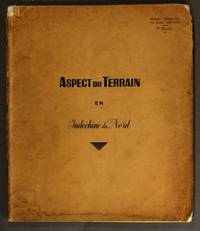
195435722Saigon: Édition du Service cartographique des F.T.E.O. 1954. First edition large square 4to pp. 117; photographic illustrations throughout; some wear a few short splits in the wrapper extremities else very good in original brown wrappers printed in black on the upper cover. At head of title: Forces terrestres du Nord Vietnam. 2. Bureau. Issued during the final battle for France in Vietnam at Dien Bien Phu. Cornell Arizona and Michigan only in OCLC. <br/><br/> Édition du Service cartographique des F.T.E.O. unknown books
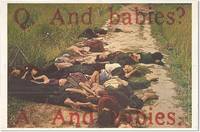
197083515New York: Art Workers Coalition 1970. Offset lithograph in colors; 64cm x 97cm 25" x 38". Mild creasing to extremities else a fine clean copy; unbacked. This one of a presumably small number of copies bearing a rubber-stamped message which reads: "This poster was originally co-sponsored by the Museum of Modern Art. On Dec. 19 trustee William S. Paley forbid the Museum to associate its name with this poster. Do the Trustees approve of the massacre" stamped twice in the image lower right. <br /> <br /> One of the true icons of Twentieth Century American protest art this poster created by the Art Workers Coalition under the guidance of Fraze Dougherty Jon Hendricks and Irving Petlin was issued to bring attention to the horrendous My Lai massacre of March 1968. The photograph by Ron Haeberle originally appeared in Life Magazine. The Museum of Modern Art had originally promised to underwrite the poster's creation and to donate paper and printing costs - but later abandoned the project under the objections of board President William S. Paley. The AWC still managed to print fifty thousand copies which they distributed for free. As a response to MoMA's backing out of the project an unknown number of the posters were rubber-stamped with the message quoted above and a demonstration was held inside the museum in front of Picasso's Guernica where copies of the poster were unfurled and given away. These events are recorded in a 2015 interview with co-creator John Hendricks: ".We had a big meeting of Art Workers' Coalition about how we should address their MoMA's reneging of the agreement with us. It was decided to make a rubber stamp.saying "This is the poster that the Museum of Modern Art agreed to do jointly with Art Workers' Coalition and Bill Paley and Arthur Drexler refused to do" or something like that. So we stamped as many posters as we could with that stamp. Then we had a number of demonstrations in front of the museum and inside in front of Guernica." interview with William Twersky WT_History Blog April 2015. We have traced no copies in commerce or institutional collections that make note of the rubber-stamped notice. In 1972 the design was repurposed to protest President Richard Nixon's campaign for a second term; for that version the motto was changed to "Four More Years Four More Years" 83515. Art Workers Coalition unknown
1674244<p>Rare first edition of this account of the state of Christianity in Thailand Cambodia and Vietnam by rivals of the Jesuits the newly founded Société des Missions Etrangères.</p> Le Petit, Couterot, & Angot hardcover books
180621219London, Cadell and Davies in the Strand, 1806. XVII(I S., 1 Bl., 447 S. 2 gefalt. kolorierte Kupferstichkarten und 19 (1 mehrfach gefalt.) kolorierten Aquatinta-Tafeln. Kl.-4°. HLdr. des 19. Jahrhunderts mit Rückenschildern und Rückenvergoldung (etw. berieben und bestoßen). [5 Warenabbildungen]
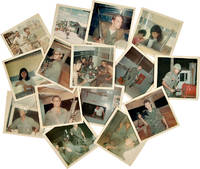
1972WRCAM55575Various places in Vietnam 1972. 145 photographs all but thirteen in color most approximately 3 1/2 x 3 1/2 inches. Majority of photographs mounted on black paper stock with non-archival adhesive tape some photos retain remnants of tape at corners. Some images a bit faded but generally in very good condition. A tremendous collection of photographs depicting the personal life and military service of an unidentified African-American soldier with the last name "Williams" serving in Vietnam during the war and with numerous family photographs at home. The majority of the photographs are undated but those that are dated place the collection roughly between 1968 and 1972. Other identifying characteristics in the photographs indicate that the soldier was likely part of the United States Air Force 93rd Security Police Squadron which provided security and air base defense during the Vietnam War. There is a photograph of Williams leaning against the sign for the 93rd SPS dormitory. <br> <br> Notable in the sixty or more photographs from the soldier's time in Vietnam are images from an unidentified American Air Force base depicting soldiers in the barracks a mess hall and fraternization among soldiers; additional photographs show a heavily-armed Williams manning a bunker holding an EBONY magazine posing with a South Vietnamese soldier in an urban setting and staring strikingly at the camera wearing machine gun ammunition and a hand grenade. A series of thirteen images were taken at "Le Van Loc" a popular Vietnamese night club located on the Tan Son Nhut Air Base near Saigon indicating Williams may have been stationed at or near that base. Personal photographs show individuals of varying ages presumably family members who appear alone or in groups and at times are photographed with Williams. Several of these photographs feature children presumably Williams' at home and at an Elmhurst School function. Williams seems to have been especially proud of his motorcycle as it features in a few shots. <br> <br> A collection of both service and family photographs capturing a young African- American serviceman during the Vietnam War. unknown books
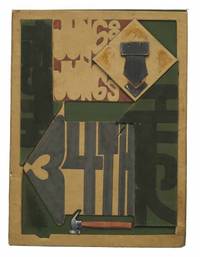
196942627Vietnam: Published by 20th EB Information Office 1969. 1st printing. Presumed one of one i.e. a unique item. Green cloth binding with front board having custom multi-layer onlays depicting the units of the 20th Brigade; rear board with diamond-shaped cut-out for a b/w photograph of a unit bulldozer. Eps original artwork of divers construction scenes; rear paste-down an original bust pencil drawing of Col. Wilson. A VG to Nr Fine item. ~ 85 leaves multi-colored paper. Illustrated with over 60 original b/w photographs most captioned ~ 45 action scenes of divers brigade projects the remainder of staff and Vietnamese citizens. 7 leaves with newspaper clipping affixed also documenting divers brigade projects. Original artwork by PFC Al Schumer. 11-3/8" x 8-1/2" <br/><br/>The 20th Engineer Brigade is a combat engineer brigade currently assigned to the XVIII Airborne Corps of the United States Army stationed at Fort Bragg North Carolina. Though its predecessor units have lineage that dates back before the American Civil War the formation was not formally designated as the 20th Engineer Brigade until its activation on 16 August 1950 at Fort Leonard Wood Missouri. Deploying overseas in November 1952 it supported construction projects in southwestern France until its return to the US on 10 September 1954. Reactivated on 1 May 1967 at Fort Bragg the brigade deployed to Vietnam where it supported American forces for several years and a dozen campaigns. The brigade was deactivated on 20 September 1971 as American forces withdrew from the country. This souvenir book comprehensively documents the brigade's activities & asssigned personnel during the period of June 1968 to June 1969. A unique item the first such we've been able to offer chronicling this period of US history. Published by 20th EB Information Office hardcover books
18906246SLND [Vietman, circa 1890] 1890 18 Photographie originales tirées sur papier albuminé, 225 x 155 mm. Contrecollées sur carton ( 295 x 230 mm.)
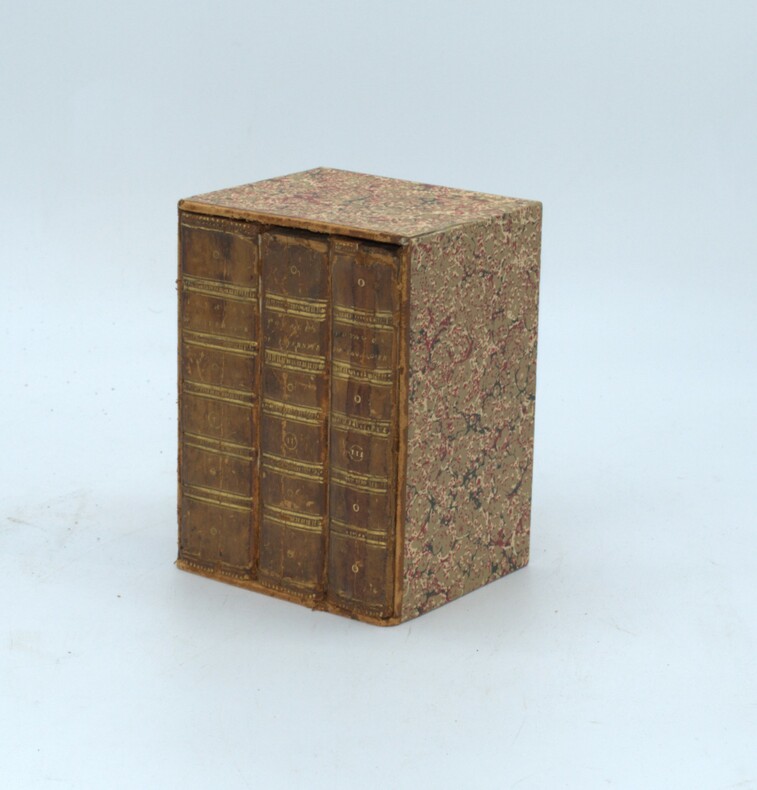
1679PHO-1446Paris , 1679 , 3 vol. in-12, plein veau sous emboîtage, dos orné , filet sur les plats , 19ffn.-780pp.-4ff. , 6ff.-616pp. , 5ff.-564pp.4ff. , charnières faibles , 1 plat détaché , coupes , coins usés, coiffes sup. tome 2 et 3 abimées, réparation au titre tome 2 , manque de papier à l’épître tome 3 , une carte avec manque , déchirure au pli à la carte du Tunquin , trace de réparation avec adhésif sur une planche coupée court .
197174766Tarrytown NY: N.p. 1971. This calligraphic and decorated scroll measures 19 x 124 inches and is composed of five sheets of laid paper attached. Calligraphic text with decoration on the margins. A very powerful yet attractive document.Written much in the style of the Declaration of Independence this scroll written by a known author and illustrated by an renown artist move in an entirely different direction all the while upholding the principles of the US primary document. The time was 1971 and the anger at American involvement in the war in Vietnam was reaching a fever pitch. Marches and demonstrations not a few of which I was dragged to as a youth were happening across the country violence was done to university students. and thousands of deaths were reported weekly on television. It was a great time of togetherness and everyone pitched in. The makers;Robert Andrew Parker; Robert Andrew Parker graduated from the Art Institute of Chicago in 1952 after serving in the Army in the 1940s. He moved to New York after he spent a summer at the Skowhegan School of Painting and Sculpture studying under Jack Levine. Parker continued to develop his printmaking skills at Atelier 17 an historically important printmaking studio founded by the renowned English painter and printmaker Stanley William Hayter. Robert Andrew Parker was also chosen in 1952 as the youngest artist to show at the Metropolitan Museum of Art in the — Exhibition of American Watercolors Drawings and Prints — the exhibition featured Stuart Davis John Marin Robert Andrew Parker and Jackson Pollock. John F. Mahoney seems have slipped the bonds of history but he had a excellent writing style. A source document. N.p. unknown
191246593Hanoi-Haiphong Vietnam: Imprimerie d’Extreme-Orient 1912. Four vols. Folio. xiii 1 370 pp. 20 plates some maps photos each with facing explanatory leaf numerous tables several large folding; Atlas unpaginated w/ 178 diagrams maps geological sections relief maps 2 very large folding colour maps some geological formation plates in colour; 4 146 2 pp. plus 25 plates each with facing explanatory leaf numerous text illustrations diagrams; 8 76 4 pp. plus 9 plates each with facing explanatory leaf numerous text illustrations diagrams. Uniformly bound in original printed wrappers some scuffing soiling edgewear occasional light foxing still a VG- uncut & unopened presentation set inscribed and presented by Honore Lantenois & Henri Mansuy to Prof. Marcellin Boule 1861-1942 French geologist palaeontologist and physical anthropologist who reconstructed the first complete Neanderthal skeleton in France. First edition presentation set of this massive first installment in the Geological Survey of Southeast Asia begun in 1908 documenting the biostratigraphy of the Yunnan Region which was awarded the Tchihatchef Prize of the French Academy of Sciences. Much of this survey work was done during the building of the Hanoi to Yunnan-fou Kunming railroad which was built by the French to exploit the tremendous mineral wealth of Yunnan. The Director of the Department of Natural Resources for France in Vietnam was Honore Lantenois 1863-1940 who worked for years with Henri Mansuy 1857-1937 and sent him back to France several times to study palaeontology at the School of Natural Resources Ecole des Mines. Lantenois recruited Jacques Deprat 1880-1935 in 1908 -- at the time a brilliant palaeontologist -- to conduct an ambitious program mapping the geology of Indochina and neighboring areas. All three men became involved in the notorious Deprat Affair which resulted in Mansuy accusing Deprat to Lantenois in 1917 that Deprat had used a few European-sources trilobites among his fossil specimens from Indochina and Yunnan. This accusation rested on the distinction that the suspect trilobites were not just similar in nature to others found in Europe but the matrix they were embedded may have originated from Europe. Although nearly 90 years later it would be determined that the trilobite fauna discovered by Deprat indicated that the Yunnan had occupied a location adjacent to Bohemia originally in the early Palaeozoic period; the French scientific community condemned Deprat at the time stripped him of his degrees and posts and forced him to leave the field. A complete set including the Atlas is quite scarce. See: Genovese Madeleine Colani and the Deprat Scandal at the Geological Survey of Indochina Journal of the Siam Society Vol. 99 pp. 269-290 2011; Osborne The Deprat Affair: Ambition revenge and deceit in French Indo-China 1999; Stokes Deprat’s trilobites and the position of the Indochina Terrane in the Early Palaeozoic Proceedings of the International Symposia on Geoscience Resources and Environments of Asian Terranes 2008 pp. 201-207. Imprimerie d’Extreme-Orient, unknown
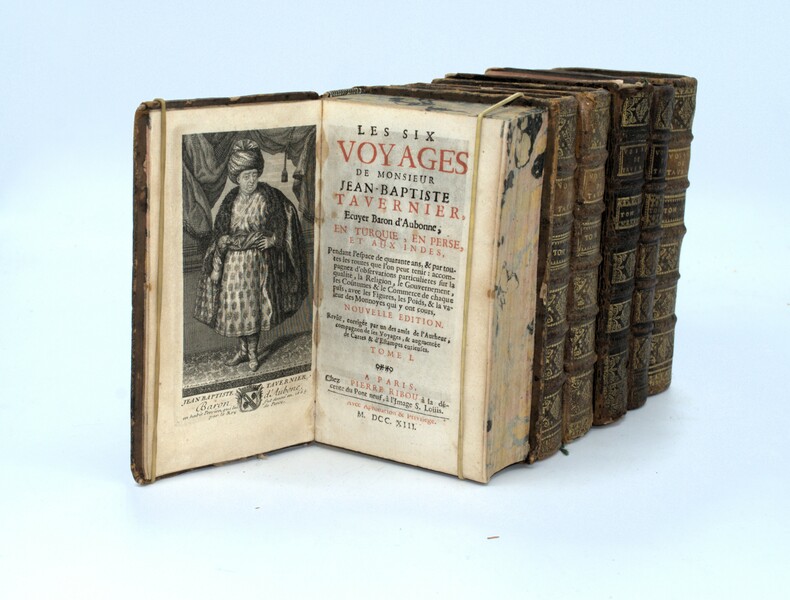
1713PHO-1341A Paris, Chez Pierre Ribou et Rouen chez Jean Baptiste Machuel (tome 5), 1713. 6 volumes in-12, relié plein veau époque, dos à nerfs orné avec pièce de titre et tomaison, tranches marbrées, Tome 5, reliure légèrement différent avec tranches rouges, coins et coiffes usés .T1,27p-501p-1f(table); T2, 1f-465-1f (table);T3 ,1f-402-3f(table);T4,1f-367-2f(table);T5 ,3f(titre, épître)-467-2f(table),T6 3f(titre, épitre)244 -2f (table) .Illustré de 63 planches la plupart repliées, dont un portrait et 3 grandes cartes (manque la carte du Japon) ; quelques vignettes dans le texte , quelques planches au tome 5 volantes, 1 planche doublée.