Anti Vietnam WarBiblio.com

330 résultats
1964222171964. Counterculture Vietnam War This pair of mimeographed documents issued in 1964 and 1969 respectively capture the shifting rhetorical and political frameworks of U.S. justification and policy aims in Vietnam offering rare comparative insight into both the Lyndon B. Johnson and Richard Nixon administrations' public positions. 1 Some Questions on Vietnam. Washington: Friends Committee on National Legislation June 3 1964. 2 Mr. Nixon's Points. N.p October 14 1969. Two double-sided mimeographed typescripts measuring 8.5" x 11" each. Together they trace the continuity and contradictions in American official thinking from the earliest stages of direct military intervention to the early attempts at managed withdrawal. The 1969 document is particularly notable for its side-by-side presentation of Nixon's proposed peace terms with those of the National Liberation Front NLF the political wing of the Viet Cong.<br /> 1 The first document dated June 3 1964 and issued by the Friends Committee on National Legislation in Washington D.C. is titled Some Questions on Vietnam. Framed as a briefing tool for concerned citizens it outlines the U.S. position in the early escalation phase of the war and provides extensive excerpts from contemporary sources including President Johnson's June 2 press conference and articles from The Washington Post and New York Times. Johnson is quoted stating that the U.S. is "bound by solemn commitments to help defend this area against Communist encroachment" reaffirming the domino theory logic underpinning American involvement. <br /> <br /> The handout catalogs U.S. military strategies then being deployed including the "Strategic Hamlet Program" in which "thousands of peasants were uprooted at gunpoint and moved into defensive village-clusters far removed from ancestral lands." Other methods included the use of lie detectors on suspected Viet Cong and defoliation tactics that the Washington Post acknowledged raised "questions of the wisdom of using such agents at all in this kind of war. where the consequences are visited upon a civilian population we are trying to defend." The leaflet also raises doubt about South Vietnamese support for the war: "the Saigon government has the allegiance of probably no more than 30 per cent of the people." Statistics from the Pentagon note that by May 25 1964 1130 American servicemen had been killed wounded or listed as missing since 1961. Senator Wayne Morse is quoted: "We have already poured into that sink-hole over $5½ billion." The final sections argue that economic aid cannot be separated from military goals and propose alternatives such as United Nations mediation. Notably the sheet warns that mail to the White House on Vietnam had been averaging fewer than 150 letters per week urging citizens to "make their views known to the President and your Congressmen."<br /> <br /> 2 The second document dated October 14 1969 presents President Nixon's public negotiating stance during the early phase of his "Vietnamization" strategy. Titled Mr. Nixon's 8 Points the yellow sheet begins with a justification of U.S. sacrifices: "The United States has suffered over a million casualties in four wars in this century. We are proud of this record and we bring the same attitude in our search for a settlement in Vietnam." Nixon outlines eight specific principles most notably: "We seek no bases in Vietnam. We insist on no military ties. We are willing to agree to neutrality for South Vietnam if that is what the South Vietnamese people freely choose." He continues "We have no intention of imposing any form of government upon the people of South Vietnam nor will we be a party to such coercion." The points include phased withdrawal over twelve months the establishment of an international supervisory body elections under international supervision release of prisoners of war and mutual agreement to observe the 1954 Geneva Accords. Nixon concludes with a reaffirmation that U.S. presence would end entirely once these measures were fulfilled.<br /> <br /> The reverse of the Nixon flyer contains The NLF's 10 Points the Viet Cong's counter-position which sharply contradicts Nixon's framing. Point 2 is categorical: "The U.S. Government must withdraw from South Vietnam all U.S. troops military personnel arms and war materiel. and liquidate all U.S. military bases in South Vietnam." Point 4 emphasizes sovereignty: "The people of South Vietnam shall settle themselves their own affairs without foreign interference." Throughout the NLF stresses full political participation neutral diplomatic relations and reunification of Vietnam as "a peaceful process. without foreign interference." Notably Point 9 demands that the U.S. government "must bear full responsibility for the losses and devastations it has caused to the Vietnamese people in both zones."<br /> <br /> Juxtaposing these two documents reveals a significant divergence between U.S. public rhetoric and Vietnamese revolutionary demands. While Nixon framed U.S. intentions as altruistic and limited the NLF viewed the war as colonial in nature and demanded unconditional withdrawal. This side-by-side format would have been a powerful tool for peace activists and educators in 1969 especially as public trust in government narratives about Vietnam eroded in the wake of the Tet Offensive and ongoing domestic protest. Very good condition overall. unknown
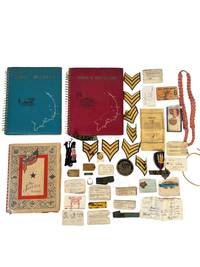
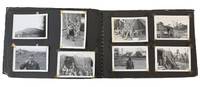
1942193041942. Coon Clarence; Coon Michael. Coons family Air Force service archive 1942-1944 and 1968-1969 documents two generations of American military experience across World War II and the Vietnam War offering direct evidence of shifting military culture wartime attitudes and generational identity within a single family. Clarence Coon's New York World War II service as an engineer gunner in the Fifteenth Air Force in Italy situates the archive within the Allied air campaign over Europe while his son Michael Coon's deployment to South Vietnam places the later material within the context of a deeply contested and culturally transformative conflict. Clarence's letters and scrapbook entries foreground a disciplined and duty-oriented perspective shaped by mid-century wartime expectations while Michael's photographic record presents a markedly different tone capturing leisure irreverence and camaraderie among soldiers during the Vietnam era. The archive preserves Clarence's written voice including lines such as "Another card to let you know that I don't do all my writing to women" and his commentary on the 1942 New York gubernatorial election "The radio just announced Bennet's Defeat. To bad. Well we will see what Dewey can do. I wish him luck" as well as his observations during stateside training "Well as far as I'm concerned they can give Tenn. back to the Indians. We are walking around in a sea of mud. Its all day rains every 5 min. I wouldn't live in the South for anything." Together these materials establish a continuous family narrative linking wartime service political awareness and personal expression across two major twentieth-century conflicts.<br /> <br /> Coons family Air Force archive. United States and Vietnam 1942-1944 and 1968-1969. Group consists of two photograph albums from Vietnam War service and one World War II scrapbook accompanied by a quantity of associated ephemera including patches medals registration cards business cards a ring and a dog tag. Archive contains approximately 123 photographs across the albums and scrapbook along with numerous postcards including 26 with manuscript correspondence on the verso and three pages of a letter incorporated into the scrapbook. Scrapbook also includes newspaper clippings documenting Clarence Coon's training and service progression including flight training in Westover Massachusetts; Nashville and Smyrna Tennessee; technical training in Gulfport Mississippi; and gunnery and pistol range distinction at Tyndall Field Florida. Vietnam-era albums depict Michael Coon and fellow servicemen in informal and candid settings including scenes of drinking recreational outings helicopter transport weapons handling and interactions with entertainment venues.<br /> <br /> The juxtaposition of World War II and Vietnam War materials within this archive provides a concentrated record of evolving American military life particularly the transition from the structured collective ethos associated with the Second World War to the more individualized and culturally expressive environment of Vietnam-era service. Clarence Coon's combat role aboard B-24 Liberator bombers during missions over Italy aligns the archive with the strategic bombing campaigns of the European theater while his writings document both military routine and domestic political awareness. In contrast Michael Coon's photographs capture the lived experience of American soldiers in Vietnam beyond formal operations including leisure dissenting humor and the visual language of 1960s youth culture within the military. Light wear from handling throughout with typical album and scrapbook aging and ephemera showing minor creasing; overall very good condition. unknown
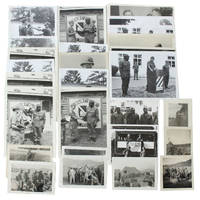
1950186871950. Barber Command Sergeant Major. U.S. Army 17th Field Artillery Battalion photographs circa 1960s to 1970s document integrated military training and the advancement of an African American senior noncommissioned officer within the post-desegregation Army. The images center on activities at a Noncommissioned Officer Academy and within field environments placing the archive within the period following the formal integration of the U.S. military and during the era of the Vietnam War. The repeated presence of Barber in both instructional and ceremonial contexts situates him within the upper ranks of enlisted leadership documenting the visibility and authority of Black noncommissioned officers at a time when opportunities for advancement had only recently expanded following mid-twentieth-century reforms.<br /> <br /> Archive of 30 black and white silver gelatin photographs. United States circa 1960s to 1970s. Photographs range in size from approximately 7 x 5 inches to 4 x 3 inches. Images depict integrated groups of soldiers within the 17th Field Artillery Battalion known as "The Persuaders" engaged in training and daily activities. Scenes include artillery instruction trench digging weapons handling camp life chapel gatherings and a graduation ceremony in which soldiers take an oath and pass a unit flag. Several photographs show Barber prominently including moments that appear to document formal oath-taking or advancement within the noncommissioned officer structure. The photographs appear to have been taken across multiple locations including a more rugged field setting and a separate academy environment.<br /> <br /> Following the desegregation of the U.S. armed forces in 1948 African American soldiers increasingly assumed leadership roles within enlisted ranks particularly during the Cold War and Vietnam War periods. The position of Command Sergeant Major represents one of the highest enlisted leadership roles in the Army responsible for discipline training and the welfare of soldiers. This archive provides visual evidence of integrated unit cohesion professional training systems and the presence of Black leadership within those structures. The combination of field exercises and formal ceremonies offers material for examining race hierarchy and institutional culture within the modern U.S. Army. Light wear consistent with handling; overall very good condition. unknown
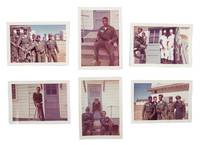
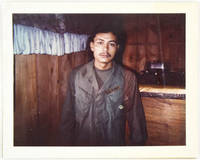
1973185751973. Cooper Howard L. Vietnam War photographs and promotion letter circa 1970s document African American noncommissioned officer service within an integrated U.S. Army and the formal evaluation structures governing advancement during and immediately after the conflict. The material centers on Sergeant Cooper's presence within a deployed unit in Vietnam alongside fellow soldiers and local civilians and extends into the postwar administrative process through a typed recommendation for promotion dated 1973. Together the photographs and letter situate the archive within the broader context of African American military participation during a period marked by both expanded combat roles and documented racial disparities in discipline assignment and promotion within the armed forces.<br /> <br /> Archive of 20 vernacular photographs and one typed letter. Vietnam and United States circa 1970s. Photographs include 15 color Kodak snapshots measuring approximately 5 x 3.5 inches or smaller depicting Sergeant Cooper and fellow soldiers primarily in uniform in Vietnam. Four black and white Agfa snapshots measuring approximately 5.5 x 3.5 inches show Cooper other servicemen and Vietnamese children. One Polaroid photograph includes two African American men standing beside Cooper with handwritten captions. Additional images depict base life and group interactions within the unit. Accompanying the photographs is a typed letter recommending Sergeant Howard L. Cooper for promotion signed by Transportation Supervisor Alice J. Griffin Fort Ord California dated 14 November 1973 one page measuring approximately 8 x 10 3/8 inches.<br /> <br /> African American soldiers served in large numbers during the Vietnam War with many attaining noncommissioned officer roles that required both leadership within units and navigation of institutional structures that did not always provide equitable advancement. The inclusion of a formal recommendation letter alongside the photographs connects personal service to bureaucratic recognition documenting how military authority evaluated performance in the postwar period. The combined visual and documentary record offers material for examining race leadership and military administration in the Vietnam era. Photographs show light wear; letter with pinholes discoloration and minor ink smear at upper edge; overall very good condition. unknown
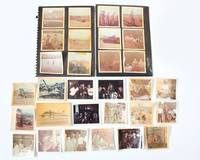
1970185581970. Vandergriff Sergeant. Vietnam War photographs 1970 to 1971 document integrated U.S. Army service during a period when African American troops were serving in substantial numbers in combat units and negotiating both military duty and racial dynamics within the ranks. The images record a tour of duty from basic training through the final days before return home placing the archive within the later phase of the Vietnam War when troop morale racial tension and antiwar sentiment were all intensifying within the U.S. military. The presence of a visibly multiracial unit with many African American soldiers situates the photographs within the post-desegregation military structure established after World War II offering direct visual evidence of daily life interpersonal relationships and combat readiness in an officially integrated force.<br /> <br /> Archive of 68 color Polaroid photographs. Vietnam 1970 to 1971. Images measure approximately 3.5 x 3.5 inches to 3.5 x 4.5 inches with approximately one quarter mounted to black board and the remainder loose. Several loose photographs include handwritten captions and soldiers' names on verso. The sequence follows Sergeant Vandergriff's service from training through deployment with scenes including soldiers smoking drinking and posing with standard-issue M16 rifles and M1911 sidearms. Additional images show helicopter interiors and aerial views a destroyed grounded helicopter tanks aircraft drill formations and encampments. Photographs also depict Vietnamese villages and local civilians including two children bathing in a river. Unit identification is not explicitly stated in the archive. Other photos depict aircraft drill marches tanks weaponry villages and locals including two Vietnamese children bathing in a river. It is not clear which unit these troops belong to. It is possible they are in the 101st Airborne which was prominent at both Birmingham and Evans.<br /> <br /> During the Vietnam War African American soldiers served in disproportionately high numbers in combat roles particularly in airborne and front-line units at a time when the U.S. military was confronting internal racial conflict alongside external war. This archive documents the lived experience of a multiracial unit operating within that structure showing informal social interaction alongside military activity and equipment. The combination of candid personal imagery and operational context provides material for examining race military culture and everyday life in a late-stage U.S. combat theater. Some photographs show minor staining and image degradation; overall very good condition. unknown
1960232781960. Black U.S. Army soldier's photo album documenting home and military life between Virginia and Vietnam in the late 1960s and early 1970s. Black servicemen moved through the formally desegregated Army during the first major U.S. war fought after official military integration. Centered a young black enlisted man the album tracks the life of service through photos at camp soldiers in formation military equipment helicopters and with portraits alongside other soldiers. Though the Korean War was the first U.S. war that was formally desegregated the units still saw unequal integration and opportunity while the Vietnam War marks an era in which a desegregated military was already well established. <br /> <br /> Photo archive of 92 color and black and white photographs ranging from 3.5" x 3.5" to 3.5" x 5" Virginia and Vietnam late 1960s to early 1970s. Mounted in a 10" x 14" spiral bound album. Many images show the compiler in uniform and civilian dress some of the earlier home scenes have handwritten inscriptions en verso. Other images show helicopter scenes in flight and at camp; tent lines wooden barracks; soldiers standing in formation gathering in small groups and posing beside military vehicles and equipment. A Virginia license plate anchors the soldier's home state and the use of quippy captions gives this soldier a voice identifying some individuals by their first name and one particular youthful photo of himself captioned "Dunn will be leaving on January the 1st army But you know he is trying to get out of it said he was going to school. Ha! Ha! Uncle Sam's school" giving a glimpse into the prior aspirations of young Black man right before being drafted.<br /> <br /> Black soldiers entered the Vietnam era military in large numbers at the same time that civil rights struggles Black Power politics and mounting criticism of the war reshaped the meaning of service for African American men. This album gives weight to that history with repeated presence of black men within camps and comradeship with white soldiers. Adhesive residue to corners and backs of some images edgewear to album and leaves and expected handling wear; photographs generally clear and legible. Overall very good condition. This album shows the ground level of Black military experience in the early post segregation Army. unknown
197052105Hamden CT: Archon Books 1970. 8vo. 349 1 pp. Numerous plates maps. Pink-coloured cloth gilt lettering on spine w/ d.j. wraparound cover art slight shelfwear very slight closed tear upper fore-edge NF/NF copy. First American edition. Archon Books, hardcover
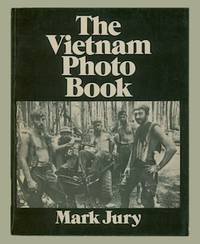
197188609NY: Grossman 1971. First trade paperback printing. Small 4to. 160 pp. Covers lightly rubbed else very near fine in illustrated wrappers with a small corner crease to the rear panel. An encounter with Robert Capa’s IMAGES OF WAR inspired Jury to communicate his own experience and that of his fellow soldiers. NY: Grossman, paperback
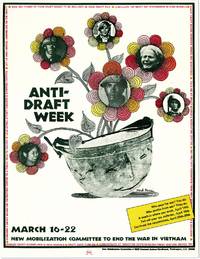
197082861Washington DC: New Mobilization Committee 1970. First Edition. Original illustrated poster offset printed in colors on white stock measuring 39cm x 50.5cm 15.25" x 20". Subtle toning along lower edge some trivial wear to extremities; unbacked very Near Fine. Striking anti-draft poster designed by Mark Morris featuring a combat helmet-turned-flower pot with the center of each flower containing the faces of men women children and soldiers. The border of the poster details specific actions civilians could take to resist the draft: bar military recruiters from high school and college campuses draft card turn-ins demanding draft counselors in high schools picketing the homes and businesses of draft board members and talk-ins et al. Not found in OCLC though we note examples held at OMCA CSPG and Minneapolis Institute of Art. 82861. New Mobilization Committee unknown
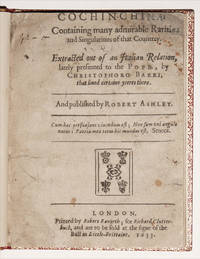
16334531London: Robert Raworth for Richard Clutterbuck 1633. Hardcover. Very Good. 4to - over 9¾ - 12" tall. Tastefully bound in ruled red morocco interior gilt dentelles; title-page dusty and trimmed at upper & outer margins; repaired corner of prelims. Otherwise very good. Rare first edition of the first book on Vietnam in English an eyewitness account of the commerce government and cultural life of Cochin-China central Vietnam written by the Jesuit missionary Cristoforo Borri and first published in Italian in 1631.Borri begins by marking the kingdom's boundaries identifying it as a narrow strip of land between Laos and the South China Sea bordered to the north by Tongking and to the south by Champa. A discussion of the kingdom's fertile land and rich natural resources follows emphasizing the abundance of fruits nuts rice fish textiles domestic stock and "all other things requisite for the entertainement of a man's life." Silk is produced in such quantities that "the baser sort of people wear it dayly." Gold and silver mines abound and "the Wood and Timber of this countrey is the best of all the world." Having piqued his readers' curiosity the author goes on to describe Cochin-China's vibrant commercial climate declaring it free of the red tape and bureaucratic hostility that so often greeted European traders in East Asia.Borri's 1631 Relazione a Jesuit missions letter directed at his Catholic superiors and lay readers was already unusual among works in its genre for devoting a substantial part exclusively to non-religious content. Ashley the translator executed further changes of his own in order to render the present work more attractive to Protestant business interests-most notably by omitting the part where Borri testified to the struggle and success of his Jesuit missions particularly the conversion of Pulucambi province. The translation also cheerfully elides two disastrous episodes in recent European trade with Cochin-China: the 1601 massacre of 23 members of an envoy from the VOC and a similar massacre in 1613 of the crew of an English trading vessel. This attempt to coax England's notoriously skittish merchants into commerce with Cochin-China is also borne out by Ashley's choice of dedicatee: Maurice Abbot the newly-elected governor of the British East India Company. According to Pollard and Redgrave the work's last signature is in 3 rather than 4 because the unsigned title-page was printed as the 4th and final leaf.Cristoforo Borri 1583-1632 a Milanese astronomer lived in Cochin-China from 1617-1622 where he learned enough of the language to hear confession. By 1633 two years after its first appearance his Relatione had been translated into French German Dutch and English. This is the first copy to appear on the market since 1988 Christie's sale of John Fleming 11.08.88.STC 1504; Lach.III v. 3 p. 1250-1266; Dror & Taylor Views of 17th C Vietnam pp. 66. Not in Löwendahl who nonetheless records translations in French German and Dutch. Robert Raworth for Richard Clutterbuck hardcover
197146090Washington D.C.: Peoples Coalition for Peace & Justice 1971. Original lithographed poster 22" x 17' ca 56cm x 43cm. Printed in three colors on white paperstock. A few stains on verso bleeding faintly through on lighter portions of image else a bright Very Good copy minimally worn -- Very Good / B. <br /> <br /> Poster promoting the 1971 "Mule Train To Wall Street" an event intended to coincide with the great Mayday Tribe march on Washington described by some observers as the most poorly planned direct action of the Vietnam era. The action ended with the arrest of some 7000 marchers before the event even got underway. The central graphic is of a leering death's-head with inset images of Black and Asian adults and children in distress with title above "Death Has Many Faces We Demand Life!" Artist not identified but a compelling and uncommon poster. Peoples Coalition for Peace & Justice unknown
83188N.p. n.d. ca 1968: Publisher not identified. Offset lithograph 57.5cm x 44.5cm. Printed in black on uncoated cream stock. Mild creasing at margins; printed area clean and fresh; Very Good or better. Issued entirely without attribution. <br /> <br /> Neither the graphic nor the text are attributed nor especially sophisticated - we suspect this is an undergraduate project. The text makes reference to America's martial history listing nine major conflicts beginning with the Revolutionary War and ending with Vietnam concluding: ".Nine Lives Has A Cat / And After That - That's That!" Not separately catalogued in OCLC; copies noted at OMCA and the Swarthmore Peace Collection. Publisher not identified unknown
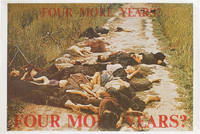
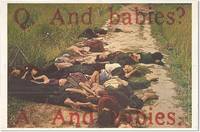
197247693N.p.: Artists' and Writers' Protest / Colorcraft Inc 1972. First Edition. Original photographic poster offset printed in colors on white stock measuring 96.5cm x 63.5cm ca.38" x 25". Some minor handling trivial wear to extremities else very Near Fine / A unbacked. One of the most gruesome and effective pieces of propaganda to emerge during the Vietnam War reproducing a photograph taken during the My Lai Massacre by U.S. Army photographer Sgt. Ronald L. Haeberle. This and other iconic photos were taken by Haeberle on March 16 1968 using his personal camera while assigned to follow Charlie Company into My Lai. Unlike the monochrome images which he returned to the Army shot with a standard-issue Army camera the color images he shot with his personal camera were brought back to the States and sold to Life magazine after Haeberle was honorably discharged. The photos were printed in the December 5 1969 issue of Life offering Americans a harrowing glimpse into some of the attrocities being committed overseas; his caption beneath this image read: "Most were women and babies. It looked as if they tried to get away." The poster was designed by members of the Art Workers Coalition and initially released in 1969 using the identical image with the overlaid text reading: "Q: And babies A: And babies." This version published four years later intentionally subverts Richard Nixon's campaign slogan "Four More Years" forcing Americans to ask whether or not they wanted Nixon for another term and by extention another four years embroiled in foreign conflict. OCLC notes a single holding MoMA. Artists' and Writers' Protest / Colorcraft, Inc unknown
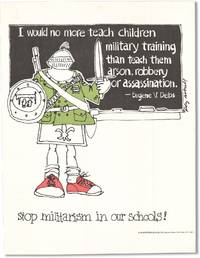
197083038New York: War Resisters League n.d. but early 1970s. Original lithographed poster with text and illustration offset printed in three colors on white stock measuring 43cm x 56cm 17" x 22". Light wear to extremities tiny diagonal crease to lower right corner with some faint foxing at upper margin and on verso; Near Fine. One of seven posters created by Averill 1949-1993 for the War Resisters League. The central image features a childlike figure decked out in military garb from various eras standing in front of a chalkboard bearing a quote from Eugene Debs. A charming poster with a strong anti-conscription message. OCLC notes a single holding at Northwestern though we find others at LC and the OMCA. 83038. War Resisters League unknown
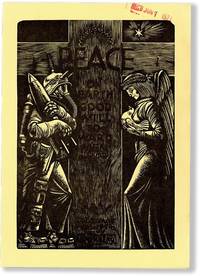
63029Philadelphia: La Salle College 1971. Bifolium 4pp 8-1/2" x 6"; printed in black on ivory card stock. Small ink stamp at upper margin of cover else Fine. Keepsake printed in support of the Nedzi-Whalen amendment "for withdrawal from Vietnam at the earliest possible date." The cover image is after an original wood engraving by Fritz Eichenberg reproduced by permission. Not separately recorded under author or title in OCLC. unknown
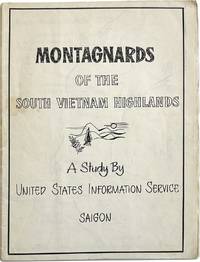
196284347Saigon: United States Information Service Vietnam 1962. Second Revised Edition. Slim quarto 21.5cm; original printed wrappers stapled; ii211pp. Mild wear and handling subtle toning and light dust-soil to wrappers with a few small faint stains; Very Good. <br /> <br /> Revised and corrected edition of a report which first appeared in September 1961 "written in response to a need on the part of the USIS Saigon Motion Picture Section for information about Montagnard dialects. Subsequent developments in the Highlands principally the increased Viet Cong activity there coupled with the fact that virtually no recent material on the Montagnards exists generated unusual interest in the report and it is now being reissued" p.ii. OCLC notes 9 holdings for the second edition. 84347. United States Information Service, Vietnam unknown
197083515New York: Art Workers Coalition 1970. Offset lithograph in colors; 64cm x 97cm 25" x 38". Mild creasing to extremities else a fine clean copy; unbacked. This one of a presumably small number of copies bearing a rubber-stamped message which reads: "This poster was originally co-sponsored by the Museum of Modern Art. On Dec. 19 trustee William S. Paley forbid the Museum to associate its name with this poster. Do the Trustees approve of the massacre" stamped twice in the image lower right. <br /> <br /> One of the true icons of Twentieth Century American protest art this poster created by the Art Workers Coalition under the guidance of Fraze Dougherty Jon Hendricks and Irving Petlin was issued to bring attention to the horrendous My Lai massacre of March 1968. The photograph by Ron Haeberle originally appeared in Life Magazine. The Museum of Modern Art had originally promised to underwrite the poster's creation and to donate paper and printing costs - but later abandoned the project under the objections of board President William S. Paley. The AWC still managed to print fifty thousand copies which they distributed for free. As a response to MoMA's backing out of the project an unknown number of the posters were rubber-stamped with the message quoted above and a demonstration was held inside the museum in front of Picasso's Guernica where copies of the poster were unfurled and given away. These events are recorded in a 2015 interview with co-creator John Hendricks: ".We had a big meeting of Art Workers' Coalition about how we should address their MoMA's reneging of the agreement with us. It was decided to make a rubber stamp.saying "This is the poster that the Museum of Modern Art agreed to do jointly with Art Workers' Coalition and Bill Paley and Arthur Drexler refused to do" or something like that. So we stamped as many posters as we could with that stamp. Then we had a number of demonstrations in front of the museum and inside in front of Guernica." interview with William Twersky WT_History Blog April 2015. We have traced no copies in commerce or institutional collections that make note of the rubber-stamped notice. In 1972 the design was repurposed to protest President Richard Nixon's campaign for a second term; for that version the motto was changed to "Four More Years Four More Years" 83515. Art Workers Coalition unknown
197018470N.p. N.p. c. 1970. Prints in uniformly near fine to very good condition with some curling to the edges. Collection of twenty-five 3 3/8 X 4 1/4 inch Polaroid snapshots mostly in color taken during an American soldier's deployment in An Khê Vietnam. Features images of soldiers grilling drinking and sitting in their bunkers with a few double exposures and a couple of photographs of female civilians. Prints have been adhered to cards with in several instances notes penned on the versos. Fascinating vernacular document of soldier life in one of the most strategically significant military zones of the Vietnam conflict. N.p. N.p. unknown
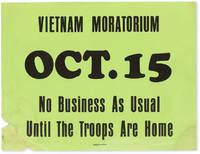
196951008Berkeley: Berkeley Graphic Arts 1969. Original broadside with text offset printed in black on lime green stock measuring 33cm x 25.25cm ca.13"x 10". Modest wear and handling with some creasing and soil to lower corners and a small triangular chip toward lower left edge; Very Good. Small broadside produced for the Moratorium to End the War in Vietnam a massive series of demonstrations held in cities across the country on October 15 1969. Given the place of publication this could likely have been used at the Moratorium Rally at UC Berkeley held at noon at Lower Sproul Plaza an event which included speeches by Fanny Lou Hamer Ron Dellums Joe Cole and Dan Siegel cf. UC Berkeley "The Pacifica Radio/UC Berkeley Social Activism Recording Project: Anti-Vietnam War Protests. Berkeley Graphic Arts unknown
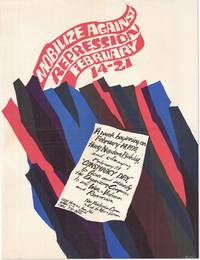
197083053Washington DC: New Mobilization Committee to End the War in Vietnam 1970. Original lithographed poster with text and design elements offset printed in five colors on white stock measuring 44cm x 57cm 17.25" x 22 3/8"; signed "Workshop" in plate at lower right corner. Old folds smoothed out some toning on verso with a 2.5cm split at center of right margin and some light wear to extremities; Very Good. New Mobilization poster promoting a week of events. "A week beginning on February 14 1970 Huey Newton's Birthday and climaxing February 21 "Conspiracy Day" to focus and intensify the Organizing Campaign to end War in Vietnam and Repression." Not separately listed in OCLC though we not an example held by the V&A. 83053. New Mobilization Committee to End the War in Vietnam unknown
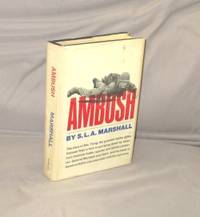
196929025<p>New York:: Cowles 1969. First Printing of the First Edition. A Near Fine copy in a Very Good price clipped dust jacket with a chip missing from the rear fold. This is Marshall's reenactment of the battle of Dau Tieng which like his other accounts is based on after action reports and battle-site interviews with the survivors. General Marshall is the author of over 30 books related to military topics and in Ambush he focuses on US engagement with Vietcong forces poised to attack an American basecamp in an effort to influence American elections. With his unequaled eye for detail Marshall tells the story rich in drama and excitement.</p> Cowles, hardcover
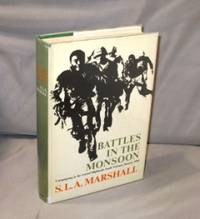
196726089<p>New York:: Morrow 1967. First Printing of the First Edition. A Fine copy in a Very Good plus unclipped dust jacket with shallow chipping to the spine. General Marshall presents a comprehensive account of three specific battles early during the Vietnam War: the battle of Bn Gia Map Vinh Thanh and Tuomorong with the formal military names of "Austin 6" "Crazy Horse" and "Hawthorne II" Marshall utilizes first hand observations and the accounts of participants involved in the various actions to present a punch by punch account of the battles as they unfolded.</p> Morrow, hardcover
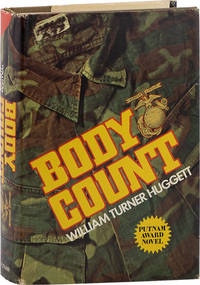
197362827New York: G. P. Putnam & Co 1973. First Edition. 8vo. 22cm x 15cm. Publisher's grey cloth. Dustjacket. Titled and decorated in gilt to spine and front board light edgewear and some minor sunning to the spine ends in a clean bright and strong dustjacket with a little corresponding fraying to the head and tail of the spne. A very good clean copy. 445pp. Internally clean. Ostensibly one of a legion of novels that deal with a green young officer finding out he has virtually no margin for error this is one of the distinguished few novels of the era that is approved of by veterans and is widely considered to be one of the very best and most authentic pieces of Vietnam fiction. The authenticity comes as less of surprise when it's considered that Huggett fought with the 3rd Marine Div. in 1968-1969 and later as a Pacification Advisor in the never ending struggle to win hearts and minds. Newman: 131. G. P. Putnam & Co unknown
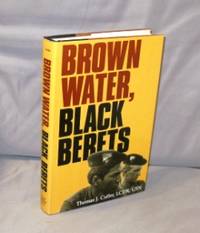
198826088<p>Annapolis:: Naval Institute Press 1988. First Printing of the First US Edition. A Fine unread copy with a blank Naval Institute book plater on front fly leaf in a Fine dust jacket This history of U.S. naval involvement in Vietnam features eyewitness accounts combined with official records to document the drama and accomplishments of the brown-water navy activities in Vietnam. The author himself a member of the black berets and a combat veteran has written a definitive account of the pain frustration and acts of courage and valor that a were a significant part of the naval effort in Vietnam.</p> Naval Institute Press, hardcover
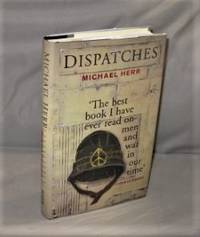
199727293<p>London:: Picador 1997. First Printing of the First UK Edition. A Fine tight unread copy in a Fine bright unclipped dust jacket. Michael Herr went to Vietnam in 1967 virtually unknown as a writer but armed with press credentials for Esquire Magazine he quickly rose above the crowd of writers covering the war with his brilliant unorthodox prose. Herr's six extended pieces in this collection capture the war and its participants like no other writer except for Tim O'Brian in his equally masterful "The Things They Carried." Herr was one of the original Gonzo New Journalists in the company of such literary trail-cutters as Hunter S Thompson Tom Wolfe Truman Capote and Gay Talese. Herr when not imbedded on numerous marine and army operations spent many off hours in the company of three other flamboyant correspondents: Tim Page Dana Stone and Sean Flynn Errol Flynn's son. Photographer Page would survive his experience in Vietnam but in 1970 while traveling by motorcycle in Cambodia Flynn and Dana Stone on assignment for Time magazine and CBS News respectively were captured by communist guerrillas at a roadblock on Highway One. They were never heard from again and their remains have never been found. Herr found himself in as much danger as the soldiers he set out to document in a war that was more disillusioning than understandable. He was with the marines during the prolonged siege of Khe Sanh and most effectively captured the hallucinatory madness of the battle. "Dispatches" is as good as war writing gets; Herr puts the reader right where he is so that his experience becomes yours which is about as close as most people would ever want to get to the real thing.</p> Picador, hardcover