[VIETNAM WAR] SUDDICK, TomBiblio.com
330 résultats
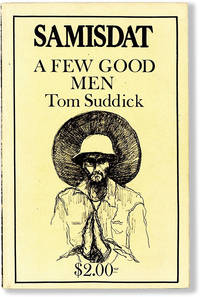
197462875Berkeley CA: Samisdat Press 1974. First Edition. First Printing. Publisher's pale green wraps titled and decorated in black to spine and front board with a reproduction of the author's USMC telegram notifying his parents of him taking a shrapnel wound to the stomach to the rear wrap. A touch of fading here and there with soome very light shelfwear but a very good strong copy. 116pp. Internally clean. Signed by the author to the title page. One peculiarity is that the final leaf of the story "Diehard" has been typed manually and added to the volume at the rear where a printed leaf would belong with no sign of an "original" leaf being missing. Whether this was a later fix from a previous owner or something done in house due to a binding error is difficult to establish especially with "homemade" publishing. This is the first appearance of "A Few Good Men" a series of short vicious little war stories that are amongst the clearest invocations of the prevalent lunacy present in the canon. It was eventually reprinted in a book form in 1978 by Morrow/Avon this first appearance seems elusive especially signed. Samisdat Press unknown
1847280021.Gpaperback. Good. Access codes and supplements are not guaranteed with used items. May be an ex-library book. paperback
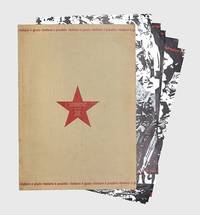
1969148329Milan: c.1969. Striking pop art-influenced suite of anti-imperialist propaganda posters published in Milan by the Comitato Vietnam - self-described in their literature as the "sezione italiana del tribunale Russell". The work of a collective comprised of six prominent Italian artists the images carry the theme 'Rebellion is right rebellion is possible' into various theatres of anti-imperialist struggle. Baratella b. 1935 Mariani b. 1936 and Spadari 1938-97 were long-term collaborators and members of the Nuova Figurazione art movement. Amadori 1945- 2015 won the Joan Miró prize in 1972. Spadari's contribution draws on the "solarised" image of Castro in the Cuban Revolution from his work "26 de julio" while in an anti-Vietnam War themed poster similarly treated repeated images of a Vietnamese women are overlain by a Lichtensteinian US fighter jet wheeling away from an explosion from which emerges a Coca-Cola bottle cap with the slogan 'Nixon boia' - Nixon executioner also the title of a song by popular singer-story teller Franco Trincale - and the partially obscured text 'Coca-Cola merda'. Nixon also features on a poster featuring his cartoonish portrait wearing a star-spangled neck-tie while being choked out by several nooses above him a ferociously snarling Black Panther head; while "Africa Rossa/Africa Nera" centres on a photographic image of the clenched first Black Power salute. Baratella based his poster around his painting "Benito Mussolini Storia del fascismo" where "Il Duce's" face morphs into a skull here with the lower part is superimposed with six small portraits of current political leaders including de Gaulle Pompidou Khrushchev and LBJ. The last in the group dramatises the Arab-Israeli conflict with a repeated image of a woman PFLP fighter - Leila Khaled - in keffiyeh and camo fatigues carrying a AK-47 above her a map of Jerusalem. No other set of these traced a couple of examples of individual posters noted institutionally; an excellent evocation of the artistic-political synergies of the period. Six large black and white photomontage posters 700 x 500 mm printed on coated paper each with the repeated slogan 'ribellarsi è giusto ribellarsi è possibile' in red; in the original tan slub-weave linen textured light card portfolio printed in red title to the front panel superimposed on a red five-pointed star. The portfolio a little rubbed and soiled pale damp spots at the spine-fold where there are a few short splits posters show light handling but overall very good. unknown
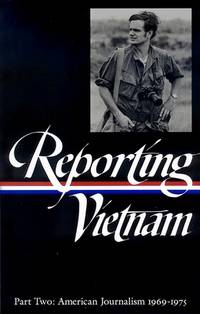
1998007557New York NY U.S.A.: Library of America The 1998 First edition stated first printing. 857 pp. Extraordinary collection of Vietnam-era journalism. In protective mylar cover. Library of America, The hardcover
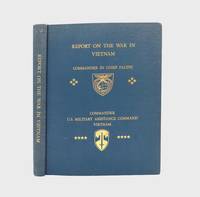
196820360Washington: Government Printing Office 1968. First edition. Maps some folding charts and diagrams photographs Index laid in at the back. 1 vols. 4to. Original blue cloth gilt. Some light soiling of cloth warping of volume and light marginal browning of text else a very good copy of this work. First edition. Maps some folding charts and diagrams photographs Index laid in at the back. 1 vols. 4to. INSCRIBED BY WILLIAM WESTMORELAND TO HEDLEY DONOVAN former editor-in-chief of Time Inc. "To Hedley Donovan-With reminiscence of our pleasant association. W. C. Westmoreland. March 1969." In his position as Editor in Chief of Time Inc. Donovan had made four trips to Vietnam to see firsthand the people and places being covered by his correspondents and to get a feel for the situation. He met with Westmoreland in Vietnam in late 1965-early 1966 and probably on his subsequent trips.<br /> <br /> Westmoreland was the Time Magazine Man of the Year for 1965. Partly reading "As commander of all U.S. forces in South Viet Nam General William Childs Westmoreland 51 directed the historic buildup drew up the battle plans and infused the 190000 men under him with his own idealistic view of U.S. aims and responsibilities. He was the sinewy personification of the American fighting man in 1965 who through the monsoon mud of nameless hamlets amidst the swirling sand of seagirt enclaves atop the jungled mountains of the Annamese Cordillera served as the instrument of U.S. policy quietly enduring the terror and discomfort of a conflict that was not yet a war on a battlefield that was all no man's land. Government Printing Office unknown
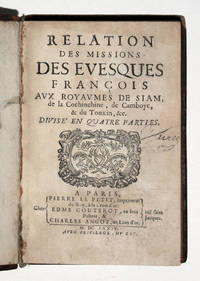
1674244<p>8 ff. 367 1 pp. Bound in contemporary calf gilt heraldic stamp on covers gilt spine with raised bands worn with joints cracked but sound head foot and corners bumped. Lacking endleaves; illegible ownership inscription on lightly soiled title; very good overall.</p><p>Rare first edition of this account of the state of Christianity in Thailand Cambodia Vietnam by rivals of the Jesuits. The Société des Missions Etrangères a new apostolic missionary group established in Paris in 1660 was as a society of secular priests who devoted their lives to foreign missions but refrained from taking vows. Under the aegis of the Propaganda Fide the Société des Missions soon became embroiled in conflicts over territory with the Jesuits. As a result of the patriotism of its priests the organization's impact extended beyond evangelicalism into the political realm: in addition to facilitating a series of embassies and treaties it also successfully established a more active trade between Indo-China the Indies and France. This Relation brought fresh information about the condition of the mission in different parts of southeastern Asia between 1666 and 1671.</p><p>It consists of four parts the first dealing with the mission in Siam and containing descriptions of amongst others Bourbon Island Madagascar and Mozambique the second treating the situation in Cochin-China the third the mission in Cambodia and the fourth being devoted to Tonkin including an account of the work of bishop Lambert de la Motte. Lambert was a member of the Society's first expedition to the Far East which had left Europe in 1660.</p><p>Fermanel de Favery c. 1632-88 superior and director of the "S'naire pour les Missions Etrangères" signs the dedicatory epistle to Cardinal de Bo' and consequently Streit Lach and Van der Kley ascribe authorship to him. The work was reprinted in 1680 and 1684 and an Italian translation <em>Relatione delle missioni de vescovi vicarii apostolici' alli regni di Siam Cocincina Camboia e Tunkino</em> was published in Rome in 1677 and 1697.</p><p> Cordier I.826 s.v. Evêques Français; Chadenat 1706 1684 ed.; Satow 46; Streit V.1797; Lach III.i.222ff.</p> Pierre Le Petit, Edme Couterot & Charles Angot hardcover
19972080502106405202Otsukishoten 1997. Soft Cover. Fine. Number of pages: 335p Otsukishoten paperback
19882090502130200540Otsukishoten 1988. Soft Cover. Fine. Number of pages: 335p Size: 31cm Number of books: 1 Otsukishoten paperback
1969737106PN. New. 1969. Soft Cover. Date is original print. This is a reprint edition. . PN paperback
1969737757PN. New. 1969. Soft Cover. Date is original print. This is a reprint edition. . PN paperback
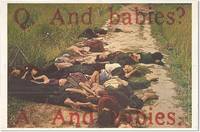
197083515New York: Art Workers Coalition 1970. Offset lithograph in colors; 64cm x 97cm 25" x 38". Mild creasing to extremities else a fine clean copy; unbacked. This one of a presumably small number of copies bearing a rubber-stamped message which reads: "This poster was originally co-sponsored by the Museum of Modern Art. On Dec. 19 trustee William S. Paley forbid the Museum to associate its name with this poster. Do the Trustees approve of the massacre" stamped twice in the image lower right. <br /> <br /> One of the true icons of Twentieth Century American protest art this poster created by the Art Workers Coalition under the guidance of Fraze Dougherty Jon Hendricks and Irving Petlin was issued to bring attention to the horrendous My Lai massacre of March 1968. The photograph by Ron Haeberle originally appeared in Life Magazine. The Museum of Modern Art had originally promised to underwrite the poster's creation and to donate paper and printing costs - but later abandoned the project under the objections of board President William S. Paley. The AWC still managed to print fifty thousand copies which they distributed for free. As a response to MoMA's backing out of the project an unknown number of the posters were rubber-stamped with the message quoted above and a demonstration was held inside the museum in front of Picasso's Guernica where copies of the poster were unfurled and given away. These events are recorded in a 2015 interview with co-creator John Hendricks: ".We had a big meeting of Art Workers' Coalition about how we should address their MoMA's reneging of the agreement with us. It was decided to make a rubber stamp.saying "This is the poster that the Museum of Modern Art agreed to do jointly with Art Workers' Coalition and Bill Paley and Arthur Drexler refused to do" or something like that. So we stamped as many posters as we could with that stamp. Then we had a number of demonstrations in front of the museum and inside in front of Guernica." interview with William Twersky WT_History Blog April 2015. We have traced no copies in commerce or institutional collections that make note of the rubber-stamped notice. In 1972 the design was repurposed to protest President Richard Nixon's campaign for a second term; for that version the motto was changed to "Four More Years Four More Years" 83515. Art Workers Coalition unknown
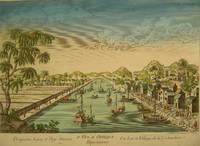
#[34149]Paris Daumont ca.1760. Contemporary handcoloured perspective view vue d'optique or Guckkastenbild depicting a view of the village of Yang-ka in Cochin with legend in Latin and French. Ca.285 x 39 cm. Handsome optical harbour view of a village with figures and canal with sailing-ships in Vietnam. unknown
2026x-1032692308Taylor & Francis Ltd 2026. Paperback. New. 164 pages. 5.50x0.38x8.50 inches. Taylor & Francis Ltd paperback
1975371379Annapolis MD: Naval Institute Press 1975. First edition. 114 pp. illustrated throughout with black and white sketches by the author. 1 vols. Oblong 8vo. Decorated green faux-leather with title in gilt on cover and spine. Fine in a very good dust jacket. First edition. 114 pp. illustrated throughout with black and white sketches by the author. 1 vols. Oblong 8vo. LCDR John M. McGrath was a young Navy pilot in 1967 when he was shot down over Vietnam. His remarkable and moving chronicle of survival and the torture and brutality suffered at the hands of his captors is illustrated with stark black and white drawings by the author who was a self-taught artist. Inscribed on the free front end paper to: "Jan & Marcy - Thanks for helping me make this book a reality. The book is beautiful - it couldn't have been done without your interest and support. It's great to be home! Warmest regards Mike McGrath." With a an accompanying original signed pen and ink sketch by the author dated 10-14-75 and titled: "Greetings from Monterey California." Inscribed by the Author. <br/><br/> Naval Institute Press hardcover
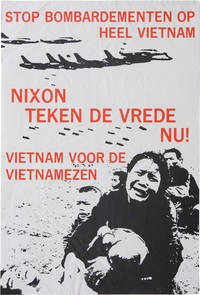
197246091The Netherlands: Comité Nationale Demonstratie voor Vrede in Vietnam ca. 1972. Original photo-illustrated poster 60x41cm. printed offset in red and black on white stock. Stock quite wrinkled else About Very Good overall. Anti-Vietnam War protest poster showing depicting a photograph of Vietnamese citizens weeping over the bodies of a child and man while military aircraft fly overhead. Imprint provided by geheugenvannederland.nl. Comité Nationale Demonstratie voor Vrede in Vietnam unknown
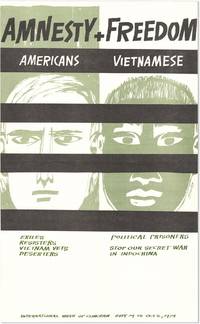
197483034N.p.: S.i. 1974. Original lithographed poster with text and illustrations offset printed in two colors on white stock measuring 26cm x 42cm 10.25" x 16.5". Faint horizontal fold at center; Near Fine. Poster promoting the International Week of Concern which ran from September 29 - October 6 1974. "The Week of Concern is a joint effort of NCUUA National Council for Universal and Unconditional Amnesty and the United Campaign. Through such international organizations as War Resisters International and the Stockholm Conference on Vietnam support for the week and activities during the week are being urged throughout the world. The primary focus during the Week of Concern is Universal and Unconditional Amnesty and End US Support for the Continuing War with emphasis on freeing Saigon political prisoners Vietnam Veterans Against the War-Winter Soldier Organization Newsletter No.27 p.7. 83034. S.i. unknown
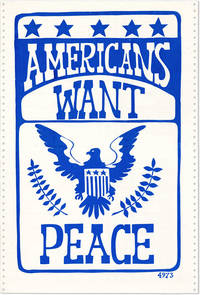
197055907Berkeley: Berkeley Political Poster Workshop 1970. Original illustrated poster silkscreened in blue on repurposed computer listing paper with perforated tractor strips measuring 38cm x 56cm 15" x 22". A Fine copy. Attractive poster featuring an altered version of the Great Seal of the United States bearing the slogan "Americans Want Peace." One of some 600 designs created by Berkeley student members of the Political Poster Workshop in 1970; on average fewer than 100 copies of each design were printed for distribution on and around campus. See WILLIAMS 9-10. Berkeley Political Poster Workshop unknown
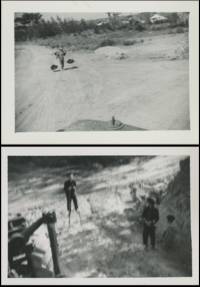
1960Cat357Japan Taiwan Korea and the US 1960. 15 ¼ x 11 inch album with attractive painted cover containing approximately 235 photos mainly 3 ½ x 5 inches and smaller. Contents generally in excellent condition. Excellent. A photo album by an unknown US Marine containing photos from his time in Okinawa Taiwan and Korea in the 1950s and 1960s. At the time—the earliest dated photo in the album is from April 1956—the Vietnam War was in its early days with Eisenhower deploying MAAG to train the ARVN in late 1955. It is not clear what unit the photographer was with as only his training platoon 46 of the Second Recruit Battalion on Parris Island is identified; however this photo’s caption includes “Photo by MAAGâ€.<br /> <br /> The album appears to be divided between the three locations each of which was strategic in the Cold War broadly and for American efforts in Vietnam in particular. It is highlighted by a series of photographs apparently from Taiwan showing agricultural workers planting and posing with their crops and children. In the 1950s under the China Aid Act the Sino-American Joint Commission on Rural Reconstruction JCRR had launched a land reform financed by American aid and staffed by ROC scientists. In the 1960s this program expanded to crop diversification and the creation of the Asian Vegetable Research and Development Center. These efforts towards agricultural development in Taiwan were like other US efforts in the region intended to contain the spread of Communism.1<br /> <br /> Other photos from Taiwan include shots of the ships; men outside their tents vehicles and straw huts smoking and playing cards; some are city streets but most are of the countryside. Several notable photos show the Marines playing at being POWs: in one a man poses with his hands on his head next to a sign reading “POW AND CAPTURED / EQUIPMENT COMPOUND†and in another one soldier pretends to march his fellow at gunpoint.<br /> <br /> Photos from Okinawa show military vehicles city streets and American and Japanese men—many Okinawans were employed by the US military during its occupation. Many scenes appear to show construction efforts with USMC-marked bulldozers and tractors driving around fields of dirt and rock in the countryside with a few of these showing Okinawa residents as well.<br /> <br /> South Korea also played an active role in the Vietnam War. Photos from Korea show tanks and other vehicles along the coast and being loaded into ships American soldiers driving and posing in the countryside and several of village streets and residents.<br /> <br /> Other subjects include target shooting transit on a ship captioned “WESTWARD HO / FAR EAST BOUND†and some that appear to be family and scenery shots in the US dated April 1961.<br /> <br /> Overall the album provides a look not just at the activities of the Marine Corps in the early US advisory era of the Vietnam War but also the people and places of the US’s strategic activities in East Asia. Of interest to historians of the Vietnam War Cold War and US empire.<br /> <br /> 1 Leo Chu “‘A bloodless social revolution’: Land reform and multiple cropping in Cold War Taiwan 1950–1979†The history of crop science and the future of food 6 no. 5 September 2024 1104–1110. unknown
19772091202133001772Chiku ma shobo 1977. Soft Cover. Fine. Number of books: 1 Chiku ma shobo paperback
1984007069University AL: Univ of Alabama Pr 1984. 281pp/illus/maps. The growth of the CIA's "air Force began with theKorean War. The CIA used CAT ti dekuver weaoibs to anti-Communist elements in Burma make numerous overflights of China in support of guerrilla carry operatives between secret bases throughout the Far East and provide secure airlift for other clandestine missions. Clean. First Edition. Hard Coveer. Near Fine/Very Good. 8vo - over 7¾" - 9¾" tall. Univ of Alabama Pr unknown
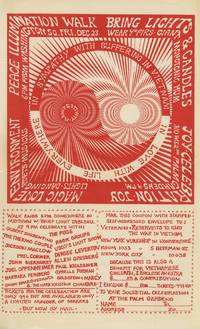
1966List36100New York: New York Workshop in Nonviolence 1966. Broadside poster printed in red on white stock approximately 14 x 11 inches. Near Fine. A poster announcing the Peace Illumination Walk an anti-Vietnam War demonstration held in New York City on Friday December 23 1966. Participants were instructed to assemble in Washington Square at 6 p.m. and march through Manhattan carrying candles “in sympathy with suffering in Vietnam.†The walk was to conclude about 8 p.m. with a light tableau in Midtown followed at 9 p.m. by a benefit celebration at the Palm Gardens. The event was organized by the New York Workshop in Nonviolence and advertised as a benefit for Vietnamese children. Speakers and performers listed on the poster include poets Allen Ginsberg Denise Levertov and Jackson Mac Low; the satirist Paul Krassner later a founder of the Youth International Party Yippies; novelist Gilbert Sorrentino; and the countercultural rock group The Fugs led by Ed Sanders and Tuli Kupferberg. The program also notes appearances by Swami Bhaktivedanta and members of the Hare Krishna movement.<br /> <br /> The poster’s radiating optical design centers on the word “manifestivity†a term used by anti-war organizers to describe protest events combining demonstration with music and performance. The lower portion includes a mail-in coupon inviting supporters to send contributions to the Veterans and Reservists to End the War in Vietnam through the New York Workshop in Nonviolence at 5 Beekman Street. New York Workshop in Nonviolence unknown
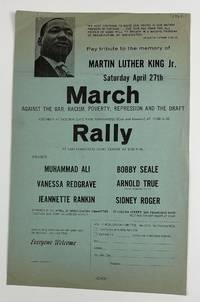
19683397San Francisco 1968. Very good. Broadsheet on blue paper 13.5 x 8.5 inches. Slight discoloration along top and bottom edges minor edge wear a few soft creases old horizontal folds. An exceedingly rare broadsheet advertising a multi-faceted public march and rally against the Vietnam War and "racism poverty and repression" which took place in San Francisco California about three weeks after the assassination of Martin Luther King Jr. The organizers of the event the April 27 Mobilization Committee framed the day's activities around Dr. King's opposition to the Vietnam War; the broadside calls for the protesters to "pay tribute to the memory" of Dr. King his portrait is printed at the top of the front side of the broadsheet and the entirety of the verso prints excerpts of an April 4 1967 speech by Dr. King railing against the Vietnam War. Particularly interesting is the eclectic list of speakers who participated in the day's events on April 27 1968 which included Muhammad Ali Vanessa Redgrave Jeanette Rankin Bobby Seale Arnold True and Sidney Roger. Ali was in the midst of his appeal after his conviction for draft evasion the previous year and was a natural candidate to speak against the injustices of the Vietnam War. Bobby Seale co-founder of the Black Panthers was four months away from participating in protests at the 1968 Chicago Democratic Convention after which he was arrested and tried as part of the sham Chicago Eight fiasco.<br /> <br /> The diversity of the speakers echoes the quantity of different issues represented by the current broadsheet: Civil Rights the Vietnam War the recent assassination of Dr. King Muhammad Ali's legal fight against the war Bobby Seale's controversial role with the Bay Area Black Panthers women's rights and the role of the American military. We could locate no other copies of this broadsheet in auction history or OCLC. unknown
1964222171964. Counterculture Vietnam War This pair of mimeographed documents issued in 1964 and 1969 respectively capture the shifting rhetorical and political frameworks of U.S. justification and policy aims in Vietnam offering rare comparative insight into both the Lyndon B. Johnson and Richard Nixon administrations' public positions. 1 Some Questions on Vietnam. Washington: Friends Committee on National Legislation June 3 1964. 2 Mr. Nixon's Points. N.p October 14 1969. Two double-sided mimeographed typescripts measuring 8.5" x 11" each. Together they trace the continuity and contradictions in American official thinking from the earliest stages of direct military intervention to the early attempts at managed withdrawal. The 1969 document is particularly notable for its side-by-side presentation of Nixon's proposed peace terms with those of the National Liberation Front NLF the political wing of the Viet Cong.<br /> 1 The first document dated June 3 1964 and issued by the Friends Committee on National Legislation in Washington D.C. is titled Some Questions on Vietnam. Framed as a briefing tool for concerned citizens it outlines the U.S. position in the early escalation phase of the war and provides extensive excerpts from contemporary sources including President Johnson's June 2 press conference and articles from The Washington Post and New York Times. Johnson is quoted stating that the U.S. is "bound by solemn commitments to help defend this area against Communist encroachment" reaffirming the domino theory logic underpinning American involvement. <br /> <br /> The handout catalogs U.S. military strategies then being deployed including the "Strategic Hamlet Program" in which "thousands of peasants were uprooted at gunpoint and moved into defensive village-clusters far removed from ancestral lands." Other methods included the use of lie detectors on suspected Viet Cong and defoliation tactics that the Washington Post acknowledged raised "questions of the wisdom of using such agents at all in this kind of war. where the consequences are visited upon a civilian population we are trying to defend." The leaflet also raises doubt about South Vietnamese support for the war: "the Saigon government has the allegiance of probably no more than 30 per cent of the people." Statistics from the Pentagon note that by May 25 1964 1130 American servicemen had been killed wounded or listed as missing since 1961. Senator Wayne Morse is quoted: "We have already poured into that sink-hole over $5½ billion." The final sections argue that economic aid cannot be separated from military goals and propose alternatives such as United Nations mediation. Notably the sheet warns that mail to the White House on Vietnam had been averaging fewer than 150 letters per week urging citizens to "make their views known to the President and your Congressmen."<br /> <br /> 2 The second document dated October 14 1969 presents President Nixon's public negotiating stance during the early phase of his "Vietnamization" strategy. Titled Mr. Nixon's 8 Points the yellow sheet begins with a justification of U.S. sacrifices: "The United States has suffered over a million casualties in four wars in this century. We are proud of this record and we bring the same attitude in our search for a settlement in Vietnam." Nixon outlines eight specific principles most notably: "We seek no bases in Vietnam. We insist on no military ties. We are willing to agree to neutrality for South Vietnam if that is what the South Vietnamese people freely choose." He continues "We have no intention of imposing any form of government upon the people of South Vietnam nor will we be a party to such coercion." The points include phased withdrawal over twelve months the establishment of an international supervisory body elections under international supervision release of prisoners of war and mutual agreement to observe the 1954 Geneva Accords. Nixon concludes with a reaffirmation that U.S. presence would end entirely once these measures were fulfilled.<br /> <br /> The reverse of the Nixon flyer contains The NLF's 10 Points the Viet Cong's counter-position which sharply contradicts Nixon's framing. Point 2 is categorical: "The U.S. Government must withdraw from South Vietnam all U.S. troops military personnel arms and war materiel. and liquidate all U.S. military bases in South Vietnam." Point 4 emphasizes sovereignty: "The people of South Vietnam shall settle themselves their own affairs without foreign interference." Throughout the NLF stresses full political participation neutral diplomatic relations and reunification of Vietnam as "a peaceful process. without foreign interference." Notably Point 9 demands that the U.S. government "must bear full responsibility for the losses and devastations it has caused to the Vietnamese people in both zones."<br /> <br /> Juxtaposing these two documents reveals a significant divergence between U.S. public rhetoric and Vietnamese revolutionary demands. While Nixon framed U.S. intentions as altruistic and limited the NLF viewed the war as colonial in nature and demanded unconditional withdrawal. This side-by-side format would have been a powerful tool for peace activists and educators in 1969 especially as public trust in government narratives about Vietnam eroded in the wake of the Tet Offensive and ongoing domestic protest. Very good condition overall. unknown
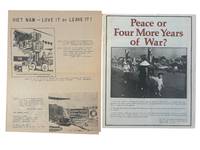
1969222221969. Archive of Two Anti-Vietnam War Pamphlets Critiquing Nixon-Era Policy 1969-1972. Birmingham AL and Cambridge MA / Los Angeles CA: Birmingham Moratorium Committee and Indochina Peace Campaign. Two pamphlets totaling 8 pages. A stark and emotionally charged pair of pamphlets confronting the human and economic cost of the Vietnam War particularly under the administration of Richard Nixon and his South Vietnamese ally Nguyễn Văn Thiệu. Both documents highlight the structural violence wrought by U.S. imperialism through quotes infographics and personal testimonies. One pamphlet issued by the Birmingham Moratorium Committee presents a Marxist-inflected indictment of American capitalism's complicity in the war; the other by the Indochina Peace Campaign anchors its critique in the grief of a widow counterposing Nixon's broken promises with devastating images of Vietnamese civilians and political prisoners.<br /> <br /> 1 Birmingham Moratorium Committee. "Viet Nam - LOVE IT or LEAVE IT!" Birmingham AL: 1969. A four-page pamphlet structured around working-class economic critique. On the front page black-and-white line art depicts a U.S. military cargo loader moving a casket-shaped crate labeled with stars beneath the caption "U.S. troops continue to be withdrawn from South Vietnam." It features a collage juxtaposing the Chase Manhattan logo with the silhouette of a prone soldier in Saigon. Alongside damning pull quotes from McNamara Gen. Harkins and Nixon ".this may have been one of America's finest hours." it lists the GI toll from 1961 to 1966: "killed: 38969; wounded & maimed: 254947." The interior spread lays out the economic beneficiaries of the war-"Who Profits"-stating "only big business. corporate profits after taxes rose 91%." One cartoon labeled "The Free Enterprise System" depicts a caricatured Nixon shaking down an American taxpayer for the wealth-hoarding "Corporations and Upper Income Earners". The final page calls for a debate and mass rally on November 13-14 involving Alabama's senators and representatives and denounces the war as a tool to "pay Vietnamese women 31¢ a day to make transistors as they do now in South Korea." The overall tone centers class exploitation with a particularly Southern regional organizing base.<br /> <br /> 2 Indochina Peace Campaign. "Peace or Four More Years of War" Cambridge MA / Los Angeles CA: 1972. Four-page pamphlet likely distributed in the lead-up to the 1972 election. The cover image-captioned "NBC-TV Dec. 12 1972"-depicts a Vietnamese woman and barefoot child walking past a bombed-out village. Beneath it is a widow's testimony: "If they had gone ahead and signed the treaty as promised my husband would be alive today with me and my children." The interior is a detailed exposé of the Nixon administration's duplicity in peace negotiations asserting that "After two years of negotiations all that remained was to settle one percent of a peace settlement." The Indochina Peace Campaign asserts that the U.S. deliberately sabotaged the Nine-Point Agreement by refusing to recognize the Provisional Revolutionary Government PRG despite "warnings by Congressmen and Senators" and international outrage over the Christmas bombings. The pamphlet cites major media: "The U.S. supported regime in Saigon have ruled by suppressing all their opposition" Pentagon Papers Gravel Edition Vol. 1 p. 256 and includes documentation of 40994 political assassinations under the Phoenix Program. A chilling image of children behind bars in Chanh Hung Prison accompanies these facts. The final call to action reads: "We have this choice: either we allow our government to prolong the rule of General Thieu or we pressure it to sign the Agreement."<br /> <br /> An ideologically diverse but thematically united pair of anti-war publications: one focused on working-class Southern economic outrage the other on moral urgency and state-sponsored atrocity. Together they demonstrate the breadth of opposition to the Vietnam War and the emotional political and class-based appeals that animated grassroots resistance across the U.S. Overall very good condition. unknown
2002014298Dubuque Ia.: Telegraph Herald Publication 2002. First Edition Collectible . Oversized Softcover. Good/No Jacket as Issued. 4to - over 9¾" - 12" tall. 289pp. Original illustrated wraps. Stated First Edition. Profusely illustrated B/W photographs throughout. "The Telegraph Herald is extremely proud to present OUR COUNTRY CALLED: A TRIBUTE TO TRI-STATE VETERANS OF KOREA AND VIETNAM. Like many of the local historically-based book publishing efforts we have taken on over the past several years OUR COUNTRY CALLED was an emotionally charged project but more importantly a much-needed effort to remember a special group of tri-state citizens.the veterans of Korea and Vietnam. Those veterans.our friends neighbors and relatives found themselves in difficult times with their 'sense of duty' challenged by geo-global politics indifference to the cause and uncertainty about the outcome of their efforts and sacrifices." Pages are bright and clean no writing underlining or highlighting. Binding is tight with no cracks or breaks. Laminate on covers are beginning to peel away. Shelfwear light bumping to edges light rubbing to corners. No previous owner markings. Very nice reading copy of this scarce title. <br/> <br/> Telegraph Herald Publication paperback