2 905 résultats
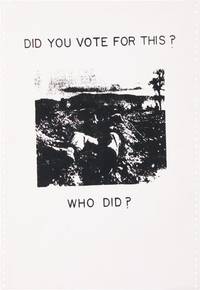
197035425Berkeley: Berkeley Political Poster Workshop 1970. Original illustrated poster silkscreened in black on white repurposed computer listing paper with perforated tractor strips measuring ca.38cm x 56cm 15" x 22". A Fine copy / A. A simple powerful anti-war image by an uncredited Berkeley student. The image is reproduced from a 1968 AP photograph of the bodies of US Marines on Hill 689 in Khe Sanh South Vietnam. The poster "is an indirect invocation of the political order in the United States and for those who remember a reminder that both Lyndon Johnson in 1964 and Richard Nixon in 1968 won the presidency with promises of peace - which were then contradicted by their actions." Benson Thomas W. Posters for Peace: Visual Rhetoric and Civic Action. One of some 600 designs created by Berkeley student members of the Political Poster Workshop in 1970; on average fewer than 100 copies of each design were printed for distribution on and around campus. Not individually listed in OCLC though we note copies held at Yale and Penn State. WILLIAMS 28. Berkeley Political Poster Workshop unknown books
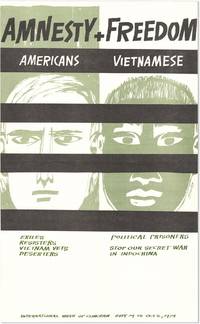
197483034N.p.: S.i. 1974. Original lithographed poster with text and illustrations offset printed in two colors on white stock measuring 26cm x 42cm 10.25" x 16.5". Faint horizontal fold at center; Near Fine. Poster promoting the International Week of Concern which ran from September 29 - October 6 1974. "The Week of Concern is a joint effort of NCUUA National Council for Universal and Unconditional Amnesty and the United Campaign. Through such international organizations as War Resisters International and the Stockholm Conference on Vietnam support for the week and activities during the week are being urged throughout the world. The primary focus during the Week of Concern is Universal and Unconditional Amnesty and End US Support for the Continuing War with emphasis on freeing Saigon political prisoners Vietnam Veterans Against the War-Winter Soldier Organization Newsletter No.27 p.7. 83034. S.i. unknown
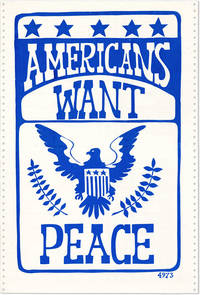
197055907Berkeley: Berkeley Political Poster Workshop 1970. Original illustrated poster silkscreened in blue on repurposed computer listing paper with perforated tractor strips measuring 38cm x 56cm 15" x 22". A Fine copy. Attractive poster featuring an altered version of the Great Seal of the United States bearing the slogan "Americans Want Peace." One of some 600 designs created by Berkeley student members of the Political Poster Workshop in 1970; on average fewer than 100 copies of each design were printed for distribution on and around campus. See WILLIAMS 9-10. Berkeley Political Poster Workshop unknown
8vo., First Editionthus; black cloth, gilt back, a near fine copy. Published a year after the US edition.
200669138Favre Sa 2006 In-8 relié 31,8 cm sur 21,8. 192 pages. Très bon état d’occasion.
Préface d'André Chamson . Illustré d'une carte . Quelques défauts en couverture .- 286 p. , 600 gr.
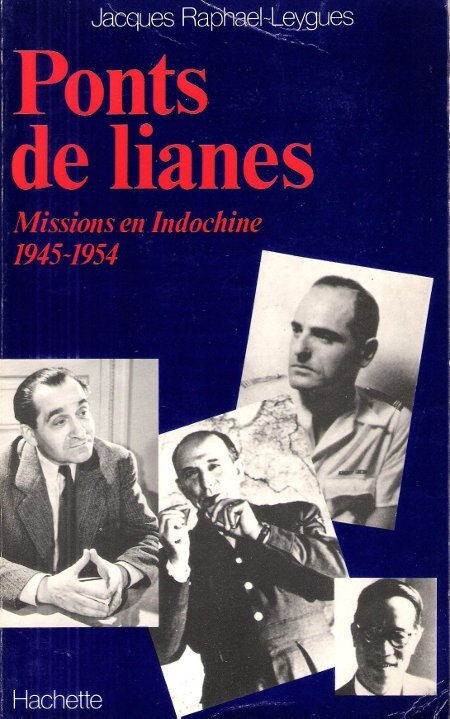
1976016174Paris Hachette 1976 Grand In 8 Préface d'André Chamson . Illustré d'une carte . Quelques défauts en couverture .- 286 p. , 600 gr.
Milano, Edizioni Movimento Studentesco, 1973, 8vo brossura con copertina illustrata a colori, pp. 117.
All'interno presente un disco 33 giri.Poesie vietnamite della resistenza.
Romanzo sulla guerra del Vietnam basato sulla sceneggiatura di Oliver Stone.
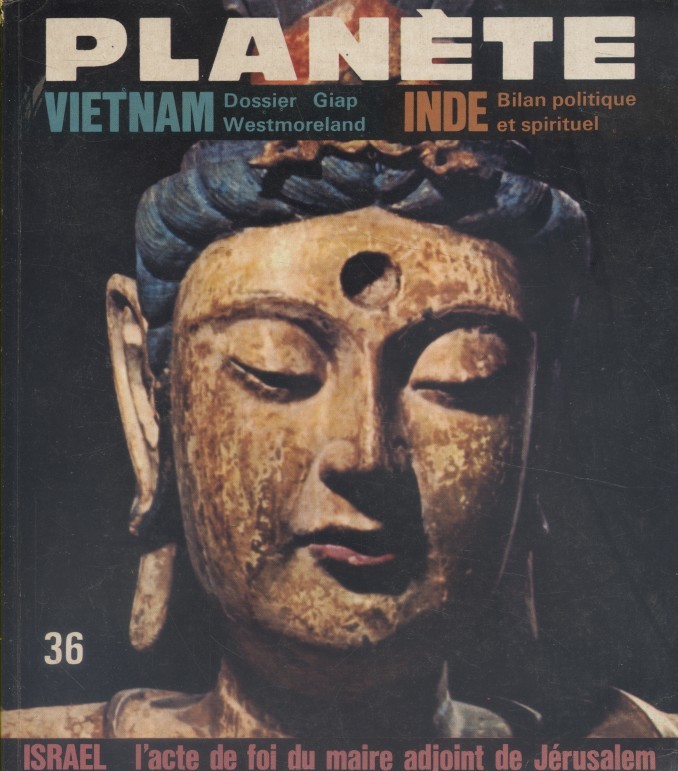
Paris, Planète, 1967. In-8 carré broché de 198 pages illustrées. Bon état
Manila, Imp. y Lit. Chofré y Comp., 1897, plano original litografiado en colores, 21 x 29 cm. con dobleces de haber estado plegado. (Raro plano que aparece en la Guía Oficial de las Islas Filipinas del año 1897).
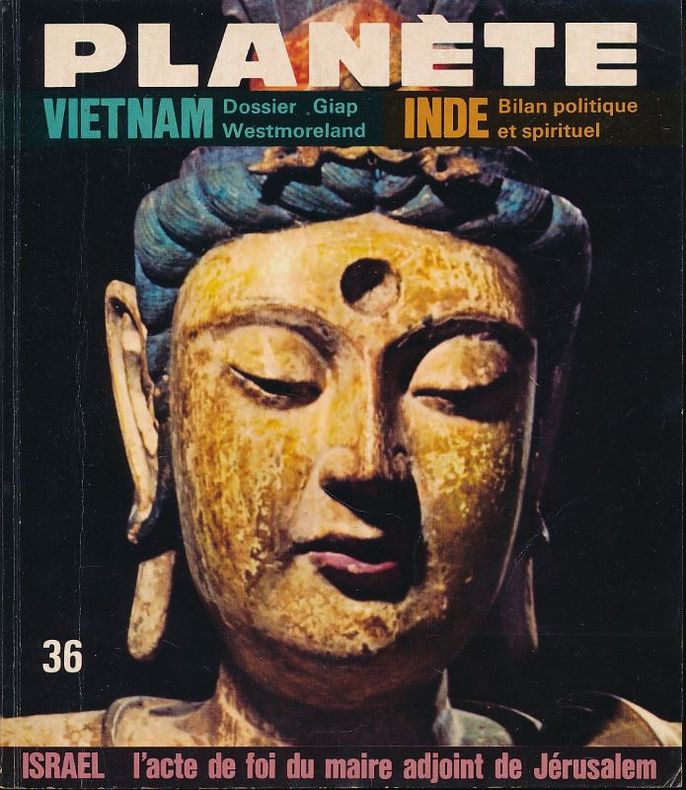
1967143285Planète Paris, Planète, 1967. In-8 carré broché de 198 pages illustrées. Bon état
193976418Mercure de France 1939 In-12. Broché, couverture imprimée, 52 pp. Bon exemplaire.
1961137870Sn. 1961 Tirages argentique, ca 9,5 x 12,5 cm. Tampons au verso Viet-Nam Cong-Hua, 1961
196712787Couverture souple. Broché. 188 pages.
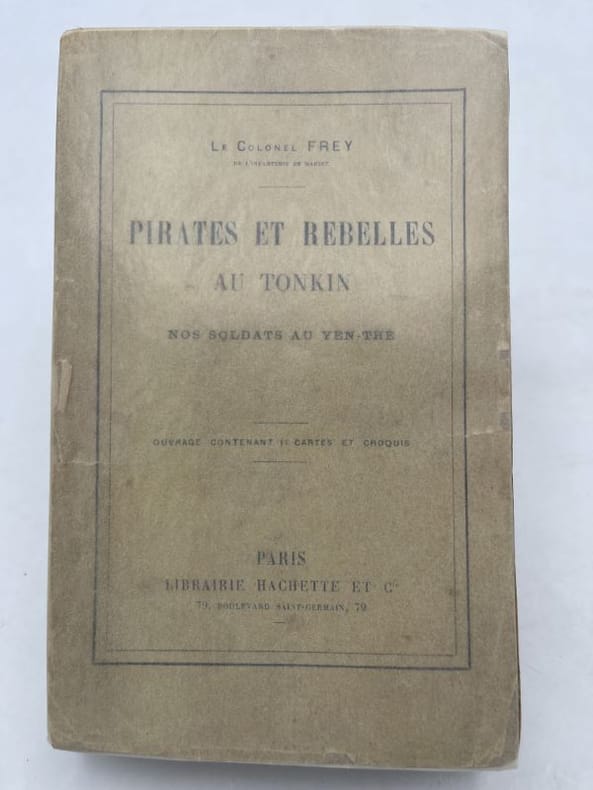
1892181416Hachette Paris, Hachette, 1892. Grand In-12 broché de X + 350 pae. Ouvrage contenant 11 cartes (dépliantes) et croquis. Le dos est cassé, l'intérieur très propre.
V22604München (Kindler) o.J. (= Lizenzausgabe mit freundlicher Genehmigung des Verlags der Nation). 8°, illustrierte Originalbroschur ( Paperback) 415 S., Abbildungen 1
4828"Paris, Flammarion, 1975, coll. ""Connections""" in 8 broché
4828"Paris, Flammarion, 1975, coll. ""Connections""" in 8 broché
In-16°, pp. 368, copertina editoriale. Bruniture dovute al tipo di carta. Indice/Table des matieres: Première Partie. La méthode phénoménologique et son contenu effectivement réal. Chap. I. L'intuition des essences; Chap. II. La thématisation de la conscience concréte; Chap. III. Les problèmes de la raison; Chap. IV. Le résultat de la phénoménologie. Seconde Partie. La dialectique du mouvement real. Chap. I. La dialectique du comportement animal comme devenir de la certitude sensible; Chap. II. La dialectique des sociétés humaines comme devenir de la raison.
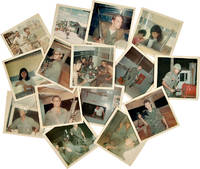
1972WRCAM55575Various places in Vietnam 1972. 145 photographs all but thirteen in color most approximately 3 1/2 x 3 1/2 inches. Majority of photographs mounted on black paper stock with non-archival adhesive tape some photos retain remnants of tape at corners. Some images a bit faded but generally in very good condition. A tremendous collection of photographs depicting the personal life and military service of an unidentified African-American soldier with the last name "Williams" serving in Vietnam during the war and with numerous family photographs at home. The majority of the photographs are undated but those that are dated place the collection roughly between 1968 and 1972. Other identifying characteristics in the photographs indicate that the soldier was likely part of the United States Air Force 93rd Security Police Squadron which provided security and air base defense during the Vietnam War. There is a photograph of Williams leaning against the sign for the 93rd SPS dormitory. <br> <br> Notable in the sixty or more photographs from the soldier's time in Vietnam are images from an unidentified American Air Force base depicting soldiers in the barracks a mess hall and fraternization among soldiers; additional photographs show a heavily-armed Williams manning a bunker holding an EBONY magazine posing with a South Vietnamese soldier in an urban setting and staring strikingly at the camera wearing machine gun ammunition and a hand grenade. A series of thirteen images were taken at "Le Van Loc" a popular Vietnamese night club located on the Tan Son Nhut Air Base near Saigon indicating Williams may have been stationed at or near that base. Personal photographs show individuals of varying ages presumably family members who appear alone or in groups and at times are photographed with Williams. Several of these photographs feature children presumably Williams' at home and at an Elmhurst School function. Williams seems to have been especially proud of his motorcycle as it features in a few shots. <br> <br> A collection of both service and family photographs capturing a young African- American serviceman during the Vietnam War. unknown books
1960Cat357Japan Taiwan Korea and the US 1960. 15 ¼ x 11 inch album with attractive painted cover containing approximately 235 photos mainly 3 ½ x 5 inches and smaller. Contents generally in excellent condition. Excellent. A photo album by an unknown US Marine containing photos from his time in Okinawa Taiwan and Korea in the 1950s and 1960s. At the time—the earliest dated photo in the album is from April 1956—the Vietnam War was in its early days with Eisenhower deploying MAAG to train the ARVN in late 1955. It is not clear what unit the photographer was with as only his training platoon 46 of the Second Recruit Battalion on Parris Island is identified; however this photo’s caption includes “Photo by MAAGâ€.<br /> <br /> The album appears to be divided between the three locations each of which was strategic in the Cold War broadly and for American efforts in Vietnam in particular. It is highlighted by a series of photographs apparently from Taiwan showing agricultural workers planting and posing with their crops and children. In the 1950s under the China Aid Act the Sino-American Joint Commission on Rural Reconstruction JCRR had launched a land reform financed by American aid and staffed by ROC scientists. In the 1960s this program expanded to crop diversification and the creation of the Asian Vegetable Research and Development Center. These efforts towards agricultural development in Taiwan were like other US efforts in the region intended to contain the spread of Communism.1<br /> <br /> Other photos from Taiwan include shots of the ships; men outside their tents vehicles and straw huts smoking and playing cards; some are city streets but most are of the countryside. Several notable photos show the Marines playing at being POWs: in one a man poses with his hands on his head next to a sign reading “POW AND CAPTURED / EQUIPMENT COMPOUND†and in another one soldier pretends to march his fellow at gunpoint.<br /> <br /> Photos from Okinawa show military vehicles city streets and American and Japanese men—many Okinawans were employed by the US military during its occupation. Many scenes appear to show construction efforts with USMC-marked bulldozers and tractors driving around fields of dirt and rock in the countryside with a few of these showing Okinawa residents as well.<br /> <br /> South Korea also played an active role in the Vietnam War. Photos from Korea show tanks and other vehicles along the coast and being loaded into ships American soldiers driving and posing in the countryside and several of village streets and residents.<br /> <br /> Other subjects include target shooting transit on a ship captioned “WESTWARD HO / FAR EAST BOUND†and some that appear to be family and scenery shots in the US dated April 1961.<br /> <br /> Overall the album provides a look not just at the activities of the Marine Corps in the early US advisory era of the Vietnam War but also the people and places of the US’s strategic activities in East Asia. Of interest to historians of the Vietnam War Cold War and US empire.<br /> <br /> 1 Leo Chu “‘A bloodless social revolution’: Land reform and multiple cropping in Cold War Taiwan 1950–1979†The history of crop science and the future of food 6 no. 5 September 2024 1104–1110. unknown
190225953HANOÏ 1902 une photographie originale albuminée en noir, format : 17 cm de large par 11,8 cm de haut, léger pli central, sans nom de photographe, noté sur la photo en haut au centre : "GARE DE HANOÏ",
19515789Service Presse Information 1951 67 photographies d'époque noir et blanc, du Service Presse Information, format 18 x 24 sauf 4 format 18 x 12, étiquettes avec légendes tapuscrites au verso, relatant la formation et le développement de l'Armée Nationale Vietnamienne (ANV) en 1951-1952, ainsi que l'après général de Lattre. Les photos sont les suivantes : Apprentissage de la lecture des cartes / Chargement des obus / La tyrolienne / Observation aux jumelles / Baptême de la 7e Promotion des Officiers Vietnamiens - Ecole de Dalat promotion Ngo Vuong Huyen, les hautes personnalités déposent des gerbes de fleurs au monument aux morts de l'Ecole / Visite de S.M. Bao Dai au Tonkin, prise d'armes à Hanoi le 20 décembre 1951 / Prise d'armes, salut sabre au clair / Prise d'armes, régiment des tirailleurs / Prise d'armes, bataillon d'infanterie, les élèves officiers / idem, présentation de l'unité de blindés / idem, régiment de parachutistes / idem, soldats équipés du fusil MAS 36 / idem, bataillons d'infanterie, les 2ème classes / Un Morane-Saulnier MS 341 roulant sur la piste d'atterrissage / Maquette d'aérodrome / Revue à Haiphong sur le golfe du Tonkin - Les LCM (Landing Craft Infantery) / ibid., la Brigade Marine d'Extrême-Orient (BMEO) / Nguyen Van Tam remet un sabre à un soldat de l'Ecole d'ECR à Saïgon en présence d'un officier parachutiste français / Nguyen Van Tam, 1er ministre, décore le drapeau de l'école d'ECR à Saigon, 1953/ Phan Huy Quat [ministre de la Défense) remettant une coupe à un soldat de l'ANV / Après les combats / Construction d'abris / Arrestation d'un groupe de combattants vietminh / Interrogatoire d'un chef de village / Un officier devant un véhicule blindé léger M8 / Bivouac au bord d'une rivière / Construction de défenses au bord d'une rivière / Mise à l'eau d'un radeau / Tirs d'obusier au bord d'une rivière / Positionnement au bord d'une rivière / Une patrouille dans la jungle / Des artilleurs en action sur un promontoire (plan rapproché) / idem, dans la jungle / Des artilleurs en action dans une cache / Transmission radio et observation des lignes ennemies / Voiture blindée de l'ANV à Ninh Binh / Char modèle M 8 / Unité mobile en action / Transport de troupes / Transmission dans la jungle / Campement dans la brousse et combats au loin / Un obusier, à l'arrière-plan le général Nguyen Van Hinh et des conseillers militaires français / Un commando de marine, mise en place d'un bazooka / Un commando de marine / Un obusier en action / Découverte d'une cache dans la maison d'un village / Arrivée à Mâu Giang / Rassemblement des habitants d'un village pour interrogatoire / Arrestation d'un combattant vietminh dans un village / Prisonniers vietminh / Découverte d'une cache à Ninh Binh / Bivouac, détente en musique / Bivouac, la préparation du riz / Concert au mess / Deux enfants vietnamiens mutilés / Stade Renault, les supplétifs prêtent serment, plan large / ibid., idem plan rapproché / Jean Letourneau, s'adressant à un écolier vietnamien dans une école à Saigon, 31-10-50 / Letourneau Ministre des Etats Associés rend visite aux blessés de l'hôpital Lanessan, Hanoi, le 27-1-52, Caporal Daer Hammerlan de Mostaganem (Oran) / Entretien de M. Letourneau avec sa majesté Sisavang Vong roi du Laos / Le général Raoul Salan et le général Mark Clark en compagnie d'officiers français assistent à la réparation d'un fusil mitrailleur / Le général Raoul Salan saluant le drapeau de l'armée vietnamienne / Visite de S.M. Bao Daï au Tonkin, prise d'armes à Hanoi le 20 décembre 1951 / Opération Brochet, la messe sur le front 10-17 octobre 1953, dans une paillotte du village de Kessate, aumônier vietnamien / Le général d'aviation Bodet et le général Bondis, avec le capitaine Deviras, réception en l'honneur du départ des pèlerins pour la Mecque le 16 juillet 1953, reportage Camus / Le général Bondis inaugure la route de Cao Lanh le 31 juillet 1953 et la stèle à la mémoire du général Chanson / Malcolm Mac Donald, Commissaire pour l'Asie du Sud-Est. Les accords de 1949 entre la France et les territoires de l'Indochine créent les Etats associés du Cambodge, du Laos et du Vietnam. L'Indépendance du Vietnam dans le cadre de l'Union française est reconnue le 8 mars 1949 (Accords de l'Elysée avec l'ex-empereur d'Annam Bao-Dai). La convention du 30 décembre 1949 prévoit notamment le développement d'une Armée nationale (ANV) et le transfert des Forces Terrestres d'Extrême Orient (FTEO), mais dont le commandement restera sous l'autorité du général commandant en chef en Indochine. Les années 1949-1950 sont un tournant marqué par la victoire de Mao en Chine, l'appui de cette dernière au Vietminh et la défaire française de Cao Bang en décembre 1950. C'est le général de Lattre, nommé en décembre 1950 haut-commissaire de France en Indochine et commandant en chef en Indochine, qui donnera l'impulsion décisive pour le développement de l'ANV. Une véritable conscription est lancée. Des centres d'instruction sont créés (Dalat, Thu Duc, Hanoï, une école de l'air à Nha-Trang...). L'aide américaine est négociée. L'organisation est calquée sur le modèle de l'armée française. Malgré de multiples problèmes, au départ de de Lattre (novembre 1951), l'ANV compte environ 130 000 hommes. Le général de Lattre meurt à Paris le 11 janvier 1952. Deux hommes succèdent au général de Lattre après sa mort à Paris en Janvier 1952: Jean Letourneau, qui cumule son portefeuille de ministre chargés des Etats Associés avec le poste de Haut-Commissaire en Indochine et le général Raoul Salan, adjoint militaire de de Lattre entre décembre 1950 et janvier 1952, puis Commandant en chef en Indochine jusqu'en mai 1953. La dimension politique n'est pas absente: le général Clark, à la suite de sa visite et des échanges avec Salan en mars 1953, appuiera les demandes pressantes de matériels à Washington. En mars 1952, le général Nguyen Van Hinh (1915-2004) est nommé chef d'Etat-Major de l'Armée Nationale Vietnamienne. Il est le fils de Nguyen Van Tam, chef de gouvernement de l'Etat du Vietnam sous Bao Daï de 1952 à 1954. Intéressante série de photos de l'ANV qui illustrent une des modalités du processus de "désengagement" de la France et le travail de communication du Service Presse Information, complètement réorganisé par de Lattre. Photographies