[Lewis & Clark Expedition] .Biblio.com
1 956 résultats
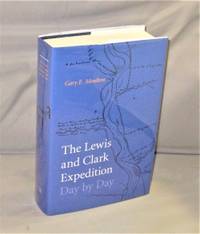
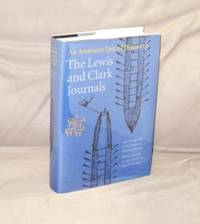
200328518<p>Lincoln:: University of Nebraska Press 2003. First Printing of the First Edition. A Fine tight copy in a Fine bright unclipped dust jacket. Moulton has edited the expedition journals into a riveting account that blends the narrative highlights if this definitive Nebraska edition. "For the first time the voices of the enlisted men and of the Native Americans are heard alongside the word of the captains." Contains new maps and illustrations. 413 pages with an index.</p> University of Nebraska Press, hardcover
201828379<p>Lewias & Clark Expedition Moulton Gary E. The Lewis and Clark Expedition Day by Day. Lincoln: University of Nebraska Press 2018. First Printing of the First US Edition. A Fine unread copy in a Fine dust jacket. In May 1804 Meriwether Lewis William Clark and their Corps of Discovery set out on a journey of a lifetime to explore and interpret the American West. The Lewis and Clark Expedition Day by Day follows this exploration with a daily narrative of their journey from its starting point in Illinois in 1804 to its successful return to St. Louis in September 1806. This accessible chronicle presented by Lewis and Clark historian Gary E. Moulton depicts each riveting day of the Corps of Discovery's journey. Drawn from the journals of the two captains and four enlisted men this volume recounts personal stories scientific pursuits and geographic challenges along with vivid descriptions of encounters with Native peoples and unknown lands and discoveries of new species of flora and fauna.</p> University of Nebraska Press, hardcover
200028338Mansfield Centre:: Lone Wolf Press 2000. Facsimile Reprint Edition. A Fine tight copy of this Facsimile Edition of Jacob's 1859 volume in green cloth binding without dust jacket as issued. Gass is best remembered for his participation in the Lewis and Clark expedition. He was the expedition's last surviving member when he died at the age of 99 in 1870. He was important to the expedition because of his service as a carpenter and he published the first journal of the expedition in 1807 seven years before the first publication based on Lewis and Clark's journals. Lone Wolf Press, hardcover
222773S.l., s.d. (1800) petit in-8, [4] ff. n. ch., couverts d'une écriture fine, soignée et lisible (environ 20 lignes par page), 13 ff. vierges, en feuilles, reliées par un ruban jaune à noeuds.
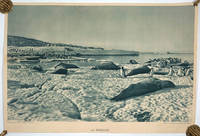
196015833Paris: Collection de la Societe de Geographie 1960. Very good overall. An image taken by Frank Hurley on the Mawson 1911-14 Australian Antarctic Expedition. One might draw the conclusion that the original image was in the collection of the French geographical society and is reprinted here in a very large format in blue ink the photo of seals and penguins lying on the pack ice. We once thought that it might have been from one of the French expeditions to the Antarctic perhaps Charcot's 4th Antarctic expedition. However Mark Pharaoh manager of the Mawson Centre at the South Australian Museum has confirmed that it is a Hurley image taken on Mawson's 1911-14 expedition. The title "La Banquise" below the image; "Cliche de la Collection de la Societe Geographie / Collection Jean-Pierre Geographie Pittoresque" lower left; lower right "Fernand Nathan Editeur Paris - Tous Droits Reserves". and with one very small thumb tack puncture below the title. 30 1/2 x 20 1/2" Collection de la Societe de Geographie unknown
1904760631904 Paris, Perrin, 1904, in 8° broché, 430 pages ; non coupé ; portrait en frontispice et carte dépliante.
102116London H.M.S.O. 1877. . First edition; folio 33.5 x 21.5 cm; 16 folding maps a few small splits to folds 16 plates further illustrations in the text; contemporary blue half roan marbled boards lightly faded neat restoration to extremities a very good copy; viii 484 pp.<br /> One of the most valuable sources for the history of exploration in northern Canada.<br /><br />The Nares expedition so called after its commander George Nares 1831-1915 sailed in two ships HMS Alert and HMS Discovery in late May of 1875 in quest of the North Pole. The ships reached Lady Franklin Bay on North Ellesmere Island and the Alert went on to reach the extreme north of the island the highest latitude that had yet been reached by a ship. In April 1876 three separate sledge parties set out but the men showed serious signs of scurvy and several members died. Nares was forced to abandon the expedition and returned to England in September that year.<br /><br />Despite the difficulties faced by the expedition it did produce important scientific results including a study of Inuit dog disease and a volume of physical observations.<br /><br />The Nares expedition is one of the best documented Arctic expeditions with eight Parliamentary Blue Books alone devoted to it between 1875 and 1878. Arctic explorer Vilhjalmur Stefansson wrote 'The Arctic Blue Books are beyond comparison the most important tool of knowledge in this field.'<br /> London H.M.S.O., 1877. hardcover
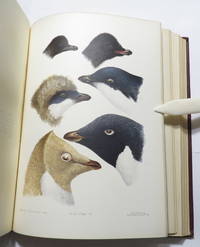
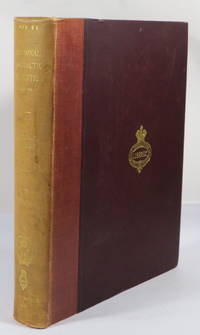
190727497London: Printed by Order of the Trustees of the British Museum. Very Good with no dust jacket. 1907. First Edition. Hardcover. Ex-library General Assembly Library New Zealand. Gilt library stamps on spine and front board. Fading to spine. Small 8mm tear to cloth at lower end of front joint. A little bruising with 18mm crease lines to lower outer corners of boards. Label on front endpaper "Presented by The Trustees of The British Museum". Overall a very good copy that although ex-library shows little sign of use and does not appear to have been a circulating copy. ; Volume Two only. xiv 362 each section individually paginated 1 1 blank pages 74 plate leaves 19 colour of which one of the Cephalodiscus plates only has small areas of red colouring 1 folding colour map in pocket at rear. In-text figures. Original red buckram cloth spine and burgundy cloth boards. Gilt lettering on spine. Page dimensions: 306 x 231mm. A volume of zoological reports from the Discovery Expedition 1901-1904 which was led by Captain Robert Falcon Scott 1868-1912. Various contributors. "The chief part of the present volume is Dr. Wilson's beautifully illustrated report on the Birds and Mammals giving his personal experiences during the Expedition as well as the results of subsequent study of the collections. This expedition was the first to discover a nesting colony of the Emperor Penguin. All the other collections of vertebrates made during the Expedition are here reported on with the exception of the embros of seals and the pelagic fishes which will be dealt with later. The investigation into the development of the feathers of the penguin raises several points of great morphological significance. The collection of fishes is small but interesting." - from the Preface to Volume II by F. Jeffrey Bell. The section on Mammals by Edward A. Wilson includes 3 colour and 2 black-and-white plates by Wilson. The section on Birds by Wilson and Pycraft includes 13 colour plates by Wilson. References: Rosove 288-2.A1 has "73 plate leaves" but the number of plate leaves given for each section add to 74 plate leaves which is correct; Renard 1129 - "The coloured plates by Wilson are particularly fine." . Printed by Order of the Trustees of the British Museum hardcover
190827532London: Printed by Order of the Trustees of the British Museum. Very Good with no dust jacket. 1908. First Edition. Hardcover. Ex-library General Assembly Library New Zealand. Gilt library stamps on spine and front board. Fading to spine. Label on front endpaper "Presented by The Trustees of The British Museum". Overall a very good copy that although ex-library shows little sign of use and does not appear to have been a circulating copy. ; Volume Four only. 2 blank iv 2 preliminary pages 13 1 blank; 5 1 blank; 41 1; 46; 16; 9 1 blank; 26; 6; 12; 56; 50 pages each section paginated individually 59 plate leaves 21 colour and another 9 with a single beige colour background tint. The fourth section is listed in the Contents as having 44 pages but it actually has 46 pages. Original red buckram cloth spine and burgundy cloth boards. Gilt lettering on spine. Page dimensions: 303 x 230mm. A volume of zoological reports from the Discovery Expedition 1901-1904 which was led by Captain Robert Falcon Scott 1868-1912. Various contributors. 20 of the colour plates are of sponges Porifera of which 9 of Tetraxonida and 11 are of Calcarea calcareous sponges. 1 colour plate of Myzostomidae marine worm. References: Rosove 288-4.A1 Rosove states 58 instead of 59 plates and 18 plate leaves for the section on Tetraxonida but this should be 19 as there are 19 plates numbered VIII through XXVI in this section. The Contents in the book also list 19 plates in this section.; Renard 1129 . Printed by Order of the Trustees of the British Museum hardcover
222587Paris, Lerouge, Petit, 1814 in-8, 86-[4] pp., broché, couv. papier rose de l'époque.
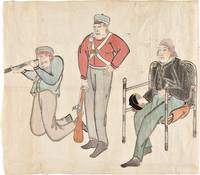
185334749Edo 1853. Watercolour and ink drawing on Japanese paper. A contemporary Japanese watercolour of Commodore Perry and members of his expedition produced at the moment of the American squadron’s arrival in Japan and the opening of sustained diplomatic contact between Japan and the United States.<br/> <br/> This lively drawing belongs to the immediate visual culture generated by Commodore Matthew C. Perry's arrival in Japan in 1853. Perry entered Edo Bay in July 1853 to deliver President Fillmore's request for a treaty and returned the following year leading to the Treaty of Kanagawa on 31 March 1854. The event prompted wide Japanese interest in the appearance dress equipment and conduct of the visiting Americans and images of the "Black Ships" and their crews circulated in manuscript painted and printed form. The composition presents three American figures isolated against the paper ground arranged almost as a study of types. At right Commodore Perry is shown seated in a chair wearing a dark naval coat and holding his hat. At center stands an armed crewman or marine in a red jacket holding a musket upright; at left another crewman kneels while looking through a telescope or spyglass. The emphasis falls on uniform posture weaponry and optical instrument details that would have marked the Americans as visually and technologically unfamiliar to Japanese observers. The drawing is especially interesting as a Japanese interpretation of the expedition distinct from the official American pictorial record produced by artists such as Wilhelm Heine. The Japanese manuscript images such as the present work preserve a different perspective shaped by local observation report and curiosity. unknown
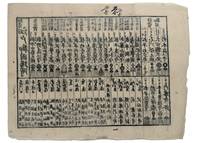
1853347481853. Three woodblock-printed sheets on mulberry paper. Mild edge wear old folds. A detailed revealing group of late Tokugawa samurai reference sheets recording the names ranks stipends heraldry standards and service obligations through which the shogunate and Edo public understood military readiness at the moment of Perry's arrival.<br/> <br/> Commodore Matthew C. Perry anchored off Uraga at the entrance to Edo Bay in July 1853. His arrival made visible the vulnerability of the Tokugawa capital and produced an immediate demand for information about coastal defence domain strength and the lords responsible for guarding the approaches to Edo. Kawaraban and related broadsides answered that demand in compressed visual form combining names crests military symbols income figures and geographical or administrative data. The first printed sheet appears to be an earlier roster of Edo office-holders or guard personnel. Its tabular format with names offices crests and standards records the recognitional system already in place within Tokugawa administration before the Perry crisis sharpened the public appetite for such information. The manuscript sheet is ruled into a large grid with headings formed from the twelve zodiac signs and the four seasons including Rat Ox Tiger Hare and the seasonal headings. The entries appear to record named houses Lords or retainers against recurring seasonal and cyclical categories probably for service attendance or ceremonial obligation. The third sheet is headed "Rekko yushinroku" here translated as "Register of Valiant Retainers of the Lords." It lists major daimyo houses and their principal retainers with domain or house headings names titles stipend figures in koku family crests standards and related insignia. Visible regional or house designations include "Kaga" "Owari" "Kii" "Satsuma" "Higo" and "Tosa." The sheet gives a graphic register of the daimyo world mobilised or imagined as mobilised around the defence of Edo Bay. Together the sheets preserve the administrative and visual language of Tokugawa defence at a moment of acute pressure. They are not formal shogunal orders and the first sheet may predate Perrys arrival but they show how late Edo Japan translated rank obligation military identity and coastal defence into portable tabular form. Their compression the names of Lords and retainers the scale of domains the crests and standards by which armed households could be recognised and the bureaucratic habits of a regime suddenly forced to account for its capacity to defend the country reveals these documents' immediacy and importance. unknown
1853347471853. 31; 31; 61pp. plus a loose sheet. Original paper wrappers stitched. Contemporary manuscript annotations in red ink in one volume Scattered worming heavy in places. Some dampstaining and dust soiling. About very good.<br/> <br/> Separate Accounts of the Arrival of Commodore Perry<br/> <br/> Three fascinating Japanese manuscript accounts of the arrival of Commodore Perry to Japan in 1853. Then first Uraga Kurotone Ni Kansaru or "The Black Ship Arriving in Uraga" comprises the official government report of events when Perry steamed into Uraga Bay. This volume contains contemporary edits to the text in red ink. The second account of Perry's arrival Edo Urgga Bikoku Fune Torai Ikken or "Arrival of the Ships at Uraga" contains a double-page manuscript sketch of the coastline of Uraga Bay together with the disposition of Perry's ships. The final volume consists of a third manuscript entitled GASSHUKKO SHOKAN WAGE UTSUSHI a copy of the report on the Perry arrival prepared by Abe Masahiro Chief Senior Councillor in the Toguwara Shogunate which includes translations of the letters from Fillmore and Perry delivered by Perry on July 8 1853. Also with a single manuscript sheet that provides a description of Perry's ship. Vital contemporary manuscript accounts of this monumental transformation in Japanese foreign relations from significant Japanese participants in events. unknown
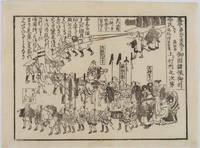
1854218512Japan. Circa1854. Black and white wood block print kawaraban 17.8 x 14cm This kawaraban is dated February 1854 and shows the retreat of the defending lords after the departure of American ships. The caption states that about 1000 people took part in the parade which was led by commanding samurai on horseback with a large cannon drawn at the rear. As it was a peaceful retreat the atmosphere appears relaxed and cheerful. . unknown
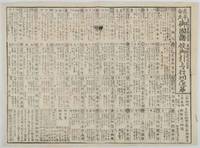
1854218513Japan. Circa1854. Black and white woodblock kawaraban 35.6 x 48.7cm ink mark upper section but text still legible otherwise a very good copy. This kawaraban dated 20 February 1854 elaborates a list of the defending lords following Commodore Perry's second visit to Edo Bay. The chart lists approximately 40 feudal lords mobilised to defend Edo each accompanied by detailed information including their house crests defensive positions and troop numbers. The total mobilisation is noted as around 375600 troops. . unknown
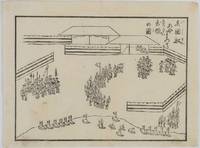
1853218506Japan. Circa1853. Black and white woodblock kawaraban 17.7 x 24cm In this kawaraban the American crew are assembled ready to board their rowing boats in anticipation of being transferred to their sailing ships. A group of American crew with pointed hats are in the middle while Japanese guards with black hats in an area surrounded by screens guard them at fore and rear. Numerous boats are ready on the beach with flags fluttering. . unknown
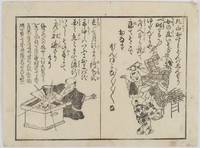
1854218390Japan. Circa1854. Black and white woodblock print 18 x 24cm a little light soiling very good. In this kawaraban two humorous and satirical poems concerning foreign arrivals are featured accompanied by illustrations. Both poems relate to foreigners and foreign ships clearly demonstrating that ordinary people were deeply interested in the arrival of foreign vessels and expressed their curiosity in various ways . unknown
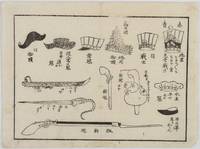
1854218389Japan. Circa1854. Black and white woodblock kawaraban 18 x 24cm. Small break in the border line along upper edge as issued. Small stain lower margin not affecting the imageotherwise good. This kawaraban features eight types of headgear worn by American crew members when they arrived in Japan including both ceremonial items and an interpreter's hat. It also illustrates a sword with its sheath alongside a bayonet and a hand-gun. Each item is depicted in meticulous detail reflecting a high level of curiosity about the foreign visitors. . unknown
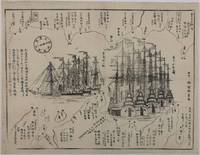
1854215028Japan. Circa1854. Black and white woodblock map with illustrations 32.2 x 41.5cm. Laid down on thick paper. Printed black border line at lower corner and occasionally in other areas along the border not printed otherwise good. This woodblock print map shows the defence layout around Tokyo Bay against the arrival of the American fleet. Names of lords who are responsible for defending particular areas are written with their rankings in terms of wealth sizes. In the centre the American ships are illustrated in detail. There are five sailing ships painted in red and three steam ships. These eight ships entered the bay on 6 February 1854. Thus this map most likely depicts the scene around that time. A caption on the left reads: 'The United States of America founded by Washington 77 years ago sent Matthew Perry with the President's letter in 1853; Perry revisited Edo in 1854.' . unknown
225135Paris, 1814 8 pièces en un vol. in-8, basane fauve racinée, dos lisse orné de filets, guirlandes et symboles militaires dorés, pièce de titre cerise, encadrement de simple filet à froid sur les plats, tranches marbrées (reliure de l'époque). Coiffes rognées, coins inférieurs abîmés.
First edition, 8vo, 67, [3]pp., disbound. Relating to the British raid on Rochefort in 1757.
First edition, 63, [1]pp., disbound. A reply to Henry Seymour Conway's 'The Military Arguments, in the Letter to a Right Honourable Author', 1758.
70723Au Kaire, de l'Imprimerie Nationale, an VII-an VIII 3 vol. in-8, 300 pp., 300 pp. et 316 pp., demi-chagrin bleu, dos à nerfs (rel. de l'éditeur).
226549Paris, C.-J. Trouvé, décembre 1822 in-8, 27 pp., en feuilles, cousu.
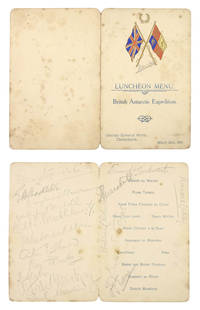
950041907-1913. . A collection of six menus and one souvenir programme various sizes and dates concerning the Nimrod British Antarctic Expedition. Preserved in archival sleeves within a blue morocco-backed fold-over box with chemise.<br /> A rare opportunity to obtain a collection of signed printed ephemera from Shackleton's first Antarctic expedition 1907-1909 during which Shackleton reached 'Farthest South' and achieved the first ascent of Mount Erebus. with the provenance of the Ship's chief engineer.<br /><br />The collection comprises:<br />1. 'To Celebrate the birthdays of our Shipmates H.J. Dunlop; & W.A.R. Michell at "Latitude 40"S. 30'/ Longitude 50"E.30'' manuscript menu in red and black ink on printed card signed on the reverse by Michell Murray Davis Mackintosh Mackay Dunlop and Captain England headed with the printed National Antarctic Expedition badge Nimrod added in ink 8vo 15.5 x 11.2 cm. <br />Menu for a meal to celebrate the birthdays of four shipmates of the Nimrod given whilst en route to Christchurch - at this point half way between South Africa and the Kerguelen Islands. Signed by four of the ship's officers and three of the eventual shore party. Food includes Potage. Dominion Crême D'Unloppè and Dessert. Abricot au Shackleton. 18 October 1907.<br /><br />2. 'Complimentary Dinner Given to Lieutenant Shackleton and the Scientists and Officers of the Antarctic Expedition of 1907' menu signed by Shackleton Bernard Day William Roberts and 7 others 4pp. upper cover printed in gilt with the 'Antarctic Expedition S.Y. Nimrod 1907'. emblem in blue 12mo 11.3 x 8.8 cm. Christchurch Freeman's Rooms. 19 December 1907. <br />Menu given for members of the Nimrod expedition by the Canterbury establishment. Shackleton was presented with a copper salver made from bolts taken from Nelson's ship Victory and Bishop Julius gave his blessing at an event attended by some eighty local dignitaries.<br /><br />3. Menu held for the 'British Antarctic Expedition' dinner held at the Canterbury Club Christchurch signed by Shackleton Wild Edgworth Davis and approximately 30 others 4pp. oval photographic illustration of polar scenes on upper and lower cover signatures on inside and lower pages punch holes at fore-edge 8vo 15.5 x 10.5 cm. 30 December 1907.<br /><br />Nimrod arrived at Lyttleton harbour on 25 March 1909 to a heroic welcome by the New Zealand public. The 'luncheon' held at the United Service Hotel the following day appears to have been a relatively intimate one the menu signed by Shackleton all but 2 members of the Shore Party and 3 of the ship's officers but none of the usual local dignitaries and was apparently unreported in the press.<br /><br />4. 'Luncheon Menu. British Antarctic Expedition. United Service Hotel Christchurch' signed by Shackleton and eighteen other members of the British Antarctic Expedition. 4-page menu the upper cover colour-printed with British flags. 26 March 1909.<br /><br />5. 'Philosophical Institute of Canterbury. Complimentary Banquet to Lieut. E.H. Shackleton M.V.C. the Shore Party and Officers of the S.Y. Nimrod on their return from Antarctica' signed by John K. Davis Nimrod's first officer Henry Dunlop and 24 other attendees 4-page menu the upper cover printed with map of the South Pole showing position reached by Discovery and Nimrod split at fold. 3 April 1909.<br />The banquet at the Philosophical Institute was a public affair at which 'a standing ovation was given to Shackleton and loud applause as he responded to the many toasts to the expedition. He said that 'They always felt dissatisfied with what might have been done. but on that plateau with no 'grub' inside them. they were forced to turn back. There had been no gentle maidens to rest their heads upon!' This was a reference to a duet that had been sung earlier in the evening and was received with laughter' The Press 5/4/09 p.8.<br /><br />6. 'South Polar Dinner given by John Howard Mcfadden. June 13. 1913' large-format menu card embellished with an original watercolour oval vignette by George Marston the Nimrod artist of a polar scene man sledge and tent against snow-covered mountains large penguin and decoration signed by the artist on the vignette 28.4 x 19.4 cm. the oval vignette c.6.8 x 9.5 cm. Oddenino's Imperial Restaurant. 13 June 1913.<br />Celebratory menu illustrated by George Marston. 'One wealthy friend was so far interested as to give an Antarctic dinner at a famous restaurant to all the available men who had been in the far South. The table was transformed into a picture of the Antarctic with artificial snow and real ice where large models of the Nimrod and the Aurora were placed at the edge of an ice-barrier thickly peopled by penguins and Marston the Antarctic artist painted special menu cards. It was a gay gathering enlivened towards the close by songs from Harry Lauder; but alas! the rich and kindly host did not pursue his hospitality to the point of providing transportation for his guests to revisit the haunts they longed for' The Life of Sir Ernest Henry Shackleton 1923 pp.191-2.<br /><br />7. Souvenir programme. 4to 'Sir Ernest Shackleton to give his Popular Lecture entitled Nearest the South Pole at the Music Hall Chester' signed twice by Shackleton 'E.H. Shackleton' in ink on the map once at the location of Farthest South and once in the lower margin 4 pages first page printed in red and black with photographic portrait of Shackleton. 21 February 1910.<br />A souvenir from Shackleton's extensive fund-raising lecture tour following the British Antarctic Expedition of 1907-9 during which Shackleton reached 'Farthest South' and achieved the first ascent of Mount Erebus. The series of talks accompanied by lantern slides proved hugely popular with audiences. An account of a similar lecture in Edinburgh describes his charismatic style of delivery: "'In the centre' he said 'you see the South Pole. Now you've seen as much as anybody else has ever seen". Hearty laughter greeted this opening as he knew it would. He had an orator's gift for dramatic effect and his humour was timed to perfection.' 'A born leader of men' article RSGSexplorers.com.<br /> 1907-1913. unknown