4 751 résultats
4to. (22), CXXI, (7), 320, (1) pp., final blank page. With lithographed folding map of the itinerary and a map of the Bengal Gulf. Publisher's original blue full cloth with giltstamped ship "Victoria" and blindstamped border to cover, as well as giltstamped spine-title. First Hakluyt edition and the principal English translation of "the first recorded visit by a Christian to Mecca" (Blackmer), containing the first printed eyewitness account of any place in today's United Arab Emirates, first published in Italian in 1510. - On his return journey from Mecca, Varthema visited Ras al-Khaimah ("Giulfar") and portrayed the city as "most excellent and abounding in everything", with "a good seaport", and whose inhabitants are "all Muslims". While Montalboddo's famous anthology of discoveries, printed in 1507, contained the first printed reference to the Arabian Gulf region, it was Varthema's work, published only three years later, that offered the first actual report from the region by a Western traveller who had visited the coast. - A gentleman adventurer and soldier from Bologna, the author left Venice at the end of 1502. In 1503 he reached Alexandria and ascended the Nile to Cairo, continuing to Beirut, Tripoli, Aleppo and Damascus, where, adopting Islam and taking the name of Yunas, he joined a Mameluke escort of a Hajj caravan and began the pilgrimage to Mecca. Thanks to his knowledge of Arabic and Islam, Varthema was able to appreciate the local culture of the places he visited. Impressed and fascinated, he described not only rites and rituals, but also social, geographical, and day-to-day details. After embarking at Jeddah and sailing to Aden, he was denounced as a Christian spy and imprisoned. He secured his release and proceeded on an extensive tour of southwest Arabia. Stopping in Sanaa and Zebid as well as a number of smaller cities, he describes the people, the markets and trade, the kind of fruits and animals that are plentiful in the vicinity, and any historical or cultural information deemed noteworthy. Returning to Aden, and after a brief stop in Ethiopia, he set sail for India. - From the collection of Col. Samuel Barrett Miles with his stamp of ownership to flyleaf. His widow sold the book to the Bath Public Reference Library in 1920 (their bookplate and shelfmark to pastedown, their blindstamped ownership to several pp., including the folding map). Old shelfmark label to spine. - Heads of spine and corners somewhat rubbed, slightly scuffed. Occasional light spotting; tear to right margin of folding map; pp. 39-42 loosened. A good copy. Howgego I, V15. Macro 2240. Cf. Blackmer 338. Gay 140.
1969852Stanford University Press Stanford CA 1969. Edition Unstated. Hardcover Original Cloth. Near Fine Condition/Very Good. Book . Near Fine HB in VG DJ protected by mylar cover. viii 586 p. 8 p. of plates: ill. maps; 24 cm. Light gray cloth over boards with silver title on black field & decoration on spine. Minor shelf wear. Text block is tight bright and unmarked. Unclipped reddish orange DJ is a color that fades easily but the spine is as bright as the front panel; scattered specks on back panel. Important study of timely topic. Presumed First Edition. Size: Octavo 8vo; up to 9 3/4" / 20-25 cm tall. 386 pages. Item Type: Book. Quantity Available: 1. Category: History; Middle East / General; United States; 1960s; . ISBN: 0804707065. ISBN/EAN: 9780804707060. Main Picture: Gregorian 1969 - Dust Jacket in archival polyester cover. Picture 2: Gregorian 1969 - Cloth cover in Near Fine condition. Picture 3: Gregorian 1969 - Publication information from verso of Title Page. Pictures of this item not already displayed here available upon request. Inventory No: 852. . 9780804707060 Stanford University Press hardcover
In 8°, t.t. edit. con sovrac. ill., pp. 481,(3), con num. dis. b.n. n.t.; copia molto buona. (x068/d)
Bologna, il Mulino, 2008, 8vo (cm. 19,5 x 12,5) brossura con copertina illustrata a colori, pp. 131 (Farsi un'idea, 156) .
Large hand-coloured four-sheet plan. Pen and ink, graphite and watercolour on paper laid on canvas. Framed and glazed. Dimensions: app. 90 x 170 cm (sheet); 105 x 205 cm (frame). Large manuscript plan in beautiful colour; a unique witness to Vanderbilt's passion and ambitions. A member of the prominent American Vanderbilt family, William Kissam (1849-1920) managed railroads and was also a horse breeder. He was one of the founders of The Jockey Club and the owner of a successful racing stable. In 1896, Vanderbilt built the American Horse Exchange at 50th Street (Manhattan). In World War II, the United States liberty ship SS William K. Vanderbilt was named in his honour. - This impressive plan represents the horse-racing stable and track at the chateau, which Vanderbilt built in 1906, with the help of Henri Guillaume and Pierre Sardou, architects. He purchased in 1903 the land in an area of Poissy called Les Gresillons, 20 miles outside Paris. At the time, he ran a breeding operation in Deauville, making the location, also called "Carrieres-sous-Poissy", particularly convenient since it is on the way from Paris to Deauville. The hippodrome comprised three oval tracks, the outer of which measured 2400 metres, as well as a straight track. A long wall separated the racing areas from the Chateau St-Louis where the Vanderbilts lived, called the Chemin Plat, now known as Avenue Vanderbilt. With the beginning of World War I, the racing stables were shut down and eventually sold. The Chateau St. Louis is now the corporate headquarters for a local quarry, which spreads over the land previously occupied by the hippodrome. As of today, only the residential building known as "Chateau Grésillons" still stands and is currently being restored. - Provenance: Ralph Esmerian (New York jeweler).
Folio. Tinted lithographic additional title by Charles Parsons, printed by Endicott & Co., 20 chromolithographic plates by Parsons after van Lennep, all printed by Endicott & Co. of New York. Expertly bound to style in half dark green morocco over period patterned cloth covered boards, spine lettered and decorated in gilt. A rare and important colour-plate book: one of the relatively few American costume books, and certainly the best such created in 19th-century America. This is a notable and unusual instance of the taste for the Ottoman or "Turkish" which manifested itself in the furniture of the period but seldom in books. In terms of American color-plate books, this is one of the only large projects from the 1860s, when the Civil War seems to have curtailed production of such lavish enterprises. "The one really big chromolithographic book of this decade [...] the art is simple, but [Charles] Parson's hand is obvious in the good lithography, and Endicott's printing is well done for its time" (McGrath). "Endicott achieved a rich variety of color which demonstrated the increased technical ability of American printers in the medium" (Reese). Henry Van Lennep was born in Smyrna, the son of European merchants. Educated, on the advice of American missionaries, in the United States, he returned to Turkey as a missionary in 1840, and spent most of the next twenty years in various parts of the Ottoman Empire. Returning to the United States in 1861, he turned his superb original drawings of Middle Eastern life into the Oriental Album. The plates include two scenes of Jewish life in the Ottoman Empire. Included are plates of "A Turkish Effendi", "Armenian Lady (at home)", "Turkish and Armenian Ladies (abroad)", "Turkish Scribe", "Turkish Lady of Rank (at home)", "Turkish Cavass (police officer)", "Turkish Lady (unveiled)", "Armenian Piper", "Armenian Ladies (at home)", "Armenian Marriage Procession", "Armenian Bride", "Albanian Guard", "Armenian Peasant Woman", "Bagdad Merchant (travelling)", "Jewish Marriage", "Jewish Merchant", "Gypsy Fortune Telling", "Bandit Chief", "Circassian Warrior", "Druse Girl". Bennett, p. 108. Blackmer Catalogue 1715. Blackmer Sale 1500. DAB XIX, 200. McGrath, pp. 38, 115, 162. Reese, Stamped with a National Character 97. Atabey 1274.
Milano-Garzanti, 1948 in 8° pp. 271 con bibliografia. Dall’indice: Allah, il suo Libro e il suo apostolato; La lingua degli angeli; I Beduini; Fatima e le sue sorelle; L’orfano sulla soglia; Una soluzione per la Palestina. Collana “Memorie e Documenti”.
556365Roma, Soc. Geogr. Italiana, 1911. Grand in-8 reliure époque demi-toile noire à la Bradel, auteur et titre dorés au dos, VI-423 pp., 2 cartes dépliantes hors-texte, tableaux et 124 illustr. en noir dans le texte d'après des photographies, index.
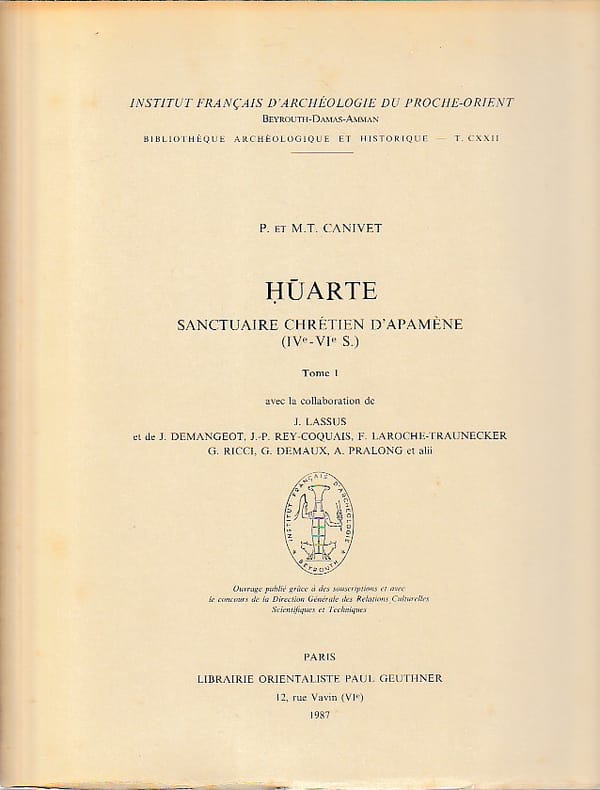
620172 volumes, Institut français d'archéologie du Proche-Orient (Beyrouth - Damas - Amman), Librairie orientaliste Paul Geuthner,1987, tome 1: 401 pp., tome 2: 176 planches, broché, non coupé, quelques rousseurs, couverture un peu jaunie, une déchirure une déchirure sur la quatrième de couverture du tome 2, état correct.
593141Beyrouth, Franz Steiner, 1967. In-8 br., 74-16 pp., 2 pl. en noir h.-t., index, bibliogr. Texte en allemand et arabe.
Broch?. 277 pages. Rousseurs.
Folio. 4 vols. bound as 1. [20], 218, [12], [2 blank]; [4], 236, [12]; [4], 244, [13], [1 blank]; [6], 231, [17] pp. First title-page printed in red and black, each title-page with Widerholds's woodcut device (motto: "Gradatim ad sidera tollor"). With 31 engraved plates (1 folding), including frontispiece and portraits of the author and his wife, by Jean Jacques Thourneyser. Further with woodcut initials, head- and tailpieces, factotums and several small woodcuts in the text. Contemporary vellum, manuscript spine-title, blue sprinkled edges. First edition in German of Pietro della Valle's deservedly famous narrative of his travels in the Middle East, with an excellent account of Muscat and the Arabian Gulf and references to Dibba. Della Valle, an Italian nobleman, sailed from Venice in 1614 to Istanbul, where he arrived in August 1614, spending a year to explore the city. He continued to Rhodes, Alexandria, Rosetta, Cairo, crossing the Sinai desert to Jerusalem, Damascus and Aleppo. From there Della Valle proceeded to Isfahan (Iran) to meet the Safavid ruler Shah Abbas I. He sojourned in Persia until early 1623, witnessing and commenting on the escalating conflict between Shah Abbas and the Portuguese empire. In 1621 he decided to return to Europe and set off for the Persian Gulf, but the Persian and English blockade prevented his sailing. By way of India he finally sailed for Muscat in January 1623, from which he crossed the Arabian Gulf to Basra, continuing overland to Aleppo, arriving in Europe in 1626. During his travels he wrote regularly to his learned friend in Naples, Mario Schipano. These 54 letters formed the basis of an account of his travels that was first published in Rome as Viaggi di Pietro della Valle from 1650 to 1658. "Della Valle displayed excellent narrative and descriptive skills, powers of acute observation, and a genuinely scholarly breadth of learning. He refused to comment on what he had not witnessed himself or checked against the best authorities [...] Della Valle's eighteen letters from Persia provide one of the most detailed sources of information for most aspects of Persian life in the second half of Shah Abbas' reign" (Gurney). - Engraved armorial bookplate on paste-down. Evenly browned throughout, some spotting, few quires in volume 3 with wormholes in gutter margin, not affecting the text, otherwise in very good condition. VD 17, 39:135561Q. Tobler, p. 95. Cf. Atabey 1269-1271 (other eds.); Blackmer 1712 (French ed.); Gurney, "Della Valle, Pietro", in: Encyclopaedia Iranica (online ed.).
4to. 3 parts in 4 vols.: 780, (34) pp. (12), 492, (24) pp. (2), 546, (24) pp. (20), 508, (18) pp. With engraved portrait of Pietro della Valle, 2 engraved title-vignettes, 3 woodcut title-vignettes, and several woodcut illustrations in the text. Contemporary full vellum with handwritten spine title and shelfmarks. All edges sprinkled red. A complete set of the first edition of Della Valle's "Viaggi", highly sought after as one of the earliest printed sources for the early history of Dibba, the coastal region at the northeastern tip of the United Arab Emirates, today ruled by the Emirates of Fujairah and of Sharjah. - Pietro della Valle (1586-1652) left Venice in 1614 on a pilgrimage to Palestine, proceeding to Baghdad and then into Persia, where he married and sojourned at the court of Shah Abbas. While staying with the Sultan of Bandar Abbas, he "met the son of the ruler of Dibba who was visiting. From this he learned that Dibba had formerly been subject to the kingdom of Hormuz, but was at that time loyal to the Safavids who in 1623 sent troops to Dibba, Khor Fakkan and other ports on the southeast coast of Arabia in order to prepare for a Portuguese counter-attack following their expulsion from Hormuz (Jarun). In fact, the Portuguese under Ruy Freire were so successful that the people of Dibba turned on their Safavid overlords, putting them all to death, whereupon a Portuguese garrison of 50 men was installed at Dibba. More Portuguese forces, however, had to be sent to Dibba in 1627 as a result of an Arab revolt. Curiously, two years later the Portuguese proposed moving part of the Mandaean population of southern Iraq, under pressure from neighbouring Arab tribes, to Dibba" (UAE History: 2000 to 200 years ago - UAEinteract, online). "Della Valle displayed excellent narrative and descriptive skills, powers of acute observation, and a genuinely scholarly breadth of learning. He refused to comment on what he had not witnessed himself or checked against the best authorities" (Gurney). He continued his travels east to the coast of India, Goa and Muscat, and thence back to Aleppo by way of Basra. He reached Rome in 1626, where the original Italian text of his letters written to the Neapolitan physician Mario Schipano was published. Only the first volume, dealing with Turkey, saw print during his lifetime. The two-part volume II on Persia was released in 1658, four years after his death, and the set was concluded in 1663 with the volume on India. Complete sets are usually encountered only with the first volume in its second edition, published in 1662. - Binding somewhat spotted. Some brownstaining throughout with occasional waterstains. Several repairs to p. 344 of vol. II; occasional insignificant marginal tears and small holes. Title page of vol. 2 (La Persia, parte prima) has the title of "parte seconda" with the word "seconda" overpasted with "prima" by the publisher. In all an attractive copy including the frequently missing portrait. Röhricht 946. Henze II, 42. Tobler 95. Gurney, "Della Valle, Pietro", in: Encyclopaedia Iranica (online ed.). Macro 1633. Cox I, 273. Wilson 234.
12mo. 4 vols. (40), 670 pp. (2) ff. (1 blank), 734, (34) pp., (2) ff. (1 blank), 792, (18) pp. 756, (24) pp. With a woodcut in the text of vol. 3, p. 193, and a full-page engraving on p. 361 of vol. 4 (both diagrammatic). Contemporary limp vellum with ms. spine titles; all edges of vol. 2 sprinkled in red. Early duodecimo edition of Della Valle's complete "Viaggi", published while the first complete edition was still under the press. Della Valle's account is highly sought after as one of the earliest printed sources for the early history of Dibba, the coastal region at the northeastern tip of the United Arab Emirates, today ruled by the Emirates of Fujairah and of Sharjah. - Pietro della Valle (1586-1652) left Venice in 1614 on a pilgrimage to Palestine, proceeding to Baghdad and then into Persia, where he married and sojourned in the court of Shah Abbas. While staying with the Sultan of Bandar Abbas, he "met the son of the ruler of Dibba who was visiting. From this he learned that Dibba had formerly been subject to the kingdom of Hormuz, but was at that time loyal to the Safavids who in 1623 sent troops to Dibba, Khor Fakkan and other ports on the southeast coast of Arabia in order to prepare for a Portuguese counter-attack following their expulsion from Hormuz (Jarun). In fact, the Portuguese under Ruy Freire were so successful that the people of Dibba turned on their Safavid overlords, putting them all to death, whereupon a Portuguese garrison of 50 men was installed at Dibba. More Portuguese forces, however, had to be sent to Dibba in 1627 as a result of an Arab revolt. Curiously, two years later the Portuguese proposed moving part of the Mandaean population of southern Iraq, under pressure from neighbouring Arab tribes, to Dibba" (UAE History: 2000 to 200 years ago - UAEinteract, online). "Della Valle displayed excellent narrative and descriptive skills, powers of acute observation, and a genuinely scholarly breadth of learning. He refused to comment on what he had not witnessed himself or checked against the best authorities" (Gurney). He continued his travels east to the coast of India, Goa and Muscat, and thence back to Aleppo by way of Basra. He reached Rome in 1626, where the original Italian text of his letters written to the Neapolitan physician Mario Schipano was published. Only the first volume, dealing with Turkey, saw print during his lifetime. The two-part volume II on Persia was released in 1658, four years after his death; in 1662 the Turkey volume saw a second edition, and the set was concluded in 1663 with the volume on India. A single-volume English translation of the Indian travels appeared in 1665. - Occasional slight brownstaining, otherwise fine. Röhricht 947, p. 238. Tobler 95. Weber II, 251. British Library STC II, 931. Cf. Graesse VII, 251. Atabey 1271 (1667 Baglioni ed., 3 vols. only). Blackmer 1712 (mixed French ed.). Macro 2233. Gurney, "Della Valle, Pietro", in: Encyclopaedia Iranica (online ed.).
230:325 mm. Engraved map. "A blown-up copy of the map designed by Gastaldi in 1548" (Al Ankary). The Gastaldi map "was the first modern map of the Arabian peninsula"; for the first time it "clearly shows the island of Bahrain and Qatar" (ibid.). Al Ankary 136.Tibbetts 27. Cf. Sultan Bin Muhammad Al-Qasimi 19 (the small version only).
230:325 mm. Engraved map. An early Ptolemaic map, showing "the mountains as lightly shaded slopes. The map includes details on towns and watercourses. The Arabian Gulf is distorted and the size of the watercourses is exaggerated" (Al Ankary). Al Ankary 147.Tibbetts 30. Not in the Al-Quasimi collection.
2 text vols. (8vo) and 2 plate vols. (large folio). (2), 491, (1), (4) pp. 788, (6) pp. text. With engraved portrait of Segato as frontispiece in the first text volume and the plate volumes with 160 engraved and aquatint plates (7 double-page), including 51 tinted and/or coloured by a contemporary hand; many plates contain multiple illustrations, making 309 illustrations in total. Contemporary green (text vols.) and brown (plates vols.) half morocco, sewn on 3 recessed cords (text vols.) and 4 tapes (plates vols.), "agate" chemical marbled sides. First edition of a beautiful series of illustrations of Egypt and classical Egyptian monuments, with the accompanying text volumes giving detailed information on each illustration. The illustrations show maps, costumes and views of both ancient and modern Egypt. The scientist and Egyptologist Girolamo Segato (1792-1836) began working on a new description and depiction of Egypt, selecting illustrations from the works of Denon, Grau and Rosellini, and also including his own original drawings. After his premature death his collaborator Domenico Valeriani finished the work and provided the accompanying texts. - Segato is best known for his technique similar to mummification, this technique of petrification remains mysterious, despite numerous studies and attempts to imitate, as he destroyed all his documentation before his death. - The text and plates volumes with marginal foxing throughout, minor except in the preliminary leaves. Otherwise in good condition. The binding slightly rubbed along the extremities, damage to the upper right corner of the first plates volume, resulting in a stain on the front endpapers, and the upper half of the sides on the second plate volume faded, otherwise good and structurally sound. Blackmer 1521 (plate volumes only, erroneously noting 159 plates). Blackmer sales cat. 984 (160 plates). Ibrahim-Hilmy II, 301. ICCU 0154707. For Segato: Almagia, "Segato, Girolamo" in: Treccani Enciclopedia Italiana (online ed.).
1929032293Cahier de France, Paris 1929. 1. Auflage Hardcover Sehr gut
1 17,5x10,5 cm., legatura in piena tela pressata e lavorata con incisioni, cornici e fregi vari, al centro l'immagine del santo, al piatto anteriore e a quello posteriorecon altri fregi floreali, , pagg. 284, piccole mancanze all'angolo in alto del piatto posteriore, allegato un ritaglio di giornale di Franco Gardini, 1987 "A 800 anni dalla battaglia tra crociati e infedeli, in francese, bella legatura, buone condizioni.
1 Vol. In-16 pag. 116. Copt. ill PROG 41073 CATT_ATT 54
In-16° pp. 116, bross. edit. ill.
Firenze, Sansoni, 1973, in-16, br., pp. 116. Con bibliografia. (“Scuola aperta”, 23).
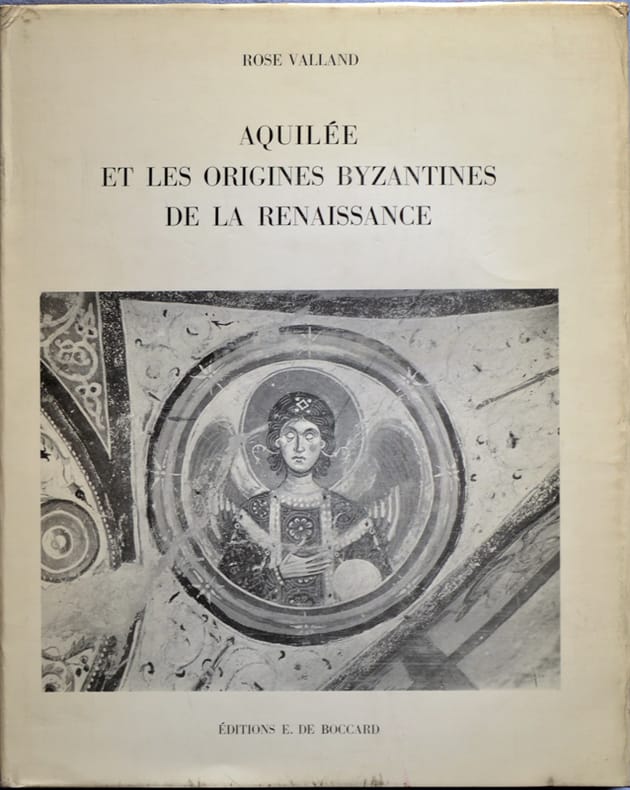
566888Paris, E. De Boccard, 1963. In-4, rel. d'éditeur pleine toile bordeaux sous jaquette illustrée en noir, 86 pp., 33 pl. en noir, bibliogr., index.
2010193251Perrin Perrin, 2010. In-8 relié à l'italienne, en plein cartonnage éditeur illustré, de 175 pages. Cartes en et hors-texte. Bon état
192480368Couverture souple. Broché. 277 pages. Papier bruni. Couverture légèrement défraîchie.