4 751 résultats
19238036Paris Plon 1923 1 vol. Broché in-12, broché, non coupé ni rogné, 289 pp. Edition originale. Un des 140 exemplaires numérotés sur Japon, en belle condition.
19188557Paris PAUL ÉMILE FRERES 1918 1 Paris, Emile-Paul frères éditeurs, 1918, in-12, broché, couverture rempliée, titre rouge lettrage rouge et noir, 270 pages.
191814794Paris Emile-Paul Frères Editeurs 1918 1 Paris, Emile-Paul Frères Editeurs, 1918, in-12, maroquin chocolat à coins, dos titré estampé doré à quatre nerfs, tête dorée reliure postérieure, couverture et dos conservés, 272 pp.
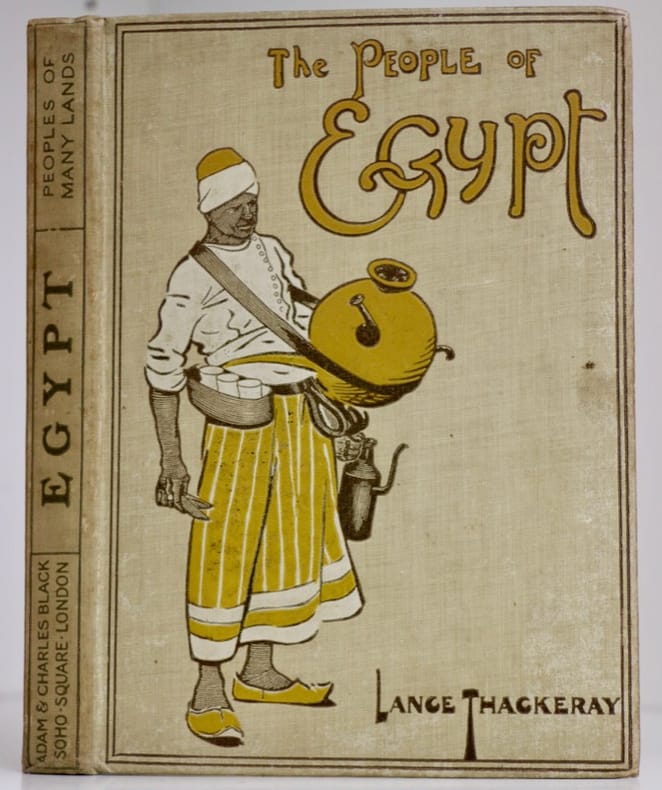
548210London, A. & C. Black LTD, 1916. In-8, cartonnage d'édition pleine-toile beige, décor polychrome sur le premier plat, titre en long sur le dos, VI-10 pp. de texte, 32 planches en couleurs et 37 dessins h.-t. en noir, qq. annotations à l'encre au contreplat.
34004Paris : Plon, 1924 - in-8 broché de 245 pages - exemplaire en très bon état, non coupé - Tirage à 1100 exemplaires - 1/890 ex. sur papier pur fil Lafuma -
Edizione: Teza edizione . Formato: 16° . Stato: Discreto . Caratteristiche: Dalla Libia a Malta a Istambul. Viaggio nel mediterraneo. Bruniture. Dorso guasto. Copertina stanca e con scritto a penna in vecchia grafia "Libia, Malta, Turchia, Tripoli" . Note epoca: XVII e.f.
8vo. XVIII, (2), 327, (1) pp. With engr. title page and lithogr. folding facsimile. Modern half calf (by Bayntun's, Bath) with giltstamped red spine label and marbled boards. Edges sprinkled in red. First edition. - The fame of the English clergyman Teonge (1621-90) rests on his present work. Due to financial difficulties, he enlisted in the Navy and became a chaplain on the ships Assistance, Bristol and Royal Oak, completing three voyages to the Mediterranean, where he searched for pirates, landed in Syria and visited Malta, Zante, Cephalonia, and Aleppo. - "The interest of Teonge's life is concentrated in the diary of the few years he spent at sea, which gives an amusing and precious picture of life in the navy at that time. This journal, from 20 May 1675 to 28 June 1679, having lain in manuscript for over a century, was purchased from a Warwickshire family by Charles Knight, who edited it in 1825 as ‘The Diary of Henry Teonge,’ with a facsimile of the first folio of the manuscript (London, 8vo). The narrative reveals the diarist as a pleasant, lively, easy-going man, not so strict as to prevent his falling in with the humours of his surroundings" (DNB). The diary contains accounts of cruises in the Channel, Atlantic, and Mediterranean, leavened with occasional songs, sonnets, acrostics, etc. "The nature of Teonge's diary, and the disappearance of the manuscript for almost a century after its first publication in 1825, led to persistent suggestions that it might have been a forgery. Confirmation both of Teonge's existence and of the sequence of events which he recorded came from the Admiralty records in the Public Record Office, and the re-emergence of the manuscript itself at a Sotheby’s sale in 1918 put the matter conclusively to rest" (ODNB). - Occasional insignificant brownstaining; altogether a well-preserved copy. Allibone 2375. DNB 56, 76. Lowndes 2605. Weber II, 412. OCLC 2438435.
Hand-coloured aquatint plate by Clark after Temple. 330 x 485 mm. From the exceedingly rare series "Sixteen views of places in the Persian Gulph", engraved after drawings taken by Richard Temple, a private in his Majesty's 65th regiment during the British attacks against the tribes of the Gulf in 1809. The port of Shinas is located near the border between Oman and the United Arab Emirates. Abbey 389, no. 17. Al-Qasimi, The Myth of Arab Piracy in the Gulf (Milton Park, 1988), pl. 15.
4to. (4), 264, (16) pp. With engraved map of Ethiopia, including part of the Red Sea and the source of the Blue Nile. Modern calf, gold-tooled spine, with red morocco title-label, and the sides blind-tooled in a panel design. Rare first English edition of Tellez's influential historical account of Ethiopia and Arabia. It is a digest of the accounts of all the Jesuit travellers to Ethiopia and Arabia, including Paez, De Montserrat, Almeida, Lobo and Mendes. It includes an account of the travels of the Jesuit missionaries Pédro Paez and Antonio de Montserrate, who were captured off the Kuria Muria islands on a mission from Goa to Ethiopia in 1590 and subsequently taken to Yemen, where they were held captive until 1596. After being sent to San'a by way of Melkis and the Wadi Hadramaut, then after three years taken to Al Mukha (Mocha), where they were forced to serve as galley slaves, they were finally ransomed in 1596 and returned to India. Paez discovered the source of the Blue Nile and is said to have been the first European to have tasted coffee in Al Mukha. - The work further includes a detailed description of Aden (Yemen) as well as of the Ethiopia-Adal War (1529-43), during which Ahmad ibn Ibrahim al-Ghazi led several expeditions against the Ethiopian emperor until most of Ethiopia came under the power of the Muslim Sultanate of Adal. The present English edition is based Almeida's "Historia geral de Ethiopia a alta" (1660), edited by Tellez. - With early owner's inscription ("W. G. Patchell") on title-page. Quires 2D and 2E transposed; a couple of millimetres shaved off the outer border of the map; a faint waterstain throughout; some leaves foxed and some occasional spots. A good copy. ESTC T133244. Paulitschke 1137. Cf. de Backer/Sommervogel VII, 1908-1910. Howgego, to 1800, A65 (Almeida).
4to. (2), 81, (7) pp. 19th century later half calf over cloth boards with giltstamped title to spine. All edges gilt. The account of the 1604/05 return voyage of the Portuguese merchant and adventurer Pedro Teixeira (1563-1645?), mentioning "Katifa (Al-Qatif) near Barhem (Bahrain)" in the Gulf (p. 15), Basra's trade with "Barhen, Catifa, Lasan, Persia, Bagdat, and all Arabia" (p. 16), as well as Badawin culture in Arabia (p. 21). Separately issued second part of the second volume of a collection of seven separate travel accounts compiled by John Stevens printed between 1708 and 1710 under the series title of "A View of the Universe", this one "for March 1710". - Contemporary handwritten ownership to title-page. Covers rubbed, with flaw to leather of upper cover. Slight, even browning; a good, wide-margined copy. Wiles, Serial Publication in England Before 1750 (1957), p. 272. Howgego, to 1800, T19, p. 1018.
8vo. (8), 384, (8), 115 [but: 215], (17) pp. With a woodcut on title-page, a woodcut initial and some woodcut tailpieces. 17th century marbled calf with gilt label to richly gilt spine, red edges. First edition of a "history of the kings of Persia compiled from the Persian histories of Mir Khwand and Turan Shah" (Howgego), in the original Spanish, by the Portuguese merchant and adventurer Pedro Teixeira (1563-1645?). It is one of the earliest European sources to mention Qatar, relating to the pearl fishery in the region: "The pearl fishery at Bahren begins some years in June, but generally in July, an lasts all that month and August … They generally go a fishing to Katar, a port on the coast of Arabia, 10 leagues to the southward of the Island Bahren. As soon an oyster is brought up, they open it, and take out the pearl. The pearls of this sea surpass all others in goodness and weight…" (English translation). The work is divided into three parts. The first, which is the largest, deals with the kings of Persia. It is a summarized translation of the voluminous Rawzat al-Safa by the Persian historian Mir Khwand (ca. 1434-1498), and is probably the first translation of the text into an European language. The second part is a translation of the Ayyibud emir Turan Shah's (d. 1180) chronicle of the kings of Hormuz, a text which is today only extant in translations. Though Teixeira's adventures started in 1586, he reached Hormuz in 1593, where he resided for several years to study its history. Both parts contain a chronological account of the kings, but also provide a more general history of the area. The last and third part contains an account of Teixeira's later travels from India to Italy in 1600-01 and 1604-05, visiting China, Mexico and the Middle East. In his preface Teixeira states that he originally wrote the work in Portuguese, but that it was translated into Spanish to appeal to a wider audience. The work appeared in a French translation in 1681, and extracts appeared in an English translation appeared in 1711, followed by a translation of the full text in 1715. - Binding slightly rubbed and with a small defect to upper spine. Slightly browned, otherwise immaculate copy in its first binding. Howgego, to 1800, T19. Maggs Bros., Spanish books 1014a. Not in Blackmer.
8vo. 90 pp. (without the final blank leaf). Small woodcut device on title, woodcut decorations and initials. Fine 19th century mottled calf by Lloyd, with gilt arms of Sebastião Pinto Leite, Conde de Penha Longa (motto "Superabo") to both covers, gilt fillets and faux raised bands to spine, compartments tooled in gilt, two red lettering pieces. Leading edges gilt; inner dentelle gilt. Marbled endpapers. First English edition of this rare work, containing an account of the failed invasion led by the young king of Portugal, Dom Sebastian, to the north of Africa, his defeat and death, and the political unrest that ensued. - Sebastian, the 24 year-old King of Portugal, invaded Morocco in 1578 with an army of 18,000 men. The army was crushed by the forces of Marwan Abd al-Malik I Saadi at the battle of Alcacer Quibir and King Sebastian was killed. The fact that he had left no successor paved the way for a series of impostors claiming the throne, only to be captured and executed (ultimately, the Spanish king would accede to the throne of Portugal). Teixeira's work narrates the machinations of the fourth such impostor, a Calabrian by the name of Marco Tullio. - Bound for the Portuguese politician and entrepreneur Sebastião Pinto Leite (1815-92), Conde de Penha Longa. Bookplate of the Fox Pointe Collection Library of Dr. & Mrs. Howard R. Knohl to pastedown. Joints of the fine binding slightly rubbed. Lightly browned throughout; title-page and verso of final leaf lightly dustsoiled. Overall in excellent condition. Rare at auction, the last copy being sold in 1991. BM-STC 23864. OCLC 32330439.
Engraved map (41 x 33 cm), hand-coloured in outline. Al-Qasimi 243.
8vo. XXIV, 195 pp., final blank page. With 25 numbered illustrations mainly depicting falcons and hunting and hawking scenes, including frontispiece and of which several full-page. Contemporary full cloth with giltstamped spine-title and illustration of a hunt to front cover. First edition. One of 500 copies of this rare Persian treatise on falconry, giving a detailed account of falcons as well as hunting-birds in general, translated by Douglas Craven Phillott. The translator's introduction gives an account of the author, a prince of Persia (d. 1874), and his book. "An excellent translation [...] A valuable addition to a falconer's library, whether or not he be interested in hawking in the East" (Barber). - Corners and spine ends lightly bumped; small tears to cloth in the upper part of the spine. Bookplate of G. J. B. Barry, depicting a falcon, to pastedown. A rare and very important work by a falconer who flourished in the middle of the 19th century. Schwerdt IV, 92. Barber 14.
8vo. 8 pp. on 2 bifolia. To W. Cabell, regarding the potential independence of Muhammad Ali of Egypt and the British occupation of Kharg Island. - A fascinating letter, composed at a time of great tumult in the Near and Middle East. It relays news of important events and evidences the willingness of the British to use force to implement their policy in the region. Lieut. Col. Robert Taylor went to India as a cadet in 1803 and did not return to England for over forty years, serving as Political Resident at Basra (1819-21) and Baghdad (1821-43). His library was purchased by the British Library in 1860 and forms the bedrock of its Arabic-language collection. - Writing from Baghdad, Taylor addresses W. Cabell of the India Board Office in London. He first informs Cabell of two loads of missing post; one outgoing tranche "lost by dromedaries running away with the bags and throwing their riders", and the mail from India "robbed by a party of Wahabis". He then notes Ottoman alarm at "the threatened independence of Mohamed Ali", and comments at length on relations with Persia, which were extremely tense due to the ongoing siege of Herat by Qajar and Russian forces: "Our envoy [John McNeill] ... was not listened to; while the Russian [Count Simonich] & his staff conducted their approaches to the fortress which was expected to fall." In response, the British occupied Kharg Island with a "small force ... not exceeding 500 men", thereby threatening military intervention. Reporting that it had "instilled a wholesome fear into the Persians", Taylor advocates the use of gunboat diplomacy elsewhere "to produce similar effects". - Official correspondence relating to Persia and the Gulf region is rarely found outside of institutional archives such as the India Office Records. This example is interesting on a number of levels, not least for showing how Britain's aggression in the first decades of "The Great Game" manifested in the Gulf. - A few later pencil annotations in a different hand; pages a little dusty.
Large folio (545 x 375 mm). (16) pp. With 6 hand-coloured lithographed plates and a lithographed title. Contemporary half calf with cloth sides, gold tooled title on front cover. First and only edition of an ethnographic study of native Indian people by William Tayler (1808-92), who was at the time Acting Salt Agent of the Central Division of Cuttack for the East India Company. He dedicated his work to "Lady William Bentinck" (born Lady Mary Acheson, 1809-50), who was the wife of the Governor-General of India. The illustrations were drawn by Tayler himself, who was an amateur artist and drew much of the Indian daily life that he encountered. He selected the present 6 drawings to be published and had them lithographed by J. Bouvier. The first 3 plates not only show the ways of Indian people, but even more so the luxurious life of the English in India. The first plate, "The Young Civilian's Toilet" shows a young man relaxing while being treated by several servants, who are named "Anglo-Indians". The room is strewn with objects of leisure. The next 2 plates, "The Young Ladies Toilet" & "The Breakfast" show equal scenes. The other 3 plates are more ethnographic in nature, showing native Indians in their everyday life: "Women grinding at the mill"; "the Sunyasees" (Sannyasis) & "The village barber". Tayler later became a controversial figure for his excessively harsh oppression of Indian people when he was the commissioner of Patna. - Spine and covers slightly worn, pages a little frayed, some foxing on the text pages. Dedication page browned. Plate 2 detached and inserted loosely. Plates in good condition. Abbey, Travel 465. Bobins I 272. H. K. Kaul, Early Writings on India 454. Prasannajit De Silva, Colonial Self-Fashioning in British India, c. 1785-1845 (2018), pp. 116-119.
Small 8vo. (8), 564, (4) pp. With 2 folding engraved maps and 8 folding engr. plates; several woodcuts in the text. Wants the portrait found in some copies. Contemporary dark brown full calf with traces of oxydized giltstamping to spine and gilt leading edges. First Amsterdam reprint: Taviernier's description of the Ottoman Imperial Seraglio - his first published work, which had appeared separately as early as 1675 - here forms the final part of his "Recueil de plusieurs relations et traitez singuliers & curieux", an independent publication which was, from 1679 onwards, appended to the author's "Six voyages en Turquie, en Perse, et aux Indes" (thus ultimately forming that collection's third and final volume). It was this volume, containing Tavernier's studies in commercial politics, that made the author's travels widely known. The fine maps show Japan and Tonquin, the plates depict costumes, a theatre performance, temples, and various processions. A woodcut in the Seraglio section gives the Islamic profession of faith, the Shahada, in Arabic script. "Tavernier spent eleven months in Constantinople before setting out on his first journey. He joined a caravan for Persia in 1638 and, between 1643 and 1668, made six voyages to Persia, India, the East Indies and Japan. During his travels he amassed a large collection of diamonds and jewels. His successful commercial enterprise was recognised by Louis XIV and he was granted a patent of nobility for his contribution to the establishment of French trade in Asia. It was Tavernier who indicated the trade routes to the East and made it possible for others to follow him. According to Brunet, the 'Recueil' appears with all editions of the 'Six Voyages' printed after 1679" (Atabey). "It appears that much of his information on the Seraglio was obtained from two former employees of the Sultan, one a Frenchman, the other an Italian" (Blackmer). - Binding rubbed but tight; a tear to one map repaired. Slight browning throughout due to paper. A good copy. Graesse VI/2, 43. Goldsmiths' 2283. Willems 1937. Atabey 1201. Cf. Cordier, BJ 393. Laures 525.
Folio (204 x 309 mm). 6 parts in one vol. (24), 264 pp. (2), 214 pp. (6), 113, (1) pp. 154, (2) pp. 87, (1) pp. 66 pp. With 37 engr. plates (many folding). Period-style full panelled calf, elaborately gilt-decorated spine on raised bands with red morocco spine label. Marbled endpapers. The first collected edition in English, translated by John Phillips and Henry Oldenburg: an account of Tavernier's travels to Turkey, Persia, India, and Japan (with large map of Japan), containing reports about the Japanese persecution of the Christians and the Dutch settlements in the Far East. Book Two, chapter Nine of the Persian Travels is of particular interest, as it contains an account of Tavernier's voyage through the Arabian Gulf, mentioning Bahrain, Bandar Abbas, Qeshm, and Hormuz and making observations on the pearl-fishing, people and navigation of the Gulf. There is also a bird's-eye map of the Strait of Hormuz showing the Musandam Peninsula (peppered with palm trees and captioned "A promontorie of Arabia the happey"), Hormuz, Larak, and Qeshm island, as well as Bandar Abbas and Bandar Kong on the Persian side. Intruguingly, this engraved map also includes depth soundings throughout the Gulf, making it useful as an early "Persian Gulf Pilot". A separate, illustrated chapter discusses extensively the invaluable pearl in the collection of the Imam of Muscat. Another illustrated chapter discusses "The Money of Arabia". In general, the plates depict festivals, processions, costumes, views, and images of the Eastern flora and fauna as well as coins and gems. - Title-page rehinged, with ownership of Thomas Hardy, dated 1698. Repaired tear to first leaf of contents. Faint marginal dampstain along lower edge of first several leaves; occasional browning, final leaves of text cleaned with some minor marginal restoration, but well-preserved on the whole. Handsome period-style calf-gilt binding fine. Blackmer 1632. Wing T251A, T252, T253. Campbell (Japan) 28. Cox I, 275f. OCLC 6071990. Cf. Wilson 223. Howgego T14. Severin 104-113. Not in Atabey or Weber.
Folio (200 x 305 mm). 6 parts in one vol. (18), 264 pp. (2), 214 pp. (8), 154, (2) pp. (6), 113, (1) pp. (14), 87, (1), 66, (2) pp. Modern half calf over marbled boards using remains of 18th-c. calf spine with modern gilt red morocco label. The first collected edition in English, translated by John Phillips and Henry Oldenburg: an account of Tavernier's travels to Turkey, Persia, India, and Japan (with large map of Japan), containing reports about the Japanese persecution of the Christians and the Dutch settlements in the Far East. Book Two, chapter Nine of the Persian Travels is of particular interest, as it contains an account of Tavernier's voyage through the Arabian Gulf, mentioning Bahrain, Bandar Abbas, Qeshm, and Hormuz and making observations on the people and navigation of the Gulf. There is also a bird's-eye map of the Strait of Hormuz showing the Musandam Peninsula (peppered with palm trees and captioned "A promontorie of Arabia the happey"), Hormuz, Larak, and Qeshm island, as well as Bandar Abbas and Bandar Kong on the Persian side. Intriguingly, this engraved map also includes depth soundings throughout the Gulf, making it useful as an early "Persian Gulf Pilot". A separate, illustrated chapter discusses extensively the invaluable pearl in the collection of the Imam of Muscat. Another illustrated chapter discusses "The Money of Arabia". In general, the plates depict festivals, processions, costumes, views, and images of the Eastern flora and fauna as well as coins and gems. - Occasional browning, but well-preserved on the whole. Blackmer 1632. Wing T251A, T252, T253. Campbell (Japan) 28. OCLC 6071990. Not in Atabey or Weber.
Folio (214 x 310 mm). 6 parts in one vol. (18), 264 pp. (2), 214 pp. (2), 66 pp, (2). (12), 14, (4), 15-46, (4), 47-87, (1) pp. (6), 113, (1) pp. 154, (2) pp. With 17 full-page engr. plates, 13 folding plates, and numerous text illustrations (including plates of Arabian coins, the great name of Allah, and other Arabian inscriptions). Contemporary calf, spine rebacked. Rare first collected edition of Tavernier's works, profusely illustrated with a fold-out map of the Arabian Gulf, an unusual, large map of Japan, and a fold-out map of the Great Moghul. Comprising: 1) The First Book of Monsieur Taverner's [!] Persian Travels; 2) The Six Trabels of John Baptista Tavernier [...] Through Turky and Persia to the Indies: 3) A Relation of Japon; 4) A New and Particular Relation of the Kingdom of Tunquin; 5) A New Relation of the Inner-Part of the Grand Seignor's Seraglio; 6) The History of the Late Revolution of the Dominions of the Great Mogol. A rare and interesting account of Turkey, Persia, India, Japan, Tonkin, and Formosa. "The Persian Gulf is the most dangerous Gulf I know, by reason of the shallowness and sharp promontories that point out into Sea [...] The Merchant would be glad to find a way through the Coast of Arabia to get to Mascate [...] Elcatif a Sea Town in Arabia, where there is a fishery for Pearls that belong to the Emir of Elcatif" (pt. I, p. 95; "Qatif" being an oasis in Saudi Arabia). Chapter XI (p. 49) of the first part deals with the breeding and nature of camels; chapter III (p. 64) mentions a voyage to Mecca; chapter XXIII (p. 255) deals with the island of Ormus (with the map of the Arabian Gulf). - The second part begins with a discussion of Arabian currency and is illustrated with plates of Arabian coinage. The most important story is perhaps that of “The Imam of Muscat Pearl - That Surpassed in Beauty All Other Pearls in the World”. In chapter XVIII of book II, "Of Pearles and the places where to find them" (p. 145), Tavernier states: "In the first place, there is a Fishery for Pearls in the Persian Gulf, round about the Island of Bakren. It belongs to the King of Persia, and there is a strong Fort in it, Garrison'd with three hundred men." Tavernier then narrates: "There is a wondrous Pearl in the possession of an Arabian Prince, that took Mascate from the Portugals. He then call'd himself Imenhect Prince of Masscaté; being known before only by the name of Aceph Ben-Ali Prince of Norennaé. It is but a small Province, but it is the best of all in the Happy Arabia. Therein grow all things necessary for the life of man; particularly, delicate fruits, but more especially most excellent Grapes, which would make most incomparable Wine. This Prince has the most wonderful Pearl in the world, not so much for its bigness, for it weighs not above twelve Carats and one sixteenth, nor for its perfect roundness, but because it is so clear and so transparent that you may almost see through it. The Great Mogul offer'd him by a Banian forty thousand Crowns for his Pearl, but he would not accept it." The use of the phrase "clear and lustrous as to appear translucent" seem to indicate a white or colorless pearl, the most sought-after color in pearls, with an optimum of lustre and orient caused by the reflection and refraction of light, respectively. The surface quality of the pearl must be exceptional and almost blemish-free in order to characterize it as a specimen surpassing in beauty all other pearls in the world, at that time. The fact that the pearl was in the possession of the Imam of Muscat in the mid-17th century indicates without any doubt that the pearl originated in the most ancient pearl fishing grounds in the world, the Arabian Gulf, most probably in the kingdom of Oman itself, at its very doorstep - on the pearl banks situated closer to the country's shoreline in the Gulf or the Strait of Hormuz. Oyster bearing reefs were well distributed throughout the Gulf, but were greater in abundance on the Arabian side of the Gulf than the Persian one. The pearls are depicted on a plate opposite page 150: "Figure one is of a Pearl which the King of Persia bought at the Fishery of Catifa in Arabia. It cost him 32,000 Tomans, or 1,400,000 Livres of our Money, at forty-six Livres and six Deneers to a Toman. It is the fairest and most perfect Pearl that ever was yet found to this hour, having no defect". Blackmer 1632. Wing T251A, T252, T253. Campbell (Japan) 28. Cox I, 275f. OCLC 6071990. Cf. Wilson 223. Howgego T14. Severin 104-113. Not in Atabey or Weber.
12mo. (20) pp., 1 blank leaf, 445, (5) pp., 3 blank leaves. Title printed in red and black. With engraved frontispiece. - (Bound with) II: Andrés, Juan. Des für 200 Jahren bekehrten Doctoris, Professoris und Praedicatoris der Muhammedischen Lehre, Johannis Andreae Mauri, nachdenckliches Buch, gegen den Mahomet und die Mahomedische falsche Lehre; von newen in Teutscher Sprache außgefertiget durch [Rudolf] Capell. Hamburg, Georg Wulff, 1685. (54), 218 pp., final blank. With engraved frontispiece. Contemporary vellum with handwritten spine title. Rare, early German edition of Tavernier's (1605-89) account of the Ottoman court drawn from his own observations. "The author's journey began in 1630. He went on a mission to Constantinople in 1636, or earlier. He states in the preface that much of his information regarding the seraglio was obtained from two former exployees of the Sultan, one a Frenchman, the other an italian, each of whom had served for many years" (Weber). The author also describes Ottoman ranks and court offices, as well as Ottoman coinage. - Bound after this is a very rare German edition of the widely received account of Islam provided by Juan Andrés, a converted Moor. First published in Spanish in 1515, it achieved immediate fame and was translated into many languages. "A crude anti-Islamic pamphlet by the Moor Abdallah, who took the Christian name of Johannes Andreas (Juan Andrés). The quotations from the Qur'an are often wildly distorted, and their interpretation biased - a fact which was even praised in the Paris edition of 1574" (cf. Göllner). - Some red underlining to Tavernier; some browning, but very well preserved. From the library of the Viennese collector Werner Habel, with his ownership stamp to front pastedown. His note of acquisition from 1976 is loosely inserted. I: VD 17, 39:126588G. Cf. Weber 270 ff. (other eds.), Graesse IV, 43 (1675 French ed.). Not in Cox. - II: VD 17, 23:286870C. Chauvin XII, p. 23, sub no. 86. Cf. Göllner I, 73 (1515 first ed.).
Folio (225 x 340 mm). 5 pts. in 1 vol. (24), 296, (4) pp. (8), 232, (4) pp. (8), 200, (4) pp. (8), 122 pp. (2), 120, (4) pp. With 2 engr. title pages, 2 engr. maps (1 double-page), 63 engravings on 30 plates (1 folding) and numerous engravings in the text. Contemp. calf with giltstamped (oxydized) cover monogram "B.P.B.F.", dated "1681". Independently published in Geneva and Nuremberg, this is one of the four slightly different Nuremberg issues of the same year. The first three parts treat Tavernier's travels to Turkey, Persia, India, and Japan (with large map of Japan), containing reports about the Japanese persecution of the Christians and the Dutch settlements in the Far East. Book Two, chapter Nine of the Persian Travels is of particular interest, as it contains an account of Tavernier's voyage through the Arabian Gulf, mentioning Bahrain, Bandar Abbas, Qeshm, and Hormuz and making observations on the people and navigation of the Gulf. Parts 4 and 5 of the present Nuremberg edition contain as a supplement the first German edition of Spon's and Wheeler's archaeological description of their journey to the Levant. The plates depict festivals, processions, costumes, views, and images of the Eastern flora and fauna as well as coins and gems. - Binding slightly chafed in places; lower corners bumped. Interior somewhat browned and brownstained; bookplate of Thomas Christian Wöhler to front pastedown. Seldom found complete; the copies last auctioned all lacked plates or the last 2 parts. The copy described by Laures is likewise incomplete, containing a mere 23 plates. Not in the Atabey collection. VD 17, 12:635124A. Lipperheide 1456 = La 6. Alt-Japan-Kat. 1472. Mendelssohn IV, 462. Laures 530. Graesse VI/2, 43. Cf. Blackmer 1631 (note); Weber II, 279 (the Geneva edition only).
Broch?. 189 pages. Couverture tach?e.
Watercolour on a large sheet of paper (image size: 74.5 × 52 cm), signed at the foot right: "E. Tarenghi". Contemporary (?) gilt wooden frame (89.5 × 66 cm), behind plastic. Attractive watercolour painting by the Italian orientalist painter Enrico Tarenghi (1848-1938), it shows three bearded men with carpets and two poufs. One of them is clearly the seller, another is inspecting the wares and the third is sitting on the ground rolling up one of the carpets. In the background a wide river (generally assumed to be the Nile), a dromedary and dozens of palm trees. Tarenghi made extensive use of photography in his work and often used photographs as a template for the background. The present setting is found more often in his work, not only showing carpet sellers, but also merchants selling fruit. The carpet trade, however, seems to be one of his favourite subjects regardless of the background. The carpets allowed Tarenghi to show off his skills, with their intricate motives, textures, creases and folds. - Small waterstain and minor defects at the foot and a few other negligible blemishes, but otherwise in very good condition. For the artist: Thieme & Becker XXXII, p. 445.
Engraved map (33.5 x 44 cm). Matted. Engraved map of the Arabian peninsula and southern Iran, with place names corrected by “a scientist very educated in the Arab language”. Al Ankary 210.