STARK FreyaBiblio.com
4 751 résultats
197027258John Murray 1970. 8vo. First Edition with frontispiece title-vignette plates and illustrations in the text and double-page map on green stock some light offsetting from fold-ins to free endpapers small neat signature on front free endpaper; green cloth gilt back a very good bright clean copy in unclipped dustwrapper. John Murray, hardcover
8vo (150 x 214 mm). (2), LVIII, 560 pp. With 7 folding chromolithographed maps (one bound as a frontispiece) and 5 woodcut maps and plans in the text (some in colour). Early 20th century library cloth with title lettered to spine in gilt. Fifth edition. Stanley (1815-81) was a progressive Anglican priest and ecclesiastical historian who would go on to serve as Dean of Westminster from 1864 until his death. - "Stanley was able to make an extended tour of Egypt and the Holy Land in 1852 and 1853. Starting from Cairo he and his companions sailed up the Nile, which he found intolerably dull, but the great granite statues of Rameses and two other pharaohs at Thebes impressed him. They went as far south as Abu Simbel, but turned back to Cairo, climbed the pyramids, and then set out on camels for the Sinai peninsula, at that time visited only by the most intrepid of European travellers. In the monastery of St Catherine at the foot of Mount Sinai they found the great German scholar Tischendorf, who on a previous visit had discovered there an important biblical manuscript, the Codex Sinaiticus. After moving on to the Gulf of 'Aqabah, they turned up the defile that led to Petra, which Stanley pronounced to be a city not of bright colours, but of dull crimson, indigo, yellow, and purple. They reached Jerusalem on Easter eve 1853, from where they made expeditions to Nazareth, Damascus, Jericho, and the Dead Sea. The tour led to the publication of 'Sinai and Palestine' in March 1856, Stanley's powers of observation and description, together with the unfamiliarity of the places that he had visited, making the book an instant success. It reached a fourth edition within a year, and as late as 1881 was still being reprinted" (ODNB). - Occasional slight browning, but very well preserved in a later library binding. OCLC 3044873. Cf. Ibrahim-Hilmy II, 257. Not in Gay.
Very Good English Original 1/4 leather bound in Ottoman lettered gilt on spine. Roy. 8vo. (24 x 17 cm). In Ottoman script. [17], 640 p., 11 p. b/w plates. 1 genealogical tree. First Ottoman Turkish Edition of Poole's 'The Mohammedan dynasties: Chronological and genealogical tables with historical introductions' was printed in 1894. Ozege: 4502. Düvel-i Islamiye. Translator: Halil Edhem [Eldem]. [= The Mohammedan dynasties: Chronological and genealogical tables with historical introductions (1894)].
Large folding map (64 x 86 cm), hand-coloured and mounted on linen. Scale 1:6,969,000. Alai, General maps E.323. Not in Al Ankary; Al-Qasimi.
4to. 28 pp. With several photographic illustrations in colour. Original printed wrappers. Stapled. Illustrated annual report of the Standard Oil Company. With handwritten inscription: "Herzliche Grüsse Henry". - The photographs display oil refineries and gas stations, but also illustrate the multi-purpose character of "Jersey" products, including gasoline used for outboard motors in Bangkok, liquefied petroleum for the operation of greenhouses in Belgium, and Esso asphalt laid in France - "a universal answer to building better highways". With a group portrait of three former and acting company presidents: M. J. Rathbone, Michael L. Haider and J. K. Jamieson.
Folio (231 x 308 mm). 24 pp. With numerous illustrations in colour and black-and-white. Original printed wrappers. Stapled. Illustrated corporate magazine of Standard Oil, celebrating the company's international activities. It includes reports on trade with European countries, the recently established Antwerp refinery, the kerosene-powered Seguin lighthouse in Maine, advancing infrastructure in North Africa, and the recycling of oil barrels as musical instruments in the Caribbean. The final three pages display sketched impressions of the Jersey Standard headquarters in New York by the artist Bettina Steinke. OCLC 1755500.
507125Leiden, E.J. Brill, 1980. In-8 rel. pleine toile bleue éditeur, titre doré au dos et plat sup., IX-415 pp., 1 carte dépliante en noir hors-texte, index.
Two and a half handwritten sides on 2 leaves. Signed "your most obedient humble servant Dr. Sprenger", and concerning various Arabic manuscripts which Sprenger is considering translating. The letter dates from Sprenger's relatively brief time in London (1836-43), and thus predates any of his published works. He decides that Ibn Kourdadbeh's 'Oriental Geography' (the earliest surviving Arabic book on administrative geography) is unsuitable as he can only locate one MS copy. Instead, he offers to produce a translation of Suyuti's famous 'History of the Caliphs', which he notes has been accounted the best of such histories by the Arab encylopaedist Haji Khalfa. Sprenger transcribes several names from English into Arabic for the benefit of his correspondent. - A well-preserved and early letter reflecting Sprenger's outstanding command of Arabic sources. The Austrian-born Sprenger became one of the most noted orientalists of the 19th century, producing a comprehensive 'Life of Mohammad from Original Sources' in 1851.
Folio (500 x 350 mm). IV, 42 pp. With 19 aquatints by Edward Orme after sketches by Spilsbury in original hand colour. Contemporary half cloth with red boards and printed label to upper cover. Second edition of English naval surgeon Francis Spilsbury’s account of his travels in Palestine and Syria during the Napoleonic campaigns there, with 19 finely hand-coloured folio aquatint views. Spilsbury was surgeon on board HMS Tigre during the campaigns of 1799 and 1800. The Tigre brought Sir William Sidney Smith to defend Acre against Napoleon’s siege, and led a naval force in support of Turkish armies which finally relieved Acre, and his text gives some account of the military campaigns and the Turkish dignitaries. In his reminiscences Napoleon accused Smith of making him miss his destiny, as Smith’s timely appearance thwarted Napoleon’s drive to invade Syria and forced him to retreat to Egypt. The views are mostly connected with the coastal towns of modern Lebanon and Israel, though several are from Spilsbury’s travels inland to meet the Grand Vizier in charge of the Turkish army, Jezzar Pacha, and other dignitaries. First published in folio in 1803, with a mezzotint portrait of Sir William Sidney Smith that was not included in this second edition; a third followed in 1823. - Some staining to covers; aquatints are perfectly preserved. Tooley 464. Cf. Atabey 1168f. Blackmer 1585. Abbey, Travel 381. Colas 2788. Weber II, 835. Aboussouan 852.
194732563Editions Boursiac | Paris 1947 | 16.50 x 25 cm | broché
8vo. 27, (1) pp. With 5 engraved plates by F. Berthout, Caen, and woodcut vignette of the Académie de Caen on reverse of t. p. Original printed wrappers. Second edition (first printed in 1820), with several illustrations published here for the first time. No. 237 of 300 copies. Rare treatise by John Spencer Smith (1769-1845), an "extrait du procès-verbal de la séance du 14 avril 1820", about the famous Chasuble of Saint-Regnobert preserved at the Cathedral of Bayeux, and about the Cufic-inscribed ivory chest, supposedly part of the Saracen spoils taken by Charles Martel, in which it is stored. The engravings show the chasuble as well as the chest and many details of the inscriptions. The original edition, published by Le Roy in 1820, contained merely a frontispiece and a single text illustration. - Wrapper torn at upper spine end. Binding loosened; significant browning to final quires. With the errata slip bound at the end. OCLC 27973008.
556281Philadelphia, Univ. of Pennsylvania Press, 1930. In-8 reliure éditeur pleine toile brune, titre doré en long au dos, XIII-198 pp., bibliogr., index.
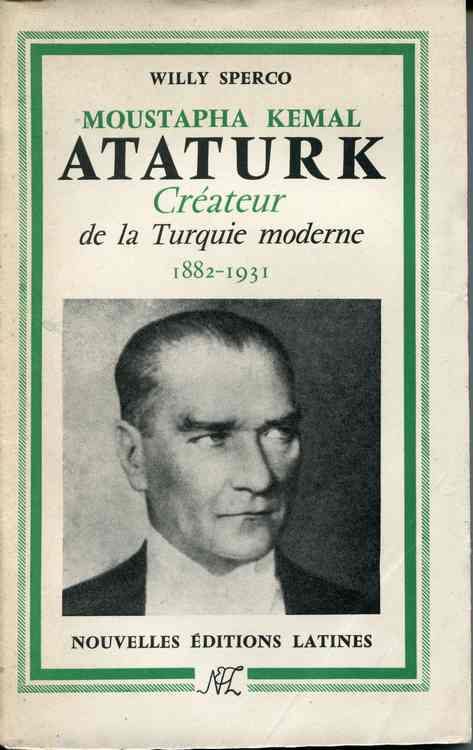
16524,Paris, Nouvelles Editions Latines 1958, 204 pp., 1 vol. in 8 br. couverture illustrée
4to. [6], 74 pp. With a woodcut garland of fruits, leaves and nuts on the title-page, 1 woodcut headpiece and 1 woodcut decorated initial. Set in roman, italic, Arabic and Greek type. Later paper wrappers. Catalogue of the collection of 126 Persian, Arabian, Turkish, Greek, Latin and other books and manuscripts donated to the Library of the University of Uppsala by Johan Gabriel Sparwenfeld (1655-1727). It was compiled by the Swedish scholars Eric Benzelius the younger (1670-1756) and Olaus Celsius the elder (1675-1743). The main series of manuscripts (items I-LXI), described in great detail, includes 41 in Arabic, Persian and Turkish, 8 in Greek (one dating back to the eighth century) and 12 in Latin and modern European languages. These are followed by 42 printed books (LXII-CIII) including 2 in Chinese, several in Arabic, the 1581 Ostrog Bible (the first Bible printed in Old Slavonic) and several other exotic languages, including Irish (set in Anglo-Saxon type). A few more manuscripts (mostly Arabic) are added at the end, numbered I-VI and I-XV, plus an unnumbered geographic manuscript in Chinese (3 volumes). This is the earliest catalogue of the Uppsala University Library's collections. The Arabic, Persian and Turkish titles are set in a large Arabic type cut for the physician and orientalist Peter Kirsten by the Swedish punchcutter Peter von Selow (who served his apprenticeship under Tycho Brahe) and first used at Breslau in 1608. Werner, printer to the university at Uppsala sice 1701, seems to have been the first Swedish printer to use types by Nicolaus Kis, two of his italics and one roman appearing in the present book, though not the roman used for the main text. - After finishing his studies at Uppsala, Sparwenfeld travelled throughout Europe and accompanied the Swedish ambassador to Moscow, where he took an interest in Slavonic languages. On his travels he collected many precious books and manuscripts. In 1687 he returned to Stockholm, where he carried out a study of manuscripts from the ancient Goths. He travelled to Holland, France and Spain, dealing with the Blaeu printing office and mediating in the production of Georgian type cut by Nicolaus Kis for the exiled King of Georgia. In 1691 he travelled to Egypt, Syria and Tunis. Though a Protestant, he presented the manuscript of his Slavonic lexicon to Pope Innocent XII, who granted him access to the Vatican library, a rare honour for a Protestant. He returned to Sweden in 1694. He continued to correspond with scholars throughout Europe even after he retired to his estate in 1712. He wrote and spoke 14 languages. - In very good condition, with only occasional very slight foxing, wholly untrimmed, preserving the deckles and point holes and with the bolts unopened. A remarkable catalogue of an extraordinary library, especially rich in Arabic manuscripts. Almqvist, Sveriges bibliogr. litteratur 2838. Smitskamp, PO 113 (note).
4to. (6), 74 pp. With woodcut title vignette. modern boards. Extensively annotated catalogue of 115 Arabic, Persian and Turkish works, mostly manuscripts which Sparvenveldt had acquired in Egypt, Syria, and Tunisia in 1691. Edited with the help of Erik Benzelius and Olof Celsius. The titles are rendered in the original languages in Kirsten's fine Arabic types, brought with him to Sweden from Breslau in 1636. - Insignificant edge staining to title page; reverse shows old library stamp of Upsala College, East Orange, NJ, dissolved in 1995. Untrimmed copy. Smitskamp, PO 113d. Schnurrer 17 & 25. Besterman 152. Warmholtz 9270.
19925744Silva 1992 In-4 reliure éditeur sous jaquette, 204 pp. Illustrations couleurs
4to. (8), 190, (4) pp. With the academy's woodcut device on the title-page (incorporating the Portuguese coat-of-arms, Athena's owl and Hermes's staff). Set in roman, italic and Arabic types. Modern green morocco, gold-tooled spine with a red morocco spine label with title in gold and the imprint in gold at the foot of the spine, marbled endpapers. First and only edition of a collection of letters written in Arabic during the reigns of Kings Manuel I and João III of Portugal (numbered 1-58 in chronological order, the dated letters from 1503 to 1528), from the official Portuguese state correspondence, with the original Arabic and a parallel Portuguese translation. The letters came from North Africa, the Gulf, East Africa, India and the East Indies. The writers include kings, princes, governors, wazirs, sheikhs and noblemen, including Kings "Mahomed Xáh" and "Mir Abanasar" of Ormus, King "Azarkam" of Barus in Sumatra, and kings of Fez, Malindi and Calicut/Kozhikode. They are especially important for the light they shed on Portugal's East Indian trade, but also provide a rare primary source of information about Islamic leaders for whom little documentation has survived. The original Arabic appears in the inside columns with the Portuguese translation in the outside columns, and the apparatus and notes are in Portuguese. João de Sousa (1734-1812), born in Damascus, came to Portugal in 1750 and was appointed the first professor of Arabic at the University of Lisbon. - The Royal Printing Office in Lisbon had used the present Arabic type in 1774 for Antonio Baptista, Instituições da lingua Arabica. The form of the Arabic type may have been influenced by Robert Granjon's of this size, cut in 1586, his smallest Arabic, which was at this time in possession of the Propaganda Fide in Rome, but the direct model and the circumstances of the cutting remain unknown. The type here measures 96 mm/20 lines (14 point). It is not the Arabic type acquired by the Biblioteca Real in Madrid in 1751 for the 1760 Bibliotheca Arabico-Hispana, which came from the Voskens and Clerk foundry in Amsterdam. - The first page of the first letter is very slightly soiled, otherwise internally fine and clean. Overall in very good condition. A remarkable primary source for numerous Arabic-speaking leaders and their relations with Portugal in the early 1500s. Macro 2098. Palau 320779. Schnurrer 186. Innocêncio IV, 41-42. Palha 2777. Krek, Typographia Arabica, p. 36, no. 3. Streit XVII, 6441. Not in Blackmer or Atabey.
8vo. Half-title and title, (4), 123, (1) pp. With 4 lithographed plates. Contemporary red morocco-backed cloth. One of 150 copies, rare. "A neat summary of nearly all that is necessary to be known in order to tame, train, and fly a hawk successfully" (Harting). - Cloth rubbed, a very good copy. Harting 217. Schwerdt II, 168.
Large 8vo. 109 (instead of 129), (2) pp. With 16 (instead of 19) plates. Marbled half calf with giltstamped title to spine. Includes 4 photographic views of Mecca, 3 of Medina and 3 of Jeddah (after Sadiq Bey and others), wants only the ten-leaf appendix, 2 portraits and the plate showing the departure of the Mahmal in Cairo. - Salih Subhi, an Egyptian public health official, was commissioned by his government to undertake the Hajj in 1888 and 1894. Here he describes the eight-month journey in great detail. Muhammed Sadiq Bey was a major pioneer in the history of Arabian photography and the first person ever to photograph the Holy Cities of Mecca and Medina. - Browned throughout due to paper. Our copy without the ten-leaf appendix before the author's epilogue and portrait. - Rare, the last copy on the market fetched £27,500 (Christie's, April 13 2010, lot 276, with author's dedication), the Burrell copy fetched £8,000 in 1999 (complete, but in modern cloth). Macro, Bibliography of the Arabian Peninsula, 2096. Auboyneau/Fevret 20. OCLC 7055812.
593015Institut Français de Damas, 1953. In-8 br., XXIII-144 pp., VI pl. en noir in fine, index.
595514circa. 1954. In-4 br., pp [116-153].
545111Damas, Institut français, 1950. In-4 agrafé, pp.85-115.
London, 1999, 4to brossura, cop. ill. pp. 162 con oltre 900 lotti prezzati.
In-8°, pp. 6. Bross. edit. SORDI, storica. Allieva di Silvio Accame, insegnò all'Università di Messina e poi di Bologna. Dal 1969 al 2001 insegnò Storia greca e romana all'Università cattolica del Sacro Cuore a Milano.
8vo. 2 vols. XXIV, 453, (3) pp. XXXVIII, 534, (2) pp. With 13 folding engr. plates and 2 folding tables. Contemp. marbled boards with giltstamped spine labels. First German edition of this account of travels in Upper and Lower Egypt, translated from the French original of the naturalist Charles Sonnini de Manoncourt (1751-1812), who had visited Egypt, Turkey, and Greece in 1777-78. The plates show landscapes, plants, fish, and antiquities. - Binding slightly bumped at extremeties; slight browning throughout. Titles stamped ("Institut für Grenz- und Auslandstudien"). Fromm 24495. Ibrahim-Hilmy II, 245. Kainbacher 398. Cox I, 395. Graesse VI/1, 439. Cf. Gay 2250 (1799 French ed.).