SIM KatharineMareMagnum

4 751 résultats
8vo., First Edition, with plates, neat inscription on front free endpaper verso; blue cloth, upper board and backstrip blocked and lettered in gilt, a near fine copy in unclipped dustwrapper. With the trade ticket of Henry Sotheran on front paste-down and compliments slip loosely inserted. Scarce.
556279Ankara, Türk Tarih Kurumu Basimevi, 1990. Fort volume grand in-4 reliure éditeur pleine toile bleu, titre doré au dos et au plat sup. LIX-703 pp., index.
Large 4to (195 x 268 mm). Title and 30 captioned plates, engraved throughout (image size ca 110 x 170 mm). Late 19th century half calf with gilt spine rules and 18th or early 19th c. giltstamped lozenge label on upper cover. Charming, rare suite of engravings showing the costumes of the Turks, including the Sultan and various courtiers of the Porte, Ottoman soldiers and janissaries, an Arabian preacher, a falconer, street salesmen, a porter smoking a long meerschaum pipe, and several Turkish ladies (one in surprisingly revealing attire). - Charles-Francois Silvestre (1667-1738) held the title of "Maître à dessiner du Roi" (Drawing Master to the King) and was in 1695 appointed art instructor to the young Dukes of Burgundy, Anjou and Berry, the grandsons of Louis XIV. The present suite, dedicated to Louis, Duke of Burgundy, reflects the orientalist fashion of its time but is also a highly original work of art demonstrating a vivid, flamboyant style and not apparently based on earlier illustrations. The title and 21 of the plates are signed in full with the Royal privilege: "F. Silvestre inv. et ex. C.P.R.", while eight are simply signed "S." and one ("Janissaire de la garde, Solac ou Pzyc") is not signed, though it is clearly executed in the same style as the others. Uncommon thus with 31 plates including the title: the copies listed by both Hiler and Colas, as well as that in the Gennadius Library at the American School of Classical Studies at Athens, are oblong volumes containing only 30 plates including the title, on a total of 15 leaves (Colas: "titre compris [...] Ces planches sont tirées à deux sur la même feuille"), while the Lipperheide copy comprised a mere 22 plates including the title, making this the most complete set known. - Insignificant browning and fingerstaining, more pronounced in title but on the whole confied to the wide margins. Hiler 799; Colas 2744 (both listing 30 plates including title). Lipperheide Lb 25 (listing title and 21 plates).
8vo. 3 vols. (8), 15, (1), 587, (1) pp. (6), XII, 543, (3) pp., final blank leaf. (4), IV, 565, (1) pp., final blank leaf. Contemporary brown boards with giltstamped red spine label. First edition, printed with the beautiful Arabic types of the Imprimerie Imperiale by J. J. Marcel, who in 1798 had brought printing to the Arabic world when he set up the first press in Cairo. - "Opus maximopere, nec vero ultra quam fas erat, laudatum et celebratum ab omnibus qui de eo referrent" (Schnurrer). "Like his Grammar, de Sacy's Chrestomathy was first compiled for his students. In the early 19th century there was a very limited body of reading matter for academic learners of Arabic [...] The Chrestomathy was intended to remedy this fault. But de Sacy immediately combined with this practical aim the scholarly task to use and make known valuable texts from the manuscript troves of the Royal Library in Paris, and so his Chrestomathy contains extensive extracts from late historians (Maqrizi) and geographers, from Hariri's Maqamat, from the Druze canon and from Qazwini's cosmography, as well as several poems from Nabiga to Ibn Farid, and, finally, keeping in mind the practical needs of future interpreters, a collection of state documents, all of this in the original Arabic with French translation and a wealth of annotations [...] It is a credit to de Sacy's interpretative mastery that the Chrestomathy [...] enjoyed a much longer life than similar works usually do, which tend soon to show their age due to the progress of scholarship: for nearly a century his work introduced learners to the masterpieces of Arabic literature" (cf. Fück). - Bindings rubbed and bumped at extremeties; interior well preserved. Scarce on the market. Schnurrer 153. Fück p. 146-148. OCLC 3822297.
Large 4to (220 x 274 mm). (6), 47-58, 483-782 pp. With 4 tables. Later red half morocco over marbled boards with gilt title to spine. Offprints from vols. 47 & 48 of the "Mémoires de l'Académie Royale des Inscriptions et Belles-Lettres" with separately printed title-page. The four "mémoires" which make up the first piece were variously read in public between 1787 and 1791, but published for the first time in 1793; the second, much longer part, was first heard on 5 April 1785. Includes long extracts in Arabic from Masoudi, Sirat Alresoul, Kitab Aldjouman, Tabari, and others. - Shelfmark to spine, unobtrusive blind library stamp to title & following 2 leaves. Ownership inscription of Col. S. B. Miles to front free endpaper, and his wife's presentation bookplate (Bath Public Reference Library) to front pastedown. Wilson 197.
4to. (12), 506, (30). With woodcut title-vignette and headpiece. Near-contemporary giltstamped full calf with giltstamped spine-title. Leading edges gilt, sumptuously gilt inner dentelle bordering silk pastedowns. Later marbled flyleaves. All edges gilt. First edition of the travelogue of the Spanish diplomat Silva y Figueroa (1550-1624), who embarked on an embassy to Persia in 1614, hoping to secure from Shah Abbas exclusive trading rights in Persia and its dependencies. As the Latin manuscript was not published and a Spanish translation did not appear until the 20th century, this French translation published by de Puis (as well as the one issued by Louis Billaine the same year) long remained the only available version of the itinerary. - In 1619, Figueroa was granted an audience in Isfahan with the Shah, who sought to conclude a trading agreement with the Spanish but would not subscribe to the ambassador's demands for the restoration of Gombroon and other Portuguese enclaves, nor to the exclusion of the English and other nationalities. Negotiations were suspended and Figueroa ended up returning to Spain, where he arrived in 1624 after an absence of ten years. His account describes Lar, Shiraz, Kašan, Qazvin, and Qom as well as other places including the caravansaries where he stayed, and gives interesting ethnographic data on the non-Muslim communities, such as the Armenians in Jolfa or the Zoroastrians, as well as a precise description of Persepolis and its cuneiform inscriptions. Although Antonio de Goueva (1602) and Giambattista and Girolamo Vecchietti (1606) had already recognized cuneiform as a type of writing, Figueroa was the first person to describe the cuneiform characters as shaped like "pyramids" and "obelisks", thus anticipating Pietro della Valle. Of the Persian dependencies, Ormuz and Bahrain were considered of particular importance, the former for its trade in silks, the latter for pearls: "Mais ce Golfe [...] qui est beaucoup plus long que large, ayant au milieu cette fertile Isle de Baharen [...] si celebre par tout l'Orient, à cause de sa riche & precieuse pesche de perles" (p. 59). Furthermore, Figueroa mentions falcons "larger and stronger than in Europe" (p. 105) as well as "excellent horses" (p. 426), and "the best dates of all of Persia" (p. 94). - Covers slightly scuffed. Interior occasionally browned and waterstained; a few small marginal tears, not touching text. Several handwritten marginal annotations, particularly in the index. Bookplate of the bibliophile and horse enthusiast Joseph Guilhem de Lagondie (1809-79) to flyleaf, who sold the book in March 1878 (handwritten note of acquisition by the new owner to flyleaf). Shelfmark label and catalogue description mounted to flyleaf. Palau 313613. Wilson 70. Diba 3. Howgego I, S105. Encyclopaedia Iranica IX, 612f. OCLC 166132497. Not in Blackmer, Atabey or Weber.
1923923BBBerlin u. Leipzig, Hansa, 1923. Gross-8°. 71 S. Mit 6 Illustr. von B. U. Horwitz. Illustr. Orig.-Pappbd. + Wichtig: Für unsere Kunden in der EU erfolgt der Versand alle 14 Tage verzollt ab Deutschland / Postbank-Konto in Deutschland vorhanden + (leicht angestaubt). = "Aus Frau Saga's Born. Eine Sammlung von Meisterdichtungen für die reifere Jugend", Bd. 6.
8vo. (22), 161, (7), 93, (3) pp. With title-page printed in red and black and decorated with Halma's engraved Athena and Demeter/Ceres device, a woodcut tailpiece, 3 woodcut decorative initials (3 different series) and a factotum built up from cast fleurons. With the main text in Arabic and a parallel Latin translation on the facing pages, and occasional words or lines in Greek, Hebrew and Syriac. Contemporary vellum, with manuscript spine title. First edition of the apocryphal Arabic Infancy Gospel, with the Arabic text on the versos and the Latin translation on the facing rectos. Sike, a noted orientalist from Bremen, based his edition on a manuscript that was formerly owned by Jacobus Golius, and the many notes include excerpts from the Qur'an and other works. The work narrates miracle stories from the first 12 years of Jesus's life, and probably originated in the fourth or fifth century. Although scholars refer to the text as the "Arabic Infancy Gospel", it was most likely originally written in Syriac. - The wide range of non-Latin types, with not only Arabic and the more common Greek and Hebrew, but also a few words of Syriac, was unusual at this date. Although the book does not explicitly say it was printed by Halma, he had a printing office in Utrecht at this date, while Vande Water appears to have been merely a bookseller-publisher. The device also appears in their joint publications and those of Halma alone, but apparently not in those of Vande Water alone. - With a label with the shelf number of the Neander library on pastedown and a later manuscript presentation inscription on flyleaf. Some foxing, mostly along the margins, otherwise in very good condition. A couple of minor stains on the binding, but otherwise also very good. Schnurrer, Bibliotheca Arabica 412. STCN (8 copies). Zenker, BO 1239. For the device: Van Huisstede & Brandhorst 618.
180925338Imprimerie Impériale | Paris 1809-1829 | 53.50 x 80 cm | une feuille
Folio. 1 page. On uncut wove paper, bearing the Schoellers-Parole blind embossed seal, margins uncut. The original autograph contribution of Sidi Ahmed Pasha to the Committee of the World League for Peace (Ligue Mondiale pour la Paix), a remarkable organization formed in 1925 with close ties to the League of Nations. The Committee itself was composed of such notaries as Queen Elizabeth of Belgium, King Carol II of Romania, John D Rockefeller, Marie Curie, and Albert Einstein, who personally gathered the present manuscripts over the course of seven years (1925-32). Among the public figures who contributed to the project were dignitaries from the newly-created League of Nations' member states. "Praise be to God! Be friends and love one another, for you are all brothers who worship God. Peace is the best policy and God leads the righteous to that which is in the best interest of nations and peoples [Signed] Sidi Ahmed Pasha". Sidi Ahmed Pasha, better know as Ahmed II Bey, ruled Tunisia from 1929 until his death in 1942 as a member of the Husseinite dynasty. Pax Mundi. Livre d'or de la paix. Enquete universelle de la Ligue mondiale pour la paix sous le haut patronage de son comite d'honneur avec l'approbation de la Societe des nations, du Bureau international du travail et de la Cour permanente de justice internationale. Geneve, Societe paxunis, 1932.
1st edition. Hardback in dustjacket. VG/VG. Foreword by Lord Caradon. 12060. eng
8vo (194 x 130 mm). Arabic manuscript on paper. 90 leaves, 15 lines per page written in more than one hand in cursive script with several words in red; numerous diagrams and tables. Contemporary limp red morocco. The three works comprise: - 1. "Al-Durr al-manthur fi'l-'amal bi-rub' al-dustur". A treatise on calculating time with the aid of the sine quadrant, for any region (GAL II, p. 218, 1, attributed by Brockelmann to Sibt al-Maridini's grandfather, the astronomer Abdallah ibn Khalil ibn Yusuf Jamaladdin al-Maridini al-Qahiri, d. 1406). - 2. "Raqa'iq al-haqa'iq fi hisab al-daraj wa'l daq'iq" ("Subtleties of Truths on Arithmetic of Degrees and Minutes"). Instructions for the calculation of celestial motions with the aid of minute proportions (GAL II, p. 217, 11). A commentary on a work by his teacher, the Egyptian mathematician and astronomer Shihab al-din Abu'l-'Abbas Ahmad ibn Rajab ibn Tibugha 'Ibn al-Majdi' (1365-1447), entitled "Kashf al-haqa'iq fi hisab al-daraj wa'l-daq'iq" ("Opening Truths on Arithmetic of Degrees and Minutes"). - 3. A commentary, "Risalah [al-Fathiyya (al-Shihabiyya)] fi'l-'amal al-jaybiyya" ("Treatise on [Fath al-Din (Shihab al-Din)]". Operations with the sine quadrant (GAL II, p. 216f., 7). - Sibt (Ibn Bint) al-Maridini (the Elder, 1423-1506) lived in Cairo and Damascus. He served as the muwaqqit (time-keeper) of the al-Azhar mosque in Cairo, and was a pupil of Ibn al-Majdi. His works are often conflated with those of his grandfather, and with those of his like-named son, who died in 1527 (GAL II, p. 468). - A few old repairs occasionally affecting letters; altogether very well preserved. Provenance: from the property of Dr. Eugene L. Vigil (b. 1941), of Lynden, Washington, USA. For Sibt al-Maridini see B. A. Rosenfeld & E. Ihsanoglu, Mathematicians, Astronomers & Other Scholars of Islamic Civilisation and their Works, Istanbul 2003, pp. 276f., no. 815, and pp. 293-298, no. 873.
372, (8) pp. Original wrappers. 4to. Decades of the history of the Iraqi Communist Party. - A good copy. OCLC 775696684.
1990MS-33Boulder CO.: Westview Press 1990. Scholarly text explores the failure of liberal nationalism in Iran and examines the movement's three major opportunities and subsequent failures to gain political power in Iran- the latest during the 1977-1979 revolution. The author addresses the key question of whether the failure of liberal nationalism can be blamed o structural constraints or is the result of the movement's own internal dynamics that a complex interplay between these elements against the backdrop of global power politics defeated the movement in Iran. Includes an assessment of future prospects for a secular-liberal-nationalist movement in post-revolutionary Iran. 214 pp. Publisher's stamp on half-title page. First Edition. Soft Cover. As New. 8vo - over 7¾" - 9¾" tall. Westview Press Paperback
Folio. 1 page. On uncut wove paper, bearing the Schoellers-Parole blind embossed seal, margins uncut. The original autograph contribution of Si Kaddour Benghabrit to the Committee of the World League for Peace (Ligue Mondiale pour la Paix), a remarkable organization formed in 1925 with close ties to the League of Nations. The Committee itself was composed of such notaries as Queen Elizabeth of Belgium, King Carol II of Romania, John D Rockefeller, Marie Curie, and Albert Einstein, who personally gathered the present manuscripts over the course of seven years (1925-32). Among the public figures who contributed to the project were dignitaries from the newly-created League of Nations' member states. "Rebellion sleeps in the heart of man, may he be cursed who awakens it'. Thus spoke our Prophet. This is still the living doctrine of modern Islam. How could it not prefer the pure and simple joys of peace to the torments and dark nights of war! [Signed] Benghabrit". Si Khaddour Benghabrit rose to prominence under the French regime in Morocco . He is also remebered for his courage in saving the lives of the many Jews during the Second World War by disguising them as Muslim members of his Paris mosque - somewhere between 500 and 1600 people were saved from deportation in this way, and the Medal of Justice has been awarded to the descendants of Benghabrit by the Yad Vashem Memorial. Pax Mundi. Livre d'or de la paix. Enquete universelle de la Ligue mondiale pour la paix sous le haut patronage de son comite d'honneur avec l'approbation de la Societe des nations, du Bureau international du travail et de la Cour permanente de justice internationale. Geneve, Societe paxunis, 1932.
Large 8vo. XXVIII, 436, CXXVIII pp. With lithogr. frontispiece and 18 lithogr. plates. Half calf with red morocco label to spine. Marbled endpapers. First edition of this very rare study of Indian Muslim customs, manners, social habits and religious rites. At the request of the British-Indian surgeon Gerhard Andreas Herklots (1790-1834), the work was composed in his native Dakhini by the "liberal-minded" Ja'far Sharif and then translated by the editor. Subsequently published under title "Islam in India, or, The Qanun-i-Islam; the customs of the Musalmans of India". - Extremities very slightly rubbed and bumped. Occasional brownstaining, otherwise in good condition. Provenance: engr. bookplate of George R. Elliot on front pastedown; later in the library of the Indian-born surgeon Charles Marsh Beadnell (1872-1947; his ownership on flyleaf). OCLC 5152176.
Very Good English Paperback. Large 8vo. (23 x 12 cm). In English. 48 p. The perspective and the proposals of Social Democratic Populist Party concerning the issues of the east and the southeast of Turkey. Social Democratic Populist Party Central Executive Committee, July 1990, Ankara. [Propaganda brochure]. Rare. Just one copy in OCLC.
Large 8vo. 3 vols. in one. 244, 148, 736 pp. With folding map. Contemporary half calf with giltstamped Arabic title to spine. Extensive "history and geography of the Sudan": an invaluable study based upon information gathered by Anglo-Egyptian intelligence during the years of the Mahdist State. In Arabic throughout. - From the library of FitzRoy Somerset, Lord Raglan (1885-1964); latterly removed from the Raglan family library at Cefntilla Court in Wales (bookplate). A good copy.
182821532Philadelphia: John Grigg. 1828. First Edition. Hardcover. Very Good. Boards with moderate wear to extremities. Top spine chipped. Slight browning to pages with occasional light staining.; 1/2 moroccon boards. The author was a well-traveled journalistic multitalent from England. Traveling to nowadays Iran was an extremely unusual destination by the time of publication and still is. The book is embellished by 12 hand-colored steel engravings all present. From the contents: Part 1: Of the Government. Part 2: Legislation. Part 3: Religion. Part 4: Manners and Customs. Part 5: Arts and Science.; 12mo 7" - 7½" tall; 181 pages . John Grigg hardcover
8vo (154 x 208 mm). Arabic manuscript on paper. 267 ff. (final 6 leaves are supplied in a 19th century hand). Naskh script in black and red, with many numerical charts and calculations in text and margins. Rebacked contemporary red morocco, ruled and stamped in blind. Commentary on a work by the Egyptian mathematician Ahmad ibn Muhammad ibn al-Ha'im (ca. 1352-1412), the "Murshidat al-talib ila asna al-matalib fi ilm al-hisab" ("A student's guide to the summit of learning on the science of mathematics"). Al-Ha'im is famous for his contributions to mathematics, especially in the field of early algebra. The author of the commentary, Baha al-Din Muhammad al-Shinshawri (d. 1590), finished this work in 1587. The present copy was completed by the scribes Abd al-Rahman bin Wali Allah and Shihab al-Din al-Wiqay al-Shinway al-Shafi' on Friday, the 18th of Rabi' al-Thani 1023 AH at Cairo's Al-Azhar Mosque in Ottoman Egypt. - The text incorporates several small mathematical charts as well as marginal calculations, which provide a key insight into the development of mathematical notation and visual organization in the early 17th century. - Covers rebacked and spine replaced, along with final six leaves which were probably completed in Western Asia in the 19th century. Several small waqf stamps. A few paper repairs and marginal wormholes, otherwise well-preserved. Cf. GAL II, 125.
Oblong 8vo (170 x 110 mm). 67, (5) pp., illustrated throughout. Original brown printed wrappers decorated with the Haganah symbol and the Israeli flag, interior flaps illustrated with coloured maps. A rare Haganah publication on the first year of Israeli statehood printed in English, Yiddish, and Hebrew. The book is made up of 62 patriotic half-tone plates illustrated from photographs of war, politics, and parades, with a few additional images of ships of settlers. Each illustration is captioned in three languages, and most are dated. - The publication was intended for an audience of Israeli soldiers on the occasion of Rosh Hashana, with two introductory remarks addressed "To the Soldiers of the Nation" and "To the Soldiers of Israel", authored by Brigadier Chief of General Staff Yaakov Dory (1899-1973) and Chairman of the Central Soldiers Welfare Committee Joseph Baratz (1890-1968), respectively. Dory was the first Chief of Staff for the IDF, and Baratz was elected to the first Knesset; both had been involved with Haganah since the early days of the Zionist movement. The maps on the interior flaps of each wrapper, printed in colour, are titled "Palestine Partition Map according to U.N. Decision of 29th November 1947" and "Israel Occupied Area at the beginning of the second truce, 18th July, 1948". - Light wear, otherwise in good condition. OCLC 39498227.
895 x 945 mm. Polyconic projection, constant ratio linear horizontal scale 1:4,000,000. Blue-line print. Framed. The only known example: a highly detailed map of the Arabian Peninsula, published by the "Arabian American Oil Co." in March 1942, two years before the company was formally so renamed, and the first effort to produce a large-scale map of the entire Peninsula that satisfied modern technical needs. Clearly produced in a very limited edition for internal use at the crucial, transitional moment in Arabian oil exploration, this is the earliest known map to use the name that still survives in "Saudi Aramco", issued at a time when the company was still officially Standard Oil of California. - The legend identifies railways, primary and secondary roads as well as "explorers' routes", oil pipelines, intermittent streams, airports, towns, "Arab wells", oases, "sand areas", "sabkhas", and "marsh". The Maidan-i-Naftun and Naft Safid oilfields in Iran (and the pipelines that link them to the A.I.O.C. Refinery at Abadan) are illustrated, as are the Kirkuk oilfield and the pipelines running from there to Haifa and Tripoli. Dammam and Dhahran, the sites of the first commercial oil wells in Saudi Arabia, also feature on the map. Aside from that, however, there is no illustrated oil development in the Middle East: the map effectively illustrates the blank slate that was Arabian oil exploration in the early 1940s. On the coast of what was then Trucial Oman, Sharjah, Dubai (with airfield) and Abu Dhabi are identified; the areas to the southwest of Abu Dhabi City are labelled "Sabkha es Salmiyah" and "Taff". Shows adjoining areas from the Bosporus to Somaliland and the USSR. - The "compiler and tracer" (cartographer and draughtsman) is identified as the Aramco engineer G. S. Sheets; separate fields to indicate "checked by" and "revisions" remain blank. Sheets had joined Aramco's predecessor, the California Arabian Standard Oil Company, in 1939 and immediately began work in Dhahran as a geological draftsman in the Production (Exploration) department. Upon his return to the U.S. he prepared several geological maps including the present one and acted as liaison with the Army Map Service. In 1942 he became attached as a civilian to the U.S. Army Corps of Engineers, Army Map Service, but he returned to Arabia in 1944 and in 1955 became staff assistant to the director of Concession Affairs. - In excellent state of preservation. Extremely rare: OCLC locates only two examples, both of which appear to be photocopies (Library of Congress and American University of Beirut). While the large 1963 map of Arabia that succeeded this, also produced by Aramco geologists, has occasionally appeared in the trade, no other original of this early map could be traced in libraries or in auction or trade records. A unique survival. OCLC 1048657705.
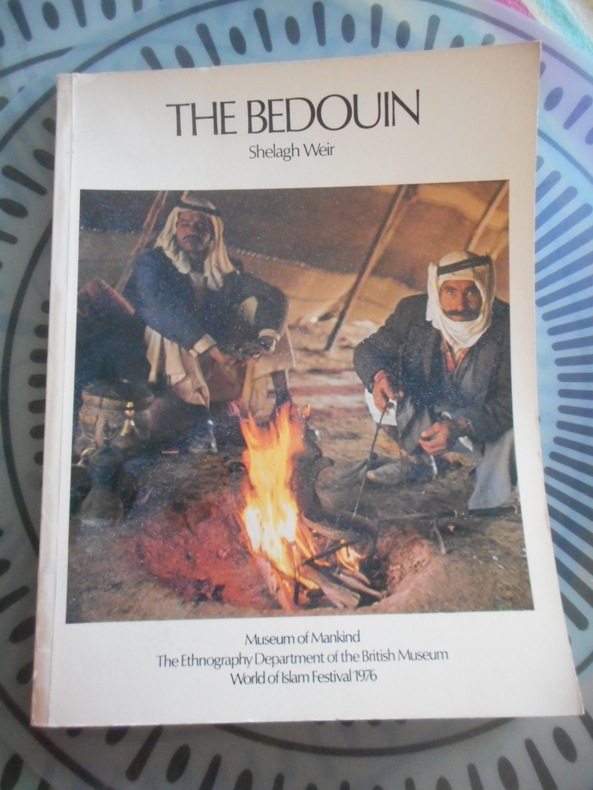
197649738Museum of Mankind, The Ethnography Departement of the British Museum, 1976. Format 19x25 cm, 89 pages. Exemplaire agrémenté d'un envoi autographe de l'auteur en page de titre. Très bon état
Volume 2 only. Small quarto in illus white and grey glossy paper wraps; 539p.; 25 cm. Includes bibliographical references In Arabic || Mythology, Assyro-Babylonian. Mythology, Semitic.