[Slave Trade].MareMagnum

4 750 résultats
Folio. XVIII, 276 pp. Modern blue wrappers with cover label. Top edge gilt. British papers and correspondence with local agents on the international slave trade, including missives exchanged with the Governor of Jeddah, and further details about the possible appointment of a Pasha of Jeddah who might labour to suppress the slave trade. - Well-preserved.
Folio. XVI, 268 pp. Modern blue wrappers with cover label. British papers and correspondence with local agents on the international slave trade, including missives exchanged between Mr. Doria, Mr. C. Wood, and Sir G. Clerk on the continued importation of slaves by the Sheikh of Bandar Lengeh, discussing steps of "signal reprehension" (p. 85) against such conduct, and further intelligence forwarded by Captain Jones from Bushire relative to the trade of slaves throughout the Arabian Gulf. - Well-preserved.
Folio. XXVIII, 467, (1) pp. Modern blue wrappers with cover label. British papers and correspondence with local agents on the international slave trade, including a Vizirial letter to the Governor of Jeddah to abolish the slave trade in his territories. - Well-preserved.
Folio. VI, 86 pp. Top edge gilt. Sewn. Rare British parliamentary papers and correspondence with local agents on the slave trade, including accounts of the extent to which many Arabs of the Gulf involved themselves in slavery in spite of their rulers having entered into agreements prohibiting such an activity: "[T]he Northern Arabs repair to the East Coast of Africa with no other motive than that of running slaves to the Persian Gulf [...] It is a known fact, that not one out of a hundred dhows that come here from the Persian Gulf, comes for any other purpose than to carry a cargo of slaves stolen from the inhabitants of Zanzibar" (p. 75). "These Sheikhs [on the Arabian coast line], who are all, more or less, bound to observe the Treaties, [...] allow the dhows to land the slaves they have succeeded in smuggling out of the Sultan's dominions [...] Could not the Sultan of Oman and the other Chiefs of the Persian Gulf be induced to issue orders calculated to prevent their subjects from carrying on this Trade?" (p. 73f.). - Disbound from a volume of parliamentary papers. Some leaves loosened, but on the whole a good copy. Wilson p. 210.
Folio. XVIII, (2), 579, (1) pp. Modern blue wrappers with cover label. Top edge gilt. British papers and correspondence with local agents on the international slave trade, including missives exchanged between Colonel Sheil and Earl Granville about steps to be taken against slave trade by Persian vessels in the Arabian Gulf, plans to intercept slaving vessels in the Gulf, the continued slave trade by the "Arabs of the coast" (p. 324) and importation of slaves by Gulf sheiks and a discussion of the penalties to be inflicted on the sheikhs who persist in importing slaves. - Well-preserved.
Folio. V, (1), 70 pp. Sewn. Rare British parliamentary papers and correspondence with local agents and officers on the slave trade, including material on the abuse of the French flag by Arab slave-dhows and on Zanzibar's Sultan Majid bin Said's attempts to exploit Anglo-French political and strategic rivalries in the region. The relevant sections are: firstly, under the heading "Correspondence with British Representatives and Agents abroad", "France" (pp. 1-3) and "Zanzibar" (pp. 12-43); and secondly, under the heading "Reports from Naval Officers", "East Coast of Africa Station" (pp. 44-70). - A good copy.
Folio. VI, 103, (1) pp. Sewn. Rare British parliamentary papers and correspondence with local agents and officers on the slave trade, including the account of a dhow seized near Jebel Yarid, on the Persian side of the Arabian Gulf, carrying a single slave, the captain of which hailed from "Debai and Shargeh" (Dubai and Sharjah; p. 76), Zanzibar slave traffic to Mecca and Muscat, etc. The relevant sections are: firstly, under the heading "Correspondence with British Representatives and Agents abroad", "Muscat" (pp. 31f.), & "Zanzibar" (pp. 33-63); and secondly, under the heading "Reports from Naval Officers", "East Coast of Africa Station" (pp. 64-102). - Neat old stamps; a very good copy.
Folio. V, (1), 86 pp. Top edge gilt. Sewn, with remains of spine. Rare British parliamentary papers and correspondence with local agents and officers on the slave trade, including material on slavery in Zanzibar, Yemen and Oman "carried on by and for the northern Arabs" (p. 37). The relevant sections are: firstly, under the heading "Correspondence with British Representatives and Agents abroad", "France" (pp. 1-5), "Zanzibar" (pp. 7-70); and secondly, under the heading "Reports from Naval Officers. - East Coast of Africa Station" (pp. 71-86). - Removed from the Public Record Office with their stamp. A good copy. Bennett 493.
Folio. IV, 69, (1) pp. Sewn, with remains of former spine. Rare British parliamentary papers and correspondence with local agents and officers on the slave trade, especially in Madagascar and off the south coast of Arabia. One item discusses the reported landing in Arabia of slaves from a French dhow, noting that "few French dhows go to Arabia without a few slaves who are sold" (p. 69). Comprises the sections "Zanzibar" (pp. 1-43); "Reports from Naval Officers - East Coast of Africa Station" (pp. 45-59); and "Appendix [Zanzibar]" (pp. 61-69). - A good copy. Bennett 495.
Folio. (III)-XI, (1), 213, (1) pp. Modern blue wrappers with cover label. Includes the extract of an 1839 letter to Viscount Palmerston regarding the slave trade between Zanzibar and Muscat and negotiations for the suppression of the slave trade there, reprinting Article XV of the Treaty entered into by His Highness the Sultan of Muscat, and with intelligence on the profits accruing to the Imaum from slavery. - Paginated "221-443" by a contemporary hand. Well-preserved.
Octavo in brown cloth boards in gold dust jacket; 217 p., 24 cm. In English. || Series: Cambridge studies in Islamic civilization.
580 x 420 mm. Colour lithograph, signed "Ibrahim K.". Mounted on styrofoam board. Bilingual safety poster in Arabic and English. - Traces of folds.
Small 4to. 93, (1); 8 pp., 1 blank leaf, (2), 111, (1) pp, 1 blank leaf. Contemporary half calf with handwritten spine-label. Marbled endpapers. First edition of the reformed Penal Code of Tunisia according to the "decret du 9 Julliet 1913 (5 Chabân 1331)", parts of which remain in force to this day. Includes the Arabic text. - Occasional light fingerstaining; a few pencil annotations. Binding rubbed; extremeties somewhat bumped. Very rare: only 3 copies listed on OCLC (Harvard; Tübingen; Beit el Bennani Collection Tunis), all records noting the French text only and apparently without the Arabic section. OCLC 80710987.
529894Paris, Plon-Nourrit, 1905 In-12, broché, XVII, 303 p.
2 volumes. Folio. With 4 engraved plates, and 3 woodcut illustrations in the text. Each volume with an engraved headpiece, the first incorporating the coat of arms of Pope Clement XI, and the second that of Jean-Paul Bignon. Contemporary calf, richly gold-tooled spine and binding edges. First edition, second issue, of a monumental collection of Greek voyages, often overlooked in the literature, including the first complete edition of Cosmas of Alexandria's celebrated "Christiana Topographia". Cosmas, a merchant from Alexandria, sailed in the Red Sea and the Arabian Gulf and visited Ethiopia ca. 530. Though he was known as "Indicopleustes", or Indian Voyager, it is doubtful whether he actually visited India. In his "Christiana Topographia" Cosmas aimed to show that the earth was flat and the cosmos shaped like rectangular vaulted box. Several of the engravings in the present volume, reproduced from a manuscript, illustrates this view. In one of them the earth is shown as a rectangle with three notches, one of them representing the Arabian Gulf, and the whole surrounded by a an ocean, with in the east another rectangle representing Paradise, out of which four rivers flow into the inhabited world. Slightly browned, with some occasional minor foxing or thumbing, and some faint stains, otherwise in very good condition. Binding also very good, only slightly rubbed and the spine of the second volume slightly damaged at the top. Howgego, to 1800, C199. Cf. Dilke, “Cartography in the Byzantine Empire”, in: Harley & Woodward (eds.), The history of cartography I, pp. 261-263.
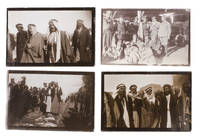
1920ABC_48727Iraq 1920. Kept in a clear plastic sleeve. With 11 snapshots all ca. 6 x 9 cm. Collection of 11 snapshots from the early 1920s likely taken by a British soldier stationed in the Middle East. It is difficult to pinpoint exactly where these photographs were taken but presumably in Mesopotamia present day Iraq. Great Britain was actively involved in Mesopotamia from 1914-1932. Prior to the First World War a large portion of the Middle East was in the hands of the Ottoman Empire. However when the Ottomans sided with Germany in 1914 Great Britain sent forces to Mesopotamia to protect the Anglo-Persian oil fields. The British army initially suffered a major defeat but eventually gained the upper hand and captured Baghdad in 1917. In 1920 after the Ottoman Empire was partitioned the United Kingdom formally established control in the region under a mandate of the League of Nations. However the Iraqi people resented this idea and revolted. In 1922 Great Britain and Iraq then signed the Anglo-Iraqi Treaty in which Iraq was given the right for self-government while Great Britain stayed in control of the country's foreign policy. This would last until Iraq's independence in 1932.The present snapshots were taken in the early days of British control in the region and depict the atmosphere at the time. They show the daily life of locals including women collecting water from the river men standing guard and the hustle and bustle in the streets. Also included are various group photos of British soldiers and locals.The photographs show some traces of wear around the corners and edges but are overall in good condition. unknown
Albumen prints (vintage). Mostly 136 x 190 mm, but some smaller (down to 121 x 90 mm). Fine, rare collection of British equestrian sports in India, mostly showing the 1922 Calcutta Races. Annotated to rear: "The Indian Grand National: 1st Hurdle", "Mr Ivan Jones 'China Egg'", "The Canal Hurdle Plate (Finish)", etc. Also shows the spectators at a Polo match, portraits of Anglo-Arabian thoroughbreds, etc. - Steeplechase racing was popular in British India both among planters and cavalry regiments. The first Indian Grand National was run at Tollygunge as early as 1895. - Well preserved.
Spiral-bound album with 6 large and 11 smaller photographs (1 image included in a duplicate print). The present album of black-and-white photographs, all taken by G. F. Larsen, later Vice President of General Services at Aramco, shows camels in the Arabian desert and the locals whom they accompany. - Occasional slight staining; well-preserved in general.
Mineral Resources Bulletins Nos. 1, 4, 7-9, 12-18, 22-26, 28. Includes maps and diagrams. Professional Papers Nos. PP-1-3. All in their original printed green wrappers or full cloth bindings. Extensive collection of rare geologic Bulletins issued by the Saudi Ministry of Petroleum and Mineral Resources (Directorate General of Mineral Resources; after 1980: Deputy Ministry for Mineral Resources), centering on the 1970s. Includes the "Professional Papers" periodical published from 1982 onwards (all three issues published). Bulletin No. 1 ("A Guide for Investment and Development") is the second printing (1968). - Occasional stamps of former holding libraries and handwritten ownerships, altogether very well preserved.
Gelatin silver prints (vintage). Approx. 87 x 142 mm. Rare collection of vintage photographs showing the breeding of race horses, mostly Arabians: the sire covering the dam, surrounded by handlers; individual portraits of horses, captioned on reverse ("Jerez Arabe", "Bourbon Barrymore", "Idilio I Arabe", "Hoyo Arabe"). - Two additional images show the breeding of donkeys. Removed from an album, with traces of glue mounting on reverse. Some brownstaining; occasional nicks or slight edge damage (slight loss to left of one image).
207 x 177 mm each, colour-printed. A set of two maps removed from an Ottoman atlas published shortly before the Great War. The first map shows the Near East, Egypt and Northern Arabia with the Hejaz Railroad's branches as completed by 1911. Diagrams in the margin depict the elevation of the railroad along its line. The second map shows the Arabian Peninsula and its railroads; an inset shows the Suez Canal (with the date of its completion given as 1869 CE and 1285 Rumi calendar). - A soft central fold and tiny edge tears. Traces of former tab-mounting within an atlas; handwritten Ottoman Turkish titles in black ink on verso.
Albumen prints on cardboard, dated on the reverse. Measurements 279:219 and 285:225 mm. The photographs show "Pilgrims entering Bethlehem on Christmas day" and an apparently English party of three tweed-clad gentlemen, one lady, a photographer-manservant, and two Arab guides posing before the Dead Sea. - The view of Bethlehem shows some fading and bears a caption the French and English, as well as the publisher's name, "Bonfils".
Mineral Resources Bulletins Nos. 1, 4, 7-9, 12-29. Includes maps and diagrams. Professional Papers Nos. PP-1-3. Mineral Resources Research 1967-68. All in their original printed green wrappers or full cloth bindings. Extensive collection of rare geologic Bulletins issued by the Saudi Ministry of Petroleum and Mineral Resources (Directorate General of Mineral Resources; after 1980: Deputy Ministry for Mineral Resources), spanning two decades from the mid-1960s to the mid-1980s. Wants merely issue 5/6 and the slim issues 10-11, as well a a final vol. of bibliography (no. 3 was never published). Includes the "Professional Papers" periodical published from 1982 onwards (all three issues published) and the "Mineral Resources Research" volume for 1967/68. - Very clean and well-preserved throughout.
C. 258 x 325 mm (cardboard); image dimensions c. 222 x 284 mm. Albumen prints (vintage) on cardboard. By Bonfils, from Bethlehem: "Tombeau de Rachel" (no. 336); "Puits des Mages" (889); "Entrée des pèlerins à Bethléem, le jour de Noël" (892, illustrated in Wieczorek/Sui, "Ins Heilige Land", p. 106); "Vue générale de Bethléem, du puits de David" (1225) and interior of the Church of the Nativity (uncaptioned); from Jaffa: "Place du marché vue générale" (238, ill. with alternative caption in W./S., p. 67); from Jerusalem: "Porte de Jaffa" (244, ill. with alternative caption in W./S., p. 73); "Mur des Juifs en vendredi" (245); "Façade du St-Sépulcre" (246); "Prison de St. Pierre" (250); "Arc de l'Ecce Homo" (252); "Ruelle allant au palais d'Hérode" (259); "Coupoles du St.-Sépulcre" (274); "Vue générale de la mosquée d'Omar" (278); interior of the Dome of the Rock ([279], illustrated with caption but trimmed in W./S., p. 85); "Porte donnant accès au-dessous du rocher" (280); "Vue générale de l'emplacement du temple de Salomon" (285); "Porte de Damas" (287); "Jardin de Gethsemané, vue générale" (303, ill. trimmed in W./S., p. 76); "Vallée de Josaphat" (310); "Intérieur du St-Sépulcre avec ornements" (850); "Grotte de Sainte-Hélène, intérieur" (855 bis); "Entrée de Jérusalem près de la porte de Jaffa" (1037) and "Rue de la Porte de Jaffa" (1038). - By Lorent: "Tombeau de David sur le Mont Sion" (288). This is apparently a print of the 1864 image illustrated in Wieczorek/Sui (p. 88), made by Bonfils and supplied with a caption. Curiously, that image is trimmed by several centimeters on the left, as compared to our print. - By the Zangakis: "Jerusalem", "Eglise du Pater couloir" (1018). - Anonymous: "Juive, costume riche" (1). - 4 photographs show slight edge defects. Occasional staining to cardboard edges, but mainly clean and well-preserved, with German ms. pencil captions.
Watercolour on paper, some on 2 sheets, mounted (sizes approximately from 155 x 230 to 300 x 480 mm), some with inscription or sketches on verso, most with captions either mounted, laid down or written directly on image. James Weir (d. 1820) was Captain of Marines on HMS Audacious from 1795 to 1800, and was also an accomplished watercolourist. Some of the earliest watercolours in this group were produced when the Audacious was on patrol off the Portuguese coast in 1796. Others were painted in the months leading up to the Battle of the Nile, when the Audacious was part of Nelson's squadron searching for the French fleet off the Italian coast after it had escaped from Toulon. Others were painted in the months leading up to the Battle of the Nile, when the Audacious was part of Nelson's squadron searching for the French fleet off the Italian coast after it had escaped from Toulon. He also depicted Nelson's flagship, HMS Vanguard, anchored at Naples Bay for repairs in October 1798, when he first met Emma Hamilton. Also shown are views of Syracuse and surrounding area, the Valley of Temples at Agrigento, Catania and Mount Etna, the Temple of Venus at Baia, the ruins of the Temple of Jupiter Olympus, the interior of the Temple of Concord, Mount Nuovo and Pozzuoli near Naples, the Temple of Ceres at Segesta, Convent of St. Nicolo Argentum, the Iron Mine of Elba. The fleet at Palermo is also depicted, where Nelson had accompanied the royal court of the Two Sicilies after they fled Naples. - Very minor scattered tears or repairs, a few restored or trimmed, light staining or spotting.