16 988 résultats
2000__0444503587Elsevier Science Health Science div 2000. Hardcover. New. 2nd edition. 560 pages. 10.50x8.00x1.25 inches. Elsevier Science Health Science div hardcover
1612527892.Gpaperback. Good. Access codes and supplements are not guaranteed with used items. May be an ex-library book. paperback
2024Atlantic-97815299054102024. Hardcover. New. hardcover
2024Atlantic-97815299054102024. Hardcover. New. hardcover
SLIVCN-9782889302642Alphil Editions (5/2019)
2024SKU1744382Union Square & Co 2024-06-04. hardcover. New. 8x1x10. New Book Ships with Tracking Union Square & Co hardcover
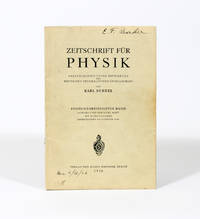
19261276Berlin: Julius Springer 1926. 1st Edition. Soft cover. Very Good. FIRST EDITION IN ORIGINAL WRAPPERS of the famous "three-man paper" the first complete self-consistent description of quantum mechanics. "In 1925 after an extended visit to Bohr's Institute of Theoretical Physics at the University of Copenhagen Heisenberg tackled the problem of spectrum intensities of the electron taken as an anharmonic oscillator a one-dimensional vibrating system. His position that the theory should be based only on observable quantities was central to his paper of July 1925 "Über quantentheoretische Umdeutung kinematischer und mechanischer Beziehungen" "Quantum-Theoretical Reinterpretation of Kinematic and Mechanical Relations". Heisenberg's formalism rested upon noncommutative multiplication; Born together with his new assistant Pascual Jordan realized that this could be expressed using matrix algebra which they used in a paper submitted for publication in September as "Zur Quantenmechanik" "On Quantum Mechanics". By November Born Heisenberg and Jordan had completed "Zur Quantenmechanik II" "On Quantum Mechanics II" colloquially known as the "three-man paper" which is regarded as the foundational document of a new quantum mechanics" Britannica's Guide to the Nobel Prizes. Particle Physics: One Hundred Years of Discoveries: "Development of matrix formalism for the Heisenberg quantum mechanics. Systems with arbitrary many degrees of freedom." Provenance: With ownership signature on front wrapper of E.F. Barker noted American physicist who worked primarily at the University of Michigan. IN: Zeitschrift für Physik Band 35 February 1926 pp. 557-615. Berlin: Julius Springer 1926. Octavo original wrappers; custom box. A few creases to wrappers chips to spine. RARE in original wrappers. Julius Springer paperback books
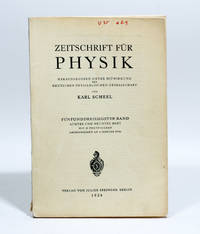
1925140940045Berlin: Julius Springer 1925. First Edition. Very Good. 1925-26. First edition. Three extremely influential papers marking the theoretical foundation for modern quantum mechanics and defining the discipline: "Uber quantentheorestische Umdeutung kinematischer und mechanischer Beziehungen" by Werner Heisenberg; "Zur Quantenmechanik" by Max Born and Pasqual Jordan; and "Zur Quantenmechanik II" by Born Heisenberg and Jordan. In Zeitschrift fur Physik Vols. 33 total pp.879-950 Heisenberg paper pp. 879-893; Vol. 34 total pp. 795-953 lean to spine; Born Jordan paper 858-888; Vol. 35 total pages pp. 557-722; Born Heisenberg Jordan pp 557-615. In publisher's original wrappers with new spines ink stamp to top right of front wrappers minor creasing and soiling to wraps. Heisenberg received the Nobel Prize for physics in 1932 for his establishment of quantum mechanics. Julius Springer unknown books
19266575Berlin: Springer 1926. First edition. <p>First edition extremely rare offprints of the two papers that founded matrix mechanics. Building on Heisenberg's demand that quantum theory be formulated in terms of observable quantities Max Born recognised that Heisenberg's rule of combination was in effect matrix multiplication. The first offprint Born-Jordan introduced the new formalism and established the non-commutative relation between position and momentum. The second the celebrated "Three-Man Paper" Born-Heisenberg-Jordan gave the first sustained presentation of quantum mechanics in matrix language recasting physical quantities as matrices and applying Hamilton's equations. In its closing section Jordan extended the method to the electromagnetic field-an early step towards quantum electrodynamics.</p>. The Birth of Modern Quantum Mechanics. <p>First edition extremely rare offprints of Born and Jordan's explication of Heisenberg's quantum mechanics - in their joint paper On Quantum Mechanics which introduced matrix mechanics to the world - and the more detailed sequel with Heisenberg himself the famous "three-man paper" which was the first comprehensive exposition of quantum mechanics in matrix language. Quantum mechanics first emerged in Heisenberg's 'Uber quantentheoretische Umdeutung kinematischer und mechanischer Beziehungen' 'Quantum-theoretical reinterpretation of kinematic and mechanical relations' published on 18 September 1925. In that paper "Heisenberg 1901-76 points out that on the atomic level the orbits of electrons and their period of revolution are not measurable but that theory should be based only on quantities that can at least in principle be experimentally observed. He went on to replace the usual position x of a point-like particle by an 'ensemble of quantities' xmn and proposed a rule for the multiplication of such ensembles . After Pauli's approval Heisenberg gave the paper to Born 1882-1970. He asked him to study it and in case he agreed to forward it to a journal for publication . Only some days later Born studied the paper. He was impressed sent the paper off for publication and began to think about more formal aspects of Heisenberg's approach. The multiplication rule Heisenberg had used for his ensembles seemed vaguely familiar to him and then he realized that this was the rule of matrix multiplication. The ensembles could be taken as matrices which were well studied by mathematicians. It was well known that in general matrix multiplication is not commutative i.e. the result of a product depends on the order in which the factors are written. For the matrices x of position and p of momentum this means that the elements of the matrix px are not necessarily equal to those of the matrix xp. Born conjectured that the commutator px − xp was equal to h/i times the unit matrix 1 although he could show that property only for the diagonal elements of the commutator. For the general proof he asked the help of Jordan 1902-80 who found it within two days . Born and Jordan began to work out quantum mechanics in matrix notation on the basis of Heisenberg's ideas. Born . left the actual writing of their paper On Quantum Mechanics to Jordan. Heisenberg Jordan and Born now began a collaboration - mostly by correspondence - in which they worked out a comprehensive exposition of quantum mechanics. Their publication On Quantum Mechanics II is usually referred to as the 'three-men paper' Drei-Männer-Arbeit. It contains the fundamental assumptions of the theory i.e. the reinterpretation of physical quantities as matrices with their special multiplication laws or 'commutation relations' and Hamilton's equations written down for these quantities . Moreover it presents a systematic way for the solution of these equations and there is a discussion of perturbation theory and of several examples. The three men were together in Göttingen for only about two weeks before Born who had written the mathematical part departed for the United States and left the final editing to Heisenberg and Jordan both twenty-three years old at the time. The paper was completed in mid-November. Its last section carries the title 'Coupled Harmonic Oscillators. Statistics of Wave Fields'. It was written by Jordan alone and practically no notice was taken of it at that time. Now it is recognized as the first description of the electromagnetic field in terms of quantum mechanics and thus as the very first step towards quantum electrodynamics" Brandt pp. 155-157. RBH lists only the Plotnick copies Christie's NY 2002.</p> <br /> <p>"Even those intimately familiar with matrix mechanics as we now understand it will find Heisenberg's 1925 paper daunting. But happily this obscurity is much less true of the article by Born and Jordan that followed Heisenberg's by about two months in the next volume of Zeitschrift für Physik and largely reformulated his theory in terms of matrix operations.</p> <br /> <p>"It happened that while or shortly after reading Heisenberg's manuscript before it was submitted for publication in July of 1925 Born quickly realized that the noncommutativity that Heisenberg had discovered could be interpreted as matrices which in general do not commute. After Pauli declined Born was able to induce his 23-year-old assistant Pascual Jordan who had studied with the mathematician Courant to help him with the mathematics of the theory. They immediately began their very lucid reformulation of Heisenberg's paper which they worked up in those two months opening with an introduction to the properties of matrices including their noncommutativity and adopting Heisenberg's assumption from the correspondence principle that Hamilton's equations of motion apply in the quantum theory a well as classically. In short order they discovered the operator or matrix expression xp - px = h/2piI. With the Hamiltonian in hand they could obtain an expression for the time dependence of an operator and using Hamilton's laws of motion treat a problem like the harmonic oscillator. Application was made to the one-dimensional oscillator from which the now familiar result E = n ½hw was obtained and the simple rotor was treated as well. The paper is a tour de force succinct and clear. It is not at all hard to see why Born always felt that he and Jordan should have been given something like equal credit for the discovery of matrix mechanics which was never the case. The details of the paper which hinted at the role of Hermitian bilinear or quadratic forms in representing observables though the specific language of Hermitian operators on a Hilbert space was not yet used were mostly the work of Jordan .</p> <br /> <p>"The third paper this one by all three Born Heisenberg and Jordan BHJ . submitted eight weeks after Born and Jordan's paper introduced the language of Hermitian forms quite explicitly . Perhaps the most startling discovery by Heisenberg and more explicitly by Born and Jordan was that the products xp and px were different that is that as 'operators' x and p do not commute in quantum mechanics. Thus a quantity like p x = px - xp came in the BHJ paper to be known as a 'commutation rule' or 'commutation relation' after the common notion of commutativity. In this paper we also find the general expression for the time dependence of a dynamical variable or as the authors put it 'any quantum mechanical quantity' in terms of the commutator with the Hamiltonian which is equivalent to giving the time dependence of an operator in what we know as the 'Heisenberg picture'. Throughout the development emphasis is placed on the canonical transformations that lead to a diagonal matrix representing the dynamical variable typically the energy the Hamiltonian.</p> <br /> <p>"Another important application found in the BHJ paper is to time-dependent perturbation theory. An examination of their chapter 2 reveals the equations for the energy eigenvalues in first- and higher-order perturbation theory in a fairly transparent form for even the modern reader and in the same chapter degenerate perturbation theory is treated by diagonalizing a submatrix of the perturbing interaction involving the degenerate states.</p> <br /> <p>"In the next chapter of the paper the challenging problems of continuous spectra involving continuous matrices are addressed although in a less than mathematically rigorous way therefore leaving some unanswered questions. It is worth noting that Heisenberg was not entirely comfortable with Born and Jordan's casting the theory in what for the time was a fairly sophisticated mathematical form. He wrote Pauli saying that: 'I am pretty unhappy about the whole theory and thus was glad that you were so completely on my side in your views on mathematics and physics. Here Göttingen I'm in an environment that thinks the exact opposite and I do not know if I'm not just too stupid to understand mathematics.' In the same vein Pauli wrote Ralph Kronig that 'one must next attempt to free Heisenberg's mechanics from the Göttingen torrent of erudition.' Of course these two founders of quantum mechanics would soon be proved wrong .</p> <br /> <p>"The BHJ paper was titled 'On quantum mechanics. II' thus deliberately announcing it as the successor to the Born-Jordan paper rather than of Heisenberg's original work. Hilbert . since 1895 had been at Göttingen where all three authors BHJ were working at the time - before Heisenberg's move to Leipzig. It is in this paper BHJ that Jordan provided the first sketch of transformation theory . On the other hand although dynamical variables are transformed the states have not yet emerged as vectors in Hilbert space. But the relationship of these results to the eigenvalues of Hermitian operators are clearly spelled out and Hilbert's work is cited.</p> <br /> <p>"One of the most important aspects of the paper is to be found in its chapter 4 'Physical applications of the theory' the introductory section of which is titled 'Laws of conservation of momentum and angular momentum: intensity formulae and selection rules.' Here we see the angular momentum algebra for the first time using the new commutation rules which were obtained directly from the commutators of p and x . Here are to be found the standard expressions for the commutators involving the angular momentum operators not using that term of course the matrix elements of the angular momentum operators . and implicitly the 'ladder operators' for angular momentum . Although the paper was submitted in November 1925 the advance over Heisenberg's original paper from the end of July is enormous. Among other things it led directly to Pauli's treatment of the hydrogen atom. In all the early papers including those of Heisenberg of Born and Jordan of BHJ and even of Dirac the problem of the hydrogen atom was ducked as being too difficult in favor of the harmonic oscillator or the simple rotor for example" Purrington pp. 59-62.</p> <br /> <p>"The endeavours of Born Heisenberg and Jordan led to the development of the theory of matrix mechanics which was applicable to all types of multiply periodic systems to nondegenerate and degenerate ones and in principle even to aperiodic systems. In addition the authors realized that the matrix equations had a simpler structure than the corresponding classical equations . the discussion of conservation laws also appeared to be considerably more elementary. The three authors succeeded in presenting the theory in a finished and compact form" Mehra p. 92.</p> <br /> <p>In the last chapter of the three-man paper Jordan introduced the process of 'second quantization' the first attempt at a quantum-mechanical treatment of the electromagnetic field thinking of the electromagnetic field in terms of quanta is 'first quantization'; that picture has to treated using quantum mechanics hence 'second quantization'. "Jordan himself rated his calculation as 'almost the most important contribution I ever made to quantum mechanics' . Jordan's original approach to second quantization not Dirac's became the standard procedure among researchers and in textbooks to formulate quantum field theory" Dittrich. Jordan tends to be overlooked today due to his Nazi-era writings that praised Hitler's regime. Some feel that this probably prevented him from being awarded the Nobel Prize in 1954 jointly with Born and Bothe. Heisenberg received the Nobel Prize in 1932 "for the creation of quantum mechanics".</p> <br /> <p>Brandt The Harvest of a Century 2009. Dittrich 'The cofounder of quantum field theory: Pascual Jordan' The European Physical Journal H 40 2015 pp. 241-260. Mehra The Historical Development of Quantum Theory vol. III 1982 see Chapter III for a full account of the three-man paper. Purrington The Heroic Age. The Creation of Quantum Mechanics 1925-1940 2018.</p> <br/> <br/> Two vols 8vo 228 x 156 mm. I. Offprint from: Zeitschrift für Physik Bd. 34 Heft 11/12 28 November 1925; II. Offprint from: Zeitschrift für Physik Bd. 35 Heft 8/9 4 February 1926. Berlin: Springer 1925 -1926. Springer unknown
a94162Berlin 1925 first edition. Springer. Thick octavo hardcover. 3/4 Grey cloth with yellow marbled boards. Gilt spine letters. Volume 34 of Zeitschrift fur Physik. 953p. Born and Jordan article on pages 858-888. Many other important articles in this volume by Otto Hahn Lise Meitner M Laue Reiche Smekal others in the volume as well. Near Fine just slight wear binding very secure; hinges not cracked; no owner marks; not exlib. No owner marks.Together with the work of Werner Heisenberg this paper helped define Quantum Mechanics. Pictures available on request. . hardcover
1925140940045Berlin: Julius Springer 1925. First Edition. Very Good. 1925-26. First edition. Three extremely influential papers marking the theoretical foundation for modern quantum mechanics and defining the discipline: "Uber quantentheorestische Umdeutung kinematischer und mechanischer Beziehungen" by Werner Heisenberg; "Zur Quantenmechanik" by Max Born and Pasqual Jordan; and "Zur Quantenmechanik II" by Born Heisenberg and Jordan. In Zeitschrift fur Physik Vols. 33 total pp.879-950 Heisenberg paper pp. 879-893; Vol. 34 total pp. 795-953 lean to spine; Born Jordan paper 858-888; Vol. 35 total pages pp. 557-722; Born Heisenberg Jordan pp 557-615. In publisher's original wrappers with new spines ink stamp to top right of front wrappers minor creasing and soiling to wraps. Heisenberg received the Nobel Prize for physics in 1932 for his establishment of quantum mechanics. Julius Springer unknown
19262822Berlin: Julius Springer 1926. 1st Edition. original wrappers. Very Good. FIRST EDITION IN ORIGINAL WRAPPERS of the famous "three-man paper" the first complete self-consistent description of quantum mechanics. "In 1925 after an extended visit to Bohr's Institute of Theoretical Physics at the University of Copenhagen Heisenberg tackled the problem of spectrum intensities of the electron taken as an anharmonic oscillator a one-dimensional vibrating system. His position that the theory should be based only on observable quantities was central to his paper of July 1925 "Über quantentheoretische Umdeutung kinematischer und mechanischer Beziehungen" "Quantum-Theoretical Reinterpretation of Kinematic and Mechanical Relations". Heisenberg's formalism rested upon noncommutative multiplication; Born together with his new assistant Pascual Jordan realized that this could be expressed using matrix algebra which they used in a paper submitted for publication in September as "Zur Quantenmechanik" "On Quantum Mechanics". By November Born Heisenberg and Jordan had completed "Zur Quantenmechanik II" "On Quantum Mechanics II" colloquially known as the "three-man paper" which is regarded as the foundational document of a new quantum mechanics" Britannica's Guide to the Nobel Prizes. <br /> <br /> Particle Physics: One Hundred Years of Discoveries: "Development of matrix formalism for the Heisenberg quantum mechanics. Systems with arbitrary many degrees of freedom."<br /> <br /> IN: Zeitschrift für Physik Band 35 February 1926 pp. 557-615. Berlin: Julius Springer 1926. Octavo original wrappers. Small chip at base of spine. "Born Heisenberg 35" in pencil on spine. Volume/issue number written in ink at top of front wrapper. <br /> <br /> One of the foundational papers in quantum mechanics rare in original wrappers. Julius Springer unknown
20092-8448170008McGraw-Hill Interamericana de España S.L. 2009. Paperback. New. Spanish language. 11.18x9.06x0.79 inches. McGraw-Hill Interamericana de España S.L. paperback
0364528338.Ghardcover. Good. Access codes and supplements are not guaranteed with used items. May be an ex-library book. hardcover
1908B77213no place: Lewis Publishing Company 1908. Hardcover. Very good. Four volume complete set! Half-leather boards octavos 544pp. 539pp. 475pp. and 491pp. illustrated in b&w. Books have rubbing and wear to leather spines and corners that includes some mild loss to leather that lets boards show through at corners joints cracked rubbing and soil to boards bindings tight texts clean and unmarked with gilt to top edges of text blocks. THIS LARGE HEAVY SET WILL REQUIRE ADDITIONAL SHIPPING FEES. Lewis Publishing Company hardcover
1785943405.Ghardcover. Good. Access codes and supplements are not guaranteed with used items. May be an ex-library book. hardcover
BN260291Dorling Kindersley. Hardcover. So kocht Korea <br/><br/>So kocht Korea Bourke Jordan; Pyo Rejina Dorling Kindersley hardcover
Paris, Editions A.M., 1946 - in-12, broché - portrait-frontispice - 151 pp - Ex. non coupé - Propre .
4104Paris, Editions A.M., 1946 - in-12, broché - portrait-frontispice - 151 pp - Ex. non coupé - Propre .
5533P., Amiot-Dumont, 1955, in 8, broché, 232pp. ; illustrations hors-texte.
2013__3112454898De Gruyter 2013. Hardcover. New. reprint edition. 133 pages. German language. 6.14x0.50x9.21 inches. De Gruyter hardcover
__3112668952De Gruyter Art & Architecture 1912. Hardcover. New. reprint edition. 73 pages. German language. 5.00x0.50x8.00 inches. De Gruyter Art & Architecture hardcover
2012x-144115955XContinuum Intl Pub Group 2012. Paperback. New. 1st edition. 192 pages. 9.13x6.14x0.55 inches. Continuum Intl Pub Group paperback
192619803New York: Frederick A. Stokes Co 1926. 1st edition. Yellow cloth binding with black lettering. Yellow dust jacket. VG largish smudge to right center of the ffep/VG avg wear. 368 pp including Glossary. Crown 8vo. <br/><br/>A romance set during the Boxer rebellion. Frederick A. Stokes Co hardcover books