382 résultats
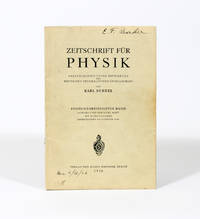
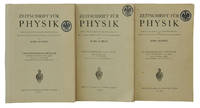
1925140940045Berlin: Julius Springer 1925. First Edition. Very Good. 1925-26. First edition. Three extremely influential papers marking the theoretical foundation for modern quantum mechanics and defining the discipline: "Uber quantentheorestische Umdeutung kinematischer und mechanischer Beziehungen" by Werner Heisenberg; "Zur Quantenmechanik" by Max Born and Pasqual Jordan; and "Zur Quantenmechanik II" by Born Heisenberg and Jordan. In Zeitschrift fur Physik Vols. 33 total pp.879-950 Heisenberg paper pp. 879-893; Vol. 34 total pp. 795-953 lean to spine; Born Jordan paper 858-888; Vol. 35 total pages pp. 557-722; Born Heisenberg Jordan pp 557-615. In publisher's original wrappers with new spines ink stamp to top right of front wrappers minor creasing and soiling to wraps. Heisenberg received the Nobel Prize for physics in 1932 for his establishment of quantum mechanics. Julius Springer unknown books
19261276Berlin: Julius Springer 1926. 1st Edition. Soft cover. Very Good. FIRST EDITION IN ORIGINAL WRAPPERS of the famous "three-man paper" the first complete self-consistent description of quantum mechanics. "In 1925 after an extended visit to Bohr's Institute of Theoretical Physics at the University of Copenhagen Heisenberg tackled the problem of spectrum intensities of the electron taken as an anharmonic oscillator a one-dimensional vibrating system. His position that the theory should be based only on observable quantities was central to his paper of July 1925 "Über quantentheoretische Umdeutung kinematischer und mechanischer Beziehungen" "Quantum-Theoretical Reinterpretation of Kinematic and Mechanical Relations". Heisenberg's formalism rested upon noncommutative multiplication; Born together with his new assistant Pascual Jordan realized that this could be expressed using matrix algebra which they used in a paper submitted for publication in September as "Zur Quantenmechanik" "On Quantum Mechanics". By November Born Heisenberg and Jordan had completed "Zur Quantenmechanik II" "On Quantum Mechanics II" colloquially known as the "three-man paper" which is regarded as the foundational document of a new quantum mechanics" Britannica's Guide to the Nobel Prizes. Particle Physics: One Hundred Years of Discoveries: "Development of matrix formalism for the Heisenberg quantum mechanics. Systems with arbitrary many degrees of freedom." Provenance: With ownership signature on front wrapper of E.F. Barker noted American physicist who worked primarily at the University of Michigan. IN: Zeitschrift für Physik Band 35 February 1926 pp. 557-615. Berlin: Julius Springer 1926. Octavo original wrappers; custom box. A few creases to wrappers chips to spine. RARE in original wrappers. Julius Springer paperback books
192042964Redhill: H. M. Stationery Office 1920. <p>Patent for the Flip-Flop Circuit the Basis for Electronic Memory </p> <p>Eccles William Henry 1875-1966 and Frank Wilfred Jordan 1882- . Patent specification 148582 . . . improvements in ionic relays. Redhill: Printed for His Majesty's Stationery Office by Love & Malcomson Ltd. 1920. 5pp. Folding plate. Errata slip tipped to first leaf. 267 x 195 mm. Unbound. Light wear along gutter margin and fore-edge but very good. Stamps of the Belgian Bureau voor den Industrieelen Eigendom Bibliotheek. </p> <p>First Edition. On June 21 1918 British physicists William Henry Eccles and Frank Wilfred Jordan professors of engineering at London's City and Guilds Technical College filed a patent for "Improvements in Ionic Relays"—the first flip-flop circuit. The device originally called the Eccles-Jordan trigger circuit consisted of two active elements vacuum tubes. The schematic drawing illustrating Eccles and Jordan's patent shows two flip-flops "one drawn as a cascade of amplifiers with a positive feedback path and the other as a symmetric cross-coupled pair" Wikipedia. The patent specification no. 148582 was first published in 1920. </p> <p>Early flip-flops were known variously as trigger circuits or multivibrators. A flip-flop circuit has two stable states and as Claude Shannon pointed out in his Mathematical Theory of Communication 1948 can be used to store one bit of information. Flip-flop circuits operate using Boolean algebra AND OR NOT. Prior to the invention of electronic computing Eccles and Jordan viewed their invention as a "method of relaying or magnifying in electrical circuits for use in telegraphy and telephony." However with the invention of electronic computing that used vacuum tubes as switches flip-flops became the basic storage element in sequential logic used in digital circuitry and the basis for electronic memory. In September 1919 Eccles and Jordan described the flip-flop in a brief one-page paper "A trigger relay utilizing three-electrode thermionic vacuum tubes" The Electrician 83 September 19 1919 p. 298. However the patent filed the previous year and consisting of 5 pages plus illustration remains the first description of this invention. Very rare. </p> . H. M. Stationery Office unknown books
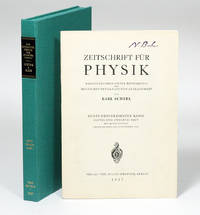
19272348Berlin: Julius Springer 1927. First edition. Original wrappers. Fine. FIRST EDITION IN ORIGINAL WRAPPERS of Jordan and Klein's introduction of the "second quantization"; one of the founding papers of quantum field theory. FROM THE LIBRARY OF NIELS BOHR with his stamp on the front wrapper. In Jordan's "paper with Klein written while the two of them were in Copenhagen in the spring of 1927 a generalization of Dirac's treatment of bosons was given to allow for the interaction of the bosons with one another. Their point of departure was a Schrödinger equation for the field operator containing a nonlinear term to account for the interaction of the field itself. "The equivalence of this description with that using symmetric wave functions in configuration space was established. The 'particles' that emerged from the imposition of the quantum condition commutation rules on the field variables thus obeyed Bose statistics. Heisenberg found the results of Jordan and Klein very attractive. In his interview with Kuhn and Heilbron in 1963 he recalled: 'I liked it very much because now I could see "All right. There is an entirely different picture to start with the wave picture and if I quantize that picture--that is if I make this picture open to the same restriction as the particle picture--then the two pictures become equivalent." That is exactly what I wanted' Heisenberg 1963 session 8 p. 21. "Bohr at the Solvay meeting of 1927 saw Jordan and Klein's work as supporting his views of complementarity. Pauli at that same congress welcomed the formulation since it allowed to formulate the quantum theoretic description of an assembly of bosons entirely in 3-dimensional space. "In a letter to Kronig in November 1927 Pauli described the work of Jordan and Klein as 'wirklich schön' really beautiful. In fact the Jordan and Klein paper converted Pauli to the Jordan viewpoint about the quantization of matter fields. The article by Jordan and Klein made clear to both Heisenberg and Pauli who were then collaborating on a general theory of relativistic quantized fields how to proceed in describing the interaction between the electromagnetic field and charges. Pauli who up to that time had been reluctant to accept Jordan's views on quantization of matter fields embraced Jordan's viewpoint. After the publication of the Jordan-Klein article Pauli and Heisenberg agreed that the quantization of matter fields was the correct approach. In December 1927 Heisenberg could write Bohr that the important work of Jordan and Klein had been the stimulus of his thinking long and hard on the formulation of relativistic quantum mechanics and that he and Pauli were making good progress" Schweber QED and the Men Who Made It: Dyson Feynman Schwinger and Tomonaga pp.35-37. Also included is Jordan's paper: Über Wellen und Korpuskeln in der Quanenmechanik pp. 766-775. Provenance: From the library of Niels Bohr with his stamp on the front wrapper. IN: Zeitschrift Für Physik Band 45 18 November 1927 pp. 751-765. Berlin: Julius Springer 1927. Octavo original wrappers; custom box. A touch of edgewear. A FINE COPY rare in original wrappers. Julius Springer unknown books
1926140498Beverly Hills CA: Metro-Goldwyn-Mayer MGM 1926. Draft script for the 1927 Silent film. <br/><br/>Based on the 1913 yellow peril play by Henry Maurice Vernon and Harold Owen and previously adapted for the screen in 1919 directed by Maurice Elvey and starring Matheson Lang. Lon Chaney in full yellowface murders his daughter after discovering she loves the son of a British diplomat then seeks revenge on son and his the entire family. <br/><br/>Anna May Wong who has a small role in the film was originally considered for the role of the daughter but censorship of mixed race relationships on the screen caused the role going to a white actress a sadly all-too-familiar story in her career. Wong would leave Hollywood for Europe the following year after once again being denied the lead role in a film because of her race this time in "The Crimson City."<br/><br/>Tan titled wrappers rubber-stamped copy No. 543 and production No. 1589 dated Nov. 13 1926 with credits for story writer Louise Jordan Miln and screenwriter Lorna Moon. Title page integral with the first page of the text dated October 20 1926 with credits for screenwriter Moon and story writer Miln. 102 leaves with last page of text numbered 96. Ditto style mimeograph duplication. Pages Near Fine wrapper Very Good bound with two gold brads. Metro-Goldwyn-Mayer [MGM] unknown books
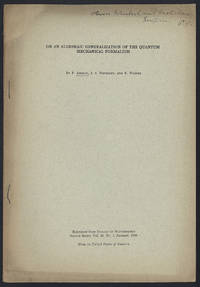
1934432721934. <p>Jordan Pascual 1902-80; John von Neumann 1903-57; and Eugene Wigner 1902-95. On an algebraic generalization of the quantum mechanical formalism. Offprint from Annals of Mathematics second series 35 1934. 29-64pp. 254 x 176 mm. Original printed wrappers margins a bit dust-soiled. Very good. Presentation Copy Inscribed by Jordan to physicist Gregor Wentzel 1898-1978 on the front wrapper: "Herrn Wentzel mit hertzlichen Grüssen! P. J." </p> <p>First Edition Offprint Issue of Jordan von Neumann and Wigner's classic paper on one of the mathematical foundations of quantum mechanics introducing what are now known as the formally real Jordan algebras. "When the real numbers the complex numbers and the quaternions were sent down from platonic heaven to tell the world about the algebraic structure of quantum mechanics they took on human avatars and wrote this paper" Baez. </p> <p>In an earlier paper Jordan had introduced the "Jordan algebras" a special type of non-associative algebra to formalize the notion of an algebra of observables in quantum mechanics. </p> <p>"In 1932 Pascual Jordan tried to isolate some axioms that an "algebra of observables" should satisfy. The unadorned phrase "algebra" usually signals an associative algebra i.e. one in which a b c = a b c but this not the kind of algebra Jordan was led to. In both classical and quantum mechanics observables are closed under addition and multiplication by real scalars. In classical mechanics we can also multiply observables but in quantum mechanics this becomes problematic. . . . </p> <p>"However in quantum mechanics one can still raise an observable to a power and obtain another observable. From squaring and taking real linear combinations one can construct a commutative product . . . This led Jordan to define what is now called a formally real Jordan algebra . . . In 1934 Jordan published a paper with von Neumann and Wigner classifying finite-dimensional formally real Jordan algebras" Baez; emphasis ours. </p> <p>The formally real Jordan algebras correspond to various spin factors which in turn "have an intriguing relation to special relativity" Baez; see Baez for a more detailed account of Jordan von Neumann and Wigner's paper. Jordan algebras also play important roles in other branches of mathematics: Lie groups and algebras differential geometry projective geometry probability and statistics. </p> <p>Jordan presented this copy of his paper to theoretical physicist Gregor Wentzel who also made contributions to quantum mechanics: He is best known for the Wentzel-Kramers-Brillouin approximation for finding approximate solutions to linear partial differential equations with spatially varying coefficients. Baez John "State-Observable Duality Part 2." The N-category Cafe: A Group Blog on Math Physics and Philosophy. N.p. 27 Nov. 2010. Web. Accessed 12 Sept. 2014.</p> . unknown books
192846031Berlin 1928. unknown books
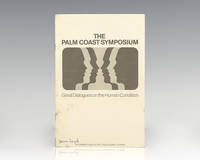
197496039Palm Coast Florida: The Palm Coast Symposium 1974. First edition program from the November 1974 <span class="match">Palm</span> <span class="match">Coast</span> <span class="match">Symposium signed by Saul Bellow Gunnar Myrdal James D. Watson Sidney Hook Vernon E. Jordan Kate Millett William F. Buckley Jr. Arthur Schlesinger Jr. E. T. York Truman Capote Leslie Fiedler Harold Rosenberg Lionel Trilling Norman Young and Melvin M. Tumin throughout. Octavo original wrappers. In near fine condition. An exceptional collection of signatures. </span> The first Palm Coast Syposium inaugurated a series of great dialogues on the human condition featuring a distinguished group of participants. Lecture topics included Human Nature and Human Destiny Uplifting the Underpriveleged The Universities: For What and Whom and Popular Culture and Elite Culture. The Palm Coast Symposium unknown books
1909287755Montgomery Ala: The Paragon Press 1909. First Edition. Hard Cover. Very Good binding. Uncommon memoir of William Christopher Jordan who served in Company B of the 15th Alabama. He states in the preface that he draws from his wartime diary complete company roll and memory of the battles of Suffolk and Gettysburg serving under Longstreet. Not found in Nevins Eicher or Nicholson. Jordan's family lived in Society Hill Eufala and Midway Alabama. Previously owned by Arthur Jordan Butt great-nephew of the author. Personal inscription on the front endpaper; "Great Uncle of Arthur Jordan Butt" written on the title page; and four early photographs of the Jordan family home and genealogical records tipped in on the preliminaries. Portrait frontispiece. Publisher's green cloth binding with gilt lettering. Very Good. Jeanette Holland Austin. The George Frontier vol. III p. 246. The Georgians: Genealogies of Pioneer Settlers pp. 200-201. Very Good binding. The Paragon Press unknown books
19851233744Boulder Colorado: Geological Society of America 1985. Anthology. Included books and maps in very good condition. Sun fading and occasional tears to several of the paper wrappers that store the folded maps. Nevertheless the maps themselves remain clean and bright. Comprises 67 volumes and 25 maps. In addition to the accompanying maps many volumes include multiple plates. Collection includes many regional map sheets with accompanying text. PLEASE NOTE that due to the number of these volumes and their respective weight that special shipping arrangements are required. 1233744. Rockville Non-Retail Listings. Geological Society of America unknown books
19981274708New York: Tom Deherty Associates 1998. First Edition First Printing. Hardcover. 8vo. 715pp.; VG/VG; spine yellow with red and black lettering; dust jacket protected with a Mylar covering price uncut; very mild shelfwear; text block clean; SIGNED on title page by George R. R. Martin Anne McCaffrey Robert Silverberg Terry Prachett Tad Williams and Orson Scott Card.; shelved case 8. 1274708. Shelved Dupont Bookstore. Tom Deherty Associates hardcover books
1931WRCAM55550Dallas 1931. 632pp. including portrait frontispiece printed on verso of titlepage. Original printed wrappers stapled. Minor toning around the edges of the wrappers bottom corners bumped. Text lightly toned but clean. Very good. A brief but informative account of one German immigrant couple's life in frontier Texas one of only 100 copies printed and "read by the writer at a family reunion held on the Llano River on August 5 1931 to commemorate the seventy-fifth anniversary of the coming of Ernst Jordan and family to Upper Willow Creek now Art Mason County Texas." The author Gilbert J. Jordan was the pioneer couple's grandson and his narrative follows his grandparents from their arrival in Galveston in 1845 to Indianola to Fredericksburg to New Braunfels to the small community of Art Texas in the hill country northwest of Austin. The portrait frontispiece shows both Ernst and Lizette Jordan in middle age. A bibliography at the end records Jordan's sources in writing the larger narrative. The present copy is inscribed by Gilbert Jordan to Fred White Sr. on the inside front wrapper with Jordan's additional note reading: "One of 100 copies." OCLC locates fourteen copies all but one of them in Texas institutions. A scarce account of early Texas and its German immigrants. OCLC 2631860. unknown books
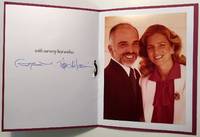
19952643151995. pamphlet. Color satin-finish photograph 7.5 x 5.5 inches in its original presentation folder with a gold embossed crown on the front signed in ink by Hussein and Noor beneath the printed sentiment on opposite panel. No place no date circa 1995. Fine condition.<br/><br/> unknown books
1977147972N.p.: N.p. 1977. Draft script for the 1977 play which premiered March 21977 at the Little Theatre for only 6 performances closing on March 6 1977. Copy belonging to director and producer Charles Grodin whose name address and phone number are printed on the bottom of the title page.<br/><br/>A comedy about a man who comes home to find his wife has run off with a door-to-door cello salesman.<br/><br/>Set in a home in Southern California. <br/><br/>Black Studio Duplicating Service titled wrappers with credits for playwright Jordan Crittenden. Title page present with credits for playwright Jordan Crittenden. 90 leaves with last page of text numbered 2-39. Mimeograph duplication rectos only. Pages Near Fine wrapper Near Fine bound with two gold screw brads. N.p. unknown books
198089106Boston: Beacon Press 1980. First edition of this collection of the poetry of African-American poet June Jordan. Octavo original illustrated wrappers as issued. Presentation copy inscribed by the poet on the front free endpaper "1984 for Richard Lautz wishing you courage and joy always J. Jordan." Photograph of Jordan by Sara Miles. In near fine condition. Uncommon signed and inscribed. Poet activist and teacher June Jordan authored several award-winning books of poems on themes of black women black literature child welfare and education in America. Dynamic rebellious and courageous her poetry is a lyrical catalyst for change. Beacon Press unknown books
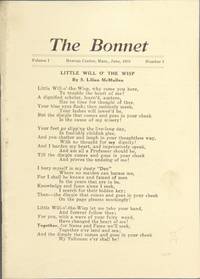
191945701Newton Centre Mass: The Bonnet 1919. First edition of the only known number small 8vo pp. 12; original printed self-wrappers; about fine. Includes two unsigned contributions from H. P. Lovecraft listed on p. 12 as one of the "Official Critics." An ephemeral example of Lovecraft's involvement with the amateur press movement with an unattributed poetic tribute to Helene Hoffman Cole Second Vice-President of the Bonnet Club Officials; and a brief paragraph under "Trimmings." The editor Winifred Virginia Jordan was rumored in amateur press circles to have been linked romantically to Lovecraft. See Joshi & Schultz eds. An. H. P. Lovecraft Encyclopedia p. 41. <br/><br/> The Bonnet unknown books
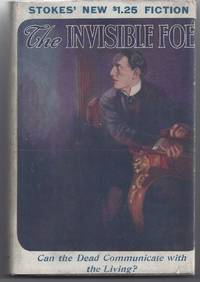
1920006547New York City: Fredrick A. Stokes 1920. 1st Edition. Hardcover. Very Good/Near Fine/Very Good Plus. 8vo. 279pp. Beautiful First American Edition. Original Blue/Grey cloth with titles stamped in navy on spine and front board. Square tight and clean throughout with little or no wear. A touch of toning to edges. A few spots of discoloration on the rear board that looks like a printing defect. End-papers mildly off-set. Previous owner's name stamped on ffep. Some spotting to page edges. Very attractive and quite scarce unclipped though unpriced dust-jacket price of $1.25 on bottom of front flap has some wear to edges and short closed tear on at the heel. Light soiling. A couple of tiny nicks. Still fresh and bright and quite uncommon in any condition. Story about spiritualism adapted from the play by Walter Hackett. A gorgeous collectable copy of a very difficult item to find particularly in nice condition and in dust-jacket. Fredrick A. Stokes hardcover books
1982186036New York: Charles Scribner's Sons 1982. 1982 - 2004. Hardcover. VG Covers show general light use. Bookblocks have some age toning and darkening at corners. Small amount of writing from previous owner on front end pages. All volumes black cloth gilt lettering and decoration; color frontis occasional bw illustrations. Each volume paginated separately circa 500-700 pp. No dust jackets as issued. Set includes Volumes 1-12 Volume 13 index Vol 14 Interim Index. Interim index is paperback. Vols. 1-13 published 1982-1988 were editedby Strayer; Supplement 1 published 2004 was edited by Jordan. I. Aachen-Augustinism. 1982. II. Augustinus Triumphus-Byzantine literature. 1983. III. Cabala-Crimea. 1983. IV. Croatia-Family sagas Icelandic. 1984. V. Famine in the Islamic world-Groote Geert. 1985. VI. Grosseteste Robert-Italian literature. 1985. VII. Italian Renaissance-Mabinogi. 1986. VIII. Macbeth-Mystery plays. 1987. IX. Mystery religions-Poland. 1987. X. Polemics-Scandinavia. 1988. XI. Scandinavian languages-Textiles Islamic. 1988. XII. Thaddeus legend-"Zwart noc". 1989. XIII. Index; prep. by Wm. J. Richardson Associates Inc. 1989 XIV. Interim index. Charles Scribner's Sons hardcover books
193637908Berlin: Springer 1936. Jordan Pascual 1902-80. Anschauliche Quantentheorie: Eine Einf¸hrung in die moderne Auffassung der Quantenerscheinungen. 8vo. xii 320pp. Berlin: J. Springer 1936. 231 x 155 mm. Blue cloth c. 1936 rebacked preserving orig. spine with leather label. Fine copy from the library of Nobel Laureate Emilio SegrË 1905-89 with his signature slightly trimmed on the title and occasional pencil notes. First Edition of this textbook on the "new" quantum theory by one of the founders of that science. Jordan made fundamental contributions to the creation of the new quantum mechanics particularly in the two-part paper "Zur Quantenmechanik" 1925 on which he collaborated with Max Born and William Heisenberg. In the first part "Zur Quantenmechanik I" Born and Jordan used the mathematics of matrix calculus to fashion Heisenberg's new theoretical matrix mechanics into a systematic theory of quantum mechanics; in the second part known as the "three-man paper" Born Heisenberg and Jordan extended the Born-Jordan formalism of the first paper to systems with many degrees of freedom numbers of particles. Jordan's application of this new formalism to the radiation field contained in the last section of "Zur Quantenmechanik II" served as the beginning of quantum field theory. This copy of Jordan's work is from the library of Emilio SegrË discoverer of the element technetium and recipient of a share of the 1959 Nobel Prize for his work on the antiproton. DSB. 37908. Springer unknown books
1982157392New York: Charles Scribner's Sons 1982. 1982 - 2004. Hardcover. VG clean and tight. Art school ex-lib. set with usual marks including numbering on 10 of the spines. All volumes black cloth gilt lettering and decoration; color frontis occasional bw illustrations. Each volume paginated separately circa 500-700 pp. No dust jackets as issued. Set includes Volumes 1-12 Volume 13 index and Supplement 1. Heavy and will require extra postage. Vols. 1-13 published 1982-1988 were editedby Strayer; Supplement 1 published 2004 was edited by Jordan. I. Aachen-Augustinism. 1982. II. Augustinus Triumphus-Byzantine literature. 1983. III. Cabala-Crimea. 1983. IV. Croatia-Family sagas Icelandic. 1984. V. Famine in the Islamic world-Groote Geert. 1985. VI. Grosseteste Robert-Italian literature. 1985. VII. Italian Renaissance-Mabinogi. 1986. VIII. Macbeth-Mystery plays. 1987. IX. Mystery religions-Poland. 1987. X. Polemics-Scandinavia. 1988. XI. Scandinavian languages-Textiles Islamic. 1988. XII. Thaddeus legend-"Zwart noc". 1989. XIII. Index; prep. by Wm. J. Richardson Associates Inc. 1989 XIV. Suppl. 1. 2004. Each volume has its own ISBN; there is no ISBN for the complete set. The encyclopedia covers over 112000 persons places things and concepts of "legitimate scholarly interest" in 7000 distinct articles in more than 8000 pages written by over 1800 contributing editors from academic institutions mainly in the United States but also Europe and Asia. It is the largest and most detailed modern encyclopedia of the Middle Ages in the English language comparable to the nine volume German Lexikon des Mittelalters. The "upside-down-T in a circle" symbol on the spine and cover is an artistic interpretation of the T and O map which was first described in the Etymologiae the most influential encyclopedic work of the Middle Ages. Charles Scribner's Sons hardcover books
1981147355N.p.: N.p. 1981. Second Draft script for the eleventh episode of the fifth season of the anthology series "American Playhouse" which originally aired on April 21 1986 on PBS. With a few small holograph ink and pencil annotations to the front wrapper and page I-3-25.<br/><br/>A local reporter receives a hefty bribe by a corrupt county commissioner to ignore an eco-activism group's protests against a new development but soon finds himself conflicted over the brutal tactics the commissioner uses to silence the activists.<br/><br/>Set and shot in Fort Myers Florida<br/><br/>Red untitled wrappers. Title page present noted as Second Draft with credits for screenwriter Victor Nunez and director John D. MacDonald. 132 leaves with last page of text numbered IV-4-130. Dot matrix duplication rectos only. Pages Very Good wrapper Very Good bound with a plastic prong. N.p. unknown books
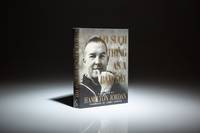
200010549Atlanta GA: Longstreet Press 2000. First Edition. Hardcover. Fine/near fine. Signed by President Jimmy Carter and his White House Chief of Staff Hamilton Jordan No Such Thing As A Bad Day a memoir by Hamilton Jordan. Twelvemo x 260pp. Black hardcover title stamped in gilt on spine. Stated "First Printing 2000" on copyright page. A fine copy never read. In publisher's near fine dust jacket faint shelf wear retail price on front flap. Signed by Hamilton Jordan on the front free endpaper. Inscribed by President Jimmy Carter on his foreword: "To Georgia Young Democratic Club - Jimmy Carter." Hamilton Jordan 1944-2008 served as the White House Chief of Staff to President Jimmy Carter. He was one of the youngest people to serve in that position in history. His tenure was plagued with controversy as the media portrayed him as inexperienced and a southern "good ole boy." Mr. Jordan died in 2008 due to cancer. Longstreet Press hardcover books
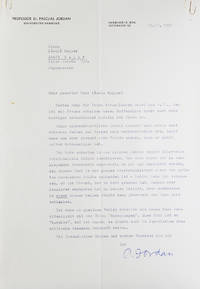
1911317085Hamburg 19/11/71. 1 page 22 lines. 4to. Old folds. Fine. 1 page 22 lines. 4to. Solid if anodyne letter from the noted German scientist Pascual Jordan 1902-1980 remarking that his chief interest in recent years has been pure mathematics which "gives joy to no one who is not already a matehmatician"; Jordan also observes that his books are sold in the Soviet Union and that his work in the press Begegnungen could be sold in Yugoslavia without objection.<br/><br/>Jordan was a German physicist who made significant contributions to quantum mechanics and quantum field theory along with Heisenberg and Born. He contributed much to the mathematical form of matrix mechanics and developed canonical anticommutation relations for fermions. While the Jordan algebra is employed for and is still used in studying the mathematical and conceptual foundations of quantum theory it has found other mathematical applications.<br/>He would have won the Nobel Prize if he had not been a Nazi. unknown books
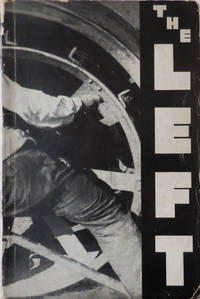
193123239Davenport: The Left 1931. First edition. Paperback. Very Good. Spring 1931 issue of this radical leftist magazine edited by Redfield and others. The magazine only lasted two issues. Very good condition with some wear to covers. Includes contributions by Weston Zukofsky Leonard Spier Lola Ridge and others. Socialism and the Arts. The Left paperback books
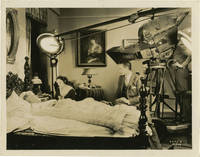
1932137137Beverly Hills CA: Metro-Goldwyn-Mayer MGM 1932. Vintage reference photograph from the set of the 1932 film with a printed snipe on the verso. Based on the novel by Upton Sinclair. <br/><br/>Victor Fleming directs Dorothy Jordan and Lewis Stone in an early scene from his pre-Code epic about Prohibition. <br/><br/>10 x 8 inches. Very Good plus. Metro-Goldwyn-Mayer [MGM] unknown books