4 534 résultats
1962124613Paris Gallimard, coll. "La Bibliothèque idéale" 1962 1 vol. broché in-12, broché, 299 pp., 14 planches hors-texte, bibliographie. Exemplaire du service de presse avec un bel envoi de l'auteur : "A André Breton, qui est deux fois dans ce livre, qui lui doit un surcroît de poésie, en attentif hommage, J. Charpier".
1953124622Paris Seghers, coll. "Poètes d'aujourd'hui" 1953 1 vol. broché in-16, broché, couverture illustrée, non coupé, 207 pp., portrait-frontispice et 12 planches hors-texte. Edition originale de ce choix. Un des 15 exemplaires de tête sur Hollande, celui-ci non justifié, en belle condition.
1953124624Paris Seghers, coll. "Poètes d'aujourd'hui" 1953 1 vol. broché in-16, broché, couverture illustrée, non coupé, 207 pp., portrait-frontispice et 12 planches hors-texte. Edition originale de ce choix. Un des 20 exemplaires numérotés sur alfamarais.
6188Adès/Pierre Seghers Paris
1946124599Paris Gallimard 1946 1 vol. Broché in-folio, broché, non paginé. Edition originale numérotée sur Chataignier. En belle condition, non coupé.
194633209Paris, Gallimard, 1946. Gr. in-4 broché (33 x 25,5 cm) non paginé. Edition originale numérotée 1/2350 exemplaires sur papier de châtaignier (après 75 exemplaires sur divers papiers), celui-ci le n° 180. Très bel exemplaire, extrêmement frais. Couverture également en bel état.
40966Paris, Gallimard, 1946. Gr. in-4°, non paginé. Broché.
30444Paris, Gallilmard, 1946. 1 vol. in-folio, toile verte, titre doré en long au dos. Reliure postérieure, dos légèrement passé. Couverture conservée. Bon exemplaire. Petit cachet ex-libris d'André Gallet sur le titre. (52) ff.
38348Nrf, Gallimard. 1960. In-12. Br. 121 p. BE. Dessin en page de garde.
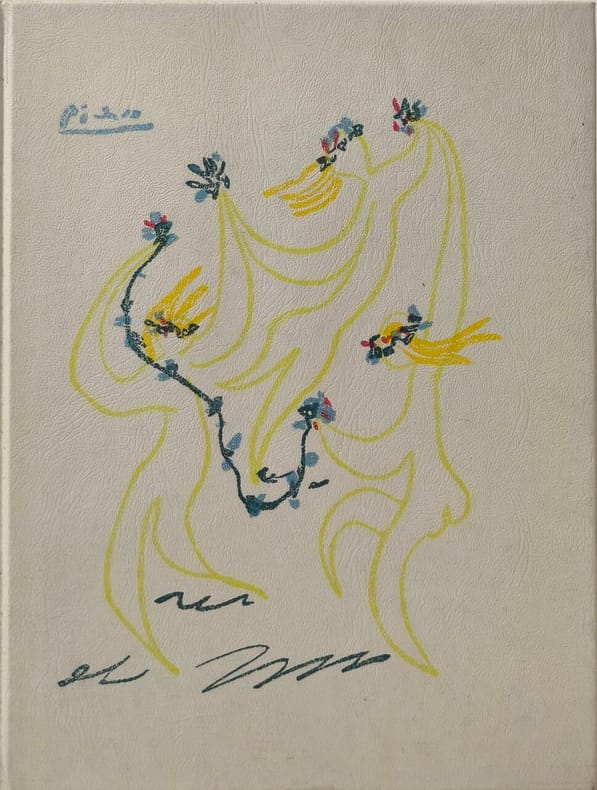
1960124607Bogotá 1960 1 vol. broché in-folio, en feuilles, sous couverture rempliée illustrée, 133 pp. Édition originale en langue espagnole illustrée de 17 dessins à pleine page par l'architecte Fernando Martínez Sanabria. Exemplaire numéroté sur papier "Bond Modern Gloss" avec un envoi autographe signé du traducteur au résistant et député Emmanuel d'Astier (1900-1969). Légères traces d'usure en couverture, sinon bon exemplaire.
1948024739Paris nrf - GALLIMARD 1948 un volume grand in-8° (190 x 245mm), non paginé. Reliure en pleine peau marbrée verte, dos et plats muets, couverture crème titrée noir conservée. (dos et pourtours de plats insolés, rousseurs éparses). Réédition, l'édition 'originale fut publiée en 1925.
290481982 . Gallimard "La Pléiade" In 12 reliure cuir de l'éditeur/jaquette et rhodoïd .Etui .XLIV ,1424 pp.
29449Gallimard ,Bib. De la Pléïade , In 12 reliure cuir de l'éditeur/jaquette rhodoïd et étui .XLIV ,1424 pp.
19753642Éditions rombaldi 1975 232 pages in8. 1975. Reliure editeur cartonnée. 232 pages.
16782NRF / Gallimard / Bibliothèque de la Pléiade Paris, 1975, in-12 reliure éditeur sous rhodoïd (pas de boitier ni de jaquette) XLII-1415pp. Œuvre poétique : Éloges - La Gloire des rois - Anabase - Exil - Vents - Amers - Chronique - Oiseaux - Chanté par celle qui fut là - Chant pour un équinoxe. Prose : Discours - Hommages - Témoignages. Correspondance : Lettres de jeunesse - Lettres d'Asie - Lettres d'exil.
198803678Hamburg, Rowohlt, 1988. kt, 215S, gutes Exemplar, rororo 12139
in-8, 259 pp., cartonnage éditeur avec jaquette il Bel exemplaire. [NV-33]
65971Frankfurt am Main : S. Fischer [2023]. 255 Seiten ; 20 cm, 314 g, mit Schutzumschlag Festeinband, gebundene Ausgabe, Hardcover/Pappeinband, Exemplar in gutem Erhaltungszustand, Neupreis in Euro: 24,--
75813Frankfurt, S. Fischer, 2023. Die feministische Revolte im Iran 255 S. Pappband mit Umschlag / gebundene Ausgabe
1 Vol. In-16 p pag. 30 10 tavv. f.t PROG 24492 CATT_ATT 37
New Persian Original bdg. HC. Roy. 8vo. (24 x 17 cm). In Persian with bilingual in Persian and Azerbaijani Turkish on cover. (Poems chiefly in Azerbaijani). 701, [23] p., 15 unnumbered color and b/w plates. Complete works of Shah Ismail (Hatai). Khatâ'î, Shâh Ismâ'îl Safavî: Kulliyât-i dîvân, nasîhatnâmah, dahnâmah, qûshmâlâr, Fârsjâ shi'rlar.= Sah Ismail Sefevi (Hetai) külüyyati: Qezeller, qesideler, nesihetname, dehname, qosmalar. Prep. by Mirza Resul Ismailzade. Ismail I, also known as Shah Ismail I was the founder of the Safavid dynasty, ruling from 1501 to 23 May 1524 as Shah of Iran (Persia). The rule of Ismail is one of the most vital in the history of Iran. Before his accession in 1501, Iran, since its conquest by the Arabs eight-and-a-half centuries before, had not existed as a unified country under native Iranian rule, but had been controlled by a series of Arab caliphs, Turkic sultans, and Mongol khans. Although many Iranian dynasties rose to power amidst this whole period, it was only under the Buyids that a vast part of Iran proper came under Iranian rule (945-1055). The dynasty founded by Ismail I would rule for over two centuries, being one of the greatest Iranian empires and at its height being amongst the most powerful empires of its time, ruling all of present-day Iran, Azerbaijan Republic, Armenia, most of Georgia, the North Caucasus, Iraq, Kuwait and Afghanistan, as well as parts of modern-day Syria, Turkey, Pakistan, Uzbekistan and Turkmenistan. It also reasserted the Iranian identity in large parts of Greater Iran. The legacy of the Safavid Empire was also the revival of Iran as an economic stronghold between East and West, the establishment of an efficient state and bureaucracy, its architectural innovations and its patronage for fine arts. One of his first actions, was the proclamation of the Twelver sect of Shia Islam to be the official religion of his newly-formed state, which had major consequences for the ensuing history of Iran. Furthermore, this drastic act also gave him a political benefit of separating the growing Safavid state from its strong Sunni neighbors -the Ottoman Empire to the west and the Uzbek confederation to the east. However, it brought into the Iranian body politic the implied inevitability of consequent conflict between the shah, the design of a "secular" state, and the religious leaders, who saw all secular states as unlawful and whose absolute ambition was a theocratic state. Ismail was also a prolific poet who, under the pen name Kha?a?i (which means "he who made a mistake" or "he who was wrong" in Persian), contributed greatly to the literary development of the Azerbaijani language. He also contributed to Persian literature, though few of his Persian writings survive. Ismail is also known for his poetry using the pen-name 'Khatai'. He wrote in the Azerbaijani language, a Turkic language mutually intelligible with Turkish,[60] and in the Persian language. He is considered an important figure in the literary history of Azerbaijani language and has left approximately 1400 verses in this language, which he chose to use for political reasons.[60] Approximately 50 verses of his Persian poetry have also survived. According to Encyclopædia Iranica, "Ismail was a skillful poet who used prevalent themes and images in lyric and didactic-religious poetry with ease and some degree of originality". He was also deeply influenced by the Persian literary tradition of Iran, particularly by the Shahnameh of Ferdowsi, which probably explains the fact that he named all of his sons after Shahnameh-characters. Dickson and Welch suggest that Ismail's "Shâhnâmaye Shâhî" was intended as a present to his young son Tahmasp. After defeating Muhammad Shaybani's Uzbeks, Ismail asked Hatefi, a famous poet from Jam (Khorasan), to write a Shahnameh-like epic about his victories and his newly established dynasty. Although the epic was left unfinished, it was an example of mathnawis in the heroic style of the Shahnameh wri