4 538 résultats
1928ABC_50475Iran 1928. Oblong album 24.5 x 29.6 cm. Mid-19th-century bright blue faux-leather the front board features a pictorial on-lay within a rectangular frame the illustration depicts a young woman in traditional costume holding a large ceramic vessel. The joints are laced through onto 2 supports. With 19 black and white photographs ca. 23.1 x 17.1 cm on thick dark blue/black paper. 9 ll. Collection of 19 engineering photographs taken in Iran dating from ca. 1928 to 1930 CE. The majority of the images are annotated with the year 1308 AH 1929-1930 CE while only photograph 7 is dated 1307 AH 1928-1929 CE.The album documents large-scale engineering works and urban modernisation in Iran during the early years of the Pahlavi dynasty 1925-1941 under Reza Shah Pahlavi 1878-1944. In this period cities such as Tabriz underwent significant restructuring and infrastructural development as part of broader state-led reforms.The photographs depict surveying activities including measuring instruments mounted on tripods uniformed officials and extensive reconstruction works. Several photographs are identifiable as views of Tabriz including the development of the Gaji Gate Darb-e Gajil in December 1929 Ahrap Ahrab Street and Munjam Street under construction. Other views show street levelling and widening works illustrating the transformation of older urban quarters into broader modern thoroughfares.Further noteworthy subjects include railway works and one photograph taken in Jafarabad shows several men wearing a combination of traditional clothing including papakha-style headgear and Western clothing reflecting the broader cultural transition of the period. The present work therefore stands as an informative visual record of early 20th-century Iranian engineering urban renewal and state modernisation.With some glue staining to the dark blue paper on several pages. A few photographs show minor marginal wear not affecting the images themselves. The final photograph is not mounted on the album paper but on a separate piece of card and is loosely inserted. Otherwise in good condition.l Cf. Tofigh Kouzehkanani & Zelef "Towards extroverted urbanism: Haussmannization and building a new urban identity in Tabriz 1925-1942" ITU AZ 22 3 2025 pp. 559-577 hardcover
Very Good Turkish, Ottoman (1500-1928) Contemporary fine quarter leather binding. Five raised bands to spine, second gilt title as "Tarih-i seyyâh", others gilt decorations. Brown boards are embossed decoratively. Demy 8vo. (21 x 15 cm). In Ottoman script (Old Turkish with Arabic letters). [12], 194 p. Hegira: 1142 = Gregorian: 1729. Slightly wear on colophon and the first page. Otherwise a good copy. Extremely uncommon first Ottoman edition printed in the first printing house of the Islamic world as the third Islamic incunabula, of this eye witness and first-hand account, and one of the most important chronicles describing the history of late Safavid Iran in the 18th century, the Iranian invasion of Afghanistan and the siege and the fall of Isfahan in 1722 written by Kruzinski who was a Polish Jesuit missionary served in the Persia in the early 18th century. In 1720 he was nominated advocate general of the mission in Persia and became the secretary to the Bishop of Isfahan. Krusinski himself, however, claimed later on that he is not only the author but also the translator of this work. As a chronicle, this is a history of Iran under the Safavids from 1499 up to 1727 with a special focus on the 1722 Afghan invasion that terminated the Safavid dynasty. "His account of the conditions and events preceding and during the siege and the subsequent demise of the Safavids is unique. It also offers key insights into the workings of the late Safavid state and government as well as the functions of the royal harem." (Bloomsbury). Translated and expanded by Ibrahim Müteferrika of Kruzinski's Latin manuscript written in 1726 in Istanbul and entitled "Historia revolutionis monarchia Persica". The book was first published in Italian, French, and English translations, in Rome (1727), Paris (1728), and London (1728). The founder of the legendary first printing house in the Islamic world, Ibrahim Müteferrika (1674-1745), was the editor and translator of this book. Ceridehâne [i.e. Journal House] Printing House is the successor of the Müteferrika Press in the early 19th century. "The book is a Turkish translation of the history of Iran written in Latin by the Jesuit missionary Judas (Jan) Tadeusz Krusinski (1675-1751). The work, whose title can be translated as 'A voyager's description on the apparition of the Afghans and on the reasons of the Safavid Empire being undermined', focuses on the Afghan invasion of 1722 which led to the fall of the Safavid dynasty, but also offers an overview on the historical processes of early 18th-century Safavid Iran. The publication of this work was made actual not only by the vicinity of Iran to the Ottoman Empire but also by the historical turn reorganizing the relations of power in the region and triggering the intervention of the Ottomans as well. This may have been the reason that among the first Turkish incunabula this was the work published in the highest number of copies. This publication also offers an early example of copyright disputes, as Krusinski considered the Turkish translation as his own work, while Müteferrika, who does not mention his name in the printed version, suggests himself to be the translator". (Source: The Mysterious Printer Ibrahim Muteferrika and the Beginnings of Turkish Book Printing: Library of Hungarian Academy of Sciences Online). The workshop of Müteferrika began its historical mission in 1728. They published 17 works in 22 volumes. The printing house served as a means to the long-term goal of Müteferrika, his efforts to broaden the horizon and modernize the knowledge of Ottoman society and Islamic civilization. This is evidenced by the subjects of the books selected for publishing, the motivations put forth in the publisher's introductions, as well as by the documents illuminating the background of the publication of each book, also published in print. One of 1200 copies. OCLC: 312516053 (For printed copies: Two copies).; Özege: 19897.
1885143011885. Iran Art Qajar School Lovers in Embrace gouache painting on paper nineteenth century represents the courtly aesthetic erotic refinement and dynastic visual language that defined Persian painting under Qajar rule. The composition situates a princely male figure and his adorned companion in intimate embrace reinforcing themes of aristocratic leisure romanticized sovereignty and elite identity in Qajar Iran. The work supports research in Persian court painting gender representation in Islamic art Qajar costume and regalia and nineteenth century Iranian material culture.<br /> <br /> Persian Qajar gouache on paper with gold illuminated border. Depicts a young prince wearing blue and gold coat and karakul headgear embracing female companion adorned with tiara and pearls. Floral and animal illuminated margins including deer and monkeys. Image size 18.5 x 11 inches.<br /> <br /> The prince's distinctive headgear confirms Qajar rather than Zand period attribution aligning the work with the heightened stylization and opulent textile rendering characteristic of nineteenth century Tehran ateliers. Comparable compositions appear in Qajar painting traditions associated with artists such as Mohammad Sadiq whose courtly embrace scenes similarly emphasize costume detail glassware and staged intimacy as markers of refinement. The illuminated border populated by floral and animal motifs situates the lovers within a cosmological and decorative framework typical of Qajar manuscript aesthetics adapted to single-sheet painting. Minor browning to margins and discreet restoration to verso margins not affecting image. Very good. A refined example of Qajar visual culture centered on dynastic elegance and performative intimacy. unknown
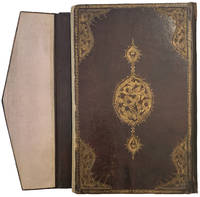
1800MEE1104Persia: undated pre-1800. 1800. 11.25 x 7.5 inches. ca. 228 leaves Written mostly in old Farsi with some Arabic marginal notes. With one leaf f. 66 illuminated on upper quadrant another 2 leaves with a penciled sketch where an illumination was planned but never completed ff. 108 170. There are numerous decorative motifs of flowers throughout the manuscript. Each leaf is variously partitioned perhaps suggestive of a garden! in this case with flowers adorning most leaves. Binding style suggests 18-19th centuries. Bound in Islamic style Ottoman period full Turkey morocco with elaborate gilt rule corner and centre ornamental flourishes with leather flap; some minor repairs to the sides of the binding are evident when examined closely. MANUSCRIPT OF SAADI' GOLESTAN THE GREAT PERSIAN POET: ORIGINAL COMPLETE MANUSCRIPT OF ONE OF THE MOST FAMOUS OF ALL PERSIAN POETS SA'ADI OF SHIRAZI. The calligraphic style and the binding are suggestive of the 16th or 17th century. This piece is embellished with numerous leaves many of which are decorated by hand with small compartments of flowers each realized from the title of Sa'adi's Gulistan Golestan Flower Garden of Sa'adi. Sa'adi is "probably the single most influential work of prose in the Persian tradition completed in 1258 by Mosarref-al-Din Mole known as Shaikh Sa'di of Shiraz." – Encyclopaedia Iranica. / The manuscript is mixed with both poetry and stories or narratives along with a moral as well as some commentaries. / PROVENANCE: Signed Kiffin Yates Rockwell 1892–1916 later label of: Kiffin Ayres Rockwell Beloit Wisconsin June 28 1942. Kiffin Yates Rockwell was a World War I fighter pilot and the first American to shoot down an enemy aircraft in WWI. He shot down a German pilot. Thus the manuscript is clearly in the United States and kept there since before 1942. "Kiffin Yates Rockwell the youngest son of James Chester and Loula Ayres Rockwell." see below. What may clear up some confusion here is that there are at least two persons with this name and there may be three. Kiffin Ayres Rockwell II or III Oct. 8 1917-Jan. 27 1998 who served in the air force in Korea is buried in Black Mountain North Carolina. Sa'adi opens with poems of Sa'eb of Tabriz a Safavid poet of Indian style of poetry added to the text. "Back of the shell kingly gems are orphans." undated [pre-1800]. hardcover
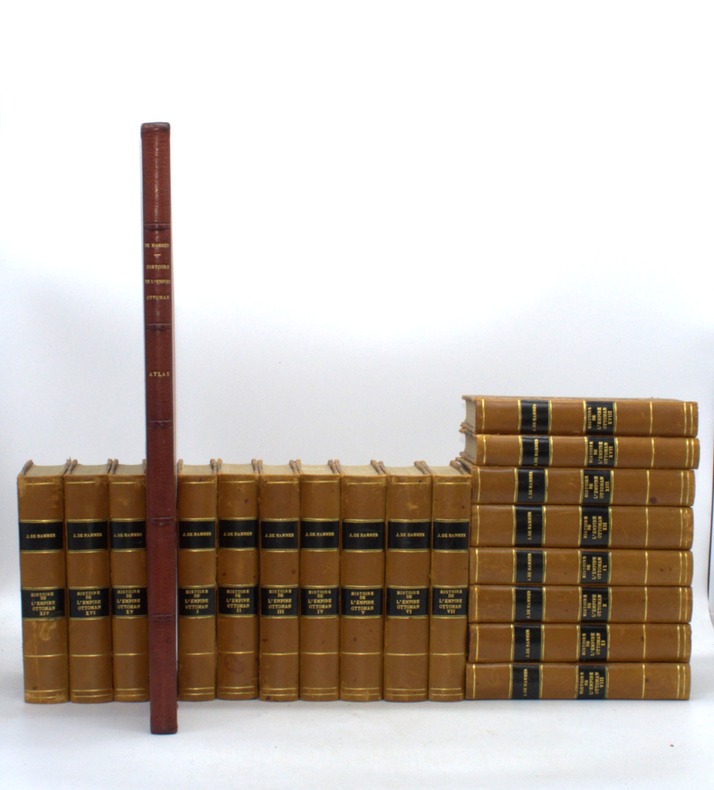
1835PHO-1982Paris, Bellizard, Barthes, Dufour et Lowell ; Londres, Bossange, Barthes et Lowell ; Saint-Petersbourg, Fd. Bellizard et Cie, 1835-1844. 18 volumes de texte in-8 et un atlas in-folio. TEXTE : 18 volumes in-8, relié demi basane et coins moderne, dos lisse orné avec pièces d’auteur, titre et tomaison noires, frottements et épidermures, défauts d’usage, rousseurs dans le texte, tampon et étiquette du relieur. ATLAS : Paris. Bellizard, Dufour etc. 1844. Imprimé chez Thierry Frères. Demi basane et coins à long grain grenat, dos à nerfs avec titre et auteur, In-folio (520x345mm), IV-82pp.-40 planches, il est composé du Commentaire sur l’Atlas de l’Empire Ottoman, d'une liste des cartes, d'une carte générale de l'Empire Ottoman (690x550mm), de 22 cartes particulières (dont une sur 2 feuilles) (815x850), de 13 plans de batailles ou de siège, et de 4 plans de villes dont un grand plan dépliant de Constantinople (690x670mm), le plan de Vienne est en 2 états, par G. Heck et Plée et gravé par U. Muschani, roussurs éparses, 2 cartes uniformément brunies avec réparations, mouillure claire en marge, tache sur les 16 premiers feuillets en tête et en fin d’ouvrage en pied. Provenance : collection de S.A.R. le Prince Osman Ibrahim d'Égypte (1951-2025), fils de S.A.R. le Prince Amr Ibrahim d'Égypte et de S.A.I. la Princesse Nejla Hibetullah Sultan (Necla Osmanoğlu) de Turquie, petite-fille du dernier calife Abdulmejid II et du sultan Mehmed VI, avec sa marque au tampon.
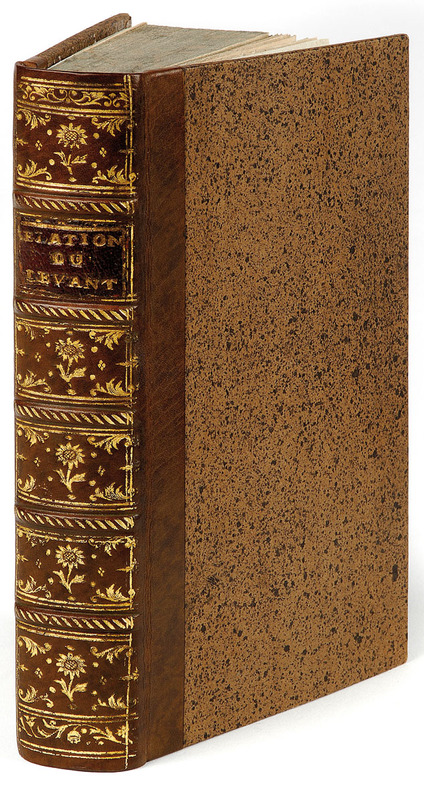
167116086Lyon, Jean Thioly, 1671 ; in-12 ; demi-veau havane pastiche du XVIIIe, tranches marbrées, dos décoré et doré, pièce de titre ; (28), titre, Épître, Préface, 481, (17) pp.
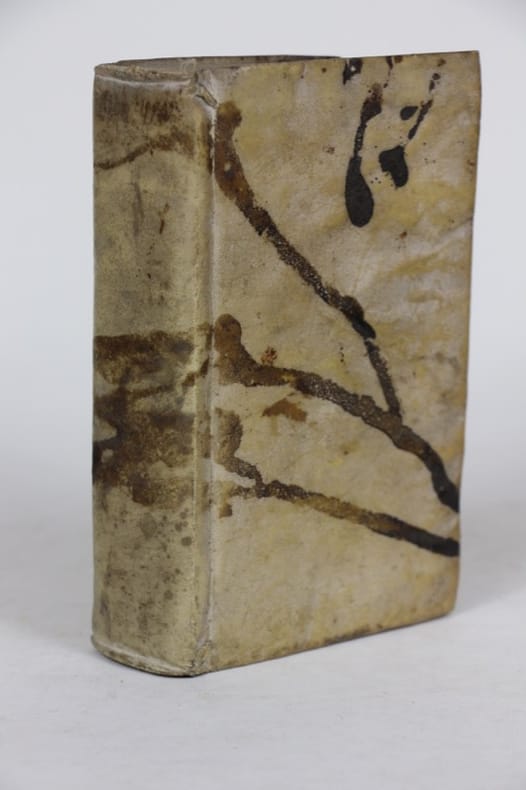
1610141230Antwerp, Hieronymus Verdussen 1610 Petit in-8, plein vélin souple muet de l’époqure. 8- 384-115 [alias 215]- 16 pp. Avec une gravure sur bois sur la page de titre, une initiale et quelques culs-de-lampe gravés sur bois. Reliure tachée. Intérieur frais.
159215856Frankfurt, Fischer, 1592. 16 Bll., 294 S., 9 Bll. 4°. Blindgeprägtes SchweinsLdr. der Zeit auf Holzdeckeln mit 2 intakten Schließen (Rücken restauriert, Bezug teils ergänzt, bestoßen und etw. fleckig). [9 Warenabbildungen]
49273ABo.J. 168 nn. Bll. Mit blaugrundigem Zierstück. Text in Schwarz und Rot in blau-goldenen Kartuschen. Leder-Einband mit Klappe und goldgepr. Deckelbordüre. Gepr. Medaillons.
168164836Genf, Johann Hermann Widerhold, 1681. Fol. Drucktitel in Rot u. Schwarz m. Holzschn.-Vignette. Mit illustr. Kupfertitel, gest. Portraittafel, 3 Textkupfern, 18 Kupfertafeln, 1 Holzschn.-Tafel u. 2 (1 gefalt.) Kupferkarten. Zus. ca. 900 S., Pgmt. d. Zt. m. durchzogenen Bünden.
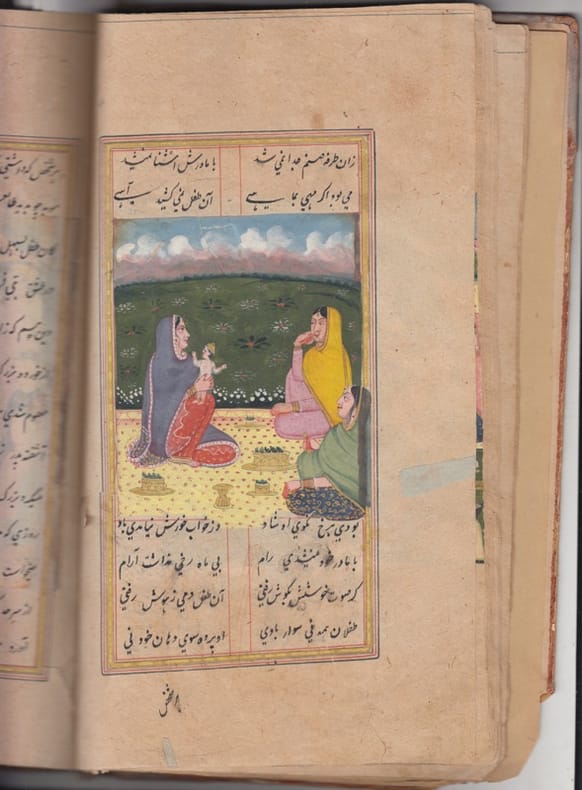
27397reliure postérieure, IN 4 étroit - dos abimé; coin plat manquant- 33 miniatures ,peintures polychromes à la gouache : papier lustré
1922184807London: W. M. Clowes and Sons for the Permanent Committee on Geographical Names for British Official Use 1922-37. Arabic place names for the use of soldiers and military surveyors A collection of 8 pamphlets all but one in their first editions with lists of geographical names of the Arabian Peninsula and the Levant - including Saudi Arabia Kuwait Qatar the United Arab Emirates Oman Yemen Trans-Jordan Syria "the French Mandatory Territory" and Iraq - as well as Iran. They were produced by the Royal Geographical Society for soldiers and surveyors working with maps. The Permanent Committee on Geographical Names P. C. G. N. was a body of scholars and linguists who regularly met to discuss policies and practical issues such as the correct spellings of foreign geographical names for use in official documents and publications. In 1921 the Committee updated the RGS System of rules for spelling native names - first adopted by the War Office and later used by the Admiralty in 1885 and throughout the First World War - which led to the creation of this series of lists. Major General Edward Gleichen 1863-1937 formerly Director of the Political Intelligence Bureau was its first Chair 1920-37. The differences in vowel pronunciation among the Arabic colloquials and between colloquial and classical Arabic had generated a variety of alternative spellings for place names in the Arabic-speaking world. The introductions explain preferences for vowel renditions acknowledging the use of alternative official spellings specific to the French mandatory territory in Syria. Some place names include the Hebrew or Greek counterpart others illustrate the confusion that might arise from a lack of transliteration conventions such as "Kethrabba" instead of "Kefrabbeh" as well as incorrect spellings in general use reaching the number of seven for Dujail near Baghdad. The lists also include approximate distances from major cities. For Iran the introduction states that "Persian orthography is by no means fixed and consistent and especially is there uncertainty about the identity and length of many vowels". The lists - which span a large territory including Azerbaijan Isfahan Bushire Tehran and Khurasan - specify that "the boundaries of the provinces of Iran are for the most part indefinite". Together 8 pamphlets octavo. Text in Arabic and English. List of publications to last verso. Stitched as issued. Contents minimally toned else fresh and clean faint traces of central vertical fold: a fine collection. unknown
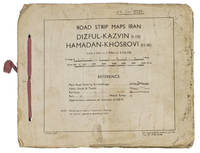
1944ABC_4794483 Rep Group. I.E." 1944. Original beige printed paper wrappers side stichted by hand through 3 holes with a reddish pink cloth ribbon. Oblong 21 x 255 cm. With 1 index map and 16 numbered folding strip maps. Exceptionally rare collection of folded strip maps of roads in Western Iran which was very likely meant for military use during the Second World War. The abbreviated inscription on the front wrapper possibly stands for "24th brigade branch transportation office" though it is unknown which 24th brigade this would have been. The maps were originally printed on quarter inch sheets in 1942 and have been significantly enlarged for this edition to a scale of 1 inch to 2 miles. We have not been able to trace any other copies of either the first or second edition of this work anywhere.With an owner's inscription on the front wrapper. The maps and back wrapper have been reinforced with bookbinder's gauze. The wrappers are somewhat soiled creased and the edges are somewhat frayed. The maps have slightly browned and the index map has a small brown stain in the lower outer corner without affecting the image. Otherwise in good condition. 83 Rep Group. I.E.", hardcover
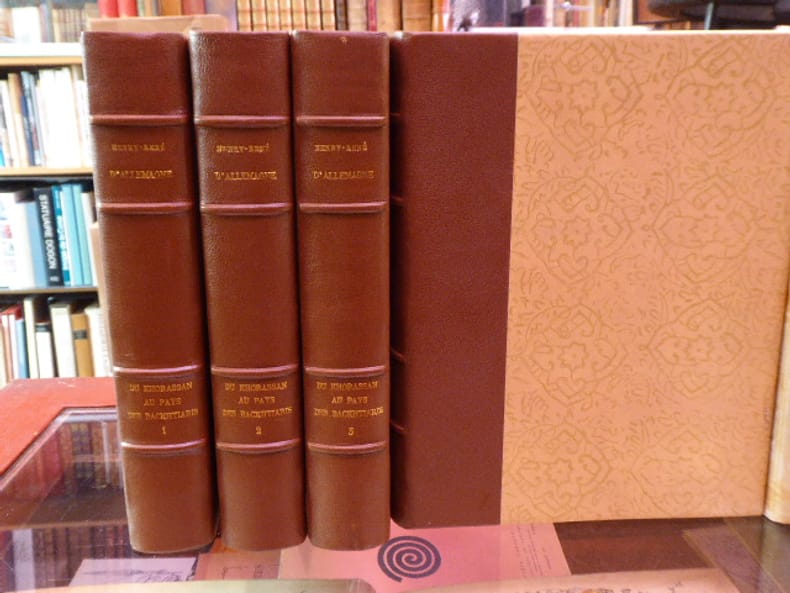
195986Hachette Paris 1911 4 volumes grands et forts in-4 carré ( 320 X 245 mm ) de de 228, 255, 271 et 323 pages, demi-chagrin chocolat, dos à nerfs janséniste, couvertures en chromolithographie conservées, tranches mouchetées. Ouvrage contenant 960 clichés dans le texte et 255 planches hors-texte dont 47 en couleurs sous serpente légendée. Frontispice au décor d'oiseaux et de fleurs au verso est placé la reproduction en couleur d'une miniature Perse. EDITION ORIGINALE de ce luxueux ouvrage consacré à la Perse et au Turkestan. Tirage Limité à 500 exemplaires, celui-ci 1 des 250 spécialement réservé pour l'auteur avec un envoi autographe de sa main à Monsieur Jacques BIGOT daté du 1er janvier 1912. Très bel exemplaire d'une grande fraîcheur.D'ALLEMAGNE était archiviste à la bibliothèque de l'Arsenal. Il voyagea en Perse et au Turkestan russe en 1899, puis de nouveau en 1907, accompagné de Jean VINCHON, qui prit de nombreuses photographies et notes de terrain intéressantes, lesquelles servirent de base à l'ouvrage de D'ALLEMAGNE. L'itinéraire de cette mission scientifique passe par Kiev, Odessa, Vladikavkaz, Tiflis, Bakou et Krasnovodsk. L'objectif est l'étude archéologique des monuments transcaspiens et du Turkestan. Elle permettra de rassembler une importante collection ethnographique, notamment des tapis et des céramiques persans. De retour en 1907 en compagnie de Jean VINCHON, il visita les villes de Khiva et les environs de son oasis. Il fit don au Louvre d'un fragment de stèle funéraire rapporté de Samarcande.Première édition de ce luxueux ouvrage consacré à la Perse et au Turkestan.Les deux premiers volumes sont consacrés à l'étude de la géographie, de l'agriculture, du commerce, de l'industrie et de l'art de la Perse, ainsi que de ses coutumes politiques, militaires et religieuses. Les deux derniers volumes relatent leur retour en Perse en 1907, via Ishqabad, Mashhad, Nichapour, Sebzevar, Sharoudi, Téhéran, Qom, Ispahan, Djoumougoum, le Bakhtiari, puis leur retour par Ispahan, Téhéran et la mer Caspienne.
18256434Paris, Librairie Nationale et Etrangere, 1825. 1825 2 vol. in-8° (210 x 140 mm.) , 3 ff., XI, 282 pp.; 2 ff., 243 pp et 60 planches lithographiées et coloriées dont 6 dépliantes, et une carte dépliante aux contours coloriés. (Rousseurs, déchirures et coin inférieur d'une planche restaurés). Cartonnage d'époque imitant le veau marbré, dos lisses ornés, titres et tomaison de maroquin rouge et bleu, tranches rouges.
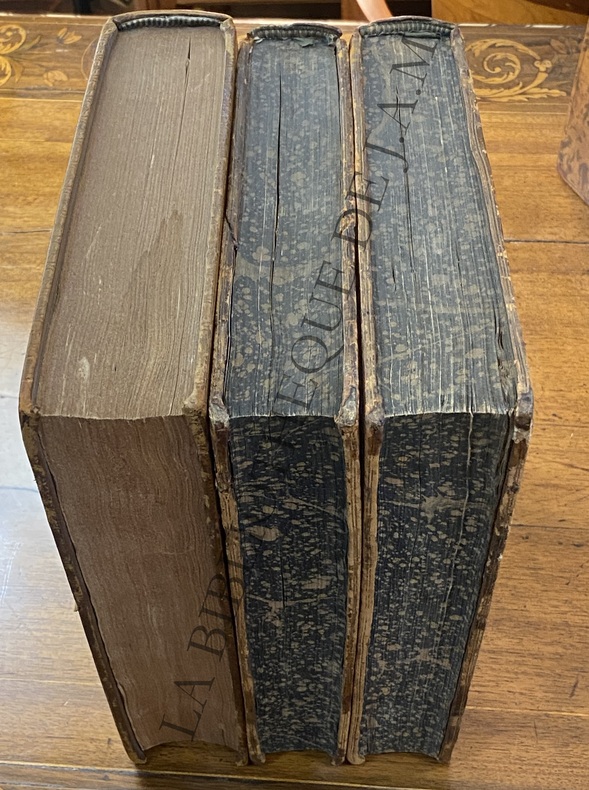
1771Zend-Avesta-Tilliard-1771Édition originale, Deux parties en trois volumes dépareiller, in-4, plein cuir marbré pour les deux volumes de la première partie, vaux blond pour le deuxième et dernier volume, dos a nerfs, épidermure manque aux coins, quelques rousseurs dans la deuxième partie de l'ouvrage, traces de mouillures claires, dans la troisième partie de l ouvrage . Intérieur frais.
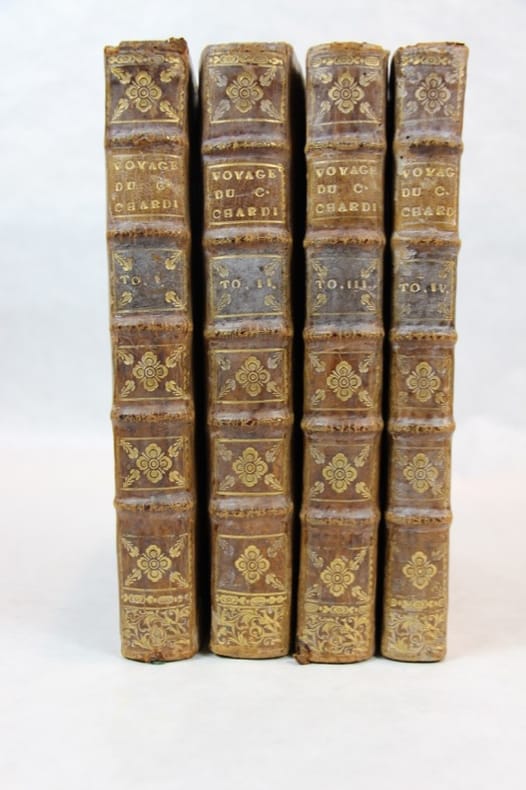
1735139789Amsterdam, aux dépens de la Compagnie, 1735 4 volumes in-4, veau marbré, dos à nerfs, caissons ornés, tranches mouchetées Reliure de l'époque, 7 ff.n.ch. faux-titre & titre, avertissement des libraires, préface, placement des gravures- 390 pp.- ff.n.ch.- 359 pp.- 2 ff.n.ch.- 437 pp.- 3 ff.n.ch.- 324 pp.- 15 ff.n.ch. 80 planches gravées dont le frontispice répété, la plupart replées et de grande dimension. Épidermures sur les plats, coins usés, petits accrocs à certaines coiffes. Un planchze double déliée. Intérieur très frais. La plus belle et la plus complète édition des Voyages de Chardin l'originale de 1686 consistant en un seul volume in-folio. tant pour le texte la première s'arrête en 1673 que pour les gravures. Joaillier protestant exerçant, comme son père, Place Dauphine, Jean Chardin 1643-1713 effectua, pour des raisons commerciales, plusieurs voyages en Perse, région alors très peu connue des Occidentaux 1665, 1671-1680, avec des incursions en Turquie, dans le Caucase et en Inde. Fuyant la France en 1681, avant même la promulgation de l'Edit de Fontainebleau, il se réfugia à Londres, où Charles II le nomma bijoutier de la Cour. De la bibliothèque du baron Camille de Warenghien de Flory 1890-1965, avec ex-libris.
1962523703Paris: Au Vent D'Arles 1962. Softcover. Near Fine. First edition. Hors commerce issue limited to 155 copies. Quarto. 37pp. Tan printed wrappers. Covers are slightly toned with very faint foxing else a near fine unopened copy. An elusive title in this 1962 edition published by Au Vent D'Arles and issued with the text sheets only reserved for distribution hors commerce by St. John Perse Georges Braque and Janine Cremieux. OCLC locates 11 copies; six in the U.S. The Getty copy in their description states: "No etchings accompany this ed." Oiseaux was also separately published along with etchings by Georges Braque under the title L'Ordre des Oiseaux 1963.<br /> <br /> This is one of a few copies reserved for Saint-John Perse not numbered and designated in type on the colophon leaf: "Exemplaire Saint-John Perse" and Signed by St-John Perse in ink on the limitation page. This copy is also Inscribed by St.-John Perse to Lincoln Kirstein on the front flyleaf: "A Lincoln Kirstein pour qui la vie est creation. Amicalement St-John Perse Washington 1963." Kirstein started the influential little magazine Hound and Horn while still a Harvard student and cofounded the New York City Ballet with George Balanchine in 1946. His sister Mina Kirstein Curtiss fluent in French was a Smith College professor and she also translated and edited publications by French authors including Saint-John Perse with whom she had a close friendship. Au Vent D'Arles unknown
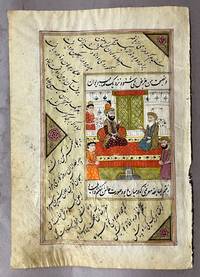
1650007147Iran 1650. No Binding. Good. Single illuminated manuscript leaf approx. 207 x 143 mm recto and verso with a finely painted Safavid miniature on the recto depicting a courtly audience scene: a ruler seated on a carpeted dais in conversation with an elder figure attended by courtiers within an architectural interior featuring tiled walls and a fountain. Executed in opaque watercolor and gold the composition and palette are characteristic of mid-Safavid manuscript painting. The text is written in an accomplished nasta'liq hand within gold-ruled borders. The verso displays an ornamental poetic layout with geometric compartments central medallion and polychrome floral cornerpieces indicating a deluxe literary manuscript likely poetic or historical in nature. Safavid Iran probably Shiraz. The calligraphy illumination and figural style correspond to Shiraz production of the mid-17th century a period noted for refined manuscript painting and decorative page design. Good overall condition. Moderate toning and wear to paper with soft creases and scattered staining. Minor rubbing to pigments and gold. Old tape remnants at the corners on verso; edges slightly worn. The miniature and calligraphy remain well preserved and visually appealing. Ships unmounted and unframed <br/> <br/> unknown
1756PHO-10591756/1758 ,à Paris chez Desaint et Saillant , 4 tomes en 5 volumes in-4 (275x220mm) , relié couverture d’attente, dos lisse , grandes marges sur beau papier, non rognés, (manque aux dos , charnières faibles mais corps solides , 2 plats détachés , bord brunis)
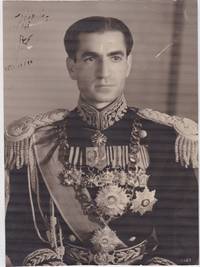
15164Mohammed Reza Pahlevi Shah of Iran before the revolution. Very rare signed vintage photo inscribed in his hand in ink "To my dear sister. 1332." The photo is notably dated 1953 the same year as the Revolution. Black and white photo measures 6.5x9" and depicts the Shah in full military regalia with medals and epaulets. Minor rubbing not affecting signature or image. Otherwise in very good condition. unknown books
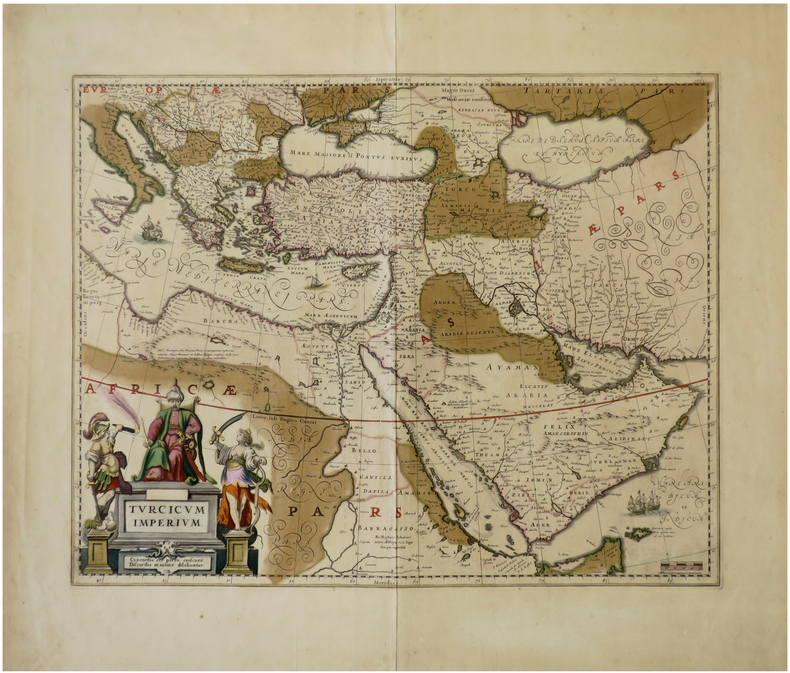
1640LBW-6792[Amsterdam, circa 1640]. 410 x 517 mm.
1871PHO-1755Paris, Imprimerie Impériale & Nationale, 1871-1930, 7 vol. (sur 9, manque tome 2 & 3) In-8°, brochage éditeur. Édition bilingue : Texte arabe avec traduction française en regard, Tome I, (1871), 2ff.-XII-408pp.,Tome IV, (1914), 2ff,VII_XI ,480pp., Tome V(1928); 3ffnch.-VI-515 pp; Tome VI (1928) ;3ffnch.-IX-518 ;Tome VII (1929); 3ffnch.-X-438 pp; Tome VIII (1930); 3ffnch-X-446 pp.; Tome IX (1930) ,3ffnch.-VI-299 pp. , en fin d’ouvrage , notes et variantes, correction ainsi que la table des matières .Manque les tomes 2/3 , petits défauts de reliure.
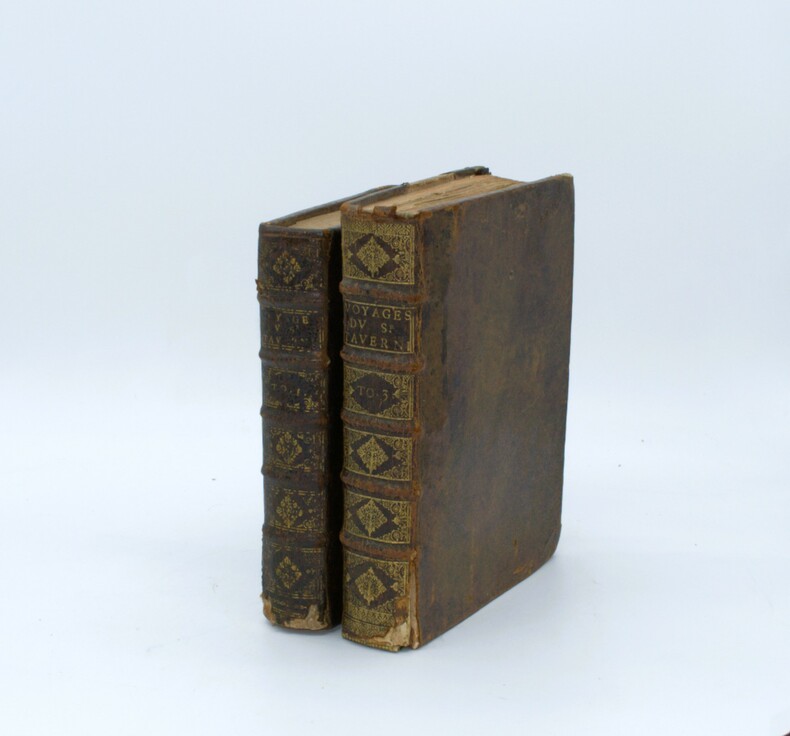
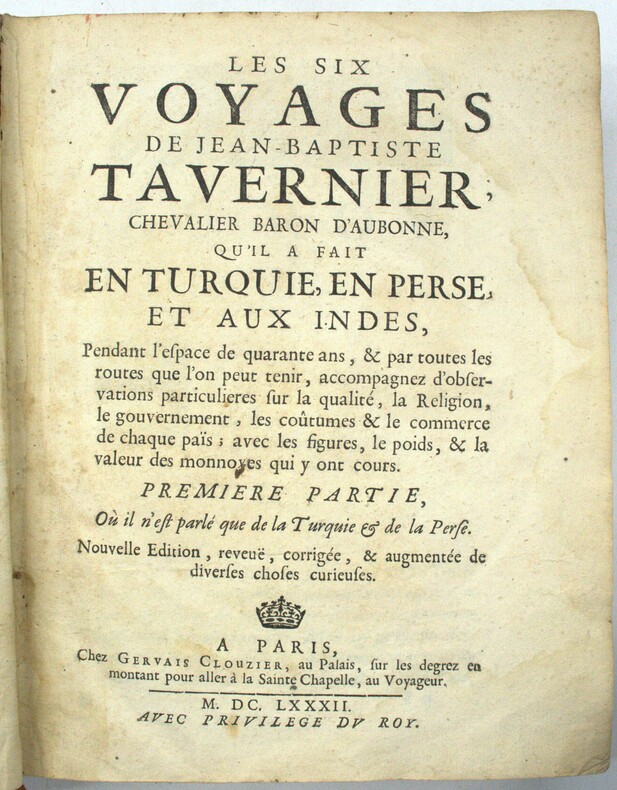
1680PHO-1964Paris, chez Gervais Clouzier, 1682-1680, 3 volumes in-4 (246x195mm), 14ff.-636pp., 4ff.-481pp., 8ff.-72pp.-1f.-156pp.-1f.-96pp.-4ff.-1f.-178pp., Illustration : Tome 1 ; 7 planches (6 dépliantes) sur 8, Tome 2 ; 26 planches dont 15 de monnaies, 5 de pierres et 4 gravures dans le texte, Tome 3 ; 2 grandes cartes (Japon, 79x56cm et Tunquin, 56x41cm) et 8 planches dépliantes. Basane époque, dos à nerfs avec titre et tomaison, frottements, griffures et épidermures, Tome 1 ; accroc au plat, coiffe sup. absente, 2 coins usés, rousseurs, mouillure en coin puis en marge, planches avec déchirures sans manque, page 431 déchirée avec manque. Tome 2 ; fente au dos et charnière, coins usés, rousseurs et brunissures, 1 planche déchirée sans manque. Tome 3 ; coins usés, coiffes arasées, carte du Japon volante, déchirure carte du Tunquin, carte du Japon légèrement oxydée, petites rousseurs.
1676PHO-1352A Paris, Chez Gervais Clouzier, 1676-79, 2 volume in-4 (sur 3),30pp.- 698pp.-8pp.-2ff.,8 ff., 72 pp., 1 f., 156 pp.,2 ff., 96 pp. , 1 f., 178 pp., tome 1 ,illustré de 6 planches (7) et tome 3 ; 12 cartes et planches (complet), relié plein veau époque , dos à nerfs ornés avec titre et tomaison , tranches mouchetées , coins , coiffes et coupes usés , début de fente, manque de matière , tome 1 plus petit avec quelques rousseurs , plan d’Erevan coupé court , déchirures aux plis ,réparation carte du Tunquin , manque le tome 2.