351 résultats
1928ABC_50475Iran 1928. Oblong album 24.5 x 29.6 cm. Mid-19th-century bright blue faux-leather the front board features a pictorial on-lay within a rectangular frame the illustration depicts a young woman in traditional costume holding a large ceramic vessel. The joints are laced through onto 2 supports. With 19 black and white photographs ca. 23.1 x 17.1 cm on thick dark blue/black paper. 9 ll. Collection of 19 engineering photographs taken in Iran dating from ca. 1928 to 1930 CE. The majority of the images are annotated with the year 1308 AH 1929-1930 CE while only photograph 7 is dated 1307 AH 1928-1929 CE.The album documents large-scale engineering works and urban modernisation in Iran during the early years of the Pahlavi dynasty 1925-1941 under Reza Shah Pahlavi 1878-1944. In this period cities such as Tabriz underwent significant restructuring and infrastructural development as part of broader state-led reforms.The photographs depict surveying activities including measuring instruments mounted on tripods uniformed officials and extensive reconstruction works. Several photographs are identifiable as views of Tabriz including the development of the Gaji Gate Darb-e Gajil in December 1929 Ahrap Ahrab Street and Munjam Street under construction. Other views show street levelling and widening works illustrating the transformation of older urban quarters into broader modern thoroughfares.Further noteworthy subjects include railway works and one photograph taken in Jafarabad shows several men wearing a combination of traditional clothing including papakha-style headgear and Western clothing reflecting the broader cultural transition of the period. The present work therefore stands as an informative visual record of early 20th-century Iranian engineering urban renewal and state modernisation.With some glue staining to the dark blue paper on several pages. A few photographs show minor marginal wear not affecting the images themselves. The final photograph is not mounted on the album paper but on a separate piece of card and is loosely inserted. Otherwise in good condition.l Cf. Tofigh Kouzehkanani & Zelef "Towards extroverted urbanism: Haussmannization and building a new urban identity in Tabriz 1925-1942" ITU AZ 22 3 2025 pp. 559-577 hardcover
1885143011885. Iran Art Qajar School Lovers in Embrace gouache painting on paper nineteenth century represents the courtly aesthetic erotic refinement and dynastic visual language that defined Persian painting under Qajar rule. The composition situates a princely male figure and his adorned companion in intimate embrace reinforcing themes of aristocratic leisure romanticized sovereignty and elite identity in Qajar Iran. The work supports research in Persian court painting gender representation in Islamic art Qajar costume and regalia and nineteenth century Iranian material culture.<br /> <br /> Persian Qajar gouache on paper with gold illuminated border. Depicts a young prince wearing blue and gold coat and karakul headgear embracing female companion adorned with tiara and pearls. Floral and animal illuminated margins including deer and monkeys. Image size 18.5 x 11 inches.<br /> <br /> The prince's distinctive headgear confirms Qajar rather than Zand period attribution aligning the work with the heightened stylization and opulent textile rendering characteristic of nineteenth century Tehran ateliers. Comparable compositions appear in Qajar painting traditions associated with artists such as Mohammad Sadiq whose courtly embrace scenes similarly emphasize costume detail glassware and staged intimacy as markers of refinement. The illuminated border populated by floral and animal motifs situates the lovers within a cosmological and decorative framework typical of Qajar manuscript aesthetics adapted to single-sheet painting. Minor browning to margins and discreet restoration to verso margins not affecting image. Very good. A refined example of Qajar visual culture centered on dynastic elegance and performative intimacy. unknown
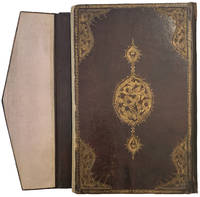
1800MEE1104Persia: undated pre-1800. 1800. 11.25 x 7.5 inches. ca. 228 leaves Written mostly in old Farsi with some Arabic marginal notes. With one leaf f. 66 illuminated on upper quadrant another 2 leaves with a penciled sketch where an illumination was planned but never completed ff. 108 170. There are numerous decorative motifs of flowers throughout the manuscript. Each leaf is variously partitioned perhaps suggestive of a garden! in this case with flowers adorning most leaves. Binding style suggests 18-19th centuries. Bound in Islamic style Ottoman period full Turkey morocco with elaborate gilt rule corner and centre ornamental flourishes with leather flap; some minor repairs to the sides of the binding are evident when examined closely. MANUSCRIPT OF SAADI' GOLESTAN THE GREAT PERSIAN POET: ORIGINAL COMPLETE MANUSCRIPT OF ONE OF THE MOST FAMOUS OF ALL PERSIAN POETS SA'ADI OF SHIRAZI. The calligraphic style and the binding are suggestive of the 16th or 17th century. This piece is embellished with numerous leaves many of which are decorated by hand with small compartments of flowers each realized from the title of Sa'adi's Gulistan Golestan Flower Garden of Sa'adi. Sa'adi is "probably the single most influential work of prose in the Persian tradition completed in 1258 by Mosarref-al-Din Mole known as Shaikh Sa'di of Shiraz." – Encyclopaedia Iranica. / The manuscript is mixed with both poetry and stories or narratives along with a moral as well as some commentaries. / PROVENANCE: Signed Kiffin Yates Rockwell 1892–1916 later label of: Kiffin Ayres Rockwell Beloit Wisconsin June 28 1942. Kiffin Yates Rockwell was a World War I fighter pilot and the first American to shoot down an enemy aircraft in WWI. He shot down a German pilot. Thus the manuscript is clearly in the United States and kept there since before 1942. "Kiffin Yates Rockwell the youngest son of James Chester and Loula Ayres Rockwell." see below. What may clear up some confusion here is that there are at least two persons with this name and there may be three. Kiffin Ayres Rockwell II or III Oct. 8 1917-Jan. 27 1998 who served in the air force in Korea is buried in Black Mountain North Carolina. Sa'adi opens with poems of Sa'eb of Tabriz a Safavid poet of Indian style of poetry added to the text. "Back of the shell kingly gems are orphans." undated [pre-1800]. hardcover
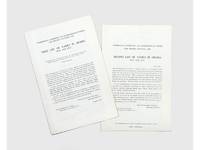
1922184807London: W. M. Clowes and Sons for the Permanent Committee on Geographical Names for British Official Use 1922-37. Arabic place names for the use of soldiers and military surveyors A collection of 8 pamphlets all but one in their first editions with lists of geographical names of the Arabian Peninsula and the Levant - including Saudi Arabia Kuwait Qatar the United Arab Emirates Oman Yemen Trans-Jordan Syria "the French Mandatory Territory" and Iraq - as well as Iran. They were produced by the Royal Geographical Society for soldiers and surveyors working with maps. The Permanent Committee on Geographical Names P. C. G. N. was a body of scholars and linguists who regularly met to discuss policies and practical issues such as the correct spellings of foreign geographical names for use in official documents and publications. In 1921 the Committee updated the RGS System of rules for spelling native names - first adopted by the War Office and later used by the Admiralty in 1885 and throughout the First World War - which led to the creation of this series of lists. Major General Edward Gleichen 1863-1937 formerly Director of the Political Intelligence Bureau was its first Chair 1920-37. The differences in vowel pronunciation among the Arabic colloquials and between colloquial and classical Arabic had generated a variety of alternative spellings for place names in the Arabic-speaking world. The introductions explain preferences for vowel renditions acknowledging the use of alternative official spellings specific to the French mandatory territory in Syria. Some place names include the Hebrew or Greek counterpart others illustrate the confusion that might arise from a lack of transliteration conventions such as "Kethrabba" instead of "Kefrabbeh" as well as incorrect spellings in general use reaching the number of seven for Dujail near Baghdad. The lists also include approximate distances from major cities. For Iran the introduction states that "Persian orthography is by no means fixed and consistent and especially is there uncertainty about the identity and length of many vowels". The lists - which span a large territory including Azerbaijan Isfahan Bushire Tehran and Khurasan - specify that "the boundaries of the provinces of Iran are for the most part indefinite". Together 8 pamphlets octavo. Text in Arabic and English. List of publications to last verso. Stitched as issued. Contents minimally toned else fresh and clean faint traces of central vertical fold: a fine collection. unknown
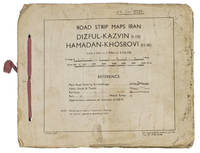
1944ABC_4794483 Rep Group. I.E." 1944. Original beige printed paper wrappers side stichted by hand through 3 holes with a reddish pink cloth ribbon. Oblong 21 x 255 cm. With 1 index map and 16 numbered folding strip maps. Exceptionally rare collection of folded strip maps of roads in Western Iran which was very likely meant for military use during the Second World War. The abbreviated inscription on the front wrapper possibly stands for "24th brigade branch transportation office" though it is unknown which 24th brigade this would have been. The maps were originally printed on quarter inch sheets in 1942 and have been significantly enlarged for this edition to a scale of 1 inch to 2 miles. We have not been able to trace any other copies of either the first or second edition of this work anywhere.With an owner's inscription on the front wrapper. The maps and back wrapper have been reinforced with bookbinder's gauze. The wrappers are somewhat soiled creased and the edges are somewhat frayed. The maps have slightly browned and the index map has a small brown stain in the lower outer corner without affecting the image. Otherwise in good condition. 83 Rep Group. I.E.", hardcover
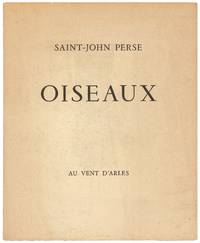
1962523703Paris: Au Vent D'Arles 1962. Softcover. Near Fine. First edition. Hors commerce issue limited to 155 copies. Quarto. 37pp. Tan printed wrappers. Covers are slightly toned with very faint foxing else a near fine unopened copy. An elusive title in this 1962 edition published by Au Vent D'Arles and issued with the text sheets only reserved for distribution hors commerce by St. John Perse Georges Braque and Janine Cremieux. OCLC locates 11 copies; six in the U.S. The Getty copy in their description states: "No etchings accompany this ed." Oiseaux was also separately published along with etchings by Georges Braque under the title L'Ordre des Oiseaux 1963.<br /> <br /> This is one of a few copies reserved for Saint-John Perse not numbered and designated in type on the colophon leaf: "Exemplaire Saint-John Perse" and Signed by St-John Perse in ink on the limitation page. This copy is also Inscribed by St.-John Perse to Lincoln Kirstein on the front flyleaf: "A Lincoln Kirstein pour qui la vie est creation. Amicalement St-John Perse Washington 1963." Kirstein started the influential little magazine Hound and Horn while still a Harvard student and cofounded the New York City Ballet with George Balanchine in 1946. His sister Mina Kirstein Curtiss fluent in French was a Smith College professor and she also translated and edited publications by French authors including Saint-John Perse with whom she had a close friendship. Au Vent D'Arles unknown
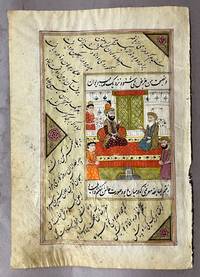
1650007147Iran 1650. No Binding. Good. Single illuminated manuscript leaf approx. 207 x 143 mm recto and verso with a finely painted Safavid miniature on the recto depicting a courtly audience scene: a ruler seated on a carpeted dais in conversation with an elder figure attended by courtiers within an architectural interior featuring tiled walls and a fountain. Executed in opaque watercolor and gold the composition and palette are characteristic of mid-Safavid manuscript painting. The text is written in an accomplished nasta'liq hand within gold-ruled borders. The verso displays an ornamental poetic layout with geometric compartments central medallion and polychrome floral cornerpieces indicating a deluxe literary manuscript likely poetic or historical in nature. Safavid Iran probably Shiraz. The calligraphy illumination and figural style correspond to Shiraz production of the mid-17th century a period noted for refined manuscript painting and decorative page design. Good overall condition. Moderate toning and wear to paper with soft creases and scattered staining. Minor rubbing to pigments and gold. Old tape remnants at the corners on verso; edges slightly worn. The miniature and calligraphy remain well preserved and visually appealing. Ships unmounted and unframed <br/> <br/> unknown
1970ABC_50132Iran 1970. The collection is housed in a plastic file folder with each photograph also separately kept in a plastic folder. Various sizes. With 10 photographs. Collection of ten beautiful press photographs of the oil industry in Abadan Iran which was home to the largest oil refinery in the world at the time these photographs were taken. They show various parts of the industry such as the oil refinery oil tankers pipelines and fire department. The photographs were take by various French and German news agencies.With the stamps of various French and German news agencies on the back of each photograph. Some of the photographs are slightly creased. Otherwise in good condition. unknown
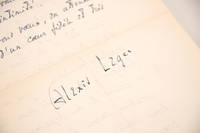
1956900001956. Fine. 18 février 1956 21.3 x 27.7 cm Une feuille Autograph letter dated and signed by Alexis Léger 26 lines in blue ink written from Washington to his friend Emily Amram describing the torments of his convalescence following a ""stupid accident"".Folds inherent to mailing.The poet thanks his friend for her floral attentions during his illness: ""combien la présence de vos fleurs m'a aidé contre les mauvaises ombres pendant mes jours de réclusion !"" and much to his regret must once again postpone the visit he had promised her: ""une mauvaise grippe washingtonnienne qui m'a surpris déjà fatigué peu après mon retour chez moi achevé de me déprimer et pour ne pas accabler encore l'affectueuse sollicitude de bons amis comme vous et Phil je n'ai su écœuré de moi-même que me condamner au silence et à la solitude.""He intends to banish his dark thoughts by granting himself a stay by the sea in the South: ""Je pars demain pour le sud et vais demander au voisinage de la mer la possibilité de me libérer par la natation; des dernières traces de mon stupide accident.""  unknown
201087401Michael Imhof Verlag. New. 2010. Hardcover. 3865684866 . FREE UPGRADE to Courier/Priority Shipping Upon Request - IN STOCK AND IMMEDIATELY AVAILABLE FOR SHIPMENT - Flawless copy brand new pristine never opened -- Text in German. 592 pages; 852 illus. -- with a bonus offer-- . Michael Imhof Verlag hardcover
26975'Published by Survey Directorate G.H.Q. Paiforce 1944. All one page 20 x 33cms some stained but texts clear and complate. 1. Index map of Iraq and Iran for a 1:100000 scale survey series produced by the British military command PAIFORCE during World War II. All 20 x 32.5cm a couple sl. stained mainly good condition.1.Four Index maps of Iraq and Iran ¼ series I.D.R./X.D.R./G.S.G.S. 9002 3919 nos. 1-42.Index map of Iraq and Iran for a 1:100000 scale survey series produced by the British military command PAIFORCE during World War II. Index Map of 'Irq rn 1:100000 Series I.D.R. 9003'.3.Four Index Maps of places/areas of IRAN:a. Ahwaz 1:10000 series 1D MISC/563 to 573 stamped 11 June 1944b. Askaran and Sanandaj N.W. 1:25000 series …9005 stamped 25 June 1944c. Gach-I-Sar 1:50000 series stamped 11 June 1944d. Khurramshahr Abandan 1:12500 series4.Six Index Maps of places/areas of IRAQ all 1:25000 series ID 9005:a. Ba'qubab. Faidahc. Haffad. Hindiyae. Falluja f. MoselNo reference to other copies yet found. 'Published by Survey Directorate, G.H.Q. Paiforce [1944] unknown
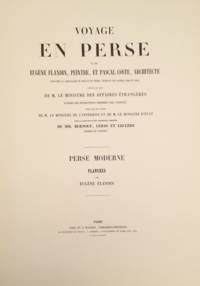
145801976. Flandin Eugène. Voyage en Perse. Perse Moderne Planches documents the architecture cities and landscapes of nineteenth century Iran through the drawings produced during a French archaeological and artistic expedition to the region in 1840. French artist Eugène Flandin traveled to Iran with architect Pascal Coste as part of a diplomatic mission supported by the Académie des Beaux Arts in Paris. During two years of travel across western and southern Iran the expedition produced extensive drawings of monuments urban centers and archaeological sites associated with the Qajar period. These images later formed the basis of Perse Moderne one of the most significant illustrated records of nineteenth century Iran produced by European artists.<br /> <br /> Flandin Eugène. Voyage en Perse. Perse Moderne Planches. London: Burness Faridany Limited 1976. Limited facsimile edition issued to commemorate the centennial of Flandin's death. Elephant folio measuring approximately 17 x 24 inches. The volume contains one hundred tinted lithographic plates reproducing the illustrations from the original nineteenth century publication. The plates depict architectural monuments and landscapes including royal mosques and palaces the city and ports of Tehran the ruins of Persepolis the tomb of Saadi and other locations recorded during Flandin's expedition.<br /> <br /> The original Perse Moderne was published in 1854 as part of a large multi volume series documenting the results of Flandin and Coste's travels through Iran. The expedition provided one of the earliest systematic visual surveys of Persian architecture and urban landscapes available to European scholars and artists. Flandin's drawings preserved detailed views of monuments and settlements during the Qajar period and have been widely cited by historians of Persian art and architecture as a major documentary source for nineteenth century Iran. The 1976 edition reproduces these images in a limited printing of six hundred copies allowing modern readers access to the visual material of a work that is otherwise difficult to obtain in its original form. One elephant folio volume with one hundred tinted lithographic plates housed in the original box. Minor handling wear to the box while the volume and plates remain well preserved. Overall condition very good. unknown
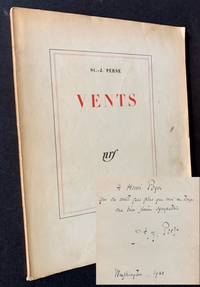
194619265Paris: Librairie Gallimard 1946. Original wraps. Very Good . WARMLY INSCRIBED BY ST.-JOHN PERSE TO PRE-EMINENT LITERARY SCHOLAR AND YALE PROFESSOR HENRI PEYRE on the front free endpaper. A solid very presentable copy to boot of the 1946 1st edition. #2236 of 2350 copies "sur papier de chataignier". Bright and VG in its off-white wrappers with very light soiling to the front panel and mild offsetting creasing and soiling at the rear panel. Very small paper cuts along the fore-edges of the preliminaries otherwise clean as could be internally with no writing or markings to speak of. Tall quarto one of the Nobel Prize winner's long poems written during his American "exile Librairie Gallimard unknown
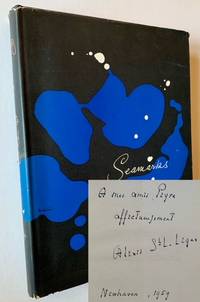
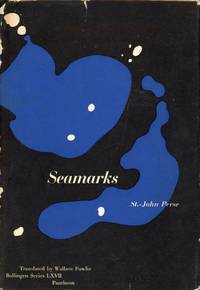
195819209New York: Pantheon Books The Bollingen Series 1958. Decorative Cloth. Near Fine/Near Fine. WARMLY INSCRIBED BY SAINT JOHN PERSE USING HIS REAL NAME "ALEXIS SAINT LEGER" TO PRE-EMINENT LITERARY SCHOLAR AND YALE PROFESSOR HENRI PEYRE on the front free endpaper. A very sharp copy to boot of the 1958 1st American edition. Clean and Near Fine just a touch of light offsetting at the front inner hinge in a crisp price-intact Near Fine dustjacket with very mild chipping along the spine ends and the top-edges. Tall quarto wonderful dustjacket design by Paul Rand. Translated from its original French by Wallace Fowlie part of the formidable Bollingen Series in this case LXVII. Pantheon Books (The Bollingen Series) unknown
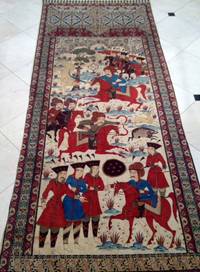
1890146641890. Hand painted Persian textile depicting Shah Abbas I nineteenth century a monumental example of Qajar period revivalist visual culture that reinterprets Safavid imperial iconography to articulate Persian kingship martial virtue and historical memory. Centered on one of the most mythologized rulers in Iranian history the composition presents a continuous figural narrative in which Shah Abbas I appears mounted on horseback in a royal hunt sword drawn as he confronts a lion while turbaned cavalry attendants bearing spears observe. A secondary vignette shows the Shah pursuing a wild boar reinforcing long standing Persian associations between sovereignty mastery over nature and military prowess. Rendered in a frontal highly legible style with flattened perspective and rhythmic repetition the imagery translates the visual language of Persian manuscript illustration into large scale textile form reflecting nineteenth century Qajar engagement with earlier Safavid models of centralized authority and dynastic legitimacy.<br /> <br /> Hand painted Persian figural textile. Qajar period nineteenth century. Approximately 117.5 x 51 inches 9.8 x 4.25 feet.<br /> <br /> The upper register introduces a martial tableau of Persian warriors confronting Indian soldiers mounted on elephants imagery that evokes enduring visual memory of imperial expansion and recalls narratives associated with Nader Shah's eighteenth century campaigns against the Mughal Empire. In the Qajar period particularly in the later nineteenth century Safavid rulers such as Shah Abbas were repeatedly invoked across painting lacquer and textile production as symbols of national continuity and restored sovereignty. This textile operates within that historicist framework layering Safavid royal imagery with later martial memory to construct a composite vision of Persian power across centuries. Minor edge tears including one approximately 1 inch and three approximately 3 inches within the border and along the edge not affecting the central figural imagery; colors remain bold and composition visually strong. Overall condition: very good. unknown
19588751New York: Pantheon 1958. Second Edition. Hardcover. Very good/Good. Octavo. 6.5 x 9.25 in. 239 pp. Translated from the original French by Wallace Fowlie. Very good in original cloth-backed paper-covered boards bright gilt titling to spine. with toning to head of text block and board edges with mild foxing and a good pictorial dust jacket with chipping to spine extremities including some loss to foot and head of spine jacket and corners as well as a few small closed tears to edges. Inscribed on the front free endpaper by Perse in French to Elizabeth "Betty" Holden co-founder of the MFA at Warren Wilson College in Swannanoa North Carolina and a poet and writer in her own right. Parallel text in original French and translated English. Bollingen Series LXVII. Perse later won the Nobel Prize for Literature in 1960. Pantheon hardcover
198865915Washington DC: U.S. Government Printing Office 1988. Presumed first edition/first printing. Wraps. Very good. No dust jacket. 3 volumes Parts. xi 340; xi 242; xi 1646 p. 23 cm. Illustrations. Iran Chronology. Title continues: "First Session July 7 8 9 and 10 1987: Testimony of Oliver L. North. Document Number 100-7. Part I Testimony of Oliver L. North Questioning by Counsels; Part II Testimony of Oliver L. North and Robert C. McFarlane Questioning by Members; Part III Appendixes to Parts I and II. Ltc North was subsequently tried for perjury. Mr. McFarlane survived a suicide attempt. U.S. Government Printing Office paperback
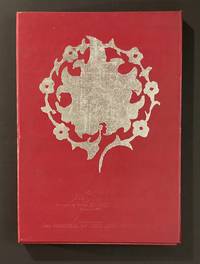
19721176<p>ShishumÄ«n jashn-i hunar ShÄ«rÄz-Takht-i JamshÄ«d 9 tÄ 17 ShahrÄ«var 1351 / N.p. Iran: N.d. 1972. Portfolio with six interior folders loose inserts within each chiefly texts in dual translation Persian-English some with calligraphy and additional minor illustrations. 4to. Very good. Red full leather folding portfolio embossed with silver foil. 1176</p><p><i>The interior folders present accompanying texts artist and performer bios and other notes for presentations by international artists and performers in attendance at the festival including Karlheinz Stockhausen Robert Wilson Merce Cunningham and Dance Company and Katakali Shanta Rao. Two additional folders present notes on "Iranian Theater Films" and "Traditional Persian Music" with individual texts and notes on Somai Group Jalil Shahnaz Hossein Tehrani Ahmad Ebadi and Hossein Qavami music ; Bijan Saffari Goldooneh Knanom Esmail Khalaj theater ; and showings by the free cinema association including works by film makers Ahmad Asudeh Hasan Bani-Hashemi Naser Taqvai and others. As of February 2021 OCLC locates only two holdings in North America.</i></p>
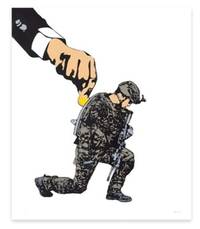
202454121xRUN 2024. First Edition. As new. 1xRUN 2024. Original hand-painted stencil on paper. Size: 19.63 in x 23.38 in. SIGNED and numbered in a Limited Edition of only 10 prints. CONDITION: Fine/As New. MAD b. 1987 is an Iranian muralist based in Istanbul. He has been painting on walls since 2008. His intricate use of unique stencils and spray paint has reached the walls and galleries in several countries including Iran United States Netherlands United Kingdom Norway Turkey and Indonesia. MAD is fascinated by the power of storytelling and mythology. His artwork blends mystery and ambiguity to create narratives that lead to different interpretations and audiences to question their surroundings. 1xRUN unknown
196239526Paris: Au Vent d'Arles 1962. FIRST EDITION of this important collection of poetic reflections on Braque's birds. 37 pp. A SPECIAL COPY PRINTED ESPECIALLY FOR SAINT-JOHN PERSE aside from the 150 numbered copies. Printed on extremely fine thick Richard de Bas laid paper. 4to. Original printed wraps. UNCUT AND UNOPENED WITH NO DEFECTS. ABSOLUTELY PRISTINE AND PERFECT AND EXTREMELY RARE AS SUCH. <br/><br/> Au Vent d'Arles paperback
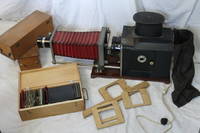
4d3800ca. 1936-1938. Maße der Fotoplatten ca. 98 cm x 84 cm Maße der Holzkästchen ca. 13 cm x 36 cm x 115 cm leicht angestaubt. - Die Reisen gingen durch den gesamten Iran und zeigen Aufnahmen vom Taurus-Gebirge; Durchstreifen des Tigris mit Packtieren; Mossul; Elburs-Gebirge; Passtale bei Teheran; Besteigung des Totschal in 3960 m Höhe; Alburs; Isfakan und Teheran Straßenzüge; Gebäude; Moscheen; Völkerbilder; Auto-Reisekarawane; Tunnelbau Transiranische Eisenbahn; Ktesinhon; Rutba; Bergpässe; Schiffsreise; zwei Karten vom Iran / Zum Belichten der Bilder ein ICA Laterna Magica Projektor Laterne XXL um 1925 mit ausziehbarem Balg Glühbirne von Osram Nitra Objektiv Verdunklungstuch sowie 4 Bildhaltern aus Holz inklusive Holz-Transportkiste Gesamtmaß des Projektors: ca. 20 cm x 78 cm x 405 cm - unknown
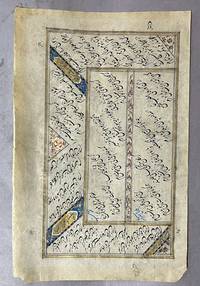
16500071451650. No Binding. Good. Single manuscript leaf size approx. 217 x 133 mm in Persian written on both recto and verso in elegant black nasta'liq script on buff paper. The text is arranged in ruled panels with a central vertical floral divider and enlivened by diagonal gilt cartouches and triangular cornerpieces illumintated in gold deep blue and polychrome floral decoration. The text is composed in refined Persian literary prose with rhythmic cadence consistent with ethical and didactic writing in the tradition of Sa'di of Shiraz and is very likely drawn from the Golestan or a closely related classical prose work. The confident calligraphy and balanced design are characteristic of Safavid-period book production intended for cultivated private readership. The illuminated cartouches with reserved script together with the delicate floral ornamentation reflect a mature Safavid aesthetic while later marginal or interlinear annotations in blue attest to continued reading and use. Condition is consistent with age and use. The paper shows overall toning and surface wear with areas of rubbing and discoloration including a noticeable rubbed patch affecting text on one side. Minor losses at lower corners and abrasions. Gold and pigments remain largely intact and visually effective. The calligraphy throughout remains clear and legible. Preserved as a single detached leaf. Ships unmounted and unframed <br/> <br/> unknown
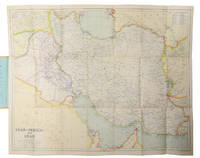
1930L6CC0NQYKB25London: George Philip & sons 1930. Colour printed map 54 x 68 cm with yellow covers 19.5 x 11 cm. Map of Iran Iraq and parts of the surrounding countries including modern Kuwait Bahrain Qatar and the UAE in the 1930s published in the series "Philips' authentic imperial maps for tourists & travellers". Published in the early years of the discovery of oil in the Middle East the map shows roads and railways but also caravan routes submarine cables and oil pipelines.Slightly soiled in very good condition. George Philip & sons, unknown
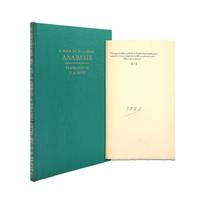
1930324915London: Faber 1930. First edition. One of 350 copies signed by T. S.Eliot. 75 pp. 1 vols. Tall 8vo. Green cloth titled in gilt t.e.g. Fine copy light paste action to endpapers in edgeworn publisher's slipcase. First edition. One of 350 copies signed by T. S.Eliot. 75 pp. 1 vols. Tall 8vo. T. S. Eliot won the 1948 Nobel Prize in Literature. Gallup A16b Faber unknown
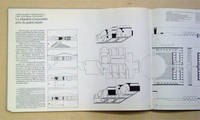
80424o. Angaben Organisation nationale pour la conservation des monuments historiques en Iran 1977. Quer-4° 30.5 x 42 cm 130 S. zahlr. Abb. Pläne Kart. Einband etw. unsauber u. gebrauchsspurig Bibliotheksschild am Fuss Fuss min. läd. Stempel a. Schmutztitel Papier min. gebräunt innen sonst tadellos. EA. Enth.: Résumé et conclusions; Aspects historiques et archéologiques; Concept de restairation; Aspects techniques. 010 o. Angaben, [Organisation nationale pour la conservation des monuments historiques en Iran], 1977 unknown