Mittelsten Scheid, JörgAntiquariat.de

768 résultats
201330375Berlin : Nicolai 2013. 135 S. : Ill. ; 22 cm Top Zustand, Pp., gebundene Ausgabe, ++ Stempel Presseexemplar ++ Hardcover/Pappeinband, Neupreis in Euro: 22,95, sonst Exemplar in sehr gutem Erhaltungszustand
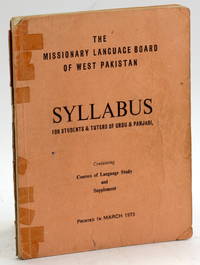
19735463John W. Wilder / Maktaba Jadeed Press 1973. Paperback. None Provided. Biderectional text 51 pp in English 8 pp. in Urdu. 12mo stapled binding in peach wraps. Quite worn and handsoiled wrappers loose and detached annotated in pen and pencil. Exceedingly scarce. Unrecorded in OCLC. John W. Wilder / Maktaba Jadeed Press paperback
2007307272007 Paris, Buchet-Chastel,2007, In huit, 478 pp, couverture blanche, souple,
1977057004Quetta (Pakistan)., Goshe-E-Adap., 1977. Second edition. X, 387 Seiten mit wenigen Abbildungen, Tabellen und Karten. Englischsprachige Ausgabe. Zustand: Der Schutzumschlag ist aufgehellt (lichtrandig) und hat kleine Einrisse. Buchhandelsstempel auf Vorsatz. 8°. OPappband mit OUmschlag.
19641102240113Government of Pakistan 1964. Map. Very Good. 92x104 cm. Full color. Detailed historical map of Pakistan including geography local provinces and available natural resources. Cloth-backed. Unmarked in fine condition. Government of Pakistan unknown
PLEASE NOTE: THIS IS AN INCOMPLETE COPY. EZRA POUND ARTICLE AND MANY OTHER PAGES HAVE BEEN REMOVED AND ARE NOT INCLUDED. WE OFFER THIS COPY PRIMARILY FOR ITS RARE COVER. Features: Great cover photo of controversial expatriate poet Ezra Pound; A Lament for Pakistan, by James Michener; The Heroin Babies - Going Cold Turkey at Birth; Wild purple color-photo fashion ad for Pam Bee; Chinese fashion photos; Lovely color-photo fashion ads; Photos of Vermont home designed by Hobart Betts; and more. Somewhat above-average wear. Some pages loose and, we repeat, many pages are missing. Book
Broch?. 80 pages. Couverture factice. 23 x 31 cm.
19801627München : BLV, 1980. EA. zahlr. meist fb. Abb, 176 S., 4°, OLin. m. SchU.,
198098151Berg der Berge. München, BLV, 1980. Kl.-4to. Mit zahlreichen, teils farbigen fotografischen Abbildungen. 174 S., 1 Bl. Or.-Pp. mit Schutzumschlag; tlw. verblasst bzw. etw. gebräunt. [4 Warenabbildungen]
2008142964König der Berge. Schicksalsberg Nanga Parbat. München, Frederking & Thaler / Geo, 2008. 4to. Mit zahlreichen farbigen fotografischen Abbildungen u. Karten auf den Vorsätzen. 292 S. Or.-Pp. mit Schutzumschlag.
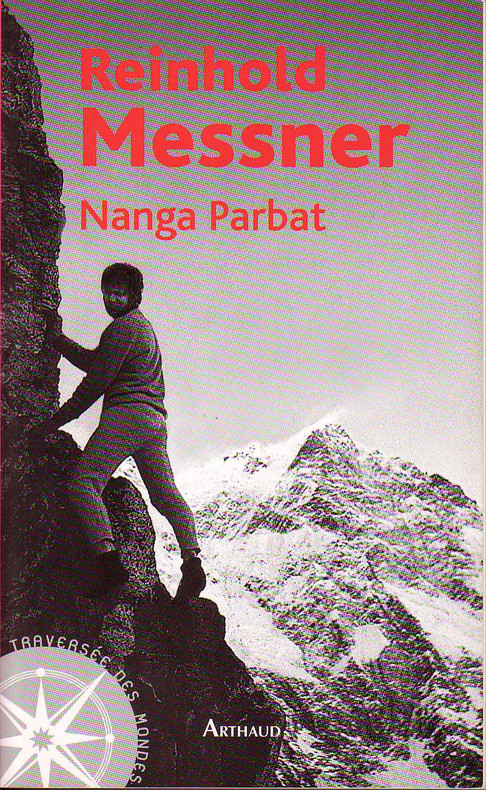
2010MONTAGNEEE55551116Grenoble, Artaud, 2010, 13,5 x 22, 306-XVI pages sous couverture illustrée. Avec XVI pages d'illustrations noir & blanc. Traduit de l'allemand par Claire Boulard.
200895271FBWeinheim:, Wiley-Vch, 2008. 308 (2) Seiten, farbig illustrierte Vorsätze, roter OPpbd. mit weißem Rückenschildchen, illustrierter OU., 21 x 15 cm.
Seuil 1954, In-8 broché, 521 pages. Bon état.
Broch?. 525 pages. Cachets.
Broché. 525 pages.
ML238Seuil 1954 , in8br, 621pp Indonésie, Birmanie , Pakistan Langue: Français
1954173864Seuil Seuil, 1954. In-8 broché de 521 pages. Bon état.
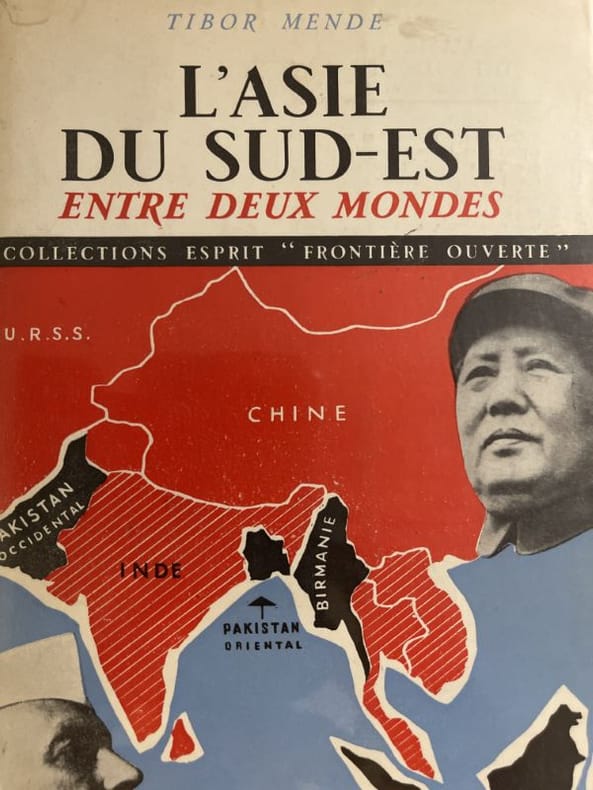
19548825Seuil, 1954, in-8°, 525 pp, traduit de l'anglais, 8 pl. de photos hors texte, cartes, broché, bon état (Coll. Esprit "frontière ouverte")
1978119278Entwicklungspolitische Bedeutung eines Massenmediums. Bochum, Studienverlag Brockmeyer, 1978. 2 Bl., 260 S., 2 Bl. Or.-Kart.; Rücken etw. gebräunt, Vorderdeckel mit Fleck. (Bochumer Studien zur Publizistik- u. Kommunikationswissenschaft, 19).
No marks or inscriptions to contents. A very clean very tight copy with bright unmarked boards, very faint small stain to lower page edges, no effect on pages and no bumping to corners. Dust jacket not price clipped or marked or torn or creased with minor traces of storage. 262pp. The story of the transfer of power fromn the Raj to India and Pakistan in 1945-47 and the vital and exciting part played in this by events on the North-West Frontier.
196020042[Düsseldorf] : Dt. Bücherbund, [1960]. 424 S. : 1 Faltkt. hinten im Buch. 8°. [Lizenzausg.]. OLwd ohne SU.
Very Good Turkish, Ottoman (1500-1928) Original wrappers. No bdg. Wear spine, dispersed pages. Roy. 8vo. (24 x 17 cm). In Ottoman script (Old Turkish with Arabic letters). 197, 6 p., 5 panoramic folded huge b/w plates (Including the photographic plts.; 1-) Turkish Convention May, 13, 1923, Detroit, Mich by Photo Craft Byallen -23x39 cm-; 2-) [Among the Young Turks in Detroit, -23x106 cm-; 3-) In the White House with the President, -23x106 cm-; 4-) Islamic Society in the US, -32x40 cm-; 5-) Among the Young Turkish people in Chicago, -23x26 cm-). First and only edition of this exceedingly rare travel account of America by Dr. Mehmed Fuad [Umay], (1885-1963), who was a Turkish doctor and the founder of Himâye-i Etfâl [i.e. Society for the Protection of Orphans], a society that was established in 1921 to provide orphanages to children of the deceased soldiers in the Turkish War of Independence; began visiting many of the Turkish colonies in the US, giving lectures and raising a considerable amount of money for the establishment of these orphanages in Turkey. On 21 March 1923, Fuad Bey was granted permission from the Grand National Assembly of Turkey to go to the US in order to raise funds among the Ottoman immigrants for immediate war relief. Thus, for the first time, humanitarian action became an organized effort by fostering diaspora mobilization. Fuad Bey arrived in Ellis Island on 6 April 1923 on a ship named SS Aquitania and headed to the Ottoman Welfare Association at 35 Rivington Street. In the first meeting held by the Ottoman Welfare Association for the benefit of Turkish Orphan Society, Fuad Bey notes that a total of USD 17,500 was raised in just six hours. To those who donated over USD 1,000, a personally autographed picture of Mustafa Kemal was given by Fuad Bey. He visited the Turkish colonies in Wisconsin, Illinois, Michigan, New York, New Jersey, Massachusetts and Rhode Island. He lectured about the Turkish War of Independence (1919-1922) and the success of the struggle, and many Turkish and Kurdish workers residing in these cities donated their life savings to support the construction of orphanages and the reconstruction of the entire country. Fuad's visit to Peabody, Massachusetts aroused exceptional excitement among the Turkish and Kurdish immigrants. It was the first chance for the Muslim Anatolian immigrants to manifest their national pride and attachment to the homeland. At the same time, their socioeconomic achievement was evidenced with the arrival of Fuad Bey in Peabody in an auto decorated with a large American flag and followed by a dozen autos filled with Turks, the machines decorated with American and Turkish flags.". A day before his arrival, the Turks refrained from work and "went around with badges in honor of his coming. Mehmed Fuad noted that there were around 600 Turks when he visited Peabody in 1923. Despite their small number, they had established Kizilay [i.e. Turkish Red Crescent] society. After being shown some of the tanneries in Peabody and Salem, Fuad gave an address to the Turks and Kurds at the Peabody Institute. The scene was described as: "All the Turks in town were present. They made a spectacle of the doctor's visit, many of them taking a day off. They wore badges in his honor and displayed in front of the Institute the American and Turkish flags. Great enthusiasm was shown. Baskets of roses were carried down the aisles and the flowers were bought at any price, bunches of money being put in the baskets. It was said that USD 8,000 was raised among the Turks of this city for Dr. Fuad Bey to take back with him.". Fuad Bey visited Peabody for a second time on 14 August 1925, as he came for the National Conference of Social Workers held in Denver, Colorado in June, 1925. When he arrived in Massachusetts, he was met by a delegation of Turkish people from [.]". (Source: Ottoman Immigrants and the Formation of Turkish Red Crescent Societies in the United States). No printed copy in OCLC.; Özege 727.; TBTK 11126.
1979105336Erlangen 1979. 196 S. mit 3 Figuren, 12 Bildern und 10 in Tasche beilieg. mehrfach gefalteten Karten, Groß 8°, Original-Karton (Softcover), Name auf Vorsatz, gutes Exemplar,
Very Good Urdu Paperback. Cr. 8vo. (18 x 13 cm). In Urdu. 12 p. Lithographed edition. Ali was an Indian Muslim leader of the Khilafat Movement that erupted in response to the fall of the Ottoman Empire. He was the elder brother of the renowned political leader Mohammad Ali Jouhar. Shaukat Ali was born in 1873 in Rampur state in what is today Uttar Pradesh in India but later played role in partition of India on religious lines. He was educated at the Aligarh Muslim University. He was extremely fond of playing cricket, captaining the university team. Shaukat Ali helped his younger brother Mohammad Ali Jouhar publish the Urdu weekly Hamdard and the English weekly Comrade. In 1915 he published an article which said Turks were right to fight the British. These two weekly magazines played a key role in shaping the political policy of Muslim India back then. In 1919, while jailed for publishing what the British charged as seditious materials and organizing protests, he was elected as the last president of the Khilafat conference. He was re-arrested and imprisoned from 1921 to 1923 for his support to Mahatma Gandhi and the Indian National Congress during the Non-Cooperation Movement (1919-1922). His fans accorded him and his brother the title of Maulana. In March 1922, he was in Rajkot jail and was later released in 1923. While still a supporter of Congress and its non-violent ethos, Ali even surpassed some of his colleagues in also providing support to the revolutionary independence movement. To this end, he supplied guns to Sachindranath Sanyal. He opposed the 1928 Nehru Report. Instead, he demanded separate electorates for Muslims and finally the Khilafat Committee rejected the Nehru Report. Shaukat Ali attended the first and second Round Table Conferences (India) in London in 1930-31. His brother Jouhar died in 1931, and Shaukat Ali continued on and organized the World Muslim Conference in Jerusalem. In 1936, Ali became a member of the All India Muslim League and became a close political ally of and campaigner for Muhammad Ali Jinnah, the future founder of Pakistan. He served as member of the 'Central Assembly' in British India from 1934 to 1938. He travelled all over the Middle East, building support for India's Muslims and the struggle for independence from the British rule in India. (Source: Wikipedia).
8vo., First Edition thus, some mild offsetting from fold-ins to free endpapers; red cloth, backstrip lettered in white, red top (lightly spotted and faded), a very good, bright, clean copy in unclipped dustwrapper. With dustwrapper artwork by Peter Rudland. Published simultaneously with the first edition. The basis of George Cukor's feature film (1956) starring Ava Gardner and Stewart Granger.