1 640 résultats
Original single-sheet steel engraving of a very fine quality. Overall size ca. 215 x 270 mm. Image size ca. 130 x 190 mm. A two-line caption engraved at bottom in elegant handtooled open-face and italic types. Engraved Artist's and Engraver's signatures underneath image. Engraved Publisher's line below. The print is in its original state, trimmed and gilded on three sides. It is printed with warmer ink, somewhat more dramatic in mood, with fine, crisp detail, subtlety and elegance. In overall fine condition. Preserved in pH-balanced, acid-free Renaissance archival paper. ~ A delicately executed steel engraving, representing a major illustrative work on 19th century Palestine, Syria, and Asia Minor. William Henry Bartlett (born London, 1809) was one of the foremost illustrators of topography of his generation. He travelled extensively throughout Britain, the Americas, and the Middle East, producing his work on location. In 1854 he made his last trip to the Holy Land; he died of fever on board a French ship on his return voyage to England. Bartlett's primary concern was to extract the picturesque aspects of a place and render "lively impressions of actual sights", as he wrote in the preface to "The Nile Boat" (London, 1849). His work became widely known through the numerous engravings after the original drawings and paintings he made. The interest in these engravings today is as much for the exquisite quality of the rendering and presentation of the architecture of the period, as it is for the representation of the landscape. Published in 1836 by Peter Jackson, Late Fisher, Son & Co. of London, it was originally accompanied by descriptions written by John Carne.
Original single-sheet steel engraving of a very fine quality. Overall size ca. 215 x 270 mm. Image size ca. 130 x 190 mm. A two-line caption engraved at bottom in elegant handtooled open-face and italic types. Engraved Artist's and Engraver's signatures underneath image. Engraved Publisher's line below. The print is in its original state, trimmed and gilded on three sides. It is printed with warmer ink, somewhat more dramatic in mood, with fine, crisp detail, subtlety and elegance. In overall fine condition. (Some marginal spotting.) Preserved in pH-balanced, acid-free Renaissance archival paper. ~ A delicately executed steel engraving, representing a major illustrative work on 19th century Palestine, Syria, and Asia Minor. William Henry Bartlett (born London, 1809) was one of the foremost illustrators of topography of his generation. He travelled extensively throughout Britain, the Americas, and the Middle East, producing his work on location. In 1854 he made his last trip to the Holy Land; he died of fever on board a French ship on his return voyage to England. Bartlett's primary concern was to extract the picturesque aspects of a place and render "lively impressions of actual sights", as he wrote in the preface to "The Nile Boat" (London, 1849). His work became widely known through the numerous engravings after the original drawings and paintings he made. The interest in these engravings today is as much for the exquisite quality of the rendering and presentation of the architecture of the period, as it is for the representation of the landscape. Published in 1836 by Peter Jackson, Late Fisher, Son & Co. of London, it was originally accompanied by descriptions written by John Carne.
Original single-sheet steel engraving of a very fine quality. Overall size ca. 215 x 270 mm. Image size ca. 130 x 190 mm. A two-line caption engraved at bottom in elegant handtooled open-face and italic types. Engraved Artist's and Engraver's signatures underneath image. Engraved Publisher's line below. The print is in its original state, trimmed and gilded on three sides. It is printed with warmer ink, somewhat more dramatic in mood, with fine, crisp detail, subtlety and elegance. In overall fine condition. (Some spotting.) Preserved in pH-balanced, acid-free Renaissance archival paper. ~ A delicately executed steel engraving, representing a major illustrative work on 19th century Palestine, Syria, and Asia Minor. William Henry Bartlett (born London, 1809) was one of the foremost illustrators of topography of his generation. He travelled extensively throughout Britain, the Americas, and the Middle East, producing his work on location. In 1854 he made his last trip to the Holy Land; he died of fever on board a French ship on his return voyage to England. Bartlett's primary concern was to extract the picturesque aspects of a place and render "lively impressions of actual sights", as he wrote in the preface to "The Nile Boat" (London, 1849). His work became widely known through the numerous engravings after the original drawings and paintings he made. The interest in these engravings today is as much for the exquisite quality of the rendering and presentation of the architecture of the period, as it is for the representation of the landscape. Published in 1836 by Peter Jackson, Late Fisher, Son & Co. of London, it was originally accompanied by descriptions written by John Carne.
Original single-sheet steel engraving of a very fine quality. Overall size ca. 215 x 270 mm. Image size ca. 130 x 190 mm. A two-line caption engraved at bottom in elegant handtooled open-face and italic types. Engraved Artist's and Engraver's signatures underneath image. Engraved Publisher's line below. The print is in its original state, trimmed and gilded on three sides. It is printed with warmer ink, somewhat more dramatic in mood, with fine, crisp detail, subtlety and elegance. In overall fine condition. (Few marginal spots, not affecting image.) Preserved in pH-balanced, acid-free Renaissance archival paper. ~ A delicately executed steel engraving, representing a major illustrative work on 19th century Palestine, Syria, and Asia Minor. William Henry Bartlett (born London, 1809) was one of the foremost illustrators of topography of his generation. He travelled extensively throughout Britain, the Americas, and the Middle East, producing his work on location. In 1854 he made his last trip to the Holy Land; he died of fever on board a French ship on his return voyage to England. Bartlett's primary concern was to extract the picturesque aspects of a place and render "lively impressions of actual sights", as he wrote in the preface to "The Nile Boat" (London, 1849). His work became widely known through the numerous engravings after the original drawings and paintings he made. The interest in these engravings today is as much for the exquisite quality of the rendering and presentation of the architecture of the period, as it is for the representation of the landscape. Published in 1836 by Peter Jackson, Late Fisher, Son & Co. of London, it was originally accompanied by descriptions written by John Carne.
Original single-sheet steel engraving of a very fine quality. Overall size ca. 215 x 270 mm. Image size ca. 130 x 190 mm. A two-line caption engraved at bottom in elegant handtooled open-face and italic types. Engraved Artist's and Engraver's signatures underneath image. Engraved Publisher's line below. The print is in its original state, trimmed and gilded on three sides. It is printed with warmer ink, somewhat more dramatic in mood, with fine, crisp detail, subtlety and elegance. In overall fine condition. Preserved in pH-balanced, acid-free Renaissance archival paper. ~ A delicately executed steel engraving, representing a major illustrative work on 19th century Palestine, Syria, and Asia Minor. William Henry Bartlett (born London, 1809) was one of the foremost illustrators of topography of his generation. He travelled extensively throughout Britain, the Americas, and the Middle East, producing his work on location. In 1854 he made his last trip to the Holy Land; he died of fever on board a French ship on his return voyage to England. Bartlett's primary concern was to extract the picturesque aspects of a place and render "lively impressions of actual sights", as he wrote in the preface to "The Nile Boat" (London, 1849). His work became widely known through the numerous engravings after the original drawings and paintings he made. The interest in these engravings today is as much for the exquisite quality of the rendering and presentation of the architecture of the period, as it is for the representation of the landscape. Published in 1836 by Peter Jackson, Late Fisher, Son & Co. of London, it was originally accompanied by descriptions written by John Carne.
Original single-sheet steel engraving of a very fine quality. Overall size ca. 215 x 270 mm. Image size ca. 130 x 190 mm. A two-line caption engraved at bottom in elegant handtooled open-face and italic types. Engraved Artist's and Engraver's signatures underneath image. Engraved Publisher's line below. The print is in its original state, trimmed and gilded on three sides. It is printed with warmer ink, somewhat more dramatic in mood, with fine, crisp detail, subtlety and elegance. In overall fine condition. (Light spot or two.) Preserved in pH-balanced, acid-free Renaissance archival paper. ~ A delicately executed steel engraving, representing a major illustrative work on 19th century Palestine, Syria, and Asia Minor. William Henry Bartlett (born London, 1809) was one of the foremost illustrators of topography of his generation. He travelled extensively throughout Britain, the Americas, and the Middle East, producing his work on location. In 1854 he made his last trip to the Holy Land; he died of fever on board a French ship on his return voyage to England. Bartlett's primary concern was to extract the picturesque aspects of a place and render "lively impressions of actual sights", as he wrote in the preface to "The Nile Boat" (London, 1849). His work became widely known through the numerous engravings after the original drawings and paintings he made. The interest in these engravings today is as much for the exquisite quality of the rendering and presentation of the architecture of the period, as it is for the representation of the landscape. Published in 1836 by Peter Jackson, Late Fisher, Son & Co. of London, it was originally accompanied by descriptions written by John Carne.
Original single-sheet steel engraving of a very fine quality. Overall size ca. 215 x 270 mm. Image size ca. 130 x 190 mm. A three-line caption engraved at bottom in elegant handtooled open-face and italic types. Engraved Artist's and Engraver's signatures underneath image. Engraved Publisher's line below. The print is in its original state, trimmed and gilded on three sides. It is printed with warmer ink, somewhat more dramatic in mood, with fine, crisp detail, subtlety and elegance. In overall fine condition. Preserved in pH-balanced, acid-free Renaissance archival paper. ~ A delicately executed steel engraving, representing a major illustrative work on 19th century Palestine, Syria, and Asia Minor. William Henry Bartlett (born London, 1809) was one of the foremost illustrators of topography of his generation. He travelled extensively throughout Britain, the Americas, and the Middle East, producing his work on location. In 1854 he made his last trip to the Holy Land; he died of fever on board a French ship on his return voyage to England. Bartlett's primary concern was to extract the picturesque aspects of a place and render "lively impressions of actual sights", as he wrote in the preface to "The Nile Boat" (London, 1849). His work became widely known through the numerous engravings after the original drawings and paintings he made. The interest in these engravings today is as much for the exquisite quality of the rendering and presentation of the architecture of the period, as it is for the representation of the landscape. Published in 1836 by Peter Jackson, Late Fisher, Son & Co. of London, it was originally accompanied by descriptions written by John Carne.
Original single-sheet steel engraving of a very fine quality. Overall size ca. 215 x 270 mm. Image size ca. 130 x 190 mm. A three-line caption engraved at bottom in elegant handtooled open-face and italic types. Engraved Artist's and Engraver's signatures underneath image. Engraved Publisher's line below. The print is in its original state, trimmed and gilded on three sides. It is printed with warmer ink, somewhat more dramatic in mood, with fine, crisp detail, subtlety and elegance. In overall fine condition. (A spot.) Preserved in pH-balanced, acid-free Renaissance archival paper. ~ A delicately executed steel engraving, representing a major illustrative work on 19th century Palestine, Syria, and Asia Minor. William Henry Bartlett (born London, 1809) was one of the foremost illustrators of topography of his generation. He travelled extensively throughout Britain, the Americas, and the Middle East, producing his work on location. In 1854 he made his last trip to the Holy Land; he died of fever on board a French ship on his return voyage to England. Bartlett's primary concern was to extract the picturesque aspects of a place and render "lively impressions of actual sights", as he wrote in the preface to "The Nile Boat" (London, 1849). His work became widely known through the numerous engravings after the original drawings and paintings he made. The interest in these engravings today is as much for the exquisite quality of the rendering and presentation of the architecture of the period, as it is for the representation of the landscape. Published in 1836 by Peter Jackson, Late Fisher, Son & Co. of London, it was originally accompanied by descriptions written by John Carne.
Original single-sheet steel engraving of a very fine quality. Overall size ca. 215 x 270 mm. Image size ca. 130 x 190 mm. A two-line caption engraved at bottom in elegant handtooled open-face and italic types. Engraved Artist's and Engraver's signatures underneath image. Engraved Publisher's line below. The print is in its original state, trimmed and gilded on three sides. It is printed with warmer ink, somewhat more dramatic in mood, with fine, crisp detail, subtlety and elegance. In overall fine condition. Preserved in pH-balanced, acid-free Renaissance archival paper. ~ A delicately executed steel engraving, representing a major illustrative work on 19th century Palestine, Syria, and Asia Minor. William Henry Bartlett (born London, 1809) was one of the foremost illustrators of topography of his generation. He travelled extensively throughout Britain, the Americas, and the Middle East, producing his work on location. In 1854 he made his last trip to the Holy Land; he died of fever on board a French ship on his return voyage to England. Bartlett's primary concern was to extract the picturesque aspects of a place and render "lively impressions of actual sights", as he wrote in the preface to "The Nile Boat" (London, 1849). His work became widely known through the numerous engravings after the original drawings and paintings he made. The interest in these engravings today is as much for the exquisite quality of the rendering and presentation of the architecture of the period, as it is for the representation of the landscape. Published in 1836 by Peter Jackson, Late Fisher, Son & Co. of London, it was originally accompanied by descriptions written by John Carne.
Original single-sheet steel engraving of a very fine quality. Overall size ca. 215 x 270 mm. Image size ca. 130 x 190 mm. A two-line caption engraved at bottom in elegant handtooled open-face and italic types. Engraved Artist's and Engraver's signatures underneath image. Engraved Publisher's line below. The print is in its original state, trimmed and gilded on three sides. It is printed with warmer ink, somewhat more dramatic in mood, with fine, crisp detail, subtlety and elegance. In overall fine condition. (Few marginal spots.) Preserved in pH-balanced, acid-free Renaissance archival paper. ~ A delicately executed steel engraving, representing a major illustrative work on 19th century Palestine, Syria, and Asia Minor. William Henry Bartlett (born London, 1809) was one of the foremost illustrators of topography of his generation. He travelled extensively throughout Britain, the Americas, and the Middle East, producing his work on location. In 1854 he made his last trip to the Holy Land; he died of fever on board a French ship on his return voyage to England. Bartlett's primary concern was to extract the picturesque aspects of a place and render "lively impressions of actual sights", as he wrote in the preface to "The Nile Boat" (London, 1849). His work became widely known through the numerous engravings after the original drawings and paintings he made. The interest in these engravings today is as much for the exquisite quality of the rendering and presentation of the architecture of the period, as it is for the representation of the landscape. Published in 1836 by Peter Jackson, Late Fisher, Son & Co. of London, it was originally accompanied by descriptions written by John Carne.
Original single-sheet steel engraving of a very fine quality. Overall size ca. 215 x 270 mm. Image size ca. 130 x 190 mm. A two-line caption engraved at bottom in elegant handtooled open-face and italic types. Engraved Artist's and Engraver's signatures underneath image. Engraved Publisher's line below. The print is in its original state, trimmed and gilded on three sides. It is printed with warmer ink, somewhat more dramatic in mood, with fine, crisp detail, subtlety and elegance. In overall fine condition. Preserved in pH-balanced, acid-free Renaissance archival paper. ~ A delicately executed steel engraving, representing a major illustrative work on 19th century Palestine, Syria, and Asia Minor. William Henry Bartlett (born London, 1809) was one of the foremost illustrators of topography of his generation. He travelled extensively throughout Britain, the Americas, and the Middle East, producing his work on location. In 1854 he made his last trip to the Holy Land; he died of fever on board a French ship on his return voyage to England. Bartlett's primary concern was to extract the picturesque aspects of a place and render "lively impressions of actual sights", as he wrote in the preface to "The Nile Boat" (London, 1849). His work became widely known through the numerous engravings after the original drawings and paintings he made. The interest in these engravings today is as much for the exquisite quality of the rendering and presentation of the architecture of the period, as it is for the representation of the landscape. Published in 1836 by Peter Jackson, Late Fisher, Son & Co. of London, it was originally accompanied by descriptions written by John Carne.
Original single-sheet steel engraving of a very fine quality. Overall size ca. 215 x 270 mm. Image size ca. 130 x 190 mm. A two-line caption engraved at bottom in elegant handtooled open-face and italic types. Engraved Artist's and Engraver's signatures underneath image. Engraved Publisher's line below. The print is in its original state, trimmed and gilded on three sides. It is printed with warmer ink, somewhat more dramatic in mood, with fine, crisp detail, subtlety and elegance. In overall fine condition. (A light spot.) Preserved in pH-balanced, acid-free Renaissance archival paper. ~ A delicately executed steel engraving, representing a major illustrative work on 19th century Palestine, Syria, and Asia Minor. William Henry Bartlett (born London, 1809) was one of the foremost illustrators of topography of his generation. He travelled extensively throughout Britain, the Americas, and the Middle East, producing his work on location. In 1854 he made his last trip to the Holy Land; he died of fever on board a French ship on his return voyage to England. Bartlett's primary concern was to extract the picturesque aspects of a place and render "lively impressions of actual sights", as he wrote in the preface to "The Nile Boat" (London, 1849). His work became widely known through the numerous engravings after the original drawings and paintings he made. The interest in these engravings today is as much for the exquisite quality of the rendering and presentation of the architecture of the period, as it is for the representation of the landscape. Published in 1836 by Peter Jackson, Late Fisher, Son & Co. of London, it was originally accompanied by descriptions written by John Carne.
Original single-sheet steel engraving of a very fine quality. Overall size ca. 215 x 270 mm. Image size ca. 130 x 190 mm. A two-line caption engraved at bottom in elegant handtooled open-face and italic types. Engraved Artist's and Engraver's signatures underneath image. Engraved Publisher's line below. The print is in its original state, trimmed and gilded on three sides. It is printed with warmer ink, somewhat more dramatic in mood, with fine, crisp detail, subtlety and elegance. In overall fine condition. (Few marginal spots.) Preserved in pH-balanced, acid-free Renaissance archival paper. ~ A delicately executed steel engraving, representing a major illustrative work on 19th century Palestine, Syria, and Asia Minor. William Henry Bartlett (born London, 1809) was one of the foremost illustrators of topography of his generation. He travelled extensively throughout Britain, the Americas, and the Middle East, producing his work on location. In 1854 he made his last trip to the Holy Land; he died of fever on board a French ship on his return voyage to England. Bartlett's primary concern was to extract the picturesque aspects of a place and render "lively impressions of actual sights", as he wrote in the preface to "The Nile Boat" (London, 1849). His work became widely known through the numerous engravings after the original drawings and paintings he made. The interest in these engravings today is as much for the exquisite quality of the rendering and presentation of the architecture of the period, as it is for the representation of the landscape. Published in 1836 by Peter Jackson, Late Fisher, Son & Co. of London, it was originally accompanied by descriptions written by John Carne.
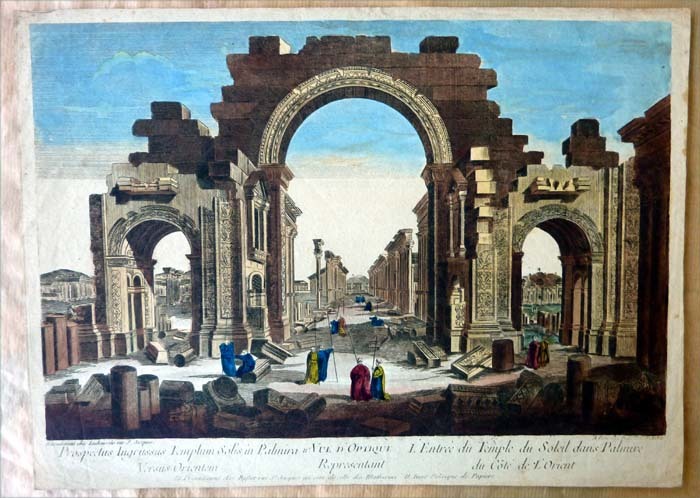
13576paris Basset; rue Saint Jacques vers 1750 1 Une vue d'optique de dimensions 38,5x28 cm; coloriée à la main. Grandes marges.
GF216291 page in8 - en tête de la Chambre des députés - (2 trous de classeurs) -
Une vue d'optique de dimensions 38,5x28 cm; coloriée à la main. Grandes marges. Quelques rousseurs. Mais bel état pour ce monumenten péril. Voir photo.
14900Lille, Paris, Bruges . Société Saint-Augustin, Desclée, De Brouwer et Cie Grand In-8 Ecu 237 pp, 60 gravures en noir in et hors-texte. Intérieur très correct ; toutes tranches dorées, cartonnage décoré en couleurs et dorures, frotté. Multiples coupures au dos, manques en tête et queue ; dos réparé pour le texte. En l'état.
1930X99930Halle/Saale, Max Niemeyer Verlag 1930 viii + 79pp., original 1930-edition, 30cm., softcover (spine bit repaired at upper end, well protected by an extra cover in transparent cristal paper), text and interior in very good condition, X99930
1979af75Le jardin de Flore Coups de coeur d'Alexandra, Sélection Abraxas-libris Planches sous chemise 1979 "In-plano (58 x 77,5 cm.), 14 planches couleurs sous chemise cartonnée en toile bleue-grise, accompagnées de cahiers de description sous emboîtage cartonné noir in-4 (22,5 x 33,5 cm.) / de la page 256 à la page 318, ""cet ouvrage est le 17e publié par Le Jardin de Flore (une tentative ambitieuse pour repenser et renouveler l'édition de livres rares et précieux). Consacré aux oiseaux du Nil et de la Syrie, ce recueil de gravures faisait partie de la monumentale ""Description de l'Égypte"" née de l'expédition napoléonienne dans ce pays. C'est Daniel Jacomet, imprimeur d'art à Montrouge qui a reproduit les 14 planches de cette suite et procédé, entièrement à la main, à la mise en couleurs des oiseaux. Ceux-ci au nombre de 44, sont représentés grandeur nature. L'ensemble à été tiré à 250 exemplaires numérotés sur un papier Chiffon du Moulin du Gué. Le texte a été tiré par Francis Mérat, imprimeur à Paris"" (exemplaire n°91), mise en couleurs avec l'aide de Jean-Marie Le Danois ; cahiers de description en très bon état / menus incidents à la chemise, chemise et planches: coiffes et coins frottés, quelques traces aux plats un peu piqués, quelques rousseurs au 1er contreplat, planches en excellent état, superbes couleurs, très bel état. Livraison a domicile (La Poste) ou en Mondial Relay sur simple demande."
viii + 79pp., original 1930-edition, 30cm., softcover (spine bit damaged and repaired at upper end), text and interior in very good condition, X99930
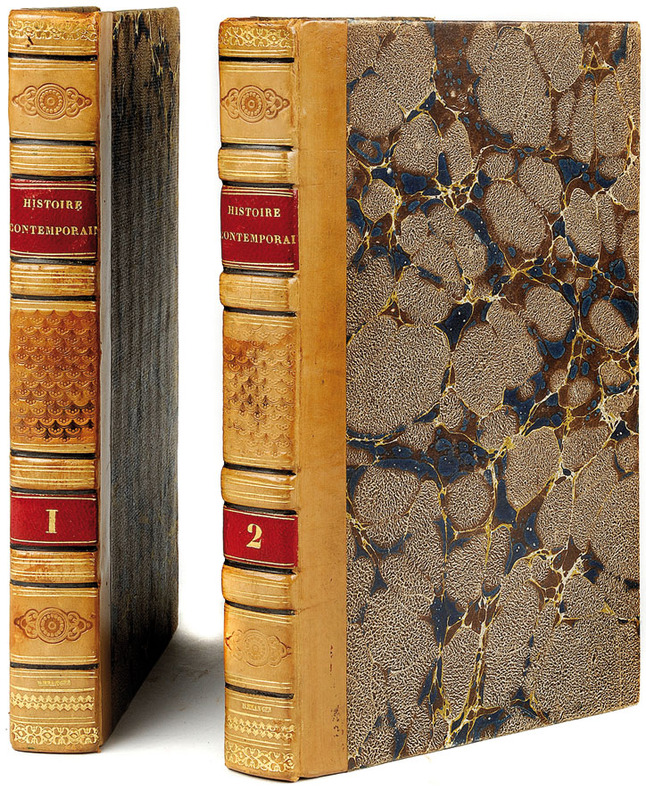
182517472Paris, Vernarel et Tenon (imp. de Lebel), 1825 ; 2 tomes in-8, demi veau blond glacé, dos à quatre nerfs plats encadrant les pièces rouges de titre et de tomaison, dos décoré de roulettes dorées et fleurons à froid, tranches marbrées (Beranger) ; XVI, 433, (2) pp. ; XXVII, 363 pp.
Two Vols. Cm. 19; pp. IX, (3), 412; (8), 484. Contemporary half leather. Complete with 6 Chromolithographies and a map. Well preserved. First edition. (Midlle East, Egypt, Syrian) 1395/P
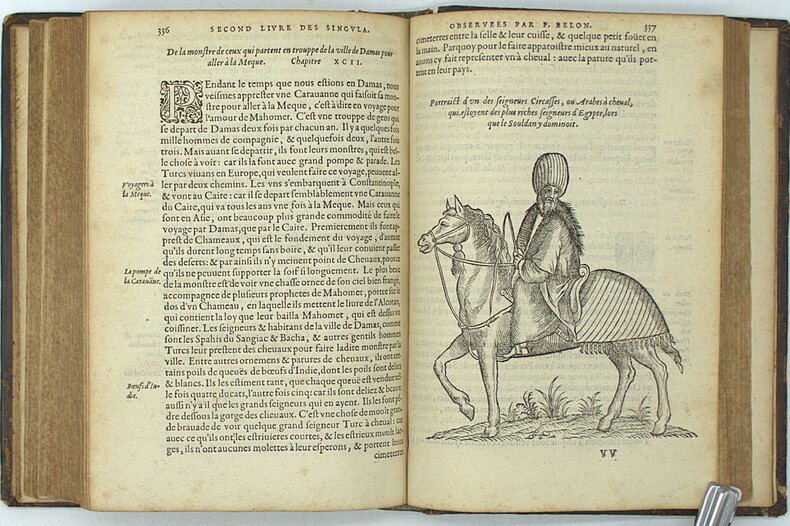
1588PHO-2120Paris, Hierosme de Marnes & la Veuve Guillaume Cavellat, 1588. Petit in-4 (21,6 × 15,5 cm), [12] ff., 468 pp., [1] f. (achevé d’imprimer, marque de l’imprimeur au verso). Basane fauve mouchetée du XVIIe siècle, dos à cinq nerfs orné, titre doré, tranches mouchetées, reliure un peu usée, frottements et épidermures, petit manque au dos, charnière fendillée, très légères rousseurs, infimes trous de vers marginaux.