REYNAUD (Charles).Livre Rare Book
1 643 résultats
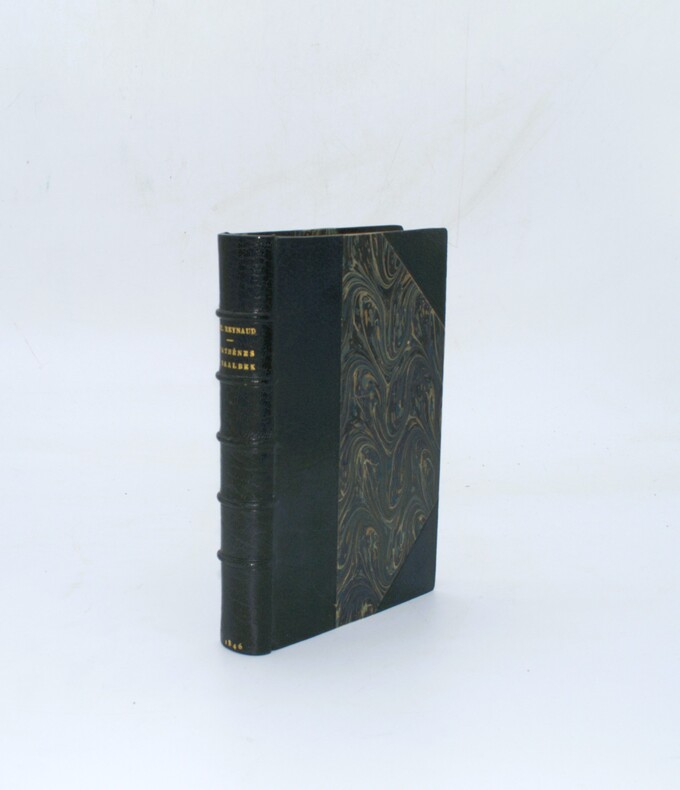
1846PHO-2354Paris, Furne [Imprimerie de H. Fournier], 1846, in-12 (19x13cm), 2ff.-290 pp.-1f., demi maroquin vert et coins, dos à nerfs avec auteur et titre, tête doré, couverture conservée, reliure signée Magnin. Bel exemplaire bien relié
In-8 (Cm 24 x 22), pp. 369, brossura editoriale illustrata, illustrazioni bianco nero e colori nel testo. Firme di possesso manoscritte all'occhietto. OTTIMO
369 p. con molte ill. nel testo; 24 x 22 cm. Brossura editoriale. Molto buono. Catalogo della mostra di Roma
369 p., molte ill. in nero n.t.; 24 x 22 cm. Bross. edit. Dedica all'occhietto, per il resto buono
Milano, Electa, 1985, 8vo brossura, cm. 23,5 x 21,5 pp. 370. Capolavori oggi in gran parte perduti per sempre.
Milano, Electa, 1985, 8vo quadrato (cm. 24 x 22) brossura editoriale con copertina illustrata a colori, pp. , cm. 23,5 x 21,5 pp. 370 con 276 illustrazioni e tavole fotografiche in nero e a colori nel testo. Catalogo della mostra di Roma, Campidoglio - Palazzo dei Conservatori, 15 febbraio - 26 marzo 1985.
0872431738.Gpaperback. Good. Access codes and supplements are not guaranteed with used items. May be an ex-library book. paperback
Milano, 1957, stralcio con copertina posticcia muta, pp. 375/390 con una cartina e numerose fotografie. - !! ATTENZIONE !!: Con il termine estratto (o stralcio) intendiamo riferirci ad un fascicolo contenente un articolo di rivista, sia che esso sia stato stampato a parte utilizzando la stessa composizione sia che provenga direttamente da una rivista. Le pagine sono indicate come "da/a", ad esempio: 229/231 significa che il testo è composto da tre pagine. Quando la rivista di provenienza non viene indicata é perchè ci è sconosciuta. - !! ATTENTION !!: : NOT A BOOK : “estratto” or “stralcio” means simply a few pages, original nonetheless, printed in a magazine. Pages are indicated as in "from” “to", for example: 229/231 means the text comprises three pages (229, 230 and 231). If the magazine that contained the pages is not mentioned, it is because it is unknown to us.
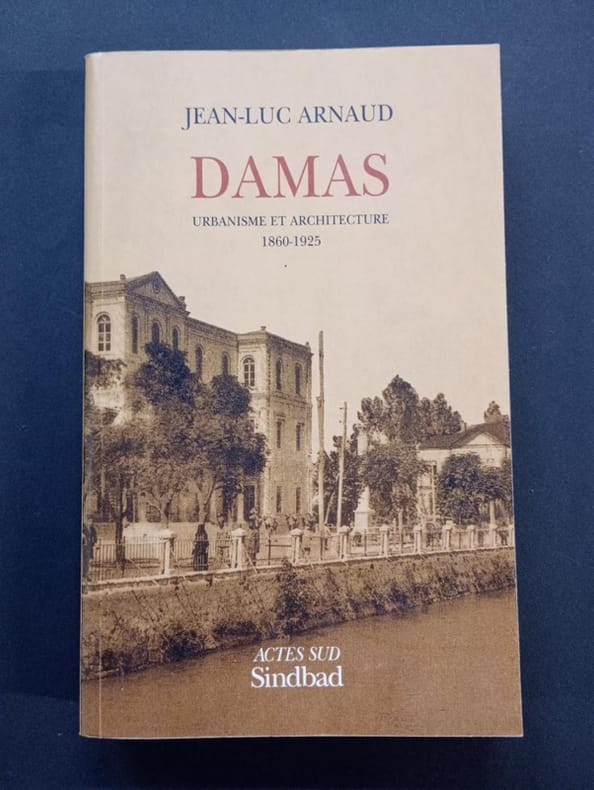
2006132124Actes Sud, coll. « Sinbad » 2006 In-8 broché 22,6 cm sur 14,1. 355 pages. Bon état d’occasion.
1964X93256Wiesbaden, Franz Steiner/ Deutsche Morgenländische Gesellschaft 1964 xii + 215pp., in the series "Abhandlungen für die Kunde des Morgenlandes" Volume XXXV-2, 23cm., original softcover, stamp at first title page, else in very good condition, [contains texts in arabian dialect from Damascus (Syria) based on recorded spoken words, and with a translation in German], X93256
199471943L'Harmattan, 1994, gr. in-8°, 303 pp, 32 pl. de photos hors texte, document : Lamartine à Damas, biblio, index, broché, couv. illustrée, état correct
New English Paperback. Pbo. Roy. 8vo. (24 x 17 cm). In French. 84, [1] p. "Translittération Abréviations Introduction Traduction Partie relative aux édifices de Damas Les souks de Damas Les églises et les couvents de Damas Les mosquées de Damas Les hammams de Damas Les cafés de Damas Les khân-s de Damas Les hôtels (lukanda) de Dama Partie relative aux quartiers de Damas Les portes de Damas Les forteresses de Damas Les cours d'eau et les lieux de promenade à Damas Les lieux de promenade de Damas Partie relative à la terre, aux plantes, aux arbres et à l'air de Damas L'instruction à Damas Les écoles chrétiennes Les écoles musulmanes Les écoles juives Les bibliothèques de Damas Partie relative à l'artisanat et au commerce de Damas Son commerce Partie relative aux habitude des Damascènes et à certaines de leurs coutumes Les coutumes des habitants de Damas lors des décès A propos du gouvernement de Damas et de ses ramifications Divers Table des matières de l'ouvrage Damas en 1878 Une période de transition La tradition et la savoir-vivre Une chronique pour la postérité ? Conclusion Bibliographie".
P., Place des victoires, 2001. In-4 cartonné avec jaquette, 223 pages.
Broch?. 358 pages. Tr?s bon ?tat.
Milano, 1955, stralcio con copertina posticcia muta, pp. 959/974 con fotografie, tavole fotografiche ed una cartina. - !! ATTENZIONE !!: Con il termine estratto (o stralcio) intendiamo riferirci ad un fascicolo contenente un articolo di rivista, sia che esso sia stato stampato a parte utilizzando la stessa composizione sia che provenga direttamente da una rivista. Le pagine sono indicate come "da/a", ad esempio: 229/231 significa che il testo è composto da tre pagine. Quando la rivista di provenienza non viene indicata é perchè ci è sconosciuta. - !! ATTENTION !!: : NOT A BOOK : “estratto” or “stralcio” means simply a few pages, original nonetheless, printed in a magazine. Pages are indicated as in "from” “to", for example: 229/231 means the text comprises three pages (229, 230 and 231). If the magazine that contained the pages is not mentioned, it is because it is unknown to us.
Soft boards have some toning. Pages unopened ; The Green Guide Books; 16mo 6" - 7" tall; 260 pages
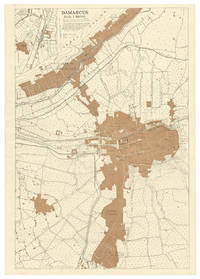
1918M2BH82CWPN7GDamascus: Field Survey Company. R.E. E.E.F. 1918. Map of Damascus 73.5 x 51 cm printed in black and tan on a scale of 1:10000. Extremely rare British map of Damascus with a more detailed inset map of the area around Kadem Station to the west of the city centre the northern terminus of the Hejaz railway between Damascus and Medina especially rare in its present first state published by the British forces only a week after the fall of Damascus. Drafted by the Royal Engineers from a captured enemy map dated June 1918 with additional detail of Kadem Station from aeroplane photographs taken by the R.A.F. and printed under the surveyors supervision in the field probably in Damascus on a portable press carried by the Field Survey Company.The ancient city of Damascus one of the final prizes taken by the British and allied forces in World War I was long a great cultural centre the head of the Syrian Hajj Road and more recently the northern terminus of the Hejaz Railway and the headquarters of the Ottoman-German forces in the Middle East. In the last months of the war British forces met stiff resistance in Palestine and it was only weeks before the end of the conflict that they managed to break into Syria. British forces and their allies captured the Damascus on 1 October 1918. Lawrence of Arabia who was part of the conquering force was disappointed not to have been amongst the first allied troops to enter the city especially as he envisaged Damascus as the future capital of an independent and unified Arab state and Prince Feisals army supported the British and allied forces with that understanding unaware that the British and French in 1916 had made a secret agreement to divide the Ottoman territories outside the Arabian peninsula among themselves. Although Feisals troops did raise their flag in Damascus on 1 October and declare an independent Syrian state it was in fact to be ruled as a French protectorate until 1945.All maps printed by British and allied forces in the field in the Middle East during WWI are extreme rarities. The present map would have been issued in only a very small print run for the use of senior British officers and printed on fragile paper in a large format its survival rate would have been very low. We can trace only a single other example of the map in its present first state held by the British Library. The British forces printed the map in a second state with some revisions for the Survey of Egypt in 1919 but it is also extremely rare in that second state.In very good condition clean and bright with just some minor creasing from having been rolled for many years.l British Library Cartographic Items: Maps 48855.11; WorldCat 557017180 same copy; cf. 557017192: 1 copy of 1919 revision. Field Survey Co[mpan]y. R.E., E.E.F., unknown
2000N3914Mainz: Philipp Von Zabern 2000. Original Decorative Hardcover. Near Fine. 4to. 535pp. Richly illustrated. A fine copy. <br/> <br/> Philipp Von Zabern hardcover
185061765Ohne Ort, um 1850. Bild ca. 9,5 x 14 cm, Blatt ca. 14 x 21 cm. 1 Blatt, verso weiß.
xii + 215pp., in the series "Abhandlungen für die Kunde des Morgenlandes" Volume XXXV-2, 23cm., original softcover, stamp at first title page, else in very good condition, [contains texts in arabian dialect from Damascus (Syria) based on recorded spoken words, and with a translation in German], X93256
35502284, Paris, Sequana, 1941; in-12 broché. 143 pp. EDITION ORIGINALE RARE. Qq. ill. dans le texte par J. Noetinger.
in-4°126 pages, nombreuses illustrations (dont plus. pleine page couleurs), broche, couverture, jaquette illustree. Tres bel exemplaire. [VU-2]
1779983821Lucian cianucian Greek Lucianos Latin Lucianus born AD 120 Samosata Commagene Syria now Samsat Tur.—died after 180 Athens Greece<br /><br />Danza Dialogo di Luiano con Annotazioni con annotazioni. <br /><br />In Firenze : nella stamperia di Gaspero Pecchioni 1779. Original edition. 8vo. Old wrappers iv 44 p. Some stains to titlepage. Very good copy. In this dialogue the Cynic Crato who has no in pantomimic dancing or those who go to see it is converted to its appreciation by his friend Lycinus.<br />This is a translation into Italian with notes of Lucian's famous dialogue on pantomime or "tragic dancing" in ancient Greece. In "tragic" dancing a dramatic plot is enacted by a masked and costumed dancer supported by an actor. The dancer's lines are spoken for him by someone else. There is also a chorus and for accompaniment the flute and the syrinx with various instruments of percussion. The work is dedicated to Antonio Muzarelli who was ballet master at the Burgtheater in Vienna at a time when ballet was detested by Emperor Joseph II although the art form was gaining some popularity due to the reforms of Jean-Georges Noverre 29 April 1727 – 19 October 1810 the a French dancer and balletmaster generally considered the creator of ballet d'action. The dialogue was probably written in Antioch in 162–165 a.d. when the Emperor Verus was there in compliment to him because of his interest in pantomime at a time when visual art was held inferior to literary art. This work underscores the legitimacy of dance because Lucian recognizes the intellectual character of dance. He emphasizes that a dancer must be able to express his or her ideas and sentiments through the intelligibility of movement and posture. Lucian's dialogue on dancing remains popular today due to its clever dialogue and clarity of argument. Rare: two OCLC locations one in North America: NYP Pecchioni books