[JUDAICA; RELAND Hadrian] Hadriani Relandi:Livre Rare Book
3 525 résultats
17168475Norimbergae [Nuremberg], Petrum Conradum Monathum, 1716. Gros in-8 de [18]-787-[83]-[2bl.] pages, plein vélin ivoire du temps, dos lisse, titre doré au dos dans une cartouche de roulette dorée, tranches mouchetées. Hormis une pâle auréole d'humidité en marge supérieure de quelques feuillets, bel exemplaire.
170448770Amsterdam Franciscus Halma 1704. Folio. 455 x 29 cm. Contemp. full blindtooled Dutch vellum. Raised bands. Spine ends with tears some cracking along fronthinge but not loose. Vellum at frontcover a bit soiled. Egraved titlepage Coxis del. ianen fecit. Printed titlepage in red/black with an engraved vignette. 15119511 pp. 1 engraved plate with portrait and coat of arms. 4 large folded engraved maps. Light yellowing to margins of textleaves but maps and text fine and clean. 3 of the maps engraved by F. Halma. <br/><br/><em>The maps are the Francois Halma reissues of Sanson's maps from 1683. </em> hardcover
170448770Amsterdam, Franciscus Halma, 1704. Folio. (45,5 x 29 cm.). Contemp. full blindtooled Dutch vellum. Raised bands. Spine ends with tears, some cracking along fronthinge, but not loose. Vellum at frontcover a bit soiled. Egraved titlepage (Coxis del., ianen fecit). Printed titlepage in red/black with an engraved vignette. 15,(119),51,(1) pp., 1 engraved plate with portrait and coat of arms. 4 large folded engraved maps. Light yellowing to margins of textleaves, but maps and text fine and clean. (3 of the maps engraved by F. Halma).
2014110726Valiz. New. 2014. Hardcover. 9078088729 . FREE UPGRADE to Courier/Priority Shipping Upon Request - IN STOCK AND IMMEDIATELY AVAILABLE FOR SHIPMENT - Flawless copy brand new pristine never opened - -- with a bonus offer-- . Valiz hardcover
ORD-14610Nouvelle édition soigneusement corrigée & augmentée de quelques notes. Neuchâtel. Société Typographique. 1772. 1773. 6 volumes in-12 (102 x 168mm) pleine basane racinée, dos à 5 nerfs ornés de caissons, pièces de titre maroquin rouge, de tomaisons maroquin brun, gardes marbrées, tranches rouges, 556, 444, 502, 468, 431 et 448 pages. Etiquette de P. Gauvry libraire à Bordeaux. Coiffes lgt arasées, petits défauts d'usage aux reliures sinon beaux exemplaires. Manque le tome VII comme souvent. Rare.
1930213451930. Dubek Cigarettes photographic album of British Mandatory Palestine produced in the 1930s-1940s documents the development of Jewish agricultural settlements industry security organizations and cultural institutions within the Yishuv during the late Mandate period. The album presents a visual narrative of Zionist nation building through images of collective agricultural labor industrial production settlement construction and educational life. Such imagery circulated widely in the interwar and wartime decades as part of broader efforts to promote Jewish settlement in Palestine and to demonstrate the institutional capacity of the Yishuv to sustain a modern society. The photographs therefore document a formative phase in the development of Jewish communal infrastructure and social organization prior to the establishment of the State of Israel.<br /> <br /> Dubek Cigarettes. Album of British Mandatory Palestine. Palestine: Dubek Cigarettes circa 1930s-1940s. Hebrew language cigarette card album containing 200 black and white photographic cards mounted within printed pages accompanied by Hebrew captions and descriptions. The photographs depict agricultural labor associated with kibbutz communities including images of women harvesting crops working in fisheries and participating in factory production. Additional cards document industrial development such as textile production citrus agriculture and export and cigarette manufacturing. Several sections show security and defense activity including Jewish guards patrols and fortified settlements associated with protective measures adopted by Jewish communities during the Mandate period. Other photographs highlight infrastructure including bridges roads water towers and public buildings along with educational and cultural institutions such as libraries schools and youth activities. Scenes of public gatherings and celebrations further emphasize the formation of communal identity within the Jewish population of Palestine.<br /> <br /> During the final decades of British administration in Palestine Jewish settlement expanded through organized agricultural collectives urban development and new infrastructure projects supported by Zionist institutions. Visual publications such as cigarette card albums functioned both as educational materials and as popular visual media presenting the progress of Jewish settlement and economic development. Images of collective labor fortified communities and modern infrastructure illustrate the practical and ideological foundations of the Yishuv's political aspirations during the Mandate era. Folio album in original illustrated stiff wrappers with string binding containing 200 mounted cigarette cards with printed Hebrew captions. Moderate wear to covers with edge rubbing toning and light soiling; interior pages show mild foxing with cards largely well preserved a few slightly lifting but present. Overall good condition. The album offers a substantial photographic record of Jewish settlement activity and institutional life in Mandatory Palestine during the decades preceding Israeli statehood. unknown
Later Boards. 8vo. 44, [2] pages. 23 cm. First edition. In Russian. 'From the history of the party', part one, published by the Central Committee of the Jewish Communist Workers Party (Poale Zion) , 1924 [Tsentralnyi komitet Evreiskoi kommunisticheskoi rabochei partii (Poalei-Tsion) ]. Consists of materials from the history of the Poale Tsion party before the 1919 split. Includes a Russian translation of Ber Borochov's Programme, almost certainly the first appearance of it in Russian, and documents from the party during the 1905-1906 revolutionary period. The Left Poale Zion in Russia participated in the Bolshevik revolution and constituted their own brigades in the red army, and flourished for a few years in the early twenties as an autonomous Jewish political party allied with the Bolsheviks. The party remained legal until 1928 when it was liquidated by the NKVD. Subjects: Communism - Soviet Union. Jews - Soviet Union. Evreiskaia kommunisticheskaia rabocheia partiia. World Socialist Union of Jewish Workers - Po'alei Zion. OCLC lists 4 copies (Harvard, Yale, Dartmouth, Natl Libr Israel) . Pages aged, soiled, fragile edges (though not chipping) . Boards soiled. About Good condition. Important. (ZION-8-11)
1st edition. Original illustrated publisher's boards, 8vo, xxii, (2), 17-518, (1), (1 blank).Illustrated With Maps and Numerous Engravings. English interspersed with Hebrew. Frontispiece portrait of author, foldout maps of Land of Israel, lithographed views of Holy Places. Singerman 1161. The nineteenth century saw a dramatic growth in interest in the Holy Land due to new directions in Bible studies and the growing popularity of visiting the region. This renewed attention was reflected in the expanding body of literature of geographies and travelogues. One such Hebrew work was Joseph Schwarz's Tevuot ha-Aretz, published in Jerusalem in 1845. When Schwarz visited the United States, four years later, as a rabbinical emissary from the Holy Land he arranged for Isaac Leeser to translate and publish Tevuot ha-Aretz. When it appeared the following year as this work, "A Descriptive Geography and Brief Historical Sketch of Palestine," it was recognized as one of the most important Jewish works published in America up to that time. Leeser proudly stated in his introduction: "The execution of the whole (book] is the work of Jewish writers and artists, the drawings being executed by Mr. S. Shuster, a lithographer belonging to our Nation." Leeser further expressed his hope that the publication of the volume might "extend the knowledge of Palestine, and also to enkindle sympathy and kind acts for those of our brothers, who cling to the soil of our ancestors." Isaac Leeser was an American rabbi, educator, and author, founder of the Jewish press of America. "Leeser participated in all Jewish movements. He was the earnest promoter of all the national enterprises-the first congregational union, the first Hebrew day-schools, the first Hebrew college, the first Jewish publication society-and of numberless local undertakings. [His monthly magazine] "The "Occident" acquired a national and even an international reputation; the Maimonides' College, of which he was president, paved the way for future Jewish colleges in the United States; and his translation of the Bible became an authorized version for the Jews of America. " (JE) An ex-library copy in later boards with more staining sold in 2019 at auction for over $6800. Our copy with original publisher's decorated boards, lacking the first map but all other plates and maps present. Wear to boards, especially at spine, Good Condition over all. (AMR-57-11A)
[8] 9-94 pages. Select Bibliography. First published in London in 1930. "Professor Einstein is better known as a physicist than as a Zionist. Yet for many years he has given abundant proof both of a keen interest in Zionism and of a penetrating insight into its underlying ideas. He is impelled to Zionism by his acute consciousness of the excessive price at which the blessings of assimilation are bought by the Jewish communities of the Western world, which for him are mainly represented by that of Germany. The price is a loss of solidarity, of moral independence and self-respect. These, in his view, can be regained only if assimilated Jews find some common task, of absolute human value, to which they can bend their corporate energies as Jews. Such a task is to be found in the restoration of Jewish national life in Palestine." - Introduction. Unmarked with average wear. Backstrip lettering faded. Binding tight. A sound copy of this important compilation. Emanuel p.51. Boni, Russ & Laurence 306. Book
1719127501719 3 volumes, reliure pastiche (20ème) plein veau havane moucheté in-octavo (binding full calfskin in-octavo), dos long (spine without raised band), décoré or (gilt decoration) filets et roulettes or (gilt line) et fleuron au fer plein ( floweret with full blocking stamp) - titre frappé or (gilt title) - pièce de titre sur fond bordeaux (label of title) avec filets or (label of title with gilt line) et pièce de tomaison sur fond bordeaux (label of volume numbering) - filets or, toutes tranches lisses (all smooth edges) jaspées (all marbled edges) rouges (all red edges), orné de 2 cartes dépliantes (folding maps) hors-texte (full page engraving) gravées sur Bois (engraving-wood) en noir (Une carte de la Natolie par de l'Isle et une carte de la Basse Egypte et du cours du Nil par Lucas) et de 32 gravures hors texte gravées sur Bois (engraving-wood) en noir dont 16 depliantes (folding plates), légères traces de cicatrices de mouillures marginales (scars of waterstains) dans le bas des volumes et seulement dans les toutes dernières pages, [24]-384-[8] + [2]-384-[4] + [2]-345-[9] pages, 1719 Rouen Robert Machuel le jeune Editeur,
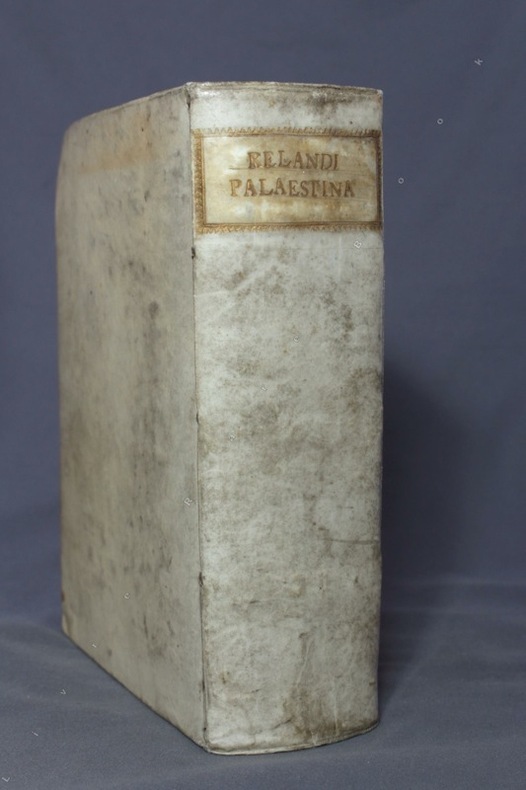
1714X119435Trajecti Batavorum [Utrecht], Ex libraria Guilielmi Broedelet 1714 Complete in 3 parts in one physical volume, part I: pp. [10],391,[1], Part II: pp. [4],396-511, Part III: pp. [4],516-1068,[94], with an additional engraved title, illustrated with engraved vignettes and with 15 engraved plates out of text (of which 13 folding) among which 9 maps and a large folding portrait of the author as well as a large folding genealogical table, 1st edition, text in Latin, 20x17cm., first title in red and black, text is clean and bright, small reference number on first title page, manuscript ex-dono on blanco endpaper (prize book of the School of Zwolle), contemporary brown full-leather binding (intact but with some wear at ends and joints, gilt decorations on boards and spine, gilt title on red label at spine, missing ties), a good copy of this work by the Dutch orientalist Reland (1676-1718) who made the first geographically accurate maps of Palestine and surroundings based upon his own study during his travel to Palestine, weight: 1.5kg., [Content: Part I: "In quo de Palaestinae nominibus, situ, terminis, partitione, aquis, montibus, et campis agitur", II: "in quo agitur de intervallis locorum Palaestinae", III: "in quo de urbibus et vicis Palaestinae agitur" which is in fact a topographical dictionary], X119435
In-4 (mm. 318x242), 4 volumi, elegante legatura edit. in tela (lievi abras.) con decoraz. e tit. oro e a secco al piatto anter., tagli dorati, pp. X,240,(4); VI,240,(4); VI,240,(4); VI,236; titoli in rosso e nero, molto ben illustrati da centinaia di incisioni su legno nel t. (numer. a p. pag.) e da 44 pregevoli tavv. inc. su acciaio f.t. - per lo più di vedute - incluse: 4 differenti antiporte, 4 grandi vignette ai frontespizi, 2 carte geografiche in tinta e a doppia pag. (Palestina - Egitto e Sinai), come da Indice. Questa importante opera, realizzata con il contributo di noti studiosi della Palestina, ci conduce attraverso “Jerusalem, Bethlehem, Samaria, Nazareth, Galilee, Mount Hermon, Damascus, Palmyra, Baalbek, Lebanon, Acre (the key of Palestine), Mount Carmel, Lydda, The Dead Sea, The convent of St. Catherine, Sinai, Cairo, Memphis, Thebes, Edfu and Philae”. Arross. ai soli risg., altrimenti fresco esemplare ben conservato, su carta distinta. .
1735PHO-674Paris, Charles J.-B. Delespine fils, 1735.T1(4), xvi, (2), 470 pp., ( 22) .T2(3), 521 pp., (14) .T3(6), 558 pp., (17).T4(6), 572 pp., (16).T5 (5), 613 pp., (15). T6 (4) 615 pp., (17) 6 volumes in-12, veau moucheté, dos à nerfs orné avec pièce de titre et tomaison, tranches marbrées (Reliure de l'époque), défauts d’usage, manque au dos , charnières fendues , coiffes arasées .
77356Paris, Librairie Catholique de l’Oeuvre de Saint-Paul 1886, 1887, 350x280mm, 318 + 354pages, demi-percaline. Plats papier marbré. Auteur, titre et tomaison dorés au dos. Belle reliure. Très bel exemplaire.
1939184044London: His Majesty's Stationery Office 1939. I am empowered in the name of the Government of Great Britain to give the following assurances First edition representing the first official publication of the deeply contentious McMahon-Hussein correspondence which cast a shadow over the future of Palestine for decades. The British Government released the full letters during the St James's Palace Conference in response to mounting pressure over the precise wording of McMahon's commitments. Shortly after the release a committee was formed to examine the precise implications of the letters. It concluded that "His Majesty's Government were not free to dispose of Palestine without regard for the wishes and interests of the inhabitants of Palestine". British representatives on the committee maintained that Palestine was excluded from McMahon's commitments but agreed that "the language in which its exclusion was expressed was not so specific and unmistakable as it was thought to be at the time" p. 10. Octavo pp. 18. With colour folding map. Original printed self-wrappers wire-stitched as issued. 15 March 1939 ownership mark of Harold Meek 1922-2016 architectural historian typed at head of title page. Light toning and creasing: near-fine. unknown
1938PALESTIN010092His Majesty's Stationery Office London. 1938. First edition. Royal octavo. 310 pages. Thirteen maps the first being opposite page 53 the next ten folded and tipped in at the rear the final two folded and tipped onto rear endpaper. Originally issued in blue wrappers with the last two maps in a pocket. Recently rebound in blue cloth not retaining the original wrappers. This report was commissioned by the Prime Minister Neville Chamberlain to supersede and thereby bury the Peel Report which had found the Mandate to be unworkable and had set out partition boundaries. Woodhead duly dismissed the idea of partition.Staining tea to inner margins of first 20 pages. Some creasing to edges and corners of maps. Very good. His Majesty's Stationery Office, London. hardcover
Very Good Turkish, Ottoman (1500-1928) Modern full morocco in Ottoman traditional style. Roy. 8vo. (25 x 17 cm). In Ottoman script (Old Turkish with Arabic letters). 119 p., 15 unnumbered b/w plates, and 1 color double-paged map of Northwest Africa and the Sahara Desert. First and only edition of this exceedingly rare book of Sahara and other territories of North Africa, written by Sadik El-Müeyyed, including his surviving report and travel account written to be presented to the Ottoman Sultan Abdulhamid II. It's a reference text that specifies the military and the political measures of the Sahara exploration, gives extensive information about the Benghazi region of Tripoli and about Muhammad al-Senusi, the leader of the Senûsî (Senussi) movement there, and his followers. With the impressive and enthusiastic expression of Sadik el-Müeyyed's descriptions, this work reveals not only the affairs of the Ottoman government but also the mysteries of the journeys that have taken months in the Sahara desert, uncovers the living standards of the desert peoples, and sheds light on an unknown aspect of the North African history. Özege 132.; Not in Kursun.
In-16 p. (mm. 153x102), cartoncino rustico antico, titolo ms. al dorso, pp. 192; al frontespizio è xilografata una crocefissione con il motto “Mors Mea Vita tua”. Questa celebre opera è molto ben illustrata da decine di interessanti vignette che raffigurano vedute di città italiane e del Medio Oriente (Venezia, Pola, Zara, Corfù, Candia, Rhodi, Gerusalemme, Nazareth, Tunisi, Alessandria, Cairo, Babilonia), i più importanti monumenti di Gerusalemme e dei luoghi sacri alla venuta di Gesù Cristo; alcune tavv. illustrano animali. A lungo fu considerata la sola guida disponibile ai pellegrini per arrivare alla Terra Santa. Nel volume anche: "Una breve regola di quanto si deve osservare nel detto Viaggio; e ciò che si paga da luogo a luogo, si' di Dazj, come d'altre cose. Aggiuntovi il modo di pigliare le Sante Indulgenze, ed a quali Chiese, Monasteri, ed altri luoghi siano concesse. Di nuovo aggiuntavi una Tavola, che dinota quante miglia sono da luogo a luogo infino a Gerusalemme". Il Frate Noè Bianco, dell'Ordine di S. Francesco, intraprese questo viaggio nel 1527. L'opera ebbe grande successo e molte furono le ediz. fino al Settecento. Cfr. Brunet,I,847-848 che cita numer. ediz. del Cinque e Seicento fino a quella di Bassano del 1742 - Fossati Bellani,I, n. 119, un’ediz. della fine ‘700, primi ‘800, con le stesse ns. pagg. - Choix de Olschki,IX,14320 un’ediz. di Venezia del 1629, con 96 cc.nn. Corto di margini; al fine, su ca. 10 carte, alone al marg. interno super., altrimenti esemplare molto ben conservato.
1657PHO-1458A Troyes, par Nicolas Oudot, et se vendent à Paris: Chez François Clousier, 1657. in-4; [6ff. (sur 7: feuillet de dédicace en fac-simile), dont titre, portrait légendé de La Boullaye, préface], 558p., [5ff. Table, fautes, privilège du 12 février 1657]; 33 illustrations sur bois dans le texte dont 16 à pleine page. Reliure d'époque en basane brune, dos à nerfs avec titre , coupes , coiffes et coins usés , frottements. un coin déchiré au titre sans atteinte au texte. Mouillure angulaire au premier portrait P. 73 déchirée avec manque de papier ,sans atteinte au texte. P. 165: manque en coin avec perte de qq mots; PP. 173 et 175: déchirures sans perte de texte; P. 234: manque de papier en pied avec perte de quelques mots; taches d'encre pp. 264 ; pp. 460 à 485: petites galeries de vers marginales en pied. Ex-libris manuscrit Dominium Antonium Biguet. Seconde édition
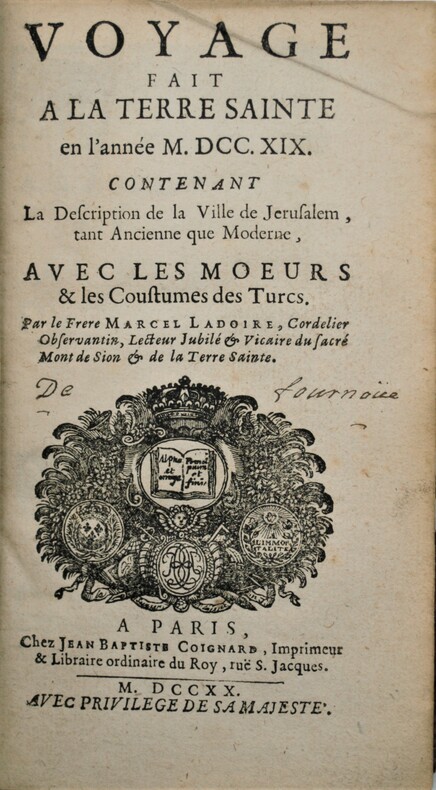
1720PHO-9761720, à Paris chez Jean Baptiste Coignard , In-12,7ffnch - 398pp- relié plein veau brun, dos à nerfs orné, pièce de titre (petit manque) , tranches mouchetées , coiffes arasées , coins usés(Reliure de l'époque).
209 pages. Index. Nine black and white plates. Twelve black and white figures. Fold-out two-colour plan of Jerusalem at back. Published posthumously. A detailed investigation of the question of the validity of the traditional sites of the Holy Sepulchre and of Golgotha. Average wear and soiling to dark yellow exterior. All lettering and gilt decorations clearly legible/visible upon backstrip and front board. Binding intact. Prior owner's signature atop title page, otherwise unmarked. A sound copy. Book
195125321<p><b>AMERCAN CHRISTIAN PALESTINE COMMITEE.</b>Scrapbook compiled by Harrison Fry Religion Editor of the Philadelphia <i>Evening Bulletin</i> one of the twenty-two tour participants. April 1951. Items glued or stapled to several pages with additional papers laid in. In green leatherette boards rules and decorations in yellow. 120 pp. 9½ x 11¾ x 1 in. </p><br /><p>The <b>American Christian Palestine Committee</b> ACPC was created in 1946 by merger of the American Palestine Committee 1931-1946 and the Christian Council on Palestine 1942-1946. Its purpose was to educate American Christian leaders about the post-Holocaust need for a Jewish state to publicize the new states' accomplishments to fight anti-Semitism and to support the country's existence. Over 20000 Christian leaders mostly Protestants were members. The ACPC sponsored seminars published educational materials created a speaker's bureau and conducted study tours taking religious leaders and journalists to Israel and adjoining Arab lands.</p><p>This scrapbook documents a trip from March 31 - April 28 1951. Its goals include making a "comprehensive study of Arab-Israel problems" including finding "suggested solutions for the resettlement of these tragic victims of the Arab-Israel War of 1948." The tour visited Israel Jordan and Lebanon and was the first ACPC group to visit to Palestinian refugee camps.</p><p>The group met Israeli Prime Minister David Ben-Gurion; Hashemite Kingdom of Jordan Foreign Minister Achmed Tooqan; Rabbi Jaacov Herzog son of the Chief Rabbi of Jerusalem; and American Ambassador to Israel Monnet Davis as well as other government and university officials and mayors. Early items in the scrapbook are typed copies of their itinerary including stops in Beyrouth Beirut Jerusalem Tel Aviv Haifa and Nazareth; a list of participants with their affiliations; and memoranda. It also includes airline tickets postcards hotel reservations including the King David Hotel and ephemera. Of particular interest is a printed pamphlet with basic information about the Knesset that includes Fry's notes of the group's meeting with Ben-Gurion 1886-1973. After about two weeks in the Middle East Fry also briefly visited Rome Paris and London. He used his notes for an article in the Philadelphia <i>Evening Bulletin</i>.</p><p>The scrapbook collects printed ephemera that illustrate Israel presented itself including a large color "tourist guide map" of Tel-Aviv 13½ x 9½ in. a 24- x 17-inch folding color "motor map" of Israel laid in with their route highlighted in red and with tourist information on each city on the verso; and a small program for a production of "Carmen" by the Hebrew National Opera. Other items include a Vocabulary for Visitors to Israel; and the post-return typed or handwritten letters Fry received including messages of friendship from other tour attendees.</p><p>Black-and-white photographs include an 8 x 10-inch photo of the group of travelers boarding their PanAm plane; a 5 x 7-inch photo of them at the Mosque of Omar; a photograph of settlers at the "future site of 'Kfar Truman'"; and photographs of the group at other sites that they visited such as the Garden of Gethsemane.</p><p><b>Excerpts:</b></p><p>Harrison W. Fry "People of Israel and Neighboring Nations Hope for Peace Despite Border Quarrels" <i>Evening Bulletin </i> Philadelphia April 22 1951</p><p>"<i>In Jerusalem—which means City of Peace—there is much talk of peace. In the Arab countries of Lebanon and Jordan there is more talk of co-operation than of hate. It may be a hopeful index. But no one agrees as to where it will start…</i> <i>if you look carefully there is the desire for peace down at the grass roots among Arabs living as displaced persons in caves and tents and among Israelis living under an austere program.</i>"</p><p>Harrison W. Fry "Ben-Gurion Wants U.S. Help to Bring Peace in Near East" <i>Evening Bulletin</i> Philadelphia April 25 1951</p><p>"<i>Prime Minister David Ben-Gurion of Israel would welcome the good offices of the United States in establishing peace in the Near East. Israel and the Arab states are now operating under an uneasy armistice with frequent border incidents</i>… <i>The shaggy white-haired leader of the modern miracle that is the State of Israel interrupted conferences in connection with the meeting of the Knesset Israel's Parliament now in session to greet the members of the American Christian Palestine Committee study group of which the writer is a member. With all the frankness of a long-time friend he talked of Israel's plans and problems and answered questions with a refreshing frankness free of diplomatic double talk.</i>"</p><p>Harrison W. Fry "Architects of New Israel Are Building Up from Soil" <i>Evening Bulletin</i> Philadelphia April 27 1951</p><p>"<i>In the valley of the Armageddon the old Biblical plains of Esdraelon the scene of many ancient victories and disasters of the Jews the modern Jews won their first victory of the land in the early twenties when the drained the malarial swamps. Today the valley is a Garden of Eden of fragrant orange citrus and olive groves and garden crops—a delight to the eyes after days of traveling in the eroded dust-storm swept Arab lands to the east of Israel… In the Hula Lake section north of the Sea of Galilee and Capernaum where Christ performed his miracles the Jews are today performing modern miracles by reclaiming further swamp areas.</i>"</p><p>Harrison W. Fry "Debris of Intolerance Bears Fruit of Freedom in Israel" <i>Evening Bulletin</i> Philadelphia May 2 1951</p><p>"<i>In a cave on Mt. Zion ancient citadel of Jerusalem are the ashes of thousands of Jewish martyrs to Nazi intolerance—a symbol of 6000000 who so perished. About them are the sacred scrolls desecrated by the Nazis. One of these had been made into a house coat by a Nazi who apparently did not read Hebrew because it bears on its back the warning that the Lord will wreak vengeance upon those who persecute his people… Atop a tower on this hill which borders no-man's land in the uneasy truce with the Arab kingdom of Jordan an Israeli soldier keeps vigil above these shrines that appeal for peace and tolerance. The Jews have put the terrible evidence of intolerance underground and are building a new tomorrow. They want to talk of peace in the Near East the whole refugee problem including the Arabs.</i>"</p><p>Carl Herman Voss to Members of ACPC Study Tour May 11 1951</p><p>"<i>I want to express appreciation for the cooperative spirit all of you manifested on the Tour. You were really a wonderful crew! Thanks too to all of you once again for the lovely Menorah and plate for Hanukkah with which you surprised me during our last evening together in Israel</i>."</p><p>"Assignment Well Covered" <i>Jewish Exponent</i> May 11 1951</p><p>"<i>Harrison W. Fry seasoned newspaperman and religious editor of the</i> Evening Bulletin<i> did a splendid job in reporting and interpreting the events in Israel as he observed them during his two weeks' tour of the country at the invitation of the American Christian Palestine Committee. His articles that have appeared in the</i> Evening Bulletin <i>during these past few weeks have given the readers of the</i> Bulletin <i>a clear insight into some of the problems concerning the country and the manner in which the Government and the people of Israel are grappling with these problems.</i>"</p><p>Carl Hermann Voss to Harrison Fry July 6 1951</p><p>"<i>I did have a chance to hear from my friends that you have given some excellent reports since you returned from the Middle East and that you were as stimulated and thrilled by the trip as was I… I was a bit disappointed not to have your assent to our reiterated invitation to be listed among the speakers for the Club Program Service the speakers' bureau of the American Christian Palestine Committee but I presume that compelling reasons determined your decision. Won't you still reconsider We would look upon your addition to the list of speakers for Club Program Service as a real boon for the ACPC.</i>"</p><p>Memo of Harrison W. Fry to Walter Lister n.d.</p><p>"<i>Judge Levinthal called me late yesterday to say that he and some of his friends were thinking of nominating me as a member of a small party of Christian clergymen from all parts of the United States who are being sent expenses paid to visit Palestine and get first had information of conditions there. Would I accept if the full committee approved. Had I been to Palestine.</i>"</p><p>"<i>I told him the prospect thrilled me as I had never been to Palestine. I told him that Fry disassociated form The Bulletin did not mean anything and much as I would like to go on my own I felt I should not unless the matter was cleared through The Bulletin.</i>"</p><p><b>Harrison W. Fry</b> 1892-1973 was born in Pottstown Pennsylvania and married Laura V. Umstead 1894-1967 in 1918. He entered journalism before World War I with the <i>Public Ledger</i> and then served as religion and education editor for the Philadelphia <i>Evening Bulletin</i>for forty-two years. Fry interviewed every president from Theodore Roosevelt to Harry S. Truman. He served as a charter member and later president of the Education Writers Association in 1948-1949 and was a founding member of the Religion Newswriters Association in 1949.</p><p><b>Carl Hermann Voss</b> 1911-1995 was a Congregational minister who served in Brooklyn; Pittsburgh; Raleigh North Carolina; and Saratoga Springs New York. During World War II he founded and led the Christian Council on Palestine before becoming one of the founding members of the American Christian Palestine Committee.</p><p><b>Louis E. Levinthal</b> 1892-1976 received three degrees from the University of Pennsylvania and was a judge of the Court of Common Pleas for Philadelphia County from 1937 to 1959. He was president of the Zionist Organization of America from 1941 to 1943 and special adviser for Jewish affairs to the postwar European Command in 1947-1948. He served as chairman of the board of governors of Hebrew University in Jerusalem from 1962 to 1968.</p><p>Starting in 1951 the group's activities were opposed by the pro-Arab American Friends of the Middle East later proven to be funded in part by the CIA. The ACPC wound down in the early 1960s when the Israeli embassy and consulates took over the task.</p> hardcover
195125321<p><b>AMERCAN CHRISTIAN PALESTINE COMMITEE.</b>Scrapbook compiled by Harrison Fry Religion Editor of the Philadelphia <i>Evening Bulletin</i> one of the twenty-two tour participants. April 1951. Items glued or stapled to several pages with additional papers laid in. In green leatherette boards rules and decorations in yellow. 120 pp. 9½ x 11¾ x 1 in. </p><br /><p>The <b>American Christian Palestine Committee</b> ACPC was created in 1946 by merger of the American Palestine Committee 1931-1946 and the Christian Council on Palestine 1942-1946. Its purpose was to educate American Christian leaders about the post-Holocaust need for a Jewish state to publicize the new states' accomplishments to fight anti-Semitism and to support the country's existence. Over 20000 Christian leaders mostly Protestants were members. The ACPC sponsored seminars published educational materials created a speaker's bureau and conducted study tours taking religious leaders and journalists to Israel and adjoining Arab lands.</p><p>This scrapbook documents a trip from March 31 - April 28 1951. Its goals include making a "comprehensive study of Arab-Israel problems" including finding "suggested solutions for the resettlement of these tragic victims of the Arab-Israel War of 1948." The tour visited Israel Jordan and Lebanon and was the first ACPC group to visit to Palestinian refugee camps.</p><p>The group met Israeli Prime Minister David Ben-Gurion; Hashemite Kingdom of Jordan Foreign Minister Achmed Tooqan; Rabbi Jaacov Herzog son of the Chief Rabbi of Jerusalem; and American Ambassador to Israel Monnet Davis as well as other government and university officials and mayors. Early items in the scrapbook are typed copies of their itinerary including stops in Beyrouth Beirut Jerusalem Tel Aviv Haifa and Nazareth; a list of participants with their affiliations; and memoranda. It also includes airline tickets postcards hotel reservations including the King David Hotel and ephemera. Of particular interest is a printed pamphlet with basic information about the Knesset that includes Fry's notes of the group's meeting with Ben-Gurion 1886-1973. After about two weeks in the Middle East Fry also briefly visited Rome Paris and London. He used his notes for an article in the Philadelphia <i>Evening Bulletin</i>.</p><p>The scrapbook collects printed ephemera that illustrate Israel presented itself including a large color "tourist guide map" of Tel-Aviv 13½ x 9½ in. a 24- x 17-inch folding color "motor map" of Israel laid in with their route highlighted in red and with tourist information on each city on the verso; and a small program for a production of "Carmen" by the Hebrew National Opera. Other items include a Vocabulary for Visitors to Israel; and the post-return typed or handwritten letters Fry received including messages of friendship from other tour attendees.</p><p>Black-and-white photographs include an 8 x 10-inch photo of the group of travelers boarding their PanAm plane; a 5 x 7-inch photo of them at the Mosque of Omar; a photograph of settlers at the "future site of 'Kfar Truman'"; and photographs of the group at other sites that they visited such as the Garden of Gethsemane.</p><p><b>Excerpts:</b></p><p>Harrison W. Fry "People of Israel and Neighboring Nations Hope for Peace Despite Border Quarrels" <i>Evening Bulletin </i> Philadelphia April 22 1951</p><p>"<i>In Jerusalem—which means City of Peace—there is much talk of peace. In the Arab countries of Lebanon and Jordan there is more talk of co-operation than of hate. It may be a hopeful index. But no one agrees as to where it will start…</i> <i>if you look carefully there is the desire for peace down at the grass roots among Arabs living as displaced persons in caves and tents and among Israelis living under an austere program.</i>"</p><p>Harrison W. Fry "Ben-Gurion Wants U.S. Help to Bring Peace in Near East" <i>Evening Bulletin</i> Philadelphia April 25 1951</p><p>"<i>Prime Minister David Ben-Gurion of Israel would welcome the good offices of the United States in establishing peace in the Near East. Israel and the Arab states are now operating under an uneasy armistice with frequent border incidents</i>… <i>The shaggy white-haired leader of the modern miracle that is the State of Israel interrupted conferences in connection with the meeting of the Knesset Israel's Parliament now in session to greet the members of the American Christian Palestine Committee study group of which the writer is a member. With all the frankness of a long-time friend he talked of Israel's plans and problems and answered questions with a refreshing frankness free of diplomatic double talk.</i>"</p><p>Harrison W. Fry "Architects of New Israel Are Building Up from Soil" <i>Evening Bulletin</i> Philadelphia April 27 1951</p><p>"<i>In the valley of the Armageddon the old Biblical plains of Esdraelon the scene of many ancient victories and disasters of the Jews the modern Jews won their first victory of the land in the early twenties when the drained the malarial swamps. Today the valley is a Garden of Eden of fragrant orange citrus and olive groves and garden crops—a delight to the eyes after days of traveling in the eroded dust-storm swept Arab lands to the east of Israel… In the Hula Lake section north of the Sea of Galilee and Capernaum where Christ performed his miracles the Jews are today performing modern miracles by reclaiming further swamp areas.</i>"</p><p>Harrison W. Fry "Debris of Intolerance Bears Fruit of Freedom in Israel" <i>Evening Bulletin</i> Philadelphia May 2 1951</p><p>"<i>In a cave on Mt. Zion ancient citadel of Jerusalem are the ashes of thousands of Jewish martyrs to Nazi intolerance—a symbol of 6000000 who so perished. About them are the sacred scrolls desecrated by the Nazis. One of these had been made into a house coat by a Nazi who apparently did not read Hebrew because it bears on its back the warning that the Lord will wreak vengeance upon those who persecute his people… Atop a tower on this hill which borders no-man's land in the uneasy truce with the Arab kingdom of Jordan an Israeli soldier keeps vigil above these shrines that appeal for peace and tolerance. The Jews have put the terrible evidence of intolerance underground and are building a new tomorrow. They want to talk of peace in the Near East the whole refugee problem including the Arabs.</i>"</p><p>Carl Herman Voss to Members of ACPC Study Tour May 11 1951</p><p>"<i>I want to express appreciation for the cooperative spirit all of you manifested on the Tour. You were really a wonderful crew! Thanks too to all of you once again for the lovely Menorah and plate for Hanukkah with which you surprised me during our last evening together in Israel</i>."</p><p>"Assignment Well Covered" <i>Jewish Exponent</i> May 11 1951</p><p>"<i>Harrison W. Fry seasoned newspaperman and religious editor of the</i> Evening Bulletin<i> did a splendid job in reporting and interpreting the events in Israel as he observed them during his two weeks' tour of the country at the invitation of the American Christian Palestine Committee. His articles that have appeared in the</i> Evening Bulletin <i>during these past few weeks have given the readers of the</i> Bulletin <i>a clear insight into some of the problems concerning the country and the manner in which the Government and the people of Israel are grappling with these problems.</i>"</p><p>Carl Hermann Voss to Harrison Fry July 6 1951</p><p>"<i>I did have a chance to hear from my friends that you have given some excellent reports since you returned from the Middle East and that you were as stimulated and thrilled by the trip as was I… I was a bit disappointed not to have your assent to our reiterated invitation to be listed among the speakers for the Club Program Service the speakers' bureau of the American Christian Palestine Committee but I presume that compelling reasons determined your decision. Won't you still reconsider We would look upon your addition to the list of speakers for Club Program Service as a real boon for the ACPC.</i>"</p><p>Memo of Harrison W. Fry to Walter Lister n.d.</p><p>"<i>Judge Levinthal called me late yesterday to say that he and some of his friends were thinking of nominating me as a member of a small party of Christian clergymen from all parts of the United States who are being sent expenses paid to visit Palestine and get first had information of conditions there. Would I accept if the full committee approved. Had I been to Palestine.</i>"</p><p>"<i>I told him the prospect thrilled me as I had never been to Palestine. I told him that Fry disassociated form The Bulletin did not mean anything and much as I would like to go on my own I felt I should not unless the matter was cleared through The Bulletin.</i>"</p><p><b>Harrison W. Fry</b> 1892-1973 was born in Pottstown Pennsylvania and married Laura V. Umstead 1894-1967 in 1918. He entered journalism before World War I with the <i>Public Ledger</i> and then served as religion and education editor for the Philadelphia <i>Evening Bulletin</i>for forty-two years. Fry interviewed every president from Theodore Roosevelt to Harry S. Truman. He served as a charter member and later president of the Education Writers Association in 1948-1949 and was a founding member of the Religion Newswriters Association in 1949.</p><p><b>Carl Hermann Voss</b> 1911-1995 was a Congregational minister who served in Brooklyn; Pittsburgh; Raleigh North Carolina; and Saratoga Springs New York. During World War II he founded and led the Christian Council on Palestine before becoming one of the founding members of the American Christian Palestine Committee.</p><p><b>Louis E. Levinthal</b> 1892-1976 received three degrees from the University of Pennsylvania and was a judge of the Court of Common Pleas for Philadelphia County from 1937 to 1959. He was president of the Zionist Organization of America from 1941 to 1943 and special adviser for Jewish affairs to the postwar European Command in 1947-1948. He served as chairman of the board of governors of Hebrew University in Jerusalem from 1962 to 1968.</p><p>Starting in 1951 the group's activities were opposed by the pro-Arab American Friends of the Middle East later proven to be funded in part by the CIA. The ACPC wound down in the early 1960s when the Israeli embassy and consulates took over the task.</p> hardcover books
1939N4645Jerusalem: Government Printer 1939. First Edition . Half Cloth. Very Good. 8vo. Some 12000pp for the 14 volumes. HEBREW LANGUAGE. Each colume with owner's stamp on the firtst page MODAI ADVOCATES -TEL AVIV Some spotting on edges and front end papers. A few pages loose. General minimal wear. UNIFORM HALF CLOTH BINDING. A VERY GOOD COPY OF THIS RARE OFFFICIAL PUBLICATION FO THE PALESTINE MANDATE. <br/> <br/> Government Printer hardcover
184339862Paris, Challamel, [1843]. Grand in-8 de (4)-228 pp. chiffrées par erreur 328, demi-maroquin vert, dos lisse, tête dorée, non rogné (relié vers 1880 par Thivet).