6 262 résultats
20182090502124701360Bijinesu-sha 2018. Soft Cover. Fine. Number of books: 1 Bijinesu-sha paperback
20052083002115703455Kawade Shobo Shinsha 2005. Soft Cover. Fine. Number of pages: 143p Size: 22cm Number of books: 1 Kawade Shobo Shinsha paperback
20082083002115707197Kawade Shobo Shinsha 2008. Soft Cover. Fine. Number of pages: 143p Size: 22cm Number of books: 1 Kawade Shobo Shinsha paperback
20042083002115704849Kawade Shobo Shinsha 2004. Soft Cover. Fine. Number of pages: 135p Size: 22cm Number of books: 1 Kawade Shobo Shinsha paperback
2083002115706969Kawade Shobo Shinsha N.A. Soft Cover. Fine. Number of pages: 127p Size: 22cm Number of books: 1 Kawade Shobo Shinsha paperback
20152083002115700987Kawade Shobo Shinsha 2015. Soft Cover. Fine. Number of pages: 159p Size: 22cm Number of books: 1 Kawade Shobo Shinsha paperback
20052111902158300394Kawade Shobo Shinsha 2005. Soft Cover. Fine. Number of pages: 151p Out of stock Reprint undecided Size: Size cm: 21.5 x 17 x 1.1 Number of books: 1 Kawade Shobo Shinsha paperback
20152083002115705827Kawade Shobo Shinsha 2015. Soft Cover. Fine. Number of pages: 287p Size: 22cm Number of books: 1 Kawade Shobo Shinsha paperback
20102090202120804810PHP Institute 2010. Soft Cover. Fine. Volume: 1 PHP Institute paperback
19962091502135307734Gingashuppan 1996. Soft Cover. Fine. Volume: 1 Gingashuppan paperback
19802090202120808928Not Available 1980. Soft Cover. Fine. Volume: 1 Not Available paperback
20002080502107002956Nihonbungeisha 2000. Soft Cover. Fine. Number of pages: 286p Size: 19cm Nihonbungeisha paperback
8vo [23 x 16 cm]; xii, [ii], 257 pp, glossary, bibliog, endpaper maps. original quarter cloth, boards, dj, fine. A picture of this book is available upon request by email. The author observes that societies that do not eat people are fascinated by those that do. "An artful blend of travel memoir and historical narrative", and a fascination of cannibals and their adaptation to modern times.
8vo [22 x 14 cm]; [x], 172 pp, frontis, illustrations from photos, map endpapers. original cloth, dj (bit worn at spine ends), else fine. A picture of this book is available upon request by email. The author describes his life in Papua New Guinea in the 1930s, where he tried to break down the isolation of the various peoples there. Much on the customs and society of the native peoples. The area was an Australian colony at the time.
16°, pp.566, br. ed., manca la sovracop.
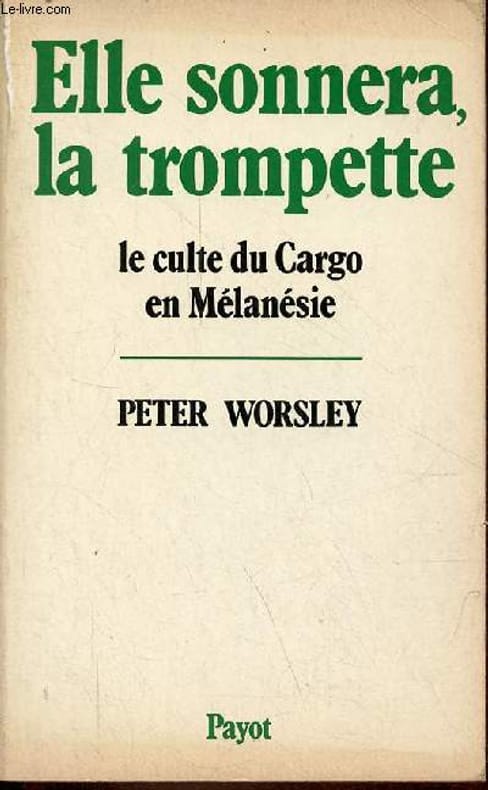
1977R100059278Payot. 1977. In-8. Broché. Etat d'usage, Couv. légèrement passée, Dos satisfaisant, Papier jauni. 318 pages - couverture jaunie.. . . . Classification Dewey : 996-Autres régions du pacifique
7670Paris, Berget-Levrault, 1947. In-8 broché, non coupé, XVIII-200 p. Coll. "La Seconde Guerre Mondiale - Histoire et Souvenirs". Traduit sous la dir. de Louis de Vignaux. Bon état. Rapport biennal au Secrétaire d'Etat à la Guerre des U. S. A.
1944WRCAM41429Mios Woendi 1944. Three pages of typed index followed by sixty- two photographs each 5 x 6 1/2 inches. Photographs numbered in lower right corner corresponding to index and backed by linen. Oblong 12mo. Original Plexiglas binding brad bound with a cover reading: "Construction Photographs 55th Seabee's." The photographs are clean and clear. Near fine. A very interesting album of photographs documenting the construction of the U.S. Navy Base on the tiny island of Mios Woendi during World War II. Located in the Dutch East Indies near Indonesia Mios Woendi was an important base for American PT boats and for larger ships as well. The photographs in this album show the construction of the base by the U.S. Navy construction battalion known as the "Seabees." The photographs give aerial views of the island the dense foliage the Seabee's camp and dozens of detailed views of all stages of the construction of the base. Also dozens of PT boats - this could be "McHale's Navy." Likely produced in a very small number for military authorities and participants in the construction. We are unable to locate any other copies. unknown books
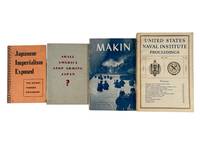
1939214021939. Various authors and issuers group of wartime pamphlets and periodicals 1939-1945 documenting American interpretations of Japanese expansionism prewar economic policy debates and U.S. military operations in the Pacific Theater. The material operates in Cultural/Representational Mode illustrating how military governmental and institutional publications framed Japanese imperial strategy and justified American military response while also presenting technical and battlefield analysis intended for both military and informed civilian audiences. These works collectively offer insight into wartime messaging strategic interpretation and the evolving American understanding of Pacific conflict from prewar trade tensions through active combat operations.<br /> Four printed works issued between 1939 and 1945 including Shall America Stop Arming Japan 1939; Japanese Imperialism Exposed: The Secret Tanaka Document 1942; United States Naval Institute Proceedings Vol. 69 No. 485 May 1943; and Makin U.S. War Department 1944. Staple-bound and softcover formats illustrated with photographs maps charts and technical diagrams. Shall America Stop Arming Japan presents statistical charts detailing American exports of strategic materials noting that Japan sourced significant percentages of copper scrap iron and petroleum from the United States accompanied by arguments advocating embargo. Japanese Imperialism Exposed reproduces the controversial Tanaka Memorial describing a proposed sequence of territorial conquest beginning with China and extending across Asia and the Pacific. Makin issued by the War Department's Historical Division provides a detailed narrative of the U.S. Marine assault on Makin Atoll with photographs of tanks infantry movement and captured terrain alongside fold-out maps showing defensive positions and invasion routes. United States Naval Institute Proceedings includes articles analyzing naval aviation logistics and strategic doctrine with photographic illustrations of aircraft such as the XLRQ-1 seaplane glider and PV-1 Ventura patrol plane as well as discussions of wartime and postwar naval policy.<br /> Together these publications trace the progression of American engagement with Japan from economic and diplomatic tension to full-scale military conflict combining advocacy intelligence interpretation and operational reporting. The juxtaposition of prewar policy argument with wartime combat analysis and technical discussion demonstrates the range of printed materials used to inform persuade and document during the Pacific War. These works support research into wartime propaganda military strategy and the informational frameworks through which the United States understood and prosecuted the war against Japan. Light wear to spines and edges with minor toning to pages; overall very good condition. A cohesive grouping illustrating the intersection of policy debate ideological framing and battlefield documentation in World War II print culture. unknown
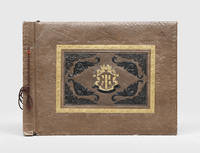
1940182459Manila: 1940s. A graphic album showing fighting in the Philippines the Marshall Islands Papua New Guinea Guam the Solomon Islands and Palau. The compiler chose to include violent images displaying the brutality of the campaign. The album opens with portrait shots of individual Marines or groups along with photographs of American encampments and ships. The scenes then turn more distressing with images of dead locals including children lying on the beach or next to tanks. The photographs were taken across the Pacific theatre: one shows an American soldier holding a flame-thrower on Kwajalein Atoll another shows a beach landing at Luzon and a third shows a Marine posing next to a sign in Bougainville. Most were taken in the final years of the conflict including at Guadalcanal and Peleliu. There are also shots of the end of the war one showing a Japanese soldier surrendering with a white flag and another showing Japanese prisoners of war in a camp in Guam. The final photograph is the most famous "Raising the Flag on Iwo Jima" showing six Marines raising the US flag on Mount Suribachi during the Battle of Iwo Jima. This photograph won the 1945 Pulitzer Prize for Photography. The majority of the photographs are commercial with a few opening portrait shots of the unidentified compiler. Oblong folio 286 x 390 mm. With 55 gelatin silver photographs one lacking approximately 90 x 130 mm landscape or portrait corner-mounted with tape recto and verso on 7 leaves remainder blank. With 2 additional gelatin silver photographs loosely inserted. Contemporary brown sheep commercial album tied through punched holes with brown cord front board stamped with central armourial panel in blind gilt and black. Boards chipped at extremities especially front board bottom left corner rear board rubbed leaves nicked at fore edge photographs moderately toned and creased some slightly torn and abraded: a good example. hardcover
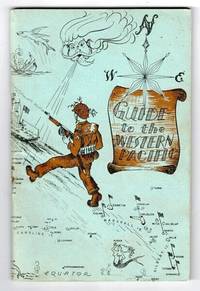
194472872Pearl Harbor Oahu Hawaii: CinCPac--CinCPOA Bulletin no. 126-44 August 1944. 8vo pp. 124; 10 delightful maps in the text 1 double-page and tables in the text; very good in original pictorial blue wrappers printed in red and black. At the head of the title page: "Restricted. CinCPac--CinCPOA Bulletin no. 126-44, August unknown
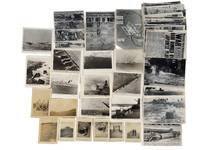
1945213921945. U.S. military operations in the Pacific Theater during World War II photograph and newspaper archive 1941-1945 documenting the Battle of Iwo Jima and the attack on Pearl Harbor. The archive pairs soldier-taken snapshots with official U.S. Navy and press photographs showing how combat equipment and battlefield conditions. The featured original snapshots contain handwritten notations en verso identifying dates specific locations soldiers and equipment.<br /> <br /> The archive comprises 39 silver gelatin photographs ranging from roughly 3.5 x 5 to 6 x 8 inches together with original wartime front pages of the Honolulu Star-Bulletin covering the attack on Pearl Harbor the fall of Italy and the Allied invasion of Europe. Images include amphibious landings on the black sand beaches of Iwo Jima with landing craft advancing under naval bombardment; U.S. Navy battleships destroyers and landing craft firing on shore defenses; and aerial scenes of dogfights and bombing runs. Close-up battlefield images depict the wreckage left in the wake of combat including destroyed landing craft craters from naval artillery and Japanese fortifications. Several photographs focus on the role of air power with images of Japanese aircraft under attack U.S. planes engaging in dogfights and B-29 Superfortresses bombing enemy positions. A particularly striking image captures a Japanese bomber scoring a direct hit on the USS Yorktown with billowing smoke rising from the carrier. Handwritten notations on some images identify U.S. servicemen locations such as Mount Suribachi and captured Japanese positions. The series of larger military-produced photographs and newspaper clippings have inscriptions on verso identifying locations and vessels depicted as well as the name tag "K .Benden." Among these are portraits of American soldiers posing at key strategic points inspecting captured bunkers and standing beside wrecked aircraft. <br /> <br /> Reconnaissance images show terrain and fortified positions; ground-level views show cratered landscapes wrecked landing craft and captured Japanese fortifications. One image shows the USS West Virginia during the Pearl Harbor attack with fire damage and crew visible; another shows a Japanese aircraft striking the USS Yorktown. Other photographs show servicemen near Mount Suribachi inspecting bunkers and beside wrecked aircraft. Many images carry printed captions within the negatives; others have handwritten verso annotations identifying locations dates vessels and personnel including one marked "K. Benden." Light wear minor edge creasing and occasional surface marks; overall in very good with strong image clarity. unknown
23098108like new. unknown
237 pages including index. With illustrations from thirty-two photographs. Spine missing. Past moisture exposure to bottom inch of book resulted in fading to that portion of blue cloth boards and very light staining to contents which are otherwise mildly yellowed and in good condition. Hinges intact. Minimal markings. Very good reading copy. Book
8vo., First Edition, with photographs and maps in the text; buff boards, white cloth back lettered in gilt, ivory endpapers, a fine copy in unclipped dustwrapper.