2 832 résultats
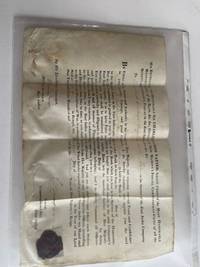
2687430 July 1850. Vellum Document 40 x 25cms bottom edge sl. crumpled faint water stin lright margin text clear and complete. With Seal. SIGNED by General Sir Charles James Napier Commander-in-Chief in India and J.P. Kennedy John Pitt Kennedy Military Secretary East Indies see Wikipedia entry a productive life. See Image. 30 July 1850. hardcover
1655331 January 2 May and 3 October 1822. All three from East India House London. The three items in fair condition on lightly aged and worn paper. All three addressed to 'My dear George' and one with valediction from 'your affectionate Father'. The letters are described below in reverse chronological order. ONE: AL. 3 October 1822. 8pp. folio. A long letter on two bifoliums half of which describes an interview between Bosanquet and the new Foreign Secretary and future Prime Minister George Canning in which Bosanquet presses his son's case for preferment within the diplomatic service George was at the time attached to the British Embassy in Paris and would rise to the post of chargé d'affairs at Madrid 1828-1830. Bosanquet begins by stating that he has had the meeting with 'Mr Canning' George Canning 1770-1827 and 'was received with apparent great cordiality. I congratulated him on his late appointment as Foreign Secretary on 13 September & told him that as I considered Lord Londonderry i.e. Castlereagh the previous Foreign Minister who had committed suicide on 12 August 1822 as the real minister of the country he had I considerd sic stept into his shoes & that he had a great & important business to perform but that I might say I felt that he stood in an awful & difficult situation - that the winds would blow very hard in the next year & that if through his means we could weather the storm alluding to his song upon Pit sic being the man who had weathered the storm all the nation would be indebted to him - This seeme'd to please him much'. He tells Canning that 'the country was in the most wretched state that the agriculturalist had lost at least 1/3d I thought half of their capital that considering this capital was at least 3 hundred millions it was a fearful moment'. As the conversation proceeds Canning states that they 'think alike upon this subject'. He drops his 'preliminary discourse' and states to Canning 'many points relative to Turkey'. Canning introduces Bosanquet to Sir Joseph Planta 1787-1847 with whom he intends to 'settle the subject'. Bosanquet tells him that he has 'lost a friend in Lord Londonderry - that he had plac'd you in your present situation & I had hopes he would have protected you in it' and that he hopes Canning will do the same. Canning 'seemed to draw up more than I expected upon this'. He enumerates the 'load of applications & remembrances' he has received stating that they cannot 'all be satisfied'. Bosanquet continues to press his son's case stating that he does not 'ask for a life of idleness' and that he is 'not fitted for such a slave as I knew any inferior retainer of Government was'. As the conversation proceeds Canning discusses one of the Paris attaches - 'I have forgot his name that had been recommended by Sir Charles Stewart sic for Sir Charles Stuart 1779-1845 British Ambassador in Paris and hence George's boss- he was the person I imagine whom you supposed Sr. Charles would have taken to Vienna if he had you there'. The 'conference' with Canning over Bosanquet speaks to Planta whom he finds 'a most Gentlemanly person - he speak sic plain - which I like - He was almost the right hand of Lord Londonderry & will I dare say be so to any person who fills the office of Foreign secretary - he has risen by his merit alone & is very unlike Hamilton i.e. William Richard Hamilton see next letter'. He tells his son he realises that there is nothing to give him 'much pleasure in this long detail' and advises him to 'stay as long as you can be useful at Paris - What will be the result of all Political measures that are going & will go on no person can tell or foresee - I have been trusted and was consulted when it was thought I could be of use & it may be the case again'. He concludes in praise of Castlereagh and with a little domestic news. TWO: ALS. 31 January 1822. 5pp. 4to. With a further page of mathematical calculations. The first part of the letter concerns an untraced pamphlet 'suppos'd to be written by Mr Hamilton William Richard Hamilton 1777-1859 antiquary and diplomat under the immediate superintendence of Lord Londonderry' which he is sending him. Bosanquet is critical of this which he regards as 'evidently the ministers manifesto'. 'Hamilton is I understand certainly to go to Naples as envoy I wish I could hear of your going somewhere.' He continues on the topics of his 'chimney business' and 'an agricultural meeting at Hertford on Fryday sic'. THREE: ALS. 2 May 1822. 4pp. 4to. He is forwarding the answer of 'Thomas' to questions he posed him on the subject the recipient posed to him in a letter. Regarding the economic crisis in England he writes: 'Here we are struggling with difficulties of every kind of which agricultural distress is the most prominent Whether it will lead to any thing like parliamentary reform I dont know - but I should not be at all surpris'd if it were to prepare the way for something & I think our constitution is something like a stocking if a stitch runs & is not stopt immediately there is no saying where the <rip> will end. We know by the example of Dr. Jno <Colpeper> Stocking that a silk stocking may be darn'd into a worsted one or vice versa.' He has just returned from a 'Bank of England meeting where it has been resolv'd that one of their privileges should be given up viz "that no banks shall be established with more than 6 partners" - as far as relates to 60 or 65 miles from London when now the number of partners will be unlimited'. He discusses this with reference to 'the monopoly of the old Lady in Leaden Hall Street i.e. the East India Company'. 31 January, 2 May and 3 October 1822. All three from East India House, London. unknown
20045Paris 20 March 1817. Four pages 12mo very good condition. His correspondent's letter eventually reached him in Paris where he'd resided since the last August "in coinsequence of my son-in-law the Baron de Montalembert being appointed by the French Government Minister at the Court of Wurtemberg . but political reasons and the difficulty of procuring a suitable house in that small capital have hitherto prevented our joining him." His daughter has to go through a "Municipal marriage" under the Napoleonic Code to establish her children's legitimacy. They plan to return to Stuttgart for a time then return down the Rhine with his grandson to Brussels and then to England. "I shall then make you one of my earliest calls at the British Museum when I trust I shall find you well - illness and the sad state of my daughter's health . prevented my visiting any of my friends except the day that I did underlined twice call on Mr Planta yourself & Mr Combe . In the meantime have the goodness to add my name to the list of your subscribers for 2 copies of your interesting work of sic the ruins of Babylon - I fear I have no way of sending the amount from here - I assure you I am always happy to have the pleasure of seeing or hearing from you - & particularly wished it during the publication of the Oriental Memoirs - but you were tehn generally out of town & I believe not in good health ." Note: Claudius Rich Author of: 'Memoir on the Ruins of Babylon' 'Mines de l'Orient' reprinted London 1815; 'Second memoir on the ruins' London 1818 Paris, 20 March 1817 unknown
1952052344India: Autograph note: Paper for the International Congress of Sociology Istanbul Session 1952 1952. Soft cover. Very Good. 4to - over 9¾ - 12" tall. Original typed paper by Mukerjee with some autograph corrections in text andsignature. 4to. 30 x 24 cm. In English. 21 p. Type paper with autograph corrections and signature. Signed 'Radhakamal Mukerjee'. Paper for the International Congress of Sociology Istanbul Session. Watermarked 'Glorious Bond' paper made in Sweden. Mukerjee a leading thinker and social scientist of modern India was Professor of Economics and Sociology and Vice-Chancellor of the University of Lucknow. Mukerjee played an important and constructive role in the Indian independence movement. He was a highly original philosopher of history and a discerning interpreter of culture and civilization and a 1962 recipient of the third highest Indian civilian honour of the Padma Bhushan. Mukerjee was the son of a barrister in Baharampur West Bengal a city located some 185 km north of Kolkata. He grew up in a household with a scholarly focus and a library devoted to history literature the law and Sanskrit texts. After attending Krishnanagar College he gained an academic scholarship to Presidency College under the University of Calcutta. He earned his honours degrees in English and History. Mukerjee opened the discourse of the Ashtavakra Gita into English with his posthumous work published in 1971. Mukherjees theory of society sought to explain the values of civilization. In sense Radhakamal was a pioneer of transdisciplinary approach in science. Radhakamal Mukerjee emphasized interdisciplinary disciplinary approach towards the understanding of life. Mukerjee sought to break the barriers between physical sciences and sciences relating to persons aspects. He was a pioneer of Sociology in the 1900s. Wikipedia. <br/> <br/> [Autograph note: Paper for the International Congress of Sociology, Istanbul Session], 1952 paperback
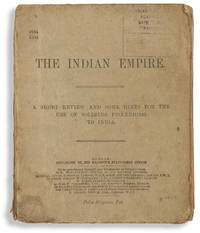
117119London HMSO 1917. . 24 mo 13 x 11 cm; 7 plates at end folding map in pocket at rear Indian Military Base stamp to upper wrapper; publisher's brown paper wrappers lightly soiled slight wear to extremities spine at some point torn and glued back down a good copy; 130 pp 23 pages ads.<br /> The 1917 issue of this handbook issued originally in 1912 to prepare British soldiers for deployment in India. Chapters cover the geography history culture religion languages government climate and with several devoted to the British and Indian armies and fighting classes. The plates depict the military uniforms of the Baluchis Pathans Madrasi Sepoys Tamils Punjabis Sikhs Gurkhas and Rajputs.<br /><br />The 1917 issue appears expanded as it has 130 pages compared to the 1912 and 1913 issues which have 119 pages.<br /><br />This issue is only in 15 libraries worldwide and only in three UK libraries Manchester Oxford Brookes East Anglia and not in BL which only has the 1912 and 1913 issues.<br /> London, HMSO, 1917. unknown
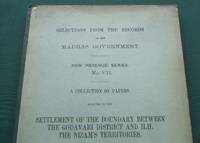
1912012636Madras: printed by the Superintendent Government Press 1912. 3 volumes. Books measure 33.5x21.cm. Collation v147pp 468pp large folding plan 472pp large folding map. Bound in original publishers cloth backed printed boards. Covers lightly rubbed age darkened title in manuscript on spines library label and sold stamp on top boards. Bindings in good firm condition. Internally occasional library mark/stamp. Pages and plan/map in very good clean condition. Good solid clean volumes. Hardcover. Good Plus. Quarto. printed by the Superintendent Government Press Hardcover
1921012280Lashkar: Printed at the Alijah Darbar Press 1921. Book measures 33x21.cm. iv 3441pp. Bound in original publishers cloth backed printed boards. Binding lightly rubbed bumped age darkened library label on top baord. Binding in good firm condition. Internally occasional library stamp cancellation stamp. Pages in good clean condition. A good solid copy. . Hardcover. Near Very Good. Quarto. Printed at the Alijah Darbar Press Hardcover
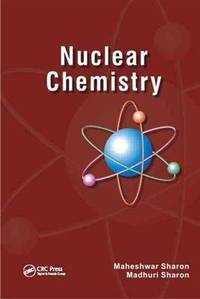
ria9781439809389_inpHardback. New. New Book; Fast Shipping from UK; Not signed; Not First Edition; Focusing on techniques for the detection and measurement of radioactivity this book offers a guide to select the type of counter type of source sample duration for which the counting must be made and the radiation emitted by the iso hardcover
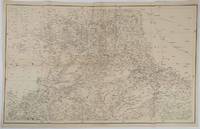
1859189711Calcutta.: Surveyor Generals Office. 1870. Reissue of 1859 edition. Lithographed map 57.2 x 93 cms; 61.1 x 96 cms sheet original folds old paper repairs to the verso and a sealed marginal tear central folds archivally strengthened some toning to the folds and creasing but the map in remarkably good clean condition. Impressive large Calcutta printing from the Survey of India showing Rajasthan Uttar Pradesh and surrounding states with extremely detailed delineation of settlements roads railways rivers and major points of interest the Taj Mahal is highlighted. . Surveyor Generals Office. unknown
2020DBS-9781774073681ARCLER PRESS 2020. 1 ST. Hardcover. New. ARCLER PRESS hardcover
2020DBS-9781774073681ARCLER PRESS 2020. 1 ST. Hardcover. New. ARCLER PRESS hardcover
2020DBS-9781774073353ARCLER PRESS 2020. 1st. Hardcover. New. ARCLER PRESS hardcover
2020DBS-9781774073353ARCLER PRESS 2020. 1st. Hardcover. New. ARCLER PRESS hardcover
2020DBS-9781774072356ARCLER PRESS 2020. 1st. Hardcover. New. ARCLER PRESS hardcover
2020DBS-9781774072356ARCLER PRESS 2020. 1st. Hardcover. New. ARCLER PRESS hardcover
2021DBS-9781774076132ARCLER PRESS 2021. 1ST. Hardcover. New. ARCLER PRESS hardcover
2021DBS-9781774076132ARCLER PRESS 2021. 1ST. Hardcover. New. ARCLER PRESS hardcover
2020DBS-9781774071953ARCLER PRESS 2020. 1st. Hardcover. New. ARCLER PRESS hardcover
2020DBS-9781774071953ARCLER PRESS 2020. 1st. Hardcover. New. ARCLER PRESS hardcover
2020DBS-9781774073704ARCLER PRESS 2020. 1 ST. Hardcover. New. ARCLER PRESS hardcover
2020DBS-9781774073704ARCLER PRESS 2020. 1 ST. Hardcover. New. ARCLER PRESS hardcover
2021DBS-9781774076156ARCLER PRESS 2021. 1ST. Hardcover. New. ARCLER PRESS hardcover
2021DBS-9781774076156ARCLER PRESS 2021. 1ST. Hardcover. New. ARCLER PRESS hardcover
2020DBS-9781774073438ARCLER PRESS 2020. 1 ST. Hardcover. New. ARCLER PRESS hardcover
2020DBS-9781774073438ARCLER PRESS 2020. 1 ST. Hardcover. New. ARCLER PRESS hardcover