GIRAUD M. F-S-VLivre Rare Book
Antiquariat.de
Benares am Ganges. (Nach derNatur). Chromolithographie nach E. T. Compton.
190076592[ca. 1900]. Bildgröße 13,5 x 21 cm. Unter Passepartout.

Antiquariat Reinhold Pabel · DE - Hamburg29,00 €
519 résultats
182199937916Paris Eymeri 1821, In Paris Eymeri 1821, In-12 relié pleine basane de l'époque, dos lisse trés orné, guirlande d'encadrement sur les plats. 428 pages. Gravures. Mors un peu fragile, bon exemplaire.
1821113917Paris, Alexis Eymery 1821 Tome 2 seul. In-16 17 x 10 cm. Reliure de l’époque basane fauve marbrée, dos lisse orné de petits fers encadrés de roulettes dorées, fer de la pension Mathieu sur le premier plat, 428 pp., 6 gravures coloriées hors texte, table des matières. Coins émoussés et frottés, intérieur frais.
190076592[ca. 1900]. Bildgröße 13,5 x 21 cm. Unter Passepartout.
18303541FBBerlin, Verlag Königlich Preußische Kalender-Deputation, 1830. 16°. 13 x 9,5 cm. 204, 108, 107, 66 Seiten. Pappband der Zeit mit reicher Blindprägung und Rundum-Goldschnitt. Pappschuber. [8 Warenabbildungen]
185929865ABAmsterdam, Kraay 1859. Gr.8°. Frontispiz, Titel, 1 Bl., 390 S. Rotes HLdr der Zt mit Rückentitel und etwas Rückenvergoldung. Einband berieben, stellenweise auch beschabt. Teils etwas stockfleckig. Wenige Textseiten mit etwas Tafelabklatsch. Eine Tafel im weißen Rand eingerissen.
189328414Vendôme Typograohie Lemercier, Huet Successeur 1893 In-8 ( 3 fascicules ) pagination continue, 292 pp- année complète, une tache claire en marges du dernier fascicule
189328415Vendôme Typograohie Lemercier, Huet Successeur 1893 In-8 ( 3 fascicules ) pagination continue, 292 pp- année complète, une tache claire en marges du dernier fascicule
1900198362Madras, 1900. M. 6 Taf. 92 S. OBr. Umschlag leicht angeschmutzt, knickspurig u.a. Rücken geklebt. Min. randgebräunt.
1889002014No Place: No Publisher 1889. Cabinet card of a Regimental boxing match in India approximately 165mm x 105mm in size dated 1889 to reverse. Image faded pin hole to either end where once pinned up slightly rubbed. Reverse has notes in ink 'From Joseph Theodore O'Brien to his affectionate chum Edward Perkins Ramplu India 20th February 1889 for Rs 150 37 rounds'. First Edition. Unbound. Good. 32mo Oblong. Cabinet Card. No Publisher Paperback
1892129834Paris, Société d'Éditions scientifiques, 1892 In-8, demi-basane rose, dos à nerfs, couvertures et dos conservés, III- 493 pp., 116 figures et illustrations en noir et blanc dont 31 hors texte d'après les croquis et photos de l'auteur, grande carte in fine.
1825LBW-31781821 [1825]. 548 x 410 mm.
190037613- 2 feuilles 25 x 30 cm. Quelques rousseurs.
188484478- 1 carte 30 x 23 cm, pliée en deux.
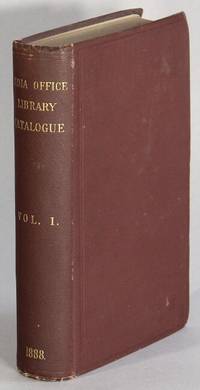
188869822London: printed by Eyre and Spottiswoode printers to the Queen's Most Excellent Majesty 1888. 8vo pp. 4 567 1; original brown cloth gilt-stamped spine; near fine. Without the separately printed Index and Supplements. This is the first in a series of catalogues that ran until 1937. It is the only catalogue of western books in the India Office. Other volumes included books in Sanskrit Hindistani Hindi Panjabi Pushtu Sindhi Bengali Oriya Assamese Marathi Gujarati and Persian languages. printed by Eyre and Spottiswoode, printers to the Queen's Most Excellent Majesty unknown
1892012276London: Printed for the Indian Government By Eyre and Spottiswoode 1892. Book measures 34.5x22.cm. xii522pp. Bound in period or early blind stamped cloth with gilt lettering. Cloth lightly rubbed dust/dirt marked library label on top board. Binding in good condition. Internally occasional library stamp cancellation stamp age tanning. Pages in good condition. . Cloth. Good Plus. Quarto. Printed for the Indian Government By Eyre and Spottiswoode Hardcover
186812856Lacroix, Verboeckhoven et Cie Paris, Bruxelles 1868 1 vol. In-12 broché de 334 pp., couverture imprimée.
18045517AGNürnberg, A. G. Schneider u. Weigel 1804. Kupferstich-Karte. Altes Flächen - und Grenzkolorit. Darstellung: 70 x 54 cm Blatt:80 x 57,5 cm Mittelbug, leichte Gebrauchssp., im Ganzen gut erhalten. Auf Wunsch Digitalaufnahme in jpg-Format erhältlich- photo in jpg-format available. Je nach Versandart können die Portokosten bis zu 2 ? weniger als angegeben betragen.
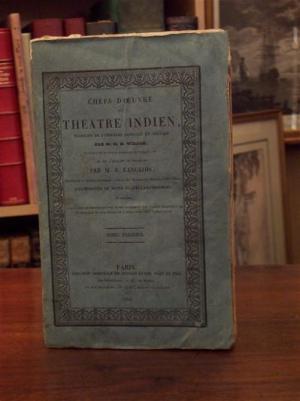
18282899Traduits de l’original sanscrit en anglais par H. H. Wilson, et de l’ anglais en français par Langlois.Manque de papier au dos du tome 2. Brochés. Paris Dondey-Dupré 1828 2 volumes in-8°.
185041637Leipzig u. Dresden, Payne, um 1850. Bild ca. 14 x 20 cm, Blatt ca. 20 x 25,5 cm. 1 Blatt, verso weiß.
1887R106630Trichinopoly [= Tiruchirappalli]/ Paris, Collège St-Joseph/ Retaux-Bray 1887-1889 Complet en 2 tomes: vi,411 + 315pp., avec 1 carte dépliante et 37 gravures hors-texte (dont des planches dépliantes et en double-page), 29cm., brochures originales (avec quelques rousseurs), texte et intérieur sont frais, bon état, poids: 2.1kg., R106630
1889104572Trichinopoly, Collège Saint-Joseph, et P., Retaux-Bray, 1889, 2 vol. in-8°, vi-411 et 315 pp, 37 gravures hors texte, dont le frontispice (24 gravures pleine page, 3 gravures sur double page, 10 gravures dépliantes), une carte dépliante hors texte, reliures demi-chagrin noir, dos à 5 nerfs, titres dorés (rel. de l'époque), dos lég. frottés, C. de bibl., trace de mouillure angulaire sur les pages de garde du tome I, état correct
1900100865c. 1900. 54 diapositive glass lantern slides 3-1/4 x 4 and 3-1/4 x 3-1/4 inches six hand-colored bound at edges with gummed paper or metal frame some with manufacturer's printed label and manuscript caption; a few with hairline cracks. Housed in contemporary wooden box with lid. A varied collection of ethnographic and architectural scenes largely from Northern India with a few of Ceylon Sri Lanka tea production. Some of the locations include Darjeeling Mumbai Bombay Kakinada Elephanta Caves Mumbai Calcutta including many of the Hooghly River Dehli Sinla Ceylon Kashmir as well as one scene of European tourists scaling pyramids in Egypt. The collection appears to have been gathered from various sources with plates manufactured by T.H. McAllister New York William Garrison Reed Boston J. Moore Birmingham and William H. Rau Philadelphia. unknown
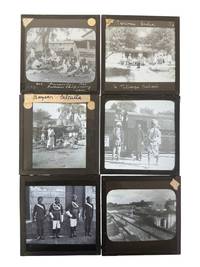
1900232871900. India glass lantern slide archive documenting class hierarchy dichotomy in British India with scenes of village labor bazaar exchange railway movement industrialization Sikhs and colonial cavalry circa 1900-20. Images clearly depict the class divid and Cast system; villagers and laborers are shown seated on bare ground in carpentry work men and goats occupy an unpaved settlement space Sikh men stand beside a railway carriage tied to imperial transport networks a factory scene introduces mechanized industry and a formal portrait of turbaned cavalry soldiers.<br /> Photo archive of 8 glass lantern slides 3.25" x 3.25" India circa 1900 to 1920. Several slides retain manuscript captions on the mounts including "Central India" "Village School" "Bazaar Calcutta" and "MV. parannis an Indian carpentry clas." "Parannis" is probably a misspelling or misreading of "Pariahs" a historical caste/community term used in colonial-era descriptions of South Indi The British largely preserved formalized and exploited the Indian caste system rather than dismantling it. Their relationship with caste was pragmatic: caste became a tool for administration taxation labor control military recruitment and social organization across British India. The "Village School" slide shows a line of children and adults posed before a low building under dense tree cover with one figure standing forward in the open yard. The carpentry slide shows a large group of Indian boys outdoors beneath a tree seated or crouched on the ground around planks and hand tools with timber laid across the foreground and simple structures behind. The Calcutta bazaar scene places vendors baskets and goods in an open market setting under palms while the village scene presents men in loose garments in what seems to be a cattle farm setting. One slide shows Sikh men beside a railway carriage one barefoot in the foreground and others gathered near the rail car doors linking Indian bodies to the movement of goods troops and passengers through the colonial rail system. Another slide presents four uniformed soldiers in turbans possibly the Madras cavalry posed formally with boots sashes and weapons before a masonry wall. The factory view shows smoking industrial works with long roofs tracks and an extended production yard further cementing colonial industrialization within the archive.<br /> <br /> British rule in India relied on linked systems of extraction transport discipline and military force and these slides place those systems beside the people who bore their unequal social effects. Railways expanded under colonial finance and administration to move troops raw materials and commercial goods; industrial sites grew beside older economies of hand labor and bazaar trade; Indian soldiers and cavalry units served within an army organized to secure imperial control; and rural schools workshops and village scenes expose the local social world that existed under those pressures rather than outside them. Light edge wear some mount loss to several slides; no cracks or chips. Overall very good condition. British colonialism widened India's class divide by concentrating wealth transport and military power in imperial systems while leaving many Indians in village labor and low paid market work. unknown
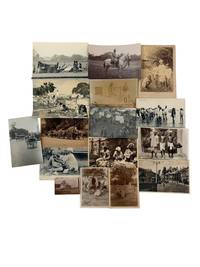
1890234981890. Colonial Indian labor photo archive depicting street work informal commerce transport labor and social hierarchy under British rule circa 1890s-1920s. British India depended on low-paid manual labor to move people goods food and raw materials through cities ports hill stations and military cantonments. The group contrasts workers seated on the ground with baskets tools tents carts and roadside goods against riders on horseback and passengers carried by rickshaw carriage and bullock cart. <br /> <br /> Photo archive of 16 silver gelatin photographs and black-and-white real photo postcards various sizes India circa 1890s-1920s. Marketplace sellers sit among baskets cloth tents and on the ground goods; families and workers gather beside tents and rough encampments; men pull or guide rickshaws carriages and ox-drawn carts through colonial streets. A mounted man sits formally on a white horse while views of Simla show pedestrians commercial buildings and hill-station streets associated with British administration and seasonal elite life. Additional scenes show an outdoor "Hindu barber" "Indian coolies" carrying large baskets men seated by stonework near a Gothic-style building children posed in white garments some hand written captions en verso identify locations or tasks.<br /> The archive records the everyday labor that supported colonial India before independence when caste landlessness debt and imperial wage economies shaped who carried cleaned hauled shaved sold and served. Ligh toning handling and edge wear; overall in very good condition. A late colonial documentation of Indian labor and social separation grounded in street work transport marketplace survival and the visible privileges of those being carried or served. unknown
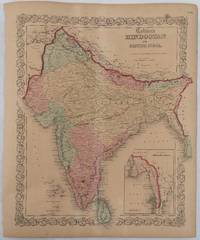
1859224156New York.: J. H. Colton. 1859. Hand-coloured map 40 x 33 cms inset map "Continuation of British India" 12 x 9.3 cms showing Burma elaborate decorative burst border a few spots sheet age-toned inner margin a little chipped not affecting the map and small split in the outer margin no loss text "Farther India or Indo-China" from Colton's atlas on the verso an attractive map in good condition. Attractively hand-coloured map showing different districts presidencies and independent kingdoms with contrasting pastel pinks yellows greens and blues. Major Presidencies Bengal Bombay and Madras are shown alongside extensive detail on river networks the Himalayan range roads and early railway lines connecting major trading hubs. Published a year after the East India Company was stripped of its governing powers following the tumultuous events of the 1857 Indian Rebellion Sepoy Mutiny. This 1859 map is one of the very first American atlas sheets printed to reflect the formal establishment of direct British Crown rule the Raj. It illustrates a subcontinent transitioning from a corporate-held trade monopoly into the crown jewel of Queen Victoria's empire neatly delineating newly pacified administrative boundaries. . J. H. Colton unknown