[INDIA]Biblio.com
519 résultats
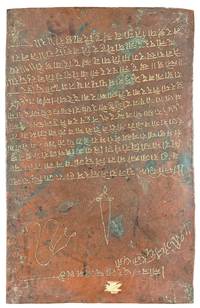
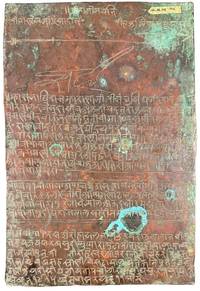
181942798Eastern India possibly Bengal or Assam circa 18th-19th century. Copper plate 13 7/8 x 9 1/8 inches engraved on both sides. The principal face with several lines of incised text at the head followed by a large engraved validating or emblematic mark and below this three dense sections of text divided by ruled horizontal lines. The reverse largely uninscribed with three small engraved seals or validating marks near the edge. An inscribed copper plate of Indian origin possibly Bengal or Assam engraved in a Bengali or Bengali-Assamese script and preserving a formal documentary text in metal.<br/> <br/> This copper plate belongs to the South Asian tradition of preserving legal devotional and administrative records on durable metal supports. Copper plate documents often described as tamrapatra or copper charters were used for grants endowments title rights decrees and other formal acts their material permanence giving them authority beyond that of ordinary manuscript documents. The present example appears to preserve a substantial text arranged in ruled sections and accompanied by validating marks. The script appears close to Bengali or Bengali-Assamese. The letterforms show rounded and looped shapes consistent with scripts used in eastern India. If confirmed this would suggest an origin in Bengal Assam or a neighbouring region where related scripts were used for administrative and religious writing. From their earliest centuries of development copper plate inscriptions have occupied a central place in South Asian documentary culture particularly in the recording of land grants royal edicts temple endowments and other formal transactions. Their durability made them suitable for preserving records intended to endure and they were often deposited in temples or held by families or institutions as proof of rights and privileges. While earlier examples are frequently associated with royal chancelleries the practice continued into the early modern and colonial periods with regional administrations and local authorities maintaining related forms of documentation. The present plate appears to belong to this later phase of the tradition when such documents were still being produced for administrative legal or commemorative purposes. Its relatively large format and the density of inscription suggest a formal text of some substance while the additional engraved devices indicate an effort to authenticate or formalise the record. The copper plate offers a direct example of a documentary practice that bridges manuscript culture and more durable forms preserving both the text itself and the physical conventions of its transmission. unknown
181942797Western or Northern India circa 18th or 19th century. Copper plate 15 1/2 x 9 3/4 inches engraved on both sides one face densely filled with horizontal lines of incised text and with additional marks including a dagger or torch device and other validating or ownership marks. The reverse more sparsely inscribed with two lines of text. An inscribed copper plate of Indian origin engraved on both sides and belonging to the South Asian tradition of preserving legal devotional and commemorative texts.<br/> <br/> A striking survival from the documentary culture of South Asia where copper served as a durable support for records intended to outlast paper and palm leaf. Such copper records often described as tamrapatra or copper charters were valued because they were portable difficult to alter and capable of serving as enduring witnesses to grants decrees endowments title rights and other formal acts. The script appears to belong to the Nagari family possibly Devanagari or a related cursive administrative hand such as Modi the script long used for Marathi official and business writing. From their earliest centuries of development copper plate inscriptions have occupied a central place in South Asian documentary culture particularly in the recording of land grants royal edicts temple endowments and other formal transactions. Their durability made them suitable for preserving records intended to endure and they were often deposited in temples or held by families or institutions as proof of rights and privileges. While earlier examples are frequently associated with royal chancelleries the practice continued into the early modern and colonial periods with regional administrations and local authorities maintaining related forms of documentation. The present plate appears to belong to this later phase of the tradition when such documents were still being produced for administrative legal or commemorative purposes. Its relatively large format and the density of inscription suggest a formal text of some substance while the additional engraved devices indicate an effort to authenticate or formalise the record. The copper plate offers a direct example of a documentary practice that bridges manuscript culture and more durable forms preserving both the text itself and the physical conventions of its transmission. unknown
1846LITT3107MParis: Garnier frères, Fournier, 1841. Nouvelle édition augmentée de lettres inédites et accompagnée d'une carte, 2 volumes in-12; T.I: [iv], 370p., 1 grande carte dépliante. T.II: [iv], 372p. Reliure demi dos ornée à cuir.
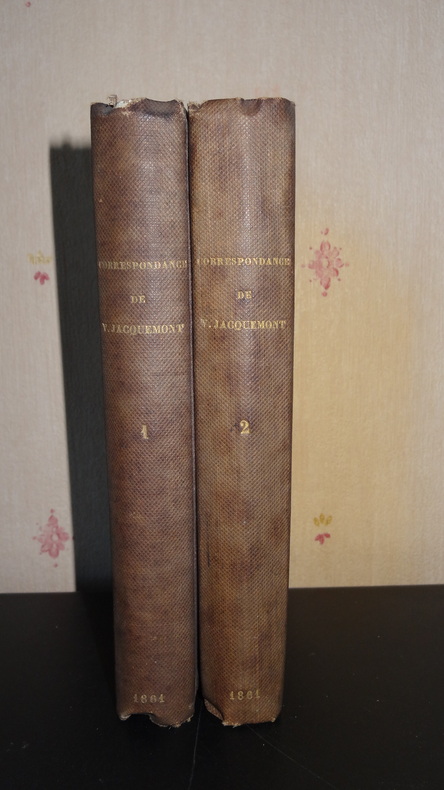
1861JC2915Paris; Garnier Frères, Libraires-Éditeurs, cinquième édition, 2 volumes reliés pleine percaline, 432 + 442 pages, 1 carte dépliante en fin du tome 2, reliures défraîchies, dos passés uniformément, intérieur correct avec rousseurs éparses et jaunissement de quelques pages dûs à l'insertion d'articles de journaux, état général correct. Frais de port en supplément.
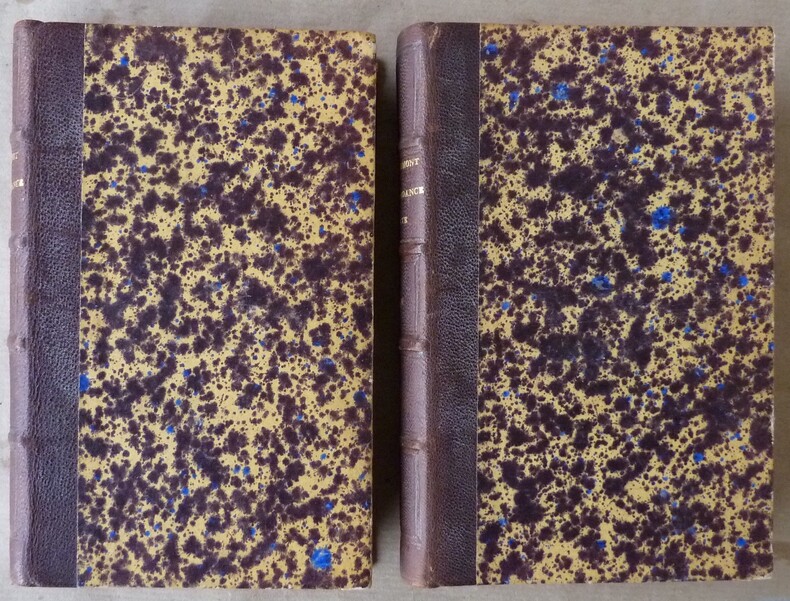
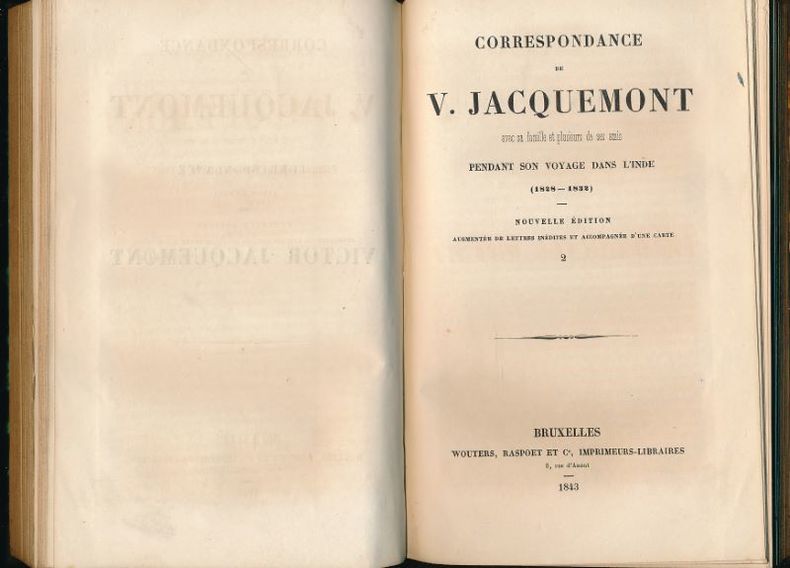
1843X32821Bruxelles, Wouters, Raspoet et Cie. 1843 278 + 284pp.+ 1 carte dépliante, nouvelle édition augmentée de lettres inédites et accompagnée d'une carte, couv.cart. avec plats marbrés, dos en cuir (titre et faux-nerfs dorés), qqs. cachets aux pages de titre, peu usagé, bon état, X32821
186146849Couverture rigide. 2 volumes, reliure demi-basane. 432 + 442 pages.
187792581877 Paris, Calmann Lévy, 1877. Ensemble de deux volumes de format in 12 de XVI, 390 pp. , et 430 pp. Reliure de l'époque en demi chagrin brun, titres et tomaison dorés.
184685461846 Paris - Paris Garnier Frères, 1846 - 2 volumes in12, demi chagrin vert, dos orné, 370 , 372 p. 2 volumes, notes bibliographiques, appendice, carte de l'Inde dépliante en noir en fin du volume II par Victor Jacquemont 4ème édition accompagnée d'une carte nouvelle
183319686Paris Librairie de H. Fournier 1833 2 vol. in-8 demi-bas. verte, dos ornés, armes aux dos [Rel. de l'époque]
184376121843 2 volumes (two books), demi-reliure bleu-marine à coins (half binding with corners) grand in-octavo, dos long (spine without raised band) - fers spéciaux (between the raised bands specials blocking stamps) - titre frappé or (gilt title) et tomaison (volume numbering), mors et coins à filets gras or (joints and corners with broad gilt lines), papier marbré aux plats (cover with marbled paper) - quatrième plat abîmé (back cover lightly damaged), tranches jaspées (marbled edges), pages de garde peignées à motif "coquille sur fond caillouté" (painting flyleaf), illustration : carte repliée in fine déchirée mais complète (torn but complete folding map at rear), naissances de rousseurs (beginning of the redness marks), 278+284 pages, 1843 à Bruxelles Wouters - Raspoet et Compagnie Imprimeurs-Libraires,
1834394572 tomes en 1 vol. in-12 reliure romantique demi-maroquin vert, dos à 4 nerfs plats richement dorés estampés à froid, tranches marbrées, H. Dumont, Bruxelles, Londres, Dulau et Ce, 1834, 360-353 pp. et une grande carte dépliante
1861123248P., Garnier Frères, 1861, 2 vol. in-12, 432 et 442 pp, 5e édition accompagnée d'une carte nouvelle, reliures demi-chagrin carmin, dos à 4 nerfs, titres et caissons dorés, encadrements à froid sur les plats (rel. de l'époque), plat sup. du tome I sali, rousseurs éparses, sans la carte annoncée, bon état
1843140922Bruxelles Wouters, Raspoet et Bruxelles Wouters, Raspoet et Cie, 1843. 2 parties reliées en une seul volume In-8 demi-basane verte, dos à nerfs soulignés de filets dorés. 278 + 284 pages. Bien complet de la grande carte dépliante. Petits frottements à la reliure, corps de l'ouvrage en bon état. Bon exemplaire.
1861dk446Paris, Garnier frères, libraires-éditeurs, 6, rue des Saints-Pères Relié 1861 In-12, (11.5x17.5 cm), relié demi-cuir vert, dos à 5 nerfs avec le titre et la tomaison dorés, 432 pages, 5e édition accompagnée d'une carte nouvelle, tome isolé, coupures de journaux insérées avec l'ouvrage ; rousseurs, coiffes et coins légèrement frottés, état d'usage. Livraison a domicile (La Poste) ou en Mondial Relay sur simple demande.
184690601Paris, Garnier Frères, H. Fournier 1846 2 volumes. In-12. Reliures de l’époque demi-basane verte, dos lisses ornés de fers dorés encadrés de filets à froid, 370-372 pp., 1 carte repliée in fine. Reliures légèrement frottées, rousseurs marginales.
1841137608Paris, H. Fournier aîné, Garnier frères 1841 2 volumes. In-12 18 x 11,5 m. Reliures demi-chagrin violine, dos à nerfs ornés de filets dorés, 570-572 pp., 1 carte repliée de l’Inde, table des matières. Exemplaires en bon état, intérieur très frais, exempt de rousseurs.
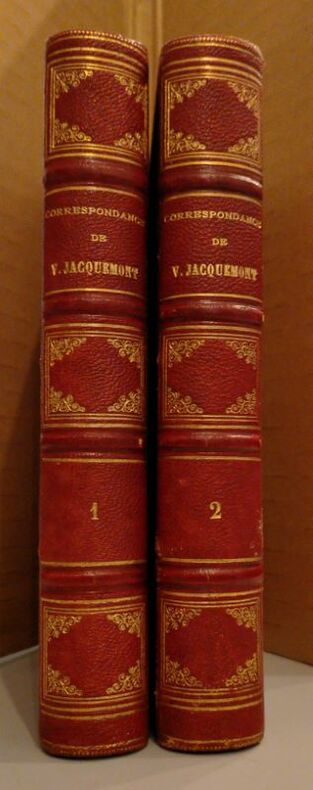
1841024381Paris Garnier frères - Fournier ainé 1841 Deux volumes in-16°, (4) 370 et (4) 372 pp. Cartonnages anciens en percaline rouge, dos lisses ornés du titre, de tomaison et de filets dorés, gardes cailloutées. (une coiffe un peu marquée, présence de rousseurs sur les tranches, les gouttières et à la marge de quelques feuillets, une cerne claire à la marge des 10 premiers feuillets au tome I). Complet de la carte repliée en fin du tome I.
185688813Couverture souple. 4 revues. 16 x 25 cm. 318 pages. Rousseurs. Couvertures légèrements défraîchies.
18961095282Zürich, Henckell, 1896. Titelportr., 4 Bl., 120 S. OPp.
1839022098London: Smith Elder and Co. 1839. First Edition. Hardcover. Fairly unobtrusive library blindstamp on frontispiece pictorial title map and several text pages. Still an attractive clean example of a scarce title in a Fine clamshell box. Modern half polished calf with marbled boards and matching calf corners 5-1/2" x 9"; xvii 3 283 1 pages housed in a red buckram clamshell box. Lacking the printed title page but with the lithographed additional pictorial title and illustrated with a hand-colored map 8 engraved plates 7 of which are hand-colored including 1 folding and several text engravings. In 1834 the author's husband was posted to Cutch a western district of present-day Gujarat India and there she gathered the notes and made the drawings that would form the basis for this her first publication. <br/><br/> [Smith, Elder and Co.] hardcover
1839223681London.: Smith Elder and Co. Cornhill. 1839. Engraved handcoloured frontispiece opposite the additional engraved title page sketch map and 7 other full-page illustrations one folding and 5 hand-coloured text illustrations 2 half-title xvii including both the engraved and printed title pages 283pp; original blind-stamped pebbled green cloth boards 23 x 14.5 cms re-backed mounting the original gilt-lettered backstrip endpapers renewed scant spotting the boards faded and the backstrip chipped at the foot with the neat inked inscription of a previous owner but in very good condition. Scarce. Pioneering account beautifully illustrated after sketches by the author. Marianne Postans travelled to India in 1833 with her husband Thomas Postans a Captain in the 15th Regiment of the Bombay Native Infantry where he was posted to Cutch Kutch the northwestern region of modern-day Gujarat. They both shared a deep interest in the people and traditions of India. Marianne's account attempts to describe the culture of the region its bards and bardic literature including specific songs and stories of Kutchi bards arts and crafts and agriculture and trade. She also describes in detail rituals such as infanticide and the practise of sati. <br>The beauty of the Rann awed her: “The distant aspect of the Runn resembles that of the ocean at ebb tide; and as some water always remains on it the refraction of light produces the most beautiful and mysterious effects decorating it with all the enchantments of the most lovely specimens of mirage whose magic power exerting itself on the morning mists indues this desert tract with the most bewitching scenes…”. . Smith, Elder and Co. Cornhill. hardcover
1891RO80067571HACHETTE et Cie. 1891. In-12. Broché. Bon état, Couv. convenable, Dos satisfaisant, Quelques rousseurs. 334 pages.. . . . Classification Dewey : 954-Asie du Sud, Inde
189144661891 Paris, Hachette, 1891, in 12, broché, 335 pages
1839PHIL1490Stgt., Scheible 1839. kl.-8°, LIV, 247 S., 1 gestoch. Front.; x278 S., 1 gestoch. Front., HLn. d. Zt., etw. berieb., gemust. Vorsatzpapier, vereinzelt etw. stockfl.
1897106396BBLeipzig, Wilhelm Friedrich, 1897. Gr.-8°. V, 478 S., [1] Bl. OLn. mit goldgepr. Rücken- u. Deckeltitel.