(Jamaica) Seutter, MatthiasBiblio.com
10 résultats
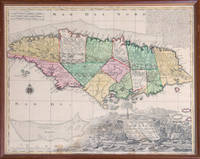
173034040Augsburg 1730. Contemporary coloring. 1 vols. 22 1/4 x 19 1/4 inches. Framed and glazed. Contemporary coloring. 1 vols. 22 1/4 x 19 1/4 inches. Kapp no. 56 The Printed Maps of Jamaica to 1825 unknown
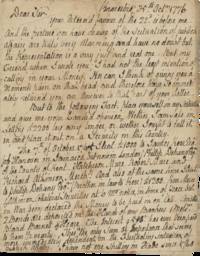
1776List3149Knaresborough England 1776. Single three page letter measuring 6 ¼ x 7 ¾ inches. Normal wear; Near Fine. A letter from Nathaniel Sharpe in Knaresborough to Edmund Green a merchant in London addressed to Green at the Jamaica Coffee House. This café the first of its kind in London was established in the mid-17th century; in 17th and 18th century Britain coffee houses were popular meeting places particularly for conducting business. Sharpe writes to Green:<br /> <br /> “Your Esteem’d favour of the 22d is before me and the picture you have drawn of the situation of publick affairs are truly very alarming and have no doubt but the Representation is a very just and real one. . But to the following Fact place yourself in my situation and give me your Candid opinion Wether I am safe in letting £2200 lay any longer or whether I ought to call it in and place it out on a Security in this Country.â€<br /> <br /> He describes his investments and states that:<br /> <br /> “I have not one shilling in Trade since 1760 and in Decemr. 1762 Retir’d to this place and found myself in possession of a Happiness that I could ill brook to part with. And which I would wish to preserve. Should this sum be in no danger I can live as usual.â€<br /> <br /> The American Revolutionary War had a significant impact on the British economy; at the time Sharpe was writing although the conflict had been ongoing for some time the war itself was in its early days and uncertainty was high.<br /> <br /> Other than asking for financial advice Sharpe tells Green that Green’s “Brother Tommy had . taken a Cup of Liquor rather too freely and had been drawn into Cards†alarming their mother who had requested that Sharpe inform Green about the event; asks Green to visit her; and sends his good wishes to a mutual friend. unknown
1789227355London: Sold by B. White and Son 1789. Third edition first edition was 1756. 49 copper-engraved plates by George Dionysius Ehret. viii 503 646 Index pp. 1 vols. Folio. Bound in contemporary diced calf rebacked. Bookplate of Clarence Dillon Dunwalke Library and with a note that it comes from the Library of Owen D. Young Esq. Third edition first edition was 1756. 49 copper-engraved plates by George Dionysius Ehret. viii 503 646 Index pp. 1 vols. Folio. Browne was an Irish physician who lived for several years in the West Indies and settled in Jamaica in 1746. This is his major work particularly valuable for its contribution to botany. Sabin 8671; Nissen BBl 255; Cundal Bibliographia Jamaicensis 416 Sold by B. White and Son unknown
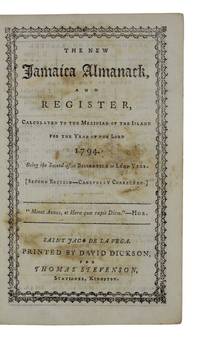
1794AQ30515Saint Jago de la Vega: Printed by David Dickson for Thomas Stevenson Stationer Kingston 1794. 146pp 14. With two hand-coloured engraved leaves of plates depicting 'Signals for distinguishing the Several Packets on the Falmouth Station' bound in before title. Variously interleaved at front with numerous blanks at end inserted some of which removed. Contemporary perhaps original gilt-tooled wallet-format calf over card boards the fold-over flap missing but with an open fore-edge to upper board with marbled paper-lined pocket. Rubbed and marked with some occasional staining sometimes rather unsightly to text childish pen and pencil trials to endpapers engraved signals largely erased and some blank- interleaving or areas of text. Occasional manuscript correction to text. Bifolium G3-4 detached from the binding. A rare Jamaican-printed almanac - with the original engraved signals leaves apparently issued only in this edition - featuring an early example of West-Indian Hebrew printing. Almanacs were apparently first issued in Jamaica during the 1760s printed by Weatherby & McCann Walker & Strupar Douglass and Aikman and later Alexander Aikman alone at Kingston. The rival New Jamaica Almanack and Register first appeared in the same city in 1788 printed by Bennett and Dickson for the stationer Thomas Stevenson of King Street. From 1791 this same title was printed by David Dickson alone at Spanish Town Saint Jago de la Vega. This is definitely not the second appearance of a Dickson printed almanac either printed at Kingston or Spanish Town editions for 1791 1792 and 1793 are known for example with the Saint Jago de la Vega imprint despite the title designation. In addition to providing a calendar specifically for use in the colony noting for example the dates of various Jamaican assizes these eighteenth-century almanacks are perhaps best known for their inclusion of some of the earliest examples of printing with Hebrew type - specifically produced for the use of the largest Jewish community in the Atlantic outside of London - in the Western hemisphere significantly predating any American-printed Hebrew calendar. This is displayed in this edition as a final calendar leaf headed 'Of Months Sabbaths and Holidays which the Hebrews or Jews observe and keep for the Years 5554 an 5555 of the Creation'. Whilst much of the remainder of the first half of the volume relates to British government and administration the first 30pp of the second half includes a description of the geography and history of Jamaica and excerpts various commercial treaties applicable including the 'Act for regulating the Commerce with America' and notes the duties due to the Receiver-General for landing traded goods. Rather disturbingly this includes the government duty of £2 'per head' imposed upon the importers of enslaved Africans. Fully 44 further pages headed 'Jamaica Lists' relate to the civil administration and military establishments of the colony including lists of officials and appointees headed by the then Lt.-Governor Major General Adam Williamson. Included in this section are extensive details on the economic output of the plantations of the island grouped by parish within different counties often revealing the extent of enslavement. Thus St. George is noted as housing '19 Sugar Works and 5 more settling 90 other Settlements 7000 Slaves and 4500 Cattle' whilst Trewlawny housed '86 Sugar Works 126 other Settlements 27000 Slaves and 15000 Cattle'. Copies of the Dickson-printed almanacks printed during the final decade of the eighteenth- century are known with and without maps. There is none present here but equally there is no obvious absence of such. However the only reference we can find to any edition of an almanac with engravings of signals flags as here is in the 1794 edition; indeed the foot of the first of the two engraved leaves notes that it was 'Engraved for the New Jamaica Almanac 1794'. Given the increasingly visible presence of Royal Naval ships in the West Indies due to action taken against French colonies in the War of the First Coalition it is entirely possible that the signals were placed in some copies of the 1794 New Jamaican Almanack instead of the map. OCLC locates three copies worldwide Temple with a map and two at Yale one without a map or signals wanting pp81-102 and possibly pp.145-6; and another without map but with the signals. ESTC N67930. 12mo in 6s. Printed by David Dickson, for Thomas Stevenson, Stationer, Kingston hardcover