[Jamaica].Biblio.com
488 résultats
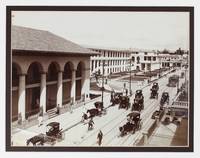
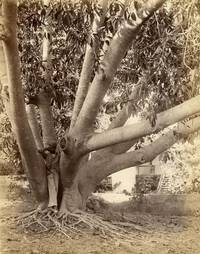
61311c.1880. . Albumen print. Fair tonal range and in good condition; Dimensions: 235 x 185mm. 9.5 x 7.5 inches.<br /> <br /> [c.1880]. unknown
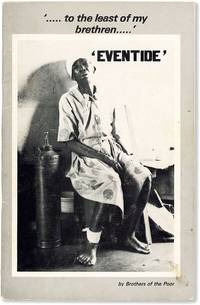
198158149West Kingston Jamaica: Brothers of the Poor / Eventide Home Institution 1981. First Edition. Slim octavo 21.75cm; original pictorial card wrappers; ii50pp; illus. Light wear rubbing and dust-soil to wrappers with a few tiny stains to same; contents clean; Very Good. A book produced to raise donations for the Eventide Relief Fund in the wake of the horrific May 20 1980 fire which tore through a building on the campus killing 157 people. The Eventide Home Institution was established in 1870 as a home for elderly women though it would eventually open its doors to the destitude crippled and severely handicapped children and men of the island. The home was perpetually underfunded and overcrowded with several buildings condemned repeatedly and described as "a tinderbox." Following an introduction by David Johnson the contents are largely dedicated to stark black & white photographs all captioned of the various types of residents the institution cares for virtually all in an exceedingly deplorable state. Scarce; OCLC notes 7 holdings NYPL UCLA Howard Ransom Center U.Illinois BL Natl.Library of Jamaica. Brothers of the Poor / Eventide Home Institution unknown
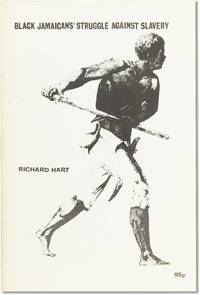
197984943London: Community Education Trust 1979. New Edition. Slim octavo 21.5cm; pictorial wrappers stapled; ii322pp; illus. Inscribed by the author on the inner front cover to Puerto Rican editor translator and literary critic Roberto Marquez: "For Roberto Marquez / with fraternal greetings / Richard Hart / Sept.1981." Gentle sunning to spine touch of dust-soil to rear wrapper; Near Fine. Text of two lectures by the Jamaican historian and politician delivered at the Institute of Jamaica in May 1975 and first published by the Institute in 1977. With a foreword by George Lamming. Uncommon in commerce. 84943. Community Education Trust unknown
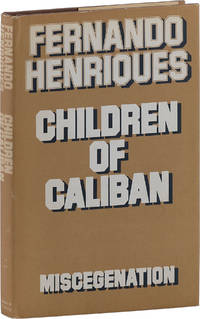
197464110London: Secker and Warburg 1974. First Edition. First impression. Octavo. Cloth hardcover; dustjacket; xii196pp; illus. Neat ownership stamp to front free endpaper and title page else tight clean and unmarked. In the original dustwrapper price-clipped else Fine. <br /> <br /> The Jamaican anthropologist's final published work a pioneering study of attitudes towards race-mixing in the West Indies Latin America and the United States. Henriques 1916-1976 was a major theorist of class color and sexuality best-known for his massive three-volume survey Prostitution and Society 1962-68. He was Director of the Centre for Multi Racial Studies from 1964 to 1974. Secker and Warburg unknown
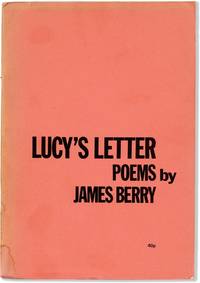
197585005London: Limestone Publications / The City Literary Institute 1975. First Edition. Slim octavo 21.75cm; mimeographed sheets stapled into pink card wrappers printed in black; 23-32pp. This copy is from the library of to Puerto Rican editor translator and literary critic Roberto Marquez inscribed to him by the author on the title page: "Roberto Marquez / with best wishes / July 27 1976 / James Berry / 108 Stanford Avenue / Brighton / Sussex England." <br /> <br /> Early collection of verse by the Jamaican poet who migrated to the UK in 1948. He was known for being one of the earliest writers to integrate Jamaican vernacular in his poetry. The title poem is written in the voice of Lucy a Jamaican woman newly arrived in London and missing Jamaica and many of the poems represented here share the perspective of Jamaican migrants in English society. A nice inscription to Marquez who at the time was founder and editor of the journal Caliban: A Journal of New World Thought and Writing. Uncommon; OCLC notes a single holding at Cambridge. 85005. Limestone Publications / The City Literary Institute unknown
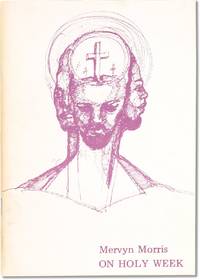
197684942Kingston Jamaica: Sangster's Book Stores 1976. First Edition. Slim octavo 20cm; pictorial wrappers stapled; 45-32pp with black & white illustrations throughout by Lorna Goodison. Inscribed by the author on the title page to Puerto Rican editor translator and literary critic Roberto Marquez: "Roberto / Every good wish / Mervyn." Morris has also signed his full name above his printed name. Sunning to spine minimal wear with a faint dampstain to lower left corner; Very Good. Early collection of verse by the first poet laureate of Jamaica several of which first appeared in the pages of The Daily Gleaner and Bim and were broadcast by the Jamaica Information Service and Radio Jamaica. A nice association copy inscribed to Marquez who at the time was founder and editor of the journal Caliban: A Journal of New World Thought and Writing. 84942. Sangster's Book Stores unknown
197884944Gordon Town Jamaica: Valley Publications 1978. First Edition. First Printing. Slim octavo 21.25cm; pictorial card wrappers stapled; 56-52pp. Inscribed by the author on the title page to Puerto Rican editor translator and literary critic Roberto Marquez: "For Roberto & the comrades of Caliban / Joe Pereira." Gentle sunning to spine small stain to lower right corner of rear wrapper; contents clean; Very Good. Collection of verse by the Jamaican-born poet translator and educator in which he profiles Jimmy Cliff Patrice Lumumba Marcus Garvey Count Ossie and others. A nice association copy inscribed to Marquez who at the time was founder and editor of the journal Caliban: A Journal of New World Thought and Writing. OCLC notes 25 holdings. 84944. Valley Publications unknown
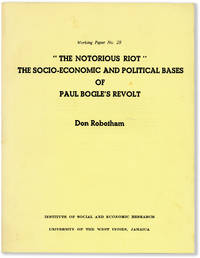
198181354Kingston: Institute of Social and Economic Research University of the West Indies 1981. First Edition. Quarto. Printed card wrappers; 95pp. Mimeographed; printed from typescript. Slight external wear; internally clean tight and unmarked; Very Good. Published as ISER Working Paper No. 28. Institute of Social and Economic Research, University of the West Indies unknown
19105793Kingston: A. Duperly & Sons 1910. About very good. Eight glossy sepia-toned photographs each approximately 6 x 9 inches; matted to 14 x 16 inches. Some creasing and wear more pronounced on a handful of images. Minor soiling minimal fading crisp images. A nice group of photographs from the noted Kingston studio of A. Duperly and Sons initially established by patriarch Adolphe Duperly in the 1840s. The images here show local life and scenery including a view of the rebuilt King Street following the 1907 earthquake; local women with baskets perched atop their heads; a man carrying bananas; and several images featuring locals at bends in a river notably one that shows a dapper Black man seated by a stream beneath some palm trees his hat resting on his upturned knee. A wonderful representation of the work accomplished by the Duperly studio after it was rebuilt following the Kingston Earthquake of 1907. A. Duperly & Sons unknown
183937001London 1839. 12 1 blank 1 docket pp. Folio with caption title as issued. New stitching. Very Good.<br /> <br /> Reports are printed "on the actual state of the labouring population and sugar cultivation" with disturbing news that the local magistrate prevents "the labourers from settling and working upon the properties on which they are located." The circumstances under which the laborers work are "wholly unsatisfactory" and further measures are necessary "to protect the rights of the emancipated population of Jamaica. unknown
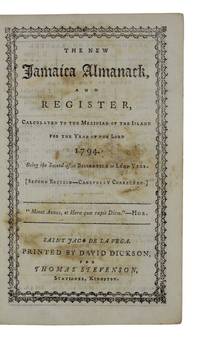
1794AQ30515Saint Jago de la Vega: Printed by David Dickson for Thomas Stevenson Stationer Kingston 1794. 146pp 14. With two hand-coloured engraved leaves of plates depicting 'Signals for distinguishing the Several Packets on the Falmouth Station' bound in before title. Variously interleaved at front with numerous blanks at end inserted some of which removed. Contemporary perhaps original gilt-tooled wallet-format calf over card boards the fold-over flap missing but with an open fore-edge to upper board with marbled paper-lined pocket. Rubbed and marked with some occasional staining sometimes rather unsightly to text childish pen and pencil trials to endpapers engraved signals largely erased and some blank- interleaving or areas of text. Occasional manuscript correction to text. Bifolium G3-4 detached from the binding. A rare Jamaican-printed almanac - with the original engraved signals leaves apparently issued only in this edition - featuring an early example of West-Indian Hebrew printing. Almanacs were apparently first issued in Jamaica during the 1760s printed by Weatherby & McCann Walker & Strupar Douglass and Aikman and later Alexander Aikman alone at Kingston. The rival New Jamaica Almanack and Register first appeared in the same city in 1788 printed by Bennett and Dickson for the stationer Thomas Stevenson of King Street. From 1791 this same title was printed by David Dickson alone at Spanish Town Saint Jago de la Vega. This is definitely not the second appearance of a Dickson printed almanac either printed at Kingston or Spanish Town editions for 1791 1792 and 1793 are known for example with the Saint Jago de la Vega imprint despite the title designation. In addition to providing a calendar specifically for use in the colony noting for example the dates of various Jamaican assizes these eighteenth-century almanacks are perhaps best known for their inclusion of some of the earliest examples of printing with Hebrew type - specifically produced for the use of the largest Jewish community in the Atlantic outside of London - in the Western hemisphere significantly predating any American-printed Hebrew calendar. This is displayed in this edition as a final calendar leaf headed 'Of Months Sabbaths and Holidays which the Hebrews or Jews observe and keep for the Years 5554 an 5555 of the Creation'. Whilst much of the remainder of the first half of the volume relates to British government and administration the first 30pp of the second half includes a description of the geography and history of Jamaica and excerpts various commercial treaties applicable including the 'Act for regulating the Commerce with America' and notes the duties due to the Receiver-General for landing traded goods. Rather disturbingly this includes the government duty of £2 'per head' imposed upon the importers of enslaved Africans. Fully 44 further pages headed 'Jamaica Lists' relate to the civil administration and military establishments of the colony including lists of officials and appointees headed by the then Lt.-Governor Major General Adam Williamson. Included in this section are extensive details on the economic output of the plantations of the island grouped by parish within different counties often revealing the extent of enslavement. Thus St. George is noted as housing '19 Sugar Works and 5 more settling 90 other Settlements 7000 Slaves and 4500 Cattle' whilst Trewlawny housed '86 Sugar Works 126 other Settlements 27000 Slaves and 15000 Cattle'. Copies of the Dickson-printed almanacks printed during the final decade of the eighteenth- century are known with and without maps. There is none present here but equally there is no obvious absence of such. However the only reference we can find to any edition of an almanac with engravings of signals flags as here is in the 1794 edition; indeed the foot of the first of the two engraved leaves notes that it was 'Engraved for the New Jamaica Almanac 1794'. Given the increasingly visible presence of Royal Naval ships in the West Indies due to action taken against French colonies in the War of the First Coalition it is entirely possible that the signals were placed in some copies of the 1794 New Jamaican Almanack instead of the map. OCLC locates three copies worldwide Temple with a map and two at Yale one without a map or signals wanting pp81-102 and possibly pp.145-6; and another without map but with the signals. ESTC N67930. 12mo in 6s. Printed by David Dickson, for Thomas Stevenson, Stationer, Kingston hardcover
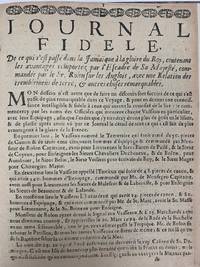
169560184to. 227 x 170 mm. 8 pp. Bound in marbled paper over boards. Margins short cropping page numbers on 2 leaves and just touching but not obscuring the top of some letters of text. Generally very good. <br /><br /><p>Very rare with one recorded copy in Bordeaux of a detailed and lively account of this French expedition against Jamaica during the Nine Years War comprising a string of brutal attacks over the summer of 1694 led by Jean-Baptiste Du Casse. Appointed Governor of Saint-Domingue in 1691 Du Casse had earlier in his career been involved with the slave-trading Compagnie du Senegal and had served throughout the Atlantic world in various capacities including as admiral and privateer. Very familiar with the Caribbean and the ways of the filibusterers and buccaneers operating there he was the best candidate for the difficult job of rallying competing interests to align with those of <i>la France d'outre-mer </i>at a time when funding from France was scarce with Louis XIV distracted by the War of the League of Augsburg closer to home. </p><p>In brief 3 French warships accompanied by numerous transport ships under the command of Captain Rollon were sent to Saint Dominique to provide support to the colonists against the Spanish in neighboring Hispaniola. Soon after their arrival they were reassigned by Du Casse to cruise off Jamaica in early April 1694 where they eventually landed at Port Morant on the eastern coast of the island. Over a period of six to seven weeks they ravaged plantations destroyed over 50 sugar-works and kidnapped hundreds of slaves along with killing and torturing numerous English colonists. Soon to follow Du Casse assembling a small fleet of colonial brigantines and sloops embarked from Saint Dominique with 1500 men for Jamaica. He set sail down the southern coast to Carlisle Bay en route to Spanish Town which he planned to plunder. However a militia company of planters and slaves successfully defended their ground and Du Casse withdrew to St. Dominque but not before destroying Carlisle Bay. "The expeditions richest prize was undoubtedly the 1300 to 3000 captured slaves who proved crucial to the immediate future prosperity of the French colony" Pritchard p. 318 where our narrator points out they could be sold for 60 to 120 piastres each.</p><p>Narrated chronologically the eye-witness account gives vivid testimony to the preparations execution and aftermath of the expedition against Jamaica over the spring and summer months and into the fall of 1694 touching on the internal state of martial affairs between the Spanish and French on the divided island they occupied together. The narrator's lively digressions and personal reflections leave no doubt that he was on the spot when he comments on the disease probably Yellow Fever which ravaged the crews the tremors under foot which incited fear of another earthquake like the one which flattened Port Royal two years before the unexpected collateral encounters and skirmishes with the English in the area related through colorful anecdotes and the general atmosphere of depravation of the crews and the weakness of the Saint Dominique defenses against incursion by the Spanish as a result in large part to the lack of sufficient material support coming from France. </p><p>"If Du Casse could declare the attack on Jamaica a success the same conclusion could not be made by the navy. By August sickness was swiftly reducing crew numbers. <i>Le Solide</i> which had been long in the Islands was immediately sent back to France her crew being too diminished for further use. <i>Le Téméraire</i> had lost 50 of her best sailors and the captain of the English prize now called <i>Le Faucon</i> had died. By September <i>L'Envieux</i> had lost 100 men including her captain and disease claimed Captain du Rollon of Le <i>Téméraire</i>. The four warships including <i>Le Hazardeux</i> departed Cap Francais in early October but further disaster awaited them in the Atlantic" Pritchard p.318– storms capture by the English starvation fire shipwreck disappearance and death. Of the 350 men who departed France at the beginning of the year only 130 returned by year's end. </p><p>Collated against the copy at the Collection de la ville de Bordeaux Bibliotheque municipale see https://issuu.com/scduag/docs/bbx17016 a copy with numerous printer's creases significantly obscuring text; Pritchard <i>In Search of Empire: The French in the Americas 1670-1730</i> Cambridge 2004; Charlevoix <i>Histoire de l'Isle Espagnole ou de S. Domingue</i> 1731 vol. 2 p. 261. Not in Landis.</p> hardcover
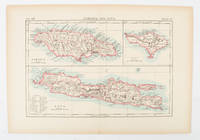
1900174875London and New York.: Encyclopedia Britannica. circa1900. Map in three insets after W & AK Johnston engravers with printed outline colour 18.9 x 28.9 cm central fold paper age-toned but in very good condition. Interesting map which first appeared in the ninth edition of Encyclopedia Britannica. . [Encyclopedia Britannica] unknown
14752'Jamaica No 81'. Executive Committee Office. 26 January 1856. 3pp. foolscap 8vo. Bifolium. In good condition on lightly aged and worn paper. The letter begins: 'Gentlemen I am directed to inform you that a Bill of Exchange drawn by His Excellency the Governor and the Members of the Executive Committee on the Lords of the Treasury for the sum of £10.822 . 9 . 6 at thirty days' sight will be forwarded to you by the Receiver General by the present Mail together with Bills of the Colonial Bank making with the Bills already forwarded the further sum of £9.500 - and to provide altogether the sum of £20.000 which I am to instruct you to receive and pay to the Bank of England in liquidation of that amount payable there on the 1st April next for Interest and Sinking Fund on the Jamaica Guaranteed Loan.' The letter continues for more than a page in the same vein. From the Hankey & Co. banking archive. Underneath summary of contents "Ansd do 16 Feb. /56 the date of receiving W.W. William Wilson of Hankeys" has initialled 'Jamaica No 81'. Executive Committee Office. 26 January 1856. unknown
First and only edition, [2], 30pp., stitched as issued in blue paper wrappers, a very good copy. The author argues against putting an additional duty on sugar "which... would be a great hardship on the sugar-planter in the West Indies, and very little benefit to the revenue...". He sets out all the costs involved in producing sugar, such as the price of slaves and the cost of keeping them, the higher freight costs, insurance, cost of animals and contributions to the defence force. Finally, he states the advantages of the sugar trade for Britain and shows how an additional duty would be to the detriment of the trade. Goldsmiths'-Kress, 8163; Hanson, 5917; Sabin, 40397; ESTC gives the British Library as the only UK hold.
14751Duckenfield Hall Estate letter: On Hankey's letterhead of 7 Mincing Lane London EC; 29 December 1915. Meylersfield and Friendship Estates letter: no place; dated 26 June 1917. The two items are in very good condition on lightly-aged paper. Accompanying the two items is the envelope in which they were contained docketted: 'Letters. Duckinfield sic Hall Estate Meylersfield Estate & Friendship Estate Trust'. Both items are signed 'Cyril Gurney H. A. Trotter L. M. Harvey'. ONE Duckenfield Hall Estate letter: 1p. 4to. Begins: 'Owing to the value of Duckenfield Hall Estate being largely in excess of £6000 the sum at which it stands in the firm's books it is agreed between us that in the event of the death of a partner his executors shall receive a share of the surplus profits after ten per cent has been paid on £6000.' The letter continues on the topic of the action to be taken 'in the event of the estate being sold'. A descendant of the English judge Sir John Gurney 1768-1845 and a member of a prominent abolitionist family Cyril Gurney had married Margaret Evelyn Trotter in 1894. TWO: 1p. foolscap 8vo. Setting out what is to be done with 'any profit or surplus arising from the sale of Meylersfield Estate or from the trust in connection with he winding up of Friendship Estate.' From the Hankey & Co. banking archive. Duckenfield Hall Estate letter: On [Hankey's] letterhead of 7 Mincing Lane, London, EC; 29 December 1915. Meylersfield and Frien unknown
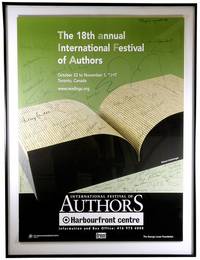
19970297531997. A promotional poster for the annual Toronto literary festival which each year since 1980 has brought together some of the best writers of contemporary world literature. This is one of only a handful of copies signed by all or most of the year's participants approximately 54 signatures. Signed by: Robert Stone Barry Lopez Richard Ford Michael Ondaatje Anne Michaels Colm Toibin Bharati Mukherjee Jamaica Kincaid Guy Vanderhaeghe Michael Turner Jane Urquhart Mavis Gallant Ann Beattie Nino Ricci James Reaney and many others. From the collection of the promoter of the festival Greg Gatenby. Designed by Richard Artschwager. 17" x 23". Rolled else fine. No Binding. Fine. unknown
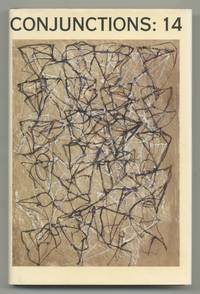
1989524075New York: Charles Scribner's Sons 1989. Hardcover. Near Fine/Near Fine. First edition. Edited by Bradford Morrow. Octavo. 287 9 ads pp. With several black and white illustrations. Green remainder mark on bottom edge else fine in price-clipped and very lightly worn near fine dust jacket. Signed by editor Bradford Morrow on the title page and Signed by Jamaica Kincaid Robert Coover John Edgar Wideman Patrick McGrath and William T. Vollmann at their contributions. Also prints contributions by Robert Creeley John Hawkes and Salman Rushdie among others. Charles Scribner's Sons hardcover
1662250234Southampton House England 1662. 1 bifolium 11-3/4 x 8-1/4 in. accomplished entirely in manuscript. Docketed verso: "Sr Tho. Whetstones warrant for £100 out of the privy seals dormant. indistinct initials follow.". 1 vols. 4to. Former fold lines per usual; some surface soil to recto of document; heavy surface soil to verso of integral cognate; small perimeter chips and light distress. 1 bifolium 11-3/4 x 8-1/4 in. accomplished entirely in manuscript. Docketed verso: "Sr Tho. Whetstones warrant for £100 out of the privy seals dormant. indistinct initials follow.". 1 vols. 4to. According to David F. Marley's Pirates of the Americas Sir Thomas Whetstone 1630/31-1668 was a nephew of Oliver Cromwell "reduced from a Commonwealth naval Commodore into an impoverished West Indian rover before dying in Spanish hands." <br /> Whetstone is described by ODNB as a naval officer and adventurer and a son of the favorite sister of the protectorate. Through nepotism per the protector's "misplaced patronage" Whetsone quickly rose through the naval ranks. He ascended from a volunteer on Penn's flagship in the 1654 expedition to Hispaniola was given command of a ship on the return voyage home and eventually commanded a squadron cruising the waters between Malta and Crete.<br /> Whetstone soon became a man of questionable integrity. He flouted orders sold grain seriously needed to sustain the fleet for his own profit quarreled with officers and in general showed high levels of insolence incompetence and dallied onshore avoiding naval duties. <br /> Cromwell's death changed Whetstone's fortunes. When it became apparent to political forces that his usefulness as a pawn to control the naval fleet was insignificant Whetsone returned to England at the restoration impoverished and spent. By 1661 he was in a debtor's jail in Marshalsea where he became a royal nuisance by "bombarding" the government for employment and begging relatives for money. Finally to put this embarrassment out of harm's way the King agreed in April 1662 to give Whetstone £100 and to establish him as a Jamaican planter. The money was considered "royal bounty for his encouragement in settling a plantation in the Isle of Jamaica." Additionally Whetsone was given twelve indentured men to help him establish a foothold in the New World. <br /> Here then is the material evidence that propels Whetstone towards his destiny in the West Indies. The document is signed "T. Southampton" by Sir Lawrence Tanfield Earl of Southampton Keeper of the Privy Seal. Addressed to and directing Sir Robert Pye auditor of the exchequer and indicating that he is to give Sir Thomas Whetstone £100 ". as of his Majesty's free gift for his incouragement sic in settling a plantation in the Island of Jamaica." With this document a new chapter in Whetstone's life opened upon his arrival in Jamaica in 1662.<br /> As Marley notes Whetstone's first actions in the West Indies was not to become a sedentary planter but to be a privateer. With an Indian crew he began operating and raiding off the Cuban coast. Then personally providing recent intelligence to the infamous Sir Christopher Myngs 1625-1666 an English admiral and pirate whose riotous atrocities with his buccaneers were legendary Whetstone joined in Myngs' 1662 sacking of Santiago de Cuba. Myngs was hated by the Spanish and famed for his unbridled cruelty. His atrocities next year in 1663 with pirates Henry Morgan and Abraham Blauvelt would alarm and forced King Charles II to call for a moratorium on further attacks. In the same year Whetstone was likewise endeavoring: on record as commander of a 7-gun Spanish prize manned by sixty souls and noted as one of the "private ships of war belonging to Jamaica."<br /> In addition to his exploits at sea Whetsone was heavily involved with the arrest and deposal of the Jamaican Speaker of Assembly Samuel Long on charges of treason in 1664. By 1666 Whetsone himself became Speaker of the Jamaica House of Assembly. Circa this period he was captured by the Spanish on Providencia Island carried as a prisoner to Portobelo and then force-marched to Panama City where he was tossed in the dungeon. So angry were the Spanish at Whetstone's piratical depredations the Governor Juan Perez de Guzman wrote to Madrid blaming the man for planning "all the damage done on these coasts." Whetsone died in Spanish captivity in 1667. See ODNB; Marley Pirates of the Americas pp. 399-405 unknown
1837333372London: Printed by J. C. Chappell 1837. First edition. xii 282 vii 1pp. 8vo. Contemporary cloth black morocco spine label yellow endpapers. First edition. xii 282 vii 1pp. 8vo. An impassioned appeal by Henry Sterne resident of St. George Jamaica in defense of "apprentices" i.e. newly-freed slaves following the 1834 emancipation in the West Indies who have suffered mistreatment citing detailed legal cases and presenting legal and religious arguments: "The iron yoke of slavery for apprenticeship is equally as bad if not worse still reigns. The lash dungeons and chains are in constant attendance throughout the land and will remain so for near four long years to come" p. vii. Sabin 91337; not in Cundall Printed by J. C. Chappell unknown
186724796London: Hurst and Blackett 1867. First edition. 355 1pp. 1 vols. 8vo. Bound in 3/4 contemporary green morocco and marbled boards marbled edges. Veryu Good. First edition. 355 1pp. 1 vols. 8vo. Presentation on endpaper "C. Noles 1st Prize for Mental Arith Presented by Mr. Burden of Duke Street Grovenor Square." <br /> He travelled to Jamaica Haiti which he called "Niggerdom" and the Southern States. Hurst and Blackett unknown
1905217074Kingston Jamaica: Published for the Jamaica Committee 1905. Fifth Year of Issue. Illustrated throughout Folding map. 16 ads vi 2 116 pp. 1 vols. 8vo. Cream wrappers. Front cover off else very good. Fifth Year of Issue. Illustrated throughout Folding map. 16 ads vi 2 116 pp. 1 vols. 8vo. <br/><br/> Published for the Jamaica Committee unknown
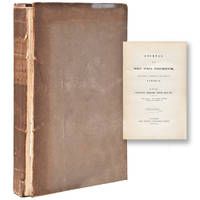
1834243094London: John Murray 1834. First edition. With leaf of Murray advertisements preceding half-title and 2 small inserted leaves of Simpkins and Marshall ads at back. viii 408 pp. 1 vols. 8vo. Original drab boards with printed paper spine label. Front board detached else very good. Bookplate of William Arthur Sixth Duke of Portland and label of Chillingham Castle. First edition. With leaf of Murray advertisements preceding half-title and 2 small inserted leaves of Simpkins and Marshall ads at back. viii 408 pp. 1 vols. 8vo. Journals of "Monk" Lewis' two residences in Jamaica in 1815-1816 and in 1817. Printed from the manuscript. The author died at sea while returning to England in 1818. It is his last book and has some dozen unpublished poems.<br /> Coleridge called it " . the most unaffected book of travels or touring I have read of late years . it is by far his best work and will live and be popular" NCBEL 3:743; Peck pp. 168-170; Sabin 40821 John Murray unknown
183416914London: John Murray 1834. First edition. 1 vols. 8vo. Original boards. Rebacked printed label laid down some spotting of leaves mostly at front and back. A good copy of this journal by the famous Gothic novelist. First edition. 1 vols. 8vo. Journals of "Monk" Lewis' two residences in Jamaica in 1815-1816 and in 1817. Printed from the manuscript. The author died at sea while returning to England in 1818. NCBEL 3:743; Peck pp. 168-170; Sabin 40821 John Murray unknown
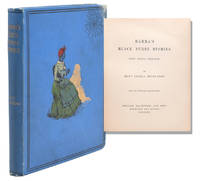
1890211388London: William Blackwood & Sons 1890. First Edition. Frontispiece five full page illustrations. xii 131 pp. 1 vols. Small 8vo. Blue pictorial cloth. Spotting and damp flaws to cloth at upper corners chiefly on back cover not affecting text some minor rubbing else about a very good copy. First Edition. Frontispiece five full page illustrations. xii 131 pp. 1 vols. Small 8vo. Jamaican dialect folk stories including West African Anansi tales. <br/><br/> William Blackwood & Sons hardcover