754 résultats
1986229746<p>First edition thus. 4to. Woodcuts by Antonio Frasconi. Original red cloth with large tan pictorial board for a front cover. Enclosed in the original publisher's red cloth drop box with tan board for a front cover. Fine fresh copy. No signatures or bookplates. Number 11 of 40 numbered copies on handmade paper signed by David M. Guss and Antonio Frasconi on the colophon page. Original publisher's prospectus laid in loose. Hardcover. Fine/No Jacket.</p> Turkey Press hardcover books
17970006092<p>Boston: S. Hall and Thomas & Andrews 1797. First Edition. Hardcover. Good. 7 Maps. Octavo new full brown calf red spine label new endpapers minor foxing. Ex libris Robert Breck in 1798 on title-page and on flyleaf minor repairs to folds of frontispiece folding map. . <br /><br />Capt. Thomas Hutchins the U. S. General Geographer supplied his notes to assist Morse the "Father of American Geography" in the completion of this work. This copy includes the map of "Georgia Western Territory" which was not incorporated in many of the copies. Howes M839; Evans 32509; not in Graff; Sowerby 3964; Sabin 50923 John Carter Brown 3902; Buck ILLINOIS 53. Contains 7 maps.</p> S. Hall, and Thomas & Andrews hardcover
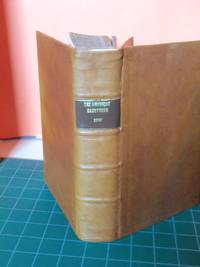
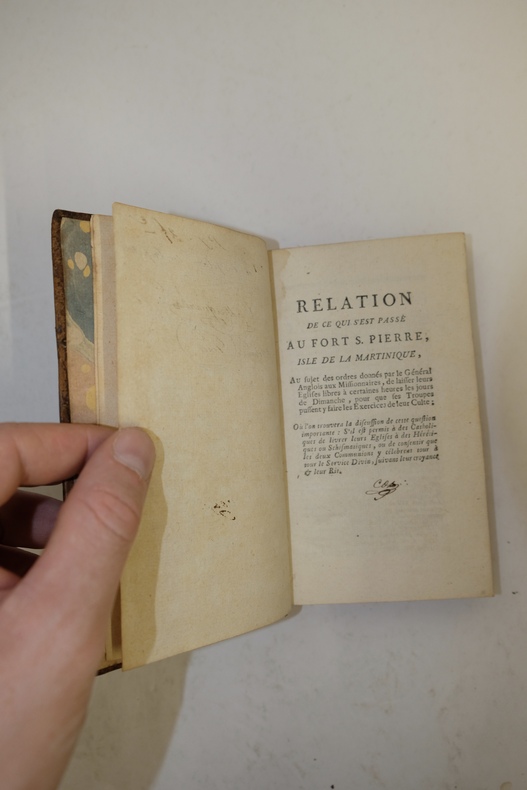
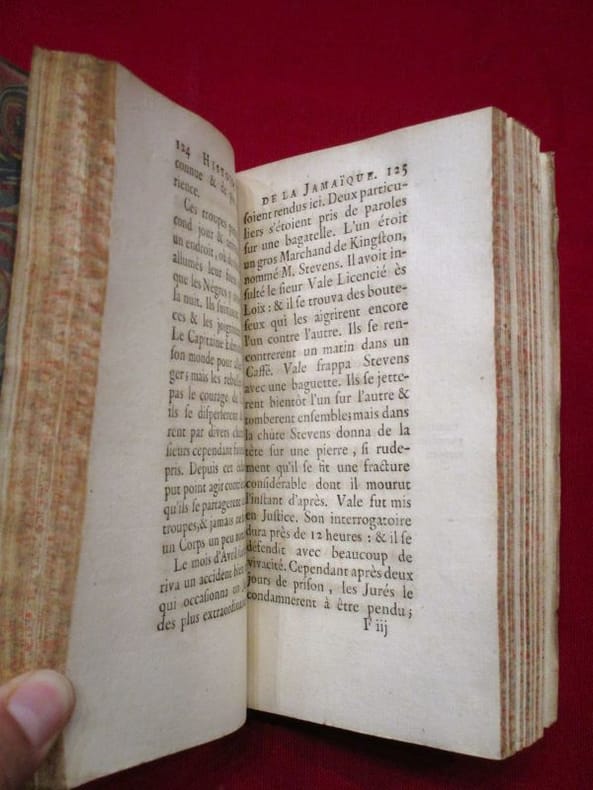
HIS4162MS.l.n.d. (1763, Conseil Supérieur de la Martinique). In-12, relié, plein veau moucheté, dos à nerfs orné, pièce de titre, filets sur chasses et coiffes, 190pp. Plusieurs ex-libris à la plume sur garde blanche et sur garde de fin. Frottements d'usage. Intérieur frais. Bon exemplaire
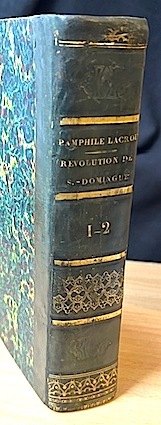
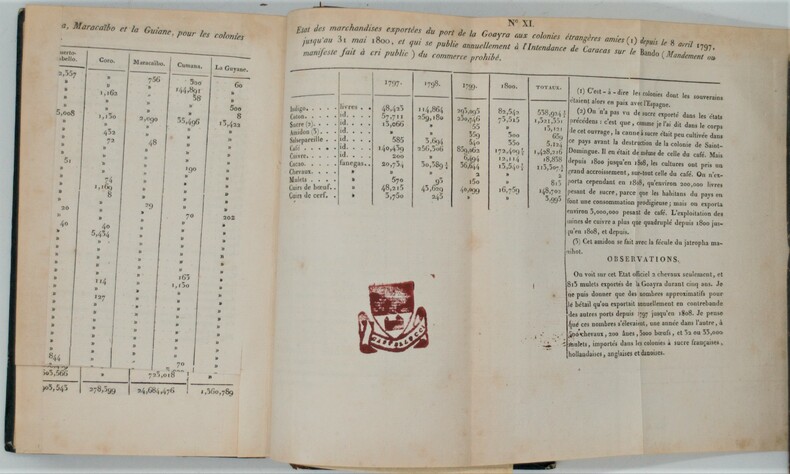
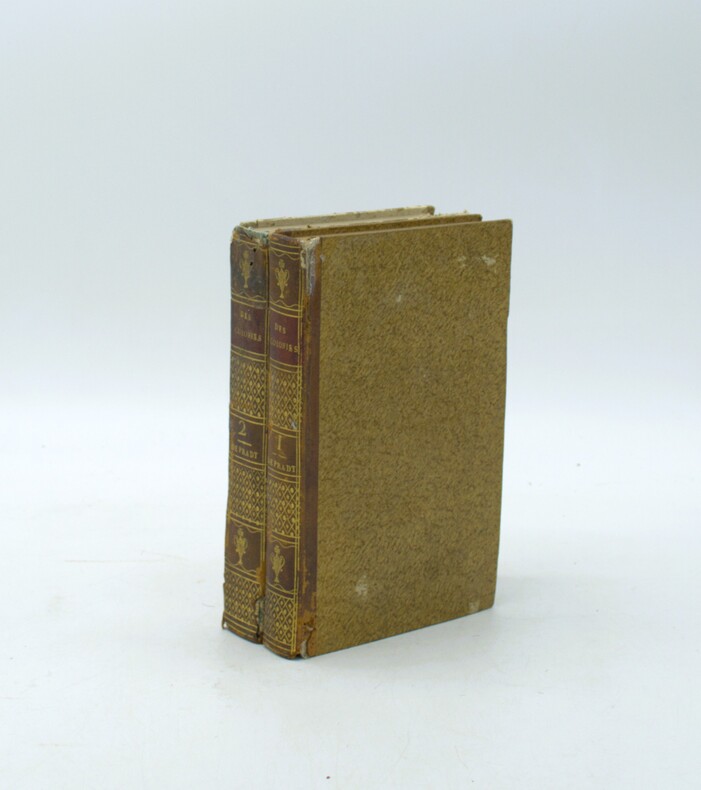
181915556Pillet ainé Paris 1819 2 vol. 2 tomes en un vol. in-8 de XV 416 pp. et 2 ff.n.ch. 350 pp. 1 f.n.ch. (errata), demi-veau de l'époque, dos lisse orné, tranches marbrées (coiffes restaurées).
1813PHO-844Paris, F. Schoëll, Libraire, 1813. In-8 (20,5 x 13,5 cm),XXVI-411 pp.,3ff-480pp-4ff (table et errata), illustré de 3 cartes déplantes et 5 tableaux dépliants .Reliure de l'époque demi-basane havane, dos lisse orné, manque au dos ,un plat détaché ,charnières faibles, cachets répétés, déchirure au pli à 1 carte. Édition très rare.
182614630Dufart Paris 1826 1 vol. In-8 de 332 pp., demi-chagrin de l'époque, dos à nerfs orné.
182513130Janet, Ponthieu Paris 1825 1 vol. In-8 de VII 480 pp., pleine basane racinée de l'époque, dos lisse orné, pièce de titre, tranches marbrées.
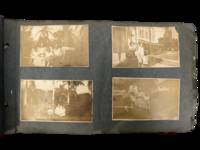
1914231551914. Caribbean photograph album likely compiled by a person connected to the Panama Canal Zone and the Caribbean documenting how steamship mobility port circulation and U.S. imperial presence linked Jamaica Venezuela Trinidad Barbados Cuba Puerto Rico the Bahamas Florida and Panama in the years after the canal opened. The felt cover lettered "PANAMA" and bearing the Seal of the Canal Zone places the album within the new travel geography created by U.S. control of the Canal Zone and the canal's 1914 opening when Panama became a central hinge between Atlantic and Pacific movement and a major point of contact between North American travelers and Caribbean port cities. Photos show passengers on steamers and docks markets and streets forts and government buildings and repeated encounters between white visitors and Afro Caribbean and mixed-heritage residents across multiple colonial and semi-colonial settings.<br /> <br /> Panama Canal Zone travel photograph album. Caribbean and circum-Caribbean locations including Kingston Jamaica; La Guaira and Caracas Venezuela; Trinidad; Key West and Palm Beach Florida; Havana Cuba; Barbados; Panama City Balboa and Colón Panama; Nassau Bahamas; and San Juan Puerto Rico. Likely circa mid 1910s to early 1920s. Oblong felt-covered album measuring 6.5" x 11" with "PANAMA" stitched in large letters on the front cover and photographs pasted to grey leaves. Contains more than 160 black-and-white photographs most approximately 2.5 x 4.5 inches many with handwritten captions identifying locations activities and occasional names. The sequence opens in Kingston with captions including "Kingston JA" and "on the steamer" then moves through island and mainland stops; "Port of Spain Trinidad" "Market at Barbados" "Rapid Transit Barbados" "Havana Cuba" "San Juan Porto Rico" "Morro Castle" "Balboa" and "Colon R.P." Repeated figures especially a young college-aged woman and an older woman appear throughout. Notable images include a group of locals in shallow water at Barbados sifting for tossed coins from rowboats; a large crowd scene in San Juan gathered for what appears to be a public speech or civic event; battlements cannon and stone defenses in Havana; vernacular dwellings and children in impoverished conditions in Balboa; posed visitor photographs in what is labeled a "bull ring"; and numerous street dockside market and architectural views that juxtapose local populations with hotels public buildings ruins and newer urban construction.<br /> <br /> The album's historical force comes from the way it captures the social landscape of Caribbean travel under early twentieth-century U.S. power. After 1914 the Canal Zone intensified Panama's role within a wider American maritime sphere while Caribbean travel increasingly moved through port infrastructures shaped by empire commerce military strategy and tourism; this album records that world at eye level with photographs of docks steamers fortifications government sites public squares and local street life rather than limiting themselves to family snapshots alone. At the same time the images preserve the unequal human encounters built into that system especially where visitors photograph Black children boatmen market crowds and working neighborhoods as part of the travel experience. Felt cover worn and soiled with losses at edges and stitching strain; leaves brittle with chipping and tears; photographs generally present and legible with silvering fading corner wear and occasional losses or lifting. Overall fair to good condition. A substantial early twentieth-century visual record of Canal Zone connected Caribbean travel with dense captioning and wide geographic reach from Jamaica and Barbados to Havana San Juan and Panama. unknown
17511177351751 A Londres, Chez Nourse, 1751, 2 volumes in-12 de 95x165 mm environ, (2) ff., 285 pages - (1) f., 248 pages, complet des 6 planches dépliantes. Pleines reliures marbrées d'époque, dos longs portant titres et tomaisons dorées, fers dorés, filet d'encadrement à froid sur les plats, filet doré sur les coupes, tranches mouchetées, gardes de papier marbré à la coquille. Coins légèrement émoussés, quelques griffures et épidermures sur le cuir, rares rousseurs sinon bon état.
1817PHO-2154Paris, Bechet,1817. 3 parties en 2 vol in 8°, (23x 13cm), demi veau époque, dos lisse orné, pièce de titre rouge, xxxii, 507 pp errata, 394 pp.-1f. (errata)- 2ff.-160pp.-1f (errata), demi veau époque, dos lisse orné avec tomaison et pièce de titre, frottements et épidermures, manque de papier au tome 2 et au dos, intérieur frais.
17596261BBLeipzig, Arkstee und Merkus, 1759. 4°. (1) Bl., (8) 726 (42) S., (1) Bl. Mit 17 (dv. 12 gef.) gest. Karten u. 11 gest. Tafeln. Lederband der Zeit mit restauriertem Rücken, schlichte Vergoldung und Rückenschild. + Wichtig: Für unsere Kunden in der EU erfolgt der Versand alle 14 Tage verzollt ab Deutschland / Postbank-Konto in Deutschland vorhanden +, A|B 17. Band.
17596261BB17. Band. Leipzig, Arkstee und Merkus, 1759. 4°. (1) Bl., (8) 726 (42) S., (1) Bl. Mit 17 (dv. 12 gef.) gest. Karten u. 11 gest. Tafeln. Lederband der Zeit mit restauriertem Rücken, schlichte Vergoldung und Rückenschild.
1890208021890. Unidentified photographers two albumen photographs of Black laborers circa 1890s to early 1900s document agricultural and skilled work performed by African Americans in the decades following emancipation when systems of sharecropping and tenant farming structured rural economies across the American South and parts of the Caribbean. These images provide visual evidence of labor organization racial hierarchy and economic dependency that persisted after the formal end of slavery with large groups of Black workers shown in relation to white overseers or employers. One photograph presents approximately forty five Black men gathered around three centrally seated white men emphasizing supervisory roles and social stratification within plantation labor systems. The clothing of the workers including cotton shirts loose trousers and wide brimmed hats reflects adaptation to agricultural work in hot climates while a smaller number of individuals in jackets and pocket watches suggests internal distinctions within Black labor communities. The second image depicts six Black carpenters engaged in coordinated manual work at an outdoor shop indicating the presence of skilled trades alongside agricultural labor.<br /> <br /> Group of two albumen photographs mounted on original cardstock measuring approximately 8 x 9.5 inches and 10 x 12 inches. The larger photograph shows an outdoor woodworking scene with six men using tools including a hammer and saw working under a thatched structure suggestive of southern or Caribbean environments. The second photograph shows a large assembled group of plantation workers with three white men seated at center. Faint pencil annotations appear in the margins of one mount. Both photographs retain strong compositional clarity with figures arranged to emphasize both collective labor and hierarchical relationships.<br /> <br /> These photographs contribute to the study of post emancipation Black life by documenting how agricultural dependency and limited access to capital shaped labor conditions into the late nineteenth and early twentieth centuries. The plantation scene illustrates the persistence of racially stratified labor organization while the carpentry image provides evidence of skilled Black tradesmen operating within local economies often without institutional support or pathways to independent enterprise. The visual contrast between collective field labor and artisanal work expands the interpretive scope of the archive situating these images within broader histories of labor race and economic transition following the end of slavery. Edge wear and minor chipping to mounts with noticeable foxing to one image primarily at the margins; images remain legible and structurally intact. Overall good condition. unknown
Jamaica South Coast Port Royal and Kingston Harbours surveyed by Captain J.W.F. Combe assisted by Lieutenant L.G. Garbett and Lieutenants J.A. Rupert-Jones & E.V Shankland 1913 Soundings East of Kingston by Lieut-Comm.r J.A. Edgell Surveying Ship "Mutine" 1914. Additional soundings from a Survey by Staff Comm.r G. Stanley 1873-4. Kingston and adjacent topography chiefly from a Colonial map.London Published at the Admiralty 18 January 1916 under the Superintendence of Captain J.F. Parry. Small corrections: 1931. Folded
1893WRCAM55675Various places as described below 1893. 28pp. manuscript index followed by 499 onionskin leaves comprising 402 letters. Five leaves laid in between leaves 195-196. Quarto. Three-quarter leather and cloth boards. Backstrip missing but boards still holding firm; rubbing and wear to extremities. Some rumpling and curling to pages ink bleed heavy at times a few small tears in leaves several small tears or holes due to ink burn occasional mild spotting and foxing. Good. A comprehensive look at the operations of a major import/export company in the Caribbean for the first part of 1893. <br> <br> J. Sala & Co. was a large international firm headquartered in New York that did business of all kinds throughout the Caribbean in particular Puerto Rico the Dominican Republic and Haiti but also Cuba Jamaica St. Thomas St. Croix and Curaçao. In DELMAR'S.TRADES DIRECTORY 1889-90 they are listed in San Juan Puerto Rico as "Ship Brokers and Commission Merchants." In THE PORT OF NEW YORK. 1893-94 their entry describes them as "General Commission Merchants" and Juan Sala and Cosme Batlle are listed as agents. They also provided banking and finance services in particular in partnership with Batlle a Spanish merchant and banker one of the wealthiest men in the Dominican Republic and a chief creditor to dictator Ulises Heureaux. As this book only covers January through part of March 1893 one gets a sense of the extent of the firm's activities. <br> <br> The copy book begins with an alphabetical directory of recipients listed along with their location and the numbers of relevant letters in the copy book. 171 recipients are listed representing over forty cities in the Caribbean along with several in England France Germany and Spain. Letters are primarily in Spanish but also appear in French for letters to Haiti and France and English for letters to England Germany Jamaica and some clients in St. Thomas and St. Croix. Several leaves have a mimeographed memorandum form with the company name and address. Almost every letter is annotated in blue pencil with the numbers of related letters in the copy book providing a further index; some letters have additional annotations in black pencil. <br> <br> All letters are signed "J. Sala & Co." and deal with a wide variety of business issues including notices about payments received and credits processed along with inquiries about late payments; credit references; consignments of turtle shells; and shipments of lumber iron pipes and whisky among other things although most often the material in question is listed as "sundries." In letters to Enrique Nebot of Monte Cristi Dominican Republic a Sala agent discusses the schooner "Annie R. Kemp" which they have chartered on his behalf and introduces the letter's bearer - the ship's captain - who is not named. The letter is in English which is presumably for the Captain's benefit since other letters to Nebot are in Spanish. The letter goes on to note that Nebot's "sundries.do not appear on the vessel's manifest and we have assured him the captain in your name that he will have no trouble whatsoever with your Custom House on that or other account." The Dominican Republic had a notoriously corrupt customs system at this time and no doubt J. Sala & Co. made sure they took advantage of every available loophole. <br> <br> A densely-informative and very interesting record of an active business engaged in a variety of endeavors in the Caribbean. THE PORT OF NEW YORK: A SOUVENIR OF THE NEW YORK CUSTOM HOUSE AND INDEX OF THE IMPORTS AND SHIPPING FACILITIES OF THIS PORT New York 1893-1894. DELMAR'S NEW REVISED AND COMPLETE CLASSIFIED TRADES DIRECTORY AND MERCANTILE MANUAL OF MEXICO CENTRAL AMERICA AND THE WEST INDIA ISLANDS Chicago: Belford Clarke & Co. 1889- 1890. hardcover books
1751PHO-1679Londres, Nourse, 1751. 2 volumes in-12, veau marbré, dos à nerfs orné, pièces de titre et de tomaison, tranches rouges (Reliure de l'époque), coiffes usées, manque les pièces de titre et tomaison au tome 2
1916biblio1324<p>This is an unusual first printing from 1916---extremely rare in this propitious 100-year anniversary a year featuring the reopening of normal relations and the visit of the U.S. President. This volume which describes in prase charts and photos the favorable advantages of 1916 Cuba may be one of the few that exist in the original state---there do not appear to be any offered in the marketplace making it an ideal addition to any collection of historical Cuba-related items.</p><p>Photos on request.</p> Foreign Publishing Company hardcover
8vo., Second Impression, with numerous plates, full-page facsimile and endpaper maps; handsomely bound in full dark green crushed morocco, sides with gilt frame border, back with raised bands, second and fourth compartments lettered and ruled in gilt, all other compartments tooled in gilt, gilt top, ribbon marker, an elegant copy ideal as a gift or for presentation. Among other adventures, Mitchell-Hedges details the discovery in 1924 of the Crystal Skill at Lubaantun (then British Honduras; now Belize). Published in the same month as the first edition. SCARCE.
1960025662Hong Kong: Hong Kong University Press / Oxford University Press / Institute of Pacific relations 1960. First Edition First Printing . Hardcover. Near Fine/Near Fine Dustjacket. Xiii 247. Orange Cloth. One Of 2000 Copies Of The First Printing But This Copy With Printed $5 Us Price At Bottom Of Front Flap So Perhaps An American Issue. Slight Signs Of Usage To Book And Dj. Inscribed To Mr. And Mrs. Z. T. Nyi Zau Tsung Nyi Of Los Angeles "With High Esteem And Respect". Information From His Archives At Usc: Theodore H.E. Chen Ph.D. 1939 Was Chairman Of Usc's Department Of Asian Studies From 1940 To 1968 And From 1960 To 1971 He Directed The East Asian Studies Center In Support Of Which He Had Obtained The First Federal Grants. Chen Also Secured Outside Funding For A Project To Help Train And Advise High School Teachers Of Chinese And Japanese. A Native Of Fuzhou China Chen Was President Of Fukien Christian University In 1946 And 1947 While On Leave To Participate In Postwar Rehabilitation. He Also Helped Organize Tunghai University In Taiwan As A Representative Of The United Board Of Christian Colleges. He Was The Author Of Nine Books Including Thought Reform Of Chinese Intellectuals And Maoist Educational Revolution And Chinese Education. Dr Chen Hits An Easy Target; The Worst Governments Are Those Who Try To Control What And How People Think And How And Where They Communicate Because Their Leaders Have An Excess Of The Oldest Disease Of Officials Crap-In-The-Brain Which Prevents Them From Engaging In Exchanges Of Facts And Ideas. <br/> <br/> Hong Kong University Press / Oxford University Press / Institute of Pacific relations hardcover
35602001, Paris, Dentu, an IX ( 1801); in-8, demi-veau blond, fil. et fleurons dor., tr. jasp. (Laurenchet). VIIIpp., 490pp.- Une grande carte dépliante par Tardieu. EDITION ORIGINALE EN FRANÇAIS. Elle est très rare. Sabin 21902 ne cite que la deuxième édition de 1804, tout comme Muller 550. Pas dans Leclerc.- Monglond V, 659 signale cette première édition, ainsi que le cat. Beinecke Lesser 557. Bryan Edwards (1743-1800) fut recueilli jeune en Jamaïque par un oncle qui lui légua sa fortune. En 1784 il fut à la tête d’une plantation de sucre. Nommé membre de l’assemblée de la Jamaïque il prononça en 1789 un discours contre les propositions de Wilberforce sur la traite des noirs. En 1791 il se rendit à St Domingue pour assister à la révolte. Peu après il retourna en Angleterre où il publia cet ouvrage en 1793.- Histoire, géographie, histoire naturelle, coutumes de la Jamaïque, de la Barbade, St Vincent, la Dominique, St Christophe, Antigua, Montserrat. Importants chapitres sur la traite et sur l’esclavage des noirs, sur la canne à sucre.- Les pp. 411 à 480 donnent une relation sur la colonie française de St Domingue, et le témoignage des scènes vues et vécues par l’auteur lors de son séjour à Port au Prince en 1791.
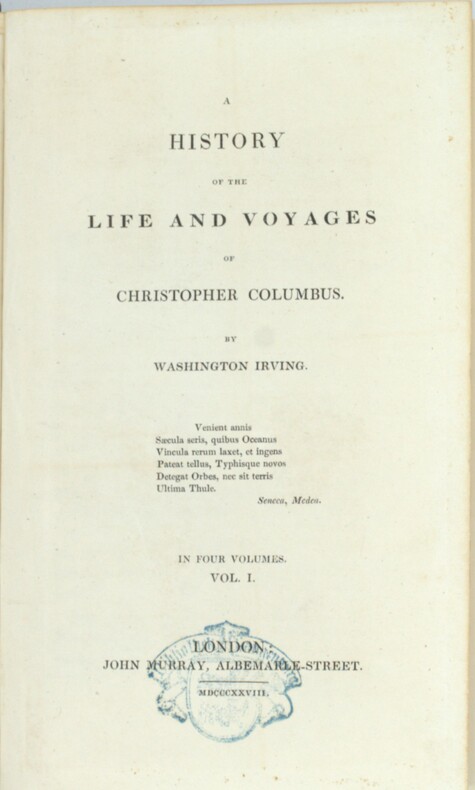
1828PHO-1507London, John Murray, 1828, 4 volumes, 8vo.,xii-473,(4)-490,viii-413,vii-489, with 2 folding maps , half calf and corners, nice copy, well bound.
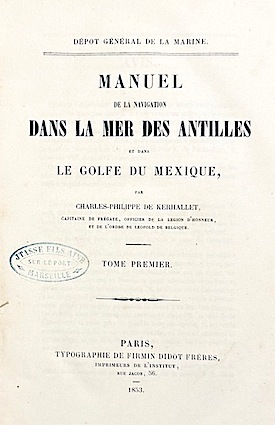
185313173Firmin Didot frères Paris 1853 2 vol. 2 vol. grand in-8 de VI 660 pp. et VI 613 pp. 1 f.n.ch. (errata); demi-basane de l'époque, dos lisse fileté.
17772318BBLeipzig, Weidmanns Erben und Reich, 1777. Gr.-8°. 1 Portrait, 13 Bl., 574 S.; 1 Bl., 618 S., 29 Bl. Mit 4 gefalteten Karten und 1 Tafel. Pappbände der Zeit mit Rückensch. + Wichtig: Für unsere Kunden in der EU erfolgt der Versand alle 14 Tage verzollt ab Deutschland / Postbank-Konto in Deutschland vorhanden +, A|B|C 2 Bände.
17772318BB2 Bände. Leipzig, Weidmanns Erben und Reich, 1777. Gr.-8°. 1 Portrait, 13 Bl., 574 S.; 1 Bl., 618 S., 29 Bl. Mit 4 gefalteten Karten und 1 Tafel. Pappbände der Zeit mit Rückensch.
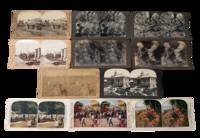
1890231711890. Stereoview archive of the post-emancipation Caribbean showing how the islands were marketed to western viewers through plantation labor export agriculture civic spectacle and catastrophe. As a group these photos function not only as an ethnographic travel archive but as evidence of the visual economy that followed slavery. The British West Indies moved through emancipation in 1834 to 1838 the French Caribbean in 1848 Puerto Rico in 1873 and Cuba in 1886 yet plantation production remained central to regional life well into the early twentieth century. These stereoviews preserve a colonial way of seeing in which Black and Afro-Caribbean labor rural discipline and extractive agriculture remained the background condition of "tropical" beauty and commercial modernity. Cuba's sugar economy in particular expanded through the nineteenth century and slavery was not abolished there until 1886 while Weyler's later reconcentration policy during the Cuban War of Independence violently reorganized rural life. Martinique after 1848 likewise shifted into new labor regimes including imported workers from India and China.<br /> <br /> Archive of 11 stereoview cards late 1890s to early 1900s depicting Cuba Jamaica Martinique Puerto Rico and the Dominican Republic. Most black and white with a few colorized. Each measure 3.5" x 7". All with captions on the margins. "Reconcentrado Farming Scene Province of Havana Cuba" links agricultural production to the brutal displacements of Spain's reconcentration campaign; "Cutting sugar cane Montego Bay Jamaica W.I." records cane labor in a colony where emancipation had not ended plantation dependency; and "Harvesting Coconuts Porto Rico" likewise frames Caribbean land through export work rather than local life. Other views extend that economic framing through cacao and coffee scenes while the paired Havana cards shift into urban leisure and public display including "Beautiful Central Park Havana Cuba" and "Holiday in Havana Cuba" the latter with both Cuban and American flags visible a telling image of the new imperial order after 1898. The disaster views from Martinique and the Lesser Antilles show how stereoview publishers also turned Caribbean destruction into consumable spectacle. the Morne Rouge card is accompanied on the reverse by the grim printed text "Dead bodies which were to be seen in Morne Rouge." while the wider context is the 1902 eruptions of Mount Pelée in Martinique and La Soufrière on Saint Vincent two catastrophes that killed roughly 30000 and 1600 people respectively and devastated local communities and agriculture.<br /> <br /> Some corner wear light toning scattered surface and edge wear. Overall very good condition. This collection gives direct visual representation of Caribbean history Atlantic slavery and emancipation plantation labor and U.S. imperial expansion in the circum-Caribbean preserving the transition from slavery to post-abolition labor. unknown