754 résultats
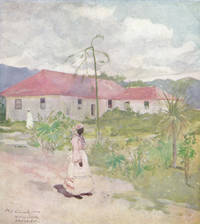
190530136London: Adam and Charles Black 1905. First edition. With 74 very fine and attractive colourplates from the paintings of Archibald Stevenson Forrest each with a captioned guard. Tall thick 8vo in the publisher's original pale blue cloth the upper cover and spine both decorated with ships craps clouds and sunbursts in brown ivory and gilt and with gilt lettering t.e.g. ix 272 4 ads pp. A handsome copy the plates all fine and bright some very occasional and light foxing within the text the lovely decorated binding is solid and firm with very little sign of wear but with a bit of mellowing to the spine front endpaper with cosmetic only spitting at the still-strong hinge. FIRST EDITION AND ONE OF THE MORE ELUSIVE TITLES IN BLACK'S TRAVEL SERIES A LOVELY BOOK IN FIRST AND ONLY EDITION. The blue seas and sun-drenched islands of the West Indies served as wonderful inspiration for both pen and paintbrush in this hard to find gem. Jamaica receives the lion's share of attention but other subjects include Barbadoes St. Lucia Dominica St. Thomas and Martinique. Archibald Forrest wonderfully captures the bright colourful scenery and colourful peoples of these tropic isles. Adam and Charles Black hardcover
Port Antonio (556x644 mm) Surveyed by Captain R.W. Glennie assisted by Lieut.t Com.dr C.S. Lockhart A.E. Harbord D.L. Cowan R.M. Southern & A.H. Stanley H.M. Surveying Ship "Mutine" Jan.y - March 1921. Intesting "Objects on this chart conspicuous to the Navigator" Titchfield Hotel, Richmond House, Isolation Hospital...London Published at the Admiralty 7 May 1923 under the Superintendence of Rear Admiral Fred.k C. Learmonth. Folded
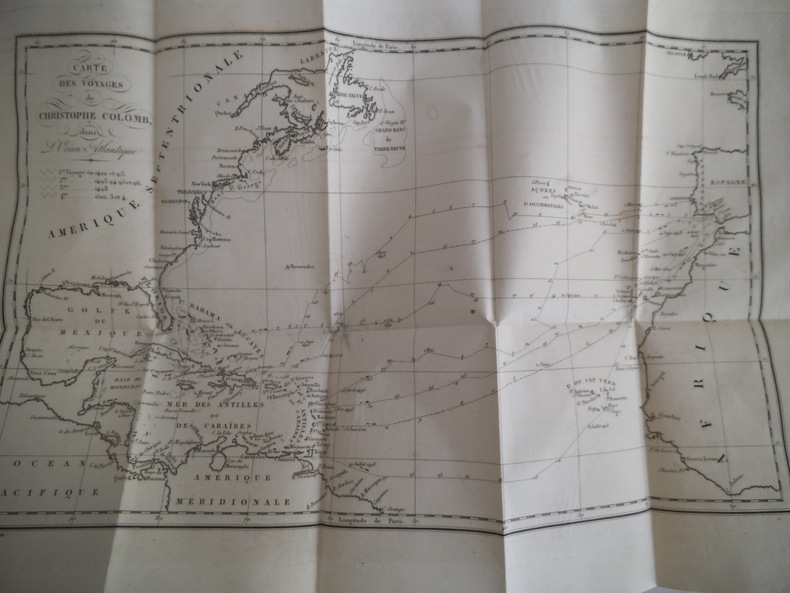
42793Paris Chez Pillet Ainé, Imprimeur Libraire 1819 in 8 (21x13,5) 1 volume broché, couverture imprimée, XII et 135 pages [1], renfort ancien sur le dos de la couverture, rousseurs éparses, non rogné. Rare. Bon exemplaire
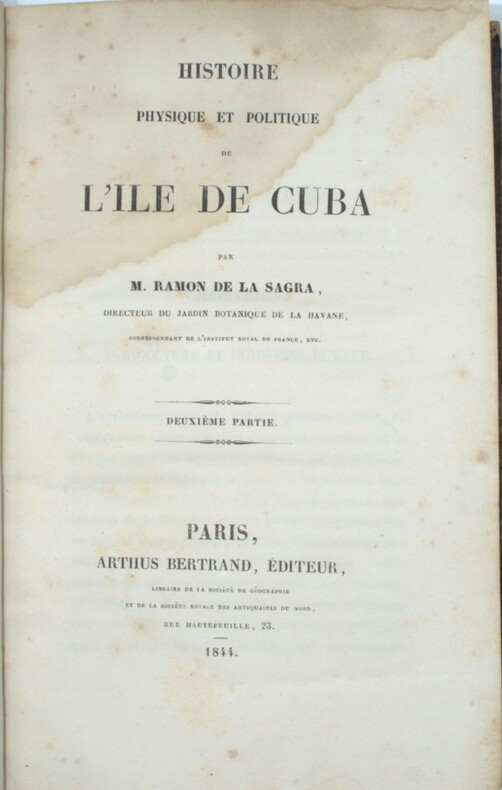
1844PHO-1491Paris, Arthus Bertrand, 1844, in-8, 2 volumes, LXXI-771-[2] pp. en numérotation continue, 20 diagrammes hors texte, demi-chagrin rouge, dos à faux nerfs, monogramme "J.M.C." doré en pied des dos, Rousseurs, quelques auréoles, l'une assez large en tête du second tome.
(Original) boards with light rubbing to extremities and faded. Spine sunned and with light fraying. Bookplate. Former owner's name on front free endpaper. Very light foxing to first and last few pages ; 60 b&w illustrations. ; 12mo 7" - 7½" tall; 366 pages
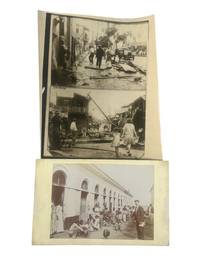
1928219181928. Puerto Rico during the early 20th century photo archive including the 1928 hurricane and colonial era life. Archive contains 3 silver gelatin photos with 2 photos being on one sheet. Each measure 8.5" x 11" to 5" x 9". One press photograph features two stacked photojournalistic images showing scenes of destruction in San Juan following the catastrophic hurricane of September 13 1928 one of the most devastating natural disasters to hit the island. The other photograph likely taken in the late 1910s is a mounted studio or missionary-style image depicting a white man standing in front of a long arched tenement-style structure surrounded by dozens of Puerto Rican women men and children many of the children barefoot and wearing minimal or tattered clothing. The larger image appears staged or observational and likely documents poverty in the aftermath of the U.S. acquisition of Puerto Rico following the Spanish-American War. The 1928 hurricane later named the San Felipe Segundo hurricane made landfall as a Category 5 storm killing over 300 people and rendering tens of thousands homeless. The press release photo captures the stark aftermath: corrugated roofs torn from buildings telephone poles shattered and citizens-both children and laborers-wandering through the wreckage-strewn streets of San Juan. These images reflect not only the physical devastation of the hurricane but also the lack of infrastructural resilience in a colony still reeling from U.S. economic control widespread poverty and racialized neglect by the mainland. The second image provides an unvarnished glimpse into the social realities of Puerto Rican life under U.S. rule during the 1910s. After the Foraker Act of 1900 and the Jones Act of 1917 which made Puerto Ricans U.S. citizens without granting them full constitutional rights the island experienced increasing political disenfranchisement and economic dependency. The presence of the white man-possibly a government official missionary or educator-visually underscores the racial and colonial dynamics at play. The surrounding community members including many children without shoes or shirts reflect systemic inequality and the enduring impacts of U.S. colonial policy on public health housing and education. Some edge wear tape on margins of smaller image and original editor's markings en verso to press photo. Overall very good condition. unknown
1853604771853. London: Printed by W. Clowes and Sons 1853. London: Printed by W. Clowes and Sons 1853. The First Compilation of the Laws of St. Lucia Saint Lucia. Laws at Present in Force in the Island of St. Lucia. London: Printed by W. Clowes and Sons 1853. vi 388 pp. Octavo 9-1/2" x 6". Contemporary calf with early rebacking red and black lettering pieces and small paper location label to spine upper lettering piece and endpapers renewed. Moderate rubbing to extremities some scuffing and edgewear to boards gilt red and black lettering pieces light toning to text internally clean. Ex-library. Old shelf label at head of spine small embossed stamps to boards inkstamp Bibliothek des Reichsgerichts to title page. A solid copy of a scarce title. $450. With index and side-notes. Saint Lucia was discovered by Columbus in 1502. The first group of colonists from England were massacred by the Caribs but the French succeeded in colonizing the island in 1642. It passed between France and Great Britain a number of times and became a British possession in 1803. It became independent and joined the Commonwealth in 1979. As one would suspect traces of French law remain in the island's legal system. The Reichsgerichtsbibliothek Imperial Court of Justice Library was at its peak Germany's largest and most important law library with 170000 works in its collection before the outbreak of the First World War. OCLC locates 9 copies in North America. Sweet & Maxwell A Legal Bibliography of the British Commonwealth 7:341. unknown
1853604771853. London: Printed by W. Clowes and Sons 1853. London: Printed by W. Clowes and Sons 1853. The First Compilation of the Laws of St. Lucia Saint Lucia. Laws at Present in Force in the Island of St. Lucia. London: Printed by W. Clowes and Sons 1853. vi 388 pp. Octavo 9-1/2" x 6". Contemporary calf with early rebacking red and black lettering pieces and small paper location label to spine upper lettering piece and endpapers renewed. Moderate rubbing to extremities some scuffing and edgewear to boards gilt red and black lettering pieces light toning to text internally clean. Ex-library. Old shelf label at head of spine small embossed stamps to boards inkstamps to title page. A solid copy of a scarce title. $450. With index and side-notes. Saint Lucia was discovered by Columbus in 1502. The first group of colonists from England were massacred by the Caribs but the French succeeded in colonizing the island in 1642. It passed between France and Great Britain a number of times and became a British possession in 1803. It became independent and joined the Commonwealth in 1979. As one would suspect traces of French law remain in the island's legal system. OCLC locates 9 copies in North America. Sweet & Maxwell A Legal Bibliography of the British Commonwealth 7:341. unknown books
1942ZB382805Cascade: Trinidad and Tobago Medical Associations 1942-70. volumes 4#2; 6#2; 11#1-2; 12#1/2; 13#1/2; 17#1/2; 21#1/4; 21#1/4; 23#1/4; 26#1/4; 30#1/4; 31/32#1/4 original paper wrappers minor library markings & with some bibliographic data corrected in pen; good; Price is for the lot. - If you are reading this this item is actually physically in our stock and ready for shipment once ordered. We are not bookjackers. Buyer is responsible for any additional duties taxes or fees required by recipient's country. Photos available upon request. Cascade: Trinidad and Tobago Medical Associations unknown
1956ZB705138Caracas: Instituto Caribe de Antropologia y Sociologia . 1956-1999. Whole Numbers 1 through 64 66 through 71 73 through 92 only; library markings but sound and good or better copies in original paper wrappers. - If you are reading this this item is actually physically in our stock and ready for shipment once ordered. We are not bookjackers. Buyer is responsible for any additional duties taxes or fees required by recipient's country. Photos available upon request. Caracas: Instituto Caribe de Antropologia y Sociologia ... unknown
Jamaica Surveyed by Staff Com.r G. Stanley 1873-5 and Lieut.t T. F. Pullen 1876-9. Morant Cays by Lieut A. Carpenter and the Officers of H. M. S. Sparrowhawk 1890.London Published at the Admiralty 27 October 1880 under the Superintendence of Captain F.J. Evan. Small corrections: 1931. Folded
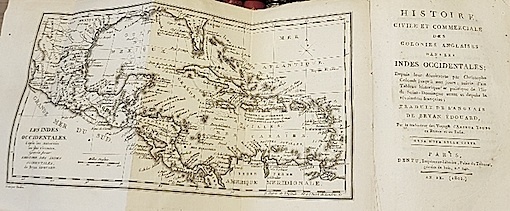
180110389Dentu Paris An IX (1801) 1 vol. Fort in-8 broché de VIII 490 pp., couverture muette de l'époque, pièce de titre papier.
Madrid, por Don Joachín Ibarra, 1783. 8vo.; 2 hs., 240 pp. Encuadernación de época, en piel marbreada, ligeramente fatigada.
Slight wear to extremities. Foxing to first couple of pages, and last couple of pages. Booksellers' blindstamp to front free endpaper ; Best known for 'Two Years Before the Mast, ' Dana visited Cuba while Congress was deciding whether to annex the island nation; 8vo; 288 pages
1977biblio106<p>This copy on the Equadoran artist's work is very fresh condition. Strikingly beautiful is the book in itself with its poignant imprinted cover portrait but this copy does not appear to have been read and has only very minor exterior fading and the marginal dust jacket shelving wear from the passage of thirty-six years. There are seventy color reproductions in the latter part of the text and commmentary by Pablo Neruda and others.</p><p>Photo on request.</p> Ediciones Nauta hardcover
1947ZB573157Port-of-Spain Trinidad British West Indies: 1947-1959 passim. Volume 1 Numbers 6 August 1947-12; Volume 2 complete in 12 issues; Volume 3 complete in 12 issues; Volume 4 Numbers 1-11; Volume 5 Numbers 2-4 6 8-12; Volume 6 Numbers 1-6; Volumes 7 Numbers 1-4 6-12; Volume 8 Numbers 1-3 6-12; Volume 9 Numbers 1-11; Volume 10 Numbers 1 3-12; Volume 11 complete in 12 issues; Volume 12 complete in 5 issues; Volume 13 complete in 12 issues; all in original paper wrappers some have library markings overall a good group. - If you are reading this this item is actually physically in our stock and ready for shipment once ordered. We are not bookjackers. Buyer is responsible for any additional duties taxes or fees required by recipient's country. Photos available upon request. Port-of-Spain, Trinidad, British West Indies: unknown
ORD-20055Textes manuscrits, le plus souvent écriture très soignée, datés de 1793. Carnet de ca 150 x 183 mm, pages non brochées, titre à l'encre violette sur la 1re couverture, la 2e portant Livre de Pacotille vndue au Cap.
ORD-20116Textes manuscrits, le plus souvent écriture très soignée, datés de 1793. Carnet de ca 150 x 183 mm, pages non brochées, titre à l'encre violette sur la 1re couverture, la 2e portant Livre de Pacotille vndue au Cap.
1799PHO-1466Buisson Paris An VII (1799) , 1 volume in-8 (sur 4) , 2 ff.n.ch.-440 pp. , pleine basane de l'époque, dos lisse ornés, pièces de titre et de tomaison, , frottements , manque de matière au premier plat, épidermures.
5300CARIBBEAN TRAVEL JOURNAL. Diary. 101 pages. The Caribbean. c. 1908-9. The handwritten journal belonging to C. B. Benson of Hudson New York. The diary recounts Bensons experience on an organized cruise group visit to Caribbean locations such as St. Thomas Puerto Rico Kingston Jamaica Caracas Venezuela Panama City Panama Port of Spain Trinidad and Martinique. Benson records his experiences in each location including his impressions of the town the locals sights he visited and local travel. He visited forts a school churches a mill a sugar plantation and Carnival celebrations. Benson took his tour during the era of colonial rule the attitudes of which infuse both his experiences and observations. Based on his mention of an earthquake in Kingston Jamaica taking place a year or two before he travelled in 1908 or 1909. St. Thomas where we arrived about 6 A.M. mid morning Jan 26 is one of the Virgin group and we found her framed and frescoed in the principal churches. Columbus in 1493 gave the group of 100 islands rocks andwhich comprise the group. St. Thomas is 13 miles in length and 3 miles in width at its broadest. And I guess we walked the length of it speaking broadly and in the abstract at this distance.The heat of the tropical sun also takes its toll and blurs our ideas of time and distance somewhat. The town of Charlotte Amelia contains 13000 inhabitants merchants and black babies and they are all dressed in their Sunday best to receive us properly.Thursday morning at 8 we went ashore at Porto sic Rico.Returning thro the village streets we stopped at the market place and noticed the display of fruits in baskets a couple of men seated on low stools with blacks in front of them.a native womanwas entertaining us in the middle of the road with a dance.When passing the island of Haiti.Do you know why we do not stop at the Island of Haiti No There are cannibals there there are so many fat people aboard you would lose your wife At St Thomas the American council held open house and received some of us who dared to invade this solitude.An hours railroad ride which was made interesting by stops at every littleand station where the bare legged boy with the oil gun in hand squirted oilbearings sic of the cars and engine. As it was before the 17 miles came to an end the rear axle of the parlor car so called because it had leather covered reclining seats caught fire. But when this happened we were nearly at the end of our journey and we were not delayed much. At the sugar plantation where we detrained we found we had some distance to walk downto the sugar mill. As there was no path and the sticky wet ground to soil made worse by the heavy rain of the night before.A sugar mill is never a clean place.The process is somewhat intricate but way he likened to the process of brewing.The cane piled up in the yard is boiled in a number of vats then is run off with barrels and in a black and solid state in shipped to the Refineries at New York. The fiber of the cane is then hardened and dried and is fed to the furnaces to boilcane. After return to the town San Juan we visited the shops. Walked out to the fort at the entrance of the harbor. The town is excellently policed and paved in the principal streets with telegram blocks.As this day was Thursday we concluded that every day was wash day for the native women and girls who for want of other diversions spend most of their time in this form of dissipation. Even the balconies of the main public street filled with traffic of street cars carriages and drays had their fill of wash some of which are found laying in the street having been carried down by the wind. No one had appropriated it as yet; and we did not add it to our collection of souvenirs. At the officers quarters I applied for a permit of the officer of the day to enter the fort San Cristobal the fort commanding the entrance to the harbor.The fort was like most forts. The high tower gave a commanding view of the town and harbor. Then we visited the Governors Palace. In the Reception Room hanging on opposite sides facing each other are life sized oil paintings of McKinley & Cleveland. In the garden were some large palms tropical ferns a fountain &.Jan 29. early in the morning we were at Kingston in Jamaica. The channel is narrow and tortuous but well Taking a local pilot we soonopposite itof three vessels one of which was the Princess Louise that was caught in the hurricane here three years ago andthe larger of the three vessels was trying to pick up the light from the light house which had been blown down. This destruction of the hurricane.After driving about a mile thru the city the destruction to the buildings & pavements made by the earthquake here a year or two ago half of the city seems to be in ruins and no attempt has been made apparently to rebuild & restore the city. Thousands of lives were lost here at that time which did immense damage to the fruits. Most of the uninhabitable part of the island belongs to the United Fruit Company a Boston Corporation who ships immense quantities of bananas from Port Antonio. Owing to recent destruction by fire of Hotel Litchfield our stop at the port of San Antonio and stay of night at the Hotel was omitted. An excursion across the island by train to Mandeville was arranged in its place.The town of Colon in its principle streets are paved with brick and appear clean. We noticed many buzzards. The air was clear and there was a delightful cool breeze blowing.We stopped at all of the stations going to Panama and noted the wonderful impressions made by the Sanitary Commission. The well ventilated and screened houses. The plan for disposal of garbage the open drainage the cleared landsBut of course the facts are here bug and drain all working to the mutual exclusion of some ideas to the American white employers. Therefore after a few months they must have a reaction in the States toand detach themselves from all absorbing facts. The fighting for life againstfires. Most things arebetween the white employers and the black employees. So we find the White Bar and the Black Bar The White Employees The Silver White Employees &c as signs on the cars intended to carry workmen back and forth from the works.Caracas the capital of Venezuela is about 3000 ft up but the sun in the middle of the day we found very hot.Plaza Bolivar was decorated with rows of colored electric lights. They are preparing for the Carnival season which ushers in Lent in Catholic countries. The market place had counters for dry goods highly colored handkerchiefs etc. Another section was devoted to fruits vegetables etc. We noticed some very large apricots. Mr. Bolivar apparently has done a great deal for his native town. He has given his name while the people furnished the funds for the largest parks a street and the coinage of the plutocrats.The Spaniard theHildago -in his easy subjugation of thepleasure loving tropical savage has replaced the native of simple taste and left in his place the mongrel half-breed with all the vices of the conqueror and none of the virtues of theIndian savage. The diary is in very good condition. It is mostly written in pencil but is quite legible. hardcover
5300CARIBBEAN TRAVEL JOURNAL. Diary. 101 pages. The Caribbean. c. 1908-9. The handwritten journal belonging to C. B. Benson of Hudson New York. The diary recounts Benson’s experience on an organized cruise group visit to Caribbean locations such as St. Thomas Puerto Rico Kingston Jamaica Caracas Venezuela Panama City Panama Port of Spain Trinidad and Martinique. Benson records his experiences in each location including his impressions of the town the locals sights he visited and local travel. He visited forts a school churches a mill a sugar plantation and Carnival celebrations. Benson took his tour during the era of colonial rule the attitudes of which infuse both his experiences and observations. Based on his mention of an earthquake in Kingston Jamaica taking place a year or two before he travelled in 1908 or 1909. “…St. Thomas where we arrived about 6 A.M. mid morning Jan 26 is one of the Virgin group and we found her framed and frescoed in the principal churches. Columbus in 1493 gave the group of 100 islands rocks and…which comprise the group. St. Thomas is 13 miles in length and 3 miles in width at its broadest. And I guess we walked the length of it speaking broadly and in the abstract at this distance.The heat of the tropical sun also takes its toll and blurs our ideas of time and distance somewhat. The town of Charlotte Amelia contains 13000 inhabitants – merchants and black babies and they are all dressed in their Sunday best to receive us properly.Thursday morning at 8 we went ashore at Porto sic Rico.Returning thro the village streets we stopped at the market place and noticed the display of fruits in baskets a couple of men seated on low stools with blacks in front of them.a native woman…was entertaining us in the middle of the road with a dance.When passing the island of Haiti.‘Do you know why we do not stop at the Island of Haiti’ ‘No’ There are cannibals there there are so many fat people aboard you would lose your wife’ At St Thomas the American council held open house and received some of us who dared to invade this solitude.An hour’s railroad ride which was made interesting by stops at every little…and station where the bare legged boy with the oil gun in hand squirted oil…bearings sic of the cars and engine. As it was before the 17 miles came to an end the rear axle of the parlor car so called because it had leather covered reclining seats caught fire. But when this happened we were nearly at the end of our journey and we were not delayed much. At the sugar plantation where we detrained we found we had some distance to walk down…to the sugar mill. As there was no path and the sticky wet ground to soil made worse by the heavy rain of the night before.A sugar mill is never a clean place.The process is somewhat intricate but way he likened to the process of brewing.The cane piled up in the yard is boiled in a number of vats then is run off with barrels and in a black and solid state in shipped to the Refineries at New York. The fiber of the cane is then hardened and dried and is fed to the furnaces to boil…cane. After return to the town San Juan we visited the shops. Walked out to the fort at the entrance of the harbor. The town is excellently policed and paved in the principal streets with telegram blocks.As this day was Thursday we concluded that every day was wash day for the native women and girls who for want of other diversions spend most of their time in this form of dissipation. Even the balconies of the main public street filled with traffic of street cars carriages and drays had their fill of wash some of which are found laying in the street having been carried down by the wind. No one had appropriated it as yet; and we did not add it to our collection of souvenirs. At the officers quarters I applied for a permit of the officer of the day to enter the fort ‘San Cristobal’ the fort commanding the entrance to the harbor.The fort was like most forts. The high tower gave a commanding view of the town and harbor. Then we visited the Governor’s Palace. In the Reception Room hanging on opposite sides facing each other are life sized oil paintings of McKinley & Cleveland. In the garden were some large palms tropical ferns a fountain &.Jan 29. early in the morning we were at Kingston in Jamaica. The channel is narrow and tortuous but well… Taking a local pilot we soon…opposite it…of three vessels one of which was the Princess Louise that was caught in the hurricane here three years ago and…the larger of the three vessels was trying to pick up the light from the light house which had been blown down. This destruction of the hurricane.After driving about a mile thru the city the destruction to the buildings & pavements made by the earthquake here a year or two ago half of the city seems to be in ruins and no attempt has been made apparently to rebuild & restore the city. Thousands of lives were lost here at that time which did immense damage to the fruits. Most of the uninhabitable part of the island belongs to the United Fruit Company a Boston Corporation who ships immense quantities of bananas from Port Antonio. Owing to recent destruction by fire of Hotel Litchfield our stop at the port of San Antonio and stay of night at the Hotel was omitted. An excursion across the island by train to Mandeville was arranged in its place.The town of Colon in its principle streets are paved with brick and appear clean. We noticed many buzzards. The air was clear and there was a delightful cool breeze blowing.We stopped at all of the stations going to Panama and noted the wonderful impressions made by the Sanitary Commission. The well ventilated and screened houses. The plan for disposal of garbage the open drainage the cleared lands…But of course the facts are here – bug and drain – all working to the mutual exclusion of some ideas to the American white employers. Therefore after a few months they must have a reaction in the States to…and detach themselves from all absorbing facts. The fighting for life against…fires. Most things are…between the white employers and the black employees. So we find the ‘White Bar’ and the ‘Black Bar’ ‘The White Employees’ ‘The Silver White Employees’ &c as signs on the cars intended to carry workmen back and forth from the works.Caracas the capital of Venezuela is about 3000 ft up but the sun in the middle of the day we found very hot.Plaza Bolivar was decorated with rows of colored electric lights. They are preparing for the Carnival season which ushers in Lent in Catholic countries. The market place had counters for dry goods highly colored handkerchiefs etc. Another section was devoted to fruits vegetables etc. We noticed some very large apricots. Mr. Bolivar apparently has done a great deal for his native town. He has given his name – while the people furnished the funds – for the largest parks a street and the coinage of the plutocrats.The Spaniard the…Hildago -in his easy subjugation of the…pleasure loving tropical savage has replaced the native of simple taste and left in his place the mongrel half-breed with all the vices of the conqueror and none of the virtues of the…Indian savage…â€. The diary is in very good condition. It is mostly written in pencil but is quite legible. hardcover books
185927043Paris France: Various Publishers 1859. French text; details below on publisher and pagination. Including: Le Pape et le Congres. Paris. E. Dentu & Didot Freres 1859. 46 pages; no author noted; OCLC credits Arthur Vicomte de Dubreuil-Helion La Gueronniere. Les Jesuites en 1860 par Charles Habeneck. Paris. Imprimerie L. Tinterlin et Cie. 1860. 32 pages. La Vraie Liberte Consequence Necessaire de la Separation des Pouvoirs Temporel et Spirituel. Par Celestin de Blignieres. Paris. Chez Tous les Libraires. 1860. 47 pages. Pale spotty foxing. Pape et Empereur. Par J.-M. Cayla. Paris. E. Dentu. 1861. 32 pages. La France Sans le Pape. Par J.-M. Cayla. Paris. E. Dentu. 1861. 32 pages. Le 89 du Clerge. Par J.-M. Cayla. Paris. E. Dentu. 1861. 32 pages. Le Pretres a Marier. Par J.-M. Cayla. Paris. E. Dentu. 1861. 31 pages. Plus de Couvents! Par J.-M. Cayla. Paris. E. Dentu. 1861. 32 pages. Paper darkened some. L'Eglise et L'Instruction Primaire a la Campagne. Par M.L. Derome. Paris. E. Dentu. 1861. 32 pages. La France Rome et L'Italie. Arthur Vicomte de Dubreuil-Helion La Gueronniere. Paris. E. Dentu. 1861. 61 pages. La France et La Liberte. Pars B. Sarrans Jeune. Paris. E. Dentu. 1861. 32 pages. Retablissement du Divorce. Par Eugene Debriges. Paris. E. Dentu. 1861. 31 pages. Paper darkened spottily foxed some. L'Empereur Rome et Le Roi D'Italie. Paris. E. Dentu. 1861. 31 pages. OCLC credits authorship to Armand Levy. L'Independence D'Haiti et La France. Par Charolais. Paris. Dentu. 1861. 32 pages. OCLC with the note: "Signed: 'Charolais' which is said to be not a pseudonym but the name of a French journalist whom Mr. Delorme had asked for political reasons to sign in his place" - Bissanthe. Haitian bibliography dictionary. Les Interets Francais et Europeens a Santo-Domingo. Paris. Dentu. 1861. 31 pages. No author noted here or in OCLC. L'Espagne et Son Avenir. Par Emile Bonnaud. Paris. Chez Castel.1860. 32 pages; last several leaves spotty foxed. Le Prisonnier du Pape. Par J.-B Charles Paya. Paris. Chabot-Fontenay. 1864. 64 pages 8 advertisements for various works by this author. Paper darkened some little spotting. La Papaute Moderne Condamnee par le Pape Saint Gregoire le Grand Extraits des Ouvrages de Saint Gregoire le Grand. Traduits et commentes par l'Abbe Guettee. Paris. Dentu. 1861. 61 pages. La Question de Cuba. Paris. Dentu. 1859. 63 pages. OCLC attributes to Philippe Athanase Cucheval-Clarigny. Unless noted above in the individual entry condition of the pamphlets are in clean very good condition. Often half-titles are present. Each pamphlet has tax stamps of 5 cen. Imperial Timbre. Front endpaper with a handwritten "Contents" with short titles and dates of the above books; all present here. Title page of the first pamphlet with the small owner name-stamp of collector George R. Brush M.D. U.S. Navy; in service as a surgeon & medical inspector from 1861-1894. Approx. 6 1/2" x 9 1/2"size; bound in red marbled-paper covered boards; red morocco leather spine; gilt decorations & titles patterned-paper endpapers. Some edge tips wear and rubbing to the boards; base of bottom spine compartment scarred and darkened; text block clean and in very good condition. . First Edition. Leather. Very Good. Various Publishers books
"In presenting this collection of West Indian calypsos, Mills Music, Inc. is proud to introduce them to the American public. Their effect is that of a fresh breeze from the Caribbean, from whence these melodies originate." - page 2. 32 pages. Charming cover illustration of Leighla Whipper. Includes lyrics, chords and piano sheet music for these songs: Back Down to the Tropics; Land of the Humming Bird; Don't You Say 'No'; Sweethearts; Chinita; A Pretty Girl Will Turn You Anyway But Loose; I'll Have Me Money By Then; In Martinique; Joe; Take Me To the Carnival; Bad Woman; My Mama; Song of the Jumbies; Ou Belle Marie Coolie. Contents clean and unmarked. Somewhat above-average external wear. Binding intact. Contemporary store and price rubber stamps upon front cover. A sound copy of this marvelous WWII-era compilation. Book
10537traduit de l’anglais par E.A. DEFAUCOMPRET Fils Deuxième édition revue et corrigée, ornée d’une carte dépliante en noir. 4 tomes en 4 volume in 8 brochés, Tome premier : faux-titre, titre, XVI, 381 pages. Tome second faux-titre, titre, VIII, 406 pages. Tome troisième faux-titre, titre VIII 364 pages. Tome quatrième faux-titre, titre, 422 pages, une grande carte dépliante en noir (et non en couleurs comme annoncée sur la couverture) Paris Librairie Charles GOSSELIN 1836 sous couverture à la date de 1843. Quelques petits défauts d’usage, sinon bon exemplaire à grande marges tel que paru
1821200023AG1821. Paris Brué 1821. Original engraving. Plate Size: 50.5 cm x 36.1 cm. Sheet Size: 68 cm x 54.1 cm. Original map. Very good condition. Extra wide margins. Some minor foxing along sheet edges. Discreet author's blind stamp with 'Carte Encyprotipe' and initials 'AB' embossed in top corner of map. Centre-fold as issued. Border with longitudinal and latitudinal information. Detailed early map of the Caribbean from an early edition of Brue's Atlas Universel Pl.35. Rich detail in Florida the Gulf Coast Central America. The eye is drawn to Cuba among the islands of the 'Grandes' and 'Petites' Antilles. As demonstrated by the map's political divisions and colourings Mexico has yet cede control of what will become Texas. Nouva Espagne and Nouv Grenade show that the aged and tottering Spanish empire has still to fall in Central and South America. The division of Hispaniola into its Haitian and Dominican parts is also shown. The great port cities of the infant United States - Charlestown Savannah and New Orleans - can be seen along the seaboard. Bermuda is shown breaching the map's top border. Reference keys and explanatory annotations and four scale-bars in lower left corner of map. Decorative title in top right corner of map. Adrien-Hubert Brué 1786 - 1832 was a renowned French cartographer. Between 1810 and 1830 Brué established himself as one of the most important French cartographers and it was during this period that his two most important works were published: Grand Atlas Universel in 1815 and Atlas Universel in 1822 which ran to several editions. Atlas Universel was published as a continuation to Grand Atlas Universel. Brués maps or cards as they were referred to at the time were characterized by the high degree of accuracy with which they were produced and the meticulous attention to detail employed in their crafting. This was possible due to Brués application of copper plate intaglio to the process of mapmaking or as Nouvelles Annales des Voyages et des Sciences Géographiques had it: by applying to the making of cards this ingenious process of drawing on copper itself. Alexandre von Humboldt the President of the Société de géographie de Paris praised the accuracy of his work and clarity that is all the more pleasing to the eye. He also was quick to update his maps with the latest scientific discoveries and nautical measurements. Wikipedia unknown