[Cuba - Manuscript]Biblio.com

131 résultats
1847LL 559<p><strong><em>"Appointment of Lieutenant General Federico Roncali count of alcoy "as governor and captain general of the island of cuba and president of the courts of the same" in replacement of general leopoldo o'donell. </em><em>Given in the palace on november 30 1847. <u>Begins:</u> Doña Isabel Segunda por la gracia de Dios y por la constitucion de la monarquia española Reina de las Españas.</em></strong> "5750</p><p>Handwritten bifolio on paper with the printed heading of Isabel II. Queen's stamp signature and plate seal with fleur-de-lys shaped paper protection. Signature of Ramón Narváez. On the second page different statements appear in Madrid and Havana signed by the Count of Villanueva also by the Marquis of Selva Alegre.</p><p>Federico Roncali count of Alcoy Cádiz 1800- Madrid 1857 came to generalship at the hands of Espartero. Between December 14 1852 and April 14 1853 he was president of the council of ministers after his time as Captaincy of the island of Cuba a position in which he replaced O'Donell. His mandate in Cuba was characterized by the creation of different infrastructures and the increase in the arrival of Chinese laborers that had begun in the previous period. During his mandate the lighthouse that bears his name Roncali was built of great importance for navigation in the Yucatan Strait "the last place on the island where the sun sets"; it is located at Cape San Antonio which was the last place where the aborigines remained at the time of colonization.</p><p>The document talks about the replacement of Captain General Leopoldo O'Donell the oath that must be taken before taking office and how it should be exercised.</p><p>UNIQUE AND OF UTMOST IMPORTANCE</p>
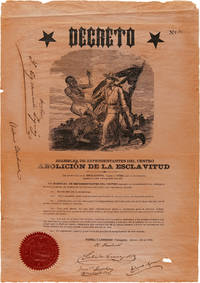
1869WRCAM56566Camagüey Cuba 1869. Pictorial letterpress broadside 18 1/2 x 13 inches. Numbered "54" in manuscript bearing the embossed red seal of the Republica Cubana and signed in ink by Salvador Cisneros y Betancourt Eduardo Agramonte Ignacio Agramonte Loyn áz Francisco Sánchez y Betancourt and Antonio Zambrana. Old horizontal folds minor creasing handful of small edge chips. Small hole in bottom margin just touching one ink signature. Very good condition. A rare and significant pictorial Cuban decree from the provisional rebel government abolishing slavery on the part of the island they controlled issued by the radical faction of the Cuban nationalists fighting against Spanish rule in the first months of the Ten Years' War. <br> <br> This proclamation is illustrated with a dramatic woodcut signed "LFR" depicting an ill-clad but exultant freed slave and a rebel celebrating in front of the Cuban flag. This decree stipulated freedom for all the enslaved people of Cuba in hopes that they would join the revolutionary struggle. The decree also provided for eventual compensation to slaveholders and ordered that freed individuals must serve the revolution either through military service or by continuing with their previous work. Among the important leaders who signed the present document were Salvador Cisneros y Betancourt as president just below the printed text and Ignacio Agramonte y Loynáz as secretary to the left of the engraving. <br> <br> The practical effect of this decree was modest as the rebels only controlled limited territory before their ultimate defeat and their territory was generally under the control of more conservative military commanders but such a proclamation joined a growing chorus of abolitionist sentiment in Cuba which finally realized the end of slavery in 1886. A powerful statement of anti-slavery policy in mid-19th century Cuba with a striking illustration of a jubilant slave celebrating his short-lived freedom. Rare with no copies recorded in OCLC. unknown books
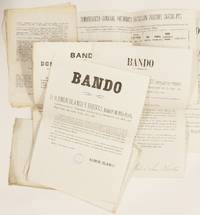
1896RF 818<p><i><b>Collection of 23 original edicts February 1896-September 1898 by the Captain Generals of Cuba 19 by General Valeriano Weyler 4 by General Ramón Blanco the last Spanish Captain General of Cuba. The edicts concern the attempts by the Spanish authorities to control the insurrection. They range from Weyler's efforts to concentrate the population in fortified encampments a measure often considered the precursor of concentration camps to Blanco´s establishing of a ceasefire in 1898.</b></i></p><p>23 ORIGINAL EDICTS; some manuscript annotations and the stamp of the Army of Cuba on some communiqués. The collection includes three items of related ephemera.</p><p>Notable collection of original edicts from Spanish authorities who participated in the Cuban War of Independence and attempted unsuccessfully to end the insurrection. The Cuban War of Independence the War of 1895 is the name given to the final Cuban war against Spanish domination. It is one of the last American wars against the Kingdom of Spain. The war began on 24 February 1895 with a simultaneous insurrection in 35 Cuban localities known as Grito de Oriente formerly known as Grito de Baire and ended in 1898 with the surrender of the Spanish Colonial army to the U.S. military advance with the assistance and support of <i>mambises</i>members of the Independentist Cuban army in the conflict known as the Spanish-American War. </p><p>Details on each of the edicts available on request. G. 11653/ RF 818. X99X001160 </p>
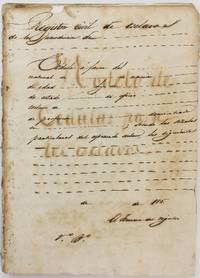
18503976Havana 1850. Good. 138pp. Folio. Stitched with remnants of leather binding along spine. A few blank leaves scattered throughout. Dampstaining and moisture damage at upper fore-edge of scattered leaves slightly affecting text. Moderate offsetting occasional ink burn. Light edge wear and tanning scattered foxing. An extensive list of slave owners in Cuba in the mid-19th century who were issued cedulas for their human property. Cedulas were integral documents for the identification and transportation of enslaved people in the bureaucracy of colonial Cuba and were usually required by the government. In the present manuscript the race and sex of the slaves being issued documents are usually identified -- Negra Negro mulata mulato Chino China e.g. -- though some are just entered as esclavos and there are several entries noted as dotaciones that is complements usually large of slaves on a plantation. The names of the owners are grouped alphabetically according to their first names generally though not in any strict order and the leaves of the manuscript are sometimes bound out of order. Often there are multiple listings of an owner most likely one for each slave in need of a cedula and in all there are approximately 2500 or more separate listings. The first leaf appears to be a model for the cedulas that were being issued to the listed slaveholders with dashes where the information on the slaves and slave owners is to be filled in. The entire document has the appearance of an index with numbers at the right side of each page indicating perhaps the page numbers in the master ledger where the original entry was made. Overall a fascinating and significant document. unknown
1875WRCAM56107Cuba 1875. Twenty-two partially-printed forms on folio sheets completed in manuscript in a variety of hands. Most printed and accomplished on the recto only though a few with print or manuscript on the verso as well. Some with old folds chipping and small tears to edges of most documents one document with the upper right corner cut away. Occasional foxing tanning and ink offsetting and bleedthrough. Several documents with additional manuscript annotations. About very good overall. An important collection of contracts documenting Chinese indentured servitude in Cuba two signed in Chinese. All but one are from various municipalities in the Matanzas Province usually attested to with an ink or blind stamp from a local official one with paper tax stamps affixed. Each contract stipulates the term of service for the "colono" - one or two years along with wages to be paid food and clothing issued duties and hours to be worked and so forth. The laborers are identified in the contracts by their assigned Spanish names with no surnames though some forms have a section for their "nombre nacional" and place of origin as well. There are provisions for what happens if the servant cannot complete their term of service due to illness pending agreement with the "patrono" and a section on options for contract renewal. The latest of these contracts dated May 24 1875 bears the laborer's signature in Chinese. He is described as "al asiatico José" aged 30 of Macao and is contracted to work for Ignacio de Cardenas for six years. Another contract from Bejucal in the Mayabeque Province is also signed in Chinese this one by "Antonio" "natural del pueblo de Leo Chao en China." This is also the only document in the collection with a signature area labeled: "Firma del interpréte ó de dos personas de confianza del colono ó dos testigos." <br> <br> Formal slavery continued in Cuba until it was abolished by Spanish royal decree in 1886; it was accompanied however by a significant population working in indentured servitude. As sugar exports rose in the mid to late 18th century there was a dramatic increase in the need for enslaved workers. "One of the explicit goals of Spanish reformist policy in the last third of the eighteenth century became the need to emulate other European nations' success with slave plantation development in the Caribbean. Partly because of this slave-based coffee and sugar estates sprang up in increasing numbers in portions of Cuba especially around Havana Santo Domingo and Puerto Rico. An expanded slave trade was a necessary condition of such growth. In Cuba alone approximately seventy thousand slaves were imported between 1763 and 1792 and another three hundred twenty-five thousand were brought in between 1790 and 1820.For the entire nineteenth century imports to Cuba amounted to about seven hundred thousand persons." - Drescher. <br> <br> The abolition of slavery in the British West Indies however meant that from the 1830s onward a new source of labor was necessary. It is this gap that indentured servitude filled. Unlike the earlier waves of European immigrants who travelled to the New World as indentured servants Asia was now the primary source. Between 1848 and 1874 125000 Chinese indentured servants arrived in Cuba alone - a figure outstripped only by the number who indentured themselves in California. "Some contemporaries and later historians.have condemned the servitude of the Asians as a thinly disguised revival of slavery. These critics have pointed to a variety of abuses to which the Asians were subjected both legally - with severe laws governing absenteeism vagrancy and insufficient work - and illegally in the form of harassment by vicious masters. Yet other observers have defended the system as a boon to the Asian workers. Voluntary reindenture at the end of their terms was common among the migrants suggesting that many Asians judged the system to be beneficial to them" - Drescher. <br> <br> Voluntary or not a large number of Chinese migrants were laboring in Cuba in the 19th century; for most of them these contracts are the only existing records of their work if not of their lives. Seymour Drescher & Stanley L. Engerman editors A HISTORICAL GUIDE TO WORLD SLAVERY New York 1998 pp.140-42 239-42. hardcover books
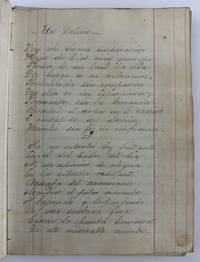
18894403Havana Cuba 1889. Good. 69pp. of manuscript text plus 77pp. of newspaper extracts. Contemporary quarter calf and marbled paper-covered boards. Moderate scuffing and wear to boards and edges spine scuffed. Hinges broken with text block only nominally attached by threads with many leaves detached. Ownership ink stamp on front free endpaper "Manuel F. Barranco" with a gilt insignia affixed below reading "MB." A unique and personal manuscript journal and scrapbook composed and maintained by an important but obscure Cuban-American poet and author Manuel Francisco Barranco y Miranda 1843-1894. Barranco was born in Puerto Principe and lived about half of his life in Cuba before emigrating to Florida in 1875. He married Mercedes Fernández y Fernández-Mora and the couple raised a family in Cuba Florida and New York. Mentions of Barranco are rare in available records but he seems to have been a colleague of famed Cuban revolutionary figure Jose Marti. Barranco and Marti were involved with a Cuban revolutionary emigrant colony in Key West as well as Cuban literary and political societies in Havana and New York such as La Liga. Regarding the latter one of Barranco's poems in the present work composed in eleven parts is titled "Versos recitados en la sesion ordinaria de la Sociedad Literaria Hispano-Americana la noche del 17 de Maya de 1889." The Sociedad Literaria Hispano-Americana or Spanish American Literary Society provides a further connection to Jose Marti as Marti was one of the most prominent members of the club in the 1880s and '90s. Barranco presumably spent the remainder of his life between Cuba and the eastern coast of the United States where he passed away in Tampa Florida in 1894.<br /> <br /> The present material was written and compiled by Barranco over about a thirty year period in the mid-19th century before and after he emigrated to the United States. The chief feature of the present work is contained in almost seventy pages of manuscript poetry by Barranco. The poems which number around a couple dozen compositions include "Un Delirio" written in six parts "Versas improvisados en el Bautiro de mi hija Ana Maria el dia 1 de Enero de 1875" "Versos improvisados en comemora cion del Bautiro de mi hija Ana Maria el dio 1 de Enero del 1876" "Al congreso de la Paz" and various sonnets and other poems dated between 1875 and 1889. Barranco authored a few poems here about his wife Mercedes with titles such as "A Mercedes" "Improvisados a la orrilla del mon - A Mercedes" and "Al contemplar tu retrato." He also composed poems about his mother Ana Maria Sebastiana de Miranda. Several of the later poems from 1888-89 are datelined Havana next to the date of composition indicating Barranco moved back and forth between Cuba and America.<br /> <br /> The manuscript text is supplemented by almost eighty pages of newspaper extracts featuring various articles letters and printed poetry by Barranco published under his own name and a pen name "Leunam." The subject matter of these pieces include education women literature and various family members and other subjects in his own poetry. An example of the latter is a memorial poem for his granddaughter Margarita Barranco who died in Puerto Principe in 1866. Following the manuscript poems themselves is a single handwritten page of contents relating to these newspaper extracts. The extracts very likely come from Cuban newspapers and periodicals since they predate his move to Florida in 1875. A printed note laid into the book reads: "A Bound Journal Containing Published and Unpublished Handwritten Letters and Poems by My Grandfather Manuel Francisco Barranco y Miranda in Habana in the mid-19th Century Probably During the Period 1859-1869." Not much else is easily discovered about Barranco providing an excellent chance for original research into the work of this obscure but important 19th-century Cuban-American poet and writer. unknown