131 résultats
184125455PARIS 1841-45 -in-8 demi-basane 31 plaquettes du même Auteur, reliées en 2 volumes, reliure demi-basane (half binding sheepskin) bleu-marine in-octavo, dos long (spine without raised band)décoré "or" (gilt decoration), Auteur et Titre frappés "or" (gilt title) avec 4 filets fins "or" de part et d'autre, 4 filets fin "or" en place des nerfs et en tête et en pied, papier marbré vert, crème et marron aux plats (cover with marbled paper), toutes tranches lisses (all smooth edges), sans illustration (no illustration), Oeuvres Reliées comme suit : TOME I ...... 1- Précis de l'Affaire Douillard-Mahaudière adressé à la Chambre des Députés, 20 pages, 1841, Paris Imprimerie de Cosse et G.-Lagionie Editeur, 2- Mémoire du Conseil des Délégués des Colonies à M. le Baron DUPERRE Amiral de France, Ministre de la Marine et des Colonies, 28 pages, 1841, Paris Imprimerie de Cosse et G.-Lagionie Editeur, 3- Conseil des Délégués des Colonies. a Monsieur le Ministre de l'Agriculture et du Commerce, 21 pages, 1841, Paris Imprimerie d'Ad. Blondeau Editeur, 4- Avis de M. JOLLIVET, Délégué de la Martinique à Monsieur le Ministre de la Marine et des Colonies, sur le projet d'Ordonnance relatif à l'emprisonnement disciplinaire des Esclaves, 24 pages, 1841, Paris Imprimerie d'Ad. Blondeau Editeur, 5- ANALYSE DES OPINIONS ET VOTES DES CONSEILS GENERAUX DE L'AGRICULTURE, DES MANUFACTURES ET DU COMMERCE, SUR LA QUESTION DES SUCRES : Lettre de Mr A. JOLLIVET, Membre de la Chambre des Députés, Délégué de la Martinique à Messieurs les Présidents et Membres du Conseil Supérieur du Commerce, SUR LA QUESTION DES SUCRES, 18 pages, 1842 Paris Imprimerie d'Ad. Blondeau Editeur, 6- Des Missions en France de la Société Abolitionniste Anglaise et Etrangère, par M. JOLLIVET, Député d'Ille-et-Vilaine, Délégué de la Martinique, 15 pages, sans date (1841)Paris Imprimerie d'Ad. Blondeau Editeur, 7- Question des Sucres dans la Chambre des Communes d'Angleterre - Du Travail Libre et du Travail Forcé. Leur Influence sur la Production Coloniale, par M. JOLLIVET, Député d'Ille-et-Vilaine, Délégué de la Martinique, Bon à Tirer avec dernières corrections de fautes et parfois de phrases rajoutée de la main de l'Auteur avant impression définitive par l'Editeur, 27 pages, Mai 1841 Paris Imprimerie d'Ad. Blondeau Editeur, 8- De L'Expropriation Forcée dans les Colonies de la Martinique, de la Guadeloupe et de la guyane par M. JOLLIVET, membre de la Chambre des Députés, 70 pages, 1842 Paris Imprimerie d'Ad. Blondeau Editeur, 9- Du Projet de Loi tendant à Régler les Attributions Financières des Conseils Coloniaux par M. JOLLIVET, membre de la Chambre des Députés, 51 pages, 2 Avril 1842 Paris Imprimerie d'Ad. Blondeau Editeur, 10- De la Philantropie Anglaise par Mr JOLLIVET, membre de la Chambre des Députés (deuxième edition), 55 pages, 1842 Paris Imprimerie d'Ad. Blondeau Editeur, 11- Discours de Mr JOLLIVET, Député d'Ille-et-Vilaine, dans les Séances des 28 et 30 Mai 1842, 15 pages, 1842 Paris Imprimerie de Cosse et G.-Laguionie Editeur, 12 - LETTRE ET REPONSE AU JOURNAL DES DEBATS, par M. JOLLIVET, Membre de la Chambre des Députés, Délégué de la Martinique, 14 pages, 1842 Paris Imprimerie de E.-B. DELANCHY Editeur, 13 - LETTRES de M. A. JOLLIVET, Membre de la Chambre des Députés et Délégué de la Martinique, 31 pages, 1842 Paris Imprimerie de E.-B. DELANCHY Editeur, 14- Analyse des Délibérations et Avis des CONSEILS COLONIAUX des Gouverneurs et des Administrateurs des Colonies sur les PROJETS D'EMANCIPATION(ABOLITION DE L'ESCLAVAGE), de la Commission présidée par M. Le Duc de Broglie, Par M. JOLLIVET, Membre de la Chambre des Députés, 69 pages, 1843 Paris Imprimerie Bruneau Editeur, 15 - L'EMANCIPATION ANGLAISE (ABOLITION DE L'ESCLAVAGE) Jugée par ses Résultats - Analyse des Documents Officiels Imprimés par ordre de M. le Ministre de la Marine et des Colonies, par M. JOLLIVET, Membre de la Chambre des Députés, Délégué de la Martinique, 104 pages, 1842 Paris Imprimerie de Moquet et Hauquelin Editeur, 16 - Enquête Parlementaire sur les COLONIES ANGLAISES publiée en Septembre 1842 - ANALYSE DE L'ENQUÊTE par M. JOLLIVET, Membre de la Chambre des Députés, 48 pages, 1843 Paris Imprimerie de Bruneau Editeur, 17- QUESTION DES SUCRES par M. JOLLIVET, Membre de la Chambre des Députés, 86 pages, 1843 Paris Imprimerie de Bruneau Editeur, 18 - PARALLELE entre les COLONIES FRANCAISES ET LES COLONIES ANGLAISES, Appendice au Rapport du Duc de Broglie par M. JOLLIVET, Membre de la Chambre des Députés, Délégué de la Martinique, 40 pages, 1843 PARIS Imprimerie de Bruneau Editeur, TOME II ..... 1 - Lettre de M. JOLLIVET, Membre de la Chambre des Députés, Délégué de la Martinique, au Rédacteur du Journal des Débats, 13 pages, 1844 Paris Imprimerie de Bruneau Editeur, 2 - Note Présentée au Conseil des Ministres Par M. JOLLIVET, Membre de la Chambre des Députés, Délégué de la Martinique, sur UN PROJET DE LOI RELATIF A LA CONSTITUTION POLITIQUE DES COLONIES, 23 pages, sans date (1844)Paris Imprimerie de Bruneau Editeur, 3 - A LOS HABITANTES DE LA ISLA DE CUBA (texte en espagnol ...par A. JOLLIVET, diputado de la camara de francia, y delegado de la Martinica), 23 pages, 1844 Paris imprimerie d'Ed. Proux et Cie Editeur, 4 - HISTORIQUE DE LA TRAITE ET DU DROIT DE VISITE. Par M. JOLLIVET, Membre de la Chambre des Députés, 35 pages, 1844 Paris Imprimerie de Bruneau Editeur, 5 - PETITIONS DE QUELQUES OUVRIERS ET OUVRIERES DE PARIS POUR L'ABOLITION IMMEDIATE DE L'ESCLAVAGE - VERITABLE SITUATION DES NOIRS DANS LES COLONIES FRANCAISES Par M. JOLLIVET, Membre de la Chambre des Députés, 20 pages, 1844 Paris Imprimerie de Bruneau Editeur, 6 - Observations Présentées par M. JOLLIVET, Délégué de la Martinique, devant la Commission de la Chambre des Pairs sur LE PROJET DE LOI (SUR L'ESCLAVAGE DES NOIRS), Tendant à Modifier les Articles 2 et 3 de la loi du 24 Avril 1833 - Séance du 11 Juin- 81 pages, 1844 Paris Imprimerie de Bruneau Editeur, 7 - QUESTION DES SUCRES EN ANGLETERRE. - DU TRAVAIL LIBRE ET DU TRAVAIL ESCLAVE, par M. JOLLIVET, Membre de la Chambre des Députés, 23 pages, 1845 Paris Imprimerie de Bruneau Editeur, 8 - DOCUMENTS AMERICAINS, ANNEXION DU TEXAS, EMANCIPATION DES NOIRS(ABOLITION DE L'ESCLAVAGE), POLITIQUE DE L'ANGLETERRE, par M. JOLLIVET, Membre de la Chambre des Députés, 40 pages, 1845 Paris Imprimerie de Bruneau Editeur, 9- ANNEXION DU TEXAS - NOUVEAUX DOCUMENTS AMERICAINS Publiés par M. JOLLIVET, Membre de la Chambre des Députés, 55 pages, 1845 Paris Imprimerie de Bruneau Editeur, 10 - DOCUMENTS AMERICAINS, 3ème Série. LES ETATS UNIS D'AMERIQUE ET L'ANGLETERRE. ANNEXION DU TEXAS. L'OREGON, par M. JOLLIVET, Membre de la Chambre des Députés, 74 pages, Avril 1845 Paris Imprimerie de Bruneau Editeur, 11 - LES COLONIES FRANCAISES DEVANT LA CHAMBRE DES PAIRS. Analyse de la Discussion Générale du Projet de Loi sur le Régime Colonial, par M. JOLLIVET, Membre de la Chambre des Députés, 112 pages, 1845 Paris imprimerie de Guiraudet et Jouaust Editeur, 12 - Chambre des Députés - Session de 1844-1845 - DISCOURS prononcé par M. JOLLIVET, Député d'Ille-et-Vilaine dans la discussion générale du projet de loi relatif aux COLONIES, Séance du 29 Mai 1845, 31 pages, extrait du Moniteur Universel du 30 Mai 1845, 1845 Paris Imprimerie Panckoucke Editeur, 13 - DISCOURS prononcés par M. JOLLIVET, Député d'Ille-et-Vilaine, dans la discussion des articles du projet de loi relatif au REGIME DES COLONIES, Séances des 2, 3 et 4 Juin 1845, extraits du Moniteur Universel des 3, 4 et 5 Juin 1845, 36 pages, 1845 Paris Imprimerie Panckoucke Editeur,
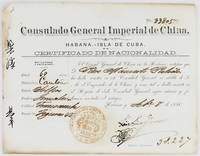
18802592Havana: September 8 1880. Very good. Partially-printed broadside 6.5 x 8.25 inches completed in manuscript in Spanish and Chinese. Small marginal wormhole mild edge wear light toning. Ink stamp of the Consulado General at bottom-center. A scarce certificate issued in 1880 by the Chinese Consulate in Havana authenticating the registration and details of a Chinese laborer in Cuba. The printed form is completed in manuscript with the name of the recipient his age place of origin occupation and place of residence. The present examples were completed for a sixty-year-old laborer from Canton being called Pedro Pulido who was going to work and/or live at 48 Calle Figueroa in Havana. The printed text states that "El Cónsul General de China en la Habana certifica que blank ha hecho constar en este Consulado General ser súbdito de S.M. el Emperador de la China y como tal se halla inscrito en el Registro de dicho Consulado General segun número y filiacion anotados al márgen." The certificate is dated September 8 1880 and is stamped with the seal of the consulate in red and with the rubberstamped signature of the Consul General Lin Liang Yuan. The form are also bears two ink signatures in Chinese in the left margin a rare occurrence. An excellent document of the bureaucracy surrounding imported Chinese labor to Cuba in the last quarter of the 19th century. September 8 unknown
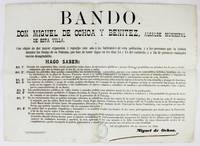
18883032Guanabacoa 1888. About very good. Broadside approximately 12 x 17 inches. Previously folded. Contemporary manuscript rubric and small ink stamp. small patch of ink burn causing separation along rubric line. A few tiny wormholes slightly affecting text. Light tanning minor foxing. An otherwise unrecorded 19th-century Cuban broadside decree announcing the rules for celebrations in Guanabacoa during "las fiestas de su Patrona" taking place on August 14 & 15 1888. The patron saint of Guanabacoa then a small town just outside Havana and now an outlying district of the city is Our Lady of the Assumption and August 15 is the Feast of the Assumption. This broadside prints eight articles the first of which allow games and "diversiones públicas" but prohibit games of chance and gambling of any kind and authorize the erection of food and drink stalls in public places that do not impede public traffic. Permission must be obtained from the municipal magistrates for balls and parties in private houses; shooting guns rockets and fireworks is still strictly forbidden but the lighting of torches is allowed during the saint's procession. Other rules regulate vehicular traffic cafés and restaurants horse races ball games and theatrical performances. A very interesting document of municipal regulation for popular religious events in Cuba during the late-19th century. unknown
1894106465<p>1894. Pamphlet format 70 pp. Illustrations; map. 14.3x11.8 cm 5½x4½" pictorial wrappers. Some light staining and wear to wrappers spine a little worn very good overall. Rare tourists' guide book produced under the auspices of the Grand Hotel Macotte with much on Havana transportation options sights to see including bull fights prices a Spanish vocabulary etc. with numerous advertisements for Cuban and some Florida businesses and other hotels. One advertisement features cigar maker La Corona. They even include an illustration of Christopher Columbus. OCLC/WorldCat lists only one copy at the California State Library Sutro Branch.</p> J. Carbonell and P. Montero, Proprietors.
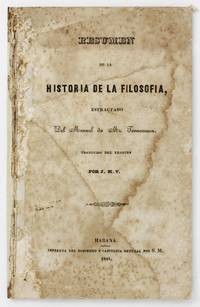
18455307Havana: Imprenta del Gobierno y Capitania General por S.M. 1845. Good. 684pp. Disbound. Some insect damage to gutter of title page ample staining throughout mostly minor foxing. A very rare mid-19th century Cuban imprint translating into Spanish a work by German philosophical historian Wilhelm Gottlieb Tennemann entitled Manual of the History of Philosophy. Tennemann originally published the work in 1812 as a much-abridged history of philosophy after authoring a massive multi-volume work on the subject. According to the translator's note at the beginning of the text the present work was produced in order to provide a text in Spanish for those studying the history of philosophy "at the Royal Academy and in the private schools of the island of Puerto Rico." The translator also notes that the history of philosophy is "one of the subjects.of the general plan of education that must be taught." The work itself is organized as a series of lectures detailing the history of philosophy chronologically from ancient Eastern and Egyptian times through the Greeks Pythagoras Socrates Plato Aristotle and many others concluding with modern thinkers such as Descartes Espinosa Hume Kant Hegel and others. The work ends with an Index and an Errata page.<br /> <br /> "Wilhelm Gottlieb Tennemann 1761–1819 German historian of philosophy was born at Erfurt. Educated at his native town he became lecturer on the history of philosophy at Jena in 1788. Ten years later he became professor at the same university where he remained till 1804. His great work is an eleven-volume history of philosophy which he began at Jena and finished at Marburg where he was professor of philosophy from 1804 till his death. He was one of the numerous German philosophers who accepted the Kantian theory as a revelation. In 1812 he published a shorter history of philosophy which was translated into English in 1852 under the title Manual of the History of Philosophy" - Encyclopedia Britannica. No copies located in the United States. Three copies found in OCLC -- two in Chile and one in Spain. Imprenta del Gobierno y Capitania General por S.M. unknown
185487325Havana: Imprenta de la Real Audiencia Pretorial por S.M. 1854. First Edition. hardcover. very good. 3 folding tables. 2 vols. in one. 8vo 1/2 contemporary black morocco; tear in a table with no loss of text. Habana: Imprenta de la Real Audiencia Pretorial por S.M. 1847 1854. Very good .<br/><br/> Imprenta de la Real Audiencia Pretorial por S.M. unknown books
1894106465<p>1894. Pamphlet format 70 pp. Illustrations; map. 14.3x11.8 cm 5½x4½" pictorial wrappers. Some light staining and wear to wrappers spine a little worn very good overall. Rare tourists' guide book produced under the auspices of the Grand Hotel Macotte with much on Havana transportation options sights to see including bull fights prices a Spanish vocabulary etc. with numerous advertisements for Cuban and some Florida businesses and other hotels. One advertisement features cigar maker La Corona. They even include an illustration of Christopher Columbus. OCLC/WorldCat lists only one copy at the California State Library Sutro Branch. </p><p><br /></p> J. Carbonell and P. Montero, Proprietors. books
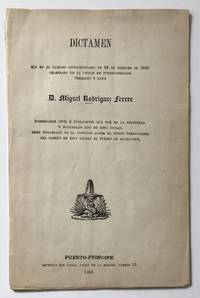
18611229Puerto-Principe: Imprenta del Fanal 1861. Good. 17pp. Leaves loose. Light wear one ink correction to text. A rare Cuban work printed outside of Havana outlining the necessity of a railroad between Puerto-Principe modern Camaguey and Santa Cruz. The many benefits of the plan are detailed herein with numerous charts. Miguel Rodriguez Ferrer 1815-1889 was a Spanish author and administrator but is best known for his work on the nature and culture of Cuba particularly his "Naturaleza y Civilizacion de la Grandiosa Isla de Cuba." He served in a number of civil administrator positions including mayor of San Antonio de los Baños and advisor to Puerto Principe. We locate a single copy at the National Library of Spain. Imprenta del Fanal unknown books
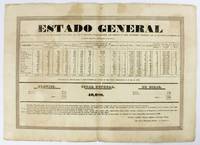
18385957Sancti Spiritus 1838. Good plus. Broadside measuring 12.5 x 17.5 inches. Previously folded. Light wear to edges and along old fold lines with a few small chips at edges. Moderate toning and soiling. An unrecorded broadside that prints statistics relating to agricultural production for the region of Sancti Spiritus in central Cuba during the late 1830s. For each municipality the broadside prints the number of property owners; ranches; land-grant farms; slaves; white employees; animals including mules donkeys cows and sheep; distances to transport and shipping hubs; and several other figures. In the bottom third of the broadside are printed the census figures from 1836 with the population totaling just over 40000 people and split into Black and white groups. Rather pointedly the figures for the white population are divided by gender while the figures for the Black population are divided by status free or slave. A very interesting statistical snapshot of a smaller rural region in colonial Cuba in 1838. Not in OCLC. unknown
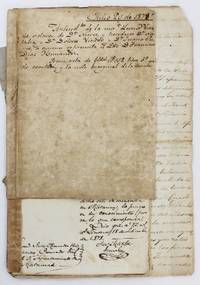
18784011Various places in Cuba 1878. Overall good. 29 leaves varying sizes. In contemporary ad hoc selfwrappers loosely stitched. Rear wrap tattered. Varying degrees of toning and wear. Scattered offsetting throughout. Fascinating gathering of documents and letters that present several cases of Cuban slaves applying for their own freedom in 1878. The gradual abolition of slavery on the island was enacted by Spain in 1880 but prior to this there were several bureaucratic mechanisms by which enslaved people could apply for or purchase their own manumission. The most interesting case amongst the present manuscript documents is the claim of a male slave that states he was born free in Puerto Rico but was somehow included in an inheritance as a young boy transported to Cuba and sold into slavery:<br /> <br /> "Un individuo que hoy se encuentran en la Cárcel del Alacranes y que dice nombrase Juhan ó José Julian Quintana y ser esclavo actualmente de Dn. Serapio Hernandez dueño de los ingenios Escorial ubicado en Colon y Sta. Rosa en Limonar y vecino de esa Ciudad calle del Rio ha solicitado se le restituyan un derechos de libertad por haber nacídolibre en Puerto Rico de donde á la edad de 5 ó 6 años le trajeron à esta Ysla y vencieron como esclavo."<br /> <br /> Interesting for the study of manumission in late-colonial Cuba and certainly worthy of further research. unknown
18095958Havana 1809. Good. 1p. on a bifolium. Printed form completed in manuscript. Previously folded. Small portion of upper left corner torn away and some scattered worming neither affecting text. Upper right of blank conjugate leaf clipped. Some scattered staining and offsetting with even tanning. An early 19th-century bill of sale for four slaves in Havana. The form completed in manuscript approves the sale by Doña Dolores Hernandez of "quatros negros" who had been brought from the coast of Africa on the slave ship Juno captained by Jabez Gibbs 1360 reales. It further states that the enslaved men are "Con la calidad de bozal alma en boca huesos en costal à uso de férias sin asegurar de tachas ni enfermedades mal de corazon gota coral de S. Lazaro ni orta qualesquiera que puede paceder la humana naturaleza porque toas corren por cuenta del comprador." The document is signed by the relevant authorities and dated March 26 1809. A good document of the slave trade in Cuba during the early 1800s. unknown
18560006868New York: D. Appleton 1856. First edition. Hardcover. fine. 12mo xii 412 pages original light brown embossed cloth. <br/><br/>These observations are related in a series of 61 letters. These were originally composed in Spanish then translated into English by Joseito. "I have thereby been enabled to impart entirely new data and reliable information instead of merely copying from books already known. . I applied myself to natives who besides an intimate knowledge of affairs in general possessed a sound judgment and an investigating disposition. It has beeen indeed a very happy incident to have found them. . That part of my work which treats on judicial matters and the secrets of the management of the tribunals will especially attract the attention of my readers. - Introductory Letter." Sabin 17816; Treiles BIBLIO. CUBANA vo. 4 p.17. D. Appleton hardcover
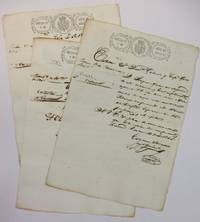
184537320Havana 1845. Each document 8-1/2" x 12-1/2" entirely in ink manuscript with decorative official printed ornamentation at head of each and signature "O'Donnell" in the left margins. Some toning and a few holes not affecting text. Good. <br/><br/> Leopoldo O'Donnell y Jorris 1st Duke of Tetuán 1809-1867 was a Spaniard of Irish ancestry from Tenerife. He went to Cuba as Captain General in 1843 and later served three separate stints as prime minister of Spain. He approved each of these requests for travel. The named Cuban Slaves are of "Lucumi" ancestry originally from the Yoruba tribes of Benin and Nigeria. The documents all dated in October 1845 refer to the slaves Joaquin Garcia de Angarica and Florentino Armenteroy Regidor.<br/> These requests were made to transfer the slave from one hacienda to another for work purposes the terms of work engagement frequently stated here. unknown books
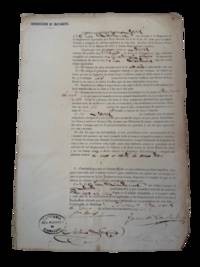
1870231451870. Cuba Chinese Labor Cuban indentured servant contract documenting the state administration of Chinese indenture in western Cuba July 1870 records the municipal enforcement of Cuban contract labor rules for Asian migrants under the post 1860 regulatory system that governed wages discipline illness food and flight. The form cites the Real Decreto of 6 July 1860 and the circular of 27 March 1861 governing the "introduccion y régimen de colonos asiáticos" placing the document within the mature legal framework used to renew and regulate Chinese labor contracts in colonial Cuba. Dated 5 July 1870 it records the continued operation of that system in Matanzas a decade after the initial decree when recontracting rationing medical provision and labor discipline had become standardized through municipal enforcement.<br /> Melchor and Roberto . 5 July 1870. Single sheet. 1 page. Approximately 8" x 11". Printed and manuscript Spanish contract on a form headed "Jurisdiccion de Matanzas." The parties are entered as the colono "Melchor" and "Roberto ." with Melchor identified as a native of a town in China and described as having completed an earlier commitment before agreeing to contract anew with Roberto for "un año." Clause 2 authorizes the patron to assign him to whatever labor his "citado patrono" requires whether in ingenios other fincas or talleres and the wage clause sets compensation at "20 escudos." The maintenance provisions specify daily rations including "12 onzas de carne" and "2 libras de plátanos boniatos ú otras sustancias alimenticias" together with medical attendance medicines during illness and two annual changes of clothing including trousers shirt and blanket. The text concludes with the employer's obligation to pay the twenty-escudo salary by completed months signatures of the parties and witnesses and an official Matanzas stamp.<br /> Contracts of this kind show the process by which Chinese labor in Cuba was renewed after a prior term and folded back into a system that combined wages with coercive control over movement occupation food clothing and bodily maintenance. The references to multiple governing orders the official jurisdictional heading and the stamped validation place the document inside the administrative chain that translated colonial labor law into enforceable local practice. Toning and scattered foxing throughout minor tears to original folds edge wear some minor wormholes and ink offsetting from the manuscript entries; text remains legible and document is in overall very good condition. A strong surviving municipal record of recontracting rationing and wage enforcement within the Chinese indenture system in Matanzas. unknown
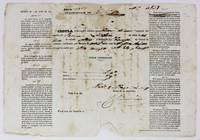
18574502Havana 1857. Good plus. Small broadside form approximately 8.5 x 12.5 inches. Previously folded with some separation and minor loss along vertical fold. Completed in manuscript with additional manuscript docketing on blank verso. Ink burn causing additional minor loss in a few small areas. Light edge wear; some staining and offsetting; light tanning. A 19-century Cuban identification form known as a cedula filled out in manuscript to authorize the travel of an Asian indentured servant between plantations in early May 1857. The document was completed for a twenty-six-year-old Asian fieldhand named Chan who had signed a contract to work for one Gallego Toriceo to be transferred to the premises of "P. Soler y Compañia." Printed at the left and right edges are nine articles from an 1855 decree that outline the regulations for issuing and keeping such documents including the following: <br /> <br /> "Estas cédulas servirán de documentos de seguridad y además de licencias de transito para los colonos que se trasladen de un punto á otro de la Isla. Los patronos respectivos cuidarán de que los colonos no emprendan el viage sin licencia expresa suya que haràn constar al pié de la cedula. Si algun colono fuere hallado sin cédula deberá ser detenido y puesto à disposicion del Gobernador ó Capitan del partido mas inmediato e cual dará conocimiento al patrono dentro de segundo dia."<br /> <br /> On the otherwise blank verso is additional contemporary manuscript docketing concerning the transfer of the cedula and therefore the laborer concerned to the receiver located in Matanzas. A very interesting document of the bureaucracy and control of indentured servitude in Cuba during the mid-19th century. unknown
18841574Habana 1884. Good plus. 2496 i.e. 498pp. Quarto. Contemporary calf gilt a.e.g.; rebacked with original spine laid down. Corners repaired with later black buckram; boards scuffed spine chipped. Hinges cracked repaired with later cloth and renewed endpapers. Minor scattered foxing and toning to text. Accomplished in a neat highly legible hand. A very attractive manuscript translation into Spanish of Pierre Larousse's well-known work on eminent and historical personages Fleurs Historiques des Dames et des Gens du Monde in a contemporary Cuban gilt goatskin binding. The manuscript connects three figures in the upper social echelons of Cuban society. José Fernandez Pellon the scribe of this volume is recorded as the Grand Master of Cuba's freemasons lodge the Gran Logia Unida de Colón y la Isla de Cuba. The translator Aurelio Almeida helped to found the organization in 1875 and at this time served as the Lodge Secretary. The initials E.D. gilt at the foot of the spine and the dedicatory inscription "A Eugenia Desvernine" refer to Eugenia Desvernine y Galdós b. 1865 daughter of the famous Cuban pianist Pablo Desvernine and Carolina Galdós y Echániz. She was also the niece of Benito Pérez Galdós the Spanish realist novelist who some authorities consider only second in stature to Cervantes. A contemporary social register remarks that Eugenia was one of the most beautiful women in Cuba perhaps an inspiration for the painstaking production of this manuscript.<br /> <br /> The original work by Larousse was a loose collection of religious parables classical myths biographies of ancient and modern historical figures. The title of the manuscript advises that is an extract and in the brief introduction Almeida explains his selection process writing that "He suprimido algunos artículos sobre cosas muy sabidas de la historia sagrada; y otros sobre la de Francia que mencionan frases ó personas casi ninca citadas ó citades solamente por las escritores francesas." He also notes several alterations and additions more relevant to Spanish history saying "En Cambio he agregado algunos artículos sobre historia de España que no están en el original y he tomado unos pocos de otra obra del mismo Mr. Larousse y de libros diversos." The result is an original amalgam of biographies historical episodes and religious parables. Interestingly we find no recorded printed editions of Larousse's work in Spanish so that the present manuscript is also an entirely original work of translation. A fascinating product of the cultural interests and mores of Cuban high society near the end of the Spanish colonial period. unknown
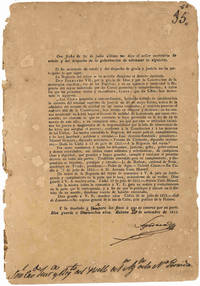
1813WRCAM46892Havana 1813. 1p. plus integral blank. Folio. Old fold lines. Moderately chipped and worn at edges. Lightly and evenly toned. Contemporary manuscript notations. Good. A rare printed decree from Cuba at the beginning of the 19th century as Spanish power in the world was waning but Spain's grip on Cuba was still quite firm. This decree issued by the King on June 14 1813 and printed on September 20 announces new laws regarding the rights to vote and to be elected to hold government positions for professors and scholars from certain universities collegiums and seminars. The decree forbade these rights to the Knights of Justice of the Order of St. John of Jerusalem as well as members of the four military orders of Santiago Calatrava Alcantara and Montesa. It is endorsed in manuscript with the imprint and header also written in by hand. Early Caribbean imprints are rare. unknown books
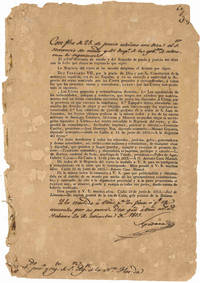
1813WRCAM46891Havana 1813. 1p. plus integral blank. Folio. Old fold lines. Moderately chipped and worn at edges. Evenly tonned. Contemporary manuscript notations. Good. A rare Havana imprint. As Spanish power in the New World was waning its grip on Cuba was threatened by domestic and foreign intruders. This decree issued by Fernando VII on June 17 1813 and printed on September 20 orders the annulment of all criminal cases. This amnesty policy extended to other areas of New Spain as well sought to placate opposition forces. It calls on all levels of government to announce and enforce the decree. It is endorsed in manuscript. unknown books
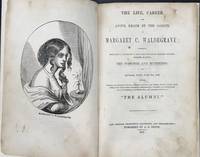
185257744New Orleans Charleston Baltimore and Philadelphia: A.R. Orton 1852. the original wrapper was dated 1853 apparently accounting for that date being used in each of the three OCLC listings. First edition of this rather primitively printed pamphlet. 8vo. 2 11-36 pp. Portrait frontispiece three wood-engraved plates. OCLC: "Sensational and presumably fictitious account of the criminal career of Margaret C. Waldegrave probably written by the publishers" the author of several similar lurid tales in the early 1850s. Contemporary pencil inscription on verso of frontispiece "Allow one vol. / plain binding / leather back." Not in Wright "American Fiction" McDade "Annals of Murder" or Jumonville "New Orleans Imprints." OCLC locates four copies American Antiquarian Soc. New York Historical Soc. Juniata British Library; AAS also holds a prospectus broadside for the work. Some interior foxing and soiling corner of one leaf renewed not affecting text. Recent plain gray wrappers. #4698. <br/><br/> A.R. Orton hardcover books
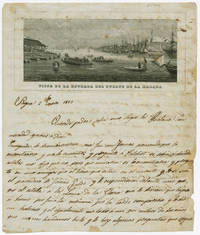
1853WRCAM54601Havana 1853. 4pp. on a bifolium. Previously folded. Some chipping at fore- edge slightly affecting text. Light dampstaining and tanning. About very good. An attractive Cuban pictorial letter sheet with a neatly executed third-page lithograph illustration of the port of Havana. The image depicts several small boats rowing barrels to and from a loading dock. In another small boat a plantation owner or some form of dignitary is being rowed to shore by a crew of men. On the right side of the image several larger ships lie at anchor and in the background on the shore is the fort guarding the mouth of the harbor the Morro Castle. <br> <br> The sheet is filled out by a man named Juan Fabre writing to his parents on Jan. 2 1853 advising them of his safe arrival in Havana. He talks about meeting up with a relative that he had not seen in two years and working at a shoe shop with another relative who adds a brief post script on the verso of the second leaf. Pictorial letter sheets of Cuba are quite rare on the market. unknown books
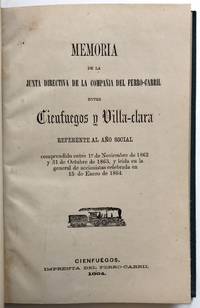
18641312Cienfuegos: Imprenta del Ferro-Carril 1864. About very good. 20pp. plus seven tables two folding. Original green cloth blind stamped and gilt lettered. Light wear at edges and spine ends; minor rubbing to boards. Manuscript letter laid in. Separation along fold and short closed tear at gutter of one plate. Light tanning. A rare annual report on the railroad that connected Cienfuegos to Santa Clara in the central portion of Cuba during the mid-1860s. The text gives details of the company's revenue and shipping totals passenger services work and improvements undertaken and levels of employment including discussion of indentured Chinese labor. The tables at the rear provide more complete statistics on the amount of products shipped number of passengers carried types of repairs carried out and the number of accidents and hospitalizations amongst employees and laborers. This copy was presented to a Señor Enrique Gatke likely a Havana investor in the company with his named lettered in gilt on the front board and with a letter from the company secretary Pedro Fernandez de Castro laid in. A scarce and detailed account of railroad operations in central Cuba during the mid-19th century. We locate only one example of any edition of these reports outside of the National Library of Cuba a copy of the 1862 report at the New York Public Library. Imprenta del Ferro-Carril unknown books
18562026Remedios 1856. About very good. 4pp. on a large bifolium. Printed form completed in manuscript. Separated at fold repaired with tissue. Light wear at edges. Light tanning and foxing. Rare Cuban population census form listing the number of residents in and around the town of Remedios located on the northern central coast of Cuba in 1856. The present document completed in manuscript lists the population according to various categories such as ethnicity and race age range occupations marital status location of residence and several others. The census includes slaves of African origin newly arrived Chinese indentured servants "colonos Asiaticos" immigrant laborers from Yucatan freedmen and free white residents "Blancos". In all there are just over 2000 people living in and around Remedios at this time comprising just over 1300 free whites over 300 free people of color 460 slaves and 19 Chinese laborers. One of the most interesting sections records the population by place of residence which shows that the great majority people in the area lived on estancias with a good part of the remaining population living on livestock farms and sugar plantations. On the final page are two additional sections which enumerate the types of property farms and other enterprises in the regions and provide statistics on agricultural and industrial production and land usage along with some manuscript notes with the signatures of the census takers or local magistrates. An interesting document of slavery agriculture and population in rural Cuba during the mid-19th century. unknown books
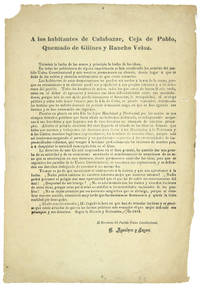
1878WRCAM38237Cuba 1878. Broadside 12 1/2 x 8 3/4 inches. Chip at upper left corner not affecting text. Small tears in all edges several repaired by tape on verso. Good. A rare and fascinating Cuban political broadside calling for an end to armed struggle but a beginning to a "struggle for ideas" at the conclusion of Cuba's "Ten Years' War" the battle for independence from Spain in 1868 to 1878. The broadside is addressed to the residents of the region around the north-central coast of Cuba some 150 miles east of Havana. The text of the broadside is signed in print by Gabriel Aguilera y Zayas Secretary of the Partido Union Constitucional PUC one of the two main political parties that developed out of the Ten Years' War. The PUC which was a conservative pro-Spanish party led by prominent Creoles sought a measure of local political autonomy while favoring continued Spanish control over Cuba. The text exhorts Cubans to partake in the ideological struggle that would succeed the armed rebellion and urges them not to fall into lethargy but to continue the battle of ideas against radicals seeking independence from Spanish colonial rule. <br> <br> Due to their ephemeral nature as well as the climate of the Caribbean any such Cuban broadsides are scarce. No copies of this broadside are located in OCLC. Important evidence of the political factionalism and the strength of pro-Spanish sentiment in Cuba in the late 19th century. Rare and possibly unique. unknown books
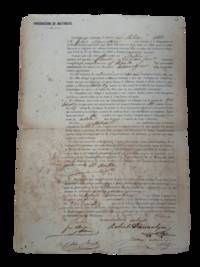
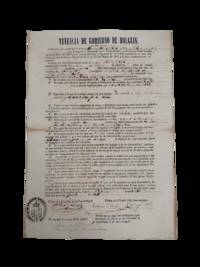
1868231331868. Cuba Chinese Labor Cuban indentured servant contract documenting the state administration of Chinese indenture in eastern Cuba in January 1868 with direct evidence of how colonial authorities private employers and local officials formalized the re-contracting of Chinese laborers under the legal framework established after the 1860 royal decree regulating Asian colonos on the island. Printed references within the form cite the Reglamento aprobado por Real decreto de 6 de Junio de 1860 and the Circular del Gobierno Superior Civil de 27 de Marzo de 1861 placing the document squarely within the coercive labor regime that Spanish Cuba built after the suppression of the transatlantic slave trade. The named employer Antonio Gonzalez the identification of the worker as a 37 year old Chinese male "Yuet" and the required signatures and government seal make the sheet a concise administrative record of the contract system through which Cuban planters and officials bound Chinese workers to plantation and rural labor in the final decade before the Ten Years' War.<br /> Tenencia de Gobierno de Holguín. January 1868. One page printed and manuscript contract form approximately 8" x 11". Printed in Spanish with extensive manuscript completion in brown ink. The form opens "Contrata que celebran el colono." and records a renewed labor agreement between a Chinese colono identified in the contract and Don Antonio Gonzalez with manuscript entries identifying the laborer as 37 years of age and supplying the individualized terms of service. The printed clauses set out the structure of the contract in eleven numbered articles including the term of service compulsory labor under the employer's orders days and hours of work subjection to discipline under the Reglamento monthly salary of 14 escudos food and clothing provisions medical attendance and hospital care treatment during illness and the requirement at the end of the contract either to renew service or enter the depósito de cimarrones. The sheet is signed by the patron the colono and the Teniente Gobernador and bears the circular official stamp of the Tenencia de Gobierno at lower left with additional show-through and seal impression visible on the verso.<br /> By 1868 Chinese indenture in Cuba had become one of the island's central labor systems supplying workers to a plantation economy still structured by slavery while giving colonial officials a paper mechanism for disciplining reallocating and surveilling labor. Forms such as this show the overlap between private contracting and state enforcement: the worker's obligations are written into a government template disputes are reserved to local authority and illness wages food clothing and renewal are all treated as administrative matters within a coercive labor order. Very good condition with horizontal fold light toning minor scattered staining and foxing and strong printed text manuscript entries seal and signatures. A compact Holguín government document showing the bureaucratic machinery of Chinese indenture in late colonial Cuba. unknown
1867231471867. Cuba Chinese Labor Cuban indentured servant contract documenting the state administration of Chinese indenture in western Cuba February 1867 records the municipal enforcement of Cuban contract labor rules for Asian migrants under the post 1860 regulatory system that governed wages discipline illness food and flight. Issued on a printed form headed "Jurisdiccion de Matanzas" the document cites the Real Decreto of 6 July 1860 and the circular of 27 March 1861 governing the "introduccion y régimen de colonos asiáticos" then applies that framework to a specific recontracting arrangement between the laborer David and a patron named Juan. Dated 17 February 1867 it shows the continued operation of this municipal contract system after the additional order of 28 March 1866 which is also cited in clause 6 governing illness and compensation.<br /> David and Juan. 17 February 1867. Single sheet. 1 page. Approximately 8" x 11". Printed and manuscript Spanish contract on a form headed "Jurisdiccion de Matanzas." The parties are entered as the colono "David" and "Juan ." with David identified as a native of a town in Asia of "oficio campo" and described as having completed a prior commitment before agreeing to contract anew. Clause 1 fixes the term at "dos años." Clause 2 authorizes the patron to direct him to whatever labor he may assign in ingenios fincas or talleres with work entered with how many hours a day. Clause 4 sets compensation together with daily maintenance including meat and vegetable rations medical assistance and medicines during illness and annual clothing allotments including trousers shirt and blanket. Clause 8 repeats the employer's obligation to pay David punctually by completed months and to fulfill all conditions set out in the contract which bears multiple signatures and an oval district stamp at lower left.<br /> Contracts of this kind show the process by which Chinese workers in Cuba were transferred from one term of service into another through standardized paperwork that joined wages to labor discipline rationing medical provision and restricted mobility. The references to the 1860 decree the 1861 circular and the 1866 order place the sheet within the evolving legal structure that governed Chinese indenture in Matanzas one of the island's major plantation districts. Toning original folds edge wear scattered creasing and light ink offsetting; text clear and overall very good condition. A strong surviving municipal record of recontracting Chinese labor in the sugar zone of nineteenth century Matanzas. unknown