2 507 résultats
20CCUBALOTCIsrael Jerusalem Havana Cuba New York Usa. Fair with no dust jacket. Non-Book. On offer is a remarkable nine-document archive tracing nearly two decades of Zionist political cultural and financial correspondence linking Cubas Jewish leadership with the centers of world Jewry in Jerusalem New York and Latin America. Together these communications chart the transformation of Cuban Jewry from a peripheral supporter of the Yishuv to an active and recognized participant in the international Zionist networka Caribbean outpost engaged in fundraising education youth mobilization and ideological exchange. Mandatory-Era Migration and Bureaucratic RestraintThe earliest piece dated September 22 1937 comes from the Jewish Agency for Palestine in Jerusalem addressed to the Zionist Federation of Cuba in Havana regarding an individual immigration request the case of Rudzenewsky. The letter opens: - . We do not have any immigration certificates in our possession; therefore we cannot discuss your request regarding obtaining Aliyah certificates at all. Issued amid the tightening British immigration quotas of the Arab Revolt this restrained refusal captures the bureaucratic limits of Mandatory-era migration and the frustration of a community newly seeking direct participation in the Zionist project. Even a sympathetic outpost such as Havana remained outside the gates of the Yishuvs allocation system dependent on permissions that never came. As one of the earliest known correspondence between the Cuban Zionist Federation and Jerusalem it marks the beginning of a paper trail that would over the following two decades trace the communitys evolution from petitioners to recognized partners in global Zionist coordination. Fundraising for Settlement and DefenseBarely six weeks later the tone shifts from denial to mobilization. On 5 Kislev 5698 November 5 1937 Keren Hayesod Ltd. the Erez Israel Palestine Foundation Fund issued a Hebrew circular from Jerusalem to its global committees including Havana. Typed on vivid blue-and-white letterhead it announced the forthcoming fourth issue of HaMassad dedicated to the great enterprise of construction and security of Keren Hayesod this year. Inviting regional feedback to ensure the bulletin fulfills its task perfectly and reflects the creative work being done in Eretz Israel the circular unites the twin imperatives of binyan uvebitachon building and defense central to the Yishuvs ethos amid the Arab Revolt. For Cubas emerging Zionist Federation this stands as one of the earliest direct communications from Jerusalem confirming the islands inclusion in the pre-state fundraising and ideological network. Wartime Solidarity and Political ConscienceTwo vivid wartime items from 1944 illustrate how ideology culture and politics intertwined in Havana. The Unión Sionista de Cuba issued a bilingual flyer inviting the Jewish public of Havana to a lecture by Nathan Bistritzky on Moscow and Jerusalem An Analysis of Two Revolutions adding: En este Acto se homenajeará al heroico Ejército Rojo en ocasión de su 26º Aniversario. In this Act the heroic Red Army will be honored on the occasion of its 26th Anniversary. An accompanying invitation from the Patronato de Ayuda al Pueblo Español greets the President of Zionist Youth and invites him to a December meeting about the struggle of the Spanish people and the delivery of economic contributions for the Year-End Effort. These intertwined documents vividly position Jewish Havana within the broader antifascist and humanitarian currents of the Second World War. Youth Networks and Ideological PluralismA Hashomer Hatzair letter of April 17 1945 conveys the disciplined optimism of the socialist-Zionist youth movement as it rebuilt its trans-American network in the final months of war. Written from the North American headquarters in New York to the Cuban branch it reports on arrangements for Tova Levin a young Hebrew teacher in training at the movements Hightstown farm who would soon travel to Cuba to assist with education and leadership development. The circular further details plans for a Latin-American management camp in Mexico and urges an immediate reply with participant names. The writers lament the branchs silence since October and request news and photographs for The Young Guard anniversary issue. Closing with With the blessing of the movement. Strong and courageous! it perfectly fuses administration and inspiration. Its bilingual Hebrew-English letterhead / Hashomer Hatzairembodies the groups dual mission: Hebrew in content international in spirit linking Havana New York and Mexico in a single youth-driven Zionist network. From Jerusalem the Executive of the Zionist Organization issued a communiqué on July 15 1946 signed by Dr. A. L. Leuterbach in the aftermath of the British arrests and seizure of the Jewish Agencys offices during the Black Sabbath raids: The imprisonment of members of the Jewish Agency came as a heavy blow to us and greatly shocked the Yishuv and the entire Zionist world. The statement thanks Jewish communities abroad for solidarity vows to continue our work without hesitation and appeals to every Zionist body to spread the spirit of Zionism even more strongly in their respective places. Although the Agencys files had been seized the call radiates steadfastness and unity amid repression. A decade later this networks endurance is reaffirmed through two trans-Atlantic communications. On December 14 1955 The Jewish Agency Inc. 16 E. 66th Street New York wrote to Betar Calle 10 esq. 3 Vedado Havana enclosing a check for $150 representing allocation by the Youth and Hechalutz Department for the period October 1 1955 through March 31 1956.The letter explicitly notes that the payment was made pursuant to instructions received from Israel confirming that the directive to fund Havanas Betar chapter originated in Jerusalem. Signed by Fannie Speiser Assistant Treasurer the letter attests to the continuing New YorkHavana financial conduit and to Israels oversight of diaspora youth programming. Soon afterward Dr. Aron Weinberger of Midstream magazine wrote inviting the Havana community to help distribute the journal for free and frank discussion of all problems that face the contemporary Jew. final item dated November 12 1956 brings the narrative full circle. Issued by the Club Juvenil del Patronato de la Casa de la Comunidad Hebrea de Cuba it invites Hashomer Hatzair Prado 260 Ciudad to attend the installation ceremony of the Patronatos new youth board to be held on Tuesday 20 November at 9 p. M. In the Conference Hall of the Patronato. Signed by Rafael Kapuskin Secretary the letter is both social and symbolicaffirming that by the mid-1950s Zionist youth movements were no longer peripheral study circles but active civic partners within Havanas central Jewish institutions. The letters tone En la seguridad de vernos honrados con vuestra presencia In the certainty of being honored by your presence embodies the confidence of a mature interconnected Jewish community just before the political transformations of late-1950s Cuba. Together these communications trace Havanas evolving role in Israel-oriented and diasporic intellectual lifefrom the practical fundraising of Keren Hayesod to the ideological pluralism of Betar and Hashomer Hatzair. As a whole the archive captures the rhythm of Cuban Zionist life from supplication and bureaucracy to political maturity and cultural dialogue. It offers scholars a uniquely multilingual cross-section of Hebrew Yiddish Spanish and English voices negotiating identity loyalty and nationhood from the Caribbean periphery of world Zionism. Condition and Language: Nine documents spanning Hebrew Yiddish Spanish and English. Mixed paper stocks; significant folds generally minor stains and varying edge tears especially prominent on thinner stock. Heavy handling all text complete and legible. Age toning. Overall Fair to Good.; Manuscripts; 8vo 8" - 9" tall; 10 pages; Signed by Author . unknown
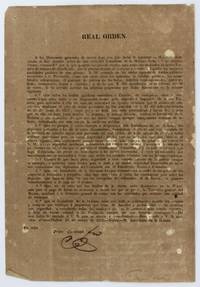
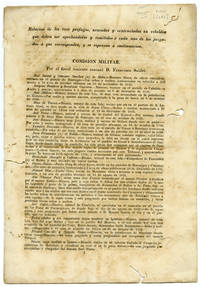
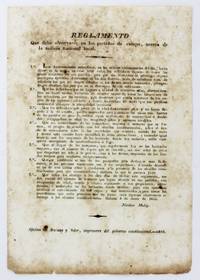
18223190Havana: January 5 1822. Good. Broadside 11.5 x 8 inches. Foxed faint signs of folding a few small wormholes not affecting text. An apparently unrecorded broadside order from the captain general of Cuba Nicolas Mahy directing all able-bodied men under the age of fifty to join up with their local militias in order to keep the peace. The local militias are directed to go out on nightly forays "en nùmero capaz de evitar las incursiones de los salteadores por los caminos y la desercion que pueda acontecer de los negros de los ingenios cafetales y demas haciendas." Additionally all men between the ages of fifty and seventy are told to report to “las casas mas fuertes de los pueblos" to form a garrison that can protect women children and the elderly in case of insurrection. By the formation of these militias and the establishment of "el uso de los pasaportes" it was hoped to identify and arrest "los vagos y mal entretenidos." All mayors within ten days of receipt of this regulation were to report the number of men they had enlisted along with their particulars. In the early 1820s much of Spanish colonial America was gripped by revolution and with these orders the Cuban government likely hoped to avoid similar unrest on the island. Several independence groups had been formed in Cuba as of the promulgation of this decree the largest of which was the Soles y Rayos de Bolívar established in 1821. Signed in print by Mahy; not in OCLC. January 5 unknown
18841574Habana 1884. Good plus. 2496 i.e. 498pp. Quarto. Contemporary calf gilt a.e.g.; rebacked with original spine laid down. Corners repaired with later black buckram; boards scuffed spine chipped. Hinges cracked repaired with later cloth and renewed endpapers. Minor scattered foxing and toning to text. Accomplished in a neat highly legible hand. A very attractive manuscript translation into Spanish of Pierre Larousse's well-known work on eminent and historical personages Fleurs Historiques des Dames et des Gens du Monde in a contemporary Cuban gilt goatskin binding. The manuscript connects three figures in the upper social echelons of Cuban society. José Fernandez Pellon the scribe of this volume is recorded as the Grand Master of Cuba's freemasons lodge the Gran Logia Unida de Colón y la Isla de Cuba. The translator Aurelio Almeida helped to found the organization in 1875 and at this time served as the Lodge Secretary. The initials E.D. gilt at the foot of the spine and the dedicatory inscription "A Eugenia Desvernine" refer to Eugenia Desvernine y Galdós b. 1865 daughter of the famous Cuban pianist Pablo Desvernine and Carolina Galdós y Echániz. She was also the niece of Benito Pérez Galdós the Spanish realist novelist who some authorities consider only second in stature to Cervantes. A contemporary social register remarks that Eugenia was one of the most beautiful women in Cuba perhaps an inspiration for the painstaking production of this manuscript. The original work by Larousse was a loose collection of religious parables classical myths biographies of ancient and modern historical figures. The title of the manuscript advises that is an extract and in the brief introduction Almeida explains his selection process writing that "He suprimido algunos artÃculos sobre cosas muy sabidas de la historia sagrada; y otros sobre la de Francia que mencionan frases ó personas casi ninca citadas ó citades solamente por las escritores francesas." He also notes several alterations and additions more relevant to Spanish history saying "En Cambio he agregado algunos artÃculos sobre historia de España que no están en el original y he tomado unos pocos de otra obra del mismo Mr. Larousse y de libros diversos." The result is an original amalgam of biographies historical episodes and religious parables. Interestingly we find no recorded printed editions of Larousse's work in Spanish so that the present manuscript is also an entirely original work of translation. A fascinating product of the cultural interests and mores of Cuban high society near the end of the Spanish colonial period. unknown books
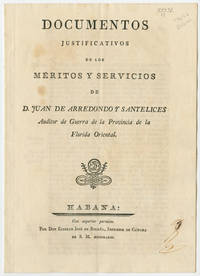
1815WRCAM49642Havana: Esteban José de Boloña 1815. 19pp. Gathered signatures stitched. Stitching mostly perished. Light fold lines minimal foxing ink marginal notations contemporary ink inscription after the text. Very good. An early Cuban imprint printed by Esteban José de Boloña the first printer in Cuba after the 1776 ban on printing. Juan de Arrondo y Santilices was an official in Spanish Florida the Auditor of War of East Florida during the early 19th century. This is a work detailing the deeds of Arrondo y Santilices likely an attempt to secure a pension. Rare with one copy located by OCLC at the John Carter Brown Library. Esteban José de Boloña unknown books
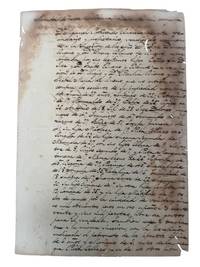
1875231241875. Slavery Cuba Spanish colonial slave sale manuscript recording the transfer of thirty-eight enslaved individuals in Cuba in 1875 materializing the sheer scale and organization of enslaved labor within the island's plantation economy during the final decade before abolition. The document enumerates a large group of enslaved people including multiple family units with young children demonstrating how slavery functioned as both an economic system and a hereditary condition sustained through the sale and reproduction of enslaved populations. Created eleven years prior to the abolition of slavery in Cuba in 1886 the manuscript documents the continued legality and normalization of large-scale slave transactions despite decades of international pressure and earlier prohibitions on the transatlantic trade offering concrete evidence of how internal markets sustained the institution in its final phase.<br /> <br /> Official Cuban slave contract documenting the sale of thirty-eight enslaved individuals for the sum of 126000 pesetas formalized before a public notary or legal authority. Single manuscript leaf written in Spanish cursive in black ink on both recto and verso densely filled with names ages and relational identifiers. Measures 8.5" x 12.25". The text lists individuals sequentially including men women and children with repeated references to kinship structures such as mothers with multiple children indicating the sale of family groupings rather than isolated individuals. The script reflects extended passages detailing ownership exclusions and conditions of transfer. A partial watermark of the official coat of arms of Cuba is visible. <br /> By 1875 Cuba remained one of the last major slave societies in the Atlantic world with sugar production driving demand for large controlled labor forces. Even after Spain curtailed the official slave trade earlier in the century illegal importation persisted into the 1860s and alternative systems of coerced labor including Chinese indenture supplemented plantation workforces. The scale of this transaction demonstrates the consolidation and redistribution of enslaved labor within domestic markets while the inclusion of children underscores the long-term economic logic of slavery as a self-reproducing system. Moderate toning and foxing concentrated along the edges with numerous small closed wormholes a few affecting portions of the text. Light edge wear present. Overall in good condition. This document provides unusually extensive nominal data on a large enslaved population encompassing the roles of kinship valuation and labor organization in late Spanish colonial Cuba. unknown
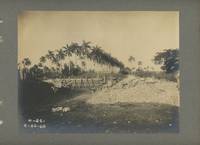
1906List3021La Habana Province Republic of Cuba 1906. Twenty-two photographs measuring 7 ¼ x 9 ½ inches mounted on heavy cardstock measuring 10 x 12 inches. Photos numbered and dated on negative. In album embossed with “Havana Central Railroad Co./ Progress Photographs/ GUANAJAYâ€. Photos with fine contrast and some wear; mounts with minor damage slightly warped with some detached from binding. Overall excellent. Havana Central Railroad Company was an American company formed in April 1905. It opened two electric tram lines—Havana to Guanajay in 1906 and Havana to Güines in 1907—before it was bought by the English company United Railways following the Panic of 1907. Offered here is a photo album showing the construction of the Guanajay line. The photographs show laborers assisted by horse-drawn carts digging culverts laying tracks and erecting bridges and buildings.<br /> <br /> This project came on the heels of the successful efforts of the Cuba Company another railroad company to make the emerging Cuban Republic amenable to American business.They did so first by using ‘revocable permits’ which could ostensibly be revoked by the new government when it was formed to circumvent the Foraker Amendment prohibiting concessions to American companies by the US’s military government; and second by using their close relationships to several members of the Cuban Constitutional Convention to include a law allowing irrevocable permits.1 These along with the Platt Amendment and Governor Leonard Wood’s General Railway Law led to what would amount to domination by US interests in Cuba particularly but not exclusively in the railroad industry.2<br /> <br /> Of interest to scholars of the early Republic of Cuba especially the history of US businesses in the country.<br /> <br /> 1 Juan C. Santamarina “The Cuba Company and the Expansion of American Business in Cuba 1898–1915†The Business History Review 74 no. 1 Spring 2000: 41–83.<br /> 2 Louis A. Pérez Jr. “Insurrection Intervention and the Transformation of Land Tenure Systems in Cuba 1895–1902†Hispanic American Historical Review 65 no. 2 1985: 229–254. unknown
18183189Havana 1818. Good. Broadside 11.75 x 8 inches. Heavily tanned. An apparently unrecorded Havana imprint comprising a broadside authorization for increased funding to be extended to the superintendent of Havana so that he can maximize the potential of the island's tobacco plantations. This credit is matched by the superintendent’s promise to use the money "con el preciso destino de comprar y remitir á España las mayores cantidades posibles de este género." The superintendent must also swear to be vigilant and honest in his account-taking reports to Spain and "Avise con toda la anticipacion posible los acopios y compras que verifique à proporcion que tenga de hacerlos y probabilidad en las remesas con seguridad aprovechándo todas las ocasiones que se le presenten para remitir cigarros y hoja de buena calidad á la Peninsula aunque sea con bandera extrangera." Signed in print and rubricated in manuscript by Pedro Carambot a Cuban official of the late 1810s. Not in OCLC. unknown
86443Havana: El Siglo XX. First Edition. hardcover. very good. 9 volumes in one. Very thick 4to 1/2 polished green calf stiff original printed wrappers bound in. Habana: El Siglo XX 1924-1932. Very good .<br/><br/> DIHIGO Y MESTRE Juan Miguel et al.<br/><br/> El Siglo XX unknown books
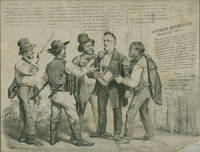
1856WRCAM53452New York: Nathaniel Currier 1856. Broadside 10 x 13 inches. Foxed bottom right corner chipped. Lower margin trimmed costing the title. Good only. Framed under glass. A scarce political cartoon regarding the controversial Ostend Manifesto the initially- secret attempt by the United States to purchase Spanish-controlled Cuba. Earlier President Franklin Pierce had instructed Pierre Soulé upon his appointment as minister to Spain in April 1853 to negotiate to buy Cuba. Three American foreign ministers serving in Europe - James Buchanan John Y. Mason and Soulé - met secretly at Ostend Belgium in late 1854 to draft a plan to either buy Cuba from Spain or force Spain to give up Cuba by inciting a Cuban revolution. The plan met with overwhelming opposition once it was made public in America. <br> <br> In the present political cartoon Buchanan is attacked for his role in the Ostend controversy. He is surrounded by four armed ruffians seeking to rob him of his coat hat watch and money a particularly sharp turn- about on the American minister to Great Britain. The muggers' demands include quotations from the manifesto which is pasted to the fence at right. Buchanan calls out: "Why! Why! This is rank robbery! Help! Help! All honest men!" <br> <br> The fallout from the Ostend controversy was widespread. President Pierce's Democratic Party split asunder after he refused to continue any discussions of the plan or any other expansionist ideas; Soulé understandably resigned; and the international community saw it as a threat to Spanish sovereignty in the region. Oddly enough James Buchanan was not too hurt by the controversy; he was easily elected president in 1856 and still harbored hope for Cuban annexation. He was smart enough however to table the Cuba question for the foreseeable future after meeting with both popular opposition and increasingly bitter sectional conflict the latter only spurred on by incidents such as the Ostend controversy. CURRIER & IVES: CATALOGUE RAISONNÉ 5021. NEVINS & WEITENKAMPF p.72-73. Nathaniel Currier unknown books
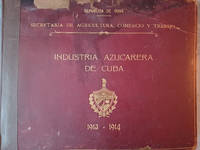
19153017<p>Portafolio azucarero de la industria azucarera de cuba 1912-1914 primera edicion libreria e imprenta la moderna poesia 1915 esta obra ha sido realizada siendo presidente de la republica de cuba dr mario garcia menocal y secretario de agriculturacomercio y trabajo el general emilio nunez caratulas originalesrestauradasgran libro ilustrado 424 pgs mas graficos libro con peso de 13 librascon 16 cm de largo por 12.5 cm de anchoes una obra super rarade colecciondonde se describen todos los centrales azucareros de cubacon fotos y sus caracteristicas publicada en el ano 1915 por la libreria e imprenta la moderna poesiaes una de las rarezas de la bibliografia cubana</p> Libreria e imprenta la moderna poesia hardcover
2015115332Society. New. 2015. Paperback. 0942576586 . FREE UPGRADE to Courier/Priority Shipping Upon Request - IN STOCK AND IMMEDIATELY AVAILABLE FOR SHIPMENT - IN STOCK AND IMMEDIATELY AVAILABLE FOR SHIPMENT - Flawless copy brand new pristine never opened - -- with a bonus offer-- . Society paperback
1832WRCAM51901Havana 1832. 18pp. Folio. Loose leaves. Heavy worming mostly marginal but somewhat affecting text in places. Light dampstaining and foxing. Good. An extensive list of fugitives from Cuban courts that covers the period from 1822 to 1832. Each section comprises a catalogue of men tried before a specific court and individual entries provide names brief descriptions mostly of skin color birthplaces likely places of residence and crimes committed together with the sentences handed down. Many men are condemned to the gallows or are facing long sentences in African or other overseas prison camps. This list was also printed as a part of the Oct. 9 1832 issue of DIARIO DE LA HABANA but a separate printing as in the present example is not found in OCLC or the relevant bibliographies. unknown books
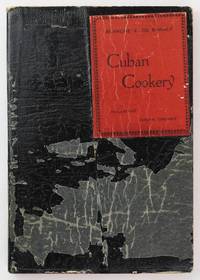
19316190Havana 1931. Very good. 150pp. Stiff black cloth covers printed paper label on front board. Front cover vertically creased light wear to boards; remnants of glassine stuck to covers. Contemporary inscription on front flyleaf. Internally clean. In a custom clamshell box. First edition of the first Cuban cook book published in English. Blanche Zacharie de Baralt 1865-1950 was born in New York; she married Luis Alejandro Baralt y Peoli in 1886 and the couple moved to his native Cuba in 1900. She earned a PhD in philosophy from the University of Havana in 1902 and went on to translate the poetry of Tagore and to write a book on Jose Marti. She also published this volume which was clearly geared toward the tourist market with the introduction emphasizing the idea of taking home the tastes of one's holiday abroad. Each chapter heading has an illustration and these were drawn by Federico Edelmann and Conrad W. Massaguer the one above the section for beans appears to show a cowboy riding along in a cloud of gas. Notably this work contains several important Cuban cocktails including the first appearance of the mojito referred to here as a Rum Cocktail or Cuban Mojo. Rare in the true first edition. unknown
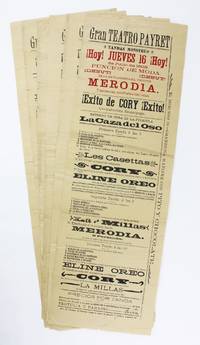
19085578Havana: Moises V. Codina 1908. Good plus. Seven broadsides each approximately 22 x 7.25 inches plus one double bill measuring about 22 x 15 inches. One broadside printed in red and black. Previously folded. Scattered shallow tears from edges not affecting text with some tape repairs on blank versos. A group of eight playbills spanning eight consecutive days in July 1908 that advertise performances and events at the Gran Teatro Payret in Havana. The theater was built by its namesake Jaoquin Payret in 1877 on a corner across from the Villanueva Railway Station now the Capitolio Nacional de la Habana and initially focused on opera and high-class performing arts to compete directly with other established theaters in the Cuban capital. The building had five floors and a capacity of 2300 but the upper balconies collapsed in 1882 after which the theater changed hands and began to showcase more varied popular offerings.<br /> <br /> These playbills publicize an array of performers including the ballet dancer Millas; a cabaret artist Eline Oreo; a magician and telepath Sidney Richards; Troupe Montrose a group of acrobats an Italian dance troupe Les Casettas; two clowns named Pito and Chocolate; and many others. Notably the programming also includes a heavy rotation of short and feature films such as La Electricidad Liquida 1907; El Inagarrables Pick Pocket 1908; Victima de la Ciencia 1907; En Chine: Voyage sur le Canal Impérial 1908; and Venganza del Dervich 1907. The playbill for Thursday July 16 with its headline and date in red proclaims the debut of Trouppe Merodia a seven-person group of acrobats and cyclists as well as the Cuban premiere of a film titled La Caza de Oso The Bear Hunt.<br /> <br /> The theater was closed by hurricane damage in 1926 but reopened as a cinema in 1935 and in the following years became known as the "Cathedral of Spanish Cinema." The building again fell into disuse and disrepair in the decades following the Cuban Revolution but was restored in 2008. A very interesting group that gives a great sense of day-to-day operations at one of Cuba's most important and historic theaters. Moises V. Codina unknown
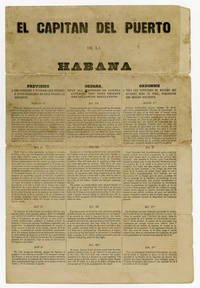
1850WRCAM51706Havana 1850. 4pp. on a bifolium 15 3/4 x 10 1/2 inches. Printed in three columns. Previously folded with some short separations along fold lines and a closed tear to top edge. Somewhat tanned with some dust soiling in upper portion of first leaf recto. Good plus. Bifolium printing of twenty-four directives intended to govern the operation of vessels in the port of Havana. They include provisions for the arrival and departure of ships their docking and mooring the storage of gunpowder while in port fire prevention and penalties for carrying firearms or other deadly weapons ashore. The document is printed in three columns which provide versions of the regulations in Spanish English and French. Daniel Warren mentioned here as the port officer in charge of preventing desertions and illegal transfers of men from ship to ship is also named as Havana shipping master in an 1858 letter from the American Consul Thomas Savage to the Governor of Havana included in a contemporary United States Senate report on foreign trade. "As early as 1828 Irish migrant Daniel Warren established 'a deposit for foreign sailors and artisans' in Havana providing an initial place for them to stay while looking for work"- Curry-Machado. A very rare piece of Cuban maritime ephemera with OCLC noting only one copy at the Harvard Law Library. OCLC 81408661. Curry-Machado CUBAN SUGAR INDUSTRY p.74. unknown books
86443Havana: El Siglo XX. First Edition. hardcover. very good. 9 volumes bound in one. Very thick 4to 1/2 polished green calf stiff original printed wrappers bound-in. Habana: El Siglo XX 1924-1932. Very good.<br/> <br/> DIHIGO Y MESTRE Juan Miguel et al.<br/> <br/> El Siglo XX unknown
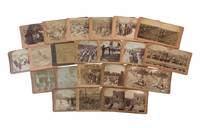
1898231301898. Spanish-American War stereoview archive circa 1898-1899 documenting how the war was pictured through mass-produced photographic views that followed U.S. mobilization battlefield action occupation and military life across both Cuba and the Philippines. These stereoviews preserves the visual system by which the war was circulated to American audiences showcasing camp organization troop movement burial hospital care naval power and overseas deployment. Particularly notable is the archive's coverage of the Rough Riders the Santiago campaign in Cuba and U.S. presence in Manila and Malate showing how stereoview photography helped normalize the war's expansion from anti-Spanish conflict into a broader American imperial presence.<br /> <br /> Archive of 21 stereoviews Various publishers. Spanish-American War stereoview archive. Cuba the Philippines and the United States circa 1898-1899. each measuring 3" x 7". The views are drawn from multiple phases and theaters of the war including camp and drill scenes in the United States embarkation and troop arrivals at Tampa battlefield and occupation imagery from Cuba and extensive and some grisly scenes from Manila and surrounding areas in the Philippines. Captions and images show soldiers in formation cavalry drill military reviews naval artillery hospital interiors encampments burial grounds and troops in active position. Cuban views include Morro Castle after bombardment dead and wounded on the battlefield of Santiago U.S. soldiers preparing to invade Cuba and troops dining near Cabañas Fortress. Philippine views include a departure for Manila American pickets routing a Filipino reconnoitering party the 18th Infantry engaged by Filipino outposts volunteers awaiting orders under the tropical sun Army Hospital Manila and "Our Boys in Camp at Malate P.I." One stereoview identifies Roosevelt's Rough Riders in the mobilization phase linking the archive to one of the war's most publicly mythologized units.<br /> <br /> As a group the stereoviews demonstrate the process by which the Spanish-American War was framed not simply as a short military victory over Spain but as a sustained structure of U.S. troop deployment and occupation extending from Cuba into the Philippines. The Manila and Malate scenes are especially important in this regard since they place American soldiers within the opening phase of the Philippine conflict where U.S. military presence quickly moved beyond liberation rhetoric into imperial control. The archive's mixture of battlefield casualties camp routine naval spectacle and celebratory review scenes shows how stereoscopic publishing converted war into a domestic viewing experience while reinforcing the legitimacy of American expansion abroad. Wear to mounts some toning; overall very good condition. A strong cross-theater visual archive of the Spanish-American War and the emergence of U.S. imperial power in Cuba and the Philippines. unknown
1850230131Um 1850. In der Platte bezeichnet. 27 x 39,8 cm (Darstellung) 39 x 49 cm (Papier).
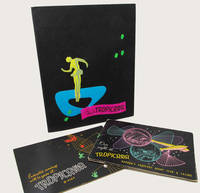
195534840Havana Cuba: The Tropicana circa 1955. 4 volumes. Original Printing. Original velour cover illustrated by hand using the technique of collage in yellow green blue pink and black and illustrated throughout with photographs designs and decorations the three brochures also in colour. Large 4to 28 x 23 cm Original velour with collage decorations to the cover the brochures of paper over board all coloured. 24 pages with numerous illustrations and 2 hand-made excerpts that allow a view of the following page. The large format brochure also includes: 1. 'Our Night at Tropicana. Havana's Fabulous Night Club & Casino' illustrated folder to insert a photograph here without photo. 2. The same with an original photograph of a party hand-dated 'Marzo 1962' and inscribed 'Boda de Cora y Vicente' with the names of the guests. The envelope is rubbed a bit. 3. The same in a different design with a photograph showing a lady in an evening dress. Her companion has been cropped from the photograph. Two additional postcards are provided here one showing the poolo of the Cabana Sun Club the other shows Calle Obispo in Havana in an older photograph. A fine copy of the 'This is Tropicana' cover and contents the brochures with a bit of age or evidence of use. VERY SCARCE. A beautiful collection from one of the most famous nightclubs of the 1950's. In 1950 Martin Fox bought Villa Mina and commissioned architect Max E. Borges to carry out the spectacular renovation with parabolic concrete arches and glass walls to roof the stage. On March 15 1952 the new Arcos de Cristal cabaret building was opened. Artists who performed at the Tropicana included star such as Nat King Cole and Josephine Baker and visitors included Edith Piaf Ernest Hemingway Jimmy Durante and Marlon Brando. Shortly after the revolution in 1959 the Tropicana like other casinos and nightclubs was nationalized. The Tropicana unknown
1676P2-5A-3Paris : Gervais Clouzier, 1676. 4 parties en deux volumes, 8° (160 x 100 mm) , plein veau époque, dos à nerfs ornés avec titre et tomaison , différence de reliure, 13ffnch.-246pp-2ffnch et 4ffnch.240pp. , 4ffnch.-297pp.-2ffnch. Et 4ffnch.-153pp.-2ffnch. , coins et coupes usés , reliure solide , mouillure sur quelques feuillets (t3-4).
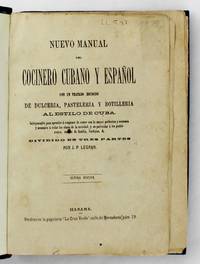
18806249Habana 1880. About very good. 199xxi3pp. Contemporary quarter red leather with modern marbled boards spine gilt. Light wear to binding. Minor soiling and wear to text. "Ultima edicion" originally published in 1857. This charming Cuban production is divided into three parts -- Sopas; Menestras Salsas Legumbres Frituras y Menudencias; and Pasteleria Reposteria y Dulceria. Each section has an index at the end of the text. The work includes local flavors such as Sopa Cubana; Ajiaco de Puerto-Principe; Lengua a la Criolla; Jigote Cubano; Pargo a la Americana; and more. We locate two copies of the 1857 edition of this work. Though we find a listing in OCLC there are no physical locations attached. unknown
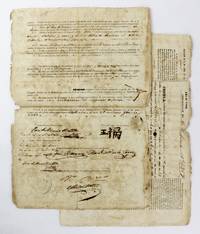
18636222Havana 1863. Good. Two partially printed broadsheets completed in manuscript 13 x 9 inches. Old folds wear at edges; some light worming slightly affecting text. Lightly soiled. A pair of documents recording the indenture of a Chinese national in Havana. The present documents contract the "Asiatico Francisco" as a cook to Don Jose Antonio Battle y Olle; the contract is dated June 28 1861 and is signed by "Francisco" in Chinese characters for a term of two years. At the end it is noted in manuscript that the Asiatico Francisco has completed the two years of his contract. The cedula is dated 1863 and indicates that Francisco is 33 years of age and now indentured for eight years as a "cocinero." An interesting pair of documents showing the continuing servitude of imported Chinese laborers particularly attractive for being signed in Chinese characters. unknown
1940442581940. Very good with some foxing soiling to the edges and some fading at the corners. 1 sheet. 9 1/4 inches by 50 inches. Mounted to card stock. Built in 1939 to resemble an old Spanish fortress and now part of a UNESCO World Heritage site the Police headquarters and the Radio Patrol had just been outfitted with the latest two-way FM radio system when this image was taken. This new communication technology only adopted by its first police department the Connecticut State Police that same year was invented by an American radio engineer Fred Link 1905-1998 who appears as the white clad figure at the center of this panorama of the fortress fronted by dozens of police cars and officers. Signed by six important Cuban officials including President Federico Laredo Brú 1875-1946 and police chief Bernardo Garcia who has warmly inscribed it Garcia would be ousted by Batista who became president in October less than a year later. Dated Havana 18 June 1940. The picture had hung in Link's office See Dan Bishop "Fred M. Link Goodwill Ambassador" in Proceedings of the Radio Club of America 72:3 Fall 1998 pages 8-13. Original frame available. unknown books
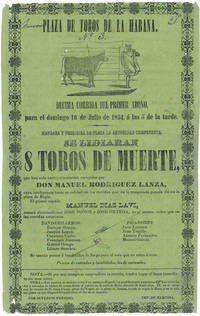
1854WRCAM46994Havana 1854. Broadside 12 1/2 x 8 inches. Printed on green paper. Old fold lines. Light wear and soiling minor separation at some folds. A few contemporary notations. Very good. Cuban broadside advertising a bullfight featuring matador Don Manuel Rodriguez Lanza and the "8 toros de muerte." The top of the sheet features a woodcut of a matador holding his cape out to a bull. The first swordsman for the fight is Manuel Diaz Lavi with two alternates listed. The names of the Banderilleros and Picadores for the fight are also noted. Bullfighting was a popular entertainment in Cuba during the Spanish colonial period though it was done away with after Cuban independence at the beginning of the 20th century. unknown books
In -4°, pp. (40), 146, (6), pergamena coeva, difetti al dorso. Prima edizione. Nato a Saragozza, l’autore insegnò a Napoli e Roma prima di partire per Cuba, dove avrebbe passato la vecchiaia. Il libro, interessante e curioso, si occupa di prostituzione e della sua accettabilità dottrinaria, argomento rispetto al quale l’autore è fortemente contrario. Lo scritto replica a un manoscritto (poi stampato a Catania, “Resolutio theologica moralis in qua occasione cuiusdam casus occurrentis afferitur et propugnatur, licite permitti posse Meretrices”, 1677) del francescano Giovanni dell’Olmo, che difendeva il diritto delle prostitute a entrare nelle dimore nobiliari napoletane. La polemica svela molto sui costumi del sesso a pagamento all’epoca. Born in Saragoza, the author was a professor in Naples and Rome before leaving to Cuba. This curious book deals with prostitution and its doctrinaire acceptability (that the author is strongly against to). This work replies to a manuscript (then printed in Catania, “Resolutio theologica moralis in qua occasione… licite permitti posse meretrices”, 1677) of a franciscan preacher, Giovanni dell’Olmo, who supports permission to prostitutes to enter in neapolitan noble palaces. This controversy reveals many facts about prostitution at time.