113 résultats
181025380New York City NY: Not Published 1810. One page letter dated New York 18th December 1810 and being given to James Thomson Grocer New York. ".Sir - As I am going to Havannah in the Brig Galen Capt. Annes it is My wish that if any accident Should happen to prevent me returning in the vessel you will See to and take possession of what property of mine may be in her and in case of My Death that by virtue of my power of attorney you collect my estate together as much as in your power and after paying my just and lawful debts remit the remainder to my brother John Gann Goodestone near Wingham County of Kent England. Yours William Gann" Approx. 8" x 13" size; ink handwriting very legible. Light wear dustiness split at one section at old fold lines; in very good condition and interesting early 19th century New York City business history law ephemera. . Manuscript. Not Bound. Good. Not Published paperback books
163153 handwritten documents in ink regarding the sale of slave girls in Cuba. The documents are written in Spanish and include details such as purchase price age and names of the girls being sold. Documents are large: 12 ½ x 8 ¾ in. Some shadows from storage with other documents paper acidification from ink. Some losses from ink acidification and wormholes. Marks from previous binding along left edge. Sale documents are numbered at bottom of pages with signatures and all have stamp from Cuban government. Good condition. One of the documents includes the year 1875 dating some of these papers to the dwindling years of the slavery in Cuba which was officially outlawed in 1886. unknown books
2003017614Madrid Spain: Centro de Arte Contemporaneo Wifredo Lam 2003. Book. Very good condition. Paperback. First Edition. Octavo 8vo. 431 pages of text. Paperback binding with a minor crease to the spine. The text is clean and unmarked. Profusely illustrated in full color. Text is in Spanish. Art museum located in La Habana or Havana Cuba. First edition. Centro de Arte Contemporaneo Wifredo Lam Paperback books
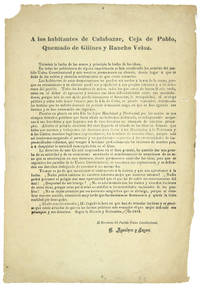
1878WRCAM38237Cuba 1878. Broadside 12 1/2 x 8 3/4 inches. Chip at upper left corner not affecting text. Small tears in all edges several repaired by tape on verso. Good. A rare and fascinating Cuban political broadside calling for an end to armed struggle but a beginning to a "struggle for ideas" at the conclusion of Cuba's "Ten Years' War" the battle for independence from Spain in 1868 to 1878. The broadside is addressed to the residents of the region around the north-central coast of Cuba some 150 miles east of Havana. The text of the broadside is signed in print by Gabriel Aguilera y Zayas Secretary of the Partido Union Constitucional PUC one of the two main political parties that developed out of the Ten Years' War. The PUC which was a conservative pro-Spanish party led by prominent Creoles sought a measure of local political autonomy while favoring continued Spanish control over Cuba. The text exhorts Cubans to partake in the ideological struggle that would succeed the armed rebellion and urges them not to fall into lethargy but to continue the battle of ideas against radicals seeking independence from Spanish colonial rule. <br> <br> Due to their ephemeral nature as well as the climate of the Caribbean any such Cuban broadsides are scarce. No copies of this broadside are located in OCLC. Important evidence of the political factionalism and the strength of pro-Spanish sentiment in Cuba in the late 19th century. Rare and possibly unique. unknown books
198644769New York: Alfred A. Knopf 1986. First Edition. First Printing. Octavo 24.25cm; beige paper and brown cloth-covered boards with titling and author's initials stamped in gilt on spine and front cover; dustjacket; xiv3804pp; illus. Some trivial wear to board edges else Fine in a lightly shelfworn Near Fine dustjacket. Memoirs of a Cuban political prisoner held in Isla de Pinos prison for 22 years detailing the day-to-day conditions he and his fellow inmates lived in tortures they suffered through and his release. Alfred A. Knopf unknown books
190015968Washington 1900. 9pp. Stapled as issued. Very Good. unknown books
1996148583Culver City CA: TriStar 1996. Shooting Script for the 1997 film. SIGNED on the title page by director-screenwriter James L. Brooks.<br/><br/>A misanthropic novelist uses sarcasm and animosity to mask his extreme obsessive-compulsive disorder but finds his highly regimented world begins to unravel when he is forced to dog-sit for his neighbor following a violent robbery. Nominated for seven Academy Awards and winning two for Best Actor and Best Actress for Jack Nicholson and Helen Hunt respectively.<br/><br/>Set in New York City and Baltimore shot on location in New York New Jersey and California.<br/><br/>Navy generic Tri-Star Pictures wrappers. Title page present dated 7/29/96 noted as Shooting Script with credits for screenwriters James L. Brooks and Mark Andrus. 164 leaves with last page of text numbered 136. Xerographic duplication with white revision pages throughout dated variously between 9-24-96 and 6-12-97. Pages Near Fine wrapper Near Fine bound internally with two gold brads. TriStar unknown books
18732024Cuba 1873. About very good. 3 folio leaves. Light wear at edges a couple of small chips at lower left edge of each leaf. Light tanning and foxing. Accomplished in a neat legible script. Scarce manuscript listing of slaves and indentured servants from a Cuban sugar plantation. The present list was made in January 1873 on the Ingenio Tartesio east of Havana near the small village of Las Pozas. On two separate sheets nine Chinese and twenty-eight African or Criollo men are listed as rented to the farm; on a third sheet eighteen slave births for 1873 and 1874 are recorded giving names mothers and dates of birth. The Chinese men are identified simply by first name and owner; the African and other slaves are listed with additional details such as nationality age owner. A section for additional observations notes which slaves have run away and at least one death. A fascinating document of slave hires on an isolated Cuban plantation during the 1870s. unknown books
185487325Havana: Imprenta de la Real Audiencia Pretorial por S.M. 1854. First Edition. hardcover. very good. 3 folding tables. 2 vols. in one. 8vo 1/2 contemporary black morocco; tear in a table with no loss of text. Habana: Imprenta de la Real Audiencia Pretorial por S.M. 1847 1854. Very good .<br/><br/> Imprenta de la Real Audiencia Pretorial por S.M. unknown books
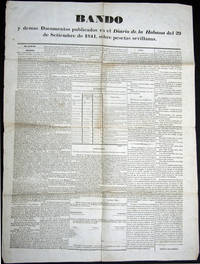
1841WRCAM15527Havana 1841. Broadside 23 x 16 1/2 inches. Splitting on middle fold else very good. A proclamation by the Spanish military government in Cuba concerning legal tender and its circulation and providing a series of regulations for commerce and exchange. unknown books
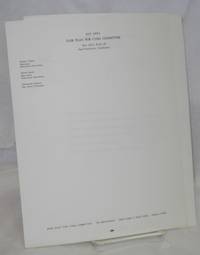
214582San Francisco: the Committee 196_. two 8.5x11 inch sheets one is blank stationery for the Bay Area chapter of the FPFC Committee while the other is a type-set form letter for thanking contributors and summarizing the purpose of the FPFC Committee. Very good condition. Staff names on both sheets are Alexander Saxton Bay Area Chairman Asher Harer Bay Area Executive Secretary and Robert Taber National Executive Secretary. Saxton was a noted historian and proletarian novelist. the Committee unknown books
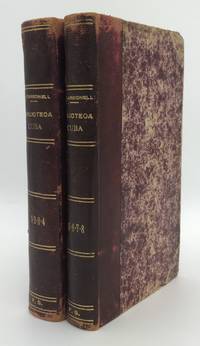
19161505Havana 1916. Good plus. Eight parts in two volumes. Original half calf and marbled boards spine gilt. Calf scuffed at spine ends; light wear to corners and edges; boards rubbed. Rear board with a dime-sized chip at lower fore-edge. Slightly later pencil ownership inscriptions to initial title pages of each volume. Small chip at fore-edge of first title page. Light tanning. The first eight issues of this scarce Cuban literary periodical which published twice monthly during 1916. The editor of the series Nestor Carbonell y Rivera grew up in the United States before returning to Cuba and obtaining his doctorate from the University of Havana; he was active in several prominent intellectual and literary society of Cuba and later served as ambassador to Argentina and Peru. Each issue of the periodical comprises one previously unpublished work by Cuban author including José Martà Manuel Sanguily and Máximo Gómez. We locate runs of the series at seven institutions as well as scattered holdings of individual issues. This set clearly bound by a contemporary Cuban subscriber one F. Gamboa. unknown books
20189560San Francisco CA: Cuba 2018. Unique. Hardcover. Fine. Minor edge wear else tight bright and unmarred. Loosely bound sheets. 8vo. np. Illus. colored plates. Unique copy. Signed by the artist. <br/><br/>Acrylic paint marker drawings on paper. Artist' shop-book used to test/design work and color schemes. A unique books of acrylic paint marker drawings of graffiti murals most of which have been executed on walls throughout the San Francisco Bay area from 2009– 2012. <br />This is an amazingly beautiful example of urban art and valuable primary research materials for African American studies calligraphy type design urban studies art history and visual art. This an unusual work as he seldom does 'women' focused typically on more political issues. Here he blends women and politics with style and flare. Also unusually he includes a small self portrait. <br />Cuba is one of the grandfathers of the San Francisco Mission School supplying both the aesthetic styles and the radical leftist politics that formed what may be the only coherent new school of American art since the Punk/graf rock art scene of the 1980s. “It was a lot of punk rock shows and stuff like that. There was always graffiti in these places and I was just like "Who is this guy I keep on seeing this guy." There was this one guy Cuba he wrote "Cuba" and it was at all the same hardcore shows in the bathroom on the door and on the street. And then I was like "What who's doing this" It was different than my idea of what graffiti was before that.” - Barry McGee in PBS’s Art of this Century 2005 <br />"We want to flex our skills and make the community look better" says the 41-year-old painter known as Cuba who has been working on walls with and without permission for more than 25 years. "It's our own form of urban renewal." -San Francisco Chronicle Monday March 7 2005 Cuba hardcover books
197147663Miami: Ediciones Universal 1971. First Edition. Octavo 20.5cm.; publisher's pictorial card wrappers; 263pp. Light shelf wear tiny dampstain to bottom fore-edge corner of textblock else Near Fine. Account of present-day Cuba by the exiled Cuban journalist who nearly twenty-five years earlier was nominated Vice President by the Socialist Revolutionary Movement with twenty-two-year-old Enrique Ovares as President. According to the author biography on the rear cover: "Ni un sólo minuto de sa vida no está dedicado a Cuba. Nadie lo aventaja en la lucha constante contra el régimen castrista y contra los malandrines que ofenden la dignidad nacional. Ediciones Universal unknown books
191386818Havana: Rambla 1913. hardcover. very good. illus. 134pp. 4to modern cloth orig. front wr. bound in. Habana: Rambla Rouza 1913. Very Good .<br/><br/> Rambla unknown books
1910WRCAM55308Havana: American Photo Co. 1910. Panoramic photograph image 7 1/4 x 47 1/4 inches on sheet 10 x 49 inches. Printed caption title below image. Publisher and date written in negative at lower right corner; in the lower left corner is written: "#5 2d Regiment U.S. Atlantic Fleet Deer Point Camp Guantanamo Bay Feb. 13 1910. 'Minnesota' 'New Hampshire' 'Mississippi' 'Idaho.'" "Printed in Germany" printed below image at lower left. Some light soiling minor fading to right side of photo some rumpling from previous rolling. Very good. An impressive view of sailors and marines from the United States' Atlantic Fleet assembled on the parade grounds of Deer Point Camp Guantanamo Bay. Well over five hundred officers seamen and marines are in formation with encampments on both sides of the grounds. In the background looking out into the harbor nineteen ships are visible in the water including the four listed on the photo: MINNESOTA NEW HAMPSHIRE MISSISSIPPI and IDAHO. One camp building with a wide veranda is behind and to the left of the sailors. <br> <br> U.S. forces with their Cuban allies first occupied Guantanamo Bay in 1898 during the Spanish American War creating a forward- operating base in their effort to wrest Spanish control of the island. In 1903 the U.S. leased forty-five square miles of land and water at Guantanamo Bay from the newly- independent Cuban government and built the Deer Point Camp to support naval operations in the Caribbean. The American facilities at Guantanamo Bay are in use to this day. The American Photo Company advertised itself as "the best equipped commercial photographers in Cuba." It established a commercial network in Havana that distributed images of Cuba on a worldwide scale. <br> <br> This photo is rare. We found no records of it at auction and no copies in OCLC however the Naval History and Heritage Command lists a copy in their collections. "US Naval Station Guantanamo Bay Cuba" UA 571.45 copy of this image Washington Navy Yard D.C.: Naval History and Heritage Command Naval Heritage Foundation accessed online. American Photo Co. unknown books
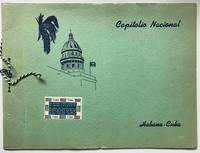
1930537Havana: Imp. "Ninon 1930. 24pp. Oblong quarto. Original green pictorial wrappers string-tied. Cuban Revolution stamp affixed to front cover. Pictorial souvenir of the Capitol Building in Havana which was inaugurated May 20 1929. Each image has bilingual descriptive text in English and Spanish on the verso. Images include the exterior of the building as well as specific locations within such as the Office of the President of the Senate the Reception Hall the Statue of the Republic and the Marti Library. A sticker on the front cover has a border of small Cuban flags around the text "Our Revolution is NOT Communist. Our Revolution is Humanist. The Cubans only want the right to an education the right to work the right to eat without fear the right to PEACE JUSTICE FREEDOM." Presumably affixed to this earlier souvenir after the start of the Cuban Revolution in 1953. An interesting addition to this piece of promotional literature. OCLC locates six copies. Imp. "Ninon unknown books
38527Washington: Government Printing Office n. d. 1st edition presumed. ca. 1901. Black leather boards gilt stamped lettering to spine. Boards stamped in blind. Glossy marbled endpapers. All boards and spines rubbed chipped and soiled. Vol IX missing boards and spine Vol XI & I boards and spine detached from textblock Vol II boards & spine detaching. Spines and hinges loose. A few leaves and 2 unfolding maps detached soiled or chipped library "Property of Michigan Commandery Loyal Legion" blue stamping throughout volumes. A Good set. Individual volumes divers paginations within each volume. Many inserted plates of b/w images fold-out maps and charts / tables & portraits housed within all volumes. 9-5/8" x 7" <br/><br/>OCLC records 7 institutional holdings of this set. Contents as stated in front pages of Vol. I: Vol I: Personal Report of General Wood Report of Lieutenant McCoy Aide-de-Camp Financial Exhibits accompanying same. Vol II: Civil Orders and Circulars issued during 1900. Vol III: Report of the Secretary of State and Government Reports of the various Civil Governors. Vol IV: Report of the Chief Sanitary Officer Report of the Chief Surgeon of the Department Report ofthe Superintendent Department of Charities. Vol V: Report of the Secretary of Finance Report of the Treasurer of Cuba Report of the Auditor for Cuba Report of the Chief of Customs Service Report of the Director General of Posts. Vol IX: Report of the Secretary of Public Works. Vol X: Report of the Secretary of Public Works continued Report of the Special Commissioner of Railroads Report of the Chief of the Light-House Board Report of the Captain of the Port Havana. Vol XI: Report of the Chief Engineer for the Fiscal Year ending June 30 1900. Vol XII: Report of the Chief Engineer for the six months ending Dec. 31 1900. Wood born on October 9 1860 in Winchester New Hampshire graduated Harvard Medical School in 1884. After working in private practice in Boston for two years he secured a job as army assistant surgeon with the rank of first lieutenant in January 1886. Routine successes and close relationships with political giants Wood formed a close friendship with Theodore Roosevelt and helped Roosevelt organize the 1st Volunteer Calvary Regiment for service in the Spanish-American War in May 1898 allowed for a quick advancement in his military service which eventually aroused some controversy. "Promoted to brigadier general and in December of that year he was promoted again to major general of volunteers and named military governor of Cuba. During his term in that post great strides were taken in improving internal conditions notably through the sanitation work of Maj. William C. Gorgas. Modern school police transportation and communications systems were established and a new constitution and body of laws were drawn up." Webster's American Military Biographies p. 488. In May of 1902 Wood stepped down from his executive position in order for the popularly elected President Tomas Estrada Palma to take over. "Aggressive ambitious and self-righteous Wood was not an easy man to work with; his change from medical doctor to fighting soldier and his rise from captain to brigadier general in the space of five years 1898-1903 aroused considerable distrust and hostility in and out of the army. his single-inded advocacy of the Plattsburgh Idea later to resurface as the ROTC contributed greatly to US readiness in World War I; unquestionably one of the greatest U.S. soldiers." -The Harper Encyclopedia of Military Biography p.807. (Government Printing Office) hardcover books
1875WRCAM56107Cuba 1875. Twenty-two partially-printed forms on folio sheets completed in manuscript in a variety of hands. Most printed and accomplished on the recto only though a few with print or manuscript on the verso as well. Some with old folds chipping and small tears to edges of most documents one document with the upper right corner cut away. Occasional foxing tanning and ink offsetting and bleedthrough. Several documents with additional manuscript annotations. About very good overall. An important collection of contracts documenting Chinese indentured servitude in Cuba two signed in Chinese. All but one are from various municipalities in the Matanzas Province usually attested to with an ink or blind stamp from a local official one with paper tax stamps affixed. Each contract stipulates the term of service for the "colono" - one or two years along with wages to be paid food and clothing issued duties and hours to be worked and so forth. The laborers are identified in the contracts by their assigned Spanish names with no surnames though some forms have a section for their "nombre nacional" and place of origin as well. There are provisions for what happens if the servant cannot complete their term of service due to illness pending agreement with the "patrono" and a section on options for contract renewal. The latest of these contracts dated May 24 1875 bears the laborer's signature in Chinese. He is described as "al asiatico José" aged 30 of Macao and is contracted to work for Ignacio de Cardenas for six years. Another contract from Bejucal in the Mayabeque Province is also signed in Chinese this one by "Antonio" "natural del pueblo de Leo Chao en China." This is also the only document in the collection with a signature area labeled: "Firma del interpréte ó de dos personas de confianza del colono ó dos testigos." <br> <br> Formal slavery continued in Cuba until it was abolished by Spanish royal decree in 1886; it was accompanied however by a significant population working in indentured servitude. As sugar exports rose in the mid to late 18th century there was a dramatic increase in the need for enslaved workers. "One of the explicit goals of Spanish reformist policy in the last third of the eighteenth century became the need to emulate other European nations' success with slave plantation development in the Caribbean. Partly because of this slave-based coffee and sugar estates sprang up in increasing numbers in portions of Cuba especially around Havana Santo Domingo and Puerto Rico. An expanded slave trade was a necessary condition of such growth. In Cuba alone approximately seventy thousand slaves were imported between 1763 and 1792 and another three hundred twenty-five thousand were brought in between 1790 and 1820.For the entire nineteenth century imports to Cuba amounted to about seven hundred thousand persons." - Drescher. <br> <br> The abolition of slavery in the British West Indies however meant that from the 1830s onward a new source of labor was necessary. It is this gap that indentured servitude filled. Unlike the earlier waves of European immigrants who travelled to the New World as indentured servants Asia was now the primary source. Between 1848 and 1874 125000 Chinese indentured servants arrived in Cuba alone - a figure outstripped only by the number who indentured themselves in California. "Some contemporaries and later historians.have condemned the servitude of the Asians as a thinly disguised revival of slavery. These critics have pointed to a variety of abuses to which the Asians were subjected both legally - with severe laws governing absenteeism vagrancy and insufficient work - and illegally in the form of harassment by vicious masters. Yet other observers have defended the system as a boon to the Asian workers. Voluntary reindenture at the end of their terms was common among the migrants suggesting that many Asians judged the system to be beneficial to them" - Drescher. <br> <br> Voluntary or not a large number of Chinese migrants were laboring in Cuba in the 19th century; for most of them these contracts are the only existing records of their work if not of their lives. Seymour Drescher & Stanley L. Engerman editors A HISTORICAL GUIDE TO WORLD SLAVERY New York 1998 pp.140-42 239-42. hardcover books
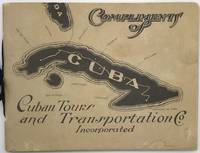
19281489Havana 1928. Very good. 60pp. Oblong 12mo. Original printed pictorial wrappers stapled and tied with ribbon. Minor wear and soiling contemporary ink stamp on rear cover. Internally clean. A handsome promotional booklet for the island of Cuba provided by the Cuban Tours and Transportation Company and extensively illustrated. After the opening leaf of text each page features a full-page photographic half-tone illustration with caption highlighting tourism spots and attractions on the island. These include an aerial view of the capitol which includes a biplane flying at camera-level; the Malecon driveway; a view of Paseo de Marti; San Francisco Machina and the Santa Clara wharves; countryside scenes depicting sugar production and agriculture; a view of the jockey club and grand stands at Oriental Park; street scenes and more. Leading hotels in Havana are shown on the last few leaves. A wonderful illustrated souvenir guide. No copies located in OCLC. unknown books
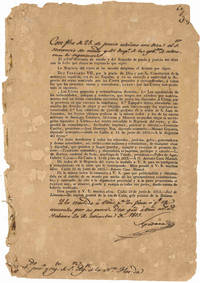
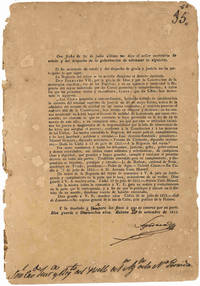
1813WRCAM46892Havana 1813. 1p. plus integral blank. Folio. Old fold lines. Moderately chipped and worn at edges. Lightly and evenly toned. Contemporary manuscript notations. Good. A rare printed decree from Cuba at the beginning of the 19th century as Spanish power in the world was waning but Spain's grip on Cuba was still quite firm. This decree issued by the King on June 14 1813 and printed on September 20 announces new laws regarding the rights to vote and to be elected to hold government positions for professors and scholars from certain universities collegiums and seminars. The decree forbade these rights to the Knights of Justice of the Order of St. John of Jerusalem as well as members of the four military orders of Santiago Calatrava Alcantara and Montesa. It is endorsed in manuscript with the imprint and header also written in by hand. Early Caribbean imprints are rare. unknown books
1813WRCAM46891Havana 1813. 1p. plus integral blank. Folio. Old fold lines. Moderately chipped and worn at edges. Evenly tonned. Contemporary manuscript notations. Good. A rare Havana imprint. As Spanish power in the New World was waning its grip on Cuba was threatened by domestic and foreign intruders. This decree issued by Fernando VII on June 17 1813 and printed on September 20 orders the annulment of all criminal cases. This amnesty policy extended to other areas of New Spain as well sought to placate opposition forces. It calls on all levels of government to announce and enforce the decree. It is endorsed in manuscript. unknown books
1865974Santiago de Cuba 1865. Very good. 10 leaves. Removed from a larger volume and restitched. Minor wear and one small area of worming at edges. Light tanning and foxing. Accomplished in several legible hands. A fantastic set of manuscript records for a slave auction house the General Slave Depository in Santiago de Cuba dating to January 1865. Santiago along with Havana and Cienfuegos was one of three major sites for slave sales on the island during the 19th century. The first leaf of the document provides a statement that the documents were assembled in accordance with the rules established for slave auctions which had been updated and approved at the end of the previous year. The second two documents lay out mortgage agreements and financial obligations between the slave house and the Real Sociedad Economica de Amigos de Pais of the city in which the auction owners acknowledge debts and forthcoming payments on the order of several thousand pesos. Following these are two leaves containing a "Relacion de los esclavos ecsistentes en el deposito de esta Ciudad en el dia de la fecha" that is a list of slaves at the depository on the day of the auction and their owners and renters which perhaps were a part of the collateral for securing the loan. A total of twenty-nine slaves are listed and the leaf that follows certifies that the list is correct according the to the director and the auctioneer of the depository. The final two leaves provide official recognition of the loan from two distinct government offices. All documents are signed by the relevant parties and government officials involved in the agreement. In all the present group of documents provides a detailed assessment of debts and human assets of the slave auction house in Santiago de Cuba in the mid-1860s and is a fascinating and valuable document of the bureaucracy and regulation surrounding the financial realities of selling slaves in Cuba during this period. unknown books
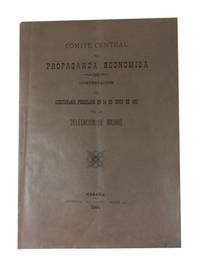
189144433Habana: Imprenta "La Razon" 1891. Paperback. Very Good. table 35p. Wrapper. 22cm. Slight vertical crease and slight wrinkling throughout. Cuban institutional stamp on title-page. Spanish text. Tariffs and taxes on Cuban export commodities mainly sugar and tobacco. <br/><br/> Imprenta "La Razon" paperback books
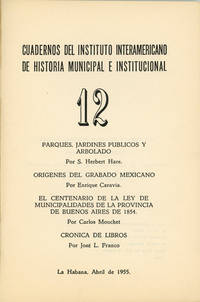
195535421La Habana: El Instituto 1955. First edition. Paper wrappers. A very good copy wrappers rubbed and soiled. 95 pp. Sm. 8vo. El Instituto unknown books