CUBA EARTHQUAKEABAA
113 résultats
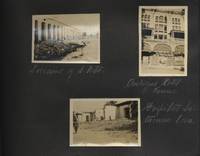
193250120Santiago de Cuba 1932. A unique album of 19 leaves of heavy black stock 7 x 5 1/2 inches with 67 mounted b&w silver photographs of varying sizes 1 3/4 x 2 1/2 inches - 3 1/2 x 5 7/8 inches all captioned in white ink. The album is titled and decorated in gilt on the upper cover "PHOTOGRAPHS: SOUVENIR OF SANTIAGO CUBA and tied with a cloth lace. Very good. An earthquake of 6.7 magnitude struck the city of Santiago de Cuba at dawn on 3 February 1932. Over half the buildings were destroyed or damaged and reports of the deaths range to 1500. These photographs show the destruction to the commercial and residential buildings and the Cathedral and the tents set up as temporary shelters. A few of the photographs were made by local commercial photographers just after the quake and the remainder within days. All captions in Spanish. <br/><br/> hardcover books
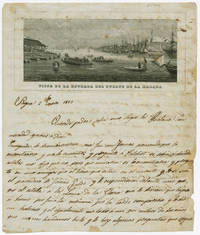
1853WRCAM54601Havana 1853. 4pp. on a bifolium. Previously folded. Some chipping at fore- edge slightly affecting text. Light dampstaining and tanning. About very good. An attractive Cuban pictorial letter sheet with a neatly executed third-page lithograph illustration of the port of Havana. The image depicts several small boats rowing barrels to and from a loading dock. In another small boat a plantation owner or some form of dignitary is being rowed to shore by a crew of men. On the right side of the image several larger ships lie at anchor and in the background on the shore is the fort guarding the mouth of the harbor the Morro Castle. <br> <br> The sheet is filled out by a man named Juan Fabre writing to his parents on Jan. 2 1853 advising them of his safe arrival in Havana. He talks about meeting up with a relative that he had not seen in two years and working at a shoe shop with another relative who adds a brief post script on the verso of the second leaf. Pictorial letter sheets of Cuba are quite rare on the market. unknown books
86083hardcover. 202pp. 8vo modern cloth; orig. wrs. bound in unopened. Madrid: Aurelio Alaria 1881. First Edn.<br/><br/> unknown books
199463548Habana 1994. Paperback. Good. Original wrappers. 28cm. Moderate general wear. Spanish text. <br/><br/> paperback books
188893403Madrid: Manuel Hernandez 1888. First Edition. pamphlet. 27 pages. 8vo original printed wrappers. Madrid: Manuel Hernandez 1888.<br/><br/> Manuel Hernandez unknown books
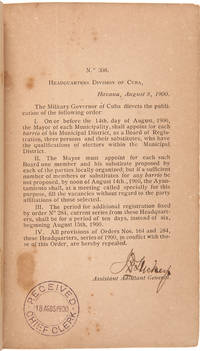
1900WRCAM51843Havana 1900. Approximately 520; 600pp. including several folding charts. Over 200 separate imprints. Original half leather and brown cloth boards spine gilt. Corners and edges worn spine rubbed boards scuffed. Initial leaves of first volume torn away but present. Several other leaves chipped and torn throughout. With many official signatures and docketing stamps. Good. Two volumes of orders promulgated in 1889 and 1900 by the American military government of Cuba after the cessation of hostilities in the Spanish-American War. Under the terms of the Teller Amendment to the Congressional Joint Resolution for war with Spain in 1898 the United States denied the intention of using the conflict as a pretext for the annexation of Cuba and promised to leave the island following the termination of the war. The American military therefore oversaw the creation of the new independent Cuban government before departing in 1902. The documents contained in this collection consist of over two hundred orders in both English and Spanish from the Headquarters Division of Cuba that helped to shape the emerging civilian government. They include instructions for the running of elections the organization of the courts and school system the appointments for various government offices provisions for tax regulations and many other critical issues facing Cuba at its independence. The directives cover two periods from January to July in 1899 and from July to September in 1901. Many of the orders are signed in manuscript by the assistants to the military governor for the island Gen. Leonard Wood including assistant adjutant generals J.B. Hickey and L.W.V. Kennon and Brig. Gen. Chief of Staff Adna R. Chaffee. An interesting documentation of the first American occupation of Cuba. hardcover books
190025439Havana Cuba: Not Published 1900. Both letters two pages on Samuel Wyman Smith Importer Havana Cuba letterhead paper; dated Jan. 4 1900 and Dec. 5 1900. Both addressed to "My Dear Gilbert"; the contents typed and concerning the fate of their mutual investment in "The Studio" restaurant & bar in Havana. ".all the papers that I can find at the Studio have been forwarded to you at Cambridge Springs. The reason for this delay has been that I have been quite ill having had a toe amputated.You will see the Studio is improving. I have just made an arrangement with two Chinamen as cooks Spanish waiters however.this should finally put the place on a paying basis." adding handwritten ".I trust you will soon send me a good sized check as I need money desperately." The letter of December relates Smith's attempts to find buyers and leasors for the restaurant ".I am bothered to death by the bills of the place existing before you left some of which I have personally guaranteed.have also had a proposition from a Spaniard to take the restaurant.As a restaurant is always a dead loser except under very competent management this seems to me to be most advantageous.The quarantine has been taken off the camps here and business is much better."; continuing to ask for money. With the original mailing envelopes addressed to Mr. W.E. Gilbert. This venture was perhaps an attempt to meet the needs of the very large population of North Americans residing in Cuba after the Spanish-American War; many businesses opened especially in Havana including hotels bars and restaurants. In his book "On Becoming Cuban: Identity Nationality and Culture" By Louis A. Perez 2008 Univ. of North Carolina Press an individual named Edward E. Nelson opened the Studio restaurant in Havana in 1899 and was not very successful per the contents of these letters. Envelopes very soiled and worn; letters with light wear old fold lines; in very good condition. Interesting Cuban - U.S. business history ephemera from the early days of the 20th century telling of the unsettled commercial climate. . Manuscript. Not Bound. Very Good. Not Published paperback books
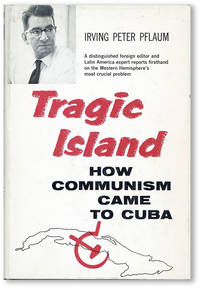
196144929Englewood Cliffs NJ: Prentice-Hall Inc 1961. Reprint. Octavo 21.5cm; black paper-covered boards with titles stamped in red on spine; dustjacket; xii196 with 8pp of black and white plates at center. Pinpoint wear to spine ends and corner tips else Fine in a Very Good dustjacket unclipped lightly shelfworn with a few tiny tears to extremities. An eyewitness report and appraisal of the Cuban revolution by a Chicago Sun-Times journalist. Prentice-Hall, Inc unknown books
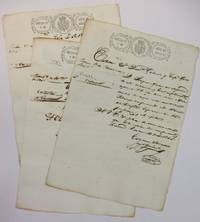
184537320Havana 1845. Each document 8-1/2" x 12-1/2" entirely in ink manuscript with decorative official printed ornamentation at head of each and signature "O'Donnell" in the left margins. Some toning and a few holes not affecting text. Good. <br/><br/> Leopoldo O'Donnell y Jorris 1st Duke of Tetuán 1809-1867 was a Spaniard of Irish ancestry from Tenerife. He went to Cuba as Captain General in 1843 and later served three separate stints as prime minister of Spain. He approved each of these requests for travel. The named Cuban Slaves are of "Lucumi" ancestry originally from the Yoruba tribes of Benin and Nigeria. The documents all dated in October 1845 refer to the slaves Joaquin Garcia de Angarica and Florentino Armenteroy Regidor.<br/> These requests were made to transfer the slave from one hacienda to another for work purposes the terms of work engagement frequently stated here. unknown books
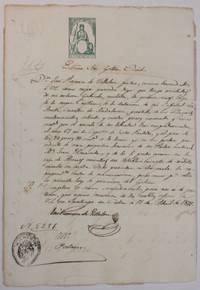
37208Each document a single manuscript page 8-1/2" x 12-1/2." Each with official stamp one also has a decorative illustrated green stamp at the head. Light wear and toning Good.<br/><br/> Each document names the slaveholder and the enslaved person granted "libertad" and the cost in escudos or pesetas of that liberty. The slaves liberated here are Saturnia "morenita criolla" age 14; Gabriela "esclava mulata" age 15; and Dolores "parda criolla" age 16. unknown books
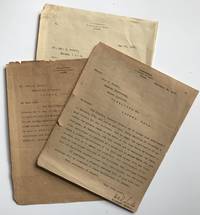
1900542Havana 1900. Good. Three typescript letters 4pp. total. Previously folded light chipping at edges. Evenly tanned. An interesting series of three letters from the Adjutant General W.V. Richards at U.S. Army Headquarters in Havana after the end of the Spanish-American War during the period of American military government. On February 28 1900 the military governor herein authorized the purchase of a book collection owned by heirs of a Don José Maria de Cardenas y Rodriguez from the town of Guanabacoa for the formation of a library at the university in Havana "at a price not to exceed $4000." In the second letter dated April 17 the collection seems to have been sold out from under them at a much lower price which has left the governor wondering why the university could not acquire the books with the allotted funds. In the third letter dated May 23 the collection seems to be for sale again by a third party and the governor again states that he is willing to purchase the collection for the previously stated sum "However to warn you that there has been so much said about the purchase of this Library for the Institute that there is danger that some of the books may have been extracted or that the property is not as valuable as when it was inspected." A neat record of a book deal gone sideways in 1900 Havana. unknown books
195944784New York: Hill and Wang 1959. First American Edition. Octavo 21cm; light gray cloth with titles stamped in red on spine; dustjacket; 89-96pp. Hint of foxing to upper board edges else Fine in a Near Fine dustjacket unclipped priced $2.50 with mild wear to extremities. Novella of the Cuban Revolution by Arenal 1926-2012 who was exiled to the United States during the Batista regime and invited back to Cuba by Castro himself. "Based on an actual incident The Sun Beats Down tells how a group of young revolutionists kidnaps a famous Mexican prize fighters from the lobby of Havana's busiest hotel" from rear panel. Hill and Wang unknown books
1902572301902. English and Spanish. English and Spanish. The U.S. Army Regulates the Railroads of Cuba Cuba. Cuba Railroad Commission. The Railroad Law Corrected Copy of the Island of Cuba and Other Provisions Related Thereto. Havana: S.n. 1902. Various paginations. Printed wrappers rear lacking some wear and creases to front cover chip to head. Toning light browning and foxing in a few places internally clean. $150. Only edition. English and Spanish. The United States assumed custodial power over Cuba under the treaty ending the Spanish-American War. Cuba gained formal independence in 1902 as the Republic of Cuba but the U.S. continued to keep troops in Cuba and retained the right to intervene in its internal and foreign affairs. During this period which lasted to 1908 with later incursions the U.S. military supervised the development of the local military and implemented several public-works projects such as a modern railroad system. The Railroad Law records the legal side of this aspect of state-building. OCLC locates 5 copies in law libraries Duke Harvard Universities of Arizona Michigan and Minnesota. unknown books
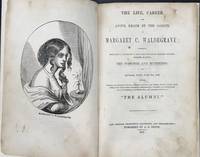
185257744New Orleans Charleston Baltimore and Philadelphia: A.R. Orton 1852. the original wrapper was dated 1853 apparently accounting for that date being used in each of the three OCLC listings. First edition of this rather primitively printed pamphlet. 8vo. 2 11-36 pp. Portrait frontispiece three wood-engraved plates. OCLC: "Sensational and presumably fictitious account of the criminal career of Margaret C. Waldegrave probably written by the publishers" the author of several similar lurid tales in the early 1850s. Contemporary pencil inscription on verso of frontispiece "Allow one vol. / plain binding / leather back." Not in Wright "American Fiction" McDade "Annals of Murder" or Jumonville "New Orleans Imprints." OCLC locates four copies American Antiquarian Soc. New York Historical Soc. Juniata British Library; AAS also holds a prospectus broadside for the work. Some interior foxing and soiling corner of one leaf renewed not affecting text. Recent plain gray wrappers. #4698. <br/><br/> A.R. Orton hardcover books
1916100842Tall 8vo stiff paper stapled illustrated some in color 54 pp. Lacks wrappers and last page but the rest of the pamphlet including the double page map of Cuba is present a few small chips some minor aging and soiling. The 9 x 21 folding map of Cuba features its railroads. There are two attractive color photographs and seven full page black and white photographs illustrating the charms of Cuba. Smaller photos including one of a sleeping car are included in the text. A rail schedule some facts about Cuba and a few advertisements for hotels and cruise lines are also included. Cuba Railroad Company, books
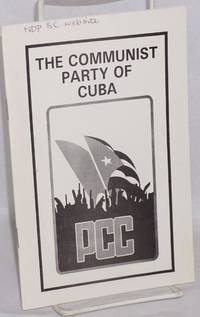
1998199828Havana: n.pub 1998. Pamphlet. 28p. wraps pen note on front wrap and minor rippling very faint from damp on rear wrap else very good condition 5.25x8 inches. Text in English with no indication of location or publisher. Pro-PCC. n.pub unknown books
1998200647Havana: n.pub 1998. Pamphlet. 28p. wraps very good condition 5.25x8 inches. Text in English with no indication of location or publisher. Pro-PCC. n.pub unknown books
1993RDINART00RJBFulcrum Publishing 1993. Fine. Dines Dorothy. The Art of Charles Partridge Adams. Leonard Stephen J.; Cuba Stanley L. Golden Colorado: Fulcrum Publishing 1993. 146pp. Illustrated. Bibliography. Oblong 4to. Signed by author. Book condition: Near fine. Dust Jacket Condition: Very good with gently rubbed and bumped edges and faint scuffs. Signed by the author Dines on dedication page. Fulcrum Publishing unknown books
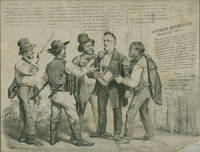
1856WRCAM53452New York: Nathaniel Currier 1856. Broadside 10 x 13 inches. Foxed bottom right corner chipped. Lower margin trimmed costing the title. Good only. Framed under glass. A scarce political cartoon regarding the controversial Ostend Manifesto the initially- secret attempt by the United States to purchase Spanish-controlled Cuba. Earlier President Franklin Pierce had instructed Pierre Soulé upon his appointment as minister to Spain in April 1853 to negotiate to buy Cuba. Three American foreign ministers serving in Europe - James Buchanan John Y. Mason and Soulé - met secretly at Ostend Belgium in late 1854 to draft a plan to either buy Cuba from Spain or force Spain to give up Cuba by inciting a Cuban revolution. The plan met with overwhelming opposition once it was made public in America. <br> <br> In the present political cartoon Buchanan is attacked for his role in the Ostend controversy. He is surrounded by four armed ruffians seeking to rob him of his coat hat watch and money a particularly sharp turn- about on the American minister to Great Britain. The muggers' demands include quotations from the manifesto which is pasted to the fence at right. Buchanan calls out: "Why! Why! This is rank robbery! Help! Help! All honest men!" <br> <br> The fallout from the Ostend controversy was widespread. President Pierce's Democratic Party split asunder after he refused to continue any discussions of the plan or any other expansionist ideas; Soulé understandably resigned; and the international community saw it as a threat to Spanish sovereignty in the region. Oddly enough James Buchanan was not too hurt by the controversy; he was easily elected president in 1856 and still harbored hope for Cuban annexation. He was smart enough however to table the Cuba question for the foreseeable future after meeting with both popular opposition and increasingly bitter sectional conflict the latter only spurred on by incidents such as the Ostend controversy. CURRIER & IVES: CATALOGUE RAISONNÉ 5021. NEVINS & WEITENKAMPF p.72-73. Nathaniel Currier unknown books
1982631121982. Paperback. Very Good. Original wrappers. 26cm. Spanish text. <br/><br/> paperback books
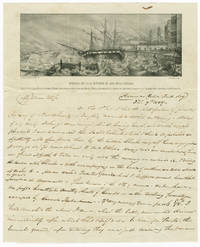
1847WRCAM56260Havana Cuba and onboard ship to New Orleans 1847. 11pp. in black or blue ink on two different Cuban pictorial letter sheets plus a folded sheet of plain paper the latter also used as the enclosure for the entire letter addressed on verso of last page of enclosure. Minor soiling old folds with a few short fold separations and a longer separation in last folded sheet. Last sheet with small abrasion from removed wax seal most of which remains. Overall good plus condition. A lengthy and interesting letter from a Pennsylvania businessman named M.L. Dawson to his "dear wife" back in Philadelphia written over the course of a few weeks during his time in Havana and onboard a ship traveling from Cuba to New Orleans in the spring of 1847. Being written over the course of several entries the letter also acts as a kind of brief diary of Dawson's time in Cuba and the Gulf of Mexico and contains much information on the people and places he saw in and around Havana and much on the ship's activities on the way to Louisiana. Two- thirds of the letter is written on two separate Cuban letter sheets that are themselves rare and desirable printed ephemeral items from mid-19th century Cuba. <br> <br> The eleven-page letter covers Dawson's stay in Havana and his voyage to New Orleans. He writes that he had previously arrived in Havana from Philadelphia. His letter begins on March 7 and Dawson details trips on horseback to the Cuban countryside which he finds beautiful. He comments on odd Cuban funerary practices Cuban agricultural products seeing the home where Santa Anna spent his exile and gives firsthand observations on the effects of slavery. He witnesses a scene in Havana where slaves are chained and forced to make repairs while being overseen by men with whips and muskets. Dawson comments that despite the beauty of the countryside "the evidence of Slavery is every where apparent." Also apparent are "the ravages of the awful storm of the 10th month last" a reference to the devastating October 11 1846 hurricane the effect of which is depicted in each of the letter sheets here. Dawson also reports on being invited to breakfast by a Cuban nobleman but was so taken aback by the food and the experience that he vows never to repeat the experience. <br> <br> After departing Havana for New Orleans on May 9 on the Brig P. Soule Dawson reports on various shipboard activities a disagreeable cursing captain slow progress boredom and seasickness. He comments on claret as the typical drink for breakfast. The letter ends on April 1 when Dawson's ship anchors in New Orleans Road. He closes with a promise to write again soon after he lands in New Orleans and sends kisses and love to his children and relatives. <br> <br> The Cuban letter sheets Dawson employs for more than two-thirds of his letter are interesting and attractive printed items in their own right. The first titled HURACAN DEL 11 DE OCTUBRE DE 1846 EN LA HABANA shows a lithographed scene of various ships in an angry sea being tossed against a breakwater in Havana harbor during the October 11 1846 hurricane. One passenger is being rescued with a breeches buoy while other ships flounder in the distance. The second letter sheet is titled TEATRO PRINCIPAL DE LA HABANA. The scene at the head of this sheet shows further destruction of the October 11 hurricane centered on the damaged ruins of the Teatro Principal Main Theater near the harbor. Two men in top hats survey the damage while an African-American man stands at left center holding long boards. Havana harbor is visible in the background showing two paddlewheel steamers and other ships damaged or sunken in the harbor. <br> <br> Mordecai L. Dawson was the proprietor of M.L. Dawson & Co. a brewery in Philadelphia. Here Dawson addresses the letter to his company noting the letter is specifically intended "for E Dawson" his wife. The Dawson brewery opened in 1820 at 79 Chestnut Street then moved to the corner of 10th and Filbert Streets in 1830 after the company purchased the old Farmers' Brewery in 1829. Dawson apparently closed his brewery in 1849 not long after penning this letter home. Though he does not state it explicitly in his letter Dawson may have been traveling to Cuba to establish an import business. Philadelphia was a pipeline for numerous imports into Cuba in the mid-19th century including beer. <br> <br> An interesting record of one man's sojourn to Cuba in the 1840s with notable observations on slavery and the Cuban situation in the wake of the October 11 1846 hurricane written mostly on two attractive and rare Cuban letter sheets that also memorialize the hurricane. hardcover books
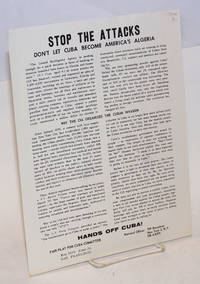
1961131306San Francisco CA: Fair Play for Cuba Committee 1961. 8.5x11 inches dense text printed on one side of single sheet very good condition "Why is the CIA hell-bent upon drowning in its own blood a people who are carrying through a revolution like our own 1776 Fair Play for Cuba Committee unknown books
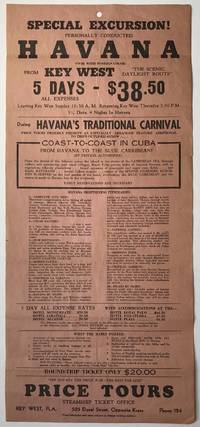
1935848Key West 1935. Very good. Broadside 18 x 8 inches. Printed on pink paper slightly faded. Old folds minor wear. Broadside advertising a steamship cruise offered by Price Tours from Key West to Havana during Carnival with additional sightseeing itineraries available once on the island. The cruise is a five-day all expenses included trip for the reasonable price of $38.50 with four nights in Havana and the option to add a driving tour across the island seeing Cuba from coast to coast. Other potential tours include a cigar factory a rum distillery Morro Castle a shopping tour and more. No copies recorded in OCLC. unknown books
1894106465<p>1894. Pamphlet format 70 pp. Illustrations; map. 14.3x11.8 cm 5½x4½" pictorial wrappers. Some light staining and wear to wrappers spine a little worn very good overall. Rare tourists' guide book produced under the auspices of the Grand Hotel Macotte with much on Havana transportation options sights to see including bull fights prices a Spanish vocabulary etc. with numerous advertisements for Cuban and some Florida businesses and other hotels. One advertisement features cigar maker La Corona. They even include an illustration of Christopher Columbus. OCLC/WorldCat lists only one copy at the California State Library Sutro Branch. </p><p><br /></p> J. Carbonell and P. Montero, Proprietors. books
1905105099<p>Four postcards approximately 3 1/2" x 5 1/2" with stamps. Some writing on image side post marked some aging and browning edges slightly bumped; otherwise very good. This collection of four postcards from Cuba are postmarked stamped and written out. The authors are Anna and Nestor although in one card the author is less clear to a Miss K. Greve. Who lived in the upper West side of New York City. One card features Baby New Year for 1907 and has some color; the other three show La Catedral a promenade and what appears to me some kind of American monument. </p> books