Slavery in CubaABAA
137 résultats
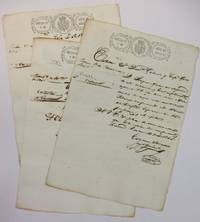
184537320Havana 1845. Each document 8-1/2" x 12-1/2" entirely in ink manuscript with decorative official printed ornamentation at head of each and signature "O'Donnell" in the left margins. Some toning and a few holes not affecting text. Good. <br/><br/> Leopoldo O'Donnell y Jorris 1st Duke of Tetuán 1809-1867 was a Spaniard of Irish ancestry from Tenerife. He went to Cuba as Captain General in 1843 and later served three separate stints as prime minister of Spain. He approved each of these requests for travel. The named Cuban Slaves are of "Lucumi" ancestry originally from the Yoruba tribes of Benin and Nigeria. The documents all dated in October 1845 refer to the slaves Joaquin Garcia de Angarica and Florentino Armenteroy Regidor.<br/> These requests were made to transfer the slave from one hacienda to another for work purposes the terms of work engagement frequently stated here. unknown books
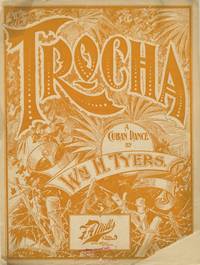
1890List3666New York: Jos. W. Stern & Co 1890. Folio sheet music illustrated pictorial cover printed in orange. 5 pp. including cover. Approximately 13 ½ x 10 ½ inches. Covers detached loss to front cover contents complete fair to good. A decorative late nineteenth-century dance publication for “Trocha†described on the cover as “A Cuban Dance†composed by the African American composer and bandleader W. H. Tyers. The elaborate pictorial cover incorporates stylized tropical foliage and island scenery rendered in a bold single-color design typical for the period’s fascination with exoticized musical forms. <br /> <br /> William H. Tyers 1870–1924 was an African American composer arranger and bandleader active in New York during the ragtime era. Born in Petersburg Virginia to Henry Tyers and Jane “Jennie†Jones both formerly enslaved he spent part of his youth in Richmond before his family relocated to New York City where he began studying piano. His early teachers recognized an aptitude for composition as well as performance and by the mid-1880s he was writing dance pieces including polkas and waltzes. Around the age of twenty Tyers secured employment as a music librarian and arranger with a touring concert company a position that brought him to Europe where he studied orchestration and arranging with Professor Gaspari in Hamburg.<br /> <br /> Returning to New York Tyers became active in the city’s rapidly expanding popular music trade working as an arranger and composer for publishers including F. A. Mills and Jos. W. Stern & Co. In 1896 he published “Sambo†a syncopated march sometimes considered to be one of the first instrumental rags.1 “Trocha†also released in the 1980s brought Tyers prominence for his ability to write Latin-style rhythms. It was re-issued in 1913 as a tango and its success led Tyers to work as an arranger with Joseph W. Stern in 1897.<br /> <br /> Tyers’ compositions blended contemporary American dance music with Caribbean and Latin themes a style reflected in pieces such as Trocha and later in his well-known ragtime composition Panama 1911 which remained a staple of early jazz and dance orchestras. OCLC finds two copies with different entries at the Cleveland Public Library and the British Museum Reference Collections. <br /> <br /> 1 “William Tyers Music Arranger†African American Registry https://aaregistry.org/story/william-tyers-born/ accessed March 10 2026. Jos. W. Stern & Co unknown
190025439Havana Cuba: Not Published 1900. Both letters two pages on Samuel Wyman Smith Importer Havana Cuba letterhead paper; dated Jan. 4 1900 and Dec. 5 1900. Both addressed to "My Dear Gilbert"; the contents typed and concerning the fate of their mutual investment in "The Studio" restaurant & bar in Havana. ".all the papers that I can find at the Studio have been forwarded to you at Cambridge Springs. The reason for this delay has been that I have been quite ill having had a toe amputated.You will see the Studio is improving. I have just made an arrangement with two Chinamen as cooks Spanish waiters however.this should finally put the place on a paying basis." adding handwritten ".I trust you will soon send me a good sized check as I need money desperately." The letter of December relates Smith's attempts to find buyers and leasors for the restaurant ".I am bothered to death by the bills of the place existing before you left some of which I have personally guaranteed.have also had a proposition from a Spaniard to take the restaurant.As a restaurant is always a dead loser except under very competent management this seems to me to be most advantageous.The quarantine has been taken off the camps here and business is much better."; continuing to ask for money. With the original mailing envelopes addressed to Mr. W.E. Gilbert. This venture was perhaps an attempt to meet the needs of the very large population of North Americans residing in Cuba after the Spanish-American War; many businesses opened especially in Havana including hotels bars and restaurants. In his book "On Becoming Cuban: Identity Nationality and Culture" By Louis A. Perez 2008 Univ. of North Carolina Press an individual named Edward E. Nelson opened the Studio restaurant in Havana in 1899 and was not very successful per the contents of these letters. Envelopes very soiled and worn; letters with light wear old fold lines; in very good condition. Interesting Cuban - U.S. business history ephemera from the early days of the 20th century telling of the unsettled commercial climate. . Manuscript. Not Bound. Very Good. Not Published paperback books
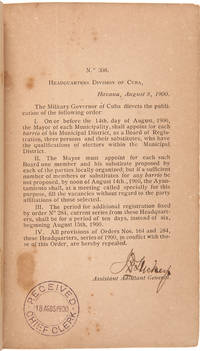
1900WRCAM51843Havana 1900. Approximately 520; 600pp. including several folding charts. Over 200 separate imprints. Original half leather and brown cloth boards spine gilt. Corners and edges worn spine rubbed boards scuffed. Initial leaves of first volume torn away but present. Several other leaves chipped and torn throughout. With many official signatures and docketing stamps. Good. Two volumes of orders promulgated in 1889 and 1900 by the American military government of Cuba after the cessation of hostilities in the Spanish-American War. Under the terms of the Teller Amendment to the Congressional Joint Resolution for war with Spain in 1898 the United States denied the intention of using the conflict as a pretext for the annexation of Cuba and promised to leave the island following the termination of the war. The American military therefore oversaw the creation of the new independent Cuban government before departing in 1902. The documents contained in this collection consist of over two hundred orders in both English and Spanish from the Headquarters Division of Cuba that helped to shape the emerging civilian government. They include instructions for the running of elections the organization of the courts and school system the appointments for various government offices provisions for tax regulations and many other critical issues facing Cuba at its independence. The directives cover two periods from January to July in 1899 and from July to September in 1901. Many of the orders are signed in manuscript by the assistants to the military governor for the island Gen. Leonard Wood including assistant adjutant generals J.B. Hickey and L.W.V. Kennon and Brig. Gen. Chief of Staff Adna R. Chaffee. An interesting documentation of the first American occupation of Cuba. hardcover books
188310007Paris Plon, Nourrit et Cie 1883 in-12 demi-chagr. dos à nerfs, orné [Rel. de l'époque]
188315500BBParis, Plon, Nourrit et Cie., 1883. 3 Bl., 349 Seiten, 2 Bl. Halblederband der Zeit mit Rückentitelvergoldung., 15500bb Kapitale, Kanten und Rücken berieben und stellenweise beschabt.
188893403Madrid: Manuel Hernandez 1888. First Edition. pamphlet. 27 pages. 8vo original printed wrappers. Madrid: Manuel Hernandez 1888.<br/> <br/> Manuel Hernandez unknown
188893403Madrid: Manuel Hernandez 1888. First Edition. pamphlet. 27 pages. 8vo original printed wrappers. Madrid: Manuel Hernandez 1888.<br/><br/> Manuel Hernandez unknown books
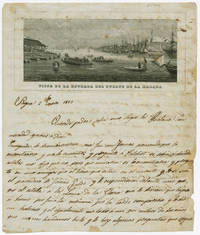
1853WRCAM54601Havana 1853. 4pp. on a bifolium. Previously folded. Some chipping at fore- edge slightly affecting text. Light dampstaining and tanning. About very good. An attractive Cuban pictorial letter sheet with a neatly executed third-page lithograph illustration of the port of Havana. The image depicts several small boats rowing barrels to and from a loading dock. In another small boat a plantation owner or some form of dignitary is being rowed to shore by a crew of men. On the right side of the image several larger ships lie at anchor and in the background on the shore is the fort guarding the mouth of the harbor the Morro Castle. <br> <br> The sheet is filled out by a man named Juan Fabre writing to his parents on Jan. 2 1853 advising them of his safe arrival in Havana. He talks about meeting up with a relative that he had not seen in two years and working at a shoe shop with another relative who adds a brief post script on the verso of the second leaf. Pictorial letter sheets of Cuba are quite rare on the market. unknown books
1850230131Um 1850. In der Platte bezeichnet. 27 x 39,8 cm (Darstellung) 39 x 49 cm (Papier).
1860KART0040Weimar, Geograph. Inst. o. J. (ca 1860). Grenzkol. Stahlst., mit Erläut. u. Glossar, 51 x 62 cm. Breitrand. Mittelfaltung. Mit hinterlegten Randläs. Im w. Rand leichte Benutzunsspuren. Im Kartenbild einige Fingerfl. Rücks. leicht verstaubt mit wenigen kl. Braunspuren. Insges. sehr guter Zustand. Die Karte umfasst das Gebiet vom Meerbusen von Mexico, der Karibik bis zum Beginn von Ecuador.
18560006868New York: D. Appleton 1856. First edition. Hardcover. fine. 12mo xii 412 pages original light brown embossed cloth. <br/><br/>These observations are related in a series of 61 letters. These were originally composed in Spanish then translated into English by Joseito. "I have thereby been enabled to impart entirely new data and reliable information instead of merely copying from books already known. . I applied myself to natives who besides an intimate knowledge of affairs in general possessed a sound judgment and an investigating disposition. It has beeen indeed a very happy incident to have found them. . That part of my work which treats on judicial matters and the secrets of the management of the tribunals will especially attract the attention of my readers. - Introductory Letter." Sabin 17816; Treiles BIBLIO. CUBANA vo. 4 p.17. D. Appleton hardcover