Governor, Cuba MilitaryBiblio.com
2 507 résultats
102449067X.Ghardcover. Good. Access codes and supplements are not guaranteed with used items. May be an ex-library book. hardcover
1024495299.Gpaperback. Good. Access codes and supplements are not guaranteed with used items. May be an ex-library book. paperback
1278900748.Gpaperback. Good. Access codes and supplements are not guaranteed with used items. May be an ex-library book. paperback
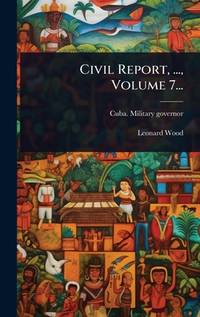
38527Washington: Government Printing Office n. d. 1st edition presumed. ca. 1901. Black leather boards gilt stamped lettering to spine. Boards stamped in blind. Glossy marbled endpapers. All boards and spines rubbed chipped and soiled. Vol IX missing boards and spine Vol XI & I boards and spine detached from textblock Vol II boards & spine detaching. Spines and hinges loose. A few leaves and 2 unfolding maps detached soiled or chipped library "Property of Michigan Commandery Loyal Legion" blue stamping throughout volumes. A Good set. Individual volumes divers paginations within each volume. Many inserted plates of b/w images fold-out maps and charts / tables & portraits housed within all volumes. 9-5/8" x 7" <br/><br/>OCLC records 7 institutional holdings of this set. Contents as stated in front pages of Vol. I: Vol I: Personal Report of General Wood Report of Lieutenant McCoy Aide-de-Camp Financial Exhibits accompanying same. Vol II: Civil Orders and Circulars issued during 1900. Vol III: Report of the Secretary of State and Government Reports of the various Civil Governors. Vol IV: Report of the Chief Sanitary Officer Report of the Chief Surgeon of the Department Report ofthe Superintendent Department of Charities. Vol V: Report of the Secretary of Finance Report of the Treasurer of Cuba Report of the Auditor for Cuba Report of the Chief of Customs Service Report of the Director General of Posts. Vol IX: Report of the Secretary of Public Works. Vol X: Report of the Secretary of Public Works continued Report of the Special Commissioner of Railroads Report of the Chief of the Light-House Board Report of the Captain of the Port Havana. Vol XI: Report of the Chief Engineer for the Fiscal Year ending June 30 1900. Vol XII: Report of the Chief Engineer for the six months ending Dec. 31 1900. Wood born on October 9 1860 in Winchester New Hampshire graduated Harvard Medical School in 1884. After working in private practice in Boston for two years he secured a job as army assistant surgeon with the rank of first lieutenant in January 1886. Routine successes and close relationships with political giants Wood formed a close friendship with Theodore Roosevelt and helped Roosevelt organize the 1st Volunteer Calvary Regiment for service in the Spanish-American War in May 1898 allowed for a quick advancement in his military service which eventually aroused some controversy. "Promoted to brigadier general and in December of that year he was promoted again to major general of volunteers and named military governor of Cuba. During his term in that post great strides were taken in improving internal conditions notably through the sanitation work of Maj. William C. Gorgas. Modern school police transportation and communications systems were established and a new constitution and body of laws were drawn up." Webster's American Military Biographies p. 488. In May of 1902 Wood stepped down from his executive position in order for the popularly elected President Tomas Estrada Palma to take over. "Aggressive ambitious and self-righteous Wood was not an easy man to work with; his change from medical doctor to fighting soldier and his rise from captain to brigadier general in the space of five years 1898-1903 aroused considerable distrust and hostility in and out of the army. his single-inded advocacy of the Plattsburgh Idea later to resurface as the ROTC contributed greatly to US readiness in World War I; unquestionably one of the greatest U.S. soldiers." -The Harper Encyclopedia of Military Biography p.807. (Government Printing Office) hardcover books
Zaragoza, Artes Gráficas Gregorio Casañal, 1920. 4to.; 128 pp. Ejemplar sin cubierta superior.
a25985Havana 1945. 12mo. 852pp. limp boards. Owner signed in front and rear. VG. hardcover
1391163338.Gpaperback. Good. Access codes and supplements are not guaranteed with used items. May be an ex-library book. paperback
1396509496.Ghardcover. Good. Access codes and supplements are not guaranteed with used items. May be an ex-library book. hardcover
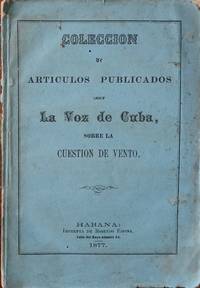
18773543<p>Coleccion de articulos publicados por la voz de cuba sobre la cuestion de vento primera edicion habanaimprenta de rosendo espina 1877 caratulas originaleslibro originalestado regularla voz de cuba fue un periodico cubano del siglo XIX en este libro se publican articulos del ingeniero cubano francisco de albearcon respecto a la construccion del acueducto de vento en la habanaAsí a solicitud del capitán general de la Isla el coronel de ingenieros >Francisco de Albear y Fernández de Lara presentó en 1855 una "Memoria acerca del Proyecto de conducción a La Habana de las aguas de los manantiales de Vento" que proyectaba un sistema de acueducto de mampostería cerrado que conduciría por gravedad las aguas de dichos manantiales hasta su destino final a una distancia de once kilómetros. En la Memoria Albear realizó un estudio de los antecedentes y las posibilidades de aprovechamiento de los acueductos anteriores efectuó un cálculo de la dotación de agua para la ciudad valoró las dificultades para lograr la obra de captación en Vento y propuso el trazado del canal hasta el depósito.</p><p>Atendiendo a la extraordinaria complejidad de la obra y a las dificultades de su ejecución en el convulso período de la >Guerra de los diez años Albear elaboró y presentó en 1876 dos nuevos documentos: la "Memoria del Proyecto de depósito de recepción y de distribución de las obras del Canal de Vento" y la "Memoria del Proyecto de la distribución del agua de Vento en La Habana". En la primera valoraba los aspectos relativos a la ubicación altura capacidad y dimensiones del depósito así como otros aspectos tecnológicos; mientras que en la segunda se argumentaban las condiciones requeridas para un buen sistema de distribución dividido en dos partes interior y exterior así como las particularidades y aportes de cada una de ellas.</p>La inauguración del Acueducto de Albear denominado finalmente así tras la muerte de su artífice el 22 de octubre de 1887 no ocurriría hasta seis años más tarde el 23 de enero de 1893 en medio de condiciones políticas y económicas sumamente adversas plagadas de dificultades no sólo topográficas y tecnológicas sino incluso higiénicas en momentos en que las llamadas "fiebres de Vento" diezmaban a sus constructores. La etapa final de las obras a cargo de la firma Runkle Smith and Co. de Nueva York y encabezada por el ingeniero Sherman Gould por la parte norteamericana fue dirigida de acuerdo con los proyectos originales por un discípulo y continuador de Albear el coronel de ingenieros >Joaquín Ruiz. No obstante su artífice llegó a tener en vida la satisfacción de ver su proyecto premiado con Medalla de Oro en la Exposición Universal de >París de 1878 donde se la consideró como una obra maestra de la ingeniería del siglo XIX. Imprenta de rosendo espina paperback
0267585276.Gpaperback. Good. Access codes and supplements are not guaranteed with used items. May be an ex-library book. paperback
1390716910.Gpaperback. Good. Access codes and supplements are not guaranteed with used items. May be an ex-library book. paperback
0364273518.Ghardcover. Good. Access codes and supplements are not guaranteed with used items. May be an ex-library book. hardcover
0483780391.Gpaperback. Good. Access codes and supplements are not guaranteed with used items. May be an ex-library book. paperback
0483780820.Ghardcover. Good. Access codes and supplements are not guaranteed with used items. May be an ex-library book. hardcover
0332730271.Ghardcover. Good. Access codes and supplements are not guaranteed with used items. May be an ex-library book. hardcover
1391173635.Ghardcover. Good. Access codes and supplements are not guaranteed with used items. May be an ex-library book. hardcover
025920949X.Gpaperback. Good. Access codes and supplements are not guaranteed with used items. May be an ex-library book. paperback
0332314847.Ghardcover. Good. Access codes and supplements are not guaranteed with used items. May be an ex-library book. hardcover
0259242853.Gpaperback. Good. Access codes and supplements are not guaranteed with used items. May be an ex-library book. paperback
0483709255.Ghardcover. Good. Access codes and supplements are not guaranteed with used items. May be an ex-library book. hardcover
0484345281.Ghardcover. Good. Access codes and supplements are not guaranteed with used items. May be an ex-library book. hardcover
0656614382.Gpaperback. Good. Access codes and supplements are not guaranteed with used items. May be an ex-library book. paperback
201532679Köln, Horbach Stiftung, 2015. 122 S., einige Farbtafeln. 21 x 27,5 cm. Fotoillustrierter Orig.-Pappband.
a58469A wonderful and poignant collection of 8 letters written by a Spanish emigrant in Cuba 1905-06. The letters total 39 sides on 12 sheets of paper all handwritten in ink in Spanish and addressed to Sra. Mercedes Chueca Alonso in Barcelona. All are signed Pepe who also identifies himself as Jose Vila Maria and as Jose Vicente. The letters include a fairly detailed account of his voyage to Cuba via Barcelona Paris Marseille; a comparison of Havana to Barcelona; advice to a prospective emigrant Mercedes's brother; and some account of his attempts to seek his fortune apparently in the miitary. In passing he mentions something of the events of the time - the August 1906 uprising and subsequent American military intervention:.El haberme hecho ciudadano Cubano fue con objecto de ingresor en la academia del cuerpo de artilleria mas me imponian condiciones que no pude aceptar pues tenia que entrar de soldado y firmar un contrato por cuartro anos y el examen para oficial era libre pues aqui el servicio es voluntario mas illegible quiero que aqui solo illegible la influencias y son muchos los libertadores que de la ultima guerra existen resultan que por muy benos examanes que se hagan podran illegible a extranjero a illegible la plaza inguesaron cuando la intervencion americana fueron relevados en sus cargoes. April 1 1906 .Hace unos dia me intregaron dos targeta y una carta tuya; en esta ultima me manifiestas estraneza por no tenor noticia mas.a circumstancias por que ha estado atravesando la Habana; pues en momentos en que ya tenia el nombramiento.a ingresor en el cuerpo del ejercito contro lo que era de esperar intervinieron los americanos por lo que me virprecisado a marcher a Port Tampa Estados Unidos en donde he permanecido hasto unos dias antes de pasar por aqui.los muchos destrozos que en esta capital. November 20 1906 Also included is a letter from Pedro Marden of Barcelona postmarked 1907 informing Sra Chueca of the death of Vicente presumably the Pepe of the other letters in Cuba of unknown causes. Together with 9 stamp-bearing envelopes. . unknown
19036457V.p. 1903. 36 postcards all completed in manuscript generally very good or better with some wear and rounded corners. <br /> <br /> A fascinating assemblage of cards written by Pre-Castro intellectuals to a Maria de Serra though a few are written to other women. It is difficult to pin down de Serra though we do know she was highly educated and very well-known and connected. It makes sense to us that she is perhaps the Maria de Serra mentioned by William Wells Brown in his important work The Rising Son or the Antecedents and advancement of the Colored Race 1874. On pg 260 Brown writes:<br /> <br /> "The free blacks in Cuba form an important element in her population and these people are found in all the professions and trades. .one of the best young ladies' academies at present existing at Havana is personally conducted by an accomplished negro woman Maria de Serra to whom many a lady of high rank owes her social and intellectual accomplishments."<br /> <br /> Further research may be fruitful in retrieving more information on this Maria de Serra.<br /> <br /> It goes without saying that the sentiments and signatures are the most appealing part of this collection. Many of the cards appear to contain original verse and all are quite legible and well preserved. Equally as lovely are the cards themselves many being of exceptional beauty as they were all chosen by artists and intellectuals. All in all a remarkable set worthy of further research. The correspondents are as follows:<br /> <br /> <br /> Diego Vicente Tejera; one of the most famous turn-of-the-century Cuban poets but also known as a short story writer orator and political activists.<br /> <p><br /> Nestor Cargonell; famous poet and writer. His son went on to become a Hollywood star.</p> <br /> <p>Conde Kostia pseudonym of Aniceto Valdivia; writer journalist poet critic lecturer dramatist founder of newspapers and Cuban diplomat.</p> <br /> <p>Rafael Maria Merchain; very influential poet and philosopher</p> <br /> <p>Enrique Fontanills; very prominent Cuban journalist.</p> <br /> <p>Florimel: great Cuban journalist writer and poet who died early in life.</p> <br /> <p>Manuel Raul Blanco Belmonte; Cuban poet.</p> <br /> <p>Ramon Meza; One of the most important Cuban writers of his time. Many of his books are considered classics and remain in print.</p> <br /> <p>Aurelio Cancio; Cuban journalist who founded "La Discusion" newspaper.</p> <br /> <p>Manuel Serafin Pichardo; one of the most popular Cuban poet of the 1900s.</p> <br /> <p>Frederico Mendes Cobos; a Cuban politician who became a a senator in 1902.</p> <br /> <p>Juan Maria Alberti: influential Cuban politician.</p> <br /> <p>Manuel Marquez Sterling; fine writer and politician.</p> <br /> <p>Jose Manuel Govin; journalist and director of the popular newspaper "El Munto"</p> <br /> <p>Cesar Cancio; Very popular Cuban poet born in St Spiritus.</p> <br /> <p>Pablo Bonachea; great Cuban journalist and director of "La Discussion" newspaper for one year.</p> <br /> <p>Jose Ernesto Trian; Cuban writer with political connections. Was ambassador to Venezuela.</p> <br /> <p>Manuel Tierso; Romantic Cuban poet</p> <br /> <p>Alvaro de la Iglesia. revered Cuban writer who penned the great "Cuban Traditions"</p> <br /> <p>Frederico Ledesma Balsunde: journalist and editor at "El Lucero."</p> <br /> <p>Fabio Fiallo; a leading Dominican writer poet and politician. He died in Cuba.</p> <br /> <p>Dulce Maria Borrero de Lujan; the most important Cuban woman writer and poet of her time.</p> <br /> <p>Frederico Hermida; author of any Cuban novels in the 1900s.</p> <br /> <p>Mariana Comas; Cuban essayist</p> <br /> <p>Joaquin Lopez Sena; renown Cuban poet and a politician from the 1900s to the 1920s.</p> <br /> <p>Eliseo Giberga; a very powerful and influential Cuban politician of the early 1900s.</p> <br /> <p>Manuek Coronado; an important Cuban journalist.</p> <br /> <p>Antonio San Miguel; Cuban writer and journalist.</p> <br /> <p>Pablo Santi Rois; Poet and respected journalist.</p> <br /> <p>Armando Celorio; One of the finest Cuban poets.</p> <br /> <p>Jose Maria Carbonell; famous Cuban poet and writer.</p> <br /> <p>Marcos Trazivark; famous Cuban writer and Musician.</p> <br /> <p>Esteban Joven; Cuban writer poet and essayist.</p> <br /> <p>Narciso de Puso; famous poet well entrenched in Cuban high society.</p> <br /> <p>Eduardo Mencis Capote; Cuban journalist popular among the elite.</p> <br /> <p>Lorenzo Frau Marsal; respected Cuban journalist</p> <br /> . unknown