2 012 résultats
54388P., Société Française d'Imprimerie et de Librairie (Ancienne Librairie Lecène, Oudin et Cie), sans date, in 4° relié demi-percaline rouge à coins de l'éditaure, dos orné, tête dorée, 224 pages ; petits défauts au cartonnage.
1822LBW-7773Paris, imprimerie de Guiraudet, mars 1822. In-8 de (1) f., 58 pp ; cartonnage de papier marbré vert, pièce de titre rouge (reliure moderne).
053907Paris Presses Universitaires de France PUF 1987 in 8 (21,5x15) 1 volume broché, couverture à rabats, 395 pages [1]. Collection '' Voix nouvelles en psychanalyse ''. Bel exemplaire
1827GITaz270A Paris chez Ledentu 1827. In-18. 3ff n ch VI-XII 2-418pp. Pleine basane havane racinée, dos lisse orné de frises, pastilles et motifs rocaille dorés, pièce de titre noire, tranches marbrées, rel époque. Orné de 6 belles gravures hors texte dont le frontispice. Bel exp.
19756086Presses de l'Université de Montréal In-8 Couverture souple Montréal 1975
19761088561976 Editions Casterman - 1976 - In-8, broché - 235 p.
1761GITaz170(1)sans lieu de l'Imprimerie de P Alex Le Prieur 1761 / (2)A Paris de l'Imprimerie de D'Houry 1761. 2 ouvrages en 1vol in-12 531 24pp. Pleine basane havane, dos à nerfs orné de compartiments dorés, pièce de titre grenat, tranches brique, rel époque. Coins et coiffes usés, 1 charnière fendue, manque à la pièce de titre, travail de vers en bordure de quelques feuillets. Peu courant.
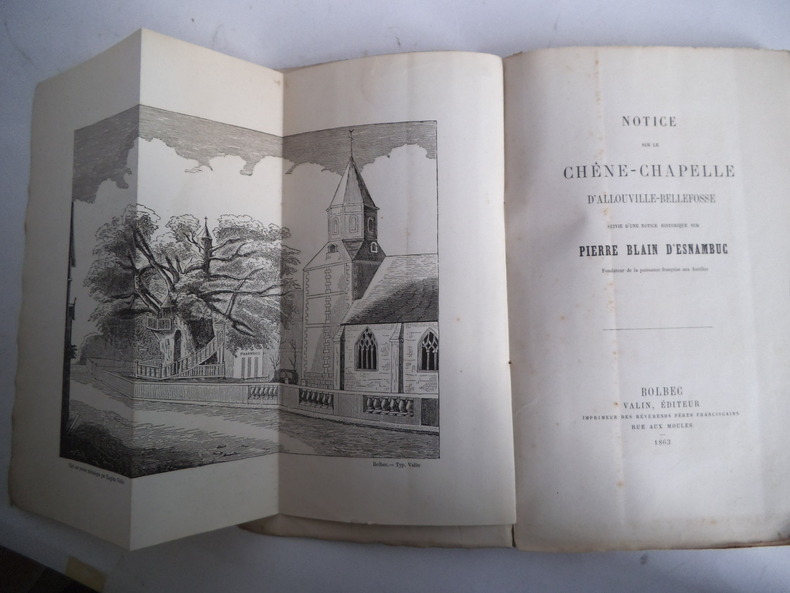
7824suivie d’une notice historique sur Pierre Blain d’Esnambuc fondateur de la puissance française aux Antilles.In 8 broché faux-titre,frontispice illustré,dépliant,titre,70 pages,Bolbec Valin éditeur 1863,à signaler une déchirure au deuxième de couverture,sans gravité
184724871Paris Imprimerie royale, 1847 2 volumes In-8 2 vol in-8, XXII +1 ff + 595 + XVI + 581. 4 ème édition revue sur la dernière publication du dépôt de Madrid augmentée de documents traduits de divers ouvrages anglais par Ch. Rigault de Genouilly. Chadenat (171) indique la deuxième édition et précise "rare et très recherché". Relié dos basane, usagée, un mors fendu et petits manques aux coiffes . Il n y a pas d'illustrations dans notre exemplaire, le texte a doublé de volume par rapport à la troisième édition
184954750Madrid, La Imprenta Nacional, 1849. Small 4to. Contemp. hcloth. Gilt lettering on spine. Stamp on title-page. (2),468 pp., 1 folded table. Internally clean and fine.
11943Paris : Jouve,1933,in-8,broché,30 pp. ;
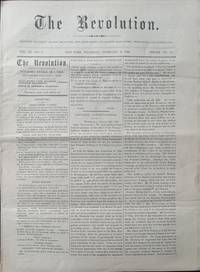
1869020893New York: Susan B. Anthony Proprietor; R.J. Johnson Publisher 1869. Wraps. Good. Side sewn journal. Approximately 12 ¼ by 9 inches. 16 pp. Early issue of the Revolution a groundbreaking and influential newspaper produced by Elizabeth Cady Stanton Susan B. Anthony and Parker Pillsbury. The paper was established to provide a voice to activists and suffragists such as Stanton and Anthony whose voices were marginalized by the mainstream press as well as many abolitionist publications with whom they had been previously allied. Anthony and Stanton advocated for an amendment giving suffrage to women along with the amendment sponsored by abolitionists that would give Black men the right to vote. Many abolitionists actively discouraged Stanton and Anthony from pursuing their amendment until the amendment enfranchising Black men passed creating a rift in the abolitionist movement as well as the women's suffrage movement. Feeling betrayed by abolitionists and Republicans who initially supported them they established the Revolution with financial help from George Francis Train a Democrat who supported women's rights but was openly racist. As the name indicates The Revolution adopted a combative radical tone with Stanton and others unafraid to take on critics. The paper openly discussed sexual and physical abuse in marriage and advocated better divorce laws that would offer women a way to escape abusive marriages. In 1869 the paper broke with Train who had supplied very little of the funding he initially offered. It published until 1872 struggling to make expenses along the way. This issue with editorial correspondence written by Elizabeth Cady Stanton as well as a letter by Susan B. Anthony addressing concerns from readers regarding George Train's contributions to the journal etc. GOOD condition. Several fold creases present with other general wrinkling. Minor toning and scattered soiling in the interior. Susan B. Anthony, Proprietor; R.J. Johnson, Publisher unknown
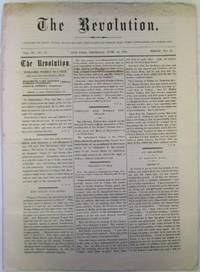
1869020934New York: Susan B. Anthony Proprietor; R.J. Johnson Publisher 1869. Wraps. Good. Side sewn journal. Approximately 12 ¼ by 9 inches. 16 pp. Early issue of the Revolution a groundbreaking and influential newspaper produced by Elizabeth Cady Stanton Susan B. Anthony and Parker Pillsbury. The paper was established to provide a voice to activists and suffragists such as Stanton and Anthony whose voices were marginalized by the mainstream press as well as many abolitionist publications with whom they had been previously allied. Anthony and Stanton advocated for an amendment giving suffrage to women along with the amendment sponsored by abolitionists that would give Black men the right to vote. Many abolitionists actively discouraged Stanton and Anthony from pursuing their amendment until the amendment enfranchising Black men passed creating a rift in the abolitionist movement as well as the women's suffrage movement. Feeling betrayed by abolitionists and Republicans who initially supported them they established the Revolution with financial help from George Francis Train a Democrat who supported women's rights but was openly racist. As the name indicates The Revolution adopted a combative radical tone with Stanton and others unafraid to take on critics. The paper openly discussed sexual and physical abuse in marriage and advocated better divorce laws that would offer women a way to escape abusive marriages. In 1869 the paper broke with Train who had supplied very little of the funding he initially offered. It published until 1872 struggling to make expenses along the way. This issue with "Who Killed Cock Robin" by Susan B. Anthony; four pieces by Elizabeth Cady Stanton a review of a book on Women's Suffrage "Impunity in Crime" "President Woolsey" "Women's Education" Also present is news on the American Equal Rights Association etc. GOOD condition. Front cover torn along the upper hinge. Several fold creases present with other general wrinkling. Minor toning and scattered soiling in the interior. Some foxing and offsetting along the top edge. Susan B. Anthony, Proprietor; R.J. Johnson, Publisher unknown
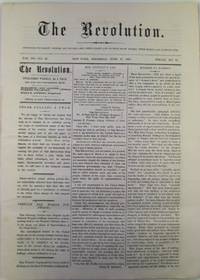
1869020935New York: Susan B. Anthony Proprietor; R.J. Johnson Publisher 1869. Wraps. Good. Side sewn journal. Approximately 12 ¼ by 9 inches. 16 pp. Early issue of the Revolution a groundbreaking and influential newspaper produced by Elizabeth Cady Stanton Susan B. Anthony and Parker Pillsbury. The paper was established to provide a voice to activists and suffragists such as Stanton and Anthony whose voices were marginalized by the mainstream press as well as many abolitionist publications with whom they had been previously allied. Anthony and Stanton advocated for an amendment giving suffrage to women along with the amendment sponsored by abolitionists that would give Black men the right to vote. Many abolitionists actively discouraged Stanton and Anthony from pursuing their amendment until the amendment enfranchising Black men passed creating a rift in the abolitionist movement as well as the women's suffrage movement. Feeling betrayed by abolitionists and Republicans who initially supported them they established the Revolution with financial help from George Francis Train a Democrat who supported women's rights but was openly racist. As the name indicates The Revolution adopted a combative radical tone with Stanton and others unafraid to take on critics. The paper openly discussed sexual and physical abuse in marriage and advocated better divorce laws that would offer women a way to escape abusive marriages. In 1869 the paper broke with Train who had supplied very little of the funding he initially offered. It published until 1872 struggling to make expenses along the way. This issue with a letter on taxes owed by Susan B. Anthony; two pieces by Elizabeth Cady Stanton "Women's privilege in Edinburgh" and a continuation of a piece on Reverend Henry Edgar. Also present is news on the American Equal Rights Association an essay on hygiene vs. fashion etc. GOOD condition. Several fold creases present with other general wrinkling. Minor toning and scattered soiling in the interior. Susan B. Anthony, Proprietor; R.J. Johnson, Publisher unknown
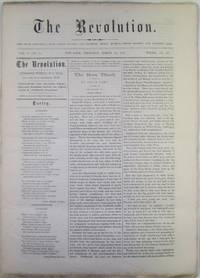
1870022308New York: Susan B. Anthony Proprietor; R.J. Johnson Publisher 1870. Wraps. Good. Side sewn journal. Approximately 12 ¼ by 9 inches. 16 pp. Early issue of the Revolution a groundbreaking and influential newspaper produced by Elizabeth Cady Stanton Susan B. Anthony and Parker Pillsbury. The paper was established to provide a voice to activists and suffragists such as Stanton and Anthony whose voices were marginalized by the mainstream press as well as many abolitionist publications with whom they had been previously allied. Anthony and Stanton advocated for an amendment giving suffrage to women along with the amendment sponsored by abolitionists that would give Black men the right to vote. Many abolitionists actively discouraged Stanton and Anthony from pursuing their amendment until the amendment enfranchising Black men passed creating a rift in the abolitionist movement as well as the women's suffrage movement. Feeling betrayed by abolitionists and Republicans who initially supported them they established the Revolution with financial help from George Francis Train a Democrat who supported women's rights but was openly racist. As the name indicates The Revolution adopted a combative radical tone with Stanton and others unafraid to take on critics. The paper openly discussed sexual and physical abuse in marriage and advocated better divorce laws that would offer women a way to escape abusive marriages. In 1869 the paper broke with Train who had supplied very little of the funding he initially offered. It published until 1872 struggling to make expenses along the way. This issue with a printing of an interview conducted by Susan B. Anthony in which she interviews "Jennie" Claflin Tennie Claflin sister of Victoria Woodhull about her part in the brokerage firm started by Woodhull and herself. They discuss a variety of subjects relating to brokerage and the skills needed to run a business. Tennie C. Claflin partnered with her activist and suffragist sister Victoria Woodhull to open this firm in 1870. Backed by Cornelius Vanderbilt the firm became quite successful tapping into the needs of women who wanted to invest. Shortly after opening the firm Woodhull and Claflin started to publish a newspaper that was considered radical at the time advocating for equal rights free love and other social movements. GOOD condition. Several faint fold creases present with other general wrinkling and creasing. Chipping and tearing along the edges. Minor toning and scattered foxing and soiling. Several pages unopened along the top edge. Susan B. Anthony, Proprietor; R.J. Johnson, Publisher unknown
in-12, 534 pp., cartonnage éditeur avec jaquette i Jaquette lég. insolée sinon bel exemplaire. [JU-4]
184954750Madrid La Imprenta Nacional 1849. Small 4to. Contemp. hcloth. Gilt lettering on spine. Stamp on title-page. 2468 pp. 1 folded table. Internally clean and fine. <br/><br/><em>This edition not in Sabin. Sabin 19679 for other editions. </em> hardcover
1740200020AG1740. Nuremberg Homann Heirs c.1740. Original hand-coloured map. Plate Size: 55.6 cm x 48.7 cm. Sheet Size: 60 cm x 52 cm. Original map. Very good condition. Trace of foxing along sheet edges. Minor open tear with missing material evident to fore edge. Lower margin running out towards left corner. Centre-fold as issued. Sandler S. 136 nach Moll; mit Dat. 1740; Kapp Jamaica 59; Palmer Bermuda 32; Campbell Barbados 26 u. Taf. X; Tooley Antigua 18 u. St. Kitts 23. - Alle Bibliogr. außer Sandler datieren 1737. Very interesting set of five maps on a single sheet showing the highly-prized British possessions in the Caribbean - St. Kitts Antigua Bermuda Barbados and Jamaica - each in excellent detail noting cities rivers roads forts plantations surrounding islands political/administrative subdivisions and a host of other topographical features. The individual maps include separate title and scale bars with most having additional descriptions in German and reference keys. Barbados is orientated with north facing left while the rest are all orientated North. A beautifully decorative title cartouche is presented in the top right and includes the title in Latin as well as German. English/German translations of mapping terms and the text on the maps is in German. Homann Erben/Heirs was a prominent German publishing firm in the European map market throughout the eighteenth century. Founded in 1702 by Johann Baptist Homann the business passed to his son Christoph upon Johanns death in 1724. Christoph died in 1730 aged only 27 and the firm was inherited by subsequent Homann heirs. This changed the name of the company which was known as Homann Erben or Homann heirs. The firm continued in business until 1848. unknown
68-7274Antilles Francaises Guadeloupe ca. 1970. Autographed post card. 10.5 x 15 cm. Very Good. En Francais. [Antilles Francaises Guadeloupe, ca. 1970] unknown
1896SY-4SWM-RAHD1896. Hardcover. Very Good. First edition 1896. Moderate external wear a little fraying at bottom of spine some foxing to textblock edges gilt and decorations remain bright. Pages somewhat yellowed with an occasional bit of foxing or minor blemish. Binding reasonably firm. hardcover
in-8°, 294 pages, nombreuses illustrations en noir et en couleurs, cartes, couverture illustree. Bel exemplaire. [DV-22]
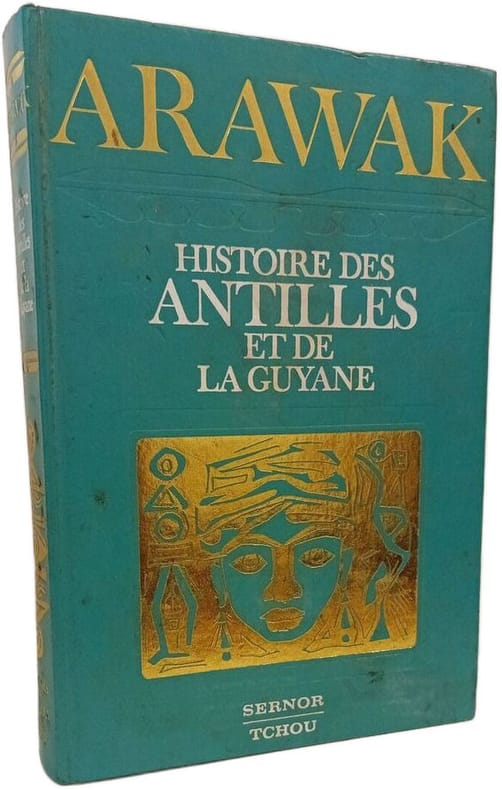
1978100152327Tchou 1978 in8. 1978. Cartonné. L'ouvrage 'Histoire spirituelle des Antilles et de la Guyane' dirigé par Elisabeth Antébi fait partie de la collection Arawak publiée par Tchou. Il rassemble des textes sur la spiritualité et l'histoire de cette région abordant des aspects religieux et culturels
016551Limoges Eugène Ardant et Cie 0 Grand in-4 (21,5 x 31,5cm), cartonnage polychrome orné de l'éditeur, 336pp. (plats usés et légèrement tâchés, déchirure de 3cm à la toile au niveau d'un mors, feuillets uniformément brunis et comportant quelques rousseurs). Nouvelle édition expurgée précédée d'une introduction de Jules Janin. 45 gravures en noir.
français In-8 de 301 pp.; reliure ornée éditeur. Riche illustration en noir et couleurs.