PRIVATEERING; WEST INDIESBiblio.com
1 975 résultats
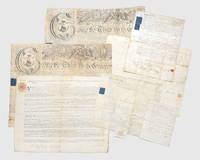
1796133528c.1796-97. Where gain is the object bring into harbour all the loaded merchantmen you can An outstanding and unusually comprehensive archive documenting the British-built armed brig Swallow a Liverpool privateer operating in the Caribbean under the experienced prize-master John McIver. The papers trace in exceptional detail the purchase fitting out commissioning and deployment of a late 18th-century privateering vessel anchored by impressive original Letters of Marque. Privateering was in essence a form of licensed warfare. As the Oxford Companion to Ships and the Sea defines it a privateer was "a privately owned vessel armed with guns commissioned by letters of marque which licensed them to take prizes in time of war" 1979 p. 670. This archive shows the process in action. The owners' letters to McIver convey both urgency and anxiety as they navigate the risks of long-distance operations during wartime revealing the network of merchants agents and seamen supporting the Swallow. Early letters make clear that McIver was the driving force: his kinsmen purchased the vessel "solely with the View to make a profitt by a Resale" yet were "well pleased you have taken the Command." The brig was refitted with 10 new iron cannon and furnished with Letters of Marque against French Dutch and later Spanish vessels. In late 1796 the Liverpool partners press McIver to sail immediately for Caribbean waters "in search of Spanish Prizes" while repeatedly stressing the need for constant intelligence. Their concerns deepen over slow remittances from their agent in Jamaica and uncertainty over whether to continue privateering or sell the ship. Built at East Cowes and bought on the stocks by the Royal Navy in 1781 the Swallow was sold in 1795 to a Liverpool consortium including Samuel McDowall the Twemlow family and the McIvers with McIver himself later taking a one-third share. At his urging the vessel was strengthened rearmed and commissioned. Her first Letter of Marque 12 July 1796 authorized cruising against the French and Dutch; a second January 1797 targeted Spanish shipping prompting an increase to 20 guns and a crew of 80. As Gomer Williams notes the Swallow "was not an ordinary privateer but an armed vessel specially hired by Government." McIver enjoyed some success: off Léogâne he sent into Port-au-Prince a large brig and schooner with French property aboard took other vessels and saved the Fame of Liverpool from capture. The letters also record his ancillary government work transporting governors and army officers. By 1797 however the quasi-peace following Leoben and Campo Formio curtailed her privateering activities. The archive also preserves McIver's account of capturing a small American merchantman in 1793 - a case serious enough to draw the attention of Thomas Jefferson and the British envoy George Hammond. The later history of the McIver/MacIver family forms a notable coda: their descendants became central figures in the creation of the Cunard Line partnering with Samuel Cunard and Robert Napier in the 1830s and 1840s to establish what became the British and North American Royal Steam Packet Company. This archive offers a superlative and unusually granular record of British privateering at a moment when European conflict fuelled an upsurge of activity in the Caribbean - a milieu in which as N. A. M. Rodger observes "the letter of marque was often a slender cover for piracy." A full listing with commentary is available on request. Overall in remarkably good condition. N. A. M. Rodgers The Wooden World 1986; Gomer Williams History of the Liverpool Privateers and Letters of Marque with an Account of the Liverpool Slave Trade 1897; Rif Winfield British Warships in the Age of Sail 1714-1792: Design Construction Careers and Fates 2007 p. 314. unknown
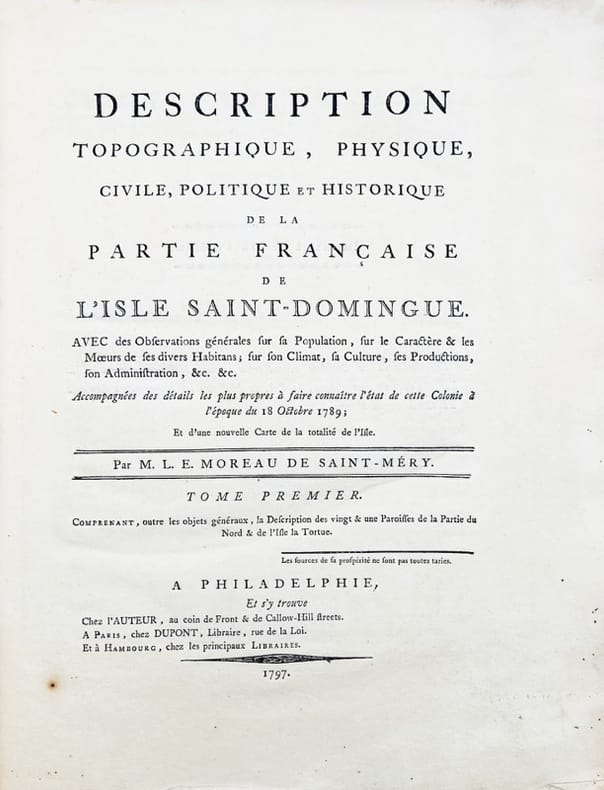
179744629Philadelphie, chez l’auteur ; Paris, Dupont ; Hambourg, les principaux libraires, 1797-1798. 2 volumes in-4 (285 x 225 mm) de XIX-(1)-788 pp., 1 carte dépliante et VIII-856 pp., 1 tableau dépliant, demi-veau fauve moucheté, dos lisse orné de filets dorés, entièrement non rogné (reliure à l'imitation).
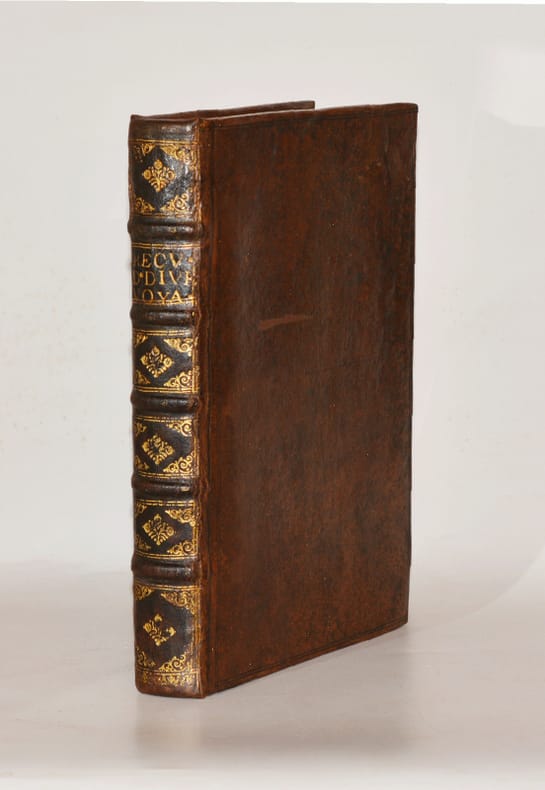
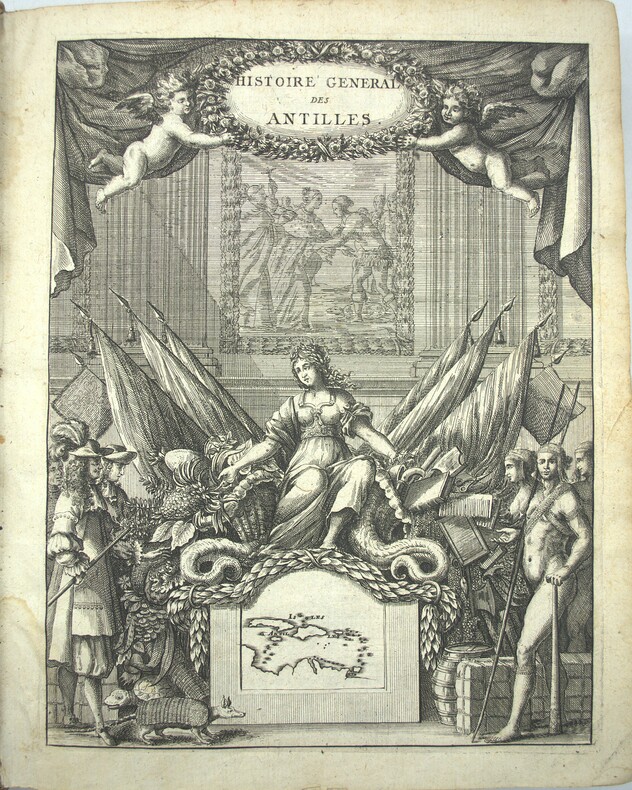
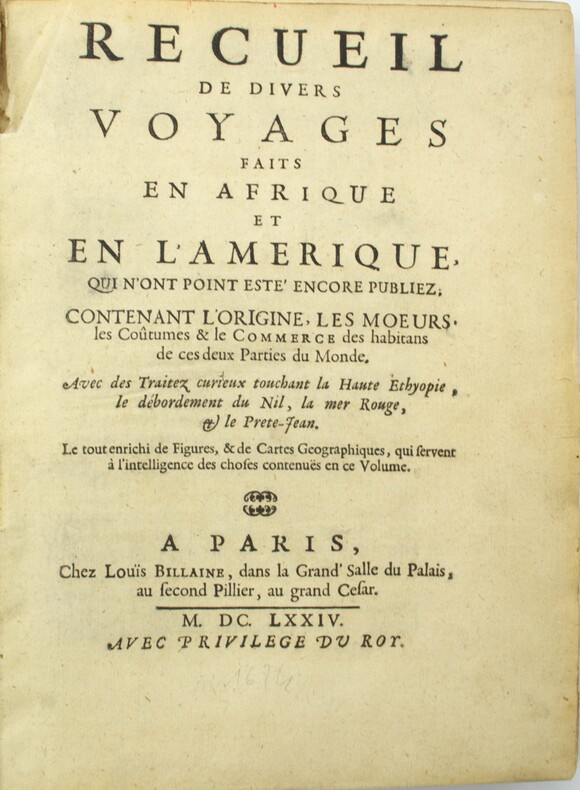
005460Paris, Louis Billaine, 1674. Cinq parties reliées en un volume in-quarto (180 X 250 mm) basane fauve marbrée, dos brun à nerfs orné de fers dorés, titre doré, tranches mouchetées en rouge (Reliure de l’époque) ; (8) ff. de titre, avis au lecteur, extrait du privilège, 262 pages, 14 planches h.-t. (dont 7 dépliantes) - 23 pages - 49 pages, 3 planches h.-t. - 83 pages [et non 81 pages, il y a en effet deux pages 54/55], 1 planche dépliante h.-t. - 35 pages, 1 planche dépliante h.-t. Discrètes et habiles restaurations à la reliure, épidermures sur les plats, infime travail de ver en fond de cahier sans atteinte au texte du premier tiers de l'ouvrage. SANS le faux titre "Colonies Anglaises" ni la CARTE de la "Description Topographique et mesure de l'Isle des Barbades aux Indes Occidentales" qui manque souvent.
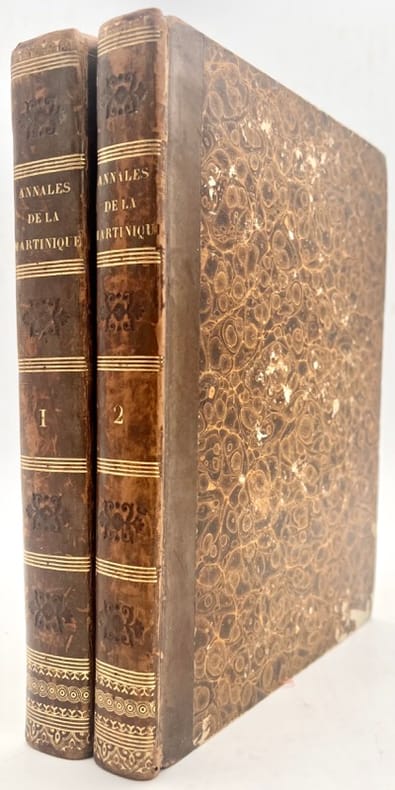
178643537Bergerac, J. B. Puynesge, 1786. 2 vol. in-4 de XXV-(1)-553-(1) pp. et XVIII-401-(1)-40 pp., demi-basane brune, dos lisse orné (relié vers 1820).
FIRST AND ONLY EDITION OF THIS ATLAS OF THE BRITISH WEST INDIES, published in France during the Seven Years' War (also known as the "French and Indian War".) xii, 171 pp + engraved title and THIRTEEN FINE MAPS, of which 8 are folding (complete). Also illustrated with ten headpieces, nine of which depict the entry into a major port. Includes Jamaica (with several maps), Barbuda, St. Kitts, Nevis, the Virgin Islands, Anguilla, Antigua, the Lucayes (now the Bahamas), and Bermuda. 4to (26 x 20.3 cm). Attractively bound in contemporary calf, with the ARMS OF KING LOUS XV OF FRANCE EMBLAZONED IN GILT ON FRONT AND BACK COVERS. Binding restored at head and tail of spine, and very solid. Small, faint marginal stain to engraved title-page, else INTERNALLY FINE AND BRIGHT, WITH MAPS AND TEXT VERY FRESH. Sabin 4553. RARE AND IMPORTANT.
1674PHO-2032Paris, Louis Billaine, 1674. in-4 (228x164) , relié plein veau , filets sur les plats , dos à nerfs orné avec titre , auteur et date (reliure pastiche),tranches rouge. L'ouvrage est illustré de 12 planches hors texte, une carte de l'Éthiopie dans le texte, trois cartes dépliantes (Barbades, Jamaïque et Virginie, Maryland et la Nouvelle-Angleterre) manque la carte du Nil, mouillures, déchirure et réparation au pli (carte des Barbardes)
234106Saint-Thomas [Antilles], 18 janvier 1743 in-folio, 12 pp. couvertes d'une écriture lisible (environ 20/25 lignes par page), en feuilles, cousu.
1667PHO-2095Paris, Thomas Jolly, 1667, 2 tomes en in-4, veau brun, dos à nerfs orné avec titre et tomaison, (Reliure de l'époque), manques aux coiffes, coins émoussés, début de fente L'illustration, gravée sur cuivre, comprend 2 titres-frontispices, 3 cartes au premier tome et 14 planches au second dont la planche figurant un couple nu, la gravure des armoiries de Harlay manque
181014534Arthus Bertrand Paris 1810 2 vol. 2 vol. in-8 de 2 ff.n.ch. XLVII 315 pp. 1 f.n.ch. (errata) et 2 ff.n.ch. 324 pp. 1 f.n.ch. (errata), demi veau vert empire moderne, dos lisse richement orné, pièces de titre et de tomaison, tranches jaunes.
245233Paris, Pagnerre, 1843 2 volumes in-8, (6)-390 pp. et (4)-488 pp., 8 pp. de Catalogue Pagnerre, demi-veau cerise, dos à nerfs orné, roulettes dorées et fleurons à froid, couverture verte imprimée conservée (reliure moderne).
17788670Paris, de l'Imprimerie Royale, 1778. 2 volumes in-4 de [4]-389-[1]-XIX-[3]; [8]-500-XXXII pages, plein veau marbré brun, dos à nerfs ornés de filets et fleurons dorés, pièces de titre en maroquin rouge, tranches mouchetées, petits accrocs aux coiffes supérieures, épidermures, coupes et coins frottés, tampon sur les pages de titre, quelques pâles rousseurs.
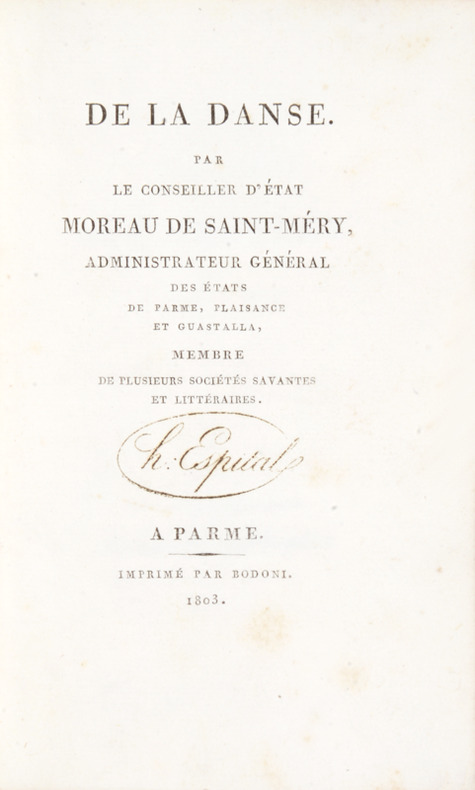
180341822A Parme, imprimé par Bodoni, 1803. Petit in-8 de (8)-61 pp. 1 feuillet blanc, basane blonde, dos lisse orné, pièce de titre en maroquin rouge, roulette dorée sur les plats (reliure de l'époque).
1841009470No Place: Notes on Gunpowder Percussion Powder; Cannon and Projectiles 1841. Half Leather. Fair/No Jacket. No place: 1841. Half leather with dark brown pebbled cloth. 75 pp. Black and white illustrations in text throughout. A technical discussion on gunpowder measuring ballistics cannons and their manufacture the use of metals in various projectiles etc. This includes a look at the composition of gunpowder and variations for different applications aspects of different metals and other substances an illustrated look at the manufacturing and testing of cannons ways of measuring ballistics with illustrations etc. Printed via lithograph from handwritten manuscript. Knowlton served as a professor at the United States Military Academy helping to teach mathematics as well as artillery. This particular copy bears pencil corrections pencil brackets and the word 'omit' next to several passages perhaps indicating this was a proof or editor's copy of some sort. FAIR/GOOD condition slightly ex-library bearing a 'torpedo station' stamp in the interior and in gilt on the spine with call numbers at the foot of the spine. Heavy scuffing and some gouging to the leather along the hinges spine and corners with superficial loss. General fading some staining and minor discoloration. Light soiling. Last name in large ink script on the title page with a few other ink notes spots etc. to the first two pages. Leaf 45/46 with heavy ink spots hatches slightly obscuring the text in places. Heavy foxing to the paper with a large dampstain affecting the lower corner. Several pages with tears and chipping along the edges with mostly minor loss. Large rice paper repair to the leaf 71/72 with the fore edge margins of the last 2 pages bearing extensive loss of paper. Notes on Gunpowder, Percussion, Powder; Cannon and Projectiles unknown
1861100126<p>Group of three daily diaries for 1861 1863 1865 and two others for 1866 and 1867. Together five diaries. Various places: 1861-1867. Each 12mo morocco wallet style bindings four black one red. Diaries for 1861 and 1863 in pencil others combination of pencil and ink. All bindings are worn 1863 is more so and a couple have some tears along edges and hinges. The 1866 diary has more significant wearm and some cracks along the edges. Group of 10 pages are loose in 1863. Condition of writing varies but generally fairly legible. Overall the group is in very good condition.Herrick was from Syracuse New York and served in Company D of the 110th Regiment of the New York Volunteers. However information from the National Park Service archive suggest he served with the 12 Regiment out of New York. He appears to have served during the siege at Port Hudson and did garrison duty at the infamous Union prison Fort Jefferson in Florida. The first diary covers his enlistment in April 1861 to the end of that year. The diary describes training and the trip to Washington where the regiment was reviewed by President Lincoln. It appears that in July 1861 he was discharged for medical reasons but for some reason he re-inlisted in August 1862. The diary for 1863 covers the entire year and includes descriptions of the siege and assault on Port Hudson. Herrick seems to have been ill during this period and stayed in camp a lot. In February 1864 Herrick and the 110th began garrison duty at Fort Jefferson the much reviled Union prison located on Garden Key Island in the Gulf of Mexico. While Herrick’s descriptions often seem somewhat monotonous the weather his health which ships came in his impressions of various drills this diary is one of very few first hand accounts inside the prison. There are some interesting entries including a prison detail discovering coffins while digging a foundation for a new building an officer arrested for selling whiskey to prisoners and a prisoner being "strung up" for stealing. Perhaps the most significant content of this diary is related to Lincoln’s assassination. In an entry on April 22nd a ship brings news to the prison "they had three prisoners slung up for rejoicing over it" Then in an entry dated July 24th the naval transport Florida brought three of the Lincoln assassination conspirators Samuel Arnold Michael O’Laughlin and Dr. Samuel Mudd to the prison. This prison wasn’t known for kindly treatment of prisoners the weather usually very hot and humid and the place was infested with bugs and misquotes. The food was what you would expect and Samuel Arnold was reported to have said the meat was so rotten "dogs ran from it." nps.gov/civilwar/soldiers</p> books
1848BB1404Brussels and Leipzig: Carl Muquardt 1848. First Edition thus. Near Fine. Translated into German by Dr. Heinrich Berghous. Imperial 8vo: x2382pp with 24 tissue-guarded hand-colored plates. Contemporary quarter calf flat spine in five compartments lettered and decorated in gilt stamped in blind; marbled covers edges and end papers. An excellent copy binding tight and unmarred moderate foxing mostly marginal to about half of text leaves but plates completely clean and richly colored. Continental editions of Catlin are quite scarce and this offers reduced-scale versions of the plates in the North American Indian Portfolio at a fraction of the cost. Howes C 243b. Sabin 11539. Pilling 684. Graff 630. First German Edition published originally in different form in London 1841 a hybrid of Catlin's two best known works Letters and Notes on the Manners Customs and Condition of the North American Indians 1841 and North American Indian Portfolio 1844. The text of this edition is an abridged version of Letters and Notes while most of the plates are scaled-down versions of the large folio plates of the Indian Portfolio. "As graphic delineations of Indian hunting and dancing scenes these plates rank next to those of Bodmer." Howes N. B. With few exceptions always identified we only stock books in exceptional condition carefully preserved in archival removable polypropylene sleeves. All orders are packaged with care and posted promptly. Satisfaction guaranteed. Carl Muquardt unknown
1667122976à Lyon, chez Christophe Fourmy 1667 In-16 15 x 8 cm. Reliure de l’époque veau havane, dos à nerfs encadrés de fers dorés, [2]-680 pp., 3 planches repliées, table. Dos terni, accrocs en pied et en tête de dos, coins émoussés et frottés, intérieur correct avec humidités. Ouvrage d’une relative rareté.
In-4 (249 x 197 mm), demi-veau havane de l'époque à petits coins de vélin, dos lisse orné de doubles filets dorés, (2), viii, 73 p., 12 tableaux hors texte dont 7 dépliants et un plan de plantation plié en fin. Edition originale et unique, rare, de ce document illustré de 12 tableaux hors texte dont 7 dépliants et un plan de plantation plié en fin. L'auteur qui signe "citoyen habitant cultivateur de Saint-Domingue" était une importante personnalité de l'île, régisseur de plusieurs grosses plantations dont celle marquis de Paroy. Ce document reprend et commente un mémoire qu'il avait adressé au ministère de la Marine et des Colonies en l'an VII (1799) pour convaincre les autorités françaises de l'intérêt de conserver et d'étendre le domaine colonial. La première partie "contient les bases d'un plan d'administration des plantations": cultures, gestion des terres et du personnel, organisation des résidences des cultivateurs, choix des cultures. Parmi ses recommandations, Avalle se prononce en faveur d'un "adoucissement de l'état des cultivateurs noirs". Dans la seconde partie, il livre le résultat d'une véritable enquête de terrain qui le conduit à rendre compte du "mouvement d'une sucrerie pendant une année", illustré de statistiques; suivi "d'observations (…) fondées sur le fruit [d'une expérience acquise] pendant plus de vingt années d'administration": nombre de cultivateurs, bâtiments et objets de manufactures, qualification des emplois, temps de travail….. Les Archives nationales et celles du Patrimoine de la Martinique conservent plusieurs documents de / et sur M.-A. Avalle qui témoignent de l'importance de sa position aux Antilles, de son activité, ainsi que de ses relations avec les autorités locales, dont Toussaint l'Ouverture. (Roquincourt, 'Bibliogr. sur la marine et les colonies', n°81. Monglond, IV 459. Sabin, H.2468). WorldCat ne recense que 8 exemplaires dans le monde. L'exemplaire comporte le monogramme "PB" doré à l'époque au dos. Bel exemplaire, très frais, parfaitement conservé.
180310561Desenne, Petit, Le Normant, Veuve Dufresne Paris an XI -1803 2 vol. 2 volumes in-8 de 2 ff.n.ch. 326 pp. XL (notes) et VIII 358 pp. 1 f.n.ch.; demi-veau de l'époque, dos lisse richement orné de motifs et palette dorés, pièces de titre et de tomaison, tranches jaunes.
1674PHO-2243Paris, Louis Billaine, 1674, in-4 (228x164), basane postérieure (19eme), dos à nerfs avec titre, lieu et date, tranches marbrées, réparations au dos et aux coins, petite réparation au pli de la carte des Barbades, intérieur frais, illustré de 12 planches (13) et trois cartes dépliantes (Barbades, Jamaïque et Virginie, Maryland et la Nouvelle-Angleterre) manque la carte du Nil comme souvent et un faux titre
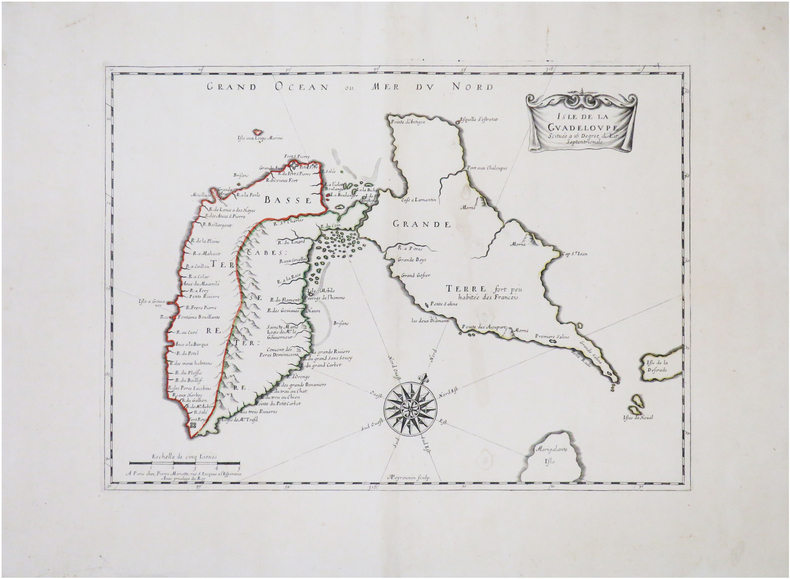
1650LBW-8846Paris, Pierre Mariette, [circa 1650]. 313 x 427 mm.
223396S.l., 1754 in-12, [3] ff. n. ch. (titre, table, errata), 360 pp., manque le faux-titre, veau fauve marbré, dos à nerfs cloisonné et fleuronné, pièce de titre cerise, encadrement de simple filet à froid sur les plats, tranches rouges (reliure de l'époque). Coiffes et coins restaurés, petites salissures à certains ff.
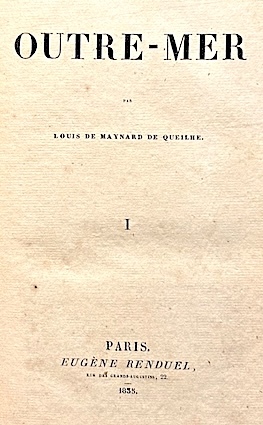
183515827Renduel Paris 1835 2 vol. 2 vol. in-8 de VII 390 pp. et 394 pp., veau glacé de l'époque, dos lisse orné, pièces de titre, gardes intérieures renouvelées (accroc à la coiffe inférieure du tome I).
019708Boston: B. Franklin Edmunds. Quarter Leather. Good. no date perhaps mid 1830s. Most likely appeared in an earlier London edition around 1828 as The Stolen Boy. Quarter leather with blue paper covered boards. Approximately 3 by 2 3/8 inches. Page edges gilt. 63 1 64 pp. With 10 full-page wood engravings including frontispieces. The first 63 pages comprise "Little Manuel" purporting to tell the true story of a young Spanish immigrant to Texas who was kidnapped by Native Americans Comanches and perhaps could be considered to fall into the "Indian Captivity Narrative" genre. Illustrated with 6 engravings. The last 64 pages contain a poem to a birthday boy by Felicia Hemans; one page of "Lines to a Young Lady; and "The Travelling Tin-Man: An American Story" by Eliza Leslie. This appears to be a moral tale for children. The book finishes with another short piece by Hofland "The Deserted Villagers; or the Confiding Boy." Eliza Leslie was perhaps best known as a cookbook author in the 19th century although she did write fiction and nonfiction. Barbara Wreaks Hoole Hofland was an English author primarily writing moral or instructive tales. Given this it is very possible Little Manuel was written as a moral tale. GOOD condition. Leather rather scuffed along the spine and hinges with moderate to heavy scuffing to the extremities. Small area of faint staining to the rear cover. Text block toned with scattered foxing and soiling. B. Franklin Edmunds unknown
1836022178Dover NH: J.T. Gibbs Publisher 1836. Quarter Leather. Poor. Folio. Quarter leather with marbled boards. Large folio. Bound volume of the Dover New Hampshire newspaper the Dover Gazette and Strafford Advertiser comprising of every weekly issue spanning from December 1 1835 to November 22 1836. Of particular note are many articles recounting events of the Battle of the Alamo in Texas. The first account appears in an early April issue of the paper reporting on what a New Orleans newspaper reported. After this short account longer articles appear documenting more of the battle the events and other news from fighting in Texas. These appear sporadically throughout the rest of the volume. For example the May 3 issue reports news from the Texas Telegraph which prints the names of those dead in the attack mentioning David Crockett James Bowie and many others. Many other articles on battles in the Texas Revolution also appear throughout as well as other news relating to it. Other news in the paper reports on a massacre of crew of the whaling ship Awashonks; the a brief account of the building of a Mormon temple in Kirtland Ohio; the Florida War with the Seminole; a massacre in Hawaii; news on insurrections of enslaved people in Kentucky and New Orleans; a piece on Sam Houston etc. POOR condition. Ex-library with minor stamping. Covers and first several blank endpapers DETACHED. Covers scuffed faded and worn especially along the extremities. Other than the first several endpapers the text block is solid and clean. One or two papers have an ownership signature in ink on the top of the page. J.T. Gibbs, Publisher unknown
178716Port-au-Prince, Paris, 1789-1790 in-4 et in-folio, Qqs lettres sont froissées.