2 192 résultats
1991006645American Booksellers Association 1991. Book. Fine. Association Copy Signed. 24 Inches X18. Poster Appox 24x18 # 6/15 AP. Total limitation of 15 Artist Proofs signed by Sendak and 40 others.Freedom to Read for Awarness of Censorship of Books to Aid the ABA Legal Defense. Signed by Barry MoserJeffrey ArcherHarlan EllisonWhoopi Goldberg Jeff BlumBeth HenlyDan RatherGary TrudeauGloria SteinheimChris Van AllisburyDavid WeisnerRobin WilliamsMickey HartJohn RicheyCharles DuttonCarolyn See Malcolm BoydAudrey & Don WoodHarrison FordJohn SaylesLane Smith Mary Higgins ClarkMariette Hartleyand many others.Incredible Piece. American Booksellers Association unknown books
1993270441993. Original Maurice Sendak pencil drawing on artist's vellum. Signed and inscribed by Maurice Sendak to Arthur Yorinks: "Feb. 6-13 1993. So Sue Me. To Arthur - with all my love! Maurice." Pencil draft for the backdrop of the play "So Sue Me" written and directed by Arthur Yorinks and performed at the Kennedy Center for the Performing Arts in Washington D.C. in 1993. The pencil draft appears in Tony Kushner's "The Art of Maurice Sendak 1980 to the Present" along with with the final full-color illustration. Matted and framed. The entire piece measures 16.75 inches by 15.5 inches. Arthur Yorinks has published 11 children's books directed numerous plays and operas and in 1990 established the Night Kitchen a children's theater company in partnership with author-illustrator Maurice Sendak. The company produced several plays directed by Yorinks and designed by Sendak including It's Alive a Halloween comedy and So Sue Me a performance featuring construction workers in pantomime. hardcover books

22111899. Original lithograph printed in colors for the set AMOUR. P. Cailler 109. 151/4 x 11 margins 21 x 16. . Deckled edge. In fine condition with full margins. unknown books
19266068Paris: H. Floury 1926-27. First edition. 28 cm; 2 volumes. 4 307 4; 4 282 2 pages. Six original drypoint sketches each printed in two states included. LACKS as commonly the 4 original lithographs from the second volume. Volume 1 with 9 color lithograph plates including front cover 17 black and white lithograph plates and 32 black and white lithographs paired with a second striking in brownish ink. Volume 2 with 13 color lithograph plates including front cover 2 tinted "helogravures" and 32 lithograph plates each reproduced in black-and-white and green-tint versions. Volume 1 one of 175 copies numbered "75" in ink over original number scratched out and volume 2 one of 200 copies legitimately numbered "75" in ink. Bound in early 20th-century gray buckram with leather title labels. Original color lithographed wraps bound in. H. Floury hardcover books
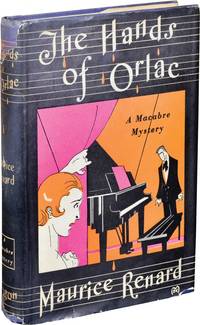
1929133042New York: E.P. Dutton 1929. First Edition. First Edition in English and first edition in hardcover preceded by the French edition "Les mains d'Orlac" in 1920. With the publisher's wraparound band. <br/><br/>A seminal horror novel rare in dust jacket written by one of the most important French genre fiction writers of the early twentieth century. The basis for several films including the classic German silent film starring Conrad Veidt "Orlacs Hande" The Hands of Orlac 1924 and its American rival the sound version starring Peter Lorre "Mad Love" directed by emigre Karl Freund for MGM in 1935 and today considered one of the greatest horror films of the 1930s. <br/><br/>Near Fine in a Very Good dust jacket with the publisher's wraparound band "The Dutton Prize Mystery for November". The jacket's deco design is bright and striking with some toning to the spine jacket and band a chip at the crown affecting a portion of the title "The Ha" and part of "n" a portion of the publisher name at the heel the "Du" in "Dutton" and a few tiny chips nicks and closed tears. <br/><br/>Barron 1999 4-125. Bleiler 1948 US. Clute & Nicholls US. Hubin 1994 US. Locke US. Reginald 12140. Senn US. E.P. Dutton unknown books
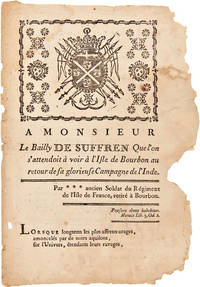
1784WRCAM48601Isle de France: Imprimerie Royale 1784. 4pp. on a single folded sheet. Quarto. Moderately worn with loss at fore- edge and gutter margins not affecting text. Lightly soiled and dampstained. Good. An early and unrecorded imprint from the colonial press at the French colony of Mauritius also known as the Ile de France. The text comprises a poem in eleven stanzas by an anonymous soldier from the Regiment of the Isle de France who retired to the island of Bourbon. As most early imprints from Mauritius are official documents this piece a work of local literature is particularly interesting and desirable. <br> <br> The Dutch were the first Europeans to become interested in the island taking possession in 1598. After exploiting the island's dense forests for a century and introducing the cultivation of sugar cane and cotton in 1710 the Dutch abandoned the colony. The French soon claimed it as "Ile de France" and the island remained under the control of the French East India Company until 1767. During the long war between France and England at the beginning of the 19th century Mauritius proved to be an important strategic naval base; as a result the British took charge of the island in 1810 and the Treaty of Paris confirmed official British possession in 1814. It remained an important sugar producing colony and in the 20th century agricultural production was expanded to include tea rice and other produce. <br> <br> Printing began on Mauritius in 1768. During the French period until 1810 only about 400 imprints were produced mostly in the form of official documents and newspapers though there are also almanacs and a few other items. All are quite rare. No copies located in OCLC and not recorded by Toussaint in his bibliography of Mauritius imprints. Imprimerie Royale unknown books
1784284321784. Quarto. 4pp. on a single folded sheet. Moderately worn with loss at fore edge and gutter margins not affecting text. Lightly soiled and dampstained. Early and unrecorded imprint from the colonial press at the French colony of Mauritius also known as the Ile de France. The text comprises a poem in eleven stanzas by an anonymous soldier from the Regiment of the Isle de France retired to the island of Bourbon. As most early imprints from Mauritius are official documents this piece as a work of local literature is particularly interesting and desirable. The Dutch were the first Europeans to become interested in the island taking possession in 1598. After exploiting the island's dense forests for a century and introducing the cultivation of sugar cane and cotton the Dutch abandoned the colony in 1710. The French soon claimed it as "Ile de France" and the island remained under the control of the French East India Company until 1767. During the long war between France and England at the beginning of the 19th century Mauritius proved to be an important strategic naval base and as a result the British took charge of the island in 1810 and the Treaty of Paris confirmed official British possession in 1814. It remained an important sugar producing colony and in the 20th century agricultural production was expanded to include tea rice and other produce. Printing began on Mauritius in 1768. During the French period until 1810 only about 400 imprints were produced mostly in the form of official documents and newspapers though there are also almanacs and a few other items. All are quite rare. No copies located in OCLC and not recorded by Toussaint in his bibliography of Mauritius imprints. unknown books
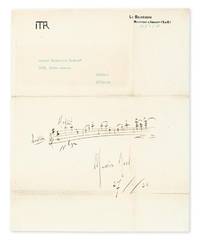
13596Used; Like New/Used; Like New. An elegant AMQS from the important French composer penned on his monogrammed stationery. Ravel has written 5 bars from his third waltz of Les Valses nobles et sentimentales notated on a hand-drawn stave. Addressed to a Madame Catherine Parker in Chicago with her name and address typewritten above the quotation and dated 27 January 1924. 1 page 4to personal stationery; separations at folds repaired verso with cello tape vertical fold touching holograph date with some loss faint uneven toning. Together with a reproduction portrait photograph.<br>The piano version of Ravel's Valses nobles et sentimentales was published in 1911 and an orchestral version was published in 1912. The title was chosen in hommage to Franz Schubert who had released collections of waltzes in 1823 entitled Valses nobles and Valses sentimentales. The piano edition is published with a quotation of Henri de Régnier: "â¦le plaisir délicieux et toujours nouveau d'une occupation inutile" the delicious and forever-new pleasure of a useless occupation. The suite contains an eclectic blend of Impressionist and Modernist music which is especially evident in the orchestrated version. unknown books
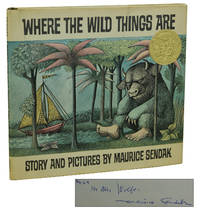
1963171123001New York: Harper & Row 1963. First Edition. Hardcover. Very Good. First edition first printing with base of title page bearing Library of Congress number 63-21253. Signed by Maurice Sendak on the half title page inscribed to a former owner and dated Dec. '64. Publisher's pictorial paper covered boards over grey cloth spine. Near Fine with light foxing to boards at edges tiny ding to bottom edge of rear board faint rubbing at corners. Slight offsetting to half title and adjacent page from laid in news-clipping announcing Maurice Sendak's upcoming speaking appearance at two schools. In a Very Good second issue dust jacket with Caldecott Medal on front panel and altered text on rear flap. After the book won the Caldecott Medal unsold copies were recalled by the publisher and supplied with new dust jackets boasting the award as found here. Jacket shows light rubbing and light toning light edge wear and a 2-inch closed tear at the top of the front panel; publisher's price of $3.50 intact at the top of the front flap though bottom corner clipped. A very sharp copy with an early signature. Harper & Row hardcover books
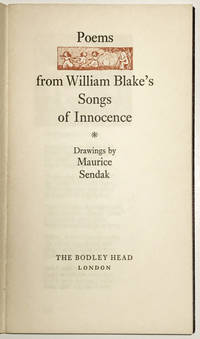
1967VBF32<p><b>SENDAK</b> Maurice:</p><p><i><b>Poems from William Blake's Songs of Innocence</b></i>.</p><p>London: The Stellar Press for The Bodley Head 1967. Eight illustrations by Maurice Sendak including one repeat: title/p.11 each printed in sanguine. 12mo.19 pp. 1 colophon; semi-stiff covers with wrap-around pictorial paper dust-jacket spine stitched as issued spine ends lightly rubbed.</p><p>PRESENTATION COPY Inscribed in ink on front free-endpaper: "Dear Sylvia – Mit Liebe! Maurice & Gene". The recipient Sylvia Milgram was Teacher-Coordinator for the Bureau of Art New York City Board of Education and a Lecturer at the Museum of Modern Art New York d. 2000. Gene is Eugene Glynn 1926-2007 psychoanalyst and Maurice Sendak's partner for more than fifty years.</p><p>First and only printing limited to 275 copies issued as a Christmas keepsake for presentation to friends of the publisher and of the artist. While on a promotional tour for the British publication of <i>Where the Wild Things Are</i> in northern England May 1967 Maurice Sendak suffered a major heart attack and he attributes his survival to the quick thinking of his editor Judy Taylor in getting him to hospital. In appreciation he prepared the drawings for this volume which was privately printed and distributed by The Bodley Head. Hanrahan A69.</p> The Bodley Head paperback books
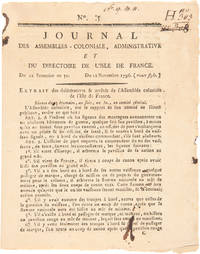
1796WRCAM48596Port Nord-Ouest: Chez F.N. Bolle 1796. 4pp. Small quarto. Single folded sheet. Contemporary manuscript notations. Light soiling and wear. Very good. Early and unrecorded imprint from the colonial press at the French colony of Mauritius also known as the Ile de France. The text contains the deliberations and acts of the colonial assembly of the island at a time when it was operating virtually independent from France. The acts all concern measures to be taken for the defense of the island at a time when British invasion was feared. <br> <br> The Dutch were the first Europeans to become interested in the island taking possession in 1598. After exploiting the island's dense forests for a century and introducing the cultivation of sugar cane and cotton in 1710 the Dutch abandoned the colony. The French soon claimed it as "Ile de France" and the island remained under the control of the French East India Company until 1767. During the long war between France and England at the beginning of the 19th century Mauritius proved to be an important strategic naval base and as a result the British took charge of the island in 1810 and the Treaty of Paris confirmed official British possession in 1814. It remained an important sugar producing colony and in the 20th century agricultural production was expanded to include tea rice and other produce. <br> <br> Printing began on Mauritius in 1768. During the French period until 1810 only about 400 imprints were produced mostly in the form of official documents and newspapers though there are also almanacs and a few other items. All are quite rare. No copies located in OCLC and not recorded by Toussaint in his bibliography of Mauritius imprints. Chez F.N. Bolle unknown books
1796284291796. Small quarto. 4pp. Single folded sheet. Contemporary manuscript notations. Light soiling and wear. Early and unrecorded imprint from the colonial press at the French colony of Mauritius also known as the Ile de France. The text contains the deliberations and acts of the colonial assembly of the island at a time when it was operating virtually independent from France. The acts all concern measures to be taken for the defense of the island at a time when British invasion was feared. The Dutch were the first Europeans to become interested in the island taking possession in 1598. After exploiting the island's dense forests for a century and introducing the cultivation of sugar cane and cotton the Dutch abandoned the colony in 1710. The French soon claimed it as "Ile de France" and the island remained under the control of the French East India Company until 1767. During the long war between France and England at the beginning of the 19th century Mauritius proved to be an important strategic naval base and as a result the British took charge of the island in 1810 and the Treaty of Paris confirmed official British possession in 1814. It remained an important sugar producing colony and in the 20th century agricultural production was expanded to include tea rice and other produce. Printing began on Mauritius in 1768. During the French period until 1810 only about 400 imprints were produced mostly in the form of official documents and newspapers though there are also almanacs and a few other items. All are quite rare. No copies located in OCLC and not recorded by Toussaint in his bibliography of Mauritius imprints. unknown books
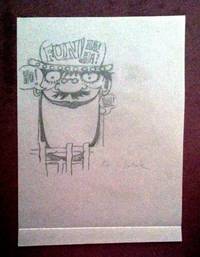
1963123No Place: Sendak 1963. Original drawing by the Author-Illustrator. Very Good . SELF-CARICATURE SIGNED by MAURICE SENDAK the famous illustrator-&-author of children's books. <br/>8vo 6.5" x 9" humorous pencil sketch & self-caricature by MAURICE SENDAK with Lewis Carrollean-aspects on translucent drawing paper. EXCEEDINGLY RARE SIGNED humorous SELF PORTRAIT--head & hat to feet--of Maurice Sendak drawn lightly in pencil on tracing paper presumably a "rough" or "prelim"inary sketch that has been Signed lightly but fully. One horizontal fold at bottom of self portrait.<br/><br/>The artist depicts himself looking and smiling at the viewer in his "Where the Wild Things Are" inimitable style. <br/><br/>The artist-illustrator's hat recalls Tenniel's sketch of the Mad Hatter in Lewis Carroll's Alice in Wonderland. An exhuberant Sendak has written "Fun! Ha! Ha!" and "Ho! He!" <br/><br/>Based upon other pieces by Sendak his use of "Ha! Ha!" may echo his elation after the enormous success of "Where the Wild Things Are."<br/><br/>This piece is Much Rarer than Sendak's famous and highly regarded book illustrations!<br/><br/>Maurice Bernard Sendak 1928 - 2012 was an American illustrator and writer of children's books. He became widely known for his book Where the Wild Things Are first published in 1963. Born to Jewish-Polish parents his childhood was affected by the death of many of his family members during the Holocaust. Sendak also wrote works such as In the Night Kitchen Outside Over There and illustrated many works by other authors including the Little Bear books by Else Holmelund Minarik.<br/><br/>He won practically every award for illustrating children's books; most notably: the Caldecott Medal from the ALA as illustrator of "the most distinguished American picture book for children" Where the Wild Things Are 1964 Sendak was also one of the Caldecott runners-up seven times from 1954 to 1982 more than any other illustrator. Also the National Book Award in category Picture Books for Outside Over There 1982. Sendak unknown books
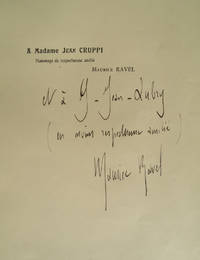
190823071Paris: A. Durand & Fils PN D. & F. 7073 1908. Small folio. Half mid-tan calf with marbled boards original publisher's wrappers printed in black and red bound in. 1f. blank 1f. title printed in red and black 1f. printed dedication "À Madame Jean Cruppi Hommage de respectueuse amitié Maurice Ravel" 1f. cast list i index ii performance notes 114 pp. <br/><br/>With an autograph inscription signed by Ravel to dedication leaf: "et à G - Jean - Aubry en moins respectueuse amitié Maurice Ravel." <br/><br/>Wrappers browned and very slightly defective. Slightly worn and browned; small tear to head of dedication repaired; small publisher's monogramatic handstamp to lower edge of verso of last page; contemporary newspaper clippings to recto of blank leaf preceding title with synopsis and review of the work by Gabriel Fauré. First Edition. Orenstein: Ravel Man and Musician p. 228. <br/><br/>L'Heure Espagnole was first performed in Paris at the Opéra Comique on May 19 1911 to a libretto closely based on the play by Franc-Nohain. <br/><br/>Madame Jean Cruppi the dedicatee convinced the director of the Opéra-Comique Albert Carré to stage the work in spite of its risqué story line. "In a letter of 17 May 1911 two days before the première Ravel wrote: 'What I've tried to do is fairly ambitious: to breathe new life into the Italian opera buffa: following only the principle . the French language like any other has its own accents and inflections of pitch.' At the same time he referred to Musorgsky's Zhenit'ba 'The Marriage' as the work's only real ancestor. It also forms part of a larger group of Spanish works that spanned Ravel's whole career and the necessary Spanish colouring provided him with a reason for a virtuoso use of the modern orchestra which he felt was 'perfectly designed for underlining and exaggerating comic effects'." Roger Nichols in Grove Music Online. Indeed composer-writer Reynaldo Hahn somewhat critically referred to Ravel's technique as "a sort of transcendent jujitsu."<br/><br/>Noted music critic Georges Jean-Aubry 1882-1949 "belonged to a circle of avant-garde musicians and littérateurs and was a frequent contributor to periodicals. Encouraged by his 20-year friendship with Debussy he wrote enthusiastically in support of contemporary French composers noting similarities between their music and that of the 18th century Couperin Rameau. He wrote perceptively in praise of Spanish composers Falla Granados Albéniz but rejected German Romanticism as expressed in the works of Wagner and Strauss." Grove Music Online. A. Durand & Fils [PN D. & F. 7073] unknown books
182972No place: No Publisher No date. Hardcover. VG_ one tie missing. Greem portfolio with cloth ties white paper label affixed to front c0over with lettering typical of 1930s. 29 illustrations printed on fine rag paper. A conundrum this book is. No text no writing of any sort. 29 unnumbered sheets of original prints. Based on the plate impression one of the 29 images appears to be an etching rather than a lithograph. Quite rare no sales or data found. No Publisher hardcover books
1926140498Beverly Hills CA: Metro-Goldwyn-Mayer MGM 1926. Draft script for the 1927 Silent film. <br/><br/>Based on the 1913 yellow peril play by Henry Maurice Vernon and Harold Owen and previously adapted for the screen in 1919 directed by Maurice Elvey and starring Matheson Lang. Lon Chaney in full yellowface murders his daughter after discovering she loves the son of a British diplomat then seeks revenge on son and his the entire family. <br/><br/>Anna May Wong who has a small role in the film was originally considered for the role of the daughter but censorship of mixed race relationships on the screen caused the role going to a white actress a sadly all-too-familiar story in her career. Wong would leave Hollywood for Europe the following year after once again being denied the lead role in a film because of her race this time in "The Crimson City."<br/><br/>Tan titled wrappers rubber-stamped copy No. 543 and production No. 1589 dated Nov. 13 1926 with credits for story writer Louise Jordan Miln and screenwriter Lorna Moon. Title page integral with the first page of the text dated October 20 1926 with credits for screenwriter Moon and story writer Miln. 102 leaves with last page of text numbered 96. Ditto style mimeograph duplication. Pages Near Fine wrapper Very Good bound with two gold brads. Metro-Goldwyn-Mayer [MGM] unknown books
1922307356Paris: M. de Brunoff 1922. Profusely illustrated with full-color covers mounted and full-page plates and photographs. 187 of 188 leaves. Folio. Original cloth with inlaid illustrated upper cover from "The Firebird" by Natalia Gontcharova. Covers and spine rubbed and soiled internally fine but lacking cover for Ballets Russes program from May 1921 featuring Picasso illustration on recto and verso. Bakst Léon. Profusely illustrated with full-color covers mounted and full-page plates and photographs. 187 of 188 leaves. Folio. An outstanding visual record of Diaghilev's Ballets Russes and Ida Rubinstein's Galas Russes in their most influential years lavishly illustrated with the works of Bakst Gontcharova Larionov Picasso Matisse Massine Derain and others. The collection is comprised of special issues of the theatrical periodical "Comoedia Illustré" and souvenir programs devoted to Ballets Russes and Rubinstein's Galas Russes for the seasons 1909-1921 with introductory letterpress text for each season by V. Svetloff. With splendid color and gilt illustrations of costume and set designs as well as numerous photographic portraits of dancers and production artists. Bakst is the most frequently represented artist in the group; the illustration inlaid to the upper cover is by Natalia Gontcharova. M. de Brunoff unknown books
1928135601Paris: Studio Soulat-Boussus 1928. Vintage double weight photograph from the set of the 1928 film. Shot by Jean Soulat and Mauric Boussus of Studio Soulat-Boussus in Paris with respective stamps on the verso. <br/><br/>An excessively rare photograph from Dreyer's masterpiece capturing Maria Falconetti in what one could accurately described as "in character." Franconetti became a stage actress in Paris in 1918 and had appeared in only one other film. For this role today still considered one of the most astonishing performances ever committed to celluloid director Dreyer reputedly pushed her to the brink of emotional collapse. It was to be her final film role after which she returned to producing and starring in light stage comedies including work at the Comedie-Francais in Paris. In 1946 having fled to South America during World War II and having suffered a lifetime of mental illness she committed suicide in Brazil. <br/><br/>6.5 x 8.75 inches. In an archival mat. Fine. Studio Soulat-Boussus unknown books
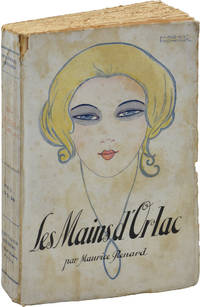
1920148871Paris: Editions Nilsson 1920. First French Edition a trade softcover original preceding the first English language edition by nine years. Text in French. Cover illustration by Maggy Monier. Rare.<br/><br/>A seminal horror novel written by one of the most important French genre fiction writers of the early twentieth century. The basis for several films including the classic German silent film starring Conrad Veidt "The Hands of Orlac 1924 and its American rival the sound version starring Peter Lorre "Mad Love" directed by emigre Karl Freund for MGM in 1935 and today considered one of the greatest horror films of the 1930s. <br/><br/>Very Good in illustrated wrappers. All edges uncut. Slight lean some vertical wrinkling to the spine small chips at a couple of corners and wrappers foxed particularly rear wrapper.<br/><br/>Barron 1999 4-125. Bleiler 1948 US. Clute & Nicholls US. Hubin 1994 US. Locke US. Reginald 12140. Senn US. Editions Nilsson unknown books
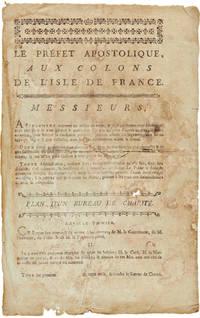
1788284311788. Folio. Broadsheet 12 3/4 x 8 inches. Moderate wear and soiling small hole in center of sheet affecting a few letters of text. Early and unrecorded imprint from the colonial press at the French colony of Mauritius also known as the Ile de France. The text contains the articles for establishing a Bureau de Charité for the island. The Dutch were the first Europeans to become interested in the island taking possession in 1598. After exploiting the island's dense forests for a century and introducing the cultivation of sugar cane and cotton the Dutch abandoned the colony in 1710. The French soon claimed it as "Ile de France" and the island remained under the control of the French East India Company until 1767. During the long war between France and England at the beginning of the 19th century Mauritius proved to be an important strategic naval base and as a result the British took charge of the island in 1810 and the Treaty of Paris confirmed official British possession in 1814. It remained an important sugar producing colony and in the 20th century agricultural production was expanded to include tea rice and other produce. Printing began on Mauritius in 1768. During the French period until 1810 only about 400 imprints were produced mostly in the form of official documents and newspapers though there are also almanacs and a few other items. All are quite rare. No copies located in OCLC and not recorded by Toussaint in his bibliography of Mauritius imprints. unknown books
1788WRCAM48600Isle de France: Imprimerie Royale 1788. Broadsheet 12 3/4 x 8 inches. Moderate wear and soiling; small hole in center of sheet affecting a few letters of text. Good. Early and unrecorded imprint from the colonial press at the French colony of Mauritius also known as the Ile de France. The text contains the articles for establishing a Bureau de Charité for the island. <br> <br> The Dutch were the first Europeans to become interested in the island taking possession in 1598. After exploiting the island's dense forests for a century and introducing the cultivation of sugar cane and cotton in 1710 the Dutch abandoned the colony. The French soon claimed it as "Ile de France" and the island remained under the control of the French East India Company until 1767. During the long war between France and England at the beginning of the 19th century Mauritius proved to be an important strategic naval base. The British took charge of the island in 1810 and the Treaty of Paris confirmed official British possession in 1814. It remained an important sugar producing colony and in the 20th century agricultural production was expanded to include tea rice and other produce. <br> <br> Printing began on Mauritius in 1768. During the French period until 1810 only about 400 imprints were produced mostly in the form of official documents and newspapers though there are also almanacs and a few other items. All are quite rare. No copies are located in OCLC and not recorded by Toussaint in his bibliography of Mauritius imprints. Imprimerie Royale unknown books
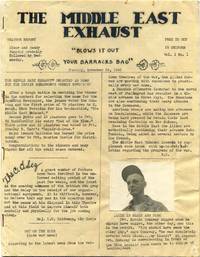
1942019148Deversoir Egypt: self-published 1942. Ephemera. Very good condition. Paperback. First Edition. Quarto 4to. The original manuscripts from which the first seven issues of the Squadron newsletter/newspaper frequency: weekly was printed. It is unknown if the publication continued beyond this initial run or how many copies of each issue was printed or distributed. Each issue consists of an average of 10 single-sided pages and contain original photographs original drawings including cartoons and news from home in a mostly humorous fashion and sometimes included information and opinions regarding the local area. There were several contributors. At least two differing typewriter fonts were used. There are articles/features on commanding officers as well as other non-commissioned officers. Stated on each issue: Free to Men in Uniform. Numerous pages are creased stained or worn and there are several paper clip marks. The 26th Group was activated on 1/20/1942 at Brookley Field Mobile AL. On 10/30/1942 or 11/01/1942 it arrived at Deversoir Egypt and in 01/1944 it set up base on the outskirts of Karachi India. Later that year affiliated groups were transferred elsewhere and the 26th Depot Repair Squadron was absorbed within the 80th Group relocated in 07/1944 to Agra India and attached to the 3rd Air Depot Group. self-published Paperback books
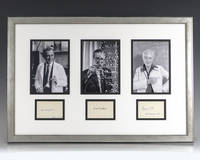
19621173981962. Signatures of each of the scientists who shared the 1962 Nobel Prize in Physiology or Medicine each signed during the Nobel Week of 1962 "James Dewey Watson December 5 1962" "Francis Crick 10th December 1962" and "M. H. F. Wilkins" each signed on individual off-white cards with a portrait of each above. In fine condition. Double matted and framed. The entire piece measures 16 inches by 23.5 inches. Contemporary signatures of these scientists are rare. The Nobel Prize in Physiology or Medicine 1962 was awarded jointly to Francis Harry Compton Crick James Dewey Watson and Maurice Hugh Frederick Wilkins "for their discoveries concerning the molecular structure of nucleic acids and its significance for information transfer in living material." unknown books
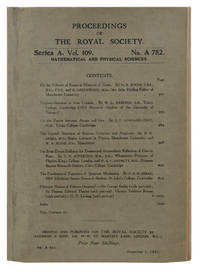
1925140940039London: Published for The Royal Society by Harrison & Sons 1925. First Edition. Very Good. First edition of Paul Dirac's first major paper as published in Proceedings of the Royal Society of London Series A Vol. 109 Dirac's paper pp. 642-653; total pages 561-653 plus obituary notices of Fellows I-XXXIV. In publisher's original wrappers with new spine pages toned and with creasing to bottoms stamp to blank verso of plates. Very Good. Published for The Royal Society by Harrison & Sons unknown books
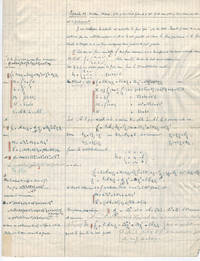
192500001491925. Original Wraps. Very Good. Three off prints on Theory of Numbers: Théorie Des Nombres & Sur les nombres de Fermat. Comptes rendus des séances de l'Académie des Sciences t. 180 p. 799 séance du 16 mars 1925 4to off print numbered p.1-2.; Sur Le Nombre N= 1/9 1023 & 1 8vo. 3 1p. ; Sur Les Nombres De Fermat. Fn= 22n 1. 8vo. 5 3p. Plus approximately 65 pages of manuscript notes in French with calculations. <br/><br/>The majority of the manuscript pages appear to deal with quadratic forms in Leonard Dickson's - Studies in the theory of numbers. 1930 which contains numerous original investigations in the theory of quadratic forms in three or four variables. In Dickson's earlier work on the History of the Theory of Numbers 1919-23 he provided little interpretation and made no attempt to contextualize the results being described. It is probably with this background that Kraitchik devoted much of the manuscript sheets to Dickson's work. Other manuscript notes dealing with other equations from Euler "Continuous la table" dated March to December 1939. The last group of manuscript pages in 8vo deal with equations from a publication of Landarsic Backman dated November 1931 and May 1938. There are a few loose sheets with calculations but no identification. These may be sheets used to make rough calculations. Together this manuscript collection and off prints offer a very good example of Kraitchik's thinking in regards the theory of numbers. Although Kraitchik is often thought of in relation to Recreational Mathematics he really spent considerable time with the Theory of Numbers. The present collection of 3 off prints and manuscript sheets most of which are on square lined sheets is thus quite rare and significant for this noted 20th century mathematician. paperback books