242 résultats
Fine English Original bdg. in original dust wrapper. In original and special slip-case. Large 4to. (36 x 26 cm). Color and b/w ills. 224 p. An introduction to the Ottoman architectural heritage in Istanbul. Large format interior and exterior views of Ottoman mosques, Topkapi Palace, and Bosporus villas are accompanied by informative text. Many original architectural line drawings (plans, sections and elevations) by the noted architect Sedad Hakki Eldem are also included.
182812890Florenz, Giuseppe Galletti, 1828. Kupferstich. Blattgröße: 41 x 46,5 cm, Druckspiegel: 28 x 35 cm. [2 Warenabbildungen]
11364Guerres contre les russes, les arabes, les allemands, les bulgares, luttes civiles contre les deux Bardas, Jean Tzimiscès, les jeunes années de BasileII le tueur de bulgares. Fort in 4 demi chagrin rouge à nerfs et à coins, titre doré, filets à froid sur les plats ; Carte de l’Empire Byzantin, en couleurs, sous serpente, faux-titre, titre,, 799 pages, non rogné, tête dorée, illustrations dans et hors-texte (un dépliant) Hachette & Cie 1896. Rousseurs plus ou moins fortes, éparses, plus concentrées en début et fin de volume,
New English Original bdg. HC. 4to. (33 x 24 cm). In Turkish. 2 volumes set (255 p.; 165 p.), color ills. Bogazin incileri: Yalilar. 2 volumes set. Vol. 1: Asya yakasi Bogaz yalilari. Vol. 2: Avrupa yakasi Bogaz yalilari.
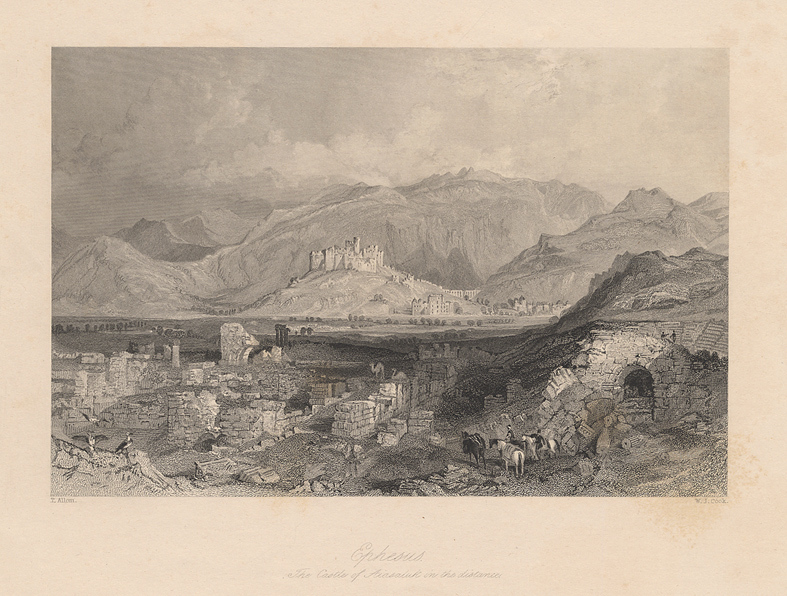
1840A141-2885c. 1840. original steel engraving, by E. Benjamin after William Henry Bartlett (1809-1854), image format c. 11,5 x 18 cm
New New English Original bdg. Dust wrapper. In publisher's special slip-case. Oblong 4to. (30 x 32 cm). In Turkish. 347 p., color ills. A luxury and photographic study of Istanbul's yalis (seasides), palaces, kiosks, and kasirs. Istanbul saraylari, kasirlari, köskleri ve yalilari. A very heavy volume in its box.
Very Good Turkish Paperback. Folio. (34 x 24 cm). In Turkish. 2 volumes set: (70 p.; 64 p.). Eldem was a Turkish architect and one of the pioneers of nationalized modern architecture in Turkey. He was born in Istanbul (1908). He graduated from the Academy of Fine Arts (Department of Architecture). Between 1931 and 1932 he traveled to France, England, and Germany with a scholarship from the academy. In 1932 he opened his own office, also started teaching at the Academy of Fine Arts, and continued until retirement in 1978. In 1934 he worked for the National Architecture Seminar in Turkey which was a complete disaster for him because of the discussions between modern architecture and traditional architecture. In 1938 he designed the Turkish Pavilion in New York Exhibition. Sedad Hakki Eldem represented the Turkish Republic at the International Union of Architects in Lozan (1948) after Second World War. Also in the same year, Sedad Hakki worked with his colleague Emin Onat on the project of Istanbul Palace of Justice. He worked on proportions and architectural organizations of Ottoman domestic houses, 18th and 19th-century palaces, and mansions. He was known as a role model and pioneer to reinterpret the Classical Ottoman Patterns in modern architecture. He was a part of the Former Artifacts Maintain Council (Eski Eserleri Muhafaza Encümeni) between 1941 and 1945 and also a part of the Supreme Council of Antiquities and Monument Real Estate (Gayrimenkul Eski Eserler ve Anitlar Yüksek Kurulu) between 1962 and 1978. His thought was about nationalizing Modern Architecture. He basically thought that International Style in architecture should not be applied everywhere. Some things should be changed in the design by considering the national and domestic texture. He has won the international Aga Khan Award for Architecture in 1986 with the project of Zeyrek Social Security Facilities. Sedad Hakki Eldem's architecture has basically 4 main periods. The first of them, between 1928 and 1934, is known for the instability of his work. After that, the second period is popular with modern trials on Ottoman architectural organization. The time frame of this period spans from 1934 until 1952. The third period of his architecture has lost its Ottoman influence, it looks more modernized between 1952 and 1962. The last part of Eldem's Architecture known for his double approach to projects. This final period started in 1962 and lasted until his death in 1988. (Wikipedia).
Very Good Very Good English Original bdg. Dust wrapper. In special slip-case. 4to. (38 x 27 cm). In English. 224 p. Istanbul. Gateway to splendour. An introduction to the Ottoman architectural heritage in Istanbul. Large format interior and exterior views of Ottoman mosques, Topkapi Palace, and Bosporus villas are accompanied by informative text. Many original architectural line drawings (plans, sections and elevations) by the noted architect Sedad Hakki Eldem are also included. 26 by 36 cms., 224 pages (135 color plates, about 40 drawings). A very heavy volume.
1914A111-199Wien, Kaiserlich-K?nigliches Milit?r-Geographisches Institut, 1914. Hochformat, ca. 42 x 55 cm, Ausgabe: mehrf?rbig; Zustand: gut +
Very Good French A fine original chromo-lithograph print from "Souvenirs de Constantinople" by Brindesi, printed in 1845. Framed, but will be sent no frame. 52x49 cm / 39x 44 cm print area. Stains on right bottom margins of the paper. The Ottoman navy, stationed in front of the Tophane Artillery barracks, is preparing to sail under the leadership of Kapudan Pasha's ship "Amiraute". Jean Brindesi was born in 1826 and worked primarily as a watercolour artist. During the Abdulmecid period (1831-1861), he worked on scenes involving soldiers in Istanbul. Two albums of lithographs after his drawings were produced by Lemercier in Paris: Elbicei Atika - Musee des Anciens Costumes Turcs de Constantinople, 1855, and Souvenirs de Constantinople, 1860; these two works are collections of picturesque views of the city of Constantinople. The originals are kept at the Istanbul Topkapi Palace Museum and at the University of Istanbul. (Source: Levantine Heritage).
5525ouvrage traduit de l’italien avec l’autorisation de l’auteur par Mme COLOMB.Petit in 4 pleine toile rouge d’éditeur titre et caissons dorés,titre doré sur le premier plat encadré d’un filet et d’une frise décorative.Faux-titre,portrait de l’auteur d’après RONJAT,titre en noir et rouge 452 pages,tranches dorées, 183 illustrations dans et hors-texte d’après les dessins pris sur nature par C. BISEO.Hachette & Cie 1883,rousseurs éparses plus ou moins fortes à certaines pages, ainsi qu'en début et fin de volume habituelles
Very Good German Original color map on cloth of Constantinople, the Bosphorus, the Golden Horn, Princess' Islands, Pera, Galata, Scutari and environment. Map on cloth. 50x60 cm. Toponyms are in German entirely. Folded. Scale: 1:100000. A detailed toponyms list titled "Verzeichnis der mit Ziffern bezeichneten öffentlichen Gebaude" under the sections A: Pera und Galata, B: Stambul, C: Skutari; and "Erlauterung der Abkürzungen". Some toponyms are transcripted Turkish into western characters like Karadenis - Bahr-i Siach, Burgas Adassi, Kisil Adalar, Jeni Djami, etc. A rare Istanbul map printed in 19th century.
Very Good Turkish, Ottoman (1500-1928) In contemporary leather bounds. 4to. (29 x 21 cm). In Ottoman script. 2 volumes set: ([22], 528 p.; 257 p., 183 illustrations, 1 plate of map, 2 folding maps, 1 folding plate.). Özege: 8283. An extremely important work on the history and ethnography of Constantinople and heritage of Byzantine Empire. Istanbul ve Bogaziçi. Bizans ve Osmanli medeniyetlerinin asar-i bakiyesi. 2 volumes set.
Fine Turkish In modern clothes. 4to. (33 x 24 cm). In English and Turkish. 2 volumes set: (xvii, [3], 357 p.; [8], 447 p.), b/w and color plates. Sedad Hakki Eldem was a Turkish Architect. One of the pioneers of nationalized modern architecture in Turkey. He was born in Constantinople (1908). He graduated from the Academy of Fine Arts (department of Architecture). Between 1931 and 1932 he travelled to France, England and Germany with a scholarship of the academy. In 1932 he opened his own office, also started teaching at the Academy of Fine Arts and continued until retirement in 1978. In 1934 he worked for the National Architecture Seminar in Turkey which was a complete disaster for him because of the discussions between modern architecture and traditional architecture. In 1938 he designed the Turkish Pavilion in New York Exhibition. Sedad Hakki Eldem represented Turkish Republic at International Union of Architects in Lausanne (1948) after Second World War. Also in the same year Sedad Hakki worked with his colleague Emin Onat on the project of Istanbul Palace of Justice. He worked on proportions and architectural organizations of Ottoman domestic houses, 18th and 19th century palaces and mansions. He was known as a role model and pioneer to reinterpret the Classical Ottoman Patterns in modern architecture. He was a part of Former Artifacts Maintain Council (Eski Eserleri Muhafaza Encümeni) between 1941 and 1945 and also a part of Supreme Council of Antiquities and Monument Real Estate (Gayrimenkul Eski Eserler ve Anitlar Yüksek Kurulu) between 1962 and 1978. His thought was about nationalizing the Modern Architecture. He basically thought that International Style in architecture should not applied everywhere. Some things should be changed in the design by considering the national and domestic texture. He has won the international Aga Khan Award for Architecture in 1986 with the project of Zeyrek Social Security Facilities. Sedad Hakki Eldem's architecture has basically 4 main periods. The first of them, between 1928 and 1934, is known by the instability of his work. After that, the second period is popular with modern trials on Ottoman architectural organization. The time frame of this period spans from 1934 until 1952. The third period of his architecture has lost its Ottoman influence, it looks more modernized between 1952 and 1962. The last part of Eldem's Architecture known for his double approach on projects.This final period started in 1962, and lasted until his death in 1988. (Source: Wikipedia). Extremely rare.
Fine Turkish Original cloth bdg. In its publisher's special box. Folio. (34 x 24 cm). In Turkish. 2 volumes set: (1213 p.), ills. Geçmisten günümüze Bogaziçi. 2 volumes set. A comprehensive study on the Bosphorus.
New English Original bdg. In publisher's special box. Folio. (33 x 29 cm). In English. 2 volumes set: (240 p., 5 unnumbered folded plates on pages; Second volume is a hard-case including two reprint panoramas and one reprint map: First panorama is a huge hand-coloured drawing shows Ottoman Palace across Sarayburnu; size 28x336 cm; Second panorama is a huge hand-coloured drawing shows Ottoman Palace across Sarayburnu again which is indicating Palace from a different angle; size 28x196 cm; and one map: 'Carta ufwer Orienten Med de Darom kring Grantzande Lander... (Turkey and its around map printed originally in early 18th century), descriptive text surrounding the map, size 65x85 cm. Cornelius Loos in the Ottoman world: Drawings for the King of Sweden, 1710-1711. [with] Panoramas & map [book]. Prep. by Lâle Uluç, David Jones, Klas Kronberg, Ersu Pekin. 2 volumes. [BOXED]. Cornelius Loos was one of the young military officers who followed Karl XII to the Ottoman Empire in 1709. From the royal headquarters in what is at present the republic of Moldova, Loos was sent to Istanbul on the King's orders in 1710. From there his journey was pursued by boat over the Mediterranean to Egypt and he returned by land through Jerusalem, Damascus, Aleppo, Konya and Izmir. Loos' mission was to make drawings of the "rarities and monuments" that he would encounter on his journey. Out of the drawings that have survived until today, one is from Palmyra, two from Rhodes and Bodrum and around forty aquarelle tush drawings from Istanbul. It is possible that part of the original drawings were destroyed in the "Skirmish at Bender" in 1713, while other works, due to various reasons, disappeared on their way to Sweden. The conserved drawings are kept at the Swedish National Museum and were exhibited there in 1985. (See catalogue titled "Cornelius Loos. Teckningar från en expedition till Främre Orienten 1719-1711", Stockholm, Nationalmuseum, 1985). The drawings represent a unique record of the urban landscape and the monuments in Istanbul in the early 18th century. The collection includes three great panoramas of the city seen from the Topkapi palace to the upper part of the Golden Horn. To the Loos paintings can be added the great Mecca painting brought to Sweden by Mikael Eneman and kept in the Uppsala University Library, and a small group of oil paintings brought back by Loos' travel companion Conrad Sparre, which are also kept in the art collection of Uppsala University. In addition there are travel accounts and correspondence from these journeys. (From the 'SRII's official site, Karin Adahl's project). "In January 1710 the Swedish king Charles XII, in exile in the Ottoman Empire, sent three of his officers on a journey from the royal camp near Bender in Moldova to travel to Constantinople and from there along the Eastern Mediterranean to Egypt. Their mission was 'to view the there existing rarities and monuments, to draw and to measure'. Cornelius Loos, one of the young officers, returned to his king in 1711 with more than 250 drawings. Only forty-nine, kept under the king's bed, survived a skirmish in the camp in 1713, the so called 'kalabalik' at Bender. King Charles had a vision to publish an encyclopaedic work about the Near East, a dream that was lost in the fire in the camp. The drawings were brought to Sweden when the king returned from the Ottoman Empire in 1714. He died in battle in Norway in 1718. Loos' drawings are unique documents of Constanttinople in the early 18th century, with large scale, detailed panoramas, important prospects of the interior of the Hagia Sophia and views from the Ottoman city. A big map is accompanied by minor drawings from the Black Sea, the Eastern Mediterranean and Egypt, as well as a spectacular set of water-colours of head dresses from the Ottoman world. The Loos collection of drawings is today kept in the National Museum in Stockholm.". Texts by Göran Baarnhielm, Ulla Ehrensvard, Nurhan Atasoy, Günsel Renda, Bo Lundstörm
New English Original bdg. HC. Oblong large folio. (31 x 45 cm). In English and Turkish. [198] p., color maps, 4 maps in end-pocket. Istanbul PTT Museum Collections map catalog.= Istanbul PTT Müzesi Koleksiyonlari harita katalogu. Prep. by Kenan Bozgeyik, Selahattin Ekinci, Makbule Akyol. 3000 copies were printed. Contents: Catalogue of maps, sketchs and graphics.; Maps: Ottoman era: Turkish (Old script), Foreign languuage.; Turkish Republic era: Postal maps, road maps, maps of medical department, maps of civilian administration.; Plans and schemas.; Statistical maps.; Graphics.; Military maps: Anatolia, Rumelia, Outside of Turkey.; Additional.; Today PTT [Turkish Post Office].
PHO-2342Paris, Fisher, s.d. 2 séries (sur 3) en 2 vol. in-4 (28x22cm),2ff.-xlii-58pp.,2ff.-60pp.,2ff.-54pp., percale éditeur décorée de fers romantique sur le plats, dos lisse orné avec titre et éditeur en pied, tranches dorées. Quelques frottements, coins usés, petites rousseurs. Tome 2 & 3, comprenant 32 gravures au tome 2 et 1 titre gravé, 32 gravures et 1 carte dépliante in-fine
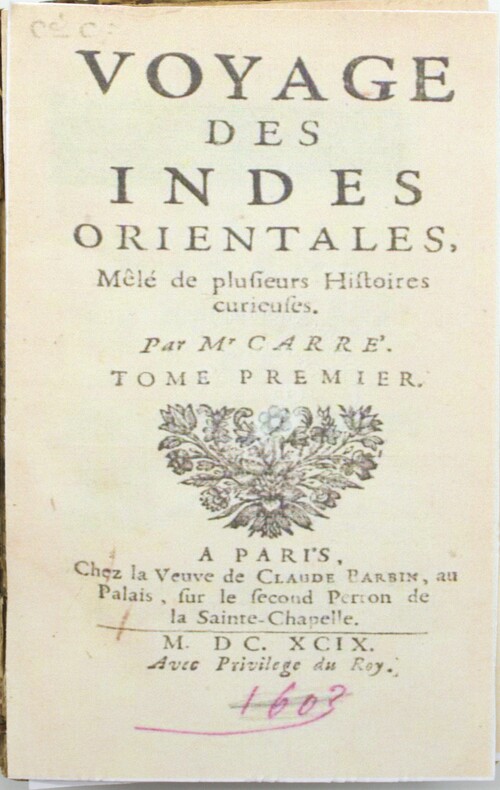
1699PHO-1741Paris, veuve Claude Barbin, 2 mai 1699, 2 tomes en un volume in-12, demi veau postérieur, dos détaché, premiers feuillets détachés, dos cassé, manque le titre du tome 1 et les deux premières pages (début de l’épitre, ici en copie)
1800PHO-2259Paris, Dentu. An VIII (1800) 2 volumes en 1 tome in-8 (20x12,5cm), XII-168pp.-169-416 pp., plein veau marbré époque, dos lisse orné avec pièce de titre grenat, tranches marbrées, début de fente, frottements, les cartes sont absentes
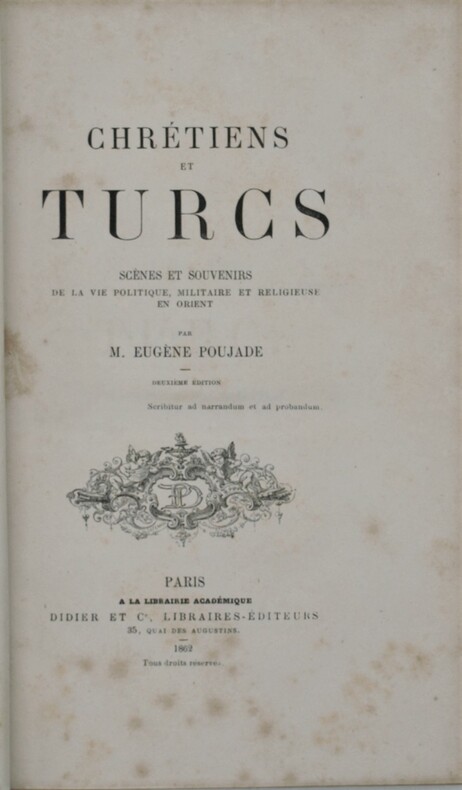
1862PHO-915Paris, Didier et Cie., 1862. relié demi-percale , dos à nerfs avec auteur et titre ,IV, 556 pp., quelques rousseurs et un cahier bruni sinon bon exemplaire dans une reliure solide.
Very Good English Original b/w portolan chart. Folded. A little foxing and some pencil markings and notes in Ottoman script in its period. Oblong double elephant folio. (70 x 102 cm). In English. Bosphorus to Kerempeh from the Russian survey of 1834 with additions and corrections by Commander W. J. L. Wharton., R. N. 1872-80. It's written 'London published according to Act of Parliament at the Hydrographic Office of the Admiralty Jare. 16th 1854. Also shows Killa Bay (Shile Bay) from a survey by Lieut. Comm. W. R. Pristen and the midshipmen of H. M. S. Royal Sovereign, 1920. Topography partly from a Turkish map. Up side of map, engraved a view from sea of entrance of the Bosphorus, Rumili (sic. Rumeli) Lighthouse and environment with several hills. And also shows Amastra (Ancient Amastris) from Russian surveys, 1834-41; Kosku Bay from a surbey by Capt. Spratt R. N. 1854; and Sungul Bay (Zonguldak) from the Heraclee Companys plans to 1915. A rare navigation chart.
11568Paris ; Londres, Fisher Fils et Cie, sans date ; in-8, demi-chagrin maroquiné cerise à coins, dos à nerfs soulignés de filets à froid et de pointillés dorés, caissons décorés, titre et tomaison dorés, triple filets dorés sur les plats, tête dorée (Bruyère) ; (6), XIII, 60, (2) pp., vignette de titre, frontispice et 31 planches gravés sur acier.
1784PHO-1112Amsterdam, s.n., 1784, 3 tomes, in-8, lvj, 274 ; 301 ; 252-208pp. ,relié plein cuir moucheté , dos lisse orné avec pièces de titre et tomaison , frise dorée sur les plats , tranches marbrées, coins usés , frottements ,petites rousseurs , Joli cachet de l'École d'artillerie de la garde impériale »