Xenophon / Hutchinson, ThomasBiblio.com
2 316 résultats
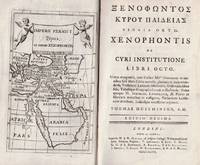
179732384AB1797. Edition Decima Bilingual in Greek and Latin. London Impensis W.&W.Ginger ad insignia Collegii Westmonasteriensis juxta Scholam Regiam 1797. Octavo. Frontispiece-Map 2 548 pages. Hardcover / Original full leather with gilt lettering on spine and boards. In protective Mylar. Very good condition with only minor signs of wear. From the library of Daniel Conner Connerville / Manch House with his Exlibris / Bookplate to pastedown. Xenophon of Athens c. 430 355/354 BC was a Greek military leader philosopher and historian. At the age of 30 he was elected as one of the leaders of the retreating Greek mercenaries the Ten Thousand who had been part of Cyrus the Younger's attempt to seize control of the Achaemenid Empire. As the military historian Theodore Ayrault Dodge wrote "the centuries since have devised nothing to surpass the genius of this warrior". For at least two millennia it has been debated whether Xenophon was first and foremost a general historian or philosopher. For the majority of time in the past two millennia Xenophon was recognised as a philosopher. Quintilian in The Orator's Education discusses the most prominent historians orators and philosophers as examples of eloquence and recognises Xenophon's historical work but ultimately places Xenophon next to Plato as a philosopher. Today Xenophon is recognised as one of the greatest writers of antiquity. Xenophon's works span multiple genres and are written in plain Attic Greek which is why they have often been used in translation exercises for contemporary students of the Ancient Greek language. In the Lives and Opinions of Eminent Philosophers Diogenes Laërtius observed that Xenophon was known as the "Attic Muse" because of the sweetness of his diction. Despite being born an Athenian citizen Xenophon came to be associated with Sparta the traditional opponent of Athens. Much of what is known today about the Spartan society comes from Xenophon's royal biography of the Spartan king Agesilaus and the Constitution of the Lacedaemonians. The sub-satrap Mania is primarily known through Xenophon's writings. Xenophon's Anabasis recounts his adventures with the Ten Thousand while in the service of Cyrus the Younger Cyrus's failed campaign to claim the Persian throne from Artaxerxes II of Persia and the return of Greek mercenaries after Cyrus's death in the Battle of Cunaxa. Xenophon wrote Cyropaedia outlining both military and political methods used by Cyrus the Great to conquer the Neo-Babylonian Empire in 539 BC. Anabasis and Cyropaedia inspired Alexander the Great and other Greeks to conquer Babylon and the Achaemenid Empire in 331 BC. The Hellenica continues directly from the final sentence of Thucydides' History of the Peloponnesian War covering the last seven years of the Peloponnesian War 431404 BC and the subsequent forty-two years 404362 BC ending with the Second Battle of Mantinea. Xenophon's writings on military strategies remain influential and are believed to be among the first to utilise and describe flanking manoeuvres and feints in military tactics. Wikipedia hardcover
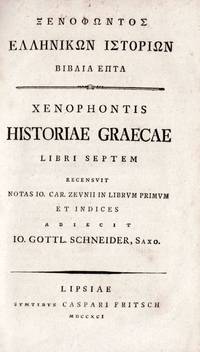
179132385AB1791. Bilingual in Greek and Latin. Leipzig Caspar Fritsch 1791. Octavo. XX 474 pages plus 28 unnumbered pages of an Index. Hardcover / Binding expertly restored by using the original full leather with gilt lettering on spine and boards. In protective Mylar. Very good condition with only minor signs of wear. Some pages unopened. From the library of Daniel Conner Connerville / Manch House with his Exlibris / Bookplate to pastedown. Xenophon of Athens c. 430 355/354 BC was a Greek military leader philosopher and historian. At the age of 30 he was elected as one of the leaders of the retreating Greek mercenaries the Ten Thousand who had been part of Cyrus the Younger's attempt to seize control of the Achaemenid Empire. As the military historian Theodore Ayrault Dodge wrote "the centuries since have devised nothing to surpass the genius of this warrior". For at least two millennia it has been debated whether Xenophon was first and foremost a general historian or philosopher. For the majority of time in the past two millennia Xenophon was recognised as a philosopher. Quintilian in The Orator's Education discusses the most prominent historians orators and philosophers as examples of eloquence and recognises Xenophon's historical work but ultimately places Xenophon next to Plato as a philosopher. Today Xenophon is recognised as one of the greatest writers of antiquity. Xenophon's works span multiple genres and are written in plain Attic Greek which is why they have often been used in translation exercises for contemporary students of the Ancient Greek language. In the Lives and Opinions of Eminent Philosophers Diogenes Laërtius observed that Xenophon was known as the "Attic Muse" because of the sweetness of his diction. Despite being born an Athenian citizen Xenophon came to be associated with Sparta the traditional opponent of Athens. Much of what is known today about the Spartan society comes from Xenophon's royal biography of the Spartan king Agesilaus and the Constitution of the Lacedaemonians. The sub-satrap Mania is primarily known through Xenophon's writings. Xenophon's Anabasis recounts his adventures with the Ten Thousand while in the service of Cyrus the Younger Cyrus's failed campaign to claim the Persian throne from Artaxerxes II of Persia and the return of Greek mercenaries after Cyrus's death in the Battle of Cunaxa. Xenophon wrote Cyropaedia outlining both military and political methods used by Cyrus the Great to conquer the Neo-Babylonian Empire in 539 BC. Anabasis and Cyropaedia inspired Alexander the Great and other Greeks to conquer Babylon and the Achaemenid Empire in 331 BC. The Hellenica continues directly from the final sentence of Thucydides' History of the Peloponnesian War covering the last seven years of the Peloponnesian War 431404 BC and the subsequent forty-two years 404362 BC ending with the Second Battle of Mantinea. Xenophon's writings on military strategies remain influential and are believed to be among the first to utilise and describe flanking manoeuvres and feints in military tactics. Wikipedia hardcover
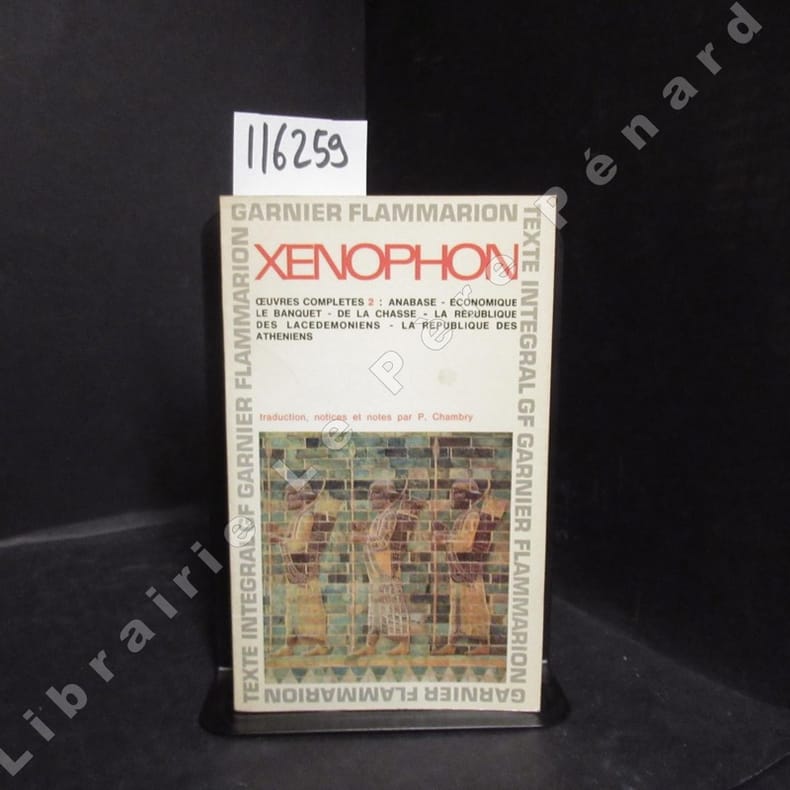
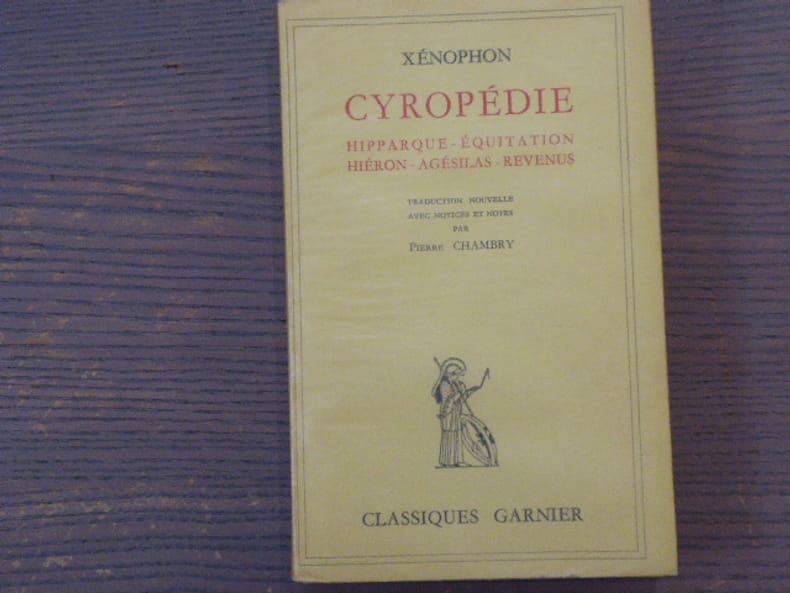
19671162591967 Editions Garnier Flammarion (GF) - 1967 - In-12, broché - 504 pages
15621PARIS, Les Belles Lettres - 1949 - 115 pages.- Très propre
15629Paris , Société d'Edition Les Belles Lettres, Publiées sous le patronage de l'Association Guillaume Budé - 1966 - In-8 - Broché - Traduction juxtalinéaire - Notice 27 & 167 - Propre
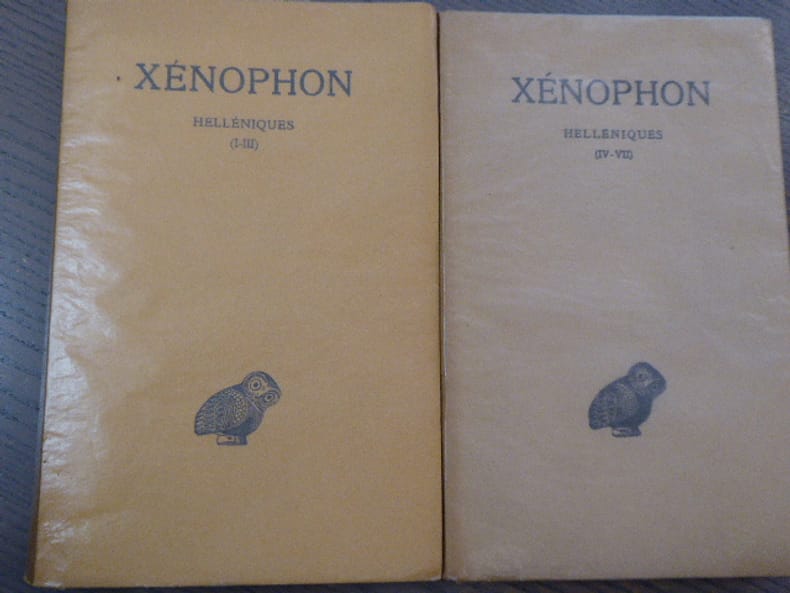
505944Les Belles Lettres Paris 1960 2 volumes in-8 ( 210 X 130 mm ), Tome I ( I-III ) de 167 pagesTome II ( IV-VII ) de 269 pages, brochés sous couvertures imprimées. Texte établi et traduit par J.HATZELD. Minimes décharges de papier collant sur les gardes, bons exemplaires.
174897991748 Sans Lieu (Paris), 1748. Et : Peine (Paris), 1748. Deux ouvrages reliés en un volume petit in 8° relié pleine basane de l'époque, dos à nerfs orné ; coiffes usées, 2 petites fentes aux mors, coins émoussés ; petite découpe angulaire à 4 feuillets, quelques rousseurs.
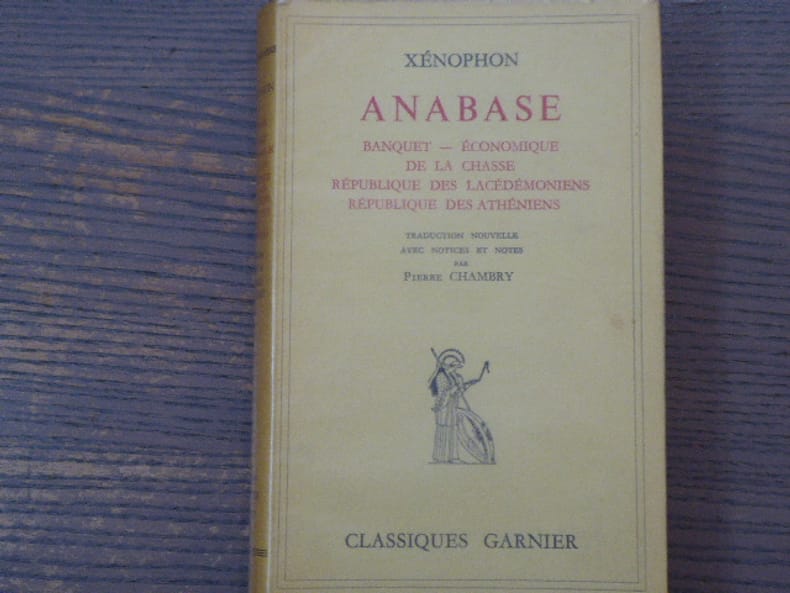
142561Garnier Paris 1954 In 8 ( 185 X 115 mm ) de 543 pages, broché sous couverture imprimée. Minimes décharges de papier collant sur les gardes, bon exemplaire.
709722Garnier Paris 1954 In 8 ( 185 X 120 mm ) de 525 pages, broché sous couverture imprimée. Minimes décharges de papier collant sur les gardes, bon exemplaire.
1941739531941 Paris, Sorlot, 1941, in 12 broché, 63 pages ; couverture illustrée.
1941827731941 Paris, Les Belles Lettres, 1972, in 8° broché, LIX-194 pages.
22643traduit et annoté par Paul Masqueray - Paris : Le Club Français du Livre (Coll. "Les portiques"), 1968 - in-8 pleine percaline, 380 pages + une carte dépliante - bon état -
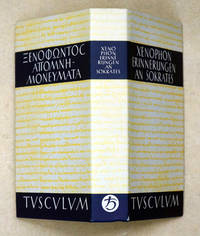
91425München Heimeran 1980. Kl.8° 397 S. OLwd. m. OU. OU m. kl. Randriss am Fuss sonst tadellos. 3. verbesserte Aufl. = Tusculum-Bücherei. Griechisch-deutscher Paralleldruck. 010 München, Heimeran, 1980 unknown
171166266à Amsterdam: Chez Henri Schelte 1711. Fine. Copy bearing the arms of Queen Elisabeth Farnese of Spain Princess of Parma. Chez Henri Schelte à Amsterdam 1711 9.50 x 15 cm In-12 relié First bilingual edition with French facing Greek translated by Pierre Coste with his footnotes. Title page printed in red and black. Extended preface by Pierre Coste. Copy bearing the arms of Queen Elisabeth Farnese of Spain Princess of Parma queen from 1714 to 1746. A woman of power whose policies profoundly influenced Spain. Double coat of arms surmounted by a closed royal crown encircled by the collars of the Orders of the Holy Spirit and the Golden Fleece. Dexter: Spain; sinister: Farnese ""or with six fleurs-de-lys azure 321"". An intriguing feature of the queens arms: the collars of the Orders of the Holy Spirit and of the Golden Fleece although these orders were never bestowed upon women. Contemporary full speckled blond calf binding. Spine with raised bands richly gilt. Crimson morocco title-piece. Arms gilt-stamped at the centre of the covers. Triple fillet border on the covers. All edges gilt. Slight wear to headcaps. Upper joint largely split. Lower joint split at head. Hieron is a dialogue by Xenophon between a philosopher Simonides and a king Hieron; through Simonides questions emerges a vision of kingship. As the edition dates from 1711 and Elisabeth Farnese only acceded to royal dignity in 1714 the association of this text with the rare arms of the young and newly crowned queen takes on a distinctly symbolic dimension: a reflection on power and on the way of preparing for it through the reading of the Ancients. Chez Henri Schelte hardcover
185496048Berlin - London - New-York : K. W. KrgerÕs Verlagsbuchhandlung - Willimas et Norgate - Garrigue 1854. 215x130mm. Notizen in Deutsch Text in Altgriechisch Chagrin-Halbledereinband. Leder eingerieben und Buchdeckel stellenweise. 271 K. W. KrgerÕs Verlagsbuchhandlung - Willimas et Norgate - Garrigue unknown
53320Berlin Fr. Lauf 1830. 8° XIV 369 S. OHLdr. golgepr. Rückenschildchen. Berieben durchgeh. stockfleckig gutes Exemplar. Namen des ersten Besitzers auf Vorsatz. Mit erklärenden Anmerkungen. Mit Register. Text altgr. 010 Berlin, Fr. Lauf, 1830 unknown
175895896Amsterdam : Aux Dpens de la Compagnie 1758. 180x110mm. 11 ff. 299 pages 2 ff. 216 pages avec la carte n/b dpliante en fin de lÕouvrage broch. Brochage en papier marbr en attente de reliure. Cachet de possesseur sur le haut de page de faux-titre. Intrieure propre. 341 Aux Dpens de la Compagnie unknown
62473Pantheon Litteraire - A. Desrez Paris 1840 In-4 28 cm xvi-818pp. texte en 2 colonnes pages non coupees quelques rousseurs quelques manques au dos Nb-0378 unknown
52436München Müller 1912. 8° 250 S. OHLdr. goldgepr. Farbschnitt. Deckel min. berieben gutes Exemplar. = Klassiker des Altertums. Erste Reihe. Sechzehnter Band. Nach der Übersetzung von C. M. Wieland neu herausgegeben. 010 München, Müller, 1912 unknown
SKU1033435Easton Press. hardcover. Very Good. 0x0x0. 1995 Easton Press. Library of Military History. Collectors Edition. Hardcover 8vo. bound in full blue leather boards with gilt lettering along spine gilt design on front and rear covers. Full gilt page edges silk moire inside covers and endpapers bound silk ribbon bookmark. Book appears unread; no marks. Fine condition. Easton Press hardcover
1594341869Easton Press. Hardcover. Very Good. May have limited writing in cover pages. Pages are unmarked. ~ ThriftBooks: Read More Spend Less.Minor shelf and handling wear overall a clean solid copy with minimal signs of use. Boards may have fading and nicks and other signs of wear and imperfection commensurate with age. Binding is tight and structurally sound. Pages unmarked. Sealed in plastic for shipping. Secure packaging for safe delivery.Dust jacket quality is not guaranteed. Easton Press hardcover
182859863Gothae et Erfordiae : Guil. Hennings 1828. 210x120mm. LXVIII- reliure demi-toile. Plats papier marbr. Dos et plats muets. Trace dÕune tiquette de cotation au dos. Quelques rousseurs. Bon tat. 565 Guil. Hennings unknown
1998701392Frankfurt am Main :: Eichborn. 1998. LXIII, 271 S. 22cm;. Zustand: Sehr Gut, eher ungelesen; Schutzumschlag fehlt, oder es gibt keinen; Schuber fehlt; Ppbd.
19642143206Lipsiae: Teubneri (= Leipzig: Teubner) 1964. XXVIII, 66, (4) Seiten. Adiectae sunt duae tabulae. 8° (17,5-22,5 cm). Orig.-Leinenband. [Hardcover / fest gebunden].
19702143638Paris: Societe d'Edition "Les belles Lettres" 1970. 159, (3) Seiten. Ungeöffnete Lagen. Bloc non tranché. 8° (19 x 12,5 cm). Orig.-Interimsbroschur [Softcover / Paperback].