1 815 résultats
Signed and inscribed by both authors upon title page. vi, 176 pages. Black and white illustrations. "A literary conjuring of the spirit of place; a collection of writings as rich and varried as the islands which has provided their inspiration. From Hardwicke in the north to Savary in the south, the islands jam the passage of the Northern Georgia Strait, creating a dynamic environment of turbulent waters and beckoning shores. In this anthology, brimming with humour, drama and tragedy, over 30 writers and artists bring us memoirs and tales of the Disccovery Islands." - back cover. Unmarked with moderate wear. A sound copy. Book
7984La Terre et les Hommes Tome 2:LA FRANCE in 4 demi-chagrin marron à nerfs,titre et fers dorés. Faux-titre,titre,carte dépliante(une petite déchirure)959 pages,1 page de table des matières,10 cartes en couleurs la plupart sur double page.69 vues et types gravés sur bois ,hors-texte,234 cartes dans le texte. Hachette & Cie 1877.rousseurs éparses habituelles, plus fortes en début et fin de volume.
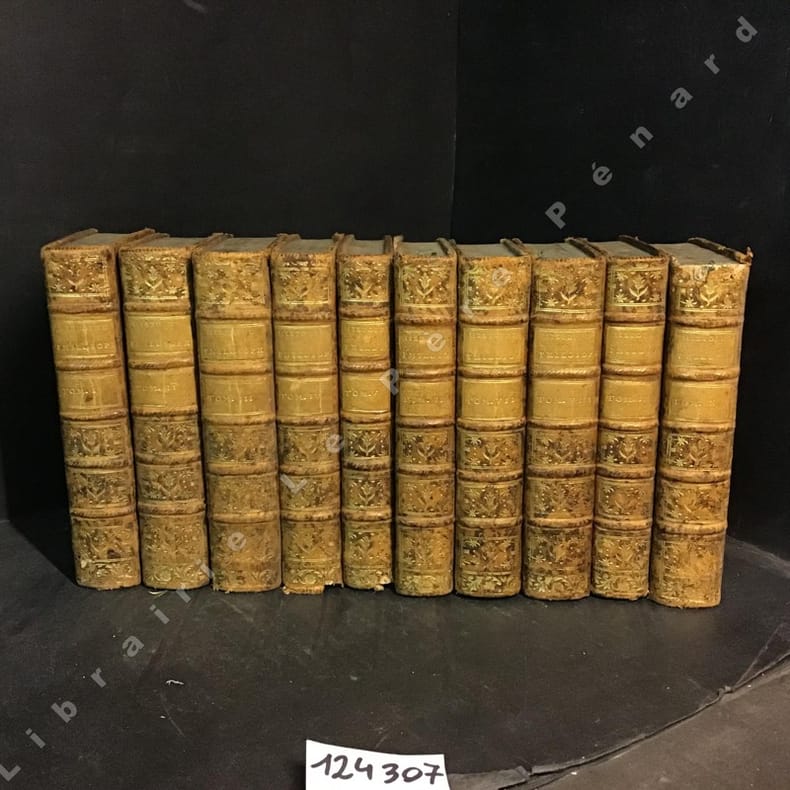
17801243071780 A Genève, Chez Jean-Léonard Pellet, Imprimeur de la Ville & de l'Académie - M. DCC. LXXX. (1780) - Dix volumes In-12, reliures pleine peau marbrée d'époque, dos à 5 nerfs avec pièce de titre et de tomaison sur fond marron clair, caissons ornés de fleurons en doré, toutes tranches marbrées, signet vert - xij-571 + 624 + 608 + 500 + 425 + 511 + 589 + 599 + 431 + 564 pages - Sans le volume d'Atlas
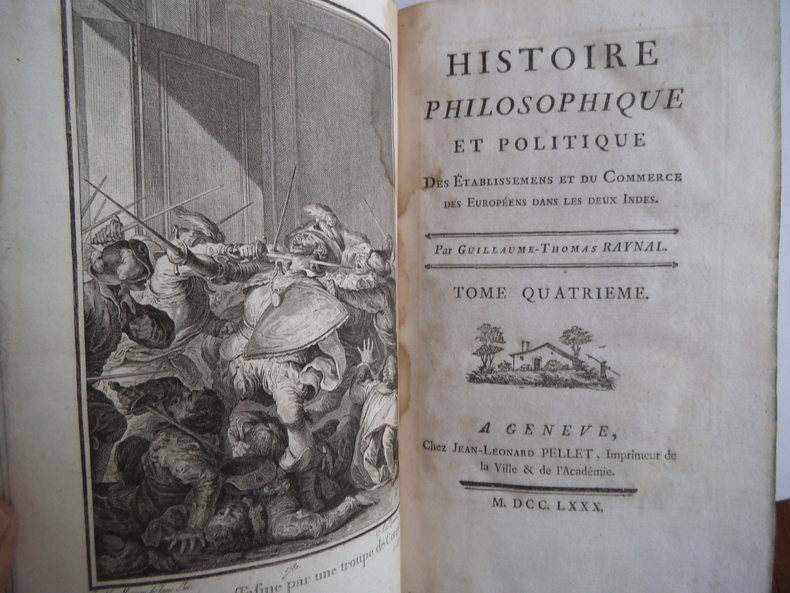
102369 tomes sur 10 en 9 volumes in 8 pleine cuir fauve raciné, pièce de titre cuir rouge, pièce de tomaison cuir vert, roulette, filets, fers dorés, triple filet doré encadrant les plats, roulette dorée sur coupes, tranches marbrées. Tome1 : faux-titre, portrait de l’auteur, en médaillon d’après COCHIN gravé par LARDY. Titre, XVI-532 pages. (Petite mouillure angle supérieur droit en début de volume) Tome 2 : faux-titre- 1 gravure en frontispice, titre, VIII, 582 pages. Tome 3 : faux-titre, 1 gravure en frontispice, titre, VIII, 580 pages(une pâle mouillure angle supérieur droit, en début de volume, une mouillure triangulaire en partie supérieure, aux dernières pages de table des matières. Tome 4 : faux titre, une gravure en frontispice, titre, VIII, 472 pages. Tome 5 faux-titre, une gravure en frontispice, titre, VII, 405 pages. Tome 6 : faux-titre, gravure en frontispice, titre, VII, 484 pages, pâle moulure en marge extérieure, plus apparente en fin de fin de volume. Tome7 : faux-titre, gravure en frontispice, titre, XVI, 558 pages. Tome 8 : faux-titre, gravure en frontispice, titre, II-538 pages. Pas de tome 9. Tome 10 : faux-titre, gravure en frontispice, titre, II, 538 pages. A Genève chez jean Léonard PELLET 1780. Les gravures en frontispice sont de MOREAU LE JEUNE. Troisième édition, la meilleure et la plus complète, le nombre de volume passe de 7 volumes auparavant, à 10 volumes. Belle édition sur beau papier.
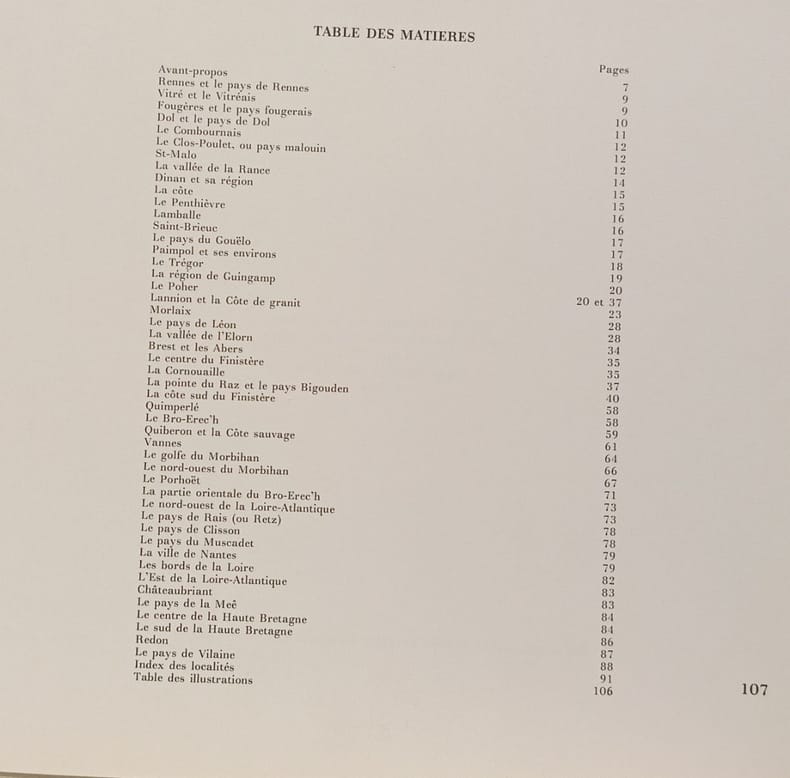
1974100152962saep 1974 in8. 1974. Cartonné. Cet ouvrage de Raymond Cornon publié par les Éditions S.A.E.P. en 1974 propose un voyage à travers la Bretagne. Il s'adresse aux promeneurs curieux souhaitant découvrir aussi bien les lieux célèbres que des coins ignorés et paisibles mettant en avant le charme des vacances et des promenades
8289Librairie Plon 1956
189542221London Harrison and Sons 1895. 4to. No wrappers as extracted from "Philosophical Transactions" Vol. 186 - I Series A. Pp. 187-241 a. 8 textillustrations apparatus. Fine and clean. <br/><br/><em>First printing of this importent paper in the history of chemistry Lord Rayleigh's most famous discovery announcing the discovery of this new gas the first finding of one of the rare gases inert gases having unusual properties and forming a distinct group in the periodic table and all with zero valency."The original paper in the "Philosophical Transactions" will undoubtly rank as a classic the investigation having been a particularly brilliant ine." Ernst von Meyer in History of Chemistry. For this discovery Lord Rayleigh and W. Ramsay received the Nobel Prize 1904.After having made several measuring of the densities of gases "Rayleigh came across a curious puzzle. With oxygen he always obtained the same density regardless of how the oxygen might be produced whether from one particular compound from a second compound or from the air. The situation was different with nitrogen. The nitrogen he obtained from air constantly showed a slightly higher density than the nitrogen he obtained from any of various compounds. Rayleigh could think of several ways in which the nitrogen obtained from air might be contaminated but none of the possibilities checked out experimentally. He was so frustrated that he went so far as to write to the journal "Nature" asking for suggestions. Ramsay a brilliant Scottish chemist asked permission to tackle the problem and received it. The upshot was that a new gas somewhat denser that nitrogen was discovered to exist in the atmosphere. It was named argon and it was the first of a series of rare gases of unusual properties whose existence had never been suspected."Asimow.Dibner Heralds of Science No. 50 - Neville Historical Chemical Library vol. II p.358. </em> unknown
189549207London Harrison and Sons 1895. 4to. Orig. full cloth. Gilt lettering to spine. Blindtooled covers. First corner a bit bumped. In "Philosophical Transactions" Vol. 186 - I Series A. XIV26024 pp. Entire volume offered. The paper: p. 187-241 a. 8 textillustrations apparatus. The title-page with faint brownspots. Otherwise internally clean and fine. <br/><br/><em>First printing of this importent paper in the history of chemistry Lord Rayleigh's most famous discovery announcing the discovery of this new gas the first finding of one of the rare gases inert gases having unusual properties and forming a distinct group in the periodic table and all with zero valency."The original paper in the "Philosophical Transactions" will undoubtly rank as a classic the investigation having been a particularly brilliant ine." Ernst von Meyer in History of Chemistry. For this discovery Lord Rayleigh and W. Ramsay received the Nobel Prize 1904. The volume also contains WILLIAM CROOKES "On the Spectra of Argon" OSBORNE REYNOLD "On the Dynamical Theory of Incompressible Viscous Fluids and the determination of the Criterion" KARL PEARSON "Contributions to the Mathematical Theory of Evolution. - II. Skew Variations in Homogenous Materials" etc.After having made several measuring of the densities of gases "Rayleigh came across a curious puzzle. With oxygen he always obtained the same density regardless of how the oxygen might be produced whether from one particular compound from a second compound or from the air. The situation was different with nitrogen. The nitrogen he obtained from air constantly showed a slightly higher density than the nitrogen he obtained from any of various compounds. Rayleigh could think of several ways in which the nitrogen obtained from air might be contaminated but none of the possibilities checked out experimentally. He was so frustrated that he went so far as to write to the journal "Nature" asking for suggestions. Ramsay a brilliant Scottish chemist asked permission to tackle the problem and received it. The upshot was that a new gas somewhat denser that nitrogen was discovered to exist in the atmosphere. It was named argon and it was the first of a series of rare gases of unusual properties whose existence had never been suspected."Asimow.Dibner Heralds of Science No. 50 - Neville Historical Chemical Library vol. II p.358. </em> hardcover
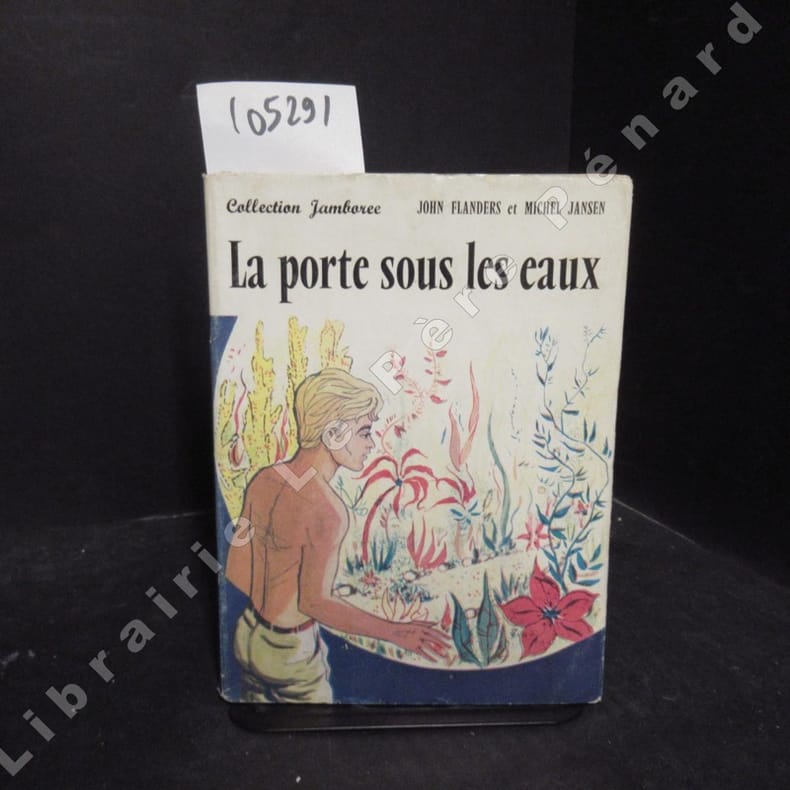
19601052911960 Ed. SPES - Coll. Jamboree - 1960 - In-12 broché, sous jaquette papier illustrée en couleurs - 188 p. - Illustrations en N&B de M. Raffray - Non coupé (sauf les premières pages)
188247024Paris Gauthier-Villars 1882. 4to. No wrappers. In: "Comptes Rendus Hebdomadaires des Séances de L'Academie des Sciences" Tome 95 No 22 a. Tome 104 No 21 entire issues offered. Pp. 1017-1076 and pp. 1387-1462. Raoult's papers: pp. 1030-33 tome 95 and pp. 1430-1433 tome 104. <br/><br/><em>First appearance of Raoult's two importent papers in which described a method for finding the molecular weight of an organic compound by the determination of the lowering of the freezing point of water that resulted from dissolving that compound in water and the law governing the relation between solutes and vapor pressure."Then in 1882 F.-M. Raoult published his results on the effects of nondissociating organic solutes from which he deduced a general law controlling the lowering of freezing points the first paper offered. Four years later he extended this work to show the effect of solutes on vapor pressure the second paper offered. Having established the effect of nondissociating compounds he was in position to show that salts produced an eeffect which though anomalous could nevertheless be explained by the supposition that a dissolved molecule broke up into other molecules. This work was of great value in supplying a new method for determining molecular weights since the depression of freezing point and vapor pressure as well a the related rise in boiling point later discovered are proportional to the moleculat concentrations ofthe solutions; it was of equal value in supporting the ideas of van't Hoff on osmotic pressure. With the announcement of the dissociation theory of Arrhenius the anomalies were explained and the full significance of the generalizations of Raoult was recognized. Raoult published the formulations of his laws in the "Comptes Rendus" for 1882 and 1887 the papers offered" Leicester a. Klickstein "A Source Book in Chemistry" pp. 471 ff. </em> unknown
189549284London arrison and Sons 1895. - Paris Gauthier-Villars 1895. 8vo. and 4to. Later full cloth gilt lettering to spine Ramsay and without wrappers Cleve. In "Proceedings of the Royal Society" Ramsay Vol. 58. Entire vol. offered. And in "Comptes Rendus Hebdomadaires des Séances de L'Academie des Sciences" Cleve Tome 120 No 15. Pp. 797- 850. Entire issue offered. Ramsay's papers: pp. 65-67 and pp. 81-89. - Cleve's paper: p. 834. Stamps tp edges and a few corners a bit bumped on vol. 58 otherwise clean and fine. <br/><br/><em>First printing of both papers in which Ramsay and Cleve - independently - announced their discovery of Helium on the Earth. Although Ramsay announced the discovery of Helium before Cleve had completed his research the Swedish chemist was independent discoverer of the element.Helium was discovered in the sun already in 1868 by Jules Janssen and independently by Lockyer the same year. Janssen discovered helium in the sun when he observed a total eclipse in India by studying the spectra of the suns chromosphere and Lockyer also by spectroscopy found that the new line in the spectrum did not belong to any element then known and he named it Helium for the sun.In the same volume as Ramsays paper there are 5 papers by NORMAN LOCKYER dealing with the discovery of Helium on the earth examining Ramsay's and Cleve's findings.Parkinson "Breakthroughs" 1895. </em> hardcover
189844238London Taylor and Francis 1898 No wrappers. In "Proceedings of the Royal Society of London." Vol.63 Nos. 399-400 both issues offered. Pp. 373-480 a. 5 plates. Ransay & Travers' paper: pp. 405-408. <br/><br/><em>First appearance of the paper in which Ramsay and Travers announced their discovery of a new element which they named "krypton" meaning hidden."Dr. William Hampson presented them Ransay & Travers with about a liter of liquid air which they used not for liquefying the argon but for obstaining sufficient skill in manipulation so that they would not risk loosing their precious fifteen liter of argon.The residue left after most of the liquid air had boliled away consisted largly of oxygen and nitrogen which Ramsay and Travers temoved with red-hot copper and magnesium. .they then examined the twenty-five cibic centimeters of residual gas and when they found it to be inerst they immediately placedit in a Pl'ucker tube connected to and induction coil and observed its spectrum. There was a bright yelælow line with a greener tint than that of the helium line and a brilliant green line that did nor coincide with any line of argon helium mercury or hydrogen. They discoverede this gas on 30 May 1898 and named it 'krypton'.they found that it belonged between bromine and rubidium in the periodic table and so great was their excitement that the younger chemist almost forgot about his examination for doctor of sciwence which had been schedules for the next day."Weeks p. 267.Parkinson "Breakthroughs" 1898 C. </em> unknown
pp. xliv, 479, (6) [Genealogies] + 18 Facsimiles, plates and maps. The frontis and engraved title may not have been issued with this large paper first edition. First fly leaves damp stained. Plates and some other leaves at end are also damped. The bulk of the text is brilliant white with extra wide margins. Large paper copy. Top edge gold gilt. Deckle edges. Early inked ownership of R. H. Lanerned(?). Early manuscript margin notations, and translation. Folio. Original full embossed morocco leather binding. Spine gold lettered with raised bands. Hardbound. "The pioneer and fundamental work on the Norse voyages to America, on which most of the subsequent literature has been based. This large folio contains the original text of the sagas in old Icelandic and translations into Danish and Latin, followed by critical discussions in Latin; extracts from ancient Icelandic geographical writings, descriptions of European relics in Greenland; descriptions and discussions of supposed Norse relics in New England and an elaborate identification of localities. A summary of the evidence and conclusions is given in English. Rafn was an enthusiast on this subject, and his enthusiasm make him over hasty and credulous in accepting the various alleged relics of the Northman." - Larned #750. "It is one of the most important contributions ever made to the study of the history and geography of our continent." (North American Review, No. xcviii, pp. 161-62.)." - Sabin 67470; Howes R13. First Edition of a landmark book. Our original price was $1250.00 **PRICE MUCH REDUCED! VOYAGES BOX 1
1968ART5746MRelié, 264 pages, paru en 1968 chez Nagel, livre en très bon état général, proche du neuf.
1390332136.Gpaperback. Good. Access codes and supplements are not guaranteed with used items. May be an ex-library book. paperback
9945in 12 demi-chagrin vert à nerfs ; titre, fer dorés. Filet à froid sur les plats, charnière intérieure toile verte. Faux-titre, frontispice, titre illustré, 320 pages, 61 gravures dans le texte et hors texte, dont 2 cartes, tranches mouchetées. Paris Librairie Hachette & Cie 1894. Très bon état.de Pétersbourg à Kazan, Kazan, au pays des Tchérénisses, le paganisme en Europe, les Tchouaves, les permiaks, traversée de l’Oural septentrional, traversée de l’Oural, la Sygva et la Slava, les grandes routes de Sibérie,
Adamson, Glenn, Meyers, ZIn Pristine Condition. unknown
43229La Courneuve.Garamont.1972.In-8,couv.à rabats jaune avec portrait.69 p.Portrait et documents. BE.
10602Flammarion In-8, broché, couverture souple ill ( jésus en toutes lettres) 231 pages, bel ensemble.
201213780OUEST FRANCE 2012 144 pages 13 2x1 6x19cm. 2012. Relié. première édition. 144 pages. Christian Querré explore les richesses insoupçonnées des Côtes-d'Armor à travers 30 thèmes incluant rites païens vestiges obscurs et légendes étonnantes. L'ouvrage invite à redécouvrir la région par ses lieux insolites mystérieux ou étonnants avec une iconographie à l'ancienne et une couverture imitation cuir
695In 12 carré pleine toile rouge éditeur(ville de Paris sur le premier plat)titre doré au dos.373 pages illustrations photographiques hors-texte.Bornéo,Malaisie,Ceylan,Afrique Orientale.Albin Michel éditeur sans date
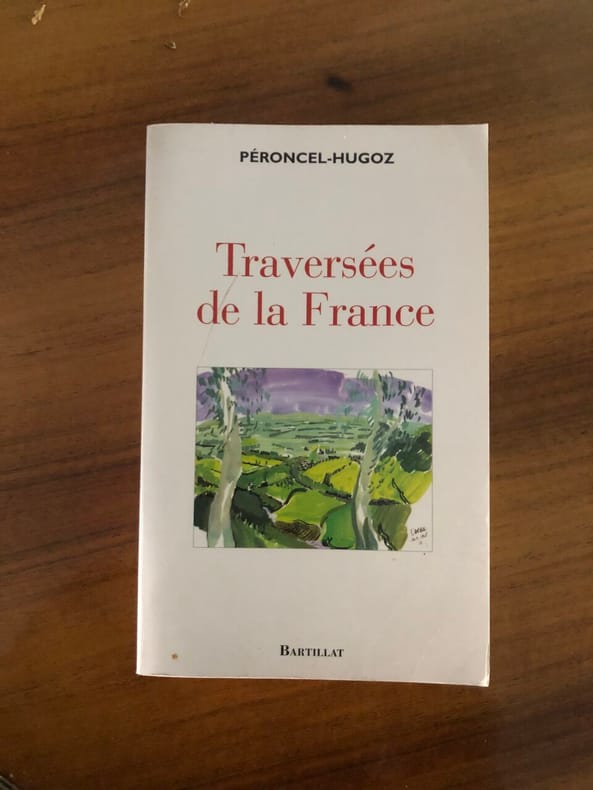
2004500167748BARTILLAT 2004 525 pages 14x3 6x21 8cm. 2004. Broché. 525 pages.
2017RO30344554Département de la Dordogne. 2017. In-4. Broché. Bon état, Couv. convenable, Dos satisfaisant, Intérieur frais. 144 pages. Nombreuses illustrations en couleur dans et hors texte.. . . . Classification Dewey : 53-Guide
19786741978 - broché - Editions Gallimard NRF - Collection "Bibliothèque des sciences humaines" - 1978 et 1982 - 2 volumes in-8 (22,5 x 14 cm) broché - 300 + 319 pages - ISBN du tome II : 2-07-029770-5 - Tome I : "La gnose et le temps et autres essais" - Tome II : "Sur l'évangile selon Thomas. Esquisse d'une interprétation systématique"
1966AUB-3939Lausanne 1966. Bel ex. relié, rel. Ornée d'éd., gd in-8 (24 cm x 21), 152 p. avec cartes, table chronologique, ill. et tables.